Jun Yuan Chiu, Jo-Han Chang (2026). Effects of Auditory–Tactile Rhythmic Cueing on Gait Parameters in Older Adults. In: Accessibility, Assistive Technology and Digital Environments. AHFE Open Access, vol. 202, pp. 114–125. https://doi.org/10.54941/ahfe1007302
Five adults aged ≥65 years completed four within-subject conditions in random order: no cue, audio-only, tactile-only, and synchronized audio–tactile cueing. In all cue conditions, the cue tempo was individualized to 10% above each participant’s natural walking cadence. Participants walked along a flat 20 m indoor straight walkway; gait was analyzed over the central 10 m steady-state segment recorded on video. To simulate public-transit ambient noise, a looped recording of real-world transit sound was played in the measurement area at 70 dBA, and illumination was maintained above 200 lux to minimize lighting-related confounds. Walking speed, cadence, and mean step length were derived from traversal time and step events extracted from video. For each participant, walking-speed change under each cue condition was computed relative to the no-cue baseline, and medians and ranges were reported to summarize overall trends and individual differences. Participants’ perceptions were assessed using a five-point Likert scale and a brief interview.This study examines, under realistic noise constraints, how auditory, tactile, and temporally synchronized audio–tactile rhythmic cueing differentially affect walking performance in older adults.
Walking Speed and Public Transportation Issues Walking speed is a core indicator of functional mobility in older adults and has been proposed as the “sixth vital sign” for rapidly reflecting functional health status in ageing populations (Fritz & Lusardi, 2009). It is also associated with mortality risk: a meta-analysis indicates that for every 0.1 m/s increase in walking speed, mortality risk decreases by 6% (Liu et al., 2024). In public transportation environments, walking tasks are often subject to time constraints; for example, road-crossing scenarios commonly assume a walking speed of approximately 1.2 m/s as the benchmark for calculating crossing time. However, empirical evidence for adults aged 65 years and older shows that the average walking speed of older adults is approximately
Effects of Auditory–Tactile Rhythmic Cueing on Gait Parameters in Older Adults 115 0.77 m/s, implying that many older individuals may be unable to complete crossings within the allocated time under time pressure (Western et al., 2025). Therefore, this study aims to develop a wrist-worn audio–tactile rhythmic cueing system and to evaluate, under simulated public-environment conditions, whether this system can improve walking speed in older adults.
Cross-Modal Cueing Strategy Under Noise Constraints Among rhythmic cueing approaches, rhythmic auditory stimulation (RAS) is the most commonly used method for gait training, and preliminary clinical evidence indicates that it can improve walking speed in older adults (Igusa et al., 2024). However, environmental noise in public transportation and public spaces can directly reduce the perceptibility of purely auditory cues. Measurements of public transportation environments show that the average noise level in subway and bus systems ranges from 70 to 80 dBA, while peak noise exposure on bus and tram lines can exceed 115 dBA (Yao et al., 2017). With ageing, the efficiency of unimodal sensorimotor processing often declines; therefore, under conditions of reduced signal-to-noise ratio, providing cross-modal compensation can often yield greater behavioural gains (de Dieuleveult et al., 2017). Based on these limitations, this study adopts a wrist-worn audio–tactile rhythmic cueing approach with temporal synchronisation. Ageing has been shown to expand the temporal window of multisensory integration; if the temporal relationship between cross-modal signals is poorly aligned, perceptual integration efficiency may be reduced (Malone et al., 2024). In this study, participants walked under simulated public transportation noise conditions, comparing a natural walking baseline with three rhythmic cueing conditions (auditory-only, tactile-only, and audio–tactile synchronised). In all three cueing conditions, the cueing frequency was individually set at 10% above each participant’s natural cadence, in order to examine the effects of different cue modalities on walking speed and stride length under the same acceleration target.
LITERATURE REVIEW
Research Gaps in Rhythmic Cueing Studies Rhythmic cueing can guide gait synchronisation through external temporal rhythms, and auditory cueing is the most common form of intervention. (Minino et al., 2021) pointed out that using 100% to 110% of an individual’s mean cadence as the auditory stimulation condition can increase stride length, and that a setting slightly above natural cadence is more favourable for gait and stability. (Laurienti et al., 2006) pointed out that the magnitude of response gains from multisensory stimulation is greater in older adults than in younger populations.(Roy et al., 2017) pointed out that, in gait synchronisation tasks, cueing that combines auditory and vibration has a multisensory advantage compared with single-sensory cueing. Existing studies have separately supported the potential of auditory cueing, vibration cueing, and synchronized multimodal cueing to improve walking performance, but there is currently no study targeting older adults that directly compares the effects of the three rhythmic cueing types: auditory, vibration, and auditory
116 Chiu and Chang multimodal. Therefore, this study includes three cueing forms for comparison in older adults to fill this research gap.
Auditory Cue This study used A4 (440 Hz) as the fixed rhythmic pitch because it is the international standard pitch and can serve as a single and stable auditory carrier (ISO, 1975). The headphone output was controlled below 70 dBA, as official hearing-health data indicate that sounds below 70 dBA generally do not cause hearing damage during prolonged exposure, whereas long-term or repeated exposure above 85 dBA may lead to hearing loss (NIDCD, 2025). Rhythmic auditory stimulation has been demonstrated to improve walking speed in older adults; therefore, while maintaining clear audibility, the sound output in this study was restricted within a safe range (Igusa et al., 2024).
Tactile Cue This study set the vibration stimulus within a range that older adults could clearly perceive without causing discomfort, and used approximately 0.5–1 g as the operating interval to maintain the perceptibility of the wrist-worn cue during walking. The vibration perception threshold in older adults increases with age, resulting in reduced sensitivity to vibration stimuli (Deshpande et al., 2008). Therefore, if the vibration output is too low, the cue is more likely to become ineffective during the experiment.
DEVICE DESIGN System Architecture and Control
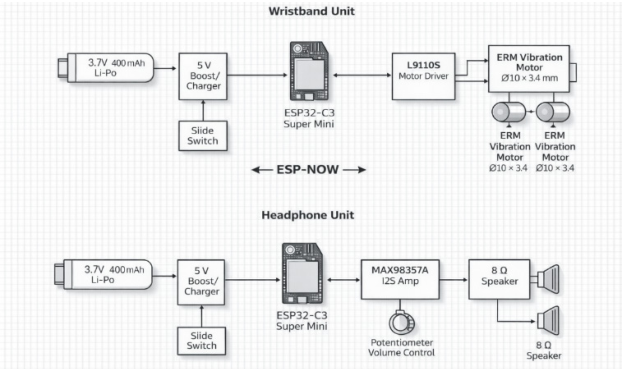
The rhythmic cueing system in this study consists of two wirelessly linked modules: a wrist-worn vibration module and an over-ear audio module (Figure 1). Both modules use the ESP32-C3 Super Mini as the main control core and communicate via ESP-NOW for low-latency packet transmission, ensuring that auditory and tactile cues remain stably synchronized during walking.
Effects of Auditory–Tactile Rhythmic Cueing on Gait Parameters in Older Adults 117 Wristband-side process (1) read the start/pause button (2) generate the 110% rhythm according to the experimental setting (3) transmit a timing packet at each cue trigger (4) synchronously drive the vibration output
Headphone-side process (1) receive packets and align the playback timing (2) execute the volume-control logic (3) stream audio output to the power amplifier via I2S for playback.
Wrist-Worn Vibration Module The wristband side uses an L9110S dual-channel driver to drive two ERM eccentric vibration motors to output tactile cues. The dual motors can be activated simultaneously within the same rhythmic event to increase the consistency and perceptibility of the tactile cue. Because the effectiveness of wearable tactile feedback strongly depends on the conformity between the skin and the interface material(Fleck et al., 2025), and considering that the skin barrier function and moisture regulation of older adults may change with age, TPU 85A was used as the vibration transmission interface so that vibrations can be transmitted to the skin more stably.
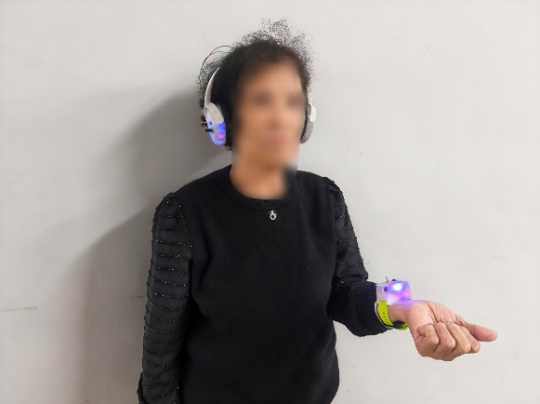
Over-Ear Audio Module on the headphone side, an I2S audio amplifier MAX98357A drives the left and right speaker units. Volume control uses a rotary variable resistor (0–100 kΩ) connected to the ESP32-C3 ADC. The firmware maps the ADC value to an audio gain coefficient and continuously scales the output amplitude, allowing participants to adjust the cue volume without altering the rhythmic parameters. The over-ear structure can also provide a certain degree of environmental noise attenuation, which helps maintain the recognizability of the cue sound in public-space environments, and the device is shown in Figure 2.
Figure 2: Device wearing illustration.
The walking test in this study was conducted in an indoor corridor, where the walkway surface was kept flat and free of obstacles. The lighting environment was maintained fixed and uniform. When older adults walk under low- illumination conditions, reductions in walking speed and shorter step length are more likely to occur (Figueiro et al., 2011). The on-site illumination was controlled at approximately 200 lux to maintain basic visibility of the walking path and consistency of measurement conditions.
To simulate real conditions in public transit corridors, background environmental noise was not completely eliminated in this study but instead maintained at a level similar to that found in public transportation environments such as metro systems and stations. The average equivalent noise level of public transportation systems is approximately 80.4 dBA (Neitzel et al., 2009), and noise exposure in public transit environments is commonly above 70 dBA. Therefore, under the condition that the cue sound remained clearly perceptible, approximately 70 dBA background noise was introduced in this study to enhance situational realism and external validity.
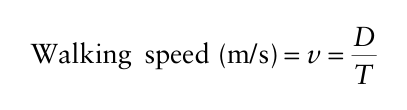
Experimental Procedure In this study, a 20 m straight path was marked in an indoor corridor: the first 5 m served as the acceleration zone, the middle 10 m as the steady- state measurement zone, and the final 5 m as the deceleration zone. All data calculations used only the middle 10 m steady-state section to reduce the influence of gait changes caused by starting acceleration and stopping deceleration(Fritz & Lusardi, 2009) 1. Two 1080p cameras installed at both ends of the walkway recorded the entire walking process, and frame-by- frame analysis was used to extract the number of steps and the traversal time while the participant passed through the steady-state section.
Equation reproduced from the original PDF.
The experimental procedure was arranged as follows: each participant first completed two full walking trials under the “no cue” condition, and the average of the two trials was used as the baseline value for that participant. To avoid fatigue influencing the measurement results, at least 2 minutes of rest were arranged between trials, and the next trial began only after the participant reported that they had recovered to a comfortable state (Alegre-Tamariz et al., 2025).
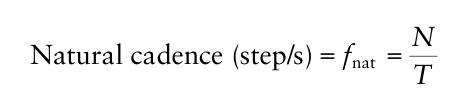
The rhythmic cue was set at 10% faster than the natural cadence. Because the wristband vibration must output pulses at fixed time intervals, the natural cadence was first calculated from the baseline step count and time, and then converted into the pulse interval.
Equation reproduced from the original PDF.
Pulse interval cue cue (ms) . . t f f 1000 1000 1 10 After completing the cue-condition walking trials, participants immediately filled out a subjective feedback scale using a five-point Likert scale (1 = strongly disagree, 5 = strongly agree) to evaluate their perception of the cues, comprehension of the cues, ability to follow the cues, and comfort and future acceptance.
The questionnaire contained five items: (1) I can clearly perceive this cue. (2) I understand that this cue is guiding my walking rhythm. (3) I can easily follow the rhythm of this cue. (4) I feel comfortable when using this cue. (5) If used in public transit walking environments in the future, I would be
willing to accept this cueing method.
The above scale was used to evaluate participants’ perception, comprehension, and following ability of the cues, as well as comfort and acceptance, serving as subjective supplementary data in addition to the objective gait metrics.
RESULTS
Walking Performance Changes A total of 5 participants aged 65 years or older were recruited in this study, including 3 males and 2 females. All participants completed walking trials under the baseline condition and three rhythmic cueing conditions within the same experimental environment. Walking speed and gait metrics were calculated using the 10 m steady-state walking section. The baseline condition consisted of Baseline1 and Baseline2; in this section, the mean of these two trials was used as the baseline performance (BaseMean) for each participant before conducting descriptive statistics and inferential statistical analysis.
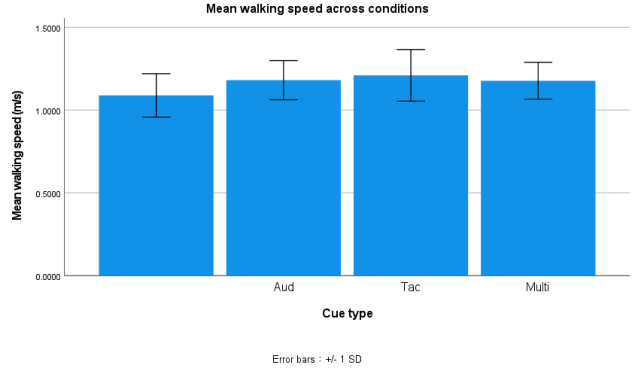
Descriptive statistics (Mean ± SD) showed that walking speed under the baseline condition was 1.089 ± 0.131 m/s. After introducing rhythmic cues, walking speed increased across all cueing conditions: auditory cueing was 1.181 ± 0.118 m/s, tactile cueing was 1.210 ± 0.156 m/s, and multimodal cueing was 1.177 ± 0.111 m/s (Figure 3). At the same time, the average completion time under the three cueing conditions was shorter, indicating that rhythmic cueing showed an overall tendency to promote walking speed under the conditions set in this study.
120 Chiu and Chang For statistical analysis, repeated-measures analysis of variance was conducted to examine the effect of different cueing conditions on walking speed. Considering that the sphericity assumption might be unstable, the Greenhouse–Geisser correction was applied. The results indicated that cueing condition had a significant effect on walking speed (Table 1). Further paired- sample t-tests comparing the baseline condition with each cueing condition showed that auditory cueing, tactile cueing, and multimodal cueing all reached statistical significance (Table 2), indicating that all three rhythmic cueing conditions significantly improved walking speed compared with the baseline condition.
Because the sample size in this study was limited to 5 participants, the results presented in this section should be regarded as preliminary validation and trend observations. Future studies should increase the sample size to improve the robustness of the findings.
Figure 3: Average walking speed and standard deviation under different cueing conditions.Table 1: Repeated-measures analysis of variance.
Table available in the original PDF paper.
Source Correction Type III Sum
F Sig.
of Squares
df Mean Square Condition Greenhouse–Geisser 0.041 1.600 0.026 8.892 .017
Table 2: Paired-sample t-test results.
Table available in the original PDF paper.
Pair Comparison (BaseMean − Condition)
Mean t df Sig. (2-tailed) 1 BaseMean − Aud −0.0919200 −3.718 4 .021 2 BaseMean − Tac −0.1213400 −3.383 4 .028
3 BaseMean − Multi −0.0883000 −2.866 4 .046 In addition to walking speed, this study als analyzed o the effects of different rhythmic cueing conditions on participants’ step length. Step length
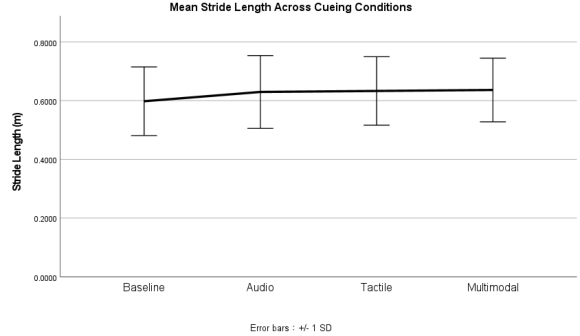
Effects of Auditory–Tactile Rhythmic Cueing on Gait Parameters in Older Adults 121 is one of the key parameters describing gait characteristics and can reflect how participants adjust their gait under rhythmic cueing. Based on the calculated data, the mean step length under each condition was as follows: the baseline condition was 0.598 ± 0.058 m; after introducing rhythmic cues, step length showed a slight increase across conditions, with auditory cueing at 0.630 ± 0.062 m, tactile cueing at 0.633 ± 0.058 m, and multimodal cueing at 0.636 ± 0.054 m (Figure 4).
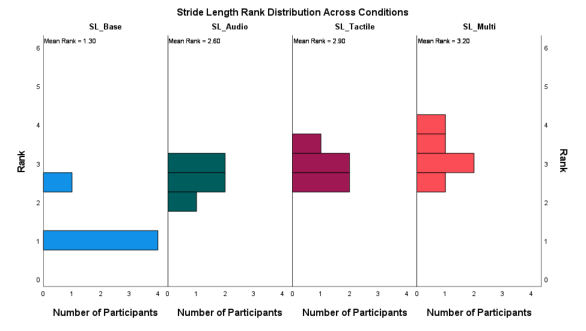
The results indicate that, compared with the baseline condition (SL_Base), the ranking of step length generally increased after rhythmic cues were introduced (Figure 5). Among the cueing conditions, multimodal cueing showed the highest mean rank (Mean Rank = 3.20), followed by tactile cueing (Mean Rank = 2.90) and auditory cueing (Mean Rank = 2.60), whereas the baseline condition had the lowest mean rank (Mean Rank = 1.30). These findings indicate that under rhythmic cueing conditions, participants’ step length performance was generally improved compared with the baseline condition.
Overall, both presentation methods demonstrate the same trend: after rhythmic cueing was introduced, participants’ step length showed a slight increase compared with the baseline condition.
Figure 4: Mean step length and standard deviation under different cueing conditions.Figure 5: Step length rank distribution under different cueing conditions.
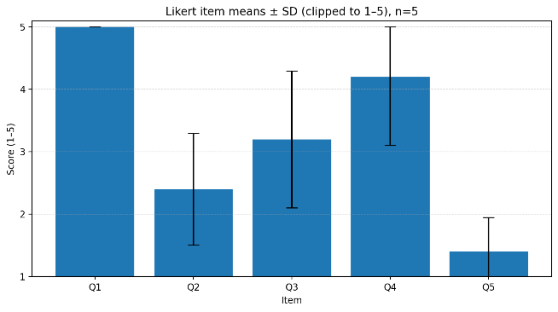
Participants’ perception of the cues showed consistent results across items: for Q1, all participants rated 5 points (Mean = 5.00, SD = 0.00), indicating that the cues could be reliably perceived under the experimental conditions. The average score for Q2 was 2.40 (SD = 0.89), with scores distributed between 1–3. The average score for Q3 was 3.20 (SD = 1.10), with scores between 2–4, indicating individual differences in the ratings of cue-following ability. The average score for Q4 was 4.20 (SD = 1.10), with scores between 3–5 (Figure 6).
Figure 6: Questionnaire mean and standard deviation.
DISCUSSION
The results of this study indicate that under a simulated public-transit walking task, all three rhythmic cueing conditions increased walking speed in older participants, with an average increase of approximately 0.09–0.12 m/s. Previous research suggests that an increase of 0.10 m/s in walking speed is considered clinically and functionally meaningful (Perera et al., 2006). Walking speed is also regarded as an important functional indicator in older adults, and its variation is closely associated with health status and functional independence. Although the sample size in this study was relatively small, the improvement in walking speed observed under rhythmic cueing suggests potential practical applicability.
The comparison among the three cueing conditions also provides additional insights. In this study, the tactile cueing condition showed the highest mean walking speed, followed by auditory cueing and synchronized audio–tactile cueing, although the differences among them were small. This suggests that under the experimental settings of this study, different sensory modalities can all serve as effective rhythmic reference sources, and multimodal cueing did not demonstrate a clear additional benefit. Multisensory integration research indicates that when older adults process cross-modal information, the effectiveness of multisensory integration may be influenced by limitations in attentional resources and sensory weighting. Therefore, in some contexts,
Effects of Auditory–Tactile Rhythmic Cueing on Gait Parameters in Older Adults 123 the difference between single-modality and multimodal effects may not be substantial (de Dieuleveult et al., 2017).
The step-length results reveal another noteworthy observation: under all three cueing conditions, step length increased slightly and did not show a clear reduction. Previous studies have suggested that when step length is constrained, individuals may increase cadence to maintain or increase walking speed (Baudendistel et al., 2021). However, this study did not observe restricted or shortened step length. Therefore, the improvement in walking speed was not achieved through a cadence compensation strategy but may reflect an overall enhancement in walking output capacity.
The subjective questionnaire results showed that participants were generally able to clearly perceive the cues (Q1 = 5.00), and the overall comfort ratings were relatively high. However, the understanding of whether the cues were guiding walking rhythm was relatively low (Q2 mean ≈ 2.40). This phenomenon is not uncommon in studies of motor control in older adults: behavioral performance may improve under external cues, yet users may not clearly perceive or verbalize the source of their strategy, especially when older adults have more difficulty identifying externally guided actions (Masters, 1992). Therefore, if the system is to be deployed in real-world settings, future designs may incorporate short synchronization practice sessions and clearer instructional guidance to reduce the comprehension barrier and improve acceptance. Similar training-based approaches for introducing rhythmic cues have also been reported in rhythmic gait-training studies involving older adults (Wittwer et al., 2020).
CONCLUSION
Design of a Wearable Audio-Tactile Rhythmic Cueing System This study developed and preliminarily validated a wearable prototype system integrating auditory and tactile rhythmic cues, and demonstrated that the system can be practically applied to research on walking assistance for older adults. The results showed that participants’ walking performance improved relative to the baseline condition after wearing the system, indicating that the proposed prototype possesses both practical feasibility and an initial basis for validation.
Application Value for Walking Assistance in Public Transportation Contexts This study focused on the walking demands of older adults within public transportation environments. The results showed that walking speed under all three rhythmic cueing conditions was higher than that under the baseline condition, while stride length did not decrease, suggesting that rhythmic cueing has potential as a walking assistance strategy in time-constrained walking situations of this kind. These findings provide preliminary application-based evidence for the design of walking assistance systems in public transportation contexts.
This study compared three cueing conditions—auditory cueing, tactile cueing, and synchronized audio-tactile cueing. The results showed that all three conditions improved walking speed, with tactile cueing demonstrating the highest average performance, whereas the multimodal condition did not show a clear advantage over the unimodal conditions. This finding indicates that different sensory modalities can all serve as effective rhythmic cues and may provide a reference for future cue modality selection; it also suggests that the advantages of cross-modal cueing may not necessarily apply to older adults.
This study preliminarily confirms the feasibility of applying a wearable rhythmic cueing system to walking assistance for older adults in public transportation contexts. However, the sample size was small; future studies should expand the sample and incorporate more comprehensive gait-related indicators in order to further strengthen the robustness of the findings.
REFERENCES
Alegre-Tamariz, J., Sánchez-Medina, J., Runzer-Colmenares, F. M., Ávila- Rodríguez, C., Bermejo-Franco, A., & Parodi, J. F. (2025). Impact of a functional gait training program as a complementary strategy to improve physical function in older adults: A randomized clinical trial. BMC Geriatrics, 25, 789. Baudendistel, S. T., Schmitt, A. C., Stone, A. E., Raffegeau, T. E., Roper, J. A., &
Hass, C. J. (2021). Faster or longer steps: Maintaining fast walking in older adults at risk for mobility disability. Gait & Posture, 89, 86–91. de Dieuleveult, A.L.; Siemonsma, P.C.; van Erp, J.B.F.; Brouwer, A.-M. Effects of aging in multisensory integration: A systematic review. Front. Aging Neurosci. 2017, 9, 80. Deshpande, N., Metter, E. J., Ling, S., Conwit, R., & Ferrucci, L. (2008). Physiological
correlates of age-related decline in vibrotactile sensitivity. Neurobiology of Aging, 29(5), 765–773. Fritz, S., & Lusardi, M. (2009). White paper: “Walking speed: the sixth vital sign” [corrected]. Journal of Geriatric Physical Therapy, 32(2), 2–5. Fleck, J. J., Zook, Z. A., & O’Malley, M. K. (2025). Wearable multi-sensory haptic
devices. Nature Reviews Bioengineering, 3, 288–302. Figueiro, M.G.; Plitnick, B.; Rea, M.S.; Gras, L.Z.; Rea, M.S. Lighting and perceptual cues: Effects on gait measures of older adults at high and low risk for falls. BMC Geriatr. 2011, 11, 49. Igusa, T.; Uchida, H.; Tsuchiya, K.; Sema, S.; Kaneko, S.; Yoshita, T.; Nagai, S.;
Kobayashi, T.; Akiba, T.; Tanaka, Y.; Kikuchi, S.; Hirao, K. Effects of rhythmic auditory stimulation on gait speed in older adult inpatients in a convalescent rehabilitation ward: A pilot randomized controlled trial. Eur. Geriatr. Med. 2024, 15, 1425–1435. International Organization for Standardization. (1975). ISO 16:1975 acoustics— Standard tuning frequency (standard musical pitch). ISO. Laurienti, P. J., Burdette, J. H., Maldjian, J. A., & Wallace, M. T. (2006). Enhanced
multisensory integration in older adults. Neurobiology of Aging, 27(8), 1155–1163. Liu, Y.; Xu, L.; Xu, Y.; Chen, T.; Zhu, G.; Chen, Y. Dose-response association between walking speed and all-cause mortality: A systematic review and meta- analysis of cohort studies. J. Sports Sci. 2024, 42, 1313–1322.
Effects of Auditory–Tactile Rhythmic Cueing on Gait Parameters in Older Adults 125 Malone, A.K.; Hungerford, M.E.; Smith, S.B.; Chang, N.-Y.N.; Uchanski, R.M.;
Oh, Y.-H.; Lewis, R.F.; Hullar, T.E. Age-related changes in temporal binding involving auditory and vestibular inputs. Semin. Hear. 2024, 45, 110–122. Masters, R. S. W. (1992). Knowledge, knerves and know-how: The role of explicit versus implicit knowledge in the breakdown of a complex motor skill under pressure. British Journal of Psychology, 83(3), 343–358. Minino, R., Troisi Lopez, E., Sorrentino, P., Rucco, R., Lardone, A., Pesoli, M.,
Tafuri, D., Mandolesi, L., Sorrentino, G., & Liparoti, M. (2021). The effects of different frequencies of rhythmic acoustic stimulation on gait stability in healthy elderly individuals: A pilot study. Scientific Reports, 11(1), 19530. National Institute on Deafness and Other Communication Disorders. (2025, April 16). Noise-induced hearing loss (NIHL). U.S. Department of Health and Human Services, National Institutes of Health. Neitzel, R.; Gershon, R.R.M.; Zeltser, M.; Canton, A.; Akram, M. Noise levels
associated with New York City’s mass transit systems. Am. J. Public Health 2009, 99, 1393–1399. Perera, S., Mody, S. H., Woodman, R. C., & Studenski, S. A. (2006). Meaningful change and responsiveness in common physical performance measures in older adults. Journal of the American Geriatrics Society, 54(5), 743–749. Roy, C., Lagarde, J., Dotov, D., & Dalla Bella, S. (2017). Walking to a multisensory
beat. Brain and Cognition, 113, 172–183. Western, M.J.; Withall, J.; Sheppard, R.; Greaves, C.; Hillsdon, M.; Stathi, A. Why didn’t the senior citizen cross the road? Gait speed in community-dwelling older adults with mobility limitations relative to pedestrian crossing times. Age Ageing 2025, 54, afaf345. Wittwer, J. E., Winbolt, M., Morris, M. E., Parsons, C., & Webster, K. E. (2020).
Home-based gait training using rhythmic auditory cues in Alzheimer’s disease: Feasibility and outcomes. Frontiers in Medicine, 6, 335. Yao, C.M.K.L.; Ma, A.K.; Cushing, S.L.; Lin, V.Y.W. Noise exposure while commuting in Toronto - a study of personal and public transportation in Toronto. J. Otolaryngol. Head Neck Surg. 2017, 46, 62.
LISTED IN THE AHFE DIGITAL BOOKSTORE CATALOGUE
Explore the complete digital volume
Accessibility, Assistive Technology and Digital Environments
Read this individual research paper free through the original publisher, or explore the full digital proceedings book.
ISBN 978-1-964867-78-6
Explore this ISBN in the AHFE Bookstore ↗Listed in the July 2026 bookstore catalogue; search by ISBN to confirm current availability · Digital book purchase optional