Tianyu Han (2026). Where Spatial Immersion Meets Diverse Experiences: Exploring Virtual Scenes through Gaussian Splatting and Parametric Iteration. In: Accessibility, Assistive Technology and Digital Environments. AHFE Open Access, vol. 202, pp. 126–136. https://doi.org/10.54941/ahfe1007303
The expansion of spatial intelligence and generative technologies has advanced 3D representation, shifting digital creation toward user perception and challenging project-oriented design paradigms. Addressing the need to balance environmental realism with conceptual adaptability, this paper proposes a computational method that integrates Gaussian Splatting (GS) and parametric iteration for exploratory virtual scene design. The study examines an urban public green space, where GS is adopted for high-fidelity scene reproduction following image acquisition. Parametric spatial prototypes are developed in Grasshopper (GH) and linked to Unity to support real-time overlay, interaction, and virtual reality (VR) navigation. The results of the System Usability Scale (SUS) show that the synergy between GS and parametric iteration enhances spatial orientation and engagement through detailed visual references. Meanwhile, this workflow achieves design richness and experiential diversity without introducing negative effects on overall usability, proving particularly effective for design tasks requiring node tracking and observation. Overall, this research presents a replicable framework that demonstrates the value of combining realistic contexts with variation rules in early design stages.
Virtual scenes are gradually evolving from visual representations toward experiential spaces shaped by user behaviour. The contemporary digital environment no longer prioritizes precision alone, but instead emphasises immersive interaction, user engagement, and cross-platform integration (Skarbez et al., 2021). This shift places new standards on early-stage scene exploration, requiring designers to accurately translate real-world conditions into virtual environments while supporting rapid iteration and comparison of multiple design alternatives (Castro Pena et al., 2021).
Despite these demands, existing design approaches present notable limitations. Although mesh-based 3D modelling has reached a high level of maturity, achieving both expressive visual quality and real-time performance Received January 29, 2026; Revised April 8, 2026; Accepted April 26, 2026; Available online July 20, 2026
Where Spatial Immersion Meets Diverse Experiences: Exploring Virtual Scenes 127 remains challenging, particularly for complex lighting and textured environments (Jamil and Brennan, 2025). Gaussian Splatting (GS) resolves this shortcoming by enabling high-fidelity, real-time scene reconstruction through explicit point-based representations and parallel rendering (Kerbl et al., 2023). Simultaneously, parametric design generates and compares spatial configurations through algorithmic rules, widely applied to overcome uncertainties in the early stages of design (Oxman, 2017; Stals et al., 2021).
Consequently, this paper presents an exploratory scene design method that integrates GS with parametric iteration. It links a GS training environment in Unity with a parametric design platform in Grasshopper (GH), facilitating the collaborative of real-scene virtualisation and adaptable spatial prototypes. Such procedure further supports multi-environment navigation and experiential feedback during design exploration. The study is guided by three research questions: (1) How can GS-reconstructed real-world scenes provide an effective
environmental foundation for design exploration? (2) How can parametric prototypes with adjustable characteristics respond to diverse spatial requirements? (3) To what extent does this integrated method support early-stage design
decision-making and evaluation?
In summary, the author intends to provide new technical solutions for creating perception-oriented virtual scenes during the design process, thereby enriching the digital generation framework for spatial immersion and diverse experiences.
LITERATURE REVIEW
Experiential design has become a central concern in virtual scene generation, particularly in contexts where immersion, presence, and engagement are treated as primary design objectives. Rather than emerging from geometric accuracy alone, perceptual quality is increasingly understood as the outcome of coordinated spatial cues, interactive triggers, and user cognition (Slater and Wilbur, 1997). Researchers indicate that presence is sustained through continuous feedback between users and digital systems, suggesting that experiential effects are shaped during use, as opposed to being evaluated only after completion (Schumacher, 2022). Therefore, in environments with strong spatial coherence, alignment between visualization and navigation has been shown to significantly influence design collaboration and willingness to explore.
Recent reconstruction technologies have shifted attention toward environmental authenticity and visual continuity. High-fidelity real-time methods enable users to perceive spatial scale, lighting, and ambience more seamlessness, which directly supports the immersive experience. GS exemplifies this tendency by balancing computational efficiency with
128 Han detailed visual output, especially in large-scale or complex scenes (Kerbl et al., 2023). Compared with mesh-based modelling and neural radiance fields, GS-based representations reduce visual discontinuities and provide a more stable perceptual background for interaction (Mildenhall et al., 2022). Empirical applications in architectural heritage, urban contexts, or landscape reconstruction further suggest that these unified representations improve spatial comprehension and realism (Ehab et al., 2025).
Parametric design offers a contrasting yet complementary strategy by addressing uncertainty in early-stage spatial creation through rule-based iteration. Instead of converging on predefined solutions, parametric systems support the construction and comparison of multiple spatial alternatives under evolving constraints (Oxman, 2017). Their effectiveness increases when geometric computation is combined with performance feedback and data- driven evaluation, enabling designers to identify tendencies and relational patterns beyond intuitive judgment (Buonamici et al., 2020). Generative algorithms and learning mechanisms further expand exploratory capacity by automating solution generation and intelligent filtering, thereby reducing reliance on manual trial-and-error while broadening feasible outcomes (Gradišar et al., 2024).
Taken together, while GS enhances environmental authenticity and perceptual continuity, it is rarely embedded as an active medium within design development. Conversely, parametric systems prioritize formal and quantitative variation, with insufficient attention to experiential feedback. This gap highlights the need for an integrated approach that combines GS spatial representation with parametric iteration to support experiential generation and validation in virtual scene.
METHODS
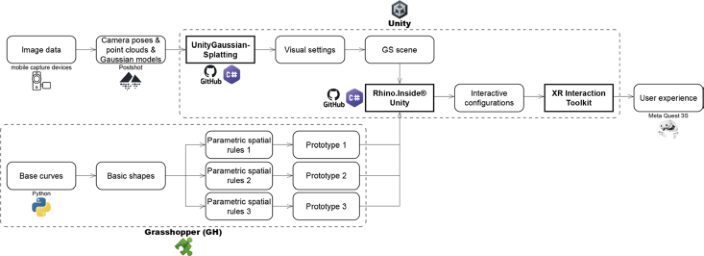
The study emphasizes the synergy between GH and Unity during the design phase, aiming to shape adaptable virtual scenes through the implementation of high-fidelity environments and embedded generative rules. The research workflow is illustrated in Figure 1.
Figure 1: The research workflow and main tools. (Source: the author).
Where Spatial Immersion Meets Diverse Experiences: Exploring Virtual Scenes 129 Real Scene Virtualization
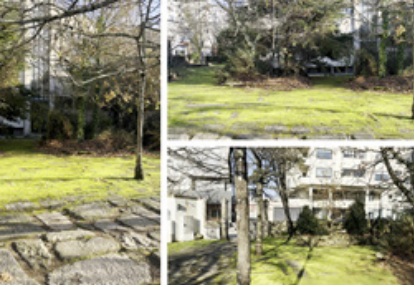
This research selected a greenfield in the city as the scene virtualization subject to maintain a realistic and continuous environmental context. The site features distinct topographical divisions alongside clearly vegetation distribution; it is also adjacent to several educational institutions, resulting in a high daily pedestrian traffic (Figure 2). This effectively reflects the coexistence of natural elements and human intervention. Consequently, the venue not only possesses strong data collection conditions, but also serves as a suitable case study for exploratory spatial design driven by diverse experiential needs.
The author first captures this area from multiple angles using a mobile device, obtaining imagery that covers key spatial elements. Subsequently, these images were imported into Postshot software to solve camera poses, generate point clouds (Figure 3a), and train Gaussian models. The output from this stage provides foundational data for accessing GS scenes.
To further enhance the virtualization effectiveness and enable its direct implementation in spatial design and interaction, the study adopted the UnityGaussianSplatting (Pranckevičius, 2025). This is a GS processing toolkit for the Unity game engine, whose core advantage is avoiding reliance on Unity’s native mesh or terrain geometry systems. Instead, it employs GPU-driven and Compute Shader-based parallel algorithms for batch and real-time rendering, significantly enhancing the loading, transformation, and computational efficiency of millions of Gaussian data points.
In the specific workflow, the PLY file generated by Postshot is imported into the Unity and functions as input source for GS. Within the UnityGaussianSplatting framework, position, scale, orientation, and radiative properties are available within the built-in rendering pipeline. This process could refine visual settings, such as debug points (Figure 3b), to prepare for 3D representation, thereby delivering seamless spatial transitions. Finally, the resulting GS scene achieves high-fidelity and reliable display (Figure 3c), allowing the real-world condition transforms from a background into a virtual context that could directly participate in design judgment.
Figure 2: Photographs of the research site. (Source: the author).Figure 3: The process of GS scene virtualization: (a) camera poses and point cloud; (b) debug points; (c) GS scene. (Source: the author).
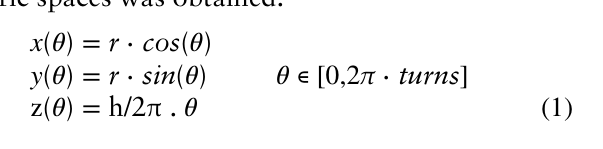
Parametric Prototype Modelling Grounded in the site’s ecological texture and pedestrian circulation patterns, the study established a design logic cantered on spiral geometry as the spatial prototype. Utilizing trigonometric functions as its mathematical foundation (1), a geometric generation algorithm was built within GH using Python code. By defining adjustable parameters, such as base circle radius, vertical increment, rotation angle, and curvature variation, the unfolding of spiral can be controlled. A half-periodic curve was ultimately selected as the modelling input (Figure 4a). After lofting (Figure 4b), topology refinement (Figure 4c), and final optimization (Figure 4d), an initial surface forming the geometric basis for the entire parametric spaces was obtained.
Equation reproduced from the original PDF.Figure 4: The evolution of basic parametric shapes: (a) half-periodic spiral curve; (b) lofted surface; (c) topological surface; (d) final optimized surface. (Source: the author).
Figure available in the original PDF paper.
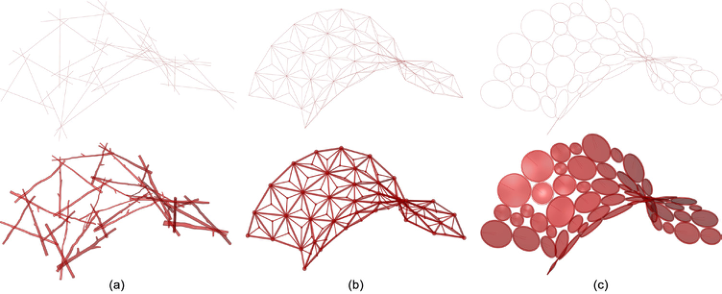
Three prototypes based on representative spatial design strategies were adopted to explore distinct experiences formed by controlling specific attributes, while preserving overall structural consistency across each generation method. These prototypes, reciprocal structure, jointed frame system, and circle packing & bubbles, represent a progressive iterative and evolutionary process. Each of them advances from structural wireframes to physical components according to their respective parametric rules (Figure 5).
Figure 5: Parametric wireframes and components of three prototypes: (a) reciprocal structure; (b) jointed frame system; (c) circle packing & bubbles. (Source: the author).
Reciprocal structure performed mesh subdivision on the preliminary spiral surface and employed GH’s mechanical constraints and relaxation algorithm. During simulation, the rod ends, which originally converged at a single point, were displaced along their respective axes, thereby generating an interlocking relationship. All result members were replaced with branch-like 3D models, shaping a structural morphology closer to natural topography. By further segmenting the mesh of the reciprocal structure and introducing a truss network with objects connected through hinged nodes, a jointed frame system is created. This prototype utilizes steel square pipes as its primary components, emphasizing modularity and prefabrication for repeated assembly and deployment. It allows for adjustments to node density and interconnection methods to observe varying degrees of spatial permeability. Both the reciprocal structure and jointed frame system could gain additional iterative branches through continuous modification of the subdivision type.
Circle packing & bubbles relies on circular collision constraints in GH. Through mutual repulsive forces between items, the centres of circles are confined within the target area, ensuring static balance where all elements fit tightly together without overlapping. The boundaries are expressed through steel rings, with ETFE bubbles embedded inside, thus yielding lightweight and translucent spatial units. This prototype emphasizes enveloping and flexible experiences, allowing adjustment of circle’s position and radius. Compared to the previous two approaches, it offers a unique structured solution for exploratory design.
Interactive Platform Integration To more intuitively observe the relationship between design and experience in GS scenes and parametric iterative prototypes, the study employed Rhino. Inside® Unity to link GH with Unity (McNeel & Associates, 2019). Its core mechanism involves C# programming to directly load Rhinoceros 3D’s computational kernel within the Unity process, enabling GH to run embedded within the Unity environment. Under this procedure, GH is responsible for complex modelling, while Unity focuses on rendering, physics feedback,
132 Han and delivering immersive experiences. Specifically, geometric data generated by each parameter modification in GH are transmitted to the Unity in real time, facilitating instant visualization and interaction without the need for traditional file export or intermediate format conversion.
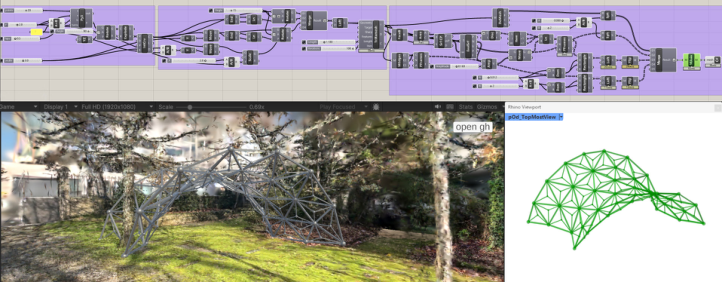
This workflow also completes the direct overlay of the prototype in the GS context, empowering designers to examine spatial volumes, scale relationships, and structural changes under different design options from a first-person perspective (Figure 6). Such real-time iteration tightly links decision-making during the exploration phase with the user experience.
Figure 6: The linkage interface between Unity and GH. (Source: the author).
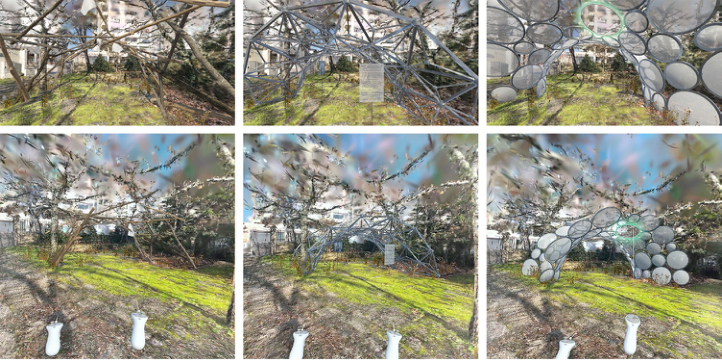
Furthermore, the research incorporates interactions and responses within Unity, including simulating wind field effects on vegetation, location-based UI and video interface triggers, and highlight displays. They apply to VR scenes defined by the XR Interaction Toolkit configuration and provide unified management for switching and navigation (Figure 7). Overall, by merging GS scenes, parametric prototypes, and human-computer interaction nodes, a dynamic spatial experience system with dual feedback loops for both environment and behaviour have been accomplished.
Figure 7: The interaction process and VR roaming of three prototypes. (Source: the author).
USER EXPERIENCE TESTING Tasks
To validate the effectiveness and usability of the proposed exploratory design method, this study recruited 23 participants with backgrounds in spatial design to conduct user experience testing. Since the author had completed the packaging of the basic configuration in advance, testers did not require prior familiarity with the tools. The process was divided into three stages. First, participants received brief operational instructions, including scene content and editable prototype properties. They were then asked to adjust relevant parameters to observe and evaluate the design process. Finally, users sequentially wear Meta Quest 3S headsets to enter the reconstructed environment with its overlaid parametric prototype, freely exploring and experiencing the complete scene and interactions.
After completing all procedures, users were asked to complete the System Usability Scale (SUS) questionnaire. It is a standardized assessment method widely used in evaluating interactive solutions and immersive environments, which effectively reflects users’ subjective judgments even with relatively small sample sizes (Brooke, 1996). It consists of 10 items using a five-point Likert scale (1 = Strongly Disagree, 5 = Strongly Agree), measuring system usability, operational consistency, learning cost, and user confidence.
RESULTS
The SUS results indicate that the overall system usability score was 71.85 (standard deviation, SD = 7.70), exceeding the general usability benchmark of 68. This demonstrates that the design system exhibits good usability in terms of interaction and operation. Meanwhile, individual scores ranged from 55 to 87.5, with most ratings concentrated above 70, further reflecting the overall positive feedback.
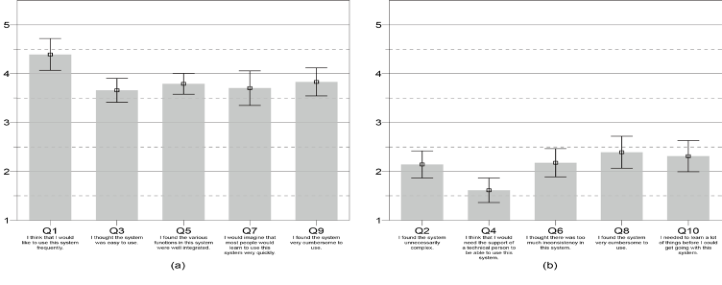
The mean (M) and SD for each item are shown in Figure 8. Evaluations related to learnability and operational consistency received high scores. The M for “I thought the system was easy to use” was 3.65, while “I would imagine that most people would learn to use this system very quickly” scored 3.70, indicating participants could adapt to the design method’s basic functions within a short period. The score of 3.78 for “I found the various functions in this system were well integrated” shows good coordination between the GS scenes and the parametric prototypes. Simultaneously, the M of 3.83 for “I felt very confident using the system” represents that users maintained relatively stable control during design and spatial perception processes. The highest-scoring item, “I think that I would like to use this system frequently”, reached 4.39, suggesting that people has both a very positive first impression and a strong willingness to use such workflow long-term.
The entries related to system complexity received relatively low scores within acceptable ranges, such as “I found the system very cumbersome to use” at 2.39 and “I needed to learn a lot of things before I could get going with this system” at 2.30. However, compared to other metrics, they still
134 Han indicate potential opportunities for improvement in the system’s intuitive interaction and operation, particularly regarding spatial structure updates.
Figure 8: M and SD of each item in the questionnaire: positive items (a); reverse- scored items (b). (Source: the author).
DISCUSSION
The findings suggest that embedding parametric iterative design spaces within GS-reconstructed real-world environments enhances the diversity and flexibility of early-stage design exploration. Implemented through the integration of Unity and GH, the system maintains stable performance despite visual and spatial complexity. The SUS score exceeding the acceptance threshold shows that participants were able to understand and operate the workflow effectively, supporting the feasibility of this virtual scene generation method from a user experience perspective.
High ratings for instructiveness and workflow fluidity highlight the system’s contribution to design cognition. The GS environment provides familiar spatial references, allowing users to quickly establish orientation and scale awareness, thereby reducing the perceived workload during modelling. High-fidelity reconstruction not only strengthens immersion, but also improves the legibility of complex structures. Feedback on the Unity-GH linkage indicates that technical integration was largely seamless experience for users, enabling them to focus on design exploration. Through continuous interaction, designers were able to test alternative spatial configurations while maintaining overall form consistency, supporting iterative refinement and encouraging sustained engagement with the system.
Responses to reverse-scored items reveal several challenges related to system transparency. Some generative processes, such as curve manipulation or real-time algorithmic optimization, were perceived as “black box” operations that could not be directly visualised. Yet these issues remained manageable through parameter adjustment, allowing designers to retain control over outcomes. This suggests that intervening in generative logic during the exploratory phase is more effective than correcting results after generation.
Where Spatial Immersion Meets Diverse Experiences: Exploring Virtual Scenes 135 Nevertheless, several limitations should be acknowledged. As GS is based on point-based radiance field rendering rather than mesh geometry, reconstructed scenes lack physical features and robust occlusion, which may cause visual misalignment with parametric models and require additional collision proxies in Unity. Hardware constraints also affected GS training quality and contributed to runtime latency in the cross-platform workflow, indicating a need for further algorithmic and system-level evolution. Moreover, user evaluation was primarily conducted with designers, which may limit the generalisability of the findings. Future studies should involve more diverse user groups and test the approach across different spatial scales and design phases.
CONCLUSIONS
This study proposes an integrated design method that combines GS with parametric iteration to support exploratory virtual scene design. By embedding parametric prototypes within hyper-realistic GS reconstructed environments and deploying them through immersive and interactive platforms, the workflow enables continuous spatial evolution and experiential feedback during early design stages.
GS provides visually coherent representations with realistic scale and detail, allowing designers to quickly comprehend and evaluate complex spaces while reducing disorientation. Meanwhile, parametric iteration supports the generation of diverse design alternatives through predefined algorithmic rules, maintaining consistency and usability. User evaluation indicates high learnability and reliability, demonstrating that modifying generative logic early in the process is more effective than refining outcomes at later stages.
The cross-platform integration of Unity and GH further enhances the feasibility of this approach by enabling the real-time adjustment, trigger response, and VR deployment. This shifts design iteration from static geometric review toward decision-making within simulated digital environments.
In summary, the research extends existing computational design methods by redefining environmental reconstruction and parametric generation as active components of experiential design. It contributes a workflow that moves virtual scene design beyond visual presentation toward perception- oriented exploration and evaluation.
REFERENCES
Brooke, J. (1996) ‘SUS: A quick and dirty usability scale’, in Jordan, P.W. et al.
(eds.) Usability Evaluation in Industry. London: Taylor & Francis, pp. 189–194. Buonamici, F., Carfagni, M., Furferi, R., Volpe, Y. and Governi, L. (2020) ‘Generative design: An explorative study’, Computer-Aided Design and Applications, 18(1), pp. 144–155. https://doi.org/10.14733/cadaps.2021.144-155. Castro Pena, M.L., Carballal, A., Rodríguez-Fernández, N., Santos, I. and Romero,
J. (2021) ‘Artificial intelligence applied to conceptual design: A review of its use in architecture’, Automation in Construction, 124, 103550. https://doi. org/10.1016/j.autcon.2021.103550.
methodological approach to inclusive digital urban design’, Urban Science, 9(6), pp. 196–237. https://doi.org/10.3390/urbansci9060196. Gradišar, L., Dolenc, M. and Klinc, R. (2024) ‘Towards machine learned generative design’, Automation in Construction, 159, 105284. https://doi.org/10.1016/j. autcon.2024.105284. Jamil, O. and Brennan, A. (2025) ‘Immersive heritage through gaussian splatting:
A new visual aesthetic for reality capture’, Frontiers in Computer Science, 7, 1515609. https://doi.org/10.3389/fcomp.2025.1515609. Kerbl, B., Kopanas, G., Leimkühler, T. and Drettakis, G. (2023) ‘3D Gaussian splatting for real-time radiance field rendering’, ACM Transactions on Graphics, 42(4), Article 139. https://doi.org/10.1145/3592433. McNeel & Associates (2019) Rhino.Inside® Unity. Available at: https://github.com/
mcneel/rhino.inside/tree/master/Unity (Accessed: 21 December 2025). Mildenhall, B. et al. (2022) ‘NeRF: Representing scenes as neural radiance fields for view synthesis’, Communications of the ACM, 65(1), pp. 99–106. https://doi. org/10.1145/3503250. Oxman, R. (2017) ‘Thinking difference: Theories and models of parametric
design thinking’, Design Studies, 52, pp. 4–39. https://doi.org/10.1016/j. destud.2017.06.001 Pranckevičius, A. (2025) UnityGaussianSplatting. Available at: https://github.com/ aras-p/UnityGaussianSplatting (Accessed: 21 December 2025). Schumacher, P. (2022) ‘The metaverse as opportunity for architecture and
society: Design drivers, core competencies’, Architectural Intelligence, 1(1), Article 11. https://doi.org/10.1007/s44223-022-00010-z. Skarbez, R., Smith, M. and Whitton, M.C. (2021) ‘Revisiting Milgram and Kishino’s reality–virtuality continuum’, Frontiers in Virtual Reality, 2. https://doi. org/10.3389/frvir.2021.647997. Slater, M. and Wilbur, S. (1997) ‘A framework for immersive virtual environments
(FIVE): Speculations on the role of presence in virtual environments’, Presence: Teleoperators and Virtual Environments, 6(6), pp. 603–616. https://doi. org/10.1162/pres.1997.6.6.603. Stals, A., Jancart, S. and Elsen, C. (2021) ‘Parametric modeling tools in small architectural offices: Towards an adapted design process model’, Design Studies, 72, 100978. https://doi.org/10.1016/j.destud.2020.100978.
LISTED IN THE AHFE DIGITAL BOOKSTORE CATALOGUE
Explore the complete digital volume
Accessibility, Assistive Technology and Digital Environments
Read this individual research paper free through the original publisher, or explore the full digital proceedings book.
ISBN 978-1-964867-78-6
Explore this ISBN in the AHFE Bookstore ↗Listed in the July 2026 bookstore catalogue; search by ISBN to confirm current availability · Digital book purchase optional