Michiko Inoue, Shota Hioki (2026). When Is Congruence Optimal? Impression-Dependent Effects of Product-Avatar Matching in VR Commerce. In: Accessibility, Assistive Technology and Digital Environments. AHFE Open Access, vol. 202, pp. 69–79. https://doi.org/10.54941/ahfe1007298
Virtual reality (VR) is increasingly used for product introduction, where virtual salespersons (avatars) guide users through products in immersive environments. Conventional design wisdom, grounded in schema congruity theory, assumes that visual congruence between product and salesperson impressions leads to more favorable evaluations. However, it remains unclear whether this “congruity advantage” always holds for affective impressions in VR commerce. In this study, we empirically examine how the relationship between product impressions and salesperson impressions, that is, congruent (similar) versus incongruent (contrasting), affects user experience in VR product introduction. In a preliminary study, we quantified eight affective impression features for products and avatars. We used a within-subjects VR experiment (N = 19; 304 observations per measure) to systematically combine each impression feature with congruent and incongruent avatar pairings. Participants rated perceived favorability, revisit intention, and purchase intention. Two-way analyses of variance indicated significant interactions between the impression feature and impression relationship for all three indicators. Cuteness and healthiness were evaluated more positively under congruent conditions, whereas interestingness yielded the opposite pattern: incongruent conditions led to higher favorability, revisit intention, and purchase intention. Other features yielded no reliable differences. These findings indicate that congruence is not universally optimal. Instead, the optimal configuration depends on the type of affective impression, suggesting impression-specific design guidelines for selecting VR salespersons in VR commerce.
In virtual reality (VR) commerce, companies are beginning to use VR spaces as new channels for product introduction and shopping. In such VR stores, users can look at and experience products while interacting with virtual salespersons (avatars) instead of human staff. In previous studies, researchers demonstrated that VRbased shopping environments can enhance aspects of the instore experience and sometimes purchaserelated outcomes compared with conventional webbased ecommerce (Li et al., 2003; Fiorentino et al., 2022; Ricci et al., 2023), but still do not fully reach the performance of
70 Inoue and Hioki physical stores (Xi & Hamari, 2021). This gap is influenced by various factors, such as spatial design, interaction naturalness, and the broader VR servicescape (Dad et al., 2016; Ricci et al., 2023). Among these factors, the salesperson is a critical interaction point and has a strong effect on user experience and purchaserelated evaluations in both physical and virtual stores (Pizzi et al., 2019).
In previous studies on VR salesperson avatar and recommendation agents, researchers focused on social impressions such as warmth, competence, and trustworthiness. The results of these studies demonstrated that anthropomorphic virtual agents with appropriate social cues can increase perceived social presence, enjoyment, trust, and purchase intention (Qiu & Benbasat, 2009; Holzwarth et al., 2006; Nowak & Biocca, 2003). However, a VR salesperson avatar is not only a social actor but also designed digital content. From a contentdesign perspective, affective impressions such as “interesting,” “cute,” “luxurious,” and “calm” are also important axes that shape user experience, similarly to affective descriptors used in the evaluation of website or media design.
In marketing and environmental psychology, schema congruity theory suggests that users evaluate stimuli more positively when the impressions of related elements are congruent, for example, when a salesperson’s appearance matches the brand or store atmosphere (Aggarwal & McGill, 2007; MeyersLevy & Tybout, 1989). In related studies on store atmospherics, researchers also demonstrated that aligning environmental cues with product and brand positioning can improve affective responses and purchase outcomes (Bellizzi & Hite, 1992; Dad et al., 2016). Simultaneously, research on incongruity has demonstrated that moderate mismatches between expectations and stimuli can enhance user experience by inducing surprise, attention, and deeper cognitive processing, particularly for hedonic or novel products (MeyersLevy & Tybout, 1989; Noseworthy et al., 2014). However, in the context of VR product introduction, it remains unclear whether congruence between product impressions and salesperson impressions is always beneficial or whether deliberate incongruity can occasionally enhance user experience. In particular, very few researchers have systematically examined this question across multiple affective impression features in a controlled VR environment.
Therefore, in this paper, we investigate how the visual impression relationship between products and VR salesperson avatars affects user experience in VR product introduction. We consider both products and avatars as designed digital content and compare them along common affective dimensions. We define congruent relationships as combinations where the product and avatar share similarly high impressions with respect to a given feature, and incongruent relationships as combinations where a high-impression product is paired with a low-impression avatar on that feature. Figure 1 illustrates example congruent and incongruent product– salesperson pairs. We address the following research questions: RQ1: For which impression features does an incongruent product–
salesperson relationship yield higher user experience indicators than a congruent relationship?
When is Congruence Optimal? Impression-Dependent Effects 71 RQ2: For which impression features does a congruent product–salesperson
relationship yield higher user experience indicators than an incongruent relationship?
Figure 1: Examples of congruent and incongruent product–salesperson pairings for (a) interestingness and (b) cuteness. Interestingness is evaluated higher under the incongruent pairing, whereas cuteness is evaluated higher under the congruent pairing.
Figure available in the original PDF paper.
The user experience indicators in this study are the perceived favorability of the product introduction, revisit intention (willingness to be guided again by the same salesperson), and purchase intention. To answer the two questions, we conducted a preliminary study to quantify the product and avatar impressions, and a main VR experiment to evaluate user experience under systematically constructed congruent and incongruent conditions.
EXPERIMENTAL DESIGN FOR SUBJECTIVE EVALUATION We conducted a main VR experiment to examine how the impression relationship between the product and VR salesperson avatar affects user experience. In the following, we refer to users as participants.
Comparison of Impression Relationship Conditions We considered two types of impression relationship between the product and VR salesperson avatar for each affective feature:
Congruent condition: A product that is rated high on a given impression feature is paired with a VR salesperson avatar that is also rated high on the same feature. Incongruent condition: The same high-impression product is paired with a VR salesperson avatar that is rated low on the same feature.
Both conditions use the same product; only the salesperson avatar is switched. Figure 1 summarizes the definition of the impression relationship conditions. “High” and “Low” are defined relative to other products or avatars based on the preliminary study described below.
To capture affective impressions that are relevant for both products and avatars as designed digital content, we adopted eight impression features inspired by previous work (Asakawa et al., 2011) on web and media design: Interestingness, Impact, Cuteness, Brightness, Healthiness, Vitality, Luxury, and Calmness
These features cover stimulation-oriented impressions (e.g., interestingness and impact), sensory impressions (e.g., cuteness and brightness), utilitarian or wellness-related impressions (e.g., healthiness and vitality), and dignity- related impressions (e.g., luxury and calmness).
Preliminary Study: Quantifying Product and Salesperson Impressions We first conducted a preliminary study to quantify the eight impression features for candidate products and salesperson avatars. The stimulus set consisted of 10 products (e.g., flowers, tableware, electronics, and food items) and 10 salesperson avatars, including anime-style young and older male/ female characters, realistic male and female characters, and undecorated and decorated robot avatars. Eleven university students (11 males; mean age = 23.3 ± 1.63 years) participated. The stimuli were presented in VR using a Meta Quest Pro head-mounted display (HMD: 1800 × 1920 pixels per eye, 90 Hz). Avatar gestures were animated with motion-capture data recorded using the Sony mocopi system. Each participant viewed all products and all avatars, and rated the extent to which each stimulus conveyed the eight impression features on a 7-point Likert scale (1 = Not at all, 7 = Very strongly). The presentation order of both the stimuli and questions was randomized.
Based on the preliminary ratings, we first computed overall impression means across the eight items for each of the 10 product candidates and excluded one very highscoring (rose) and one very lowscoring item (mayonnaise). The remaining eight products yielded moderate overall impressions (3.98–4.37 on the 7-point scale). From this set, we selected, for each impression feature, the product with the highest mean rating (e.g., frame for interestingness, sword for impact, tea for healthiness, and headphones for luxury). For the salesperson avatars, for each feature, we analogously selected one highimpression avatar (congruent condition) and one low-impression avatar (incongruent condition). For six of the eight features, the difference between the high and low avatars exceeded 3 points on the 7-point scale, and for luxury and calmness, the contrast crossed the scale midpoint, thereby ensuring a clear high–low manipulation without extreme biases on nontarget impressions.
Stimuli for the Main Experiment For the main experiment, we constructed 16 stimuli, combining eight impression features with two impression relationships (congruent vs. incongruent). For each stimulus, a VR salesperson avatar introduced a single product in a virtual store environment created with Unity. The VR salesperson avatar stood at a typical interpersonal distance in front of the participant,
When is Congruence Optimal? Impression-Dependent Effects 73 with a single product placed slightly to the avatar’s right at about chest height. The scene was implemented in Unity. The avatar performed a standardized bow and a pointing gesture toward the product. No voice guidance was used so that visual impressions were the main manipulation.
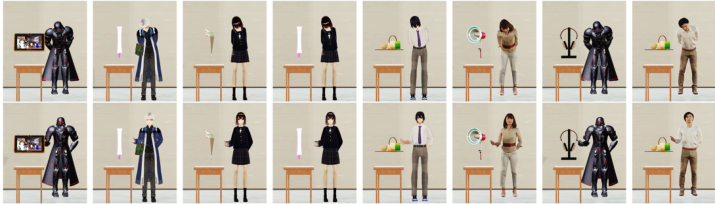
Figure 2: Examples of VR stimuli for each impression feature under (a) incongruent and (b) congruent conditions.
Figure 2 presents example VR stimuli for each impression feature under both congruent and incongruent product–salesperson relationships (8 features × 2 conditions). Figure 3 depicts the physical experimental setting, with a seated participant wearing the HMD and using a controller to provide ratings.
Subject with Meta Quest Pro
0.5 m 0.7 m
Figure 3: Experimental setting in the real space.
Figure available in the original PDF paper.
User Experience Measures We defined three user experience indicators. After each product introduction, participants answered the following questions:
salesperson introducing this product was favorable?” Q2 (Revisit intention): “To what extent would you like to be guided by this salesperson again next time?” Q3 (Purchase intention): “To what extent would you like to purchase this
product?”
For each question, we also prepared an opposite questions (e.g., To what extent did you feel that this VR salesperson introducing this product was not favorable?) and reversed the scores. The total of six items was presented in random order. All items were scored on a 7-point scale (1 = Not at all, 7 = Very much).
Participants and Apparatus Nineteen university and graduate students (12 males, 7 females; mean age = 21.84 ± 1.98 years) participated in the experiment, resulting in 304 observations per question (19 participants × 16 conditions). All participants gave written informed consent. As in the preliminary study, we used a Meta Quest Pro HMD and mocopi-based motion capture for avatar movements. Participants sat on a chair in a quiet experimental room and used a controller to confirm their responses.
Experimental Procedure Each participant first received an explanation of the scenario (“You are selecting products in a VR store…”) and then completed 16 trials. At the beginning of each trial, a red sphere appeared to standardize the initial gaze, followed by a 10-s presentation of one product–avatar combination. After the stimulus disappeared, a virtual questionnaire board with the six items was displayed, and the participant rated each item using a controller. The 16 stimuli were presented in fully randomized order.
RESULTS
For each question (Q1–Q3), we first calculated the mean score of the corresponding positive and reversed items. Then we conducted two-way analyses of variance (ANOVAs), considering both the impression feature (eight levels) and impression relationship (two levels: congruent vs. incongruent) as within-subjects factors. Because significant interactions were found for all three questions (Q1–Q3), we conducted simple main effects analyses for each question.
Q1: Perceived Favorability As summarized in Table 1, the two-way repeated-measures ANOVA on perceived favorability indicated a significant main effect of the impression feature, F(7, 126) = 3.38, p = .002, η²p = .158, and a marginal main effect of the impression relationship, F(1, 18) = 4.23, p = .055, η²p = .190. Importantly,
When is Congruence Optimal? Impression-Dependent Effects 75 the interaction between the impression feature and impression relationship was also significant, F(7, 126) = 3.30, p = .003, η²p = .155, which indicates that the effects of congruence depended on the type of impression feature.
The simple main effects of the impression relationship yielded a clear feature-specific pattern. For interestingness, the incongruent condition produced significantly higher favorability than the congruent condition (p = .028, η²p = .241). By contrast, for cuteness and healthiness, the congruent condition yielded significantly higher favorability than the incongruent condition (p = .008, η²p = .334; p = .002, η²p = .412, respectively). For the remaining features, that is, impact, brightness, vitality, luxury, and calmness, no significant differences were observed between congruent and incongruent conditions. Figure 4(a) illustrates this overall tendency: interestingness favored incongruity, whereas cuteness and healthiness favored congruence.
Figure 4: Mean subjective rating for each impression feature under congruent and incongruent conditions.
Figure available in the original PDF paper.
Q2: Revisit Intention As shown in Table 1, the ANOVA for revisit intention also indicated significant main effects of the impression feature, F(7, 126) = 2.78, p = .010, η²p = .134, and impression relationship, F(1, 18) = 6.58, p = .019, η²p = .268, in addition to a significant interaction, F(7, 126) = 2.61, p = .015, η²p = .127. Thus, revisiting intentions were generally higher in one impression relationship than the other. The magnitude and direction of this effect varied by impression feature.
Table 1: Summary of the two-way ANOVA results for user experience indicators.
Simple main effects analyses again yielded a feature-dependent pattern. For brightness and healthiness, the congruent condition produced significantly higher revisit intention than the incongruent condition (p = .010, η²p = .314; p = .003, η²p = .400, respectively). For interestingness, the incongruent condition tended to yield higher revisit intention than the congruent condition, although this effect did not reach conventional significance (p = .067, η²p = .174). No significant differences between congruent and incongruent conditions were observed for the other features. As summarized in Figure 4(b), interestingness yielded a consistent advantage for incongruity, whereas brightness and healthiness favored congruence.
Q3: Purchase Intention As summarized in Table 1, the two-way ANOVA for purchase intention indicated significant main effects of the impression feature, F(7, 126) = 8.26, p < .001, η²p = .315, and impression relationship, F(1, 18) = 4.98, p = .039, η²p = .217, in addition to a significant interaction, F(7, 126) = 2.85, p = .009, η²p = .137. As with favorability and revisit intention, this interaction indicates that the effect of congruence depended on the impression feature.
The simple main effects analyses showed that for interestingness, the incongruent condition produced significantly higher purchase intention than the congruent condition (p = .010, η²p = .314). By contrast, for cuteness and healthiness, the congruent condition yielded significantly higher purchase intention than the incongruent condition (p = .045, η²p = .205; p = .021, η²p = .262, respectively). No significant differences were observed for the remaining features. Figure 4(c) illustrates the overall pattern of purchase intention across impression features under both conditions.
DISCUSSION
The results of this study demonstrate that the effects of impression relationships between products and VR salespersons are not uniform; they
When is Congruence Optimal? Impression-Dependent Effects 77 vary systematically across impression features. All three user experience indicators, that is, perceived favorability, revisit intention, and purchase intention, yielded significant interactions between the impression feature and impression relationship, which indicates that the influence of congruence depends on which impression is emphasized.
The clearest evidence for incongruity emerged for interestingness. Across all three measures, the incongruent High–Low pairing yielded higher evaluations than the congruent High–High pairing, thereby providing a feature-specific counterexample to the assumption, rooted in schema congruity theory, that congruence is always beneficial. Given that interestingness reflects a high- arousal, stimulation-oriented impression, this pattern is consistent with the moderate incongruity hypothesis, in which moderate mismatches enhance novelty, attention, and cognitive elaboration.
By contrast, cuteness and healthiness consistently favored congruence, and brightness also favored congruence for revisit intention. These impressions relate to low-arousal, comfort-oriented qualities such as warmth, safety, and vitality, for which congruence may enhance predictability and psychological comfort. Other features, that is, impact, vitality, luxury, and calmness, did not exhibit reliable effects of the impression relationship under the present conditions.
A comparison of the three user-experience indicators indicates that impression relationships broadly influenced favorability and revisit intention, whereas the effects on purchase intention were more selective, emerging primarily for interestingness, cuteness, and healthiness. Because the products used were low-involvement items, brief single-session exposure may more readily shift affective evaluations and relationship-continuation intentions than purchase-related intentions, which are influenced by additional considerations such as price or functional needs.
Overall, the findings refine the conventional assumption that impression congruence is universally optimal and instead indicate feature-specific patterns: incongruity benefits high-arousal impressions such as interestingness, whereas congruence benefits comfort-oriented impressions such as cuteness, brightness, and healthiness. Theoretically, this contributes to a more nuanced understanding of schema congruity in VR product introduction. Practically, the results suggest that designers of VR commerce systems may strategically choose between matching and mismatching avatar impressions depending on whether the goal is to evoke comfort and trust or novelty and stimulation.
LIMITATIONS AND FUTURE WORK This study has several limitations. We manipulated only visual impressions, using a single representative product–avatar pair per impression feature and evaluating shortterm responses in a single session. In future work, we should examine how voice, speech style, and interactive behaviors interact with visual impression relationships; include multiple exemplars per feature; and investigate longerterm effects on repeated visits, brand attitudes, and actual purchasing behavior, particularly for higherinvolvement products.
CONCLUSION
In this paper, we examined how impression relationships between products and VR salespersons influence user experience in VR product introduction. Using a preliminary impression measurement and a within-subjects VR experiment, we compared congruent and incongruent product–salesperson pairings across eight affective impression features.
Regarding RQ1, for the interestingness feature, the incongruent High–Low pairing produced higher user experience evaluations than the congruent High– High pairing across multiple indicators. Regarding RQ2, for the cuteness, brightness, and healthiness features, the congruent High–High pairing produced higher user experience evaluations than the incongruent High– Low pairing. These findings demonstrate that congruence is not universally optimal; its effectiveness depends on the impression being emphasized. This refines schema congruity theory by indicating impression-specific exceptions and suggests that strategic incongruity can enhance stimulation-oriented impressions such as interestingness, whereas congruence remains effective for comfort-oriented impressions. Designers may therefore select salesperson avatars that either match or intentionally contrast with product impressions, depending on whether the goal is to evoke trust and comfort or novelty and curiosity.
ACKNOWLEDGMENTS
We thank Professor Masashi Nishiyama (Tottori University) for providing general comments and administrative support. We also thank Edanz for English-language editing of a draft of this manuscript.
REFERENCES
Aggarwal, P., & McGill, A. L. (2007). Is that car smiling at me? Schema congruity as a basis for evaluating anthropomorphized products. Journal of Consumer Research, 34(4), 468–479. Asakawa, M., & Okano, M. (2011). Web saito ni taisuru “shicho insho” no bunseki
[Analysis of “viewing impressions” of websites]. Kokoku Kagaku [Journal of Advertising Science], 54, 50–64. (in Japanese) Bellizzi, J. A., & Hite, R. E. (1992). Environmental color, consumer feelings, and purchase likelihood. Psychology & Marketing, 9(5), 347–363. Dad, A. M., Davies, B. J., & Rehman, A. A. (2016). 3D servicescape model: Atmospheric
qualities of virtual reality retailing. International Journal of Advanced Computer Science and Applications, 7(2), 85–96. Fiorentino, M., Ricci, M., Evangelista, A., Manghisi, V. M., & Uva, A. E. (2022). A multi-sensory in-store virtual reality customer journey for retailing: A field study in a furniture flagship store. Future Internet, 14(12), 381. Holzwarth, M., Janiszewski, C., & Neumann, M. M. (2006). The Influence of
Avatars on Online Consumer Shopping Behavior, 70(4), 19–36. Li, H., Daugherty, T., & Biocca, F. (2003). The role of virtual experience in consumer learning. Journal of Consumer Psychology, 13(4), 395–407. Meyers-Levy, J., & Tybout, A. M. (1989). Schema congruity as a basis for product
evaluation. Journal of Consumer Research, 16(1), 39–54.
When is Congruence Optimal? Impression-Dependent Effects 79 Noseworthy, T. J., Di Muro, F., & Murray, K. B. (2014). The role of arousal in
congruity-based product evaluation. Journal of Consumer Research, 41(4), 1108– 1126. Nowak, K. L., & Biocca, F. (2003). The effect of the agency and anthropomorphism on users’ sense of telepresence, copresence, and social presence in virtual environments. Presence: Teleoperators and Virtual Environments, 12(5), 481–494. Pizzi, G., Scarpi, D., Pichierri, M., & Vannucci, V. (2019). Virtual reality, real
reactions? Comparing consumer responses to virtual and physical stores. Journal of Business Research, 96, 547–559. Qiu, L., & Benbasat, I. (2009). Evaluating anthropomorphic product recommendation agents: A social relationship perspective to designing information systems. Journal of Management Information Systems, 25(4), 145–182. Ricci, M., Evangelista, A., Di Roma, A., & Fiorentino, M. (2023). Immersive and
desktop virtual reality in virtual fashion stores: A comparison between shopping experiences. Virtual Reality, 27(3), 2281–2296. Xi, N., & Hamari, J. (2021). Shopping in virtual reality: A literature review and future research agenda. Journal of Business Research, 134, 37–58.
LISTED IN THE AHFE DIGITAL BOOKSTORE CATALOGUE
Explore the complete digital volume
Accessibility, Assistive Technology and Digital Environments
Read this individual research paper free through the original publisher, or explore the full digital proceedings book.
ISBN 978-1-964867-78-6
Explore this ISBN in the AHFE Bookstore ↗Listed in the July 2026 bookstore catalogue; search by ISBN to confirm current availability · Digital book purchase optional