Yang Shi (2025). Virtual Reality for Education from a User Experience Perspective: A Bibliometric Analysis. In: Accessibility, Assistive Technology and Digital Environments. AHFE Open Access, vol. 162, pp. 71–80. https://doi.org/10.54941/ahfe1006014
Education is shifting from traditional multimedia to immersive Virtual reality (VR) environments. Despite numerous reviews on VR in education, few focus on user experience. Existing reviews mainly use qualitative methods, limiting objective analysis due to small sample sizes. Quantitative analysis can address this by covering more studies. This study explores VR in education from a user experience perspective (VR-E-UEP) using bibliometric methods. Methods: We used the Web of Science (WOS) core collection database and employed VOSviewer and CiteSpace for keyword, evolutionary, and co-citation analyses. Results: VR-E-UEP research hotspots are divided into four clusters: 1) specific VR applications in education, 2) advantages and key concepts of VR in education, 3) data analysis techniques, and 4) key factors affecting user experience. Evolution analysis shows early research focused on VR technology and applications, mid-term research emphasized human factors, and recent studies highlight machine learning. Frequently co-cited research falls into five categories: 1) Definitions and Technologies of Virtual Reality and Augmented Reality, 2) Advantages and Effectiveness Evaluation of Virtual Reality Technology in Education, 3) Applications of Immersive Virtual Reality in Learning and Training, 4) User Experience Measurement, 5) Statistical Analysis Methods and Theoretical Models. Finally, future research directions are discussed.
Currently, education is shifting from traditional multimedia to more immersive, interactive, intuitive, and engaging Virtual reality (VR) learning environments (Marougkas et al., 2024). With a wide array of VR software and hardware, users are active participants, enabling exploration-based learning. VR technology has great potential, attracting much research interest in education (Radianti et al., 2020). Scholars have conducted numerous systematic literature reviews. Pellas, Mystakidis and Kazanidis (2021) used systematic mapping to identify VR application design elements in higher education, finding gaps such as neglect of learning theories in development and evaluation. Checa and Bustillo (2020) reviewed 135 recommendations on serious games in immersive VR, analyzing various aspects and setting factual standards. Hamilton et al. (2021) examined I-VR
as an educational method, finding its advantages. Kavanagh et al. (2017) analyzed academic literature on VR education applications, motivations, and reporting issues, showing most researchers use VR to boost students’ intrinsic motivation and introduced recent VR technologies. These studies review VR in education, updating knowledge, but lack a user - experience perspective. Existing reviews mainly use qualitative analysis for periodic summaries, making it hard to objectively analyze trends. Quantitative analysis, however, can analyze a large number of literatures, compensating for qualitative shortcomings. This study aims to provide insights into the application of VR in education from the user experience perspective (VR-E-UEP) using bibliometric methods.
MATERIALS AND METHODS
Data Collection The sample data sources are from the Web of Science (WOS) database, utilizing the three major citation indexes commonly used: SSCI, SCI- Expanded, and A&HCI. The retrieval period is set to cover all years (i.e., from 1900 to July 2024). The retrieval date is July 2024. The retrieval strategy is as follows:
TS=(((educat) or (learn) or (teach) or (class) or (student)) and (Virtual Reality) and ((User Experience) or (Usability))) To ensure no interdisciplinary literature was overlooked, the sample data was left unpruned. As a result, a total of 1,459 articles on VR-E-UEP were obtained.
Bibliometric Analysis This study employs bibliometric methods, which involve mathematics and statistics, for the quantitative analysis of publications (Pritchard, 1969). Bibliometrics uncovers domain knowledge from bibliographic data, revealing knowledge relations (Chen, 2006). Many tools exist for bibliometric analysis; this study selects VOSviewer for its ability to handle large datasets effectively (Van Eck and Waltman, 2010) and CiteSpace (developed by Chen’s team at Drexel University) for its capacity to visualize topic trends and its widespread use in the field (Chen, 2006). The study examines VR-E-UEP in terms of its basic characteristics, keywords, hotspots, and co-citation patterns.
RESULTS
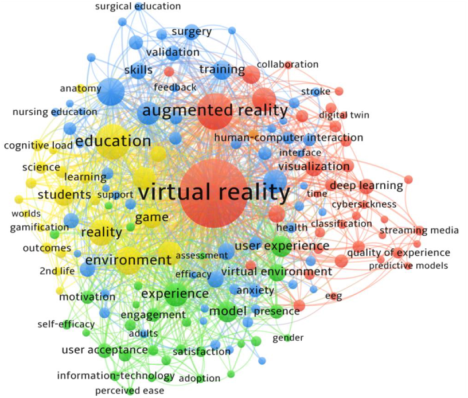
Keyword Analysis Co-occurrence analysis is key in bibliometrics. Literature keywords summarize research. In 1,459 articles, 5,399 keywords were found. After VOSviewer filtering/merging (the frequency is set to 10), 153 keywords formed 4 clusters: 1) Specific applications of virtual reality technology in education, as well as psychological and behavioral factors commonly measured, including attention, cognitive load, and behavior. 2) Key concepts in virtual reality education, such as flow, gaming, and immersive learning.
Virtual Reality for Education From a User Experience Perspective 73
3) Quantifying, Predicting, and Classifying Indicators Using Machine Learning and Meta-Analysis. 4) Key Factors in Assessing User Experience Quality in VR Educational Applications: Reliability, Safety, and Self-Efficacy (Figure 1).
Figure 1: Co-words network of VR-E-UEP.
1) Specific Applications of Virtual Reality Technology in Education Simulations are widely used in healthcare education, as seen in anatomy, architecture, care, and the context of COVID-19. Nursing students gain immersive user experience (UX) via VR headset simulations (Mäkinen et al., 2023). In AEC training, terms like “digital twin” and “construction” signal VR-digital twin integration. Digital twins model cyber-physical systems virtually, and VR enables immersive equipment-behavior viewing. Martínez-Gutiérrez (2023) integrated them for industrial mobile robot operation learning. Tarng et al. (2024) developed a system for controlling a physical robot’s digital twin and observing synced virtual-physical movements.
2) Key Concepts in Virtual Reality Education: Flow, Gaming, and Immersive Learning VR in education has key interrelated concepts (emotion, immersion, immersive learning, immersive VR) that enhance learning compared to traditional methods. These concepts suggest that immersive learning offers better emotional experiences. For instance, Williams et al. (2021) at North Carolina State University developed a VR organic chemistry lab where students experienced more positive emotions and less frustration. Keywords such as “game,” “game-based learning,” “gamification,” and “flow” suggest that VR games based on flow theory can help students achieve a flow state. Akman and Çakır (2019) created an educational VR game (Kefet Kurtul) with flow-theory guidance, providing flow in most tasks.
74 Shi
3) Quantifying, Predicting, and Classifying Indicators Using Machine Learning and Meta-Analysis Machine learning and meta-analysis are used to quantify, predict, and classify factors like intrinsic motivation, learning outcomes, and perceived ease of use. Machine learning algorithms can identify surgical factors for classifying VR surgical participants by expertise (Winkler-Schwartz et al., 2019). Dynamic gesture recognition has been incorporated into classroom teaching (Juan, 2021). In the VR-E-UEP area, meta-analysis merges results from multiple studies for more accurate training and learning outcome conclusions (Coban, Bolat and Goksu, 2022).
4) Key Factors in Assessing User Experience Quality in VR Educational Applications: Reliability, Safety, and Self-Efficacy Hardware and software reliability are essential for assessing user experience quality in VR applications, which often involve complex systems. For instance, an HTC Vive-based VR system with a waist tracker measures positional information through sensor data, with reliability and validity evaluated for postural stability (Liang et al., 2020). Safety is also critical, with studies examining VR acceptability and safety for individuals with persecutory delusions (Fornells-Ambrojo et al., 2008). Self-efficacy is another key factor. For example, the impact of a virtual product dissection environment on students’ design-learning self-efficacy is significant (Toh, Miller, and Simpson, 2015).
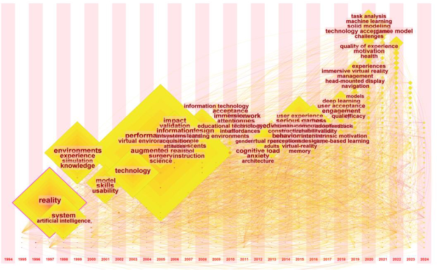
EVOLUTION ANALYSIS OF HOTSPOTS Evolution analysis shows VR-E-UEP research trends. Early on, it mainly centered on educational uses and usability. Mid-term, more focus was on human factors, assessing VR application effectiveness via learners’ psychology and behavior analysis. In recent years, machine and deep learning are popular (Figure 2).
Figure 2: Keyword co-occurrence time zone map for VR-E-UEP.
Early VR-E-UEP research hotspots were on VR’s educational application and implementation. Keywords like “Skill,” “Technology” etc. showed focus on specific-field VR implementation. For example, Chang and Lin
Virtual Reality for Education From a User Experience Perspective 75
(2014) developed a Kinect-based Chinese-cultural-festival learning system. Choi (2010) applied VR to ophthalmic surgery simulation. Mid-term, research factored in more “human” elements, evaluating VR effectiveness via learners’ psychology and behavior. Keywords like “Children,” “Gender” showed user individual differences were considered. Hite et al. (2019) studied the link between cognitive development and presence in VR science teaching for adolescents. Dayarathna et al. (2020) evaluated VR teaching module efficacy by gender. Keywords about cognitive aspects indicated what determined VR user experience quality. Also, “Serious Games”- related keywords showed their educational role, with VR enhancing learning through immersive experiences. Examples include 4D VR games (Salovaara-Hiltunen, Heikkinen, and Koivisto, 2019) and VR serious games in architecture education (Fonseca et al., 2021). In recent years, machine and deep learning are new hotspots. Feature extraction aids personalized learning and better user experience, and automated meta-analysis reveals effectiveness. Predictive models use learners’ behavior, traits, and feedback to predict learning outcomes. For example, an AI-based intelligent recognition method can boost vocal music teaching efficiency (Jing, 2022).
CO-CITATION ANALYSIS The most frequently co-cited research on VR-E-UEP is divided into five categories: 1) Definitions and Technologies of Virtual Reality and Augmented Reality; 2) Advantages and Effectiveness Evaluation of Virtual Reality Technology in Education; 3) Applications of Immersive Virtual Reality in Learning and Training; 4) User Experience Measurement; 5) Statistical Analysis Methods and Theoretical Models to Understand Complex Phenomena and Relationships Among Multiple Factors (Table 1).
Table 1: The top 3 classical literatures of each category related to VR-E-UEP.
Table available in the original PDF paper.
Group Title Year Citations
1 A Survey of Augmented
1997 56
Reality
2013 31
1 Virtual reality technology 2003 33 1 Current status, opportunities and challenges of augmented reality in education
2020 58
2 A review of immersive virtual reality serious games
to enhance learning and training
2010 56
2 What are the learning affordances of 3-D virtual
environments?
2015 46
2 A literature review on immersive virtual reality in
education: state of the art and perspectives
3 Virtual reality: how much
2007 97
immersion is enough?
3 Effects of different types of
2018 52
virtual reality display on presence and learning in a safety training scenario
Continued
76 Shi
Table 1: Continued Group Title Year Citations
Table available in the original PDF paper.
2016 41
3 How immersive is enough? A meta-analysis of the effect of immersive technology on user presence
4 An empirical evaluation of
2008 77
the system usability scale
4 Determining what individual
2009 67
SUS scores mean: Adding an adjective rating scale
4 Using thematic analysis in
2006 56
psychology
5 User acceptance of computer
1989 72
technology: A comparison of two theoretical models
1989 48
5 Perceived usefulness, perceived ease of use, and
user acceptance of information technology
1981 33
5 Evaluating structural equation models with unobservable variables and
measurement error
1) Definitions and Technologies of Virtual Reality and Augmented Reality Cluster 1 articles set a theoretical base and research framework for Augmented Reality (AR) and VR by discussing their definitions and technologies, highlighting their educational potential. “A Survey of Augmented Reality” is a foundational AR review. It systematically sums up AR’s definitions, applications, technical challenges, and future directions (Billinghurst, Clark, and Lee, 2015). “Virtual Reality Technology” comprehensively overviews VR basics, advancements, hardware, software, human factors, and applications, with a Unity 3D lab manual, serving as an important VR reference (Burdea and Coiffet, 2024). Wu et al.’s (2013) work on AR in education finds its potential in boosting student interest and active learning. However, it points out challenges like high costs, low device penetration, and lack of teacher training, suggesting solutions and future research directions.
2) Advantages and Effectiveness Evaluation of Virtual Reality Technology in Education Cluster 2 articles analyze VR’s educational advantages and effectiveness evaluation research progress and limits, guiding future evaluation. Checa and Bustillo (2020) find immersive VR serious games boost learner engagement and motivation, aid in knowledge retention and skill training. They also note a lack of long-term studies and standard evaluation tools. Dalgarno and Lee (2010) show 3D virtual environments offer immersive, interactive, and collaborative learning experiences, enhancing spatial and problem-solving skills. However, technology complexity and cost may limit its spread. Freina and Ott (2015) highlight VR’s potential in education, but also point out high costs, low device penetration, and lack of teacher training. Future research should address these issues.
3) Applications of Immersive Virtual Reality in Learning and Training Immersive Virtual Reality (I-VR) is an advanced virtual reality technology. Using high-fidelity graphics and immersive content via devices like HMDs,
Virtual Reality for Education From a User Experience Perspective 77
it simulates near-real-world experiences, fully immersing users in a virtual environment (Hamilton et al., 2021; Antonopoulos, Fokides and Koutromanos, 2024). Cluster 3 articles cover I-VR applications in learning and training. Bowman and McMahan (2007) question if full immersion is always needed in VR. Empirical evidence shows different immersion components impact presence and outcomes differently. Buttussi and Chittaro (2017) compare desktop, narrow, and wide field-of-view VR in aviation safety training. Display type affects engagement and presence, but training benefits are consistent. Cummings and Bailenson (2016) meta-analyze immersive tech’s impact on user presence, finding a medium-sized effect.
4) User Experience Measurement Cluster 4 presents tools and methods for measuring user experience, laying a theoretical groundwork for such measurements in VR-E-UEP research. Bangor, Kortum and Miller (2008) analyzed a decade’s worth of data on the System Usability Scale (SUS). They found SUS to be reliable and versatile for product usability evaluation and proposed a modification to link SUS scores with adjective ratings for better interpretation. In 2009, the same authors added a seven-point adjective-anchored Likert scale to the SUS questionnaire. The adjective ratings correlated highly with SUS scores (r = 0.822), helping non-human-factors pros understand results (Bangor, Kortum, and Miller, 2009). Braun and Clarke (2006) introduced thematic analysis as a flexible and easy-to-use qualitative analysis method. They detailed how to conduct it, discussed its advantages and disadvantages, and emphasized its importance across various fields.
5) Statistical Analysis Methods and Theoretical Models Cluster 5 covers common statistical methods and theoretical models in the VR-E-UEP field, useful for understanding complex factor relationships. Davis et al. (1989) compared the Technology Acceptance Model (TAM) and Theory of Planned Behavior (TPB) for predicting computer tech user acceptance. They found perceived usefulness and ease of use as key, laying the groundwork for TAM, which became vital for predicting user behavior. In the same year, FD Davis developed and validated scales for perceived usefulness and ease of use. He found they’re fundamental to user acceptance, with usefulness having a greater impact on usage, further solidifying TAM’s foundation and providing research tools (Davis, 1989a). Fornell and Larcker (1981) explored SEM statistical testing for unobservable variables and measurement error. They proposed a shared-variance-based test system, supporting SEM’s application in causal research.
CONCLUSION AND DISCUSSION VR-E-UEP research hotspots cluster into four: 1) specific VR educational applications, 2) VR’s educational advantages and key concepts, 3) data analysis techniques, 4) factors affecting user experience. Evolution analysis reveals early focus on VR technology and applications, mid-term on human factors, and recent on machine learning. Frequently co-cited research falls into five categories: 1) VR and AR definitions and technologies, 2) VR’s educational advantages and effectiveness evaluation, 3) immersive
78 Shi
VR applications in learning and training, 4) user experience measurement, 5) statistical methods and theoretical models. Based on this study, three questions merit further attention:
1) Multidisciplinary Integration: VR-E-UEP research mainly draws on computer science, design, and cognitive psychology. But classroom models, teaching methods, etc., impact application effectiveness. Thus, interdisciplinary theories, especially from educational theory, are needed. 2) User Experience Optimization: Positive experience enhancement, mostly on visual and auditory senses currently, could benefit from multisensory research. Also, negative factors like device stability and motion sickness need resolution (Liu et al., 2017). 3) Machine Learning: Despite much research, its recent explosive growth means it has great potential for further VR-E-UEP study.
REFERENCES
Akman, E. and Çakır, R. (2019). Pupils’ Opinions on an Educational Virtual Reality Game in Terms of Flow Experience. International Journal of Emerging Technologies in Learning, Volume 14, No. 15. Antonopoulos, P., Fokides, E. and Koutromanos, G. (2024). Understanding Learning
and Learning Experience in Immersive Virtual Reality. Technology, Knowledge and Learning, pp. 1–30. Bangor, A., Kortum, P. T. and Miller, J. T. (2008). An empirical evaluation of the system usability scale. Intl. Journal of Human–Computer Interaction, Volume 24, No. 6, pp. 574–594. Bangor, A., Kortum, P. T. and Miller, J. T. (2009). Determining what individual
SUS scores mean: Adding an adjective rating scale. Journal of Usability Studies, Volume 4, No. 3, pp. 114–123. Billinghurst, M., Clark, A. and Lee, G. (2015). A survey of augmented reality.
Foundations and Trends® in Human–Computer Interaction, Volume 8, No. 2–3, pp. 73–272. Bowman, D. A. and McMahan, R. P. (2007). Virtual reality: how much immersion is enough?. Computer, Volume 40, No. 7, pp. 36–43. Braun, V. and Clarke, V. (2006). Using thematic analysis in psychology. Qualitative
Research in Psychology, Volume 3, No. 2, pp. 77–101. Burdea, G. C. and Coiffet, P. (2024). Virtual reality technology. John Wiley & Sons. Buttussi, F. and Chittaro, L. (2017). Effects of different types of virtual reality display on presence and learning in a safety training scenario. IEEE Transactions on Visualization and Computer Graphics, Volume 24, No. 2, pp. 1063–1076. Chang, Y. H. and Lin, Y. K. (2014). “A kinect-based system for learning Chinese
cultural festivals”, in: 2014 International Conference on Machine Learning and Cybernetics, IEEE, Volume 2, pp. 462–468. Checa, D. and Bustillo, A. (2020). A review of immersive virtual reality serious games to enhance learning and training. Multimedia Tools and Applications, Volume 79, No. 9, pp. 5501–5527. Chen, C. (2006). CiteSpace II: Detecting and visualizing emerging trends and
transient patterns in scientific literature. Journal of the American Society for Information Science and Technology, Volume 57, No. 3, pp. 359-377.
Virtual Reality for Education From a User Experience Perspective 79
Choi, K. S. (2010). “Application of virtual reality in cataract surgery simulation for ophthalmology training”, in: Cataracts: Causes, Symptoms, and Surgery, Nova Science Publishers, Inc., pp. 37–76. Coban, M., Bolat, Y. I. and Goksu, I. (2022). The potential of immersive virtual
reality to enhance learning: A meta-analysis. Educational Research Review, Volume 36, p. 100452. Cummings, J. J. and Bailenson, J. N. (2016). How immersive is enough? A metaanalysis of the effect of immersive technology on user presence. Media Psychology, Volume 19, No. 2, pp. 272–309. Dalgarno, B. and Lee, M. J. (2010). What are the learning affordances of 3-D virtual
environments?. British Journal of Educational Technology, Volume 41, No. 1, pp. 10–32. Davis, F. D. (1989). Perceived usefulness, perceived ease of use, and user acceptance of information technology. MIS quarterly, pp. 319–340. Davis, F. D. (1989). User acceptance of computer technology: A comparison of two
theoretical models. Management Science, p. 984. Dayarathna, V., Karam, S., Jaradat, R., Hamilton, M. A. and Driouche, B. (2020).
Assessment of the efficacy and effectiveness of virtual reality teaching module: A gender-based comparison*. International Journal of Engineering Education, Volume 36, No. 6, p. 1938. Fonseca, D., Cavalcanti, J., Peña, E., Valls, V., Sanchez-Sepúlveda, M., Moreira, F., Navarro, I. and Redondo, E. (2021). Mixed assessment of virtual serious games applied in architectural and urban design education. Sensors, Volume 21, No. 9, p. 3102. Fornell, C. and Larcker, D. F. (1981). Evaluating structural equation models with
unobservable variables and measurement error. Journal of Marketing Research, Volume 18, No. 1, pp. 39–50. Fornells-Ambrojo, M., Barker, C., Swapp, D., Slater, M., Antley, A. and Freeman, D. (2008). Virtual reality and persecutory delusions: Safety and feasibility. Schizophrenia Research, Volume 104, No. 1–3, pp. 228–236. Freina, L. and Ott, M. (2015). A literature review on immersive virtual reality in education: State of the art and perspectives. In The international scientific conference elearning and software for education, Volume 1, No. 133, pp. 10–1007. Hamilton, D., McKechnie, J., Edgerton, E. and Wilson, C. (2021). Immersive
virtual reality as a pedagogical tool in education: a systematic literature review of quantitative learning outcomes and experimental design. Journal of Computers in Education, Volume 8, No. 1, pp. 1–32. Hite, R. L., Jones, M. G., Childers, G. M., Ennes, M., Chesnutt, K., Pereyra, M.
and Cayton, E. (2019). Investigating potential relationships between adolescents’ cognitive development and perceptions of presence in 3-D, haptic-enabled, virtual reality science instruction. Journal of Science Education and Technology, Volume 28, pp. 265–284. Jing, L. (2022). Application of Artificial Intelligence Algorithm and VR Technology in Vocal Music Teaching. Mobile Information Systems, No. 1, p. 2320198. Juan, W. (2021). Gesture recognition and information recommendation based on
machine learning and virtual reality in distance education. Journal of Intelligent & Fuzzy Systems, Volume 40, No. 4, pp. 7509–7519. Kavanagh, S., Luxton-Reilly, A., Wuensche, B. and Plimmer, B. (2017). A systematic review of virtual reality in education. Themes in Science and Technology Education, Volume 10, No. 2, pp. 85–119.
80 Shi
Liang, H. W., Chi, S. Y., Chen, B. Y. and Hwang, Y. H. (2020). Reliability and validity of a virtual reality-based system for evaluating postural stability. IEEE Transactions on Neural Systems and Rehabilitation Engineering, Volume 29, pp. 85–91. Liu, D., Bhagat, K. K., Gao, Y., Chang, T. W. and Huang, R. (2017). The potentials
and trends of virtual reality in education: A bibliometric analysis on top research studies in the last two decades. Virtual, augmented, and mixed realities in education, pp. 105–130. Mäkinen, H., Haavisto, E., Havola, S. and Koivisto, J. M. (2023). Graduating nursing students’ user experiences of the immersive virtual reality simulation in learning–A qualitative descriptive study. Nursing Open, Volume 10, No. 5, pp. 3210–3219. Marougkas, A., Troussas, C., Krouska, A. and Sgouropoulou, C. (2024). How
personalized and effective is immersive virtual reality in education? A systematic literature review for the last decade. Multimedia Tools and Applications, Volume 83, No. 6, pp. 18185–18233. Martínez-Gutiérrez, A., Díez-González, J., Verde, P. and Perez, H. (2023). Convergence of virtual reality and digital twin technologies to enhance digital operators’ training in industry 4.0. International Journal of Human-Computer Studies, Volume 180, p. 103136. Pellas, N., Mystakidis, S. and Kazanidis, I. (2021). Immersive Virtual Reality in K-12 and Higher Education: A systematic review of the last decade scientific literature. Virtual Reality, Volume 25, No. 3, pp. 835–861. Pritchard, A. (1969). Statistical bibliography or bibliometrics. Journal of Documentation, Volume 25, p. 348. Radianti, J., Majchrzak, T. A., Fromm, J. and Wohlgenannt, I. (2020). A
systematic review of immersive virtual reality applications for higher education: Design elements, lessons learned, and research agenda. Computers & Education, Volume 147, p. 103778. Salovaara-Hiltunen, M., Heikkinen, K. and Koivisto, J. M. (2019). User experience and learning experience in a 4D virtual reality simulation game. International Journal of Serious Games, Volume 6, No. 4, pp. 49–66. Tarng, W., Wu, Y. J., Ye, L. Y., Tang, C. W., Lu, Y. C., Wang, T. L. and Li, C. L. (2024).
Application of Virtual Reality in Developing the Digital Twin for an Integrated Robot Learning System. Electronics, Volume 13, No. 14, p. 2848. Toh, C., Miller, S. and Simpson, T. (2015). The impact of virtual product dissection environments on student design learning and self-efficacy. Journal of Engineering Design, Volume 26, No. 1–3, pp. 48–73. Van Eck, N. and Waltman, L. (2010). Software survey: VOSviewer, a computer
program for bibliometric mapping. Scientometrics, Volume 84, No. 2, pp. 523–538. Williams, N. D., Gallardo-Williams, M. T., Griffith, E. H. and Bretz, S. L. (2021).
Investigating meaningful learning in virtual reality organic chemistry laboratories. Journal of Chemical Education, Volume 99, No. 2, pp. 1100–1105. Winkler-Schwartz, A., Yilmaz, R., Mirchi, N., Bissonnette, V., Ledwos, N., Siyar, S., Azarnoush, H., Karlik, B. and Del Maestro, R. (2019). Machine learning identification of surgical and operative factors associated with surgical expertise in virtual reality simulation. JAMA Network Open, Volume 2, No. 8, p. e198363. Wu, H. K., Lee, S. W. Y., Chang, H. Y. and Liang, J. C. (2013). Current status,
opportunities and challenges of augmented reality in education. Computers & Education, Volume 62, pp. 41–49.
LISTED IN THE AHFE DIGITAL BOOKSTORE CATALOGUE
Explore the complete digital volume
Accessibility, Assistive Technology and Digital Environments
Read this individual research paper free through the original publisher, or explore the full digital proceedings book.
ISBN 978-1-964867-38-0
Explore this ISBN in the AHFE Bookstore ↗Listed in the July 2026 bookstore catalogue; search by ISBN to confirm current availability · Digital book purchase optional