Jin-i Hong, Yun-hwan Lee, Yeong-hun Kwon, Jongsung Kim, Minsung Yoon, Jongbae Kim (2025). Generational Physical Ability Differences in Developing a Universal XR Metaverse Platform for Inclusive Digital Leisure Culture: Focused on Bowling. In: Accessibility, Assistive Technology and Digital Environments. AHFE Open Access, vol. 162, pp. 106–116. https://doi.org/10.54941/ahfe1006018
This study analyzed intergenerational differences in physical ability focusing on bowling content within the development process of a universal XR metaverse platform for inclusive digital leisure culture. Using XR devices, motion data was acquired during bowling swings from a total of 80 participants, including Teenagers (TA), Youth (YU), Middle-Age (MA), and Old-Age (OA). The analysis focused on the velocity of the right-hand controller and chest tracker during the Forward Swing and Release phases, which influence bowling swing velocity and stability. The results revealed significant intergenerational differences in velocity for both the right-hand controller and chest tracker during the Forward Swing phase. Similarly, in the Release phase, the right-hand controller and chest tracker also exhibited significant differences across generations. These results confirm intergenerational differences in physical ability during the Forward Swing and Release phases of the bowling swing motion. Furthermore, they highlight the necessity of an XR metaverse platform that accounts for these differences. This study provides foundational data for adjusting human factors related to intergenerational physical ability in XR environments.
Leisure refers to activities during non-obligatory time that enhance happiness and quality of life (Shin & Hong, 2022). Leisure has become increasingly significant in modern society, where work-life balance is regarded as a key value (Lee and Kim, 2024). In response to this societal trend, the Korean government, based on the Framework Act on the Promotion of Leisure of Citizens, establishes a leisure activation plan every five years to create a foundation for free leisure activities and enhance quality of life through leisure. This initiative aims to ensure that all citizens can freely enjoy leisure
Generational Physical Ability Differences in Developing a Universal XR Metaverse Platform 107
activities while contributing to the development of a healthy society through leisure.
According to the 2023 National Leisure Activity Survey, which examined the state of leisure activities in South Korea, 40.9% of Korean citizens consistently participate in leisure activities, with sports activities accounting for the highest proportion (Ministry of Culture, Sports and Tourism, 2024). Leisure sports activities are effective in enhancing physical abilities, providing positive experiences such as stress relief and mood improvement, and contributing to the alleviation of negative emotions such as depression, anxiety, and stress (Lee and Kim, 2024). Today, leisure sports activities are preferred over other leisure activities and are recognized as a valuable and significant form of leisure (Yeo et al., 2008).
Bowling is a sport-for-all activity that people of all ages and genders can enjoy together. Recently, bowling in South Korea has been evolving into a new form by integrating entertainment elements, and as media exposure increases, public interest has been expanding even further (Jang, 2024). Additionally, bowling club activities are actively promoted in South Korea, and the number of bowling club members has been increasing annually (Ministry of Culture, Sports and Tourism, 2025). With these trends, bowling has become one of the representative leisure activities in South Korea, offering benefits such as health improvement and enhanced quality of life (Heo, 2021; Kim and Yoon, 2023).
The metaverse is defined as a world or platform where virtual and real spaces are integrated, allowing people and objects to interact while generating economic, social, and cultural value (Ministry of Science and ICT, 2022). The advancement of the metaverse is expanding activities that were previously conducted in existing physical spaces into the metaverse environment, blurring the boundary between reality and virtuality. This metaverse is being applied across various industries, including education, manufacturing, and finance (Nam, 2021). The key technology in implementing the metaverse, XR (Extended Reality), encompasses VR, AR, and MR (Bang, 2022). Through XR technology, users can experience immersion and interaction in an environment where the virtual and real worlds are integrated (Nam, 2021).
The metaverse is being applied across various fields; however, its primary users are teenagers and young adults in their 20s, making it predominantly a younger generation’s platform. As a result, content that can be enjoyed by a wider range of generations remains limited (Lee et al., 2023). These limitations act as barriers to the development of a metaverse that embraces and facilitates communication across generations. In particular, older generations may face difficulties in utilizing metaverse technologies and services due to physical and cognitive decline (Jang et al., 2022; An et al., 2008). Therefore, there is a growing need for content that addresses intergenerational differences and the digital divide.
This study aims to acquire and analyze motion data focusing on bowling content to identify intergenerational differences in physical ability. Through this study, we aim to provide foundational data that can be used to adjust intergenerational differences in physical ability when developing a universal XR metaverse platform, enabling people of all generations to engage in leisure culture.
METHOD
PARTICIPATIONS This study was conducted with 80 community-dwelling participants (see Table 1). Participants were operationally categorized into generations based on age as follows: 12–19 years as Teenager (TA), 20–39 years as Youth (YU), 40–59 years as Middle-Age (MA), and 60–69 years as Old-Age (OA). A total of 20 participants were recruited for each generation, resulting in 80 participants in total. Individuals with musculoskeletal disorders, vestibular impairments that hinder the use of XR devices, communication limitations or cognitive impairments, and professional bowling players were excluded from the study.
Table 1: Characteristics of participants.
Table available in the original PDF paper.
Participants TA YU MA OA Age (Mean±SD) 14.00 ±2.30 28.20 ±3.83 49.35±5.82 64.15 ±1.96 Gender Male (N) 11 10 8 9 Female (N) 9 10 12 11
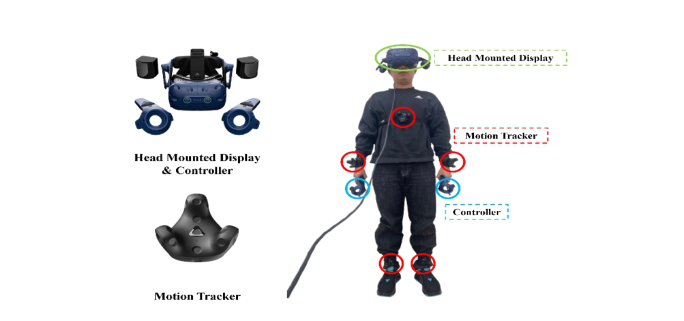
XR DEVICE This study acquired motion data using XR devices. The XR devices used in this study include a Head-Mounted Display (HMD, Vive Pro Eye), Controllers (Vive Pro Eye), and Motion Trackers (Vive Tracker 3.0) (see Figure 1). The HMD (Vive Pro Eye) provides a 1440×1600 pixel integrated resolution, with a maximum Field of View (FOV) of 110 degrees and a refresh rate of at least 90 fps. The controller contains sensors that are tracked by the base station, enabling interaction with virtual objects in the VR environment. The Motion Tracker (Vive Tracker 3.0) provides a maximum Field of View (FOV) of 240 degrees. Each XR device was worn on specific body parts to collect motion data. The HMD was worn on the head, motion trackers were attached to the chest, both wrists, and both ankles, and the controllers were held in both hands.
Figure 1: XR devices & attachment locations and appearance of XR devices.
Generational Physical Ability Differences in Developing a Universal XR Metaverse Platform 109
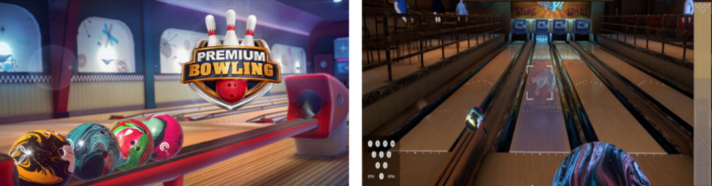
XR CONTENTS This study collected data focusing on bowling, one of the most popular leisure sports in South Korea, using Premium Bowling within the Steam VR platform (see Figure 2).
Figure 2: Premium bowling content on the Steam VR platform.
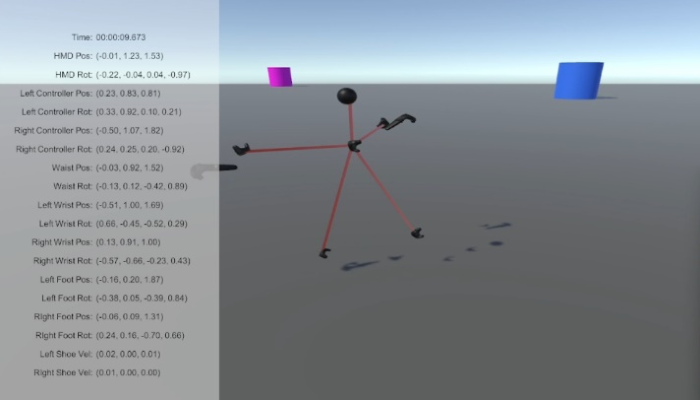
MOTION DATA ACQUISITION SOFTWARE This study integrated XR devices using the Steam VR Plugin and Open XR Plugin in a Unity environment to acquire motion data. Position data was acquired through the sensors of each device, and the collected data was stored in a CSV file. The motion data acquisition tool featured a UI display for real- time monitoring of motion data. To resolve the challenge of distinguishing overlapping trackers, a motion skeleton was created by linking the HMD, wrist, and ankle trackers using a Line Renderer. To implement the motion skeleton, objects were assigned to all XR devices (see Figure 3).
Figure 3: Motion data acquisition software UI.
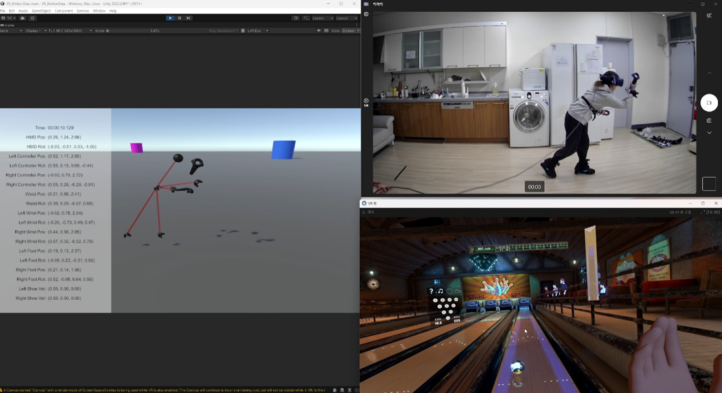
ACQUISITION OF MOTION DATA AND PHYSICAL MOVEMENT FEATURE DATA To acquire motion data and body movement characteristic data, the researcher explained the bowling steps and swing method based on the 4-step approach to the participants and provided sufficient practice time. Participants performed the step and swing motions three times according to the researcher’s instructions. If improper execution or sensing errors occurred, they were instructed to perform additional trials. The researcher simultaneously monitored the motion data acquisition software, the participant’s actual performance, and the Steam VR screen to verify the participant’s movements. The monitoring screens were recorded using OBS Studio (see Figure 4).
Figure 4: Motion data acquisition software, performance screen, and monitoring screen through the Steam VR view.
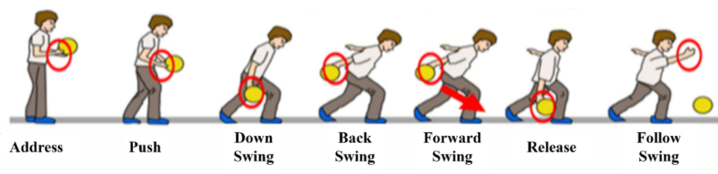
LABELING The key phases of bowling are categorized into seven stages: Address (AR), Push (PS), Down Swing (DS), Back Swing Top (BT), Forward Swing (FS), Release (RL), and Follow Swing (FS) (see Figure 5). This study labeled the acquired motion data according to the key phases of bowling to analyze intergenerational differences in physical ability across these phases. Labeling was performed using Adobe Premiere Pro, where the skeleton and swing motions in the recorded videos for each participant were examined frame by frame. The key phases of bowling were then assigned to the first column of the acquired CSV file.
Generational Physical Ability Differences in Developing a Universal XR Metaverse Platform 111
Figure 5: Key phases of bowling.
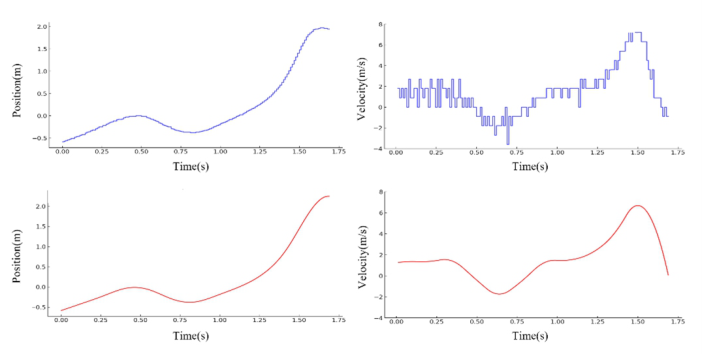
DATA PREPROCESSING AND ANALYTICAL DATA CONSTRUCTION The preprocessing of the acquired data was performed using Python, following the steps of data alignment, handling of missing values, and outlier correction in sequence. Data alignment involved correcting instances where the left and right controllers were swapped during the data acquisition process. Missing values and outliers were addressed by applying third-order spline interpolation to the position data (see Figure 6).
Figure 6: Imputation of missing and outlier data using cubic spline interpolation.
The preprocessed position data was differentiated in the X, Y, and Z components to derive velocity for analysis. Subsequently, the 3D magnitude calculation method (see Figure 7) was applied to compute the magnitude of velocity. Finally, the minimum, median, and maximum velocity values of XR devices were extracted for key segments.
Figure 7: Equations used for calculating kinematic magnitudes.
Figure available in the original PDF paper.
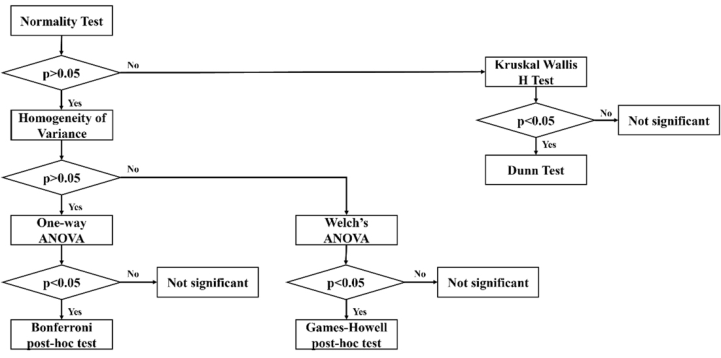
ANALYSIS This study focused on analyzing the body parts and key phases that influence the velocity and stability of the bowling swing. The analysis phases were the Forward Swing and Release phases, while the XR devices used for body parts analysis included the controller velocity of the dominant hand and the tracker velocity at the chest. The analysis was conducted using Python, and the statistical analysis procedures for examining intergenerational differences in physical ability are as follows (see Figure 8). First, the Kolmogorov- Smirnov normality test, Shapiro-Wilk normality test, and Levene’s test for homogeneity of variances were conducted to assess the normality and homogeneity of variance. Based on the results, appropriate parametric or non-parametric statistical methods were applied.
Figure 8: Statistical analysis algorithm for intergenerational difference testing.
RESULT
This study examined intergenerational differences in physical ability during the Forward Swing and Release phases of bowling. A normality test was conducted according to statistical analysis procedures; however, the velocity of the XR devices in the analyzed phases did not satisfy normality assumptions. Consequently, the non-parametric Kruskal-Wallis H test and Dunn test were performed, and the analysis results are as follows.
VELOCITY OF THE RIGHT CONTROLLER BY PHASE The velocity of the right-hand controller exhibited significant intergenerational differences in both the Forward Swing phase (H = 18.231, p<0.001) and the Release phase (H = 15.541, p<0.01) (see Table 2). In the Forward Swing phase, TA (median = 6.013), YU (median = 6.241), and MA (median = 6.079) exhibited higher velocities compared to OA (median = 5.283). In the Release phase, YU (median = 6.380) and MA
Generational Physical Ability Differences in Developing a Universal XR Metaverse Platform 113
(median = 6.265) showed higher velocities than OA (median = 5.429). In both the Forward Swing and Release phases, OA exhibited lower velocity compared to TA, YU, and MA. This may be attributed to the decline in functional abilities such as muscle strength, endurance, agility, and flexibility with increasing age (Donat et al., 2009; Joung & Han, 2021), resulting in slower controller velocity in the OA group. On the other hand, YU is at the peak of physical development, possessing optimal physical function, which likely resulted in the higher velocity observed (Allen, & Hopkins, 2015; Lee & Lee, 2018). MA is an age group where aging begins, but physical functions such as muscle strength and muscular endurance decline significantly after the 60s (Lim & Lee, 2001; Kim, 2012). Therefore, the findings of this study suggest that the velocity of MA was higher than that of OA. This result aligns with the study by DeVan and Tanaka (2007), indicating that age-related physiological changes influence athletic performance in sports activities (DeVan & Tanaka, 2007).
Table 2: Intergenerational velocity differences of the right controller.
Table available in the original PDF paper.
Phase Group Median H p-value Post-hoc Forward swing TA 6.013 18.231 0.000*** TA, YU, MA>OA YU 6.241 MA 6.079 OA 5.283 Release TA 5.646 15.541 0.001** YU, MA>OA YU 6.380 MA 6.265 OA 5.429
VELOCITY OF THE CHEST TRACKER BY PHASE The velocity of the chest tracker exhibited significant intergenerational differences in both the Forward Swing phase (H = 25.573, p<0.001) and the Release phase (H = 79.742, p<0.001) (see Table 3). In the Forward Swing phase, MA (median = 1.530) exhibited higher velocity compared to TA (median = 1.227) and OA (median = 1.366). In the Release phase, MA (median = 1.001) and OA (median = 0.876) showed higher velocity than TA (median = 0.534) and YU (median = 0.570). The tracker attached to the chest is positioned at the body’s center, and in bowling, the movement of the body’s center is a key factor in controlling the direction of the ball (Park & Baik, 2003). The results of this study showed that MA exhibited higher chest tracker velocity compared to other generations in both the Forward Swing and Release phases. In this study, MA, which includes individuals in their 40s and 50s, corresponds to an age group where postural stability and balance functions begin to decline (Kong, 2007; Oak et al., 2012). The higher chest tracker velocity observed in MA is likely a result of this decline in balance and stability functions. In the Release phase, the higher velocity in MA and
OA is likely due to declining balance and postural stability, leading to greater velocity than TA and YU.
Table 3: Intergenerational velocity differences of the chest tracker.
Table available in the original PDF paper.
Phase Group Median H p-value Post-hoc Forward swing TA 1.227 25.573 0.000*** MA>TA, OA YU 1.317 MA 1.530 OA 1.366 Release TA 0.534 79.742 0.000*** MA, OA>TA, YU YU 0.570 MA 1.001 OA 0.876
This study acquired and analyzed motion data from 80 community- dwelling participants to examine intergenerational differences in physical ability during bowling swing motions in bowling content. The analysis results showed significant intergenerational differences in the velocity of the dominant-hand controller and chest tracker during the Forward Swing and Release phases of bowling. The velocity of the right-hand controller was higher in YU compared to other generations across both the Forward Swing and Release phases, while OA exhibited the lowest velocity among the generations. These results indicate that differences in physical ability among generations affect bowling performance. Furthermore, they suggest that intergenerational differences in physical ability should be considered in the development of a universal XR metaverse platform in the future. The findings of this study can serve as foundational data for adjusting physical ability differences.
ACKNOWLEDGMENT
This research was supported by Culture, Sports and Tourism R&D Program through the Korea Creative Content Agency grant funded by the Ministry of Culture, Sports and Tourism in 2023 (Project Name: Development of universal XR platform technology to build a metaverse supporting digital cultural inclusion, Project Number: RS-2023-00270006, Contribution Rate: 100%).
REFERENCES
Allen, S. V. Hopkins, W. G. (2015). Age of peak competitive performance of elite athletes: A systematic review. Sports medicine, 45, 1431–1441. An, S. T. Lee, H. N and Lee, Y. J. (2024). The Effects of Online Network and Digital
Literacy on Depression in Older Adults: A Review of Functional Characteristics
Generational Physical Ability Differences in Developing a Universal XR Metaverse Platform 115
of Apps for Older Adults with Low Digital Literacy. Journal of Broadcasting and Telecommunications Research, 74–103. Bang, J. S. (2022). Utilization of Artificial Intelligence Technology for Expanding Metaverse Services. The Journal of The Korean Institute of Communication Sciences, 39(2), 64–73. Baxter-Jones, A. D. Eisenmann, J. C. and Sherar, L. B. (2005). Controlling for
maturation in pediatric exercise science. Pediatric Exercise Science, 17(1), 18–30. DeVan, A. E. Tanaka, H. (2007). Declines in ten-pin bowling performance with advancing age. Age and ageing, 36(6), 693–694. Donat Tuna, H. Ozcan Edeer, A. Malkoc, M. and Aksakoglu, G. (2009). Effect of age
and physical activity level on functional fitness in older adults. European review of aging and physical activity, 6, 99–106. Heo, M. S. (2021). The Effects of Degree of Participation of Amateur Bowling Members on Exercise Commitment and Life Satisfaction, Unpublished master’s thesis. Sogang University, Graduate School of Education. Jang. A. S. Lee. S. I. Kang. D. H. Kim, N. O. Jung, J. Y. Yeom, J. H. Kim. M. J and Yeo,
J. M. (2022). Survey on the human rights situation of the elderly due to the digital divide. [NHRC] National Human Rights Commission of Korea Publication. Jang. H. J. (2024). The Relationship among Fun Factors, for Bowling Participants, Sport Immersion, and Life Satisfaction. The Korea Journal of Sport, 22(4), 41–50. Joung, H. J. Han, B. S. (2021). A Meta-Analysis of Effectiveness on Korean Dance
Program to Improve Physical Fitness in the Elderly. Official Journal of the Koeran Society of Dance Science, 38(3), 49–62. Kim, H. K. Yoon, S. Y. (2023). The moderating effects of exercise satisfaction in the relationship between bowling participants’ fun factor and exercise continuity. Journal of Sport and Leisure Studies, 92, 257–266. Kim, H. S. (2012). Age- and Gender-related Differences of Muscle Mass in Korean.
Journal of Obesity & Metabolic Syndrome, 21(4), 220–227. Kim, S. D. (2016). Kinetic Analysis of the Factors Affecting the Knee Injuryin the Bowling Throwing Motion. The Korean Journal of Sport, 14(3), 175–185. Kong, S. A. (2007). A study of balance ability changes on aging. Journal of Coaching
Development, 9(4), 291–299. Lee, S. Y. Kim, Y. S. (2024). A study on middle-aged men’s leisure sports experience, aging anxiety, and existence. Journal of Sport and Leisure Studies, 96, 357–368. Lee, Y. H. Kim, J. S. Kwon, Y. H. Lee, H. J. Ko, Y. H. Kim, Y. B. Park, S. Y. Son, D.
H and Kim, J. B. (2023). Physical human factor for the development of universal XR platform to build a metaverse supporting digital inclusive leisure & culture. AHFE Open Access, 118. AHFE International, USA. Lee, J. H. Lee, H. (2018). Correlation between Physical characteristics, Balance Ability and Muscle Tone on Men and Women. Journal of Sport and Leisure Studies, 74, 599–607. Lim, J. H. Lee, J. O (2001). The Relationship between Body Composition Change and
Muscle Strength and Endurance Depending on Aging at the Senescence. Journal of the Korea Gerontological Society, 21(2), 15–24. Ministry of Culture, Sports and Tourism. (2024). 2023 National Leisure Activity Survey. https://www.mcst.go.kr/kor/s_policy/dept/deptView.jsp?pDataCD= 0417000000&pSeq=1863 Ministry of Culture, Sports and Tourism. (2025). 2024 National Sports Survey.
Ministry of Science and ICT. (2022). Metaverse New Industry Leading Strategy.
https://www.msit.go.kr/bbs/view.do?sCode=user&mId=113&mPid=112& bbsSeqNo=94&nttSeqNo=3181303 Nam, H. S. (2022). Current Status and Trends of the Metaverse. TTA Journal, 209, 22–29. Nam, Y. J. (2021). The Types and Values of Fashion Based on Virtual Reality
Technology in the Age of Digital Transformation. Journal of Basic Design & Art, 22(5), 117–128. Oak, J. S. Park, W. Y. An, K. O. Song, S. H. No, M. H. Hong, J. Y. and Shin, H. S.
(2012). The Effect of Age and Weight on Equilibrium Function Changes in Women. Health & Sports Medicine, 14(2), 61–71. Park, C. H. Baik, S. K. (2003). A Study of Deviation of C. O. G Movement and Orbit for Ball in Bowling Swing Motion. Journal of Sport and Leisure Studies, 19(2), 1261–1272. Shin, J. H. Hong, S. Y. (2022). A study on the types of leisure activities of the
people with disabilities and the characteristics of each type: Focusing on leisure restrictions. Korea Social Policy Review, 29(2), 225–253. Yeo, Y. G. Kim, Y. K and Kim, J. S. (2008). The Relationships among Sports Flow, Exercise Emotion and Leisure Satisfaction in Amateur Squash Player. Journal of Sport and Leisure Studies, 34(2), 1447–1457.
LISTED IN THE AHFE DIGITAL BOOKSTORE CATALOGUE
Explore the complete digital volume
Accessibility, Assistive Technology and Digital Environments
Read this individual research paper free through the original publisher, or explore the full digital proceedings book.
ISBN 978-1-964867-38-0
Explore this ISBN in the AHFE Bookstore ↗Listed in the July 2026 bookstore catalogue; search by ISBN to confirm current availability · Digital book purchase optional