Yeong-hun Kwon, Yun-hwan Lee, Minsung Yoon, Soyeong Park, Son Daehoon, Kim Yebon, Hyojun Lee, Yohan Ko, Jongsung Kim, Jongbae Kim (2024). Physical Human Factor Parameters through VR Leisure Contents: Focused on Motion Feature Extraction for Adults from VR Bowling. In: Human Factors in Virtual Environments and Game Design. AHFE Open Access, vol. 137, pp. 107–115. https://doi.org/10.54941/ahfe1004992
This study explores the impact of Virtual Reality (VR) on leisure sports, focusing on the analysis of motion data in VR bowling among adults aged 19-38. Acknowledging the gap in research regarding physical movement characteristics in VR sports, this work aims to contribute to the ergonomic development of VR leisure content for diverse generations. Using the Vive Pro Eye HMD, Vive Tracker 3.0, and the C2 Plus omnidirectional VR treadmill, we captured detailed three-dimensional position and velocity data. The Unity software facilitated motion data collection, while Python was employed for the analysis, particularly concentrating on the velocity features of the dominant hand controller. The analysis revealed that the Z component of velocity reached its highest mean linear speed at 6.474 during the release phase, aligning with the dynamics of traditional bowling yet underscoring VR's distinctive experience. Conclusively, the findings highlight VR's potential to enrich leisure sports, urging broader research across various VR sports contents and demographics. This pursuit is vital for understanding biomechanical and physical human factors in VR, paving the way for technologies that mitigate generational physical differences and foster the development of accessible, enjoyable VR leisure content for all ages.
comprising a wide range of activities, offer broad choices tailored to indi- vidual preferences and abilities. Bowling, one of the leisure sports gaining attention, is accessible to all ages (Jang and Lee, 2019) and known for its physical, and psychological health benefits (Kim, 2011).
Recently, the advancement of technology has introduced virtual reality (VR) leisure sports as a new form of leisure activity. VR leisure sports, com- pared to traditional leisure sports, are not constrained by time and space and can simulate various environments and conditions. Recent studies have shown that participation in VR leisure sports provides similar physical and psychological benefits to actual activities, highlighting the potential of VR technology-based leisure activities as a new form of leisure and underscoring the need for further research in this area (Bum et al., 2018).
The Ministry of Culture, Sports, and Tourism of Korea shows high inter- est in VR-based sports, actively supporting this area. This support aims to facilitate the development of VR sports facilities, allowing more people to experience new forms of leisure activities (Eun, 2018).
However, despite the active research on VR leisure sports, there is a relative scarcity of studies focusing on acquiring motion data and analyzing physical movements and characteristics. In particular, research exploring the speed of body movements in VR leisure sports is almost nonexistent. This gap suggests the need for research to deepen our understanding of VR leisure sports and develop virtual reality content that can offer better user experiences.
Human factors in virtual reality content can be defined in various ways, encompassing not only the interaction between VR devices and humans but also between content and humans (Chen et al., 2023). Human factors related to VR content and human interaction can be classified based on the character- istics of the VR content and human traits (Yang et al., 2019). Human factors classified by human traits may arise from human growth, development, and aging processes (Kim et al., 2016), necessitating ergonomically designed con- siderations. As humans mature and age, they exhibit differences in physical abilities, which can affect the utilization of new technologies like virtual real- ity content. Therefore, considering these physical ability differences among various generations using virtual reality content is crucial.
This study presents the need for acquiring and extracting characteristics of physical movements and motion data during VR leisure sports performance, focusing on individuals in young adults. By acquiring and analyzing motion data, this research ultimately aims to contribute to the development of VR leisure sports content.
METHOD
Participants This study targeted adults aged 19–38. Participants were selected and excluded based on the following criteria: 1) individuals with musculoskeletal disorders such as lower back pain, shoulder pain, or arthritis, 2) individuals unable to use devices due to vestibular organ damage, 3) individuals with communication limitations or cognitive impairments, and 4) excluding pro- fessional golfers and bowling players. To recruit participants, recruitment
Physical Human Factor Parameters Through VR Leisure Contents 109
documents were distributed to schools and institutions. Consequently, 20 adults residing in Wonju City, Gangwon Province, were selected and recruited according to the selection and exclusion criteria (see Table 1).
Table 1. Characteristics of participants.
Table available in the original PDF paper.
Participants Age (Mean±SD) 28.2 ±3.83 Gender Male (N) 10 Female (N) 10
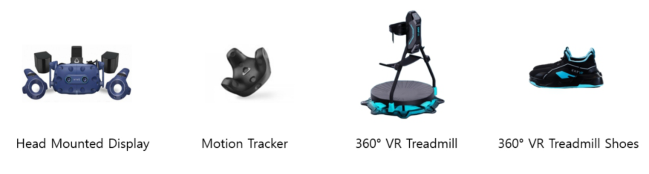
Device For this study, four types of devices were utilized. The Head-Mounted Display (HMD) used was the Vive Pro Eye from HTC. The controller used was the Vive Pro Eye HMD’s controller, and the motion tracker was the Vive Tracker 3.0. The omnidirectional VR treadmill, C2 Plus from KAT, along with the dedicated shoes provided by the omnidirectional VR treadmill, were used (see Figure 1). All devices, except for the shoes provided by the VR treadmill, include sensors with six degrees of freedom (6DoF), allowing for the acquisi- tion of three-dimensional position coordinates and rotation coordinates. The devices have a maximum sampling rate of 90hz. Sensors attached to the bot- tom of the shoes provided by the VR treadmill can obtain two-dimensional speed values. To secure the motion tracker to various body parts, straps were added to the motion tracker for use.
Figure 1: Four types of VR devices.
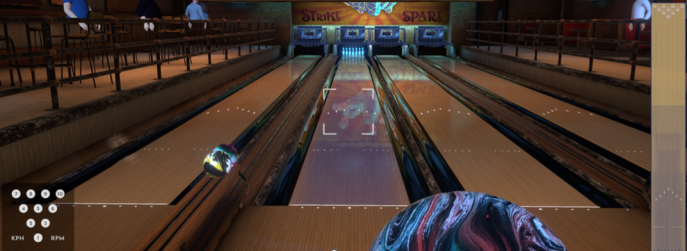
VR Content The exercise content selected for this study was bowling, a popular leisure sport in Korea. Considering the characteristics of the exercise, content that meets the following criteria was chosen: The exercise content was suitably a first-person virtual reality exercise content available on the Steam VR platform. The SteamVR platform is easily accessible and convenient to use. Additionally, first-person virtual reality exercise content offers the advantage of enhancing realism, allowing participants to immerse themselves in the con- tent (Ryu et al., 2015). Bowling content that allows the use of the dominant hand’s controller to grip and release the ball was deemed appropriate. There- fore, Premium Bowling content, which meets these criteria, was selected for use (see Figure 2).
Figure 2: StamVR premium bowling content.
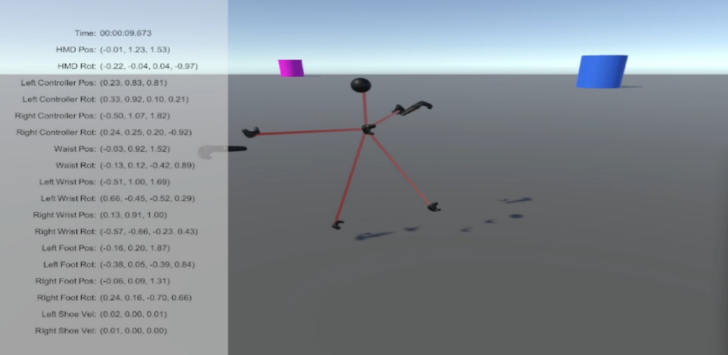
UNITY S/W TOOL FOR MOTION DATA AND PHYSICAL MOVEMENT FEATURE ACQUISITION We developed a tool based on Unity for acquiring motion data and physical movement features. Initially, we integrated each device using the SteamVR Plugin and OpenXR Plugin. Through the sensors of the integrated devices, it is possible to check the 3D Global Position values for each device. We implemented code capable of storing the three-dimensional position vector data of each device. Thus, we could save the three-dimensional position vec- tor data of each device in the format.csv file. When operating the Unity S/W acquisition tool, the left screen is arranged to allow real-time viewing of the three-dimensional position vector coordinates, and the right screen is arranged to display the motion skeleton, enabling the observation of the par- ticipant’s exercise performance. To implement the motion skeleton, objects were assigned to all devices except for the VR treadmill shoes. The motion skeleton was constructed by connecting the trackers attached to the HMD, each wrist, and ankle, centered around the motion tracker attached to the waist (see Figure 3).
Physical Human Factor Parameters Through VR Leisure Contents 111
PYTHON S/W TOOL FOR MOTION DATA AND PHYSICAL MOVEMENT FEATURE EXTRACTION To extract motion data and physical movement features, a Python-based program was developed. This program is capable of performing two main functions. Firstly, it can derive continuous functions for each participant’s data in segments for data extraction. Secondly, it calculates the average speed and acceleration of devices within the key Phases of the data represented as continuous functions for each participant. Using these calculations, it is capable of computing the mean, variance, skewness, and kurtosis.
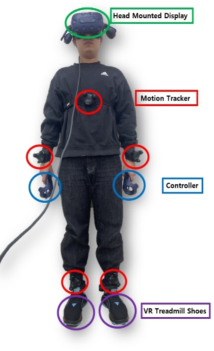
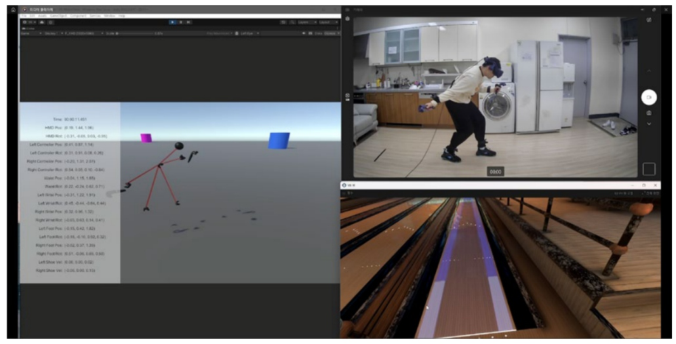
MOTION DATA AND PHYSICAL MOVEMENT FEATURE ACQUISITION PROCESS After obtaining consent from the participants to partake in the experiment, the researcher ensured that the participants were well-informed about the correct bowling actions to be performed, thoroughly explaining the 4-step approach, which is beginner-friendly. Subsequently, the participants equipped the devices on their head, waist, wrists, hands, ankles, and feet as depicted in Figure 4. Once the connection status of the devices was verified, the researcher initiated the exercise content. Within the exercise content, the par- ticipants practiced the actions guided by the researcher. After ample practice, the researcher simultaneously recorded the monitor screen using OBS Stu- dio and activated the acquisition tool. The participant was then instructed to perform the exercise actions. The monitor setup for recording included splitting the screen to display the Unity acquisition tool software, the par- ticipant’s performance scene, and the SteamVR View all in one view (see Figure 5). Following the researcher’s instructions, the participant performed the exercise actions at least three times. If any errors in performance or sensor errors from the devices occurred, the participant was instructed to perform additional actions. Throughout the data acquisition process, the researcher controlled the direction of the actions to ensure that the participants per- formed the exercise movements in a consistent direction, allowing the vector data to be collected consistently.
Figure 4: Location of tracker attachment.Figure 5: Recording scene with a split-screen layout including unity software, camera and steamVR view.
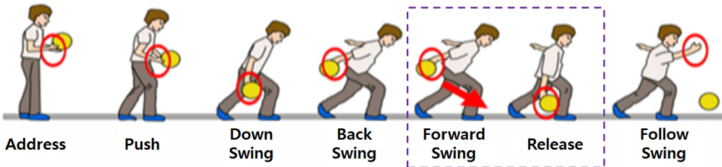
MOTION DATA AND PHYSICAL MOVEMENT FEATURE EXTRACTION PROCESS Feature extraction was performed using the acquired three-dimensional posi- tion vector data. To further understand the movements in bowling exercises, researchers identified the main Phases of the bowling exercise through liter- ature (see Figure 6) (Kim, 2015). The collected data were labeled by Phases through the review of four researchers. Previous studies reported that the lin- ear speed of the ball and wrist was highest between the backswing top and release Phases in bowling (Lee, 2006). Therefore, the speed in the surround- ing Phases of release, including forward swing, release, and follow swing, was analyzed. To check the speed of the ball and wrist, features of the speed data from the controller in the dominant hand among all devices were extracted.
After labeling, a preprocessing step for the data was conducted. This step involved handling outliers and missing values due to errors in sensing from each research device.
Figure 6: Detailed phases of bowling.
ANALYSIS For the analysis of motion data and physical movement features, Python 3.12.0 was utilized. Data from 74 instances of bowling action were analyzed. The scikit-learn library facilitated the preprocessing of the three-dimensional
Physical Human Factor Parameters Through VR Leisure Contents 113
position data of the dominant hand controller. Initially, cross-validation was employed to represent the position data on a continuous graph, through which the most suitable polynomial degree was identified. The degree and coefficients of this polynomial, along with the number of labeling data points, were saved in a JSON file. The derived polynomial was differentiated to pro- duce a velocity polynomial. Graphs displaying the velocity trends for each key Phase were created using the matplotlib.pyplot module. Moreover, the average velocity for each key Phase of the data was calculated. Finally, four statistical indicators - mean, variance, skewness, and kurtosis of the average velocity within the key Phases of the controller - were computed using the stats module from the Scipy library.
RESULT
The analysis of 74 datasets performed by 20 young adults to understand the X, Y, Z components of the velocity vector and the speed in the controller during the forward swing and release Phases of bowling yielded the following results in Table 2 and Table 3.
Table 2. Indicators for the speed X, Y, and Z components of the controller for each major phases of bowling.
Table available in the original PDF paper.
Phase Component Statistical Indicators Mean Variance Skewness Kurtosis
Forward swing X 0.093 0.141 0.226 −0.756 Y −2.303 0.798 −0.004 0.776 Z 3.778 0.708 −0.529 1.201 Release X −0.231 0.090 −0.516 0.533 Y 0.866 0.930 0.761 0.381 Z 6.474 2.233 −0.124 −0.180
Table 3. Statistical indicators of the speed of the controller in each major phase of bowling.
Table available in the original PDF paper.
Phase Statistical Indicators Mean Variance Skewness Kurtosis
STATISTICAL INDICATORS OF CONTROLLER VELOCITY X COMPONENT BY KEY BOWLING PHASES In the bowling forward swing Phase, the mean velocity in the X direction was 0.093, with a variance of 0.141, skewness of 0.226, and kurtosis of - 0.756. In the release Phase, the mean velocity was -0.231, variance was 0.090, skewness: -0.516, and kurtosis: 0.533.
STATISTICAL INDICATORS OF CONTROLLER VELOCITY Y COMPONENT BY KEY BOWLING PHASES In the bowling forward swing Phase, the mean velocity in the Y direction was -2.303, with a variance of 0.798, skewness of -0.004, and kurtosis of 0.776. In the release Phase, the mean velocity was 0.866, variance was 0.930, skewness: 0.761, and kurtosis: 0.381.
STATISTICAL INDICATORS OF CONTROLLER VELOCITY Z COMPONENT BY KEY BOWLING PHASES In the bowling forward swing Phase, the mean velocity in the Z direction was 3.778, with a variance of 0.708, skewness of –0.529, and kurtosis of 1.201. In the release Phase, the mean velocity was 6.474, variance was 2.233, skewness: -0.124, and kurtosis: -0.180.
CONCLUSION
This study collected motion data and physical movement features from 20 adults aged 19-38. We derived velocity polynomials for the dominant hand controller during the forward swing, release, and follow swing phases of the bowling exercise and presented them in visual graphs, calculating statistical indicators such as mean, variance, skewness, and kurtosis for each Phase.
The Z component, representing the direction of progression in bowling actions, showed the highest mean linear speed at release, measured at 6.474. Previous studies reported a sharp increase in linear speed during the forward swing phase between the backswing and release, with the highest speed occur- ring at release, a trend also observed in our study (Lee et al., 2006). However, these studies did not use VR equipment and focused solely on female college students, highlighting the need for careful interpretation considering these differences.
Our research was limited to bowling within VR leisure sports content and targeted young adults. Future studies should extend to various exercise contents and generations to acquire and extract data. Conducting statistical analyses on data extracted across different generations to identify significant differences in biomechanical data and presenting physical human factors is crucial. This process could provide foundational data for developing augmen- tation technologies to minimize and compensate for generational physical differences, contributing to the creation of cultural and leisure content enjoyable across diverse generations.
ACKNOWLEDGMENT
This research was supported by Culture, Sports and Tourism R&D Program through the Korea Creative Content Agency grant funded by the Ministry of Culture, Sports and Tourism in 2023 (Project Name: Development of univer- sal XR platform technology to build a metaverse supporting digital cultural inclusion, Project Number: RS-2023-00270006, Contribution Rate: 100%).
Physical Human Factor Parameters Through VR Leisure Contents 115
REFERENCES
Bum, C. H., Mahoney, T. Q., & Choi, C. (2018). A comparative analysis of satisfaction and sustainable participation in actual leisure sports and virtual reality leisure sports. Sustainability, 10(10), 3475. Chen, Y., & Wu, Z. (2023). A review on ergonomics evaluations of virtual reality.
Work, 74(3), 831–841. Cho, S. M. J., Lee, H., Shim, J. S., Youm, Y., Jung, S. J., Kim, D. J., & Kim, H.
C. (2021). Association between social network structure and physical activity in middle-aged Korean adults. Social Science & Medicine, 282, 114112. Eun, G.-H. (2021). A study on the accessibility of content production in virtual reality sports rooms. Han, J.-Y., & Ahn, J.-G. (2010). A study on the characteristics of the media environ-
ment in mixed reality space (MRS). Journal of the Korea Contents Association, 10(11), 169–179. Jang, E.-S., & Lee, J.-R. (2019). Exploring the social meanings behind the transformation of bowling alleys into rock bowling alleys. Korean Journal of Women in Physical Education, 33(3), 109–127. Kim, J.-W. (2011). The causal relationship among physical self-concept, exercise
emotion, and continued exercise participation of bowling enthusiasts. Journal of the Korean Society for the Sociology of Sport, 43(2), 895–906. Kim, S. (2015). Kinematic analysis of step type during bowling action. Journal of Korean Society of Sports Science, 24(6), 1517–1528. Kim, T. S., & Cho, J. K. (2016). A study on the development direction of age-friendly
products according to the lifestyle of the elderly: Focusing on the analysis of self-evaluation of physical functions and attitudes towards age-friendly products. Journal of Korean Design Culture, 22(1), 63–75. Lee, H. M., Lee, S. C., & Lee, H. D. (2006). Biomechanical analysis of a bowling swing. Korean Journal of Sport Biomechanics, 16(3), 53–63. Ryu, Y. S., Lee, H. C., & Kim, S. W. (2015). An analysis of the characteristics and
reasons for the use of digital game perspectives: Why do games use the third- person perspective more than the first-person perspective? Journal of the Korean Contents Association, 15(7), 75–83. Yang, S.-H., Park, B., Kang, Y.-S., Gal, W.-M., Choi, J.-H., Kim, D.-S., Kim, T.-G., & Jo, M.-S. (2019). Newest ergonomics. Hyungseul Publishing Co.
LISTED IN THE AHFE DIGITAL BOOKSTORE CATALOGUE
Explore the complete digital volume
Human Factors in Virtual Environments and Game Design
Read this individual research paper free through the original publisher, or explore the full digital proceedings book.
ISBN 978-1-964867-13-7
Explore this ISBN in the AHFE Bookstore ↗Listed in the July 2026 bookstore catalogue; search by ISBN to confirm current availability · Digital book purchase optional