The design and development of automotive Advanced Surfaces (AS), which adhere to Bezier curve definitions, are crucial in automotive design. As design management evolves, it now encompasses strategic responsibilities alongside AS model refinement. The role of design in driving corporate innovation, creating new business models, and leading organizational change has been increasingly recognized. In a world increasingly shaped by digital technologies, industries, including the automotive sector, are experiencing profound transformations driven by digitalization. Digital transformation has become a strategic priority for enterprises to maintain competitiveness.AS design projects are long-term and involve complex task allocation and coordination among multiple personnel. Traditional task management methods often fail to accurately capture changes in responsibility, leading to unclear accountability and disruptions in task flow. Additionally, new employees face a steep learning curve, increasing on boarding time and costs, and potentially delaying project timelines. These inefficiencies compromise project performance and overall success.Our digital platform offers an effective solution by centralizing issue management and enabling real-time tracking. This platform ensures that issues are promptly recorded and updated, providing clear visibility into their status and progress. It can also automatically notify relevant personnel to ensure timely follow-up, reducing the risk of omissions or duplicated efforts. This system enhances the precision, efficiency, and transparency of issue resolution, improving overall project management and workflow efficiency.To validate this digital platform we recruited 38 (20F, 18M) to participant to our experiment. NASA-TLX has been employed to measure their performance. We calculated the effect size to present the difference between control and experimental groups. For capturing quantitative data, 6 interviewees (3 professions, 3 novices) have been invited to the semi-structured interview. We used Latent Dirichlet Allocation (LDA) to uncover the latent thematic structure in the text data. This method helps us understand respondents' perspectives and supports subsequent qualitative analysis.In conclusion, we explore the introduction of digital platform management in the AS group and its remarkable results. The digital platform significantly improved data accuracy, traceability, collaboration, and decision-making speed while reducing human errors. User research revealed engineers' pressures during the transition but also highlighted positive feedback on the benefits of digital transformation. This initiative enhances AS group's efficiency and technology-centric transformation, providing a successful example for other groups in the industry.
The design and development of automotive Advanced Surfaces (AS), which adhere to Bezier curve definitions, are crucial in automotive design. As design management evolves, it now encompasses strategic responsibilities alongside AS model refinement. The role of design in driving corporate innovation, creating new business models, and leading organizational change has been increasingly recognized (Brown, 2009; Danish Design Council, 2003; Gemser & Leenders, 2001; Martin, 2009). However, existing design management tools fail to fully reflect the new roles of design, particularly in automotive design. To address this, it is necessary to align design management with contemporary trends, integrating innovative technologies with sustainable development principles to unlock design’s potential for long-term industry growth.
Recent studies in design management have questioned fundamental assumptions about innovation boundaries, agents, and processes (Cohen, 2019; Nambisa, 2017). Drawing on advances in digital technologies, these studies propose new frameworks to guide design management evolution. Unlike previous theoretical studies, this paper focuses on the capabilities
Digital Management Strategies and Technological Innovation 95
required in practical design management. To fully leverage design’s value in business, organizations must implement effective design management practices (Bruce & Bessant, 2002; Chiva & Alegre, 2007; Gorb & Dumas, 1987). In automotive AS design, new capabilities must be developed to transition from traditional technologies to those that integrate with modern industries and adapt to a knowledge-driven and creativity-driven global economy that prioritizes services, experiences, and interactions over physical products (Fulden, 2017). Therefore, automotive design management should shift focus from styling and functionality to leveraging digital design innovation to enhance operational efficiency, and corporate value. This aligns with design’s emerging role in reshaping corporate strategies (Borja de Mozota, 2003; Junginger, 2008; Lee & Evans, 2012; Ravasi & Lojacono, 2005), highlighting the potential of digital technologies in automotive design. In a world increasingly shaped by digital technologies, industries, including the automotive sector, are experiencing profound transformations driven by digitalization. Digital transformation has become a strategic priority for enterprises to maintain competitiveness (Nabiyi, 2024; Wang, 2024; Wang, 2025; Xu, 2022). This paper proposes a new design management framework grounded in digitalization theories, aiming to integrate emerging capabilities from design, management, and strategy literature to fill gaps in current tools. In this work, we report a specially digital platform for AS design management and validate it through qualitative and quantitative methods.
RELATED WORK
Jira (Atlassian, 2021) is a versatile issue management tool widely used in project management, particularly in software development and design management. Jira’s customizable features and integration with tools like Confluence and Slack facilitate team collaboration and support agile methodologies. However, its high cost and complex interface could be barriers for small teams and new users.
In past several years, our AS group managed the design issues by using the specific excel spreadsheet template, which, despite being cost-effective, become cumbersome and error-prone as project complexity increases. The lack of integration and automatic updates further complicates issue tracking.
To address these challenges, this study presents a digitized issue management tool tailored for AS design. It offers high customizability, streamlined functionality, and an intuitive interface, facilitating efficient resource allocation and team collaboration. Despite some limitations in decision-support capabilities, the tool effectively identifies, addresses, and assesses issues, supporting developer-friendly iterative improvements.
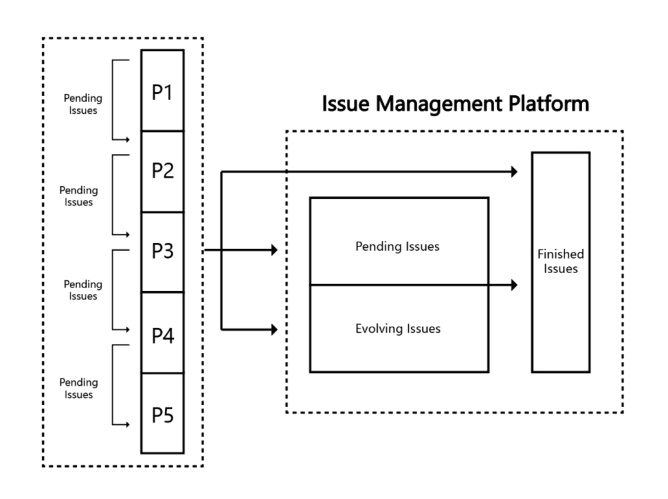
FRAMEWORK The AS design process is typically divided into five phases (P1 to P5), each generating various model data issues. These issues can be categorized into three types by their status: finished, pending, and evolving. Finished means that problems are fully resolved and no longer impact subsequent
phase; pending status remains unresolved and is carried over to the next phases; evolving status arises due to design, technology, or requirements modifications.
AS design projects are long-term and involve complex task allocation and coordination among multiple personnel. Traditional task management methods often fail to accurately capture changes in responsibility, leading to unclear accountability and disruptions in task flow. Additionally, new employees face a steep learning curve, increasing on boarding time and costs, and potentially delaying project timelines. These inefficiencies compromise project performance and overall success.
A digital platform offers an effective solution by centralizing issue management and enabling real-time tracking. This platform ensures that issues are promptly recorded and updated, providing clear visibility into their status and progress. It can also automatically notify relevant personnel to ensure timely follow-up, reducing the risk of omissions or duplicated efforts. This system enhances the precision, efficiency, and transparency of issue resolution, improving overall project management and workflow efficiency.
In addition to improving issue tracking, the digital platform optimizes task allocation and personnel management. The platform ensures clear task assignments through real-time updates of responsibilities and task statuses, preventing delays and confusion. For new employees, the platform offers clear guidance on project workflows and background information, helping them quickly understand project requirements and reducing training time. Ultimately, the digital platform improves issue management, task allocation, and overall project performance, ensuring the timely and successful delivery of AS projects.
METHOD
To validate the design management framework, we recruited 38 participants (18F, 20M) to the experiment. Each participant was required to complete the same pre-set task using both the Excel table (Control Group) and the digital platform (Experimental Group), followed by filling out a questionnaire after each task. The NASA-TLX (Hart & Staveland, 1988) was employed to quantify and compare user feedback. NASA-TLX is a tool for assessing workload that measures the user’s subjective workload during a task through six subscales (mental demand, physical demand, temporal pressure, performance, effort, and frustration).
To obtain more comprehensive data, we also conducted the semi- structured interview to gather qualitative data. To comprehensively learn user feedback, we categorized department personnel into professionals (with over five years of relevant professional experience) and novices (with less than five years of relevant professional experience). We conducted sample interviews with both groups. A total of six interviewees (3 novices and 3 professionals) were selected. The results were analyzed using thematic analysis.
Digital Management Strategies and Technological Innovation 97
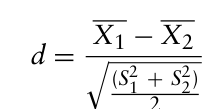
Validation Test For analyzing the questionnaire results, we used effect size to quantify the statistical significance between the means of the two groups. Cohen’s d is a standardized effect size commonly used to compare the size of the difference between two groups. It applies to fields such as psychology, education, and social sciences. By calculating the effect size, we can more clearly understand the degree of difference between different variables. X1 refers to the average value of the results from the Experimental Group. X2 means the average value of the results from the Control Group. The calculation formula is as follows:
Equation reproduced from the original PDF.
It is worth noticing that the Temporal Pressure demonstrated a medium effect (Cohen’s d = 0.34), which shows that the difference between the two groups in terms of time pressure is more obvious, with time pressure in the first group being significantly higher than that in the second group. This outcome reveals that the platform can effectively improve employees’ work efficiency and concentration, optimize time allocation and improve time management ability through time management. Besides, the Mental
Demand demonstrates a small positive effect (Cohen’s d = 0.18), indicating that the new digital platform can induce a certain degree of mental stress for users. This may be explained by the fact that employees have been accustomed to using forms for an extended period, and consequently, they may face a greater challenge in learning, operating, and managing unexpected events when transitioning to the digital management platform. At the same time, the effect size of performance is rare (Cohen’s d = −0.02), suggesting that This shows that although users feel pressure to learn to use the new platform, they are able to get started quickly and achieve comparable performance to before. Both Frustration (Cohen’s d = −0.06) and Effort (Cohen’s d = −0.07) displayed a negative effect, expressing that users found the new digital platform more accessible than the forms used before.
Theme Analysis In terms of design management theory, design activities should be supported by internal systematic processes and collaboration across departments. It is crucial to emphasize the importance of quality control and the implementation of a design audit mechanism. The standardization and systematization of the design process are fundamental, and organizations should prioritize aligning their strategic goals with user needs to ensure the correct direction and value orientation. The interview framework is anchored in these principles, with a focus on four dimensions: Organizational Support for Collaboration, Design Quality Assurance, Systematic Design Order, and Design Purpose Assurance.
To analyze the interview results, we used Latent Dirichlet Allocation (LDA) to uncover the latent thematic structure in the text data. This method helps us understand respondents’ perspectives and supports subsequent qualitative analysis.
Table 1: Interview theme analysis and explications.
Table available in the original PDF paper.
Theme Type Topic Example Organizational T1 Smooth internal project usage Support for Collaboration
T2 Problem transfer and responsibility clarification T3 Insufficient
“Communication is generally smooth.” “平常通比
” “For example, I hand over specific issues to the relevant engineers.” “比如我是把具体交相工程
” “So it’s a segmented work process.” “所以是分段式工作的
” “They can use this platform, but interactions with other departments feel limited.” 他能使用平台,但感上面跟其他部的互很 少
cross-department collaboration
Continued
Digital Management Strategies and Technological Innovation 99
Table 1: Continued Theme Type Topic Example
Table available in the original PDF paper.
Design Quality
T1 Reducing missed Assurance issues
T2 Traceability T3 Issue marking and reminders T4 Quality stability T5 Issue discovery
method
“Its main function is to reduce the omission of technical issues.” “主要作用是少技漏
” “It serves as a record.” “它起到的是一作用
” “It helps you filter out the issue and turn it into a priority.” “他你到,把它成重
” “We still rely on data review to find potential issues.” “在仍依据查
”
Systematic Design
T1 Improved operational Order efficiency
T2 Optimized labor allocation T3 Issues with
interaction logic and user experience T4 Insufficient statistical functions
“It is reflected in reducing lag issues.” “体在少卡
” “It has reduced the steps that previously required asking each person individually.” “少了以往需要逐的步
” “We can assign tasks based on different people and personnel distribution areas.” “我可以根据不同的人和你的人配比域 行派遣
” “The platform’s interaction logic needs optimization.” “平台的交互需要优化
” “The interface design is simplistic.” “界面陋
” “It does not meet the needs for more detailed analysis.” “法足更的分析需求
”
Design Purpose
T1 Improved data Assurance synchronization and format standardization
T2 Efficiency improvements T3 Features needing
optimization T4 Improved retrospective and tracking efficiency
“The platform performs reasonably well in terms of data progress synchronization.” “据展同步方面表尚可
” “The format was previously unstandardized and unable to be categorized, but these issues have now been resolved.” “格式不范,然后法分,些在解了
” “The platform does play a certain role in improving the efficiency of managers.” “平台在提高管理者效率方面有一定作 用
” “Optimizing the search and filtering functions.” “优化索和功能
” “Enhancing the batch operation capabilities.” “提升批量操作功能
” “The platform really solves the issue of review.” “解了复是真的
”
The interview results reveal that, in terms of Organizational Support for Collaboration, the platform enhances internal communication and clarifies responsibility delegation. One interviewee stated, “For example, I can transfer specific issues to the corresponding engineer.” However, cross- departmental interaction remains limited, with another participant noting, “There is little interaction with other departments.”
Regarding Design Quality Assurance, the platform stabilizes design quality, reduces overlooked issues, and improves issue notification and traceability. As one interviewee noted, “It helps filter out issues and marks them as key concerns.” However, identifying potential quality issues still depends on data review.
In Systematic Design Order, the platform improves efficiency and optimizes labor distribution. One participant remarked, “It reduces the steps of having to ask each individual.” Nevertheless, there is room for improvement in program design, with some suggesting, “The platform’s interaction logic needs further optimization.”
For Design Purpose Assurance, the platform addresses several pain points in Excel-based issue tracking, such as data synchronization, format inconsistencies, and difficulty in review. As one interviewee said, “Issues with format inconsistency and lack of categorization have been resolved.” Overall, the platform improved work efficiency and managerial effectiveness, though there is still room for refinement. Its core functions, however, have largely met their objectives.
Based on the aforementioned analysis, the platform has been shown to enhance organizational collaboration in real-world business contexts, thereby improving internal communication. It enables effective intervention by senior management to address issues promptly, with a clear delegation of responsibilities, thereby mitigating ambiguity in role definition. In terms of design quality assurance, the platform reduces the occurrence of unnoticed issues, strengthens the traceability of various processes, and, with its issue tagging and notification features, ensures that high-risk problems are addressed promptly, thereby safeguarding quality stability. Furthermore, the platform optimizes operational workflows, improves efficiency, reduces redundant tasks, and improves labor allocation. Regarding data management, the platform facilitates data synchronization and standardization of formats, further enhancing overall management efficiency.
The platform has further advanced the evolution of design management, enhancing its efficiency, intelligence, and flexibility. The digital platform has been shown to improve collaborative efficiency and decision-making transparency within design management. The optimization of issue- resolution processes enhances the team’s capacity to address complex design challenges. Additionally, the platform strengthens the visual monitoring of design quality, providing robust support for the dynamic optimization of design systems. Concurrently, it fulfills the enterprise’s demand for high readability in design processes, thereby establishing a solid foundation for strategic development through effective design management.
Digital Management Strategies and Technological Innovation 101
FUTURE WORK
The platform has revealed multidimensional shortcomings in its practical application. Firstly, defects in user experience and interaction design have increased the operational complexity. Secondly, the platform’s statistical and analytical capabilities are inadequate, failing to meet the demands of complex data analysis, thereby limiting the depth of insight into issues. Furthermore, the platform’s cross-departmental collaboration capabilities are insufficient, with limited interaction between departments. Overall, the platform still requires improvements in functional optimization and process integration, and has not fully met the dynamic development needs of the enterprise.
In the context of design management within the organization, issues such as inadequate cross-departmental collaboration, ineffective communication between management and front-line staff, and unsatisfactory staff training persist—problems that the platform is incapable of resolving. These challenges require organizational management measures such as the enhancement of cross-departmental communication mechanisms, the optimization of information transfer processes, and the development of targeted training programs to improve the overall efficiency of collaborative design management.
CONCLUSION
This paper aims to address the challenges posed by contemporary industrial development and the digital transformation enterprises are facing, while exploring the limitations of existing design management tools and proposing an innovative approach to design management. Using automotive AS design as a specific context, the study implements a digital issue management tool and combines methods such as surveys and semi-structured interviews to investigate the feasibility and practical pathways for design management innovation. The findings demonstrate that digital tools can effectively optimize design management, enhance collaboration efficiency, and improve resource allocation, thereby driving the digital transformation of design processes. Ultimately, this research provides theoretical guidance and practical foundations for the innovation of design management tools, offering valuable insights and experiences for the industry in the context of digital transformation.
ACKNOWLEDGMENT
We would like to express our sincere gratitude to the support from Car Body Technology Development Centre, BYD.
REFERENCES
Atlassian. (2021). Jira (Version 8.16) [Computer software]. Retrieved from https:// www.atlassian.com/software/jira. Borja de Mozota, B. (2003) ‘Design and competitive edge: A model for design
management excellence in European SMEs’, Design Management Journal Academic Review, 2, pp. 88–103. Brown, T. (2009) Change by Design: How Design Thinking Transforms Organizations and Inspires Innovation. New York, NY: HarperCollins.
Bruce, M. and Bessant, J. (2002) Design in Business: Strategic Innovation Through Design. Essex: Pearson Education Limited. Chiva, R. and Alegre, J. (2009) ‘Investment in design and firm performance:
The mediating role of design management’, Journal of Product Innovation Management, 26(4), pp. 424–440. Cohen, Y., Faccio, M., Pilati, F. and et al. (2019) ‘Design and management of digital manufacturing and assembly systems in the Industry 4.0 era’, International Journal of Advanced Manufacturing Technology, 105, pp. 3565–3577. doi: 10.1007/s00170-019-04595-0. Danish Design Centre. (2003) The economic effects of design. Copenhagen: National
Agency for Enterprise and Housing. Available at: http://www.seeplatform.eu/ images/the_economic_effects_of_designn. Pdf (Accessed: 16 January 2025). Gemser, G. and Leenders, M. A. A. M. (2001) ‘How integrating industrial design in the product development process impacts on company performance’, Journal of Product Innovation Management, 18, pp. 28–38. Gorb, P. (1990) Design Management. London: Phaidon Press. Junginger, S. (2008) ‘Product Development as a Vehicle for Organizational Change’,
Design Issues, 24(1), pp. 26–35. Lee, Y. and Evans, M. (2012) ‘What Drives Organizations to Employ Design-Driven Approaches? A Study of Fast-Moving Consumer Goods Brand Development’, Design Management Journal, 7, pp. 74–88. Martin, R. (2009) The Design of Business: Why Design Thinking is the Next
Competitive Advantage. Boston, MA: Harvard Business Press. Nabiyi, F., Shamizanjani, M. and Garoosi Mokhtarzadeh, N. (2024) ‘Explaining and developing the content dimensions of the digital transformation strategy’, Journal of Strategic Management Studies, 15(60), pp. 23–47. doi: 10.22034/ smsj.2023.396167.1847. Nambisan, S., Lyytinen, K., Majchrzak, A. and Song, M. (2017) ‘Digital Innovation
Management: Reinventing Innovation Management Research in a Digital World’, MIS Quarterly, 41(1), pp. 223–238. Available at: https://www.jstor.org/stable/ 26629644 (Accessed: 16 January 2025). Hart, S. G. and Staveland, L. E. (1988) ‘Development of NASA-TLX (Task Load Index): Results of empirical and theoretical research’, in Hancock, P. A. and Meshkati, N. (eds.) Human mental workload. North-Holland, pp. 139–183. doi: 10.1016/S0166-4115(08)62386-9. Ravasi, D. and Lojacono, G. (2005) ‘Managing design and designers for strategic
renewal’, Long Range Planning, 38(1), pp. 51–77. Topalo˘glu, F. and Er, Ö. (2017) ‘Discussing a New Direction for Design Management through a New Design Management Audit Framework’, The Design Journal, 20(sup1), pp. S502–S521. doi: 10.1080/14606925.2017.1353000. Wang, S. and Zhang, H. (2025) ‘Digital Transformation and Innovation Performance
in Small- and Medium-Sized Enterprises: A Systems Perspective on the Interplay of Digital Adoption, Digital Drive, and Digital Culture’, Systems, 13(1), p. 43. doi: 10.3390/systems13010043. Wang, X. and Yan, Y. (2024) ‘A Study on the Impact of Digital Transformation on Enterprise Performance: The Mediating Role of Dual Innovation and the Moderating Role of Management Power’, Sustainability, 16(21), p. 9298. doi: 10.3390/su16219298. Xu, J., Naseer, H., Maynard, S. and Fillipou, J. (2022) ‘Leveraging data and analytics
for digital business transformation through DataOps: An information processing perspective’, arXiv. doi: 10.48550/arXiv.2201.09617.
LISTED IN THE AHFE DIGITAL BOOKSTORE CATALOGUE
Explore the complete digital volume
Creativity, Innovation and Entrepreneurship
Read this individual research paper free through the original publisher, or explore the full digital proceedings book.
ISBN 978-1-964867-42-7
Explore this ISBN in the AHFE Bookstore ↗Listed in the July 2026 bookstore catalogue; search by ISBN to confirm current availability · Digital book purchase optional