Liza Wohlfart, Carmen Antuña Rozado, Venkata Gandikota, Cindia Li (2025). Citizen Frugal Innovation: Insights from international Open Innovation Challenges with underrepresented groups of society. In: Creativity, Innovation and Entrepreneurship. AHFE Open Access, vol. 166, pp. 114–123. https://doi.org/10.54941/ahfe1006117
At the AHFE 2024 in Nizza, the EU-funded FRANCIS presented insights from an international Open Innovation challenge on kitchen and household ideas that targeted groups of society that are underrepresented in comparable initiatives: challenged families, green (i.e. eco-friendly) minimalists and independent senior citizens. It highlighted lessons learned from the experiences and conceptual changes that were explored before starting the next challenge with a focus on travel, hotel and outdoor experiences. Now, the project has completed this second challenge that again aimed at involving the perspective of neglected groups by including citizens such as the operational staff of hotels and solo-travellers in the target community. The paper will detail the lessons learned from both challenges and detail if and how the changes between both challenges have proven to be an improvement or have actually failed to optiimise the process. The overarching aim of FRANCIS is to explore the potential of citizen frugal innovation (CFI), i.e. the ability of citizens to create simple high-value yet affordable solutions with limited resources. It does so by engaging citizens in idea challenges focused on everyday needs. The lessons learned presented in the paper will include facts and figures, along with insights from anecdotal evidence and results from surveys and interviews. The paper's rich data set will highlight key factors that enable or prevent citizen participation in frugal innovation. It will benefit future initiatives of industry, science and civil organizations. The paper will also examine the impact dimension of the project with respect to sustainability as well as responsible research and innovation.The following is a short summary of key findings achieved by FRANCIS: (1) It is of utmost importance to localise the citizen's support. (2) Tools and methods used in the challenges need to be simplified beyond typical standards in innovation management as, for example, used in the work with small and medium enterprises, students and startup entrepreneurs. (3) Trust and empowerment are key levers for getting citizens involved. (4) Industry coaching is helpful but expectation management is needed to create suitable awareness about citizen projects.
The EU-funded FRANCIS (www.francis-project.eu) explores the power of Citizen Frugal Innovation (CFI), i.e. the combination of Frugal Innovation and Citizen Science. It does so to bridge the gap between industry and society in an effort to deliver simple, affordable and sustainable solutions that are in line with the needs of groups in society that are often underrepresented in today’s research and innovation initiatives.
Frugal Innovation (FI) involves creating cost-effective solutions particularly for resource-constrained settings (Bhatti & Ventresca, 2013). The approach has become essential in developing countries and is increasingly relevant in developed nations, where organizations aim to cut costs, enhance sustainability, and connect with underserved markets (Tiwari & Herstatt, 2014). Prominent examples include the GE Vscan1, a pocket-sized handheld ultrasound scanner, and Daan Technologies Bob2, a 1Product website: https://vscan.rocks/ 2Product website: https://daan.tech/en/discover-bob-mini-dishwasher/?dt_cn=en
Citizen Frugal Innovation: Insights From International Open Innovation Challenges 115
small mobile dishwasher. Frugal innovation also excels in the service industry, as demonstrated by the Aravind Eye Hospitals, a chain of eye care clinics3 that ensure high-quality treatment even for patients with very limited or no financial means. While Frugal Innovation often is a way for companies to enter new, cost-sensitive markets, it is also sometimes the result of everyday people trying to find a solution for a problem that they have themselves or see in their proximity, i.e. amongst friends and family. Links between these two groups of frugal innovators, the corporate and the grassroots, are usually limited. FRANCIS aims to create synergies by supporting bottom-up frugal projects that are mentored by industry.
The increased importance of Citizen Science (CS) stresses the importance to empower grassroots frugal innovators, and provides valuable insights for the success of doing so. CS is broadly defined as the involvement of individuals in scientific processes without formal ties to scientific institutions (Buerger schaffen Wissen, 2016, 13). It encompasses various forms of participation in scientific knowledge production (Hacklay et al., 2021-a, 3), ranging from contributors and collaborators to project leaders who play meaningful roles in their initiatives (ECSA, 2015). CS thrives across multiple scientific disciplines, offering numerous benefits to researchers, society, and policymakers alike (European Commission, 2020, 64). It can enhance policy decision-making and contribute to the democratization of research (Hecker et al., 2019, 1).
Citizen Frugal Innovation (CFI) combines the strengths of both disciplines, utilizing the collective creativity of citizens to develop impactful solutions through collaborative innovation challenges (Antuña Rozado et al., 2022). FRANCIS seeks to involve diverse citizen groups, especially from underrepresented communities, to leverage their unique perspectives and experiences. This inclusive strategy guarantees that the solutions created are not only effective but also address the specific needs of a wider population.
The first of the two FRANCIS challenges was completed in 2023, the second one in 2024. The team of FRANCIS presented interim findings of the first challenge in an iSCSi publication (Wohlfart et al., 2024a) and highlighted planned changes of the second one in a publication presented at the 2024 AHFE conference in Nice, Italy (Wohlfart et al., 2024b). This paper offers a short overview on both challenges, along with their similarities and differences, to then highlight the project’s overall findings on how to succeed in CFI.
Note: Fraunhofer’s Artificial Intelligence agent FhGenie helped to improve the writing style of this paper.
THE TWO FRANCIS CHALLENGES Both challenges included three rounds. The first round was open to everyone worldwide with an age of eighteen years or more. It invited people to send in ideas for innovative solutions. The first challenge did so based on a set of slides; the second one used a short online form. Both challenges offered
3Company website: https://aravind.org/
ideation sessions to get started. The second round helped a group of selected teams to develop their ideas into concepts, supported by innovation methods. A small number of teams (five to six) were invited to the last round that aimed at improving the concept and adding a simple demonstrator. These last teams presented their prototypes in a final online event, where the solutions were ranked. Financial support was given to the teams of round two and the final round in the first challenge; the second challenge only offered a grant to the five final teams.
The First Challenge: Household and Kitchen The first FRANCIS challenge targeted kitchen and household solutions for India, Germany and Turkey. Bosch Home Appliances Turkey was the industry coach. These were the groups the challenge aimed for:
Troubled families: Individuals, who are part of a family of at least two people living together, with one family member in need of special care, for example because of low or high age (children, senior citizens) or a disability, and that feel restricted in budget and space.
Green minimalists: Individuals, who have a modest lifestyle by choice or force, for example because they value simplicity or have restricted financial means, and aim at fostering ecological and social sustainability.
Independent senior citizens: Elderly individuals and couples, who consider themselves senior citizens, live on their own or with friends/family, and manage their own household.
The following table shows two of the six finalist projects. Details on these and the other finalist projects can be found on the challenge website4.
Table 1: Overview on the finalist projects – first challenge.
Table available in the original PDF paper.
Name Details Despunte A kitchen furniture solution for individuals, especially students and budget-conscious families, living in confined spaces. The high-quality, modular shelving can be customized to fit specific space requirements accompanied by an app for planning and assembly. Holle Holle is a user-friendly, unobtrusive device designed to facilitate
making the bed. It addresses the challenge posed by large mattresses and sheets, especially for individuals with limited physical abilities. Once installed, a simple pulley mechanism tugs the sheet over the mattress edges, making bed-making easier for everyone.
The Second Challenge: Hotel, Travel and Outdoor Experiences The second FRANCIS challenge focused on enhancing hotel, travel, and outdoor experiences in India, Germany, and Colombia. The challenge was hosted by the FutureHotel network, a consortium of hospitality industry
4https://s.fhg.de/francis-challenge
Citizen Frugal Innovation: Insights From International Open Innovation Challenges 117
companies managed by Fraunhofer, alongside Globetrotter, a leading international provider of outdoor equipment. These were the four groups that were specifically invited to join:
Hotel pioneers: People working in operational departments of hotels, such as reception, housekeeping, food & beverages, who excel in innovative spirit.
Eco-conscious travellers: People with an eco-friendly mindset, who aim at prioritising the preservation of nature during both business and leisure trips.
Travel visionaries: People with a unique perspective on traveling, such as senior citizens, people with disabilities, single travellers, and the LGBTQI+ community.
Outdoor enthusiasts: People, who love outdoor activities, such as backpacking, camping, and hiking.
Table 2: Overview on the finalist projects – second challenge.
Table available in the original PDF paper.
Name Details Cook & Home A digital platform that links tourists with local hosts for authentic culinary experiences. It allows tourists to connect with citizens passionate about sharing their local cuisine knowledge while enabling hosts to earn extra income and engage with people globally. The platform prioritizes user-friendliness, particularly inviting senior citizens to serve as hosts. Smart White Cane A walking stick for visually impaired individuals navigating
unfamiliar environments. It employs IoT, AI, and robotics for real-time obstacle detection, voice guidance, and emergency alerts, ensuring safe and inclusive travel experiences. SunTabs Innovative pills that transform into sun-protective lotion when dissolved in water. The set includes the pills and a small mixing container, making preparation quick and easy—simply add water and stir. SunTabs last significantly longer than traditional sunscreens, are lightweight for easy travel (no liquid), and feature sustainable packaging with natural, vegan ingredients.
Three of the vie finalist projects are listed below. More details on them and the other projects can be found on the challenge website5.
CHALLENGE MANAGEMENT Based on the first challenge learnings, FRANCIS adapted the design of the challenge process and support to increase efficiency and ease participation. The following table highlights some of the main similarities and differences between both challenges.
5https://s.fhg.de/francis-challenge
Table 3: Overview on the challenge management of the two challenges.
Table available in the original PDF paper.
Components Commonalities Differences Consecutive rounds in the first Process Three rounds: ideas – concepts – demonstrators
One multi-lingual website for all
challenge; rounds one and two in parallel in the second challenge Platform Challenge website for
collecting and managing submissions
Active and passive participants
participants in the first challenge; three separate websites (one per language) in the second one Participants Focus on
underrepre-sented groups of society
Regional facilitators and
in the first challenge (working on vs. providing feedback to solutions); active participants only in the second one Mentors Mentors from science
and industry
One company as industry coach
students as hands-on support buddies for the teams in the first challenge; regional facilitators only in the second one Industry Industry as jury
members and coaches
Outreach partners as support for
in the first challenge that is part of the project consortium; several external companies as coaches in the second one Outreach Local outreach
partners in the target countries
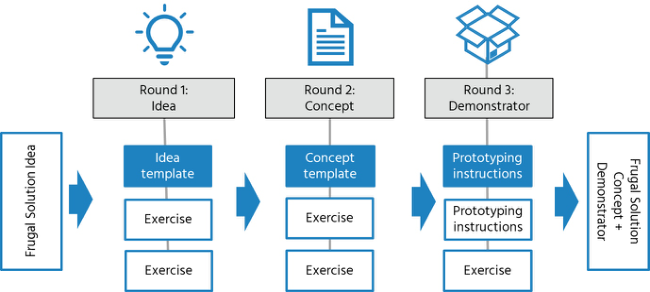
regional facilitators in the first challenge; outreach partners supported by regional facilitators in the second one The facilitation of the FRANCIS challenges was done by regional teams (one for each language group) that kept in close contact to plan and prepare their activities and to exchange lessons learned. The scientific facilitators used a toolbox with the methods shown in Table 3. Figure 1 illustrates the process. The methods of the toolkit were used in some way in both challenges.
Table 4: Overview on the FRANCIS toolbox.
Table available in the original PDF paper.
Activity Method(s) Learn about potential customers Interviews, personas Learn about competitive solutions Benchmarking Detail a product Morphological box Detail a service Customer activity cycle Design relevant business model aspects Business model canvas
Citizen Frugal Innovation: Insights From International Open Innovation Challenges 119
Figure 1: FRANCIS challenge facilitation process.
CHALLENGE STATISTICS The data that was collected through the challenge platforms includes statistics on the number of participants and submissions as well as the age of the participants and the team sizes. FRANCIS aimed at achieving the following Key Performance Indicators (KPI) in its outreach and support activities:
A high number of participants and submissions in the first, open round. The aim of both challenges was to end with about five teams in the final round, so FRANCIS selection process ensured a significant reduction of submission in the second round, before focussing on the finalists.
A diverse group of participants. FRANCIS specifically hoped to encourage the participation of underrepresented groups of society. The participants of the first challenge that were assigned to these groups were “troubled families” and “independent senior citizens”. In the second challenge, the categories “hotel pioneers” and “travel visionaries” targeted people that had a unique perspective.
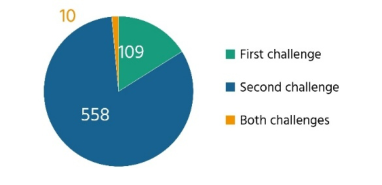
The statistics of both challenges are presented below. The figure below highlights the changes in challenge participants. While the first challenge still showed moderate outreach success with 119 people joining the first round, the second challenge manage to dramatically increase the number to 568. Both numbers include ten participants that joined both rounds. The numbers stress the positive impact of the adjusted outreach strategy.
Figure 2: Number of challenge participants.
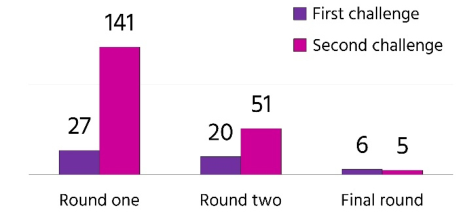
When it comes to the number of submissions, there was also a strong increase from the first to the second challenge, as the figure below shows.
Figure 3: Number of submissions.
Due to the new agile round one/two design, the number of submissions in round two of the second challenge was also much higher than the one in the same round in the first challenge. The last round of both challenges was as small as planned.
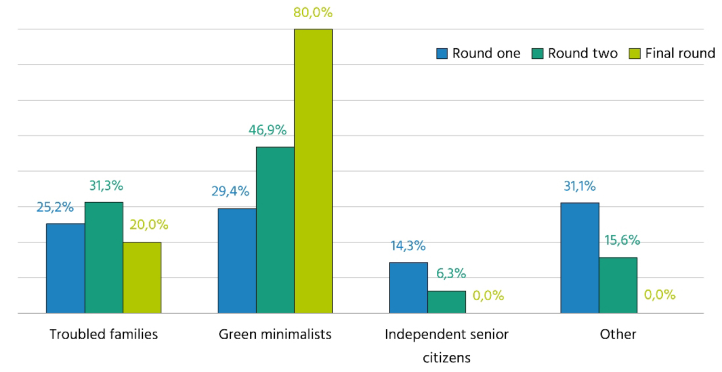
The figure below shows the participant groups of the first challenge. The number of troubled family members and independent senior citizens was between 37.6% and 39.5% for both groups combined in the first two rounds. The last round included two people from troubled families (20%).
Figure 4: Participant groups – first challenge.
The numbers of the second challenge again show that the adjustments made to the challenge design entailed improved KPI.
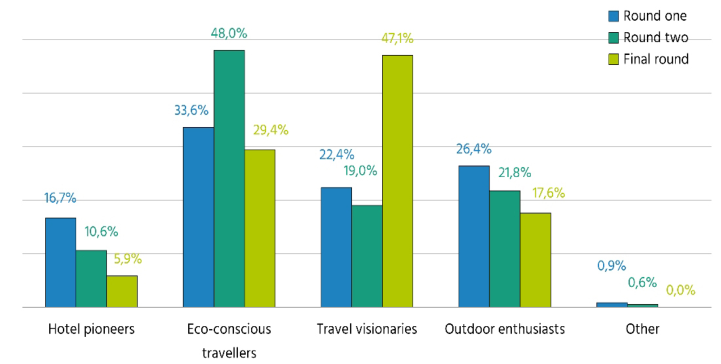
Hotel pioneers and travel visionaries combined achieved between 29.6% and 29.1% in the first rounds. The number of participants from these groups, who made it to the last round, were 53.0% of all finalists. The result also showed in the types of projects that made it to the end, with most of them
Citizen Frugal Innovation: Insights From International Open Innovation Challenges 121
specifically addressing issues of importance for underrepresented groups, such as people with disabilities, elderly people, and women.
Figure 5: Participant groups – second challenge.
IMPACT MEASUREMENT FRANCIS aims at capturing the potential impact of the challenges based on the United Nation’s Sustainable Development Goals (SDG) and relevant aspects of Responsible Research and Innovation (RRI). The project started with an indicator library that includes at least two indicators for every SDG goal and every RRI key. While the SDG were applied for capturing the impact of the challenge results (i.e. the frugal innovations), the RRI served for assessing the impact of the challenge process (i.e. the project’s support for the three rounds).
The indicators were largely formulated as self-reflective questions and directed at multiple stakeholders with a role in the innovation challenge: the challenge participants, the regional teams and the jury members. In the first challenge, the questions were included in the challenge platform; participants had to answer them when completing their submissions. The second challenge presented them in a separate survey. In addition, it ran participant interviews and invited the consortium to reflect on the impact of the finalist projects in an online workshop.
The framework changes result from several lessons in the project. Having fewer repetitive surveys, enhanced by interviews, decreased the submission barriers and ensured richer data from the participants, also because the separate survey made it more explicit that these questions did not impact the advancement of the team.
The additional consortium workshop was able to cover all seventeen SDGs and to provide various information about the expected impacts of the projects. Content-wise, FRANCIS evaluation showed that all finalist projects had substantial impact potential with respect to relevant SDG such
as “good health and well-being” (SDG 3), “reduced inequalities” (SDG 10) and “responsible consumption and production” (SDG 12). However, to materialise these potential impacts in all cases requires continuous efforts from and support for the participants.
LESSONS LEARNED FRANCIS gathered insights on many different aspects of Citizen Frugal Innovation during the challenges. The complexity of the challenge management resulted from the fact that they did not only address various countries and target groups. They also involved different types of stakeholders with specific roles. The following table highlights some of the key aspects.
Table 5: Lessons learned on challenge management.
Table available in the original PDF paper.
Components Lessons Learned Process The process with two parallel rounds increased the time for outreach activities and ensured that participants were able to move on fast Platform Having several platforms, one for each language, made it easier to
streamline communication. It, however, resulted in the need to foster stronger collaboration between regional teams and data integration issue Participants Instead of supporters, interviews with potential customers made more sense for feedback Mentors The study buddy concept did not work as planned, a focused
support team proved to be more suitable Industry One dedicated coached seemed more useful Outreach It was good to give the outreach partners more power, and to even include them as facilitators
Lessons learned from FRANCIS impact evaluation for future research includes four main points:
Evaluation questions should be kept very simple, short, and restricted in number (max 10 per survey), especially for non-expert stakeholders.
Evaluation questionnaires, especially impact related questions, should not be included in submission templates but in a separate survey.
Expert stakeholders such as challenge coordinators can contribute to a more extensive evaluation that includes all seventeen SDG. For non- expert stakeholders, qualitative descriptions of expected impact that are later matched against SDG are a better approach.
In general, an indicator library such as the one provided by FRANCIS is helpful to design suitable evaluation instruments, but the indicators must be tailored to the specific purpose, target group and challenge design.
CONCLUSION AND OUTLOOK FRANCIS has been an exciting project with many insights that are relevant for future research. The project consortium hopes that these insights will be
Citizen Frugal Innovation: Insights From International Open Innovation Challenges 123
leveraged in upcoming projects and is happy to support related initiatives. The consortium is currently consolidating the project results and will publish them in various media, most of all a podcast series, a manual for various stakeholder groups (industry, research, civil society organizations) and a series of webinars.
ACKNOWLEDGMENT
The authors would like to thank the European Commission for the funding that made our research possible, especially our officers Niam, … and Stijn. Another heartfelt thank goes to the many citizens that have joined our challenges to help and find new solutions for unmet needs. We’d also like to thank our outreach partners in the target countries that worked with, specifically the University of Colombia, Brazil, and Gene Bandhu, India. And last but not least, thank you to the various external advisors such as Jaideep Prabhu, Sara Vera …. and Matti Heilmann, who helped us to keep an eye on research excellence and industry significance.
REFERENCES
Antuña Rozado, Carmen. Wohlfart, Liza. Gandikota, V. Åkerman, Maria. Duderstadt, Henning. (2022). How Frugal Innovation can empower citizens to make their life simpler and more sustainable. Insights from two ongoing initiatives. IOP Conference Series: Earth and Environmental Science. 1122. 012063. 10.1088/ 1755-1315/1122/1/012063. Klages, Tina; Kaiser, Urban; Möbius, Katrin Tina; Weiss, Peter. 2020. Good-Practice- Leitfaden für Co-Creation-Projekte MoRRI (2018). MoRRI - Monitoring the Evolution and Benefits of Responsible
Research and Innovation. Website: https://morri.netlify.app. Weyrauch, Thomas, and Cornelius Herstatt (2017). “What is frugal innovation?
Three defining criteria.” Journal of Frugal Innovation 2, no. 1 (2017): 1–17. Wohlfart, L.; Bünger, M.; Lang-Koetz, C. and Wagner, F. (2016): Corporate and grassroots Frugal Innovation. A comparison of top-down and bottom-up strategies. Technology Innovation Management Review 6 (2016), Nr.4, S.5–17. Wohlfart, Liza. Antuña Rozado, Carmen. O’Boyle, Rachel. Gandikota, Venkata.
Klages, Tina. Pocan, Gaye. Bissling, Renaud. Sins, Adrian. Kiryakova, Reny. Krishnan-Barman, Suze (2024a). “Mastering citizen involvement in international open innovation challenges: Interim lessons learned of the FRANCIS project”, Procedia Computer Science, Volume 237, 2024, Pages 899–912. Wohlfart, Liza. Sins, Adrian. Antuña Rozado, Carmen. Maga, Martin. (2024b).
Driving Citizen Frugal Innovation: Leveraging Insights of the FRANCIS Project to Improve the Engagement of Marginalized Groups in Innovation Challenges. In: Evangelos Markopoulos, Ravindra S. Goonetilleke and Yan Luximon (eds) Creativity, Innovation and Entrepreneurship. AHFE (2024) International Conference. AHFE Open Access, vol 125. AHFE International, USA. http:// doi.org/10.54941/ahfe1004722
LISTED IN THE AHFE DIGITAL BOOKSTORE CATALOGUE
Explore the complete digital volume
Creativity, Innovation and Entrepreneurship
Read this individual research paper free through the original publisher, or explore the full digital proceedings book.
ISBN 978-1-964867-42-7
Explore this ISBN in the AHFE Bookstore ↗Listed in the July 2026 bookstore catalogue; search by ISBN to confirm current availability · Digital book purchase optional