This study introduces a pedagogical framework for playful entrepreneurial learning that can be utilized in Higher Education (HE) and, more broadly, innovative education and research. Through a multidisciplinary teaching innovation focusing on rapid prototyping and crafting of toys, an international group of teachers interested in the capacities of playful learning (PL) conducted a playful learning session first with entrepreneurship students and second with teaching education students in Finland. Building on previous theories of PL, the framework presented includes various learning tools, both tangible and technological. The playful pedagogy is grounded in sociocultural, socio-material, and enactivist approaches aimed to facilitate an entrepreneurial mindset as part of toy design assisted by everyday materials with the idea of constructing three-dimensional toy-like or playable objects as part of group work. The students were also allowed to use AI. The findings illustrate that in the emerging AI era, HE students benefit from engaging with simple materials to complement advanced technological tools such as generative AI. Our study shows that entrepreneurial learning can be enhanced through design-based learning challenges requiring a playful mindset.
In this study, we build on existing theories of play, playfulness, entrepreneurship, and adult playful learning. Playfulness and entrepreneurship share several similarities, as both are linked to creativity, self-actualization, self-expression, and a learning-by-doing and doing- by-playing attitude as a predisposition toward the world (Suomi & Heljakka, 2024). Dodgson and Gann (2018) use the term ‘entrepreneurial playfulness’ to refer to acting flexibly, creatively, and proactively in uncertain situations. In such confusing and unpredictable circumstances, playful and entrepreneurial individuals show determination and resilience to identify new opportunities. This reflects playful resilience, which entails optimism toward the future evoked by doing and doing things by playing with ideas, concepts, and possibilities (Heljakka, 2023a). This study presents
a pedagogical framework for playful entrepreneurial learning that can be utilized in higher education (HE), and, more broadly, innovative education and research. The framework is grounded in sociocultural, socio-material, and enactivist approaches aimed to facilitate an entrepreneurial mindset as part of rapid prototyping assisted by various materials and learning tools, such as playable tangible and technological tools.
In sociocultural approaches, learning is regarded as socially and culturally shared, and as situated practices rather than an individual and decontextualized phenomenon (Vygotsky, 1978; Gutiérrez & Rogoff, 2003). The socio-material perspective focuses on interactions between non- humans and humans, emphasizing the heterogeneity of system elements and the need to consider relations and mediations, not separate things and individuals (Fenwick, Edwards & Sawchuk, 2015). Enactivist approaches (Varela, Thompson & Rosch, 2017) suggest that learning processes involve bodily and environmental factors and that creative and playful learning can be supported when designing learning environments that foster learner’s embodiment through physical engagement (Kangas, 2010; Luque Carbajal & Baranauskas, 2024).
Experiential learning is considered a workable method for teaching entrepreneurial thinking (e.g., Franzén et al., 2020), and one access point to experiential learning is integrating playfulness into pedagogy. Playfulness involves a spontaneous, flexible, and future-oriented attitude and is needed to solve complex problems and engage in positive and creative interaction with others, and the environment.
In education, the playful approach is conceptually known as Playful Learning (PL), which refers to playful engagement in learning. Researchers of PL, Golinkoff et al. (2025) state that playful learning is the missing link in educational success. It emphasizes adult learners as knowledge co-creators and highlights openness, democracy, and risk-taking, fostering a playful mindset driven by intrinsic motivation (e.g., Whitton, 2022).
PL includes learning activities embedded with playful engagement and exploration, seeking learners to actively participate in their learning process. Kangas (2010) has defined the dimensions of playful learning, stating that, in addition to the considerations of creativity, playfulness, narrativity, collaboration, and emotions, playful learning—complemented by appropriate tools and pedagogical strategies—is also based on the learners’ embodiment and physical activity (see also Kangas et al., 2017). This refers to a holistic perception of the benefits of engaging one’s hands, body, and mind for learning.
PL pedagogy supports learning in unconventional and, therefore, creative ways. Playful approaches in adult learning include possibilities to learn through exploration, failures, practicing resilience, using one’s imagination, and being involved in a process where the outcome is unknown—all these are needed for future working life (Jørgensen et al., 2023) and align with understandings of what is needed to become entrepreneurial, think and act fearlessly and creatively in transforming society.
Studies in playful pedagogy as part of entrepreneurship education are still scarce, and adult playfulness, seen as tightly knit with entrepreneurial
Playful Learning Through Toy Design: Innovating Pedagogy for Entrepreneurial Learning 85
attitudes and behavior, is an under-examined and emergent resource in HE. This study demonstrates how playful learning can exercise entrepreneurial minds and student thinking in higher education by presenting a multi- university teaching innovation combining the academic areas of education, design, entrepreneurship, and playful learning research.
In our workshops with higher education students in Finland (education and entrepreneurship), we used toy design to explore and enhance entrepreneurial thinking through rapid toy creation. Visual, material, and design-based approaches to playful learning are essential because they can engage learners in activities through mind-on, hands-on, and body- on learning. Our study shows the value of this toy design-based learning approach to exercising creativity and entrepreneurial minds in higher education.
METHOD
This study examines the role of PL pedagogy in fostering entrepreneurial thinking, creativity, and student enactment in higher education (HE). Specifically, the study focuses on how visual, material, and design-based methods, such as toy design, can support the development of learners’ entrepreneurial mindset. Additionally, the research seeks to explore the significance of playfulness in entrepreneurship education and its potential in HE, where the playful approach remains relatively underexplored through the lenses of sociocultural, socio-material, and enactivist approaches. The research question is: What kind of theoretically grounded pedagogical framework can be constructed to support playful entrepreneurial learning?
To answer this question, we turn to theoretical ideas presented in entrepreneurship education, PL pedagogy, and toys as a domain within design. First, we explore the similarities between entrepreneurship and play(fulness). Second, we explain the dimensions of creative approaches in PL. Third, we motivate including toy design in our PL to support students’ entrepreneurial thinking. After foregrounding our teaching innovation through these theoretical lenses, we describe the components that were used in our co-teaching to leverage PL at two university courses in Finland.
BACKGROUND
Combining Entrepreneurship With Play(fulness) The literature on entrepreneurship education has increasingly called for new ways of teaching and learning entrepreneurship to enhance an entrepreneurial mindset (e.g., Robinson et al., 2016). Several studies have reported on the usefulness of learning by doing, or experiential pedagogies, in entrepreneurship education (Fayolle, 2018). We suggest that PL offers a fruitful avenue to this learning-by-doing approach. To validate the importance of play(fulness) competencies for entrepreneurial competencies, Suomi and Heljakka (2024) compared their similarities (see Table 1).
Table 1: Entrepreneurial and play(fulness) competencies based on Suomi & Heljakka (2024).
Table available in the original PDF paper.
Entrepreneurial Competencies Play(Fulness) Competencies Spotting opportunities Exploration Creativity Creativity Vision Imagination, fantasy Valuing ideas Resourcefulness Ethical and sustainable thinking Ethical and sustainable ideas in play Financial and economic literature Playful tools, techniques, and tactics Coping with uncertainty, ambiguity, and
Playful resilience Ambiguity,
risk
‘Amphibolous’ nature of play Working with others Social play; collaboration as a playful approach Learning through experience Playful learning
In our teaching, innovation, imagination (entrepreneurial vision) paired with exploration (spotting opportunities), and resourcefulness (valuing ideas) as part of social play (working with others), supported by playful tools, techniques, and tactics, lead to creativity. This creative approach contributes to playful resilience and helps students cope with uncertainty, ambiguity, and risk.
Creative Approaches in Playful Learning Perhaps more than ever, the world needs the creativity and exuberance of playful learners to advance and overcome current societal and planetary challenges. This calls for the need to advance the thinking of the relevance of playfulness as a mindset, antecedent, and precondition to play and play as a form of behavior that relates to active involvement in the world, a doing-by-playing approach (Heljakka, 2023).
Playfulness is a key element in playful learning (Kangas, 2010; Whitton, 2022), and it has positive effects on an individual’s creativity, problem- solving, social interaction skills, management of risk-taking, emotional intelligence, and well-being (Bateson & Martin, 2013; Whitton & Langan, 2019). Playful learning pedagogy supports the philosophy of learning in unconventional and, therefore, creative ways. Playing, imagining, and creating are considered indispensable activities in the creative process (Lacasa et al., 2015) in which any act gives rise to something new, involving recombining existing activities, ideas or knowledge in new ways or applying them in new situations (Bateson & Martin, 2013). Previous definitions of entrepreneurship, playful approaches, and playful learning share common ground in their relationship to creativity: Hjorth described entrepreneurship “as a form of social creativity, as a tactical art of creating space for play and/or invention within an established order, to actualize new practices” (Hjorth, 2005, p. 387). Entrepreneurs express their creativity by identifying gaps, reimagining existing solutions, and creating value in unexpected ways. Creativity is essential for ideating innovative products, services, or business models.
Playful Learning Through Toy Design: Innovating Pedagogy for Entrepreneurial Learning 87
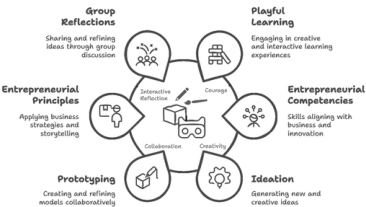
According to Franzén et al. (2020) playful approaches to entrepreneurship teaching lean on courage, creativity, conversation, and collaboration Applying these notions, the PL approach introduced in our study can in this way be formulated as follows:
Courage: Playful learning involves risk-taking, and learning through progressive failure (Whitton, 2022), but experimentalism is essential to it. Play is exploration as much as it is self-expressive—people play to discover expanded versions of themselves (Henricks, 2015). Being courageous and experimental is essential in entrepreneurship as entrepreneurs must take calculated risks and be comfortable with uncertainty.
Creativity: Rapid prototyping as a hands-on, body-on, minds-on approach is integral to playful learning (Kangas, 2010). “Play is deliberately working with the materials we encounter” (Bogost, 2016, p. 91), and playful learning uses a similar agenda. Entrepreneurs need to be creative and resourceful: Innovation often comes from testing unconventional ideas by combining them with thinking with materials.
Conversation, reformulated here as Interactive reflection: We understand both learning and play as social, contextual, and mediated forms of interaction. Entrepreneurs must be ready to interact, reflect, and engage in conversations, together and interactively; To pitch their ideas effectively to investors, customers, and stakeholders. Pitching with prototypes bridges creativity, critical thinking, and business acumen.
Collaboration: Entrepreneurs rarely work alone—they lead teams and manage partnerships. Our learning innovation involves creative group work (Burke, 2011), accentuating a co-creative approach instead of competition that involves negotiation and decision-making and strengthening leadership skills.
While creativity produces ideas and artifacts (Power, 2011, p. 316), “play is often in the materiality of things” (Heljakka, 2023b, p. 109). Earlier research shows how playing with things is a primer for innovation within technological domains (Riede et al., 2018, p. 55). Here, we extend this thinking by linking the innovation potential of ‘toying’ with materials with entrepreneurial thinking and competencies.
Explaining the Integration of Toy Design and DBL in PL Studies focusing on the material aspect of adult creativity and on tools that support creative PL in the HE context are scarce. The tools, techniques, and technologies used in PL manifest in interactions between structured learning scenarios and materials intended to activate students and generate learning experiences. In the current PL, there is much interest in game-based or even toy-based learning (Ihamäki & Heljakka, 2018). Toys provide structure to play (Back et al., 2017). Any item that can be used for play may be considered a toy.
Design-based learning (DBL) is a pedagogical approach that integrates design thinking and problem-solving into the learning process. It encourages
students to actively engage in hands-on, iterative, and creative exploration. DBL emphasizes real-world problem-solving, collaboration, and innovation, making it highly relevant to the entrepreneurship discipline (Al-Fadly & Abbas, 2021). In our innovative teaching, we used toy design to tackle design challenges. Design thinking matters in entrepreneurialism, as entrepreneurs must deeply understand users’ emotions, behaviors, and desires. Again, toy designers must experiment with materials, aesthetics, ergonomics, and interactivity, learning to adapt designs based on testing. Toy design encourages divergent thinking, as students must design for playful experiences, not just utility.
Rapid prototyping in toy design is an iterative and fast-paced process that allows designers to develop, test, and refine concepts efficiently. It involves creating quick, low-cost models to evaluate use’s physical, functional, fictional, and affective dimensions (Paavilainen & Heljakka, 2018). “Thinking in three dimensions or multiple modalities pushes creative and critical thinking and allows more opportunities for students to learn with and from one another” (Honeyford & Boyd, 2015, p. 71). Toy prototypes spark conversations about the form and functionality of the designs and their relevance to playability. Moreover, toys often have embedded narratives, and the fictional dimension of toys means that students learn to create compelling stories around their designs. The affective dimension of toy prototypes helps students to consider user emotions.
STUDY: DESCRIBING OUR TEACHING INNOVATION For courage, creativity, collaboration, and interactive reflection to flourish in successful teaching, additional considerations must occur. Three major components of invitations to play leveraged as part of PL involve a) allowing a light-hearted and psychologically safe atmosphere, b) giving students the possibility to move around in physical space, and c) inviting playfulness by creative use of various materials (Suomi & Heljakka, 2024). We ensured that the aforementioned criteria were met for the study at hand.
In our co-teaching, we designed, tried, and tested a multidisciplinary teaching innovation at two universities in Finland, involving researchers with teaching duties in entrepreneurship, design, educational sciences, and playful learning. By leveraging two workshops in different disciplines with different universities in Pori and Rovaniemi, we asked the students to a) create innovations for the plush toy market with expanding target groups and sustainability in mind and b) to brainstorm an idea that combines playfulness, a natural environment, and tourism in some way— and to build a three-dimensional and toy-like model of this through rapid prototyping.
During the workshop at the School of Economics, students attending a course in entrepreneurship titled “Entrepreneurial opportunities” (offered at the intermediate level) and working in small groups were encouraged to consider various factors when planning a new plush toy. These factors included creating backstories for the toys, ensuring relatability and
Playful Learning Through Toy Design: Innovating Pedagogy for Entrepreneurial Learning 89
collectability, fostering an emotional connection and brand loyalty, and emphasizing quality and safety. Additionally, sustainability aspects, such as replayability, were highlighted.
During the workshop with students of teacher education attending a course titled “Playful and Game-based Learning”(offered at the intermediated level), students worked in small groups to innovate play-based educational content and pitch the idea in class. Next, we explore how the dimensions of the dimensions of courage, creativity, collaboration, and conversation emerged as part of the teaching: Courage: Put into play in engagement with physical materials, workshop participants needed guidance in setting the goals for their designs built with the given materials during the workshops. We built confidence and rapport in students by showing examples of existing toys and playful designs and ensured a safe space for experimenting with the given task and materials. Importantly, as teachers, we also participated in the task by working alongside the students so that they became assured of the inclusive atmosphere of the workshop.
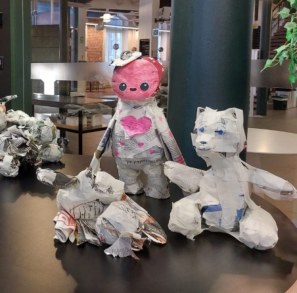
Creativity: In exercising toy design, students learn to think beyond functionality and create experiences that evoke curiosity and wonder (Legaard, 2024). The toy design session, during which students used rapid prototyping to craft and create toy prototypes from scratch, was supported by theoretical insights gained in toy design education. The goals were 1. experiential novelty, 2. possibilities for interaction, 3. fostering creativity and exploration, and 4. creating aesthetics that elicit the imagination (Legaard, 2024). We facilitated the creative process by using simple and well- known materials—scrap newspapers and masking tape, demonstrating how they could be turned into three-dimensional forms by scrunching them and wiring tape around the created paper structures.
Collaboration: The students worked in small groups to lower the threshold for learning in unconventional ways. It is important to note that students’ participation in playful learning interventions and their perceptions of being playful can vary across disciplines. To exemplify, students in design and teacher education may be more adapted to exploratory and hands-on learning. In contrast, students in economics may require more motivation and rationalization of the DBL approach as part of PL.
Conversation reformulated as Interactive reflection: The students were asked to create pitches for their designed solutions. In these pitches, they demonstrated the toys’ possible uses and playability and complimented the presentation with PowerPoint presentations or videos. Students were then encouraged to comment on each other’s group work in a friendly and constructive way, which refers to interactive reflection.
FINDINGS By using simple materials to come up with physical models for design tasks as part of rapid prototyping, students in economics and teacher education participated in PL with DBL focused on toy design. In the workshops, students prototyped, pitched, and commented on their toy concepts in groups, much like entrepreneurs pitch business ideas. The results illustrated in Figure 1. illustrate the students’ capacity to work creatively with simple materials to turn their ideas into tangible and playable objects. The co-teaching organized as multidisciplinary teaching innovation illustrated how integrating toy design into learning develops a range of entrepreneurial competencies alongside play(fulness) competencies by immersing students in a hands-on, iterative, and user-centered process. The creative nature of toy design helps, potentially, to promote hands-on, mind-on, and body- on learning and to develop mental agility, which is critical for navigating real-world business challenges. We see a strong connection here to the enhancement of a playful mindset, which may assist in developing an entrepreneurial mindset. Based on the learnings gained in the study, we introduce the “Framework for Playful Entrepreneurial Learning” in Figure 2 below.
Figure 1: Rapid prototypes of toys and playables at the two workshops.Figure 2: Framework for playful entrepreneurial learning.
Playful Learning Through Toy Design: Innovating Pedagogy for Entrepreneurial Learning 91
DISCUSSION
Our findings provide insights into the relevance of using PL to cultivate entrepreneurial skills and flexible and playful mindsets through toy design. The study’s findings encourage further instances of DBL within PL to be experimented with as part of multidisciplinary teaching within HE. Entrepreneurial skills are necessary for anyone, not just those who wish to become entrepreneurs in the future. The limitation of the research is that it only builds on learning gained as part of two workshops. However, we hope the Framework for Playful Entrepreneurial Learning will inspire more work in this field, including, for example, experimentation with other tools and even technologies, like generative AI, and consider this through the lenses of AIPlay (Kangas & Heljakka, 2024).
CONCLUSION
Entrepreneurial education must evolve beyond traditional business case studies and lectures to embrace experiential, hands-on learning methods that foster creativity, problem-solving, and adaptability. One innovative approach is integrating toy design practices into entrepreneurial learning, positioning play(fulness) as a strategic tool for developing core entrepreneurial competencies. Toy design is not just about crafting objects for entertainment; it is an iterative, user-centered, and creativity-driven process that mirrors the challenges entrepreneurs face in ideation, prototyping, testing, and innovating. By integrating toy design exercises into entrepreneurial education, we create a dynamic, interdisciplinary learning experience that fosters courage, creativity, collaboration, and conversation through interactive reflection.
ACKNOWLEDGMENT
The authors thank all students who participated in this study in Pori and Rovaniemi, Finland.
REFERENCES
Al-Fadly, A., & Abbas, S. K. (2021). Co-design-based learning for entrepreneurs in the digital age. Management and Business Economics, 30(1), 1–12. Back, J. Marquez-Segura, E. and Waern, A. (2017). Designing for Transformative
Play. ACM Transactions on Computer-Human Interaction, 24(3), article 18. Bateson, P. P. G., & Martin, P. (2013). Play, playfulness, creativity and innovation.
Cambridge University Press. Bogost, I. (2016). Play Anything. The Pleasure of Limits, the Uses of Boredom, and the Secret of Games. New York: Basic Books. Burke, A. (2011). Group work: How to use groups effectively. The Journal of
Effective Teaching, 11(2), 87–95. Dodgson, M., & Gann, D. M. (2018). The playful entrepreneur: How to adapt and thrive in uncertain times. Yale University Press. Fayolle, A. (2018). Introduction. In Fayolle, A. (Ed.) A research agenda for
entrepreneurship education (pp. 1–9). Edward Elgar Publishing.
Fenwick, T. Edwards, R,. & Sawchuk, P. (2015). Emerging approaches to educational research: Tracing the socio-material. Routledge. Franzén, R. Heljakka, K,. & Nieminen, L. (2020). Playful Approaches to Entrepreneurial Competencies in University Teaching: Introducing the 4Cs Model, in: Markopoulos, E. Goonetilleke, R., Ho, A. and Luximon, Y. (Eds.) Advances in Creativity, Innovation, Entrepreneurship and Communication of Design. AHFE 2020. Advances in Intelligent Systems and Computing, vol. 1218. Springer, Cham. Golinkoff, R. M,. Kucirkova, N,. & Hirsh-Pasek, K. (2025). Playful learning is the
missing link in educational success. Learning and Instruction, 96, 102073. Heljakka, K. & (2023a). Building Playful Resilience in Higher Education: Learning by Doing and Doing by Playing. Frontiers in Education (Vol. 8). Frontiers. Sec. Educational Psychology, Volume 8 - 2023, https://doi.org/10.3389/ feduc.2023.1071552 Heljakka, K., & (2023b). The Art of Stuff-Mess-Wonder. Creative playful learning with the Comicubes. Journal of Adult Playfulness, 5(1), 107–130. Heljakka, K., & Ihamäki, P. (2018). Preschoolers learning with the Internet of Toys:
From toy-based edutainment to transmedia literacy. Seminar.net 14(1), 85–102. Henricks, T. S. (2015). Play as Self-Realization – Toward a General Theory of Play. In Johnson, J. E., Eberle, S. G., Henricks, T. S., & Kuschner, D. (Eds.) The Handbook of the Study of Play Vol. 2. (pp. 1–24). Rowman & Littlefield. Hjorth, D. (2005). Organizational entrepreneurship. With de Certeau on creating
heterotopias (or spaces for play). Journal of Management Inquiry, 14(4), 386–398. Honeyford, M., & Boyd, K. (2015). Learning through play. Portraits, photoshop and visual literacy practices. Journal of Adolescent and Adult Literacy, July/August 2015, 63–73. Jørgensen, H. H., Schrøder, V., & Skovbjerg, H. M. (2023). Playful Learning,
Space and Materiality: An Integrative Literature Review. Scandinavian Journal of Educational Research, 67(3), 419–432. Kangas, M. (2010) Creative and Playful Learning: Learning through Game Co- Creation and Games in a Playful Learning Environment. Thinking Skills and Creativity, 5(1), 1–15. Kangas, M., & Heljakka, K. (2024). AI Play in Higher Education: Students’
perceptions of play and co-creation of knowledge with generative AI. In T. Ahram and W. Karwowski (Eds.) Human Factors in Design, Engineering, and Computing (Vol. 159). AHFE Open Access, AHFE International, USA. Kangas, M. Siklander, P. Randolph, J., & Ruokamo, H. (2017). Teachers’ engagement and students’ satisfaction with a Playful Learning environment. Teaching and Teacher Education, 63, 274–284. Lacasa, P., García-Pernía, M.R., & Cortés, S.(2015). Creative collaboration in young
digital communities. In N. Zagalo and P. Branco (Eds.), Creativity in the digital age (pp. 135–157). Springer Verlag. Legaard, J. F. (2024). Into the wonder-exploring the design of playables. Proceedings of the International Design Conference—DESIGN 2024. Luque C. M., & Baranauskas, M. C. C. (2024). Enactive interaction in support of
creative learning: A systematic literature review. International Journal of Human– Computer Interaction, 1–26. Paavilainen, J., & Heljakka, K. (2018). Analysis Workshop II: Hybrid Money Games and Toys. In: Paavilainen, Janne, Heljakka, Katriina, Arjoranta, Jonne, Kankainen, Ville, Lahdenperä, Linda, Koskinen, Elina, Kinnunen, Jani, Sihvonen, Lilli, Nummenmaa, Timo, Mäyrä, Frans & Koskimaa, Raine. Hybrid Social Play Final Report. Trim research reports (26).
Playful Learning Through Toy Design: Innovating Pedagogy for Entrepreneurial Learning 93
Riede, F. Johannsen, N. N. Högberg, A. Nowell, A., & Lombard, M. (2018). The role of play objects and object play in human cognitive evolution and innovation. Evolutionary Anthropology: Issues, News, and Reviews, 27(1), 46–59. Robinson, S. Neergaard, H. Tanggaard, L., & Krueger, N. (2016). New horizons in
entrepreneurship: From teacher-led to student-centered learning, Education +n Training, 58(7/8), 661–683. Suomi, K., & Heljakka, K. (2024). Playful learning as a pedagogical method in entrepreneurship education. In: Big questions and great answers in entrepreneurship research (Eds.) Alain Fayolle, Sandrine Le Pontois, & Duncan Pelly, Edward Elgar Publishing. Varela, F. J., Thompson, E., & Rosch, E. (2017). The embodied mind, revised edition:
Cognitive science and human experience. MIT Press. Vygotsky, L. (1978). Mind in society: The development of higher psychological processes. Cambridge: Harvard University Press. Whitton, N. (2022). Play and learning in adulthood. Reimagining pedagogy and the
politics of education. Palgrave Macmillan. Whitton, N., & Langan, M. (2019). Fun and games in higher education: an analysis of UK student perspectives. Teaching in Higher Education, 24(8), 1000–1013.
LISTED IN THE AHFE DIGITAL BOOKSTORE CATALOGUE
Explore the complete digital volume
Creativity, Innovation and Entrepreneurship
Read this individual research paper free through the original publisher, or explore the full digital proceedings book.
ISBN 978-1-964867-42-7
Explore this ISBN in the AHFE Bookstore ↗Listed in the July 2026 bookstore catalogue; search by ISBN to confirm current availability · Digital book purchase optional