Serkan Güneş (2023). Evaluation of Creative Designer Roles In Terms of Entrepreneurial Competences. In: Creativity, Innovation and Entrepreneurship. AHFE Open Access, vol. 74, pp. 115–122. https://doi.org/10.54941/ahfe1003312
In terms of defining and implementing new and innovative ideas, creativity and entrepreneurship are inextricably linked. In this context, creativity and entrepreneurship inevitably form sub-functions of each other in terms of performance. Because both concepts are carried out in uncertain and dynamic situations, their qualities mutually complement each other. However, it is not always possible for every creative person to be an entrepreneur or vice versa.Design is a creative process in which ideas originate from a combination of professional experience, intuition, and the knowledge required. The design process takes place in an uncertain environment, and design concepts do not emerge in a vacuum; they are frequently the product of the creative synthesis of earlier experiences with knowledge, insight, and entrepreneurship that have contributed to the development and success of many businesses. Design encompasses not only creative thinking but also innovative, productive, and compositional activities as part of entrepreneurship with a mix of rational, ideal, and pragmatic inquiry. Therefore, designers not only must be creative in the design phase but also need to act as entrepreneurs/intrapreneurs as they seek to identify and address customer needs and effectively communicate and prototype their ideas to potential customers. The most creative part of the design process is identifying problems and developing solutions for analysis, evaluation, and selection to help businesses improve their operations and efficiency. To achieve these goals, designers may need to assume certain roles.The concept of entrepreneurship essentially contains positive and privileged meanings. For this reason, many people believe that they have entrepreneurial characteristics and want to be mentioned as entrepreneurs. Some professions, such as industrial design, naturally claim to be entrepreneurial because of their activities. Due to the positive meaning of entrepreneurship, designers are concerned about developing and transforming their practices within the principles of entrepreneurship. Moreover, current design discourses imply that design thinking will help entrepreneurs in the generation and selection of innovative ideas. Simply put, design entrepreneurship is the collection of correct skills and abilities required to develop the right ideas and market them as successful design products. However, to be an entrepreneur, some entrepreneurial personality traits must be present in addition to the establishment of some pre-existing conditions.Within the scope of this study, it is aimed to compare the creative and innovative roles identified in the literature and attributed to designers with the competencies needed for entrepreneurship and identify possible intersections. The first stage of the study attempted to identify the roles attributed to designers and entrepreneurship competencies. The following stage of the review aims to determine the major or key roles of the designers. The next stage of the research focuses on 41 entrepreneurship competence frameworks under four main headings. The study's last section contrasted 83 creative and innovative role and definition contents assigned to designers with 41 entrepreneurial competence definitions using NLP-based text similarity measurement, and the text mining results were evaluated through correspondence analysis.
Designer roles describe the situations in which they have certain responsibi- lities and rights according to the position they have acquired in a profession. Designers perform their profession by acting in accordance with their profes- sional roles and taking appropriate actions. The complex nature of the design activity necessitates designers to take on different roles. Harmony between these roles is essential, otherwise conflict is inevitable due to incompatibility. The first dimension of the conflict is that the professionally expected role is not fulfilled by the designers. The expected role may emerge from both pro- fessionally and due to changing work conditions and practice. Another form of conflict is that the designers do not use their roles according to their place and time, that is, role mismatch.
When the literature is examined, the organic relationship between design and entrepreneurship is often emphasized. Moreover, entrepreneurship is among the roles directly defined for the designer in many studies (Tan, 2012; Press & Cooper, 2003). However, it is also seen that the sum of the right skills and abilities required to develop the right ideas and market them as successful design products is defined as the concept of design entrepreneurship (Güne¸s, 2012). The organic relationship between design and entrepreneurship que- stions how design can add value to entrepreneurial activity, since it seeks to create opportunities in both concepts (Telalbasic, 2021). Because both the methodological structure of design-oriented thinking and the existence of design awareness (Nielsen et al., 2021; Kwon et al., 2021), the nature of design to form new ventures and new product development (Valencia, 2021), and the designer’s organizational collaborations (Liu, 2021) are the ways that design supports entrepreneurship within existing frameworks to provide insight and evidence of how it contributes to their activity.
The existence of this mutually beneficial relationship between design and entrepreneurship makes it necessary to question the priorities, interests and belief structures of both fields. In this context, these two key elements of the creative ecosystem need to demonstrate their talents in a sustainable and collaborative way. The differences and overlaps between the two concepts should be revealed, the roles that will benefit each other and the advantage of using these roles as a strategic tool should be questioned. Although there are inevitable partnerships between design and entrepreneurship in terms of creating new ideas, products and services, both concepts have their own spe- cific conditions, competencies and practices. Within the scope of this study, firstly the roles attributed to designers will be discussed, then a comparison has been made over the competencies defined for entrepreneurship over the definition of each role. For comparison, NLP-based text analysis was carried out for each role and competency content, and the results were discussed through correspondence analysis.
DESIGNER ROLES AND ENTREPRENEURSHIP COMPETENCIES The concept of entrepreneurship essentially contains positive and privileged meanings. For this reason, many people believe that they have entrepre- neurial characteristics and want to be mentioned as an entrepreneur. Some
Evaluation of Creative Designer Roles in the Terms of Entrepreneurial Competences 117
professions naturally claim to be entrepreneurs because of their activities. Due to the positive meaning of entrepreneurship, others are concerned about developing and transforming their practices within the principles of entrepre- neurship. However, entrepreneurship has gained more importance recently, and it has begun to be considered the main factor of economic development, employment creation, and social development. The personality characteri- stics of entrepreneurs, who are the actors of such an important field, have also been among the entrepreneurship determinants.
In the classical sense, an entrepreneur can be defined as a person who starts a business, who is in the production process by bringing together various production factors and taking risks, and as a result, aims to gain profit. be an entrepreneur, there must be some entrepreneurial personality traits besides establishing some existing conditions. These entrepreneurial characteristics are also an essential factor in the entrepreneurial tendency of the individual.
Product designers must play certain roles in terms of their job descripti- ons. Designers play different roles in generating ideas, how to collaborate with others, and making decisions, as long as the corporate strategy allows. When the changing ways of doing business, the differences according to the sector, and the requirements of different environments of the industries are evaluated, it is seen that designers can take on very different roles in com- panies. Hales (1985), who noticed this diversity of roles long ago, tried to explain the designer with the metaphor of a chameleon. Entrepreneurship is a role that is mentioned among the designer roles and is recommended to be played by designers. Moreover, in many studies, entrepreneurship is consi- dered the main role played by the designer through the definitions of design entrepreneurship and entrepreneurial design. Design entrepreneurship is not about creating a new job, but about gaining a new vision and talent through design-oriented thinking in existing businesses. Entrepreneurial design, on the other hand, involves combining design and business concepts and desi- gning and actually implementing the entire life cycle of how a product or service gets from an idea to its market. In any case, design and entrepreneur- ship are an inseparable whole that supports each other and both concepts have something to learn from each other.
Since the design work is related to the product, it assigns certain roles to the designer in the entire life cycle of the product. In the literature study by Güne¸s (2021) using the Snowballing protocol, 83 roles were found in the lite- rature. In the work content, these roles are clustered as Creator/Conceptor as functional and Conductor/Coordinator as administrative and Connector as linking as roles. In the study conducted by Sumter et al. (2017), it is seen that the major roles of designers are determined as strategic, coordinator, and functional roles. Although the authors declare that they have identified these major roles based on the literature, it is seen that this distinction is not justified in the study. When the Design Management literature is evaluated, it is stated that the designers, by the process, operate in terms of institu- tional and project level (Topalian, 1980), policy and project level (Oakley, 1990), and strategic, tactical, and operational level (Chung, 1992). Gene- rally, it is seen that designers play roles in both the operational way and the managerial roles. However, no study has identified entrepreneurship as a key
118 Güne¸s
role for the designer. Because entrepreneurship has a very broad scope, it includes many roles that are already attributed directly and indirectly such as managing/coordinating / organizing and obtaining information/cooperation / communication. Within the scope of the designer roles of the study, Güne¸s’s work was taken as the basis.
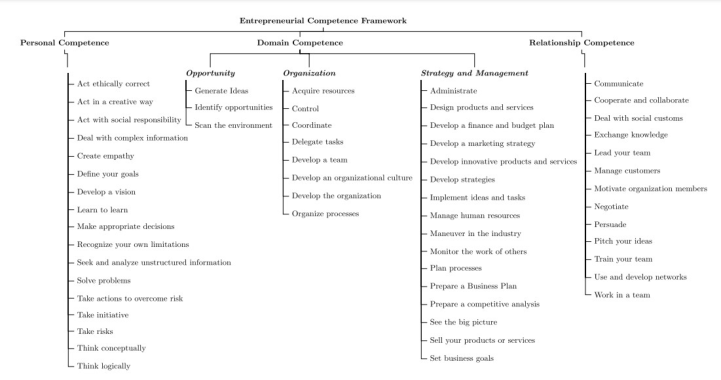
On entrepreneurial competencies, it is possible to reach different classifica- tions in the literature. The first satisfaction research identified on this subject is the work of Michelmore and Rowley (2010). In this study, the literature was examined until 2008, and it was seen that 41 competence frameworks were created under four main headings. Another study was by Tittel and Ter- zidis (2020). In this comprehensive study, the authors performed an extensive literature study on entrepreneurship competencies and made 57 qualifica- tion definitions under three basic categories (Personal, Domain, Relationship Competence), each of which includes knowledge, skills, and attitudes. This study has been accepted as the main reference of the current study due to its extensive effort in determining each competency and the most up-to-date study in its field.
METHODOLOGY
Within the scope of the study, 83 designer role definitions presented in Table 1 were subjected to mutual content analysis with 57 entrepreneurial competencies in Figure 1.
To do this, first, for each designer role, a minimum of 10 content from the literature and internet environment must be added to the system. txt for- mat is defined. For example, the ten most cited academic papers in business for the storyteller role (e.g., Taylor et. al, 2002) and 20 up-to-date content (e.g., https://en. wikipedia.org/wiki/Organizational_storytelling) that contai- ning organizational definitions on the internet were included in the content repository for this role. In this manner, a content repository was created for each role. However, under 3 basic competencies, each entrepreneurial compe- tency is defined in the comparison repository. The basic method of the study is based on scoring by comparing each role repository and the entrepreneurship content repository one by one.
Similarity assessment can be made between both texts at the lexical and semantic level. Lexical similarity is a rather superficial analysis. Here, the overlap of both word sets is compared to extract the similarity score. The higher the number of repeated words in the compared text pieces, the higher the similarity score. However, the meanings of these text fragments can dif- fer. This method is more commonly used for keyword matching. Semantic similarity refers to the similarity between two pieces of text when their con- textual meanings are considered. Semantic similarity is often used to perform NLP tasks such as description identification. The types of semantic similarity approaches are different in measuring the distance between pieces of text (Euclidean distance/cosine similarity or any other method). The compared texts are first converted to numeric vectors (e.g., with techniques such as Word2vec and Glove), and they may be semantically similar (value 1) or not (value 0). In this study, cosine similarity was used as a method. For
Evaluation of Creative Designer Roles in the Terms of Entrepreneurial Competences 119
Table 1. 83 designer roles from the literature (Güne¸s, 2021).
Intermediary Interpreter Interpreter of Complex Systems
Producer
Mediator Navigator Negotiator NPD Process Leader
Pioneer Problem Solver Researcher
Professional Promoter Quality Producer
Questioner Rationalist Requirement and Criteria Provider
Seducer Social Visionaries
Visionaries Visualizer
Star Stimulator Storyteller Strategist Strategy Visualizer Synthesizer Team Member Teamwork Leader
Trans disciplinary Integrator
Figure 1: Categorized framework of entrepreneurial competence. (Tittel and Terzidis 2020).
semantic similarity, high vector Universal Sentence Encoder in Python - Tran- sformer encoder is preferred. In summary, if there is a semantic similarity between each role definition and each enterprise competency, each similarity is added to the table as 1 point. Because of the semantic similarity analysis, the
120 Güne¸s
similarity scores of each designer role over different entrepreneurship com- petencies were recorded in the Excel table (83x57). Then, for simplification, each entrepreneurial competency was transformed into the basic categories of Personal, Domain, Relationship Competence in accordance with the study of Tittel and Terzidis (2020), and a new Excel table was created with the sum of the score values (83x3). This table was then subjected to Hierarchical Clustering Analysis (Ward’s Method) with the SPSS program.
SURVEY RESULTS According to the grouped Excel table, Relational Competencies (2087) got the highest score and Personal Competencies (1490) got the lowest score in terms of designer roles. The roles that produce the highest score for each com- petency are Entrepreneur (147), Creator (107) and Design Manager (101), respectively. This is not surprising when entrepreneurial competencies are at the forefront. It can be said that the creator role has one of the high- est values because this role prioritizes introducing something new (product, service, etc.). The expression manager, which directly refers to a managerial process, is also a common expression in all entrepreneurship competencies. The least valued role statements are Copromoter (36), Masters/Authorities (32) and Interpreter of Complex Systems (21) respectively. Although these roles are related to entrepreneurship, it is thought that the low frequency of use of the terms causes low score values.
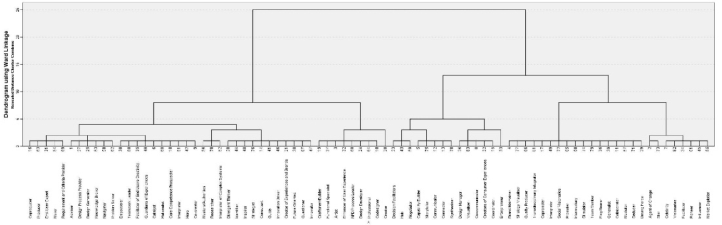
In Figure 2, the Ward’s dendrogram obtained because of the analysis is presented. A dendrogram is a diagram that shows the hierarchical relation- ship between objects. The low height of the link connecting the objects in the dendrogram indicates a high-value relationship. However, the number of common links indicates a possible clustering. In other words, it is the common connections that matter, not the horizontal object proximity. The location of the tags doesn’t make any sense. The higher the position, the later the object connects with others. At this point, clades become important before the lea- ves at the terminal end. Some clades may have a single leaf (simplicifolious). One must interpret the simplicifolious entity to show that it differs signifi- cantly from the distribution in the remaining fragments. The parts whose connections are closest to the horizontal axis are most closely related.
Figure 2: The Ward’s dendrogram of three clusters.
Evaluation of Creative Designer Roles in the Terms of Entrepreneurial Competences 121
When the Ward’s dendrogram is examined, it is seen that there are basically 3 clusters. The first set consists of 14 elements (Capability Buil- der, Co-communicator, Communicator, Connector, Coordinator, Creators of Consumer Experiences, Decision Facilitators, Design Manager, Entrepre- neur, Hub, Negotiator, Storyteller, Synthesiser, Visualizer) and exhibits more homogeneous features compared to the others. The most important featu- res of these roles are that they all score higher than the others in terms of Relational Entrepreneurship Competencies. The Negotiator role obtained the highest semantic similarity score (59) in terms of Relational Entrepreneur- ship Competencies. The second set consists of 24 roles (Agent of Change, Brand Maintainer, Celebrity, Collaborator, Copromoter, Driving Force, Faci- litator, Flag Bearer, Generalist, Influencer, Integrator, Intermediary, Market Exploiter, Mediator, Pioneer, Promoter, Quality Producer, Seducer, Social Visionaries, Star, Stimulator, Strategy Visualizer, Team Member, Transdisci- plinary Integrator, Visionaries). This cluster is not as homogeneous as the first cluster. The most important feature of this cluster is that some of the cluster members have high Personal Entrepreneurship Competence scores. This cluster generally had low domain entrepreneurship competencies, but the set had the highest Relational Entrepreneurship Competence scores after the first cluster. The third cluster shows high homogeneity. The biggest feature of this cluster is that the Domain Entrepreneurship Competencies scores are the highest. However, relational entrepreneurship competency scores were low.
CONCLUSION
There are different personality traits, values and behaviors that distinguish entrepreneurs from non-entrepreneurs, and these differences must be investi- gated and defined. Entrepreneurship competencies are important to produce, develop and implement new applications in the design process and manage- ment. Within the scope of this study, 83 designer roles and 57 entrepreneurial competencies were subjected to semantic content analysis. Because the analy- sis was within the scope of the study, it was possible to represent the designer roles in the three clusters in terms of entrepreneurial competencies. The first cluster is a relatively small cluster and rather Relational Entrepreneurship Competencies are related and show Connector quality. In terms of these desi- gner roles, being a good communicator is one of the most important skills required to display entrepreneurial qualities. Interestingly, these roles received relatively low values from technical field applications. The second cluster is a heterogeneous cluster. The element that makes this set interesting is the role in which the designer sometimes expresses himself as a detached individual by revealing his personal characteristics. It has been seen that these roles are dire- ctly related to Personal Entrepreneurship Competencies as they point to an individual who is self-confident and has values for entrepreneurship. Another feature of this cluster is the high Relational Entrepreneurship Competency scores. It refers to a group of roles that are self-confident and reveal their own discourse in a relationship. The last set is the largest set. What makes this
122 Güne¸s
cluster special is that it is domain - based. In a way, these roles, which are rela- ted to the technical part of the design process and the kitchen of the business, are directly related to the technical capacity of the entrepreneurial designer and the design process. Competencies such as analysis ability, technology and model discovery, technical knowledge, solution-oriented thinking point to the field. It was seen that each design role is directly related to the three competence areas. So every design role has some affinity for entrepreneur- ship. However, different roles show a more intense relationship with different entrepreneurial competencies. As the designer is not expected to play all these roles, only one entrepreneurial competence creates suitable conditions for him to be seen as an entrepreneur.
REFERENCES
Chung, K. W. (1992). Developing a Postgraduate Curriculum in Design Management for Korea. Journal of Art & Design Education, 11(1), 89–103. Günes, S. (2012). Design entrepreneurship in product design education. Procedia-
Social and Behavioral Sciences, 51, pp. 64–68. Güne¸s, S. (2021). Exploring the Different Roles of the Designer in Practice: Creator or Others. Journal of Engineering, 9(1), pp. 19–32. Hales, C. (1985). Designer as Chameleon. Design Studies, 6(2), pp. 111–114. Kwon, H., Choi, Y. and Lam, B. (2021). Design for Social Enterprises: A Comparative
Case Study of Design Support Programmes in the United Kingdom and South Korea. The Design Journal, 24(5), pp. 783–805. Liu, S. X. (2021). Barriers to Bringing Design Function into Technology Start-Ups: A Survey on the Incubation Programme of Hong Kong Science Park. The Design Journal, 24(5), pp. 807–828. Mitchelmore, S. & Rowley, J. (2010). Entrepreneurial Competencies: A Litera-
ture Review and Development Agenda. International Journal of Entrepreneurial Behavior and Research, 16(2), 92–111. Nielsen, S. L., Christensen, P. R. and Storvang, P. (2021). Does Design Thinking Benefit Ambidextrous Dynamics between SME Managers’ Entrepreneurial and Administrative Mindsets? The Design Journal, 24(5), pp. 683–703. Oakley, M. (1990). Design and Design Management. Cambridge, MA: Blackwell Inc. Press, M., and Cooper, R. (2003). The design experience: The role of design and
designers in the twenty-first century. Farnham: Ashgate Publishing Ltd. Sumter, D. X., Bakker, C. A. and Balkenende, A. R. (2017). The Role of Product Designers in the Transition Towards the Circular Economy: A Reality Check. In PLATE: Product Lifetimes and The Environment (pp. 391-396). IOS Press. Tan, L. (2012). Understanding the different roles of the designer in design for social
good. A study of design methodology in the DOTT 07 (Designs of the Time 2007) Projects (Doctoral dissertation). Northumbria University, Newcastle. Taylor, S. S., Fisher, D. and Dufresne, R. L. (2002). The Aesthetics of Management Storytelling: A Key to Organizational Learning. Management Learning, 33(3), pp. 313–330. Telalbasic, I. (2021). The Value of Design-driven Entrepreneurship. The Design
Journal, 24(5), pp. 675–682. Topalian, A. (1980). The Management of Design Projects. Associated Business Press. Valencia, A., Lievesley, M. and Vaugh, T. (2021). Four Mindsets of Designer- Entrepreneurs. The Design Journal, 24(5), pp. 705–726.
LISTED IN THE AHFE DIGITAL BOOKSTORE CATALOGUE
Explore the complete digital volume
Creativity, Innovation and Entrepreneurship
Read this individual research paper free through the original publisher, or explore the full digital proceedings book.
ISBN 978-1-958651-50-6
Explore this ISBN in the AHFE Bookstore ↗Listed in the July 2026 bookstore catalogue; search by ISBN to confirm current availability · Digital book purchase optional