Ana Moreira Da Silva (2022). Creativity and Emotion in Design. In: Ergonomics In Design. AHFE Open Access, vol. 47, pp. 667–672. https://doi.org/10.54941/ahfe1001996
Creativity in Design can be related to Emotion, particularly to the Emotional Mind. We perceive, interpret and memorize things differently depending on our emotional states. We are emotional and emphatic beings. The experiences we have gone through, the challenges we have learned from and the circumstances that have made us, reflect on our work as designers.Creativity is the process of solving a new problem by creating a new pattern of brain connections; it is a spark between previously unrelated concepts acquired through learning and experiencing. The act of creation requires the brain to find new associations, new connections between its neurons. The creation of something new and unusual is literally a spark that links previously unrelated neural groups and joins previously distant conceptual areas: the creative thinking.Sketching can stimulate a re-interpretive cycle in the individual designer’s idea generation process. It appears that sketches stimulate creativity in this ideas generation process, by providing new directions for ideas to breed in an individual generate-interpret cycle. A drawing happens when we engage our hands to capture what we are thinking or experiencing. The hand is an extension for our brain which can make visible our ideas through sketches. The proportion of sensorimotor cortex devoted to hand function is considerably greater than that devoted to other body segments. Several authors even call the hand has ‘the outer brain’. We are developing an ongoing research concerned with investigating the ways in which the activity of sketching stimulates creativity in design.Under a qualitative research, based on literature review methodology, through the study and interpretation of several authors’ statements, this paper investigates the relations between Creativity and Emotion in Design, and also, aims to stimulate reflection and bring new perspectives on the nowadays use of sketching within this relation creativity/emotions present in the designers mind as an emotional human being.
Under a qualitative research, based on literature review methodology, through the study and interpretation of several authors’ statements, this paper investigates the relationship between creativity and emotion, aiming to stimulate reflection and bringing new perspectives on the nowadays use of sketching within this relation creativity/emotions present in the designers mind as emotional human beings. This study integrates an ongoing resea- rch concerned with investigating the ways in which the activity of sketching stimulates creativity in design.
CREATIVITY AND EMOTION Our cultures and societies are all different, but there is something that we all have in common: the human brain. Our brain makes us who we are, connects our minds, and allows learning and creation. Howard Gardner (2010) in his book Five Minds for the Future, already considers the relevance of the Creating Mind as it is able to go beyond existing knowledge to pose new questions and offer new solutions.
Nowadays, according to several authors (Asma, S. T. and Gabriel, R., 2018; Valsiner, J., and Van Der Veer, R., 2014; Chiao, J. Y., and Immordino- Yang, M. H. 2013; Jacob, M., J., and Baas, J., (eds), 2010), we can consider different aspects of our cognitive brain, different minds. Without them, humanity could not have achieved all targets that it has. We can rightfully
consider them as part of our brains. They could be called: the Learning Mind, the Emotional Mind, the Social Mind, the Cultural Mind and the Creative Mind.
For our research we are particularly interested on the Emotional Mind and the Creative Mind.
Our neurons do not remember each set of signals that comes to them, most of all are momentary. Brain remembers only the events that are likely to be important for us in the future. Our brains are literally saturated with values and emotions. Some of them – such as safety, food and warmth - were formed by the evolution of our biological species. Others are formed throughout the course of our individual lives, such as family, religion, cultural values, social environment, tasting our favorite dishes, or admiration for a night sky filled with stars, and so on. Every individual has his/her own list. The experiences we have gone through, the challenges we have learned from and the circumstances that have made us, are significant values. This takes part of our Emotional Mind.
Scientific advances on our understanding of the brain show how emo- tion and cognition are thoroughly intertwined. We can consider emotions as an important part of our life, because they interfere in the way we feel, we experience, we behave, we think and even how we create (Norman, 2004).
In his book Emotional Design, establishing an analogy between product design and cooking, Aarron Walter (2011) states that interacting with arti- facts is comparable to eating food only for its nutritional value. New chefs make great efforts to achieve and to create multi-sensory experiences with their food. So he considers that designers should also commit themselves to design emotionally engaging experiences, concluding that usability is not enough anymore.
The creative mind allow us to generate a new world within ourselves and around us, a world that didn’t exist before. Almost everything that humanity has created has been a product of the human mind. The very ability to invent things that did not exist before – new ideas, new things, new technologies, architecture, literature, music and art – makes the brain the most interesting object in the Universe.
Creative types, ranging from scientists to artists, can come up with ima- ginative solutions to real-world issues. While others may view their ideas as mere fantasies or as irrelevant, those with creative minds find practical ways to turn their notions into reality (Cherry, 2021).
At first glance, it appears that creativity has nothing to do with learning. Indeed, if the solution to the problem is sufficiently linear, we call it learning, and it is available to small children and many other animals. If the solution is unconventional, we call the discovery of that solution ‘creative’.
The act of creation requires the brain to find new associations, new conne- ctions between its neurons. To create something new and unusual is literally a spark that links previously unrelated neural groups and joins previously distant conceptual areas: the creative thinking.
We perceive, interpret and memorize things differently depending on our emotional state, because we are emotional and emphatic beings. The experiences we have gone through, the challenges we have learned from
Creativity and Emotion in Design 669
and the circumstances that have made us, reflect on our creative work as designers.
CREATIVITY IN DESIGN TRHOUGH SKETCHING Creativity is the act of turning new ideas into reality. It is related to the ability to perceive the world in new ways, to find new relations between the real and the virtual, to make connections between what we see and what we imagine, and to generate solutions. Creativity involves the process of thinking, imaging and making (Naiman, 2021).
Trough sketching the designer’s ideas can be externalized, clarified, recre- ated and re-examined, until the finding of the design solution (Tversky and Suwa, 2009).
In design activity, in the idea generation stage, one of the sketching relevant functions is supporting a re-interpretative cycle within the thinking process (Van Der Lugt, 2005).
The rough nature of sketching means you can quickly get any concept on paper. Seeing things in a visual form can be very helpful, especially in the early stages of the design process. Sketching gives designers a chance to edit their ideas, filter out ones that don’t work, and solve issues on worthwhile concepts that need refining. Also, because it’s quick, they can feel free to try out whatever’s in their thought.
Sketching can be a great way to reset our mind when inspiration isn’t coming. Just letting ideas flow out, even if they’re not perfect, can help us get unstuck.
Gerard Huerta, typographer and graphic designer, states that when we are stuck, we should walk away from the computer and draw, because it will help us to better see a solution (Fransen, 2016).
A drawing happens when we engage our hands to capture what we are seeing, thinking or experiencing. Through sketches we externalize ideas, confer coherence on scattered concepts for clarity and for creativity.
There is a direct electrophysiological evidence that drawing by hand activa- tes large networks in the brain. When sketching, sensory-motor information for the control of the pencil/pen movement involves the senses that leave a wide mark on establishing pathways in the brain, resulting in neural activity that governs all higher levels of cognitive processing and learning (Van der Meer and Van Der Weel, 2017).
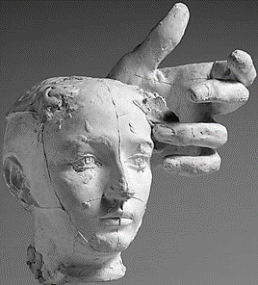
The hand is an extension for our brain that can make visible our ideas through sketches. The proportion of sensorimotor cortex devoted to hand function is considerably greater than that devoted to other body segments. Several authors even call the hand has ‘the outer brain’ because our hands have a special link to the brain. Their ‘language’, gestures and expressions reflect our mood and emotions.
Our civilization is primarily based on the knowledge, creativity, abilities and experiences of the human hand. The written word, handicrafts, drawings and paintings, a piano or a guitar piece – they are all a product of creative hands. Handicraft traditions have always constituted a basis for the design
670 da Silva
Figure 1: The hand as an extension of the brain (Source: https://neupsykey.com/the-in telligent-hand-an-extension-of-the-brain/).
and decoration of articles for everyday use. Artistic handicrafts, sculpture and painting are all based on the creative power and silent knowledge of hands.
The anatomy of the hand is very complex; its functions are based on an interaction among muscles, tendons and nerves. But no hands would function without interaction with the brain. Movements and gestures performed by the hand have their origins in the brain – the hand is the brain’s instrument and executive organ.
Doodling, drawing, outlining, putting lines on paper in search of someth- ing new is a powerful creative catalyst. Ideation and imagination need room to work it out, and based on psychological research and artistic practice, sketching space is the place where it often happens.
Scientists have even proved the key benefit of sketching for creativity, calling it ‘restructuring’ or ‘transforming ideas’ that drive on creative tran- sformation (Verstijnen, Heylighen, Wagemans, Neuckermans, 2001). This kind of freehand drawings play an important role in arranging and re- arranging concepts when formulating creative solutions, helping to reach the potential of a multisensory skill set and engage in new ways, new ideas (Jellema, Annemans, Heylighen, 2022).
Sketching can stimulate a re-interpretive cycle in the individual designer’s idea generation process through the capacity of transforming ideas and arran- ging or re-arranging concepts, opening new perspectives and possibilities for creativity.
CONCLUSION
From the literature review we can find some conclusions about the close rela- tionship between the emotional mind and the creative mind, and also how sketching can play a relevant role in creativity.
Emotion is an inherent part of our life, affecting how we feel, how we behave, how we think and how we create. Scientific advances in our under- standing of the brain demonstrate how emotion and cognition are thoroughly
Creativity and Emotion in Design 671
intertwined. Nowadays we understand how important emotion is to every- day life, how valuable it can be for every human being, and in the present case, for designers.
The hand has been called ‘the outer brain’ because our hands have a special link to the brain. Their ‘language’, gestures and expressions reflect our mood and emotions. The hand functions depend on the interaction with the brain and the intension of the brain needs the hand to execute. The hand can be regarded as the extension of the brain and the development of hand is always accompanied by important changes in the brain.
Sketches stimulate creativity in the ideas generation process, by providing new directions for ideas to breed in an individual generate-interpret cycle. When sketching, we make deep connections: combining our own emotions, concepts, experiences and ideas. Even in the first sketches, design work often follows whatever mood designers are in while working on it.
During the creative process in design, we make deep connections, we com- bine our own emotions, experiences and conceptual associations with our technical knowledge. Sketching can boost an important re-interpretive cycle in the designer’s idea generation process. Sketches are often unspecified and vague, allowing for perceptual creativity to flesh out a new structure.
Combining and restructuring both related to this measure of creativity, suggesting that both mental processes are needed in order to conceive creative products. Since the process of restructuring depends strongly on sketching, the results of the experiments suggest that sketching constitutes a crucial part of the creative process. The act of creation requires the brain to find new asso- ciations, generate new connections. Sketching can stimulate a re-interpretive cycle in the individual designer’s idea generation process. It appears that sketches stimulate creativity in this generation process, by providing new directions for ideas to breed in an individual generate-interpret cycle.
We can conclude that the activity of sketching stimulates creativity in design, most of the times inter-related with our emotional states as human beings.
ACKNOWLEDGMENT
The author would like to acknowledge the support given by CIAUD – Research Center in Architecture, Urbanism and Design, Lisbon School of Architecture, Universidade de Lisboa, and by FCT – Foundation for the Science and Technology, Portugal, within the Project UID/AUR/04026/2013.
REFERENCES
Asma, S. T. and Gabriel, R. (2018) The Emotional Mind, Cambridge, Massachusetts, USA: Harvard University Press. Cherry, K., (2021) https://www.verywellmind.com/characteristics-of-creative-people Chiao, J. Y., and Immordino-Yang, M. H. (2013) Modularity and the Cultural Mind:
Contributions of Cultural Neuroscience to Cognitive Theory, https://www.ncbi.n lm.nih.gov/pmc/articles/PMC3661285/ Fransen, M. (2016) https://www.vye.agency/blog/10-quotes-on-creativity-and-inspi ration-to-motivate-your-team
672 da Silva
Gardner, H. (2010) Five Minds for the Future, Cambridge, Massachusetts: Harvard Business Review Press. Gardner, H. (2011) Creating Minds, New York: Basic Books. Jacob, M., J., and Baas, J. (Eds), (2010) Learning Mind - Experience into Art,
Oakland: University of California Press. Jellema, P., Annemans, M., Heylighen, A. (2022) Drawing - the researcher into data: drawing as an analytical tool in qualitative research. https://www.researchgate.n et/publication/357225310 Naiman, L. (2021) Creativity at Work, https://www.creativityatwork.com/about/ Norman, D., A. (2004) Emotional Design, New York: Basic Books. Tversky, B., and Suwa, M. (2009) Thinking With Sketches, In: Tools for Innova-
tion, Chapter 4, Arthur Markman and Kristin Wood (Eds), Oxford , UK: Oxford Uiniversity Press. Valsiner, J., and Van Der Veer, R. (2014) The Social Mind: Construction of the Idea, Cambridge, UK: Cambridge University Press. Van Der Lugt, R. (2005) How sketching can affect the idea generation process in
design group meetings, In: Design Studies 26(2), Amsterdam: Elsevier. Van der Meer, A. & Van der Weel, R., (2017) Only Three Fingers Write, but the Whole Brain Works. A High-Density EEG Study Showing Advantages of Drawing over Typing for Learning. In: journal Frontiers in Psychology. https://www.ncbi.n lm.nih.gov/pmc/articles/ Verstijnen, I., Heylighen A., Wagemans J., Neuckermans, H., (2001), Sketching,
analogies and creativity. On the shared research interests of psychologists and designers. https://www.researchgate.net/publication/242674163_Sketching_anal ogies_and_creativity_On_the_shared_research_interests_of_psychologists_and_d esigners Vistisen, P., (2015), The Roles of Sketching in Design: mapping the tension between functions in design sketches, https://www.researchgate.net/publication /311858132 Walter, A. (2011) Designing for Emotion, New York: A Book Apart.
LISTED IN THE AHFE DIGITAL BOOKSTORE CATALOGUE
Explore the complete digital volume
Ergonomics In Design
Read this individual research paper free through the original publisher, or explore the full digital proceedings book.
ISBN 978-1-958651-23-0
Explore this ISBN in the AHFE Bookstore ↗Listed in the July 2026 bookstore catalogue; search by ISBN to confirm current availability · Digital book purchase optional