With the rapid advancement of information technology, media multitasking—the simultaneous use of media devices (e.g., computers, smartphones) to perform multiple tasks—has become increasingly common in daily life. Existing studies have indicated that media multitasking affects individuals’ creativity. One limitation of the previous research is that most studies only focused on utilitarian tasks. However, in practical, multitaskers are often attracted by hedonic tasks.The perceived value of a task (hedonic vs. utilitarian) is defined as the extent to which an individual’s intrinsic and extrinsic motive are satisfied. In this study, we conducted an experiment to examine how the perceived value of a secondary task influences individuals’ creativity performance in completing a primary task. Specifically, the study hypothesizes that the perceived value of the task influences attention and emotional experience, thereby impacting on creativity through distinct pathways.Eighty-three participants were recruited for a laboratory experiment employing a single-factor, two-level design (perceived value of secondary tasks: hedonic vs. utilitarian), with participants randomly assigned to two groups. Participants were instructed to finish a primary creative writing task—listing as many new functions of a refrigerator as possible—and a secondary reading task within 20 minutes. The value type of the reading task was manipulated by setting the reading material as either learning material or entertainment news. Attention to the main task and the secondary task was measured using eye-tracking (Tobii Pro Spectrum). Participants’ emotional valence and arousal during the experiment were recorded through a facial expression analysis system—Noldus Facereader 9.0. Task-switching frequencies were recorded via backend program. After completing the tasks, participants filled out questionnaires to subjectively evaluate their attention and emotions.The findings reveal that the perceived value of secondary tasks significantly influences creativity performance in the primary task. Regarding attention, participants who conducted hedonic reading tasks had higher task-switching frequencies compared to those conducted utilitarian ones, resulting in greater performance in the fluency of divergent answers. However, the effect of perceived value on creativity through the path of emotions was not supported in this study.Focusing on everyday multitasking scenarios, our study examines whether creativity varies with the value of different tasks. It vividly replicates multitasking scenarios common among university students, such as completing coursework or writing papers while simultaneously handling other tasks or browsing the web for leisure, thus achieving relatively high ecological validity. The present study reveals how the perceived value of tasks influenced individuals’ creativity through the attentional mechanisms. These findings provide evidence of the positive side of media multitasking.
With the advancement of modern technology, media multitasking has become increasingly prevalent in daily life (Benbunan-Fich and Truman, 2009). It refers to the simultaneous use of multiple media devices (e.g., computers, smartphones) for different tasks (Voorveld, 2011), which imposes a higher cognitive load compared to performing a single task at a time. Despite its ubiquity, concerns have been raised about how multitasking affects task performance, given the limitations of human cognitive capacity (Ophir et al., 2009). One topic of particular academic interest is its impact on creativity, as creative tasks typically require substantial cognitive resources (Madore et al., 2020). Creativity is defined as the ability to generate ideas that are both novel and useful (Amabile, 1983). While numerous studies have examined the relationship between media multitasking and creativity, findings remain inconclusive (Ophir et al., 2009; Gorman and Green, 2016; Loh and Lim, 2020). Some research suggests that multitasking may enhance creativity by facilitating cognitive flexibility. For instance, switching between tasks can help individuals break free from cognitive fixation (Lu et al., 2017; Luchins and Luchins, 1959). However, creativity also depends heavily on executive functions (Nusbaum and Silvia, 2011; Wiley and Jarosz, 2012), which are strained during task-switching (Zhou and Rau, 2024). Consequently, media
multitasking may negatively impact creativity by depleting these essential cognitive resources.
These inconsistent findings may stem from the varying tasks examined in previous studies. One possible explanation is the task load. Secondary tasks with high cognitive demands in media multitasking could deplete executive functions more rapidly, leading to a more pronounced negative impact on creativity performance of the main task. When the task load is controlled, how the tasks meet individual’s motives can also influence the performance. The degree to which a task satisfies an individual’s intrinsic and extrinsic motives is referred to the hedonic and utilitarian value of tasks. Previous research has revealed that the value of secondary tasks can influence individuals’ attention on the main task and their emotions, consequently impacting their main task performance (Zhou and Rau, 2024).
In practice, multitasking with tasks of different values is common during creative work. For example, when writing a paper (a primary creative task), individuals often need to refer to other papers (a utilitarian secondary task). Meanwhile, they may also browse entertainment websites or social media for relaxation out of hedonic motives (hedonic secondary task). Till now, even though the phenomenon is quite common, how the perceived value of secondary tasks influences the creativity in the main task remains underexplored. Understanding the impact of task value on creativity can help develop better strategies to do creative tasks in the age of multitasking.
The Impact of Perceived Task Value on Individual Creativity The concept of perceived value originates from the field of consumer research (Babin et al., 1994) and has been widely applied across various disciplines. Perceived value is generally categorized into two types: hedonic value and utilitarian value. Utilitarian value is characterized as “task-related” (Babin et al., 1994) and “rational”(Vieira et al., 2022), with its perception depending on whether specific task demands are met. Hedonic value, in contrast, is more subjective and personal, driven by the pursuit of enjoyment rather than task completion (Hirschman and Holbrook, 1982). It reflects the potential entertainment and emotional benefits of an experience (Bellenger et al., 1976). Tasks with different perceived values provide distinct experiences (Castel et al., 2002; Castel et al., 2007). When individuals focus on completing a utilitarian task, they may experience fatigue or cognition fixation (Risko et al., 2012), which can hinder creativity. In contrast, individuals often feel more creative after a brief period of relaxation (Oppezzo and Schwartz, 2014). This suggests that the perceived hedonic value of tasks may have a more positive impact on individual creativity than utilitarian value. Thus, we proposed the following hypothesis:
H1: Secondary tasks with hedonic values will lead to more creative performance on the primary task compared to those with utilitarian values.
The Cognitive and Emotional Paths of Multitasking Influence Research on media multitasking has been conducted across various fields, each with certain limitations due to domain-specific priorities. For instance,
The Impact of the Secondary Task’s Perceived Value on Individuals’ Creativity 251
research in Human Factors and Cognitive Psychology primarily relies on laboratory experiments to investigate the cognitive mechanisms of media multitasking, with little focus on emotional processes (e.g., Subrahmanyam et al., 2013). In contrast, studies in Consumer Behavior and Social Psychology explore emotional experiences following media multitasking, typically through surveys, but provide limited examination of cognitive processes (e.g., Xu and Wang, 2021). Few studies have integrated both cognitive and emotional processes in this context. However, cognition and emotion are closely interconnected (Koole and Rothermund, 2019) and may jointly reflect the impact of media multitasking. Thus, this study aimed to examine how the perceived value of secondary tasks on the creative performance of the main task through both the cognitive and emotional paths, providing a more comprehensive understanding.
Attention as a Mediator Attention refers to managing cognitive resources and selecting information (Kanwal et al., 2022), focusing on relevant information while filtering out irrelevant input (Posner, 1988). Drawing on the Dual Pathway to Creativity model, creativity can be influenced by both cognitive flexibility and cognitive persistence, both of which are associated with attention (Nijstad et al., 2010).
Regarding the persistency pathway, persistent attention on a task can enhance the creativity (Nijstad et al., 2010). Previous research has suggested that the perceived value of tasks in media multitasking may influence attention allocation. Zhou and Rau (2024) found that anticipating a switch to tasks with utilitarian value reduces cognitive resources allocated to the primary task. Reduced cognitive resources may impair attention allocation, leading to decreased focus on the primary task (Randall et al., 2014). Moreover, when a secondary task demands greater attention, individuals may overlook information related to the primary task, leading to reduced creativity in the primary task (Ruiz, 2021). Based on these evidences, we had the following hypothesis: H2a: Secondary tasks with utilitarian value are more likely to reduce attention to the primary task compared to those with hedonic value, thus diminishing creativity in the primary task.
Regarding the flexibility pathway, broad attentional focus and switch flexibility are positively associated with creativity (Nijstad et al., 2010). Previous research has revealed that hedonic stimulus can improve flexibility (van Steenbergen et al., 2015), and the happy mood from hedonic tasks is also positively associated with cognitive flexibility (Hirt et al., 2008). Based on these findings, we hypothesized that: H2b: Secondary tasks with hedonic value are more likely to elicit overall attentional flexibility, thus enhancing creativity in the primary task.
Emotion as a Mediator Emotion could also mediate the relationship between perceived task value and creativity. First, the type of value influences emotional responses. Zhou and Rau (2024) found that hedonic value tends to evoke more positive emotional valence, whereas utilitarian value is associated with more negative
emotional valence. Specifically, utilitarian tasks often induce anxiety and other negative emotions as individuals anticipate evaluation from others (Amabile et al., 1990). In contrast, hedonic tasks provide entertainment and emotional satisfaction (Bellenger et al., 1976), fostering positive emotions.
Moreover, emotional experiences also significantly impact creativity. Positive emotions have been shown to enhance cognitive flexibility, reduce persistence, broaden attention, and improve creative problem-solving (Ashby et al., 2002). Conversely, negative emotions, such as anxiety induced by evaluation anticipation, may hinder creativity (Amabile et al., 1990). Thus, we hypothesized that: H3: Secondary tasks with hedonic values are more likely to elicit positive emotions compared to those with utilitarian values, thus enhancing creativity in the primary task.
METHOD
Design The present study aims to examine how the perceived value of secondary tasks influences individuals’ creative performance on the main task in a multitasking context. Particularly, we focused on asynchronous multitasking, where only one task is performed at a time, with rapid switching between tasks (Foehr, 2006; Lui and Wong, 2012; Judd, 2013), because in completing high-cognitive-demanding tasks, synchronous multitasking is impossible.
The study employed a single-factor, two-level between-subjects design. A divergent thinking task was chosen as the main task, and reading tasks were chosen as the secondary tasks. The independent variable was the perceived value of secondary tasks (utilitarian vs. hedonic), the dependent variable was the participants’ creativity performance on the divergent thinking task. Participants’ attention on both primary and secondary tasks and their emotional experience were also measured.
Participants The study recruited 106 students at Beijing Normal University. After excluding inattentive responses and invalid eye-tracking/facial expression recording data, the data of 81 participants (72 females) were analyzed, with their age ranging from 18 to 25 years (M = 21.22, SD = 1.95). All participants had normal or corrected-to-normal vision and no history of mental illness. Informed consent was obtained from all participants before the experiment, and they were informed they would receive 30 RMB as compensation.
Materials
The secondary task differed for participants in the two groups. For the utilitarian group, it was emphasized that they need to learn the content of the secondary task while completing the primary task, as it would be assessed in a subsequent knowledge test (although this test did not actually exist). In contrast, the instructions for the hedonic group framed the secondary task
The Impact of the Secondary Task’s Perceived Value on Individuals’ Creativity 253
as relaxation when completing the primary task. We selected sixteen online articles of similar length for secondary tasks. Eight articles with a stronger scientific focus were adapted as materials for the utilitarian group, while eight entertaining ones were adapted for the hedonic group.
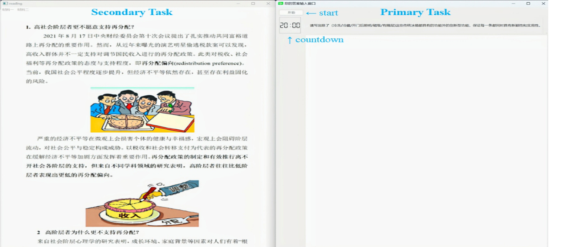
The primary task was based on a creative writing paradigm (Madjar and Shalley, 2008), requiring participants to complete a creativity writing on refrigerator functions. An example of the multitasking interface is illustrated in Figure 1. The experiment program was developed with PyQT5.
Figure 1: The left side of the figure is the secondary task, where participants are required to complete two reading materials. The right side is the primary task (i.e., the divergent thinking task). The guiding instructions roughly mean: Please write down innovative functions of refrigerators beyond the common functions (such as refrigeration and freezing).
Measures Perceived Value (Manipulation Check): After the tasks were finished, participants were introduced to the definitions of hedonic and utilitarian values. One item was used to measure participants’ perceived value of the secondary task, with scores ranging from 0 to 100. Higher scores indicate that they find the content more hedonic.
Creativity. Following Gilhooly et al.’s (2007) criteria, participants’ creative writing performance was assessed based on fluency, originality and flexibility. Fluency refers to the number of refrigerator functions written by the participants, flexibility refers to the number of categories to which these functions belong, and originality refers to the degree of novelty of the functions.1 We recruited two experts in creativity who were blinded to the study as raters. The inter-rater reliability was 0.82 for fluency and 0.78 for flexibility measured by Cohen’s kappa, and 0.76 for originality measured by correlation coefficient.
Moreover, we adopted the latest AI tool—Open Creativity Scoring with Artificial Intelligence (OCSAI; Organisciak et al., 2023)—as a supplemental measure for originality scoring. The correlation between OCSAI and expert 1The full score for originality is 10. We divided all the functions mentioned by the participants into 8 categories, so the full score for flexibility is 8.
ratings for originality was 0.52 (p < 0.001). Since an increase in fluency might influence individual’s average score of originality, we also calculated the number of items for each participant with an originality score of 8 or higher2—referred to as “high originality fluency”—as an indicator of high-level creativity.
Attention. The study used eye-tracking data, backend logging of mouse coordinates and self-reports to reflect task-specific attention. Eye-tracking metrics include: (1) Average Fixation Duration: the average time spent fixating within a specific area of interest over a given period. A longer average fixation duration indicates sustained attention to that area.
(2) Total Fixation Duration: the cumulative time spent fixating within a specific area of interest over a given period. A longer total fixation duration suggests greater attention allocated to that area.
Self-report data we adapted five items from Madjar and Shalley (2008) to measure participants’ attention when doing the primary and secondary tasks. (e.g., “I found it difficult to concentrate on this task.”) The Cronbach’s α was 0.70 and 0.82, respectively. Number of switches. Backend logging of mouse coordinates was used to track the number of switches between the primary and secondary tasks, assessing the overall attention flexibility. Each switch was recorded when the mouse moved from the primary task area to the secondary task area (or vice versa).
Emotion. For overall emotional experience, we adopted the Self- Assessment Manikin (Bradley and Lang, 1994), where participants rated their levels of valence and arousal on a 9-point scale.
Moreover, for task-specific emotional experiences, participants’ real-time facial expressions were recorded through a portable camera. We identified the time phases of the primary and secondary tasks through the time point of switches determined by backend logging of mouse coordinates. The Noldus Facereader 9.0 was used to analyse participants’ valence and arousal in each time phase, with scores ranging from –1 to 1, where higher values indicate greater arousal and more positive valence.
Procedure Participants first spent 1–2 minutes reading the instructions and completed four multiple-choice questions to ensure understanding. Once participants adjusted to a comfortable sitting position, the experimenter calibrated the eye-tracking equipment and activated the camera to record facial expressions.
Participants then performed two tasks—writing (primary task) and reading (secondary task)—over 20 minutes, with the freedom to switch between tasks at will. After time is out, participants filled out self-report questionnaires on task motivation, attention, and emotions related to the writing and reading tasks.
2A score above 8 indicates the originality of a function exceeds the mean by 1 standard deviation.
The Impact of the Secondary Task’s Perceived Value on Individuals’ Creativity 255
RESULTS
The hedonic group consisted of 38 participants, while the utilitarian group included 43 participants. A manipulation check for perceived value was conducted. The perceived hedonic value (100 – perceived utilitarian value) of hedonic group (M = 50.73, SD = 23.00) was significantly higher than that of the utilitarian group (M = 39.91, SD = 19.17), t(79) = 2.296, p = 0.024.
Test of Main Effects No significant difference in fluency was found between the utilitarian group (M = 10.47) and the hedonic group (M = 11.15), t(79) = 1.47, p = .147, neither did the difference in flexibility between utilitarian group (M = 4.93) and the hedonic group (M = 5.34), t(79) = 1.49, p = .140. Moreover, no significant difference was found in originality (human) between the utilitarian group (M = 7.02) and the hedonic group (M = 7.13), t(79) = 0.69, p = .493, neither did the difference in originality (Ocsai) between the utilitarian group (M = 0.77) and the hedonic group (M = 0.78), t(79) = 0.14, p = .889.
As an increase in fluency of lowly original answers might decrease an individual’s average score of originality, we further examined the difference in High Originality Fluency, which means the number of highly original answers. The results showed that the high originality fluency in the hedonic group (M = 1.37) were significantly higher than that in the utilitarian group (M = 0.91), t(79) = 2.08, p = .041, which partially supported H1.
Mediation Analysis First, the role of attentional flexibility was tested. A mediation analysis was conducted to examine whether number of switches (M) mediates the relationship between perceived value (X, coded as a 0–1 variable) and fluency (Y). The results revealed that perceived value significantly predicted number of switches, b = 6.95, SE = 3.32, t(79) = 2.09, p = .040, 95% CI = [0.34, 13.56]. Number of switches significantly predicted fluency, b = 0.04, SE = 0.02, t(79) = 2.66, p = .010, 95% CI = [0.01, 0.07]. The direct effect of perceived value on fluency was nonsignificant, b = 0.41, SE = 0.47, t(79) = 0.87, p = .386, 95% CI = [−0.52, 1.34]. However, the indirect effect of perceived value on fluency via task switching was significant, b = 0.28, SE = 0.23, p = .218, 95% CI [0.004, 0.885]. These findings indicate that number of switches, fully mediates the relationship between perceived value and fluency, which supported H2b. No other attention- related indicators showed significant mediation effects in this relationship (H2a not supported).
Next, the mediating role of emotion was examined. None of the emotion- related indicators significantly mediated the relationship between perceived value and creativity. Thus, H3 was not supported.
OTHER FINDINGS We conducted additional analysis, with several noteworthy findings identified. First, task switching significantly predicted fluency
(Y = 0.044X + 9.976), accounting for 10% of its variance, F(1,79) = 8.63, p = 0.004). Second, total fixation duration of primary task significantly predicted originality (human), (Y = 8.75e–7X + 6.685), accounting for 6% of the variance, F(1,79) = 4.48, p = 0.038.
DISCUSSION
The present study examines the impact of the perceived values of secondary tasks on creativity in divergent thinking tasks among college students. We explored both the cognitive and emotional mechanisms underlying the effects of media multitasking on creativity.
The Impact of Perceived Value on Creativity Regarding the cognitive aspect, our findings support the Dual Pathway to Creative Model (DPCM; Nijstad et al., 2010). In terms of the flexibility pathway, we found that participants assigned to the hedonic secondary tasks generated more high-originality answers. Mediation analysis indicated that task switching mediated the relationship between perceived value and fluency, consistent with previous studies showing that more frequent task switching reduces cognitive fixation, thus enhancing creative fluency (Lu et al., 2017).
In terms of the persistence pathway, our findings suggest that the total fixation duration on the primary task significantly predicted originality (human), aligning with previous research highlighting that deeper cognitive processing foster originality (De Dreu et al., 2012). However, no significant difference in average originality scores was found between the two groups. This may be due to our control over the length and complexity of the reading materials. Since both groups spent similar amounts of time on the secondary task, the effect of processing time on originality became evident only at the individual level.
Regarding the emotional aspect, no evidence supported H3. This may be due to ineffective manipulation of emotional states. The reading materials only influenced participants’ emotions during the secondary task, with no significant impact during the primary task. In the context of our study, the cognitive mechanisms appear to play a more decisive role than the emotional ones. Furthermore, both positive and negative emotions have been found associated with creativity (Kapadia and Melwani, 2021), suggesting that the relationship between emotion and creativity remains complex. Future research could further explore the mediating role of emotion, particularly under conditions where cognitive factors are controlled.
Theoretical Contributions Research on the effects of media multitasking has primarily focused on its negative impact on individuals. For instance, research has shown that media multitasking can lead to consequences such as memory decline (Madore et al., 2020), distracted attention (Uncapher et al., 2016), and diminished self-control (Xu and Wang, 2021), thus impairing performance on various cognitive tasks. In contrast, the results of this study suggest that media
The Impact of the Secondary Task’s Perceived Value on Individuals’ Creativity 257
multitasking with hedonic value can have a positive effect on creativity, enriching the theoretical framework of media multitasking and providing valuable insights for future research on its potential positive effects.
Furthermore, the findings about attention extend the scope of the Dual Pathway Theory. Previous studies typically explained the phenomenon using only one pathway—either flexibility or persistence Nijstad et al. (2010)— while overlooking their simultaneous contribution. The results of our study suggest that flexibility in task switching enhances fluency, while persistence in the primary task boosts originality. Both pathways influence different aspects of creativity. Similar to Zhou et al. (2024), the present study addresses the limitation of previous research which primarily focused on a single pathway, validating the Dual Pathway Theory in depicting real-world creative processes.
Practical Implications The findings of this study suggest a potential strategy for enhancing creativity: individuals who engage in a divergent thinking task while simultaneously performing a hedonic secondary task tend to achieve better performance than those who multitask with utilitarian tasks. However, two limitations should be noted when applying this strategy. First, the study did not directly compare creativity performance between multitasking with a hedonic secondary task and focusing solely on the main task. Therefore, it is premature to conclude that incorporating a hedonic secondary task universally improves performance over completing just the primary task. Second, the time allocated to the hedonic task in this study was controlled by the length of the reading material. In real-life scenarios, individuals may become overly engaged with hedonic content (e.g., social media). Thus, when using a hedonic task as a relaxation tool, the duration of engagement should be carefully regulated.
CONCLUSION
This study explores the impact of perceived task values on attention and emotional experience, as well as examines their effects on creativity. The results showed that the perceived value of media multitasking significantly influenced participants’ high-level creativity, with task switching between primary and secondary tasks playing a mediating role. No significant evidence was found for emotion. Above all, these findings provide useful insights for individuals engaging in media multitasking.
ACKNOWLEDGMENT
This study was supported by the Fundamental Research Funds for the Central Universities (Grant No. 2022NTSS13).
REFERENCES
Amabile, T. M., 1983. The social psychology of creativity: A componential conceptualization. Journal of personality and social psychology, 45(2), p. 357.
Amabile, T. M., Goldfarb, P. and Brackfleld, S. C., 1990. Social influences on creativity: Evaluation, coaction, and surveillance. Creativity research journal, 3(1), pp. 6–21. Ashby, F. G., Maddox, W. T. and Bohil, C. J., 2002. Observational versus feedback
training in rule-based and information-integration category learning. Memory & cognition, 30(5), pp. 666–677. Babin, B. J., Darden, W. R. and Griffin, M., 1994. Work and/or fun: measuring hedonic and utilitarian shopping value. Journal of consumer research, 20(4), pp. 644–656. Bellenger, D. N., Steinberg, E. and Stanton, W. W., 1976. Congruence of store image
and self image-as it relates to store loyalty. Journal of retailing, 52(1), pp. 17–32. Benbunan-Fich, R. and Truman, G. E., 2009. Technical opinion Multitasking with laptops during meetings. Communications of the ACM, 52(2), pp. 139–141. Bradley, M. M. and Lang, P. J., 1994. Measuring emotion: The self-assessment
manikin and the semantic differential. Journal of behavior therapy and experimental psychiatry, 25(1), pp. 49–59. Castel, A. D., Benjamin, A. S., Craik, F. I. and Watkins, M. J., 2002. The effects of aging on selectivity and control in short-term recall. Memory & Cognition, 30(7), pp. 1078–1085. Castel, A. D., Farb, N. A. and Craik, F. I., 2007. Memory for general and specific
value information in younger and older adults: Measuring the limits of strategic control. Memory & Cognition, 35, pp. 689–700. De Dreu, C. K., Nijstad, B. A., Baas, M., Wolsink, I. and Roskes, M., 2012. Working memory benefits creative insight, musical improvisation, and original ideation through maintained task-focused attention. Personality and Social Psychology Bulletin, 38(5), pp. 656–669. Foehr, U. G., 2006. Media multitasking among American youth: Prevalence,
predictors and pairings. Henry J. Kaiser Family Foundation. Gilhooly, K. J., Fioratou, E., Anthony, S. H. and Wynn, V., 2007. Divergent thinking: Strategies and executive involvement in generating novel uses for familiar objects. British Journal of Psychology, 98(4), pp. 611–625. Gorman, T. E. and Green, C. S., 2016. Short-term mindfulness intervention
reduces the negative attentional effects associated with heavy media multitasking. Scientific reports, 6(1), p. 24542. Hirschman, E. C. and Holbrook, M. B., 1982. Hedonic consumption: emerging concepts, methods and propositions. Journal of marketing, 46(3), pp. 92–101. Hirt, E. R., Devers, E. E., and McCrea, S. M., 2008. I want to be creative: Exploring
the role of hedonic contingency theory in the positive mood-cognitive flexibility link. Journal of personality and social psychology, 94(2), p. 214. Holbrook, M. B., 1986. Emotion in the consumption experience: Toward a new model of the human consumer. The role of affect in consumer behavior: Emerging theories and applications, 6(23), pp. 17–52. Judd, T., 2013. Making sense of multitasking: Key behaviours. Computers &
Education, 63, pp. 358–367. Kanwal, A., Abbas, S., Ghazal, T. M., Ditta, A., Alquhayz, H. and Khan, M. A.,
2022. Towards parallel selective attention using psychophysiological states as the basis for functional cognition. Sensors, 22(18), p.7002. Kapadia, C. and Melwani, S., 2021. More tasks, more ideas: The positive spillover effects of multitasking on subsequent creativity. Journal of Applied Psychology, 106(4), p. 542.
The Impact of the Secondary Task’s Perceived Value on Individuals’ Creativity 259
Koole, S. L. and Rothermund, K., 2019. Revisiting the past and back to the future: Horizons of cognition and emotion research. Cognition and Emotion, 33(1), pp. 1–7. Loh, K. K. and Lim, S. W. H., 2020. Positive associations between media multitasking
and creativity. Computers in Human Behavior Reports, 1, p. 100015. Lu, J. G., Akinola, M. and Mason, M. F., 2017. “Switching On” creativity: Task switching can increase creativity by reducing cognitive fixation. Organizational Behavior and Human Decision Processes, 139, pp. 63–75. Luchins, A. S. and Luchins, E. H., 1959. Rigidity of behavior: A variational approach
to the effect of Einstellung. Lui, K. F. and Wong, A. C. N., 2012. Does media multitasking always hurt? A positive correlation between multitasking and multisensory integration. Psychonomic bulletin & review, 19, pp. 647–653. Madjar, N. and Shalley, C. E., 2008. Multiple tasks’ and multiple goals’ effect on
creativity: Forced incubation or just a distraction? Journal of Management, 34(4), pp. 786–805. Madore, K. P., Khazenzon, A. M., Backes, C. W., Jiang, J., Uncapher, M. R., Norcia, A. M. and Wagner, A. D., 2020. Memory failure predicted by attention lapsing and media multitasking. Nature, 587(7832), pp. 87–91. Nijstad, B. A., De Dreu, C. K., Rietzschel, E. F. and Baas, M., 2010. The dual
pathway to creativity model: Creative ideation as a function of flexibility and persistence. European review of social psychology, 21(1), pp. 34–77. Nusbaum, E. C. and Silvia, P. J., 2011. Are intelligence and creativity really so different? Fluid intelligence, executive processes, and strategy use in divergent thinking. Intelligence, 39(1), pp. 36–45. Ophir, E., Nass, C. and Wagner, A. D., 2009. Cognitive control in media
multitaskers. Proceedings of the National Academy of Sciences, 106(37), pp. 15583–15587. Oppezzo, M., & Schwartz, D. L., 2014. Give your ideas some legs: The positive effect of walking on creative thinking. Journal of Experimental Psychology: Learning, Memory, and Cognition, 40(4), pp. 1142–1152. Organisciak, P., Acar, S., Dumas, D. and Berthiaume, K., 2023. Beyond semantic
distance: Automated scoring of divergent thinking greatly improves with large language models. Thinking Skills and Creativity, 49, p. 101356. Posner, M. I., 1988. Structures and function of selective attention. American Psychological Association. Randall, J. G., Oswald, F. L. and Beier, M. E., 2014. Mind-wandering, cognition, and
performance: A theory-driven meta-analysis of attention regulation. Psychological bulletin, 140(6), p.1411. Risko, E. F., Anderson, N., Sarwal, A., Engelhardt, M. and Kingstone, A., 2012.
Everyday attention: Variation in mind wandering and memory in a lecture. Applied Cognitive Psychology, 26(2), pp. 234–242. Ruiz, B. N. R., 2021. Creativity and Attention: An Individual Difference Approach (Master’s thesis, The University of Texas at San Antonio). Subrahmanyam, K., Michikyan, M., Clemmons, C., Carrillo, R., Uhls, Y. T. and Greenfield, P. M., 2013. Learning from paper, learning from screens: Impact of screen reading and multitasking conditions on reading and writing among college students. International Journal of Cyber Behavior, Psychology and Learning (IJCBPL), 3(4), pp. 1–27.
Uncapher, M. R., K Thieu, M. and Wagner, A. D., 2016. Media multitasking and memory: Differences in working memory and long-term memory. Psychonomic bulletin & review, 23, pp. 483–490. van Steenbergen, H., Band, G. P., Hommel, B., Rombouts, S. A., & Nieuwenhuis,
S. (2015). Hedonic hotspots regulate cingulate-driven adaptation to cognitive demands. Cerebral Cortex, 25(7), 1746–1756. Vieira, V. A., Rafael, D. N. and Agnihotri, R., 2022. Augmented reality generalizations: A meta-analytical review on consumer-related outcomes and the mediating role of hedonic and utilitarian values. Journal of Business Research, 151, pp. 170–184. Voorveld, H. A., 2011. Media multitasking and the effectiveness of combining online and radio advertising. Computers in human behavior, 27(6), pp. 2200–2206. Wiley, J. and Jarosz, A. F., 2012. Working memory capacity, attentional focus, and
problem solving. Current Directions in Psychological Science, 21(4), pp. 258–262. Xu, S. and Wang, Z., 2021. The immediate and delayed impact of multitasking on well-being: An experience sampling study. Human Behavior and Emerging Technologies, 3(5), pp. 710–719. Zhang, W. and Zhang, L., 2012. Explicating multitasking with computers:
Gratifications and situations. Computers in Human Behavior, 28(5), pp. 1883–1891. Zhang, Y., Mao, M., Rau, P. L. P., Choe, P., Bela, L. and Wang, F., 2013.
Exploring factors influencing multitasking interaction with multiple smart devices. Computers in Human Behavior, 29(6), pp. 2579–2588. Zhou, X. and Patrick Rau, P. L., 2024. Interruption Value Type and Source Matter in Different Phases of an Interruption Process: Emotional/Cognitive Impact and Neural Evidence. Human Factors, 66(5), pp. 1431–1449. Zhou, X., Zhang, J., Bai, B., Zhai, H. and Cui, Y., 2024. Half-hearted is better than
one-heart: Media multitasking promotes creativity in people with low working memory capacity. Acta Psychologica Sinica, 56(8), p. 1031.
Read this individual research paper free through the original publisher, or explore the full digital proceedings book.
ISBN 978-1-964867-71-7
Explore this ISBN in the AHFE Bookstore ↗Listed in the July 2026 bookstore catalogue; search by ISBN to confirm current availability · Digital book purchase optional