Qianxiang Zhou, Guanghong Xiong, Zhongqi Liu (2026). The Impact of Confined and Small-Space Environments on Human Emotions and Behavioral Performance. In: Neuroergonomics and Cognitive Engineering. AHFE Open Access, vol. 207, pp. 129–139. https://doi.org/10.54941/ahfe1007402
This study conducted a 3-day simulated experiment in a narrow, confined environment (an 8-square-meter isolation room). By integrating daily emotional questionnaires, continuous electroencephalography (EEG) measurements, and saliva and urine cortisol tests, the research explored the impact of environmental factors on 24 participants aged 18–30. The results showed that the isolation environment significantly suppressed aggressive emotions (hostility scores decreased by 10%, p = 0.019) and markedly reduced positive emotions (F = 4.327, p = 0.02), while feelings of depression, anxiety, and social loneliness increased by 14%, 21%, and 19%, respectively. In terms of Behavioral performance, the accuracy rate of the 2-back task decreased by 13%, and persistent errors in the WCST task increased by 20% in the early stage and decreased by 10% in the later stage, accompanied by a significant shortening of reaction time. At the physiological level, cortisol levels increased during the initial phase and declined in some participants after adaptation. EEG data revealed significant changes in the amplitudes of the prefrontal N2 and P3 waves as well as in high α-band power (p < 0.05). This study provides empirical data and theoretical support for the mental health management and intervention of relative personnel.
As a typical special environment for space missions, the Isolated Confined Environment (ICE) has three typical characteristics: spatial constraint (the average per capita activity space in the cabin is usually < 10 m³), social isolation (limited personnel interaction and lack of natural social support), and environmental monotony (single sensory stimulation and easy disruption of circadian rhythm) (Li et al., 2006). Existing studies have confirmed that under the ICE environment, the incidence of negative emotions such as anxiety and depression among astronauts reaches 30%–50%, the working memory capacity decreases by 15%–20%, and the task switching error rate
increases by more than 25% (Pagel et al., 2016). Abnormal fluctuations in emotions and cognitive functions may lead to risks such as misoperation of spacecraft equipment and deviations in scientific experiment data, directly threatening mission safety.
From the perspective of physiological mechanisms, environmental stress activates cortisol secretion through the hypothalamic-pituitary-adrenal (HPA) axis, and the increase in cortisol concentration in turn inhibits the function of the prefrontal cortex, forming a negative “emotion-physiology- cognition” cycle (Chrousos et al., 1998). Therefore, systematically studying the effects of confined environments on astronauts’ emotions, performance, and physiological states is of great theoretical importance for safeguarding their on-orbit mental health and ensuring mission safety. At the same time, it can provide references for the health management of operators in other ICE environments such as deep-sea exploration and polar scientific research.
Researchers conducted a 1-year follow-up study on Antarctic expedition team members and found that with the extension of isolation time, the depression score of the team members increased from 32.5 ± 4.8 to 45.2 ± 6.3 (Palinkas et al., 2004). Investigators studied fully enclosed standby officers and soldiers and found that the anxiety score of those with military service < 3 years (45.2 ± 6.3) was significantly higher than that of those with military service > 10 years (36.8 ± 5.2) (Huang et al., 2015). Wang et al. (2015) found that the neurotic personality trait of soldiers in long-term closed environments was positively correlated with interpersonal sensitivity score (r = 0.58, p < 0.01), and negative emotions played a 32.7% mediating role between them. However, most existing studies adopt single-time-point evaluation, making it difficult to capture dynamic emotional changes. In addition, the inconsistent use of terms (such as the interchange of “emotion” and “mood”) reduces the comparability of results.
In NASA’s Human Exploration Research Analog (HERA) project, researchers conducted a 120-day isolation experiment and found that the accuracy rate of the 2-back task in the middle of the experiment (60 days) decreased by 13.2% compared with the baseline, and the power of the EEG α band (8~12 Hz) decreased, indicating a decrease in the efficiency of attention resource allocation (Strangman et al., 2014). Pagel et al. (2014) found in the “Mars 500” experiment that the prefrontal blood oxygen saturation of subjects decreased by 15% on the 100th day, which was negatively correlated with the persistent error rate of WCST (r = −0.47, p < 0.05). A 180-day confined experiment was conducted with 4 people and it was found that the persistent error rate of WCST increased from 12.3 ± 2.1 to 25.6 ± 3.4 in the first 60 days and dropped to 18.5 ± 2.8 on the 120th day, showing a “damage-adaptation” characteristic (Shi et al., 2018).
In recent years, research has gradually developed towards the integrated analysis of “emotion-behavior-physiology”. It was found that the circadian rhythm disorder rate of cortisol among Antarctic expedition team members reached 40% (Leon et al., 2011). For every 1-hour delay in the cortisol peak, the reaction time of the Psychomotor Vigilance Test (PVT) the next day was prolonged by 15ms. Fan It was pointed out that the correlation coefficient between salivary cortisol concentration and anxiety score was 0.45~0.60,
The Impact of Confined and Small-Space Environments 131 which could be used as a sensitive indicator for ICE environmental stress assessment (Fan et al., 2009). However, existing studies still have limitations such as insufficient fusion of multi-modal data (such as lack of joint analysis of EEG and cortisol) and insufficient attention to individual differences (such as ignoring the regulatory role of personality traits in adaptation).
This study aims to break through the limitations of existing studies of “single dimension and static evaluation”. Through a 3-day simulated experiment in a confined and small-space environment, it reveals the dynamic impact of the environment on emotions, behavioral performance, and physiological states, and clarifies the interaction mechanism among the three. The research results can provide a scientific basis for the mental health assessment of astronauts, the optimization of cognitive training programs, and the design of human- machine ergonomics in confined cabins during aerospace missions.
EXPERIMENTAL DESIGN Experimental Environment and Schedule
Subjects lived alone in an 8 m² confined room (length 3 m × width 2.7 m × height 2.8 m) for 3 days. The room was equipped with a folding bed, an experimental computer, a simple sofa, Washing and toilet facilities. There were no electronic devices such as televisions and mobile phones, and only reading time (non-irritating books) was reserved from 19:00 to 21:00. The daily process was standardized (Table 1), including 5 emotional questionnaire fillings and 2 physiological sample (saliva and urine) collections. Questionnaire included the Buss-Perry Aggression Questionnaire (BPAQ), the State-Trait Anxiety Inventory (STAI), Self-Rating Anxiety Scale (SAS), Self-Rating Depression Scale (SDS), Emotion Regulation Questionnaire (ERQ), Perceived Stress Scale (PSS) and Positive and Negative Affect Schedule (PANAS) (Qiu et al., 2019). Except for two daily sessions of behavioral and physiological data collection, the subject was alone for the rest of the time— that is, 20 hours of solitude per day.
Table 1: Daily life and experimental schedule of subjects.
Table available in the original PDF paper.
Time Core Tasks Task Description 7:20~7:30 Wake-up+physiological sampling
Collect saliva (Salimetrics tube) and urine samples, store at −20°C 7:30~8:30 Breakfast+questionnaire Standardized breakfast (1200 kcal, carbohydrate/protein/fat = 5:3:2)
Time Core Tasks Task Description 18:00~18:10 Questionnaire
18:10~19:00 Dinner Standardized dinner (800 kcal, carbohydrate/protein/fat = 4:3:3) Repeat the morning sampling process 22:00~22:10 Washing + physiological sampling
22:10~22:20 Questionnaire 23:00 Lights out for sleep Ensure sleep time ≥ 8 hours
Participants Twenty-four healthy subjects (18~30 years old, average 23.5 ± 2.8 years old) participated the experiment. Their inclusion criteria were: ① Normal vision or corrected vision≥1.0, no eye diseases; ② Right-handed; ③ No neurological/ mental diseases or major physical diseases; ④ No alcohol or caffeine intake 1 week before the experiment, and sleep ≥ 7 hours the night before. Subjects signed an informed consent form and were paid 500 yuan/day after the experiment. This experiment was conducted at Capital Normal University and was approved by the Ethics Committee of the University (Ethics Number: CNU-20240401).
Experimental Task Go/No-Go Task: E-Prime 3.0 was used to present left and right arrows (visual angle 1.5°×0.4°). The Go stimulus was a left arrow, and the right arrow was a No-Go stimulus. The stimulus display duration was 500ms, with an interval of 800~2000ms. The task included 4 blocks (45 trials per block, No-Go stimuli accounted for 1/3). Subjects pressed the spacebar for Go stimuli and inhibited responses for No-Go stimuli. The accuracy rate and Go reaction time were recorded.
2-Back Task: The stimuli were 8 randomly presented uppercase letters (B, F, K, etc.). The stimulus duration was 500ms, with an interval of 1000~2000ms, totalling 100 trials. Subjects needed to judge whether the current letter was consistent with the one two positions before (press “S” for consistency, “J” for inconsistency). The accuracy rate and reaction time were recorded.
WCST Task: It included 4 target cards (colour: red/green/blue/yellow; shape: circle/star/triangle/cross; quantity: 1~4) and 1 response card. When the subject made 5 consecutive correct selections, the system would automatically change the default matching rule (colour/shape/quantity). Each matching rule appeared 10 rounds, totalling 10 cycles. The accuracy rate, reaction time, and number of persistent errors were recorded.
The Impact of Confined and Small-Space Environments 133 Experimental Apparatus
EEG Equipment: Neuroscan ESI-64 channel system, sampling rate 500 Hz, bandpass 0.05~100 Hz, 50 Hz notch filter. International 10-20 system Ag/ AgCl electrode cap was used. The left mastoid was the reference electrode, and the right mastoid was the recording electrode. Whole-brain average reference was used for offline analysis. Vertical electrooculogram (VEOG) electrodes were placed above and below the left orbit. Horizontal electrooculogram (HEOG) was placed at the outer canthus, and the ground electrode was located between FPz and Fz.
Physiological Detection Equipment: Salivary cortisol was detected with Salimetrics kit (detection range 0.012~3.0μg /dL, sensitivity 0.003μg/dL). Urinary cortisol was detected with Beijing North Biotechnology kit (detection range 0.3~100ng/mL, sensitivity 0.1ng/mL). Each sample was measured 3 times, and the average value was taken. Stimulus Presentation Equipment: It is a Dell Precision T7920 workstation (Intel Xeon W-2245 CPU, NVIDIA Quadro P2200 GPU), Dell U2720Q monitor (3840×2160 resolution).
Data Collection and Preprocessing Questionnaire Data: The BPAQ were collected before and after the experiment. Other questionnaire data were collected daily.
Behavioral Data: Invalid data with reaction time < 200ms (guess) or > 3000ms (inattention) were excluded (Li et al., 2017). If the effective data volume was lessen than 80%, the test would be supplemented the next day.
EEG Data: Pre-processed with EEGLAB, including: ① Channel positioning and re-referencing; ② 0.1 Hz high-pass, 30 Hz low-pass filtering, 50 Hz notch filtering; ③ ICA to remove eye blink and eye movement artifacts; ④ Segmentation (Go/No-Go: −200~800ms, 2-back: −400~1000ms); ⑤ Baseline correction (200ms before stimulus); ⑥ Removal of bad segments with absolute value > 100μV.
Physiological Data: Saliva samples were centrifuged at 3000 rpm for 10 minutes to take the supernatant. 0.1%NaN3 was added to urine samples for preservation. Both were stored at −20°C. Detection was completed within 1 week after the experiment (Pross et al., 2014).
EXPERIMENTAL RESULT Changes in Emotional State
The results of BPAQ showed (Table 2) that the hostility score of subjects significantly decreased after the experiment (t = 2.534, p = 0.019). The dimensions such as physical aggression and verbal aggression also decreased but without statistical significance (p>0.05). This indicated that social isolation can inhibit hostile emotions, but has little effect on stable aggressive traits.
Table 2: Descriptive statistical table of scores in each stage of fatigue questionnaire.
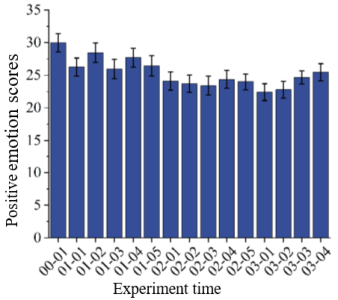
The Positive and Negative Affect Schedule (PANAS) was used to evaluate the subjects’ positive and negative emotional experiences during the experiment. The results of PANAS showed (Figure 1) that the positive emotion score significantly decreased with the extension of isolation time (F = 4.327, p = 0.02), from 29.96 ± 1.40 before the experiment to 22.42 ± 1.29 on the 3rd day, and was still lower than the baseline at the end of the experiment (25.46 ± 1.30); the negative emotion score remained between 12.50 ± 0.72~14.67 ± 0.94, without significant time effect (F = 2.10, p = 0.075). This “asymmetric impact” characteristic indicated that positive emotions are more sensitive to the ICE environment, and their decline may be due to the lack of sensory stimulation and social interaction.
(Note: 00-01 indicated the measurement value one day before the formal experiment, 01-01 indicated the first questionnaire on Day 1, 01-02 indicated the second questionnaire on Day 1, and so on)
Figure 1: Positive emotion scores.
The results of STAI showed that the scores of state anxiety (37.92 ± 5.93→39.33 ± 8.23) and trait anxiety (39.38 ± 6.71→41.29 ± 7.81) had no significant changes (p>0.05); the SAS score showed a fluctuation of “initial increase - mid-term decrease - late recovery” (58.22 ± 6.88 on the morning of the 1st day→48.04 ± 6.53 on the evening of the 1st day→55.87 ± 10.67 on the evening of the 3rd day), reflecting the subjects’ “acute stress - adaptation - cumulative stress” process (Hayes et al., 2004). The SDS score increased
The Impact of Confined and Small-Space Environments 135 from 33.04 ± 5.24 to 36.38 ± 8.79. Pearson correlation analysis showed that the SAS and SDS scores were significantly positively correlated at most time points (e.g., r = 0.760 before the experiment, p < 0.001; r = 0.669 on the evening of the 2nd day, p < 0.001), indicating that anxiety and depression have “comorbidity” in the ICE environment.
ERQ is used to assess an individual’s tendencies in emotion regulation, which is divided into two dimensions: cognitive reappraisal and expressive suppression. Cognitive reappraisal refers to regulating emotions by changing one’s interpretation of an event, while expressive suppression involves regulating emotions by inhibiting emotional expression. During the three- day confined and narrow environment isolation experiment, the participants showed no significant changes in their scores for either cognitive reappraisal or expressive suppression. The cognitive reappraisal scores remained stable at approximately 30–32 points. The results indicated that the participants predominantly employed cognitive reappraisal as their emotion regulation strategy during the experiment, which held a considerably greater advantage over expressive suppression.
PSS scores of the participants showed a cumulative increase during confinement in an isolated environment. The baseline score was 33.71 ± 6.86, with a slight decrease observed on the first day (32.17 ± 7.32), indicating satisfactory short-term adaptation. Starting from the second day, stress scores continued to rise and exceeded the baseline level, reaching a peak on the third day (36.21 ± 6.79). This suggested that prolonged exposure to a monotonous environment and psychological discomfort gradually intensified stress over time. Although repeated-measures ANOVA revealed no statistically significant effect of time (F = 1.024, p = 0.410), the overall trend indicated that confined isolation had a negative impact on emotional well-being. The findings highlight the necessity of implementing stress management and psychological interventions to alleviate accumulated mental burden in similar environments.
Behavioral Performance Go/No-Go Task: There was no significant time effect on the task accuracy rate (87%~93%, F = 1.370, p>0.05). The reaction time shortened from 377 ± 7ms to 361 ± 8ms (F = 2.060, p = 0.086), indicating that the subjects’ inhibitory control ability was not affected, and the shortening of reaction time may be due to the improvement of task proficiency.
2-back Task: The accuracy rate increased from 55% ± 18% to 84% ± 14%, but was still 13% lower than the baseline. The reaction time significantly shortened from 712 ± 88ms to 611 ± 93ms (F = 9.927, p < 0.01), indicating that the working memory ability was impaired in the early stage and gradually adapted in the later stage. The shortening of reaction time reflected the improvement of task alertness.
WCST Task: The accuracy rate fluctuated slightly (75%~82%). The reaction time significantly shortened from 1533 ± 631ms to 1235 ± 724ms (F = 10.392, p < 0.05). The number of persistent errors increased by 20% in the first two days and decreased by 10% on the 3rd day, indicating that
the cognitive switching ability was inhibited in the early stage and adapted through strategy adjustment in the later stage.
Physiological Signal Data The morning salivary cortisol concentration on the 1st day (8.2 ± 1.5nmol/L) was significantly higher than that on the 3rd day (6.1 ± 1.2 nmol/L, a decrease of 25%); the 24-hour total urinary cortisol on the 1st day (38.5 ± 5.3μg/24h) was higher than that on the 3rd day (30.2 ± 4.8μg/24h). The concentration of some subjects recovered on the 3rd day, reflecting individual differences in adaptation. The change of cortisol was consistent with the trend of PSS score, confirming the “acute stress - adaptation” process of environmental stress.
Go/No-Go Task: Tables 3 and 4 showed the amplitudes of the interested EEG ERP components in Go Trial and Nogo Trial respectively. It could be seen that in Go trials, the amplitudes of N2 wave (150230ms, F = 5.84, p < 0.01) and P2 wave (200300ms, F = 2.40, p < 0.05) at Fz electrode changed significantly, while there was no difference at Cz electrode; in Nogo trials, the amplitudes of N2 wave (240340ms, F = 1.99, p < 0.05) and P3 wave (340400ms, F = 1.96, p < 0.05) at Fz electrode were significantly different, indicating that the prefrontal cortex is more sensitive to isolation and participates in conflict monitoring and outcome evaluation.
Table 3: Average amplitudes of N2 and P2 under different experimental times(μV).
03_02 −5.92 ± 14.10 −3.41 ± 20.59 8.18 ± 43.79 7.48 ± 39.37 2-Back Task: Table 5 showed the average amplitudes of P2 and P3 components under different experimental times in the 2-back task. It could be seen that the amplitude of P3 wave (360~440ms) at Fz electrode significantly
The Impact of Confined and Small-Space Environments 137 decreased with time (F = 2.104, p < 0.01), reflecting the cumulative inhibition of prefrontal activation by working memory load.
Table 5: Average amplitudes of P2 and P3 under different experimental times (μV).
Table 6 showed the power values of different frequency bands in the 2-back task. The results of variance analysis showed that the power of the high α band (10~12 Hz) at Fz electrode in the 2-back task significantly decreased (F = 2.553, p < 0.05), indicating a decrease in the efficiency of attention resource allocation; there were no significant differences in all frequency bands (δ, θ, α, β) in the Go/No-Go task, indicating that there are specific neural responses to different cognitive tasks.
Table 6: Power values of different frequency bands in 2-back task (μV²).
The isolated environment inhibits aggressive emotions (decreased hostility), which may be due to the lack of interpersonal conflict stimulation reducing the inducement of hostility; the significant decrease in positive emotions is directly related to the lack of sensory stimulation and social interaction in the ICE environment, which is consistent with the conclusion of Shi et al. (2018) in the 180-day experiment that “positive emotions decrease most significantly in the first 30 days”. Subjects mainly used cognitive reappraisal strategy (ERQ score 30~32 points) to regulate emotions. This strategy can alleviate some negative emotions, which is also an important reason why the anxiety score did not increase significantly.
The differences in the performance of different cognitive tasks reflect the selective impact of the ICE environment on cognitive functions: inhibitory control (Go/No-Go task) is resistant to stress, while working memory (2-back task) and cognitive switching (WCST task) show a “damage-adaptation” trend, which is closely related to the regulation of prefrontal cortex function. ERP results showed changes in the amplitudes of N2 and P3 waves in the prefrontal cortex, confirming its core role in inhibitory control and conflict monitoring. The general shortening of reaction time may be due to the improvement of task proficiency and the enhancement of alertness caused by environmental stress. This “dual-drive” effect has a dual nature in space missions: the improvement of alertness can improve short-term operational efficiency, but may lead to cognitive fatigue in the long term.
The “increase-decrease” trend of cortisol is in line with the stress adaptation law, and individual differences indicate the regulatory role of personality traits (such as neuroticism); the decrease in high α band power is synchronized with the decrease in working memory accuracy, confirming the impairment of attention resource allocation efficiency. The interaction mechanism among the three is manifested as: the ICE environment activates the HPA axis→cortisol increases→inhibits prefrontal cortex function→cognitive performance decreases. At the same time, emotions (such as anxiety) can reversely regulate cortisol secretion, forming a dynamic feedback cycle.
CONCLUSION
The following conclusions could be drawn from this study: (1) The 3-day confined and small-space environment significantly inhibited
aggressive emotions, reduced positive emotions, and increased depression, anxiety, and social loneliness; the main emotion regulation strategy was cognitive reappraisal, which can alleviate the impact of some negative emotions. (2) Behavioral performance showed task specificity: inhibitory control ability was stable, while working memory and cognitive switching ability were impaired in the early stage and adapted in the later stage. The shortening of reaction time reflected the improvement of task proficiency and alertness. (3) At the physiological level, cortisol concentration increased in the early
stage and decreased in the later stage. The amplitudes of N2 and P3 waves in the prefrontal cortex and the power of the high α band changed significantly, confirming that the prefrontal cortex is a sensitive brain area to environmental stress and participates in “emotion-cognition” regulation.
REFERENCES
Chrousos, GP. (1998). Stressors, Stress, and Neuroendocrine Integration of the Adaptive Response, Annals of the New York Academy of Sciences Volume 851, NO 1.
The Impact of Confined and Small-Space Environments 139 Fan, YY. Shi, JN. (2009). The Application of Cortisol Measurement in Psychological
Research, Chinese Journal of Health Psychology, Volume 17, NO 11 Gemignani, A. Piarulli, A. Menicucci, D. et al. (2014). How Stressful Are 105 Days of Isolation? Sleep EEG Patterns and Tonic Cortisol in Healthy Volunteers Simulating Manned Flight to Mars, International Journal of Psychophysiology, Volume 93, NO 2. Hayes, SC. (2004). Acceptance and Commitment Therapy, Relational Frame Theory,
and the Third Wave of Behavioral and Cognitive Therapies, Behaviour Therapy, Volume 35, NO 4. Huang, SB. Zhang, MJ. Luan, Y. et al. (2015). Investigation and Analysis of the Mental Health Status of Officers and Soldiers in a Fully Sealed Standby Environment, The Journal of Military preventive Medicine, Volume 33, NO 6. Leon, GR. Sandal, GM. Larsen, E. (2011). Human Performance in Polar Environments,
Journal of Enviromental Psychology, Volume 31, NO 4: 3. Li, T. Zhang, M. Miao, JY. (2006). Manual for occupational hazard protection in confined spaces. Beijing: Chemical Industry Press. Li, YY. Zeng, Y. Ruan, Z. et al. (2017). Analysis of the Brain Functional State
Characteristics of Patients with Schizophrenia Who Have Not Taken Medication During the Operation of the Wisconsin Card Sorting Test (WCST). Electronic Journal of Clinical and Pharmaceutical, Volume 4, NO 43. Pagel, JI. Choukèr, A. (2016). Effects of Isolation and Confinement on Humansimplications for Manned Space Explorations, Journal OF Applied physiology, Volume 120, NO 5. Palinkas, LA. Glogower, F. Dembert, M. et al. (2004). Incidence of Psychiatric
Disorders After Extended Residence in Antarctica, International Journal l of Circumpolar Health, Volume 63, NO 2. Pross, N. Demazières, A. Girard, N. et al. (2014). Effects of Changes in Water Intake on Mood of High and Low Drinkers, Plos One, Volume 9, NO 4. Qiu, YZ. Chen, HS. Li, ZG. et al. (2019). Research on the Influencing Factors
of Urban Residents’ Mental Health from the Perspective of Neighbourhood Effects-Take Guangzhou City As an Example, Progress in Geographical Science, Volume 38, NO 2. Shi, YS. Jing, XL. Tong, FZ. et al. (2018). Study on the Emotional and Cognitive Adaptation Process of 4-person of the 180-Day, Aerospace Medicine and Medical Engineering, Volume 31, NO 4. Strangman, GE. Sipes, W. Beven, G. (2014). Human cognitive performance in
spaceflight and analogue environments, Aviation, Space, and Environmental Medine, Volume 85, NO 10. Wang, J. Xu, ZX. Wang, T. (2015). The Interpersonal Sensitivity Characteristics of Air Force Personnel in Special Environments and Their Relationship with Personality Traits and Emotions, Chinese Journal of Mental Health, Volume 629, NO 12.
LISTED IN THE AHFE DIGITAL BOOKSTORE CATALOGUE
Explore the complete digital volume
Neuroergonomics and Cognitive Engineering
Read this individual research paper free through the original publisher, or explore the full digital proceedings book.
ISBN 978-1-964867-83-0
Explore this ISBN in the AHFE Bookstore ↗Listed in the July 2026 bookstore catalogue; search by ISBN to confirm current availability · Digital book purchase optional