Alexander M. Yemelyanov, David Adeogun, Rahul Sukumaran (2026). AI-Assisted Cognitive-Behavioral Decision Support for Insurance Coverage Selection. In: Neuroergonomics and Cognitive Engineering. AHFE Open Access, vol. 207, pp. 1–11. https://doi.org/10.54941/ahfe1007390
Selecting appropriate insurance coverage requires evaluating uncertain risks while regulating cognitive and motivational processes. This paper presents ED2® Insurance Choice, an AI-assisted cognitive-behavioral decision-support system designed to help users select a level of insurance coverage that sufficiently reduces financial risk relative to their risk profile. Unlike conventional insurance comparison tools that primarily prioritize premium price, the system focuses on identifying an appropriate extent of coverage (Basic, Standard, or Comprehensive) before selecting an insurance provider. This approach is based on a self-regulation model of problem-solving in which cognitive evaluation of risk reduction and motivational regulation jointly guide the search for a satisficing solution. Integration with Microsoft Azure OpenAI APIs enables the generation of personalized cognitive and motivational risk outcomes, with associated confidence levels, along with solutions for mitigating anticipated difficulties and strategies to support goal attainment. An illustrative example of auto insurance demonstrates how cognitive risk reduction and self-efficacy–driven motivation influence which coverage alternative reaches the satisficing level. The results suggest that AI-supported guidance can improve the transparency of risk evaluation and support more informed insurance coverage selection under uncertainty.
Selecting an appropriate level of insurance coverage is a complex decision problem involving uncertain risks, probabilistic outcomes, and behavioral influences. Conventional insurance comparison tools largely prioritize premium price and provider selection, implicitly assuming that users can independently choose the most appropriate level of coverage. However, research in behavioral economics and cognitive psychology indicates that individuals often struggle to evaluate uncertain risks and frequently rely on simplified heuristics when making insurance decisions. As a result, coverage choices often reflect bounded rationality, in which individuals seek alternatives that provide an acceptable level of protection rather than maximizing expected utility. This paper introduces ED2® Insurance Choice, an AI-assisted cognitive-behavioral decision-support system designed to help users select a sufficient level of insurance coverage relative to their risk profile before engaging in price comparisons. The approach is based on a self-regulation
model of problem-solving, in which insurance coverage selection is viewed as a satisficing process that integrates cognitive evaluation of risk reduction with motivational regulation of goal-directed behavior. The system combines the Express Decision framework (Yemelyanov, 2023) with Microsoft Azure OpenAI APIs to generate personalized risk-related and motivational outcomes that support structured evaluation of coverage alternatives.
INSURANCE COVERAGE SELECTION UNDER BOUNDED RATIONALITY Insurance coverage selection lies at the intersection of behavioral economics, cognitive psychology, and risk analysis. Empirical research consistently shows that real-world insurance choices often diverge from the assumptions of classical rational-choice models. Traditional insurance theory assumes that individuals accurately evaluate probabilities and select policies that maximize expected utility. In practice, however, coverage selection is constrained by limited information-processing capacity, incomplete risk perception, and motivational influences. Rather than determining mathematically optimal coverage, individuals typically rely on simplified reasoning, heuristics, and an acceptable level of protection. Therefore, insurance coverage selection is more appropriately examined within the framework of bounded rationality, which characterizes human choice as the search for sufficiently acceptable, rather than optimal, solutions under conditions of uncertainty.
Research in insurance economics shows that individuals often do not purchase insurance coverage for low-probability but high-consequence risks even when insurance is actuarially justified. Kunreuther and Pauly (2004) explain this behavior by pointing to probability misperception and the cognitive effort required to obtain and interpret risk information. Insurance coverage decisions, therefore, tend to be reactive, increasing mainly after adverse events rather than reflecting proactive risk management.
Behavioral studies further indicate that underinsurance cannot be explained solely by affordability constraints. Cognitive and behavioral factors, including probability underweighting, optimism bias, loss aversion, and short planning horizons, also affect coverage decisions (Kunreuther et al., 2013), leading individuals to overweight immediate premium costs while discounting long- term protection benefits. These findings are consistent with research on heuristics and biases, which shows that individuals rely on simplified judgment strategies when evaluating uncertain outcomes (Tversky & Kahneman, 1974).
Framing effects also influence insurance choices. Presenting insurance alternatives in terms of protection against potential losses rather than premium price can reduce distortions in probability perception and improve alignment between perceived risk exposure and coverage selection (Johnson et al., 1993). In addition, structured coverage options can simplify evaluation by providing reference points that support satisficing behavior (Thaler & Sunstein, 2008). Together, these findings suggest that insurance coverage selection is not purely an economic optimization problem but a cognitively constrained and behaviorally influenced decision process.
The concept of bounded rationality provides the theoretical basis for explaining this behavior. Classical decision theory assumes that individuals
AI-Assisted Cognitive-Behavioral Decision Support for Insurance Coverage Selection 3 evaluate alternatives by maximizing expected utility, whereas bounded rationality emphasizes procedural rationality, in which individuals seek acceptable solutions within cognitive and informational constraints (Simon, 1955, 1976). Simon distinguished between decision-making, which focuses on selecting optimal alternatives, and problem-solving, which focuses on determining how acceptable solutions can be reached when goals are incompletely specified. Under uncertainty, individuals typically search for alternatives that are “good enough” rather than optimal. This idea is captured by the concept of satisficing, derived from satisfy and suffice, indicating that a solution must both meet relevant goals and exceed a minimal threshold of acceptability.
Insurance coverage selection can therefore be viewed as a problem- solving activity rather than a purely computational decision process. Because financial risk cannot be eliminated but only reduced to an acceptable level, individuals evaluate alternatives according to whether they provide sufficient protection given their level of risk, financial capacity, and tolerance for uncertainty. Research on heuristics and aspiration-level reasoning supports this approach, showing that individuals rely on simplified strategies rather than exhaustive optimization when evaluating alternative coverage options (Gigerenzer & Selten, 2001).
Effective insurance coverage selection under uncertainty depends on mental models of risk—internal representations that help individuals interpret causal relationships, anticipate consequences, and evaluate actions (Norman, 1983). When these models are incomplete or distorted, as often occurs in insurance contexts with probabilistic outcomes, decision quality declines. Cognitive engineering, therefore, emphasizes supporting users in constructing and refining such representations rather than relying solely on numerical risk estimates.
Systemic-structural activity theory provides an additional perspective by explaining how goals and motivation regulate behavior in problem-solving activities (Bedny et al., 2015). In this framework, the goal represents the cognitive component of activity, while motivation represents its energetic component, regulating effort toward goal attainment. Motivation depends primarily on two factors: significance, reflecting the importance of achieving the problem goal, and difficulty, reflecting the challenges associated with implementing the activity goal. In insurance coverage selection, the problem goal is to achieve sufficient risk reduction, whereas the activity goal is to obtain protection and financial support in the event of a loss. Through the evaluation of significance and difficulty, individuals transform risk-reduction objectives into specific coverage decisions.
Self-regulation theory further explains how individuals manage cognitive and motivational requirements associated with goal-directed behavior. Within Social Cognitive Theory, self-efficacy—individuals’ beliefs in their capability to perform actions required to achieve desired outcomes—plays a central role in regulating effort and persistence (Bandura, 1986). Bandura also distinguished self-regulatory efficacy, referring to confidence in sustaining goal-directed effort, and coping self-efficacy, referring to confidence in overcoming difficulties that may arise during goal pursuit (Bandura, 1997). These efficacy beliefs influence how individuals evaluate potential outcomes and regulate effort under conditions of uncertainty.
Taken together, these theoretical foundations characterize insurance coverage selection as a self-regulating risk-reduction process under bounded rationality. Rather than seeking optimal solutions, individuals evaluate alternatives according to whether they provide sufficient risk reduction while remaining consistent with their goals and capabilities. Within this process, self-efficacy plays a key role by influencing how individuals regulate effort and respond to anticipated difficulties under conditions of uncertainty. This conceptual framework leads to the self-regulation model of problem-solving presented in the following section.
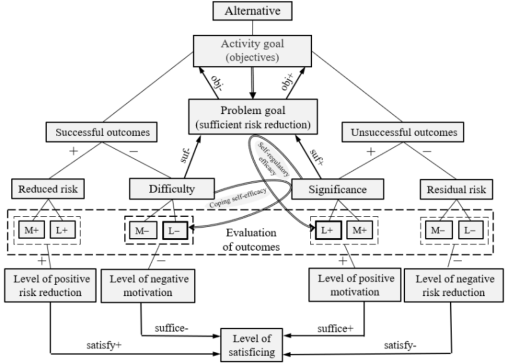
SELF-REGULATION MODEL OF PROBLEM-SOLVING The self-regulation model of problem-solving (Yemelyanov, 2025) builds on the systemic-structural model of the thinking process developed by Gregory Bedny (Bedny et al., 2015) and on experimental studies of human-operator self-regulation and risk assessment conducted by Michael Kotik (1989). Insurance coverage selection is viewed as a self-regulated satisficing process in which cognitive evaluation and motivational regulation operate concurrently under conditions of uncertainty. Within this framework, the problem goal is to achieve sufficient risk reduction. The activity goal serves as an instrumental sub-goal supporting achievement of the problem goal. It is defined in relation to a specified future risk event and focuses on implementing objectives that enable sufficient protection. In the insurance context, the activity goal is defined as receiving benefits and financial support in the event of a covered loss. As illustrated in Figure 1, the activity goal initially classifies outcomes as successful or unsuccessful, while the problem goal differentiates successful outcomes into reduced risk (cognitive) and difficulty (motivational), and unsuccessful outcomes into residual risk (cognitive) and significance (motivational).
Figure 1: Self-regulation process for determining the satisficing level of an alternative.
In insurance coverage selection, successful outcomes occur when the risk event happens, and the policy provides financial compensation that reduces or covers the resulting loss. Unsuccessful outcomes occur when the risk event
AI-Assisted Cognitive-Behavioral Decision Support for Insurance Coverage Selection 5 does not happen, and premiums are paid without receiving corresponding benefits. Each outcome is evaluated using two parameters: magnitude (M) and likelihood (L). Magnitude is expressed on a verbal scale ranging from “extremely weak” to “extremely strong,” while likelihood is evaluated on a scale from “extremely seldom” to “extremely often.” Following Kotik’s empirical findings (Kotik, 1994; Yemelyanov & Yemelyanov, 2019), these evaluations are aggregated according to established functional dependencies to derive levels of positive and negative risk reduction (satisfy+, satisfy–) and positive and negative motivation (suffice+, suffice–). The integration of these components determines the overall satisficing level of an alternative. Figure 1 illustrates how cognitive and motivational evaluations are integrated through self-regulation to determine an alternative’s satisficing level. During self- regulation, the initially uncertain problem goal (sufficient risk reduction) is clarified by identifying relevant significance (suf+) or difficulty (suf –) while the activity goal is refined through the incorporation of corresponding positive (obj+) or negative (obj–) objectives that serve as success criteria. Through this iterative process, a satisficing solution is gradually determined. Figure 1 also illustrates the role of self-efficacy as a key motivational regulator influencing both positive and negative motivation by shaping the likelihood of significance (L-) and the likelihood of difficulty (L+). The likelihood of significance (L+) reflects an individual’s willingness to invest effort in achieving the problem goal, such as sufficient risk reduction. As this willingness increases, L+ increases, strengthening positive motivation. In contrast, the likelihood of difficulty (L–) reflects the expectation that challenges may arise during goal attainment. As effort increases, L– decreases, thereby reducing negative motivation.
Self-efficacy regulates these likelihoods by influencing confidence in achieving desired outcomes and overcoming anticipated challenges. Self-regulatory efficacy increases L+ by reinforcing confidence in sustaining goal-directed effort, whereas coping self-efficacy decreases L– by strengthening confidence in overcoming potential difficulties. As a result, higher self-regulatory efficacy increases positive motivation (suffice+), while higher coping self-efficacy reduces negative motivation (suffice–). For example, in auto insurance selection, the activity goal of receiving benefits after a covered loss may reveal substantial material difficulty under liability-only coverage due to uncovered repair costs. A suggested solution, such as maintaining savings to cover potential repairs, can reduce this anticipated difficulty. Users with high coping self-efficacy may interpret such difficulty as occurring seldom, whereas those with lower efficacy may interpret it as occurring very often, thereby increasing L– and negative motivation (suffice–) and lowering the overall satisficing level of the alternative.
ED2® Insurance Choice ED2® Insurance Choice is an AI-assisted cognitive-behavioral decision- support application based on the Express Decision framework (Yemelyanov, 2023). The system guides users in selecting an appropriate level of insurance coverage (Basic, Standard, or Comprehensive) across multiple asset domains, including auto, home, health, life, business, cyber, and reputation. Unlike traditional insurance comparison websites and quoting tools that primarily
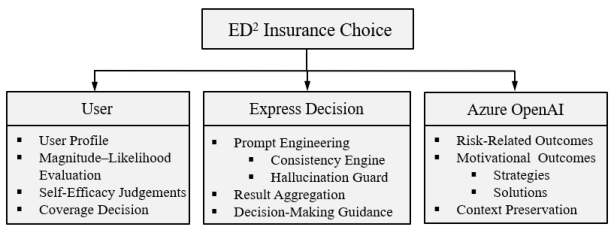
focus on comparing premiums across insurers, ED2® Insurance Choice prioritizes determining a sufficient level of coverage for the user’s risk profile before price evaluation. The system is based on the self-regulation model described in the previous section. With the integration of the Azure OpenAI API, Express Decision evolved into an AI-enhanced framework supporting two operational modes: decision-making and problem-solving. In decision- making mode (information-driven), Azure OpenAI generates positive and negative outcomes based on the user’s profile. Users evaluate the magnitude and likelihood of these outcomes to identify the alternative with the highest overall utility. In problem-solving mode (goal-driven), Azure OpenAI generates risk-related outcomes (reduced and residual risk) and motivational outcomes (difficulty and significance), each categorized as material, physical, psychological, social, or spiritual. Reduced risk outcomes include confidence levels reflecting supporting evidence, while residual risk outcomes include confidence levels indicating projected remaining risk. Each difficulty is paired with tailored solutions for mitigating anticipated challenges, whereas each significance is supported by strategies for attaining the problem goal. When evaluating the likelihood of difficulty, users apply coping self-efficacy; when evaluating the likelihood of significance, they apply self-regulatory efficacy. These structured supports guide users toward a satisficing solution. Figure 2 presents the application architecture of ED2® Insurance Choice. The architecture consists of three interacting components: User, Express Decision, and Azure OpenAI.
Figure 2: Application architecture of ED2® Insurance Choice.
The User provides a profile defined by seven attributes (asset at risk, asset value, risk factors, financial capacity, risk tolerance, decision preference, and engagement style), evaluates AI-generated outcomes by assessing magnitude (M) and likelihood (L), applies self-efficacy judgements, and ultimately determines the appropriate level of coverage.
Express Decision coordinates the cognitive–behavioral decision process through three integrated functional layers: Prompt Engineering, Result Aggregation, and Decision-Making Guidance. The Prompt Engineering module constructs structured prompts from the user’s profile using predefined JSON schemas. It incorporates two internal control mechanisms. The Consistency Engine ensures that the same user profile yields stable quantitative risk parameters (baseline risk, relative risk reduction, residual risk) across
AI-Assisted Cognitive-Behavioral Decision Support for Insurance Coverage Selection 7 operational modes by caching and reusing computed values within a session. The Hallucination Guard mitigates the risk of factually incorrect AI outputs (hallucinations) (Ji et al., 2023) by validating responses against domain constraints, requiring confidence levels for risk-related outcomes, and enforcing approved source attribution. Together, these mechanisms enhance reliability and preserve the integrity of the satisficing evaluation. Result Aggregation implements the evaluation structure illustrated in Figure 1. The activity goal classifies outcomes as successful or unsuccessful, and the problem goal further organizes them into reduced risk (cognitive) and difficulty (motivational) for successful outcomes, and residual risk (cognitive) and significance (motivational) for unsuccessful outcomes. Each outcome is evaluated by magnitude and its likelihood, using verbal scales. Based on functional dependencies identified in Kotik’s experimental research (Yemelyanov & Yemelyanov, 2019), these evaluations are aggregated into positive and negative risk reduction (satisfy+, satisfy–) and positive and negative motivation (suffice+, suffice–), which are then integrated to determine the overall level of satisficing. The Decision-Making Guidance component assists users in identifying the coverage alternative that reaches a satisficing level. It evaluates aggregated satisficing values across alternatives and provides structured feedback based on threshold and proximity criteria. If the highest satisficing level is ≥ 51% and clearly exceeds other options, the system indicates that the alternative may be selected. If the highest level is ≥ 51% but within 5% of another alternative, a high-proximity alert is generated, indicating limited differentiation. In decision-making mode, the system recommends transitioning to proactive problem-solving mode for clearer goal specification and more precise evaluation. If already in problem- solving mode, the proximity alert prompts re-evaluation of outcomes to improve differentiation among alternatives.
Azure OpenAI processes structured prompts generated by Express Decision and produces risk-related and motivational outcomes, including associated confidence levels, strategies for goal attainment, and solutions for mitigating anticipated difficulties. These responses are generated using GPT-based large language models provided through Azure OpenAI APIs. To ensure coherent and consistent evaluation across iterative interactions, the system implements session-level context preservation through structured caching. The caching mechanism retains the user’s profile attributes, selected insurance domain, previously evaluated alternatives, and prior AI-generated outputs within a problem session. This contextual information is transmitted with each subsequent request, enabling responses that remain logically aligned with earlier evaluations and preserve continuity throughout the decision process.
The technical infrastructure of ED2® Insurance Choice integrates an Angular frontend, a Spring Boot backend, and a PostgreSQL database. AI functionality is implemented through Spring AI using Microsoft Azure OpenAI APIs, which enable the use of GPT-based large language models (LLMs) to process structured prompts derived from the user profile and generate risk-related and motivational outcomes. Real-time streaming of AI-generated responses is implemented using Server-Sent Events (SSE).
Temperature is constrained (T = 0.3) to promote stable and reliable outputs, and structured JSON schemas enforce standardized response formats.
Importantly, ED2® Insurance Choice does not make the coverage decision on behalf of the user. Instead, it provides structured cognitive and motivational guidance that supports the evaluation process. While the AI generates outcomes with associated confidence levels, the user evaluates this information, applies personal judgment, and ultimately determines the satisficing level of coverage aligned with individual objectives.
ILLUSTRATIVE APPLICATION: AUTO INSURANCE COVERAGE SELECTION To demonstrate the proposed self-regulation framework, ED2® Insurance Choice is used in proactive problem-solving mode to analyze the selection of auto insurance coverage for a hypothetical user. The example illustrates how cognitive risk evaluation and motivational regulation jointly influence which coverage alternative (Basic, Standard, or Comprehensive) reaches the satisficing level. Insurance coverage selection is organized around two interrelated goals: the problem goal of sufficiently reducing the risk of financial loss and the activity goal of receiving financial support after a covered loss. As described earlier and illustrated in Figure 1, alternatives are evaluated both cognitively and motivationally. Cognitive evaluation assesses how effectively coverage reduces financial risk, whereas motivational evaluation reflects the importance of achieving sufficient risk reduction and the challenges of implementing the selected coverage. The hypothetical user owns an automobile of moderate value, operates in a relatively high-risk driving environment, and has moderate financial capacity. The profile also indicates high risk tolerance, a cost-focused decision preference, and a tendency to consult an advisor when evaluating coverage alternatives. Based on this profile, ED2® Insurance Choice generates cognitive risk outcomes for three coverage levels. These outcomes reflect the estimated reduction in financial risk and the remaining risk associated with each coverage option. The Baseline Risk (BR) is estimated at 12%, representing the annual probability of significant out-of-pocket loss if uninsured. The estimated Relative Risk Reduction (RRR) is 35% for Basic coverage, 70% for Standard coverage, and 90% for Comprehensive coverage. The Residual Risk (RR) is calculated as BR × (1 − RRR). The resulting cognitive risk outcomes and associated confidence levels are presented in Table 1.
Table 1: Cognitive risk outcomes with confidence levels.
Table available in the original PDF paper.
Coverage RRR CL(RRR) RR CL(RR) Satisfy+ Satisfy– Basic 35% Moderate 7.8% High Low–Moderate High
Standard 70% Very High 3.6% Moderate High Moderate Comprehensive 90% Extremely High 1.2% Low Very High Low
Table 1 shows the cognitive differences in risk reduction across the three coverage alternatives. Comprehensive coverage produces the greatest reduction in financial risk, whereas Basic coverage leaves the highest residual
AI-Assisted Cognitive-Behavioral Decision Support for Insurance Coverage Selection 9 risk. Standard coverage provides substantial protection with moderate residual risk. However, greater risk reduction alone does not determine which alternative becomes satisficing. Once cognitive differences in risk reduction are established (Table 1), motivational regulation determines how the coverage alternatives are evaluated in relation to the user’s goals and capabilities. Motivational outcomes reflect the importance of achieving the problem goal and the challenges associated with implementing the activity goal. Table 2 summarizes the key motivational factors for each coverage option, highlighting the primary sources of difficulty and significance together with the corresponding solutions and strategies.
Table 2: Motivational outcomes and efficacy factors.
Basic Potential out-of- pocket repair costs; financial stress after a loss
Establish a repair reserve; consult an advisor before a loss
Allocate savings to a structured risk buffer aligned with the risk-reduction objective Balanced protection and peace of mind
Standard Deductible payment and claims-processing effort
Maintain a deductible reserve; seek advisor support during claims
Frame the premium as a proactive risk investment; periodically review coverage
Comprehensive Higher premium cost; potential regret if no claim occurs
Maximum financial protection and stability
Budget adjustment and long- term financial planning
Integrate coverage into a long-term financial risk- management strategy As shown in Table 2, each coverage option is associated with specific difficulty and significance. Solutions address anticipated challenges, lowering the likelihood of difficulty (L–) and reducing negative motivation (suffice–), whereas strategies emphasize the value of achieving sufficient risk reduction, increasing the likelihood of significance (L+) and strengthening positive motivation (suffice+). Because self-efficacy regulates these likelihoods, different combinations of self-regulatory and coping self-efficacy may lead to different satisficing coverage outcomes. Table 3 summarizes how variations in self- efficacy influence which coverage alternative reaches the satisficing level.
High Moderate–High Standard Very High High Comprehensive
As illustrated in Table 3, variations in self-efficacy can lead to different satisficing coverage outcomes. When coping self-efficacy is high and anticipated difficulty is low, Basic coverage may become satisficing because premium savings align with cost-focused preferences. When both coping and self-regulatory efficacy are relatively high, Standard coverage often becomes satisficing by providing balanced protection with manageable financial commitments. When both efficacy beliefs are strong, Comprehensive coverage may become satisficing, as higher premiums are interpreted as an acceptable investment in long-term financial stability. Within the self-regulation model, self-efficacy influences motivation by regulating likelihood. Self-regulatory efficacy increases the likelihood of significance (L+), thereby strengthening positive motivation (suffice+), whereas coping self-efficacy decreases the likelihood of difficulty (L–), reducing negative motivation (suffice–). This illustrative application shows that insurance coverage selection is not determined solely by quantitative risk reduction. Cognitive evaluation establishes objective differences in risk reduction among alternatives, while motivational regulation shapes how these differences are interpreted in relation to the user’s goals and constraints. Self-efficacy further influences the evaluation by regulating motivational likelihood, thereby affecting which alternative reaches the satisficing level. By integrating quantitative risk evaluation with structured coping solutions and goal-oriented strategies, ED2® Insurance Choice supports a self-regulating decision process that helps users identify coverage that sufficiently reduces risk while remaining consistent with their capabilities and decision preferences.
CONCLUSION
This paper presents an AI-assisted cognitive-behavioral framework for insurance coverage selection based on a self-regulation model of problem- solving. Unlike conventional insurance comparison tools that focus primarily on premium prices, ED2® Insurance Choice emphasizes identifying a level of coverage that sufficiently reduces financial risk relative to the user’s risk profile. The proposed approach integrates cognitive evaluation of risk reduction with motivational regulation based on the concepts of significance, difficulty, and self-efficacy. The auto insurance example demonstrates how coverage alternatives may reach the satisficing level through the interaction of quantitative risk outcomes and motivational factors associated with goal attainment. By generating personalized risk-related and motivational outcomes with associated confidence levels, solutions for mitigating anticipated difficulties, and strategies supporting goal attainment, this system supports users in evaluating insurance alternatives within a structured, self-regulating decision-making process. Overall, the results indicate that integrating AI-generated cognitive and motivational guidance can improve transparency in risk evaluation, strengthen user engagement in the decision process, and support more informed selection of insurance coverage under conditions of uncertainty.
REFERENCES
Bandura, A. (1986). Social foundations of thought and action: A Social Cognitive Theory, Prentice-Hall, Englewood Cliffs. Bandura, A. (1997). Self-efficacy: The exercise of control. New York: W.H. Freeman
and Company. Bedny, G., Karwowski, W., and Bedny, I. (2015). Applying systemic-structural activity theory to design of human-computer interaction systems, CRC Press, Taylor & Francis Group. Gigerenzer, G., and Selten, R. (Eds.). (2001). Bounded rationality: The adaptive
toolbox. Cambridge, MA: MIT Press. Ji, Z., Lee, N., Frieske, R., et al. (2023). Survey of Hallucination in Natural Language Generation. ACM Computing Surveys, 55, Article No. 248. Johnson, E.J., Hershey, J., Meszaros, J., and Kunreuther, H. (1993). Framing,
probability distortions, and insurance decisions. Journal of Risk and Uncertainty 7(1), 35–51. Kotik, M. A. (1989). Psychology and safety (3rd ed.). Tallinn, Estonia: Valgus. Kotik, M. A. (1994). Developing applications of “Field Theory” in mass studies.
Journal of Russian & East European Psychology, 32 (4), July-August, 38–52. Kunreuther, H. and Pauly, M. (2004). Neglecting disaster: Why don’t people insure against large losses? Journal of Risk and Uncertainty, 28(1), 5–21. Kunreuther, H., Meyer, R., and Michel-Kerjan, E. (2013). Behavioral foundations of
insurance. In: Dionne, G. (Ed.) Handbook of Insurance (pp. 101–138). Springer, New York. Norman, D.A. (1983). Some observations on mental models. In: Gentner, D., Stevens, A.L. (Eds.) Mental Models, 7–14. Lawrence Erlbaum, Hillsdale. Simon, H.A. (1955). A behavioral model of rational choice. Quarterly Journal of
Economics 69(1), 99–118. Simon, H.A. (1976). Administrative Behavior, 3rd ed. Free Press, New York. Thaler, R.H. and Sunstein, C.R. (2008). Nudge: Improving Decisions about Health, Wealth, and Happiness. Yale University Press, New Haven. Tversky, A., Kahneman, D. (1974). Judgment under uncertainty: Heuristics and
biases. Science, 185 (4157), 1124–1131. Yemelyanov, A. M. and Yemelyanov, A. A. (2019). Evaluation of the factor of significance in human performance (applied activity theory approach), Chapter 7. In: G. Bedny & I. Bedny (Eds.), Applied and systemic-structural activity theory (pp. 145–175). CRC Press, Taylor & Francis Group. Yemelyanov, A. M. (2023). Express Decision: Decision-making augmentation system
(U.S. Patent No. 11,358,611), U.S. Patent and Trademark Office. Yemelyanov, A. M. and Nair, H. U. (2025). Enhancing decision-making in risk and uncertainty through OpenAI API Integration. In: A. Yemelyanov & T. Ahram (Eds.) Neuroergonomics and Cognitive Engineering. AHFE 2025 International Conference, vol. 167. DOI: 10.54941/ahfe1006128.
LISTED IN THE AHFE DIGITAL BOOKSTORE CATALOGUE
Explore the complete digital volume
Neuroergonomics and Cognitive Engineering
Read this individual research paper free through the original publisher, or explore the full digital proceedings book.
ISBN 978-1-964867-83-0
Explore this ISBN in the AHFE Bookstore ↗Listed in the July 2026 bookstore catalogue; search by ISBN to confirm current availability · Digital book purchase optional