Alexander M. Yemelyanov, Alina A Yemelyanov (2023). Self-Regulation Problem Solving for Sufficient Risk Reduction. In: Neuroergonomics and Cognitive Engineering. AHFE Open Access, vol. 102, pp. 18–27. https://doi.org/10.54941/ahfe1003001
This paper proposes the self-regulation model (SRM) for sufficient risk reduction, which is based on the self-regulation model of the thinking process developed within the systemic-structural activity theory. SRM includes two sub-models: formation of mental model and formation of the level of motivation, as well as the regulation of their interaction by using feedback and feedforward controls. Feedback control is regulated by the factor of difficulty, and feedforward control is regulated by the factor of significance. With instrumentally rational goal setting, where “reduce risk sufficiently” is an uncertain goal, self-regulation helps the individual apply their personal beliefs and experiences to find a sufficient solution to the problem. We demonstrate how SRM is implemented in ED2-CPR-Choice, a web application designed for people with serious illness to help them decide whether to attempt CPR.
Decision-making in situations of uncertainty is a difficult problem, with the risk of potential losses of money, health, reputation, etc. always present. Due to an uncertain goal, individual instrumental rationality is bounded, and the self-regulation process leads to sufficient solution of the problem. In this paper, we consider problem solving under uncertainty as problem solving for risk reduction with an uncertain goal “reduce risk sufficiently” (long- term goal) and a certain tactical goal (short-term goal). This is established in response to the risk event, and it leads to the long-term goal and makes it achievable. This makes setting the goal instrumentally rational, where ach- ievement of the short-term goal is a sufficient and necessary condition for achievement of the long-term goal. Within this setting, successful negative outcomes and unsuccessful positive outcomes represent factors of difficulty and significance, respectively, which makes them behavioral and therefore fully manageable in forming a sufficient level of motivation for achieving the goal. With instrumentally rational goal setting, where “reduce risk suffici- ently” is an uncertain goal, self-regulation helps the individual apply their personal beliefs and experiences as criteria of success to find a sufficient solution to the problem. We demonstrate how SRM is implemented in ED2- CPR-Choice, a web application designed for people with serious illness to
Self-Regulation Problem Solving for Sufficient Risk Reduction 19
help them in setting goals and applying personal beliefs and experiences when deciding whether to attempt CPR.
SELF-REGULATION MODEL The self-regulation model of decision-making and problem-solving (Yemel- yanov, 2019) is developed based on the self-regulation model of the thinking process developed within the systemic-structural activity theory (G. Bedny, Karwowski, Bedny, 2015). It implements two concurrently and dynamically running processes: formation of the mental model (FMM) and formation of the level of motivation (FLM) by using two regulators: factor of significa- nce and factor of difficulty. The factor of significance provides feedforward control, and the factor of difficulty provides feedback control. Both factors contribute to the formation of the level of motivation.
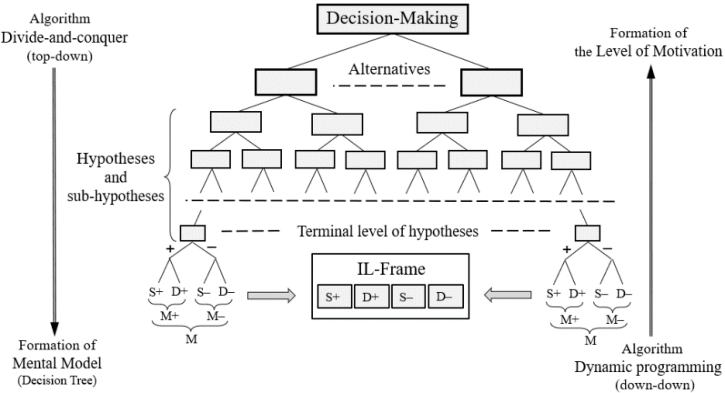
The design strategy for FMM implements a divide-and-conquer algorithm (D&C) to construct a Decision Tree (see Figure 1). The divide-and-conquer technique uses a recursive breakdown approach in decision-making: decom- pose the problem into smaller sub-problems, solve them, and then recombine their results to solve the bigger problem. This division of the problem into sub-problems may span several levels deep until a basic (ad hoc) level of certainty will be reached, at which point the problem can be positively evalu- ated within the process of FLM. In other words, the problem will contain only those outcomes for which the decision-maker will be able to deter- mine their respective positive (or negative) intensity and likelihood, which in turn, will allow to determine the positive (or negative) motivational level (preference). It should be noted that the efficiency of the divide-and-conquer algorithm increases when people apply hypotheses and split the problem into two mutually exclusive hypotheses.
Figure 1: Performance evaluation process: decision hierarchy with IL-Frame.
20 Yemelyanov and Yemelyanov
In FMM, feedback control is based on the factor of difficulty and used to verify whether the current state of the individual’s mental model is capable of either evaluating the problem or choosing the best alternative. The feedback is positive (+fb_FMM) when the individual can perform the verification, and negative (–fb_FMM) when the individual cannot perform it. When the feed- back is negative, feedforward control (ff_FMM), which is based on the factor of significance, leads to an upgrade of the existing mental model. For this pur- pose, by considering various hypothetical situations and alternative solutions, the problem is divided into sub-problems, with corresponding sub-goals that help reduce existing difficulties of verification.
The design strategy for FLM implements a dynamic programming algori- thm (DP). This algorithm determines the level of an alternative’s motivation by evaluating its outcomes in IL-Frame and aggregating results with the help of K-Rules. IL-Frame is used as a template to evaluate outcomes, according to four performance shaping factors (PSFs): positive significance S+ (presented by positive intensity I+), positive component of difficulty D+ (positive like- lihood L+), negative significance S– (negative intensity I–), and negative component of difficulty D– (negative likelihood L–). K-Rules are relations between these PSFs which have been experimentally determined by M. Kotik (1994), with the purpose of defining positive M+(I+,L+), negative M–(I– ,L–), and cumulative M(M+,M–) levels of preference of outcomes, as well as combining these levels into a cumulative level of preference (motivation) for an alternative.
IL-Frame uses verbal characteristics to measure the intensity (magnitude) and likelihood of outcomes on the verbal scales “weak – strong” and “sel- dom – often,” respectively. This soft evaluation of outcomes enables better interpretation of an uncertain goal and conditions while improving decision accuracy. When measuring the motivational level of an alternative, the level of positive motivation (motivation to attain positive outcomes) and the level of negative motivation (motivation to avoid negative outcomes) are measu- red. The level of positive motivation is determined by the level of significance of positive outcomes and the level of difficulty in obtaining them, and the level of negative motivation is determined by the level of significance of negative outcomes and the level of difficulty in avoiding them. With this in mind, the evaluation of significance of positive (negative) outcomes reflects the level (intensity) of their positive (negative) importance to the individual. Evaluation of difficulty depends on the valence of outcomes; for positive outcomes, it reflects the level of subjective possibility to attain these outco- mes, and for negative outcomes, the level of subjective possibility to avoid them. Since the decision takes place in uncertain conditions regarding the outcomes, we assume that subjective possibility can be reflected by subjective perception/feeling of their likelihood.
There are two motivation shaping factors (MSFs) that determine the level of motivation for achieving the goal: the factor of significance (FS) and the factor of difficulty (FD). FD presents difficulties in achieving the goal and FS presents the significance of the goal. Both FS and FD determine the level of motivation for achieving the goal. There are four performance shaping factors (PSFs) that determine the level of motivation for selecting the best
Self-Regulation Problem Solving for Sufficient Risk Reduction 21
alternative: positive significance (S+), positive component of difficulty (D+), negative significance (S–), and negative component of difficulty (D–).
PROACTIVE AND REACTIVE PROBLEM SOLVING: SETTING GOALS AND HYPOTHESES According to the self-regulation model, problem solving includes the conti- nuous reformulation of a problem and the development of its corresponding mental models. Setting and resetting goals as part of the formation of the mental model (FMM) is regulated by the dynamic programming (DP) algorithm to form the level of motivation (FLM) and apply the rule of self- regulation. At the beginning of problem solving under uncertainty, the goal of problem solving is formulated in a very general manner, so that only later does the goal gradually become clearer and more specific. The goal in activity theory (Bedny, Karwowski, Bedny, 2015) has two components: informa- tion (cognitive-based) and energy (emotion-based). The first component splits outcomes into desirable (positive) and undesirable (negative) categories. The second one splits outcomes according to the factor of significance (FS) and the factor of difficulty (FD). The factor of significance characterizes signi- ficance of the goal, while the factor of difficulty characterizes the difficulty of achieving this goal. It’s worth noting that FS characterizes significance of the goal as a short-term goal from the perspective of achieving the long-term goal. In other words, FS is a significance of the directness of the goal towards the long-term goal. FS forms the level of positive motivation for achieving the goal and creates peace of mind. FD forms the level of negative motivation for achieving the goal and creates anxiety.
In this paper, we consider problem solving under uncertainty as problem solving for risk reduction. Such problem solving requires setting goals: a long- term goal (LTG) and a short-term goal (STG), where LTG (goal) is “reduce risk” and STG is a sub-goal that leads to the LTG and makes it achievable. The STG is a tactical goal established in response to the risk event. STG is a certain goal that can only be either achieved or not achieved, while LTG is an uncertain goal that cannot be completely achieved, but only satisficed (a word proposed by Herbert Simon (1957) and formed from the words “sati- sfactory” and “sufficing”), i.e., achieved to a level that is sufficient for the individual. According to H. Simon, satisficing is a form of decision-making where individuals choose an acceptable option, rather than the optimal one. Therefore, “reduce risk” actually refers to “reduce risk sufficiently.” This is how LTG should be initially formulated in order to specify it later within the process of self-regulation. For example, STG could be “maintain a good pro- fessional relationship” with your boss in order to sufficiently reduce career risk.
It is important to note that STG can be set in various ways. For example, for a patient with high cholesterol levels, options for STG such as “lower LDL-C by 30%” or “lower LDL-C by 50%” may be considered to reduce the risk of heart attack and stroke. However, when selecting an STG, the following requirements must be met (achievement of STG is a sufficient and necessary condition for achievement of LTG):
22 Yemelyanov and Yemelyanov
a) STG ⇒LTG (i.e. STG leads to the LTG) If the STG is achieved, then the LTG is achieved (achievement of goal leads to sufficient risk reduction); b) Not STG ⇒Not LTG (i.e. STG is a sub-goal of LTG) If the STG is not achieved then the LTG is not achieved (failure to achieve goal leads to insufficient risk reduction).
Consequently, these two requirements mean that setting the goal is instru- mentally rational while satisfying the principle of instrumental rationality: “the goal of each sub-problem must be a sub-goal in order to rationally attain the long-term goal” (Yemelyanov, Bedny, 2020).
Depending on whether STG is achieved, outcomes are split into successful (STG is achieved) and unsuccessful (STG is not achieved) categories. LTG additionally splits them into positive and negative categories, which results in the following four groups of outcomes: successful positive, successful negative, unsuccessful positive, and unsuccessful negative. Successful posi- tive and unsuccessful negative outcomes are cognitive (information-based) outcomes that present sufficient and insufficient risk reduction, respectively; while successful negative and unsuccessful positive outcomes are behavioral (energy/emotion-based) outcomes that present difficulty and significance of achieving STG, respectively.
Problem solving can be reactive or proactive. Reactive problem solving happens under pressure after the event that causes the risk; its focus is on reducing risk after the fact. In this case, the risk event has already happened. In reactive problem solving, STG is set to reduce the risk from the present risk event. For example, STG could be “lower LDL-C by 30%” after “high cholesterol” (present risk event) has been diagnosed in order to reduce the risk of heart attack and stroke. Proactive problem solving happens before the event that causes the risk; its focus is on reducing risk in advance. In this case, the risk event has not yet happened. In proactive problem solving, STG is set to reduce the risk from the future risk event. For example, STG could be “receive insurance compensation for accidental loss” after “a car accident” (future risk event) occurs in order to reduce the risk of losing money.
In both reactive and proactive problem solving, achieving STG is associa- ted with achieving successful outcomes, while not achieving STG is associated with achieving unsuccessful outcomes. The problem is split into two subpro- blems by considering hypothesis-1 (STG is achieved) and hypothesis-2 (STG is not achieved). It should be noted that in proactive problem solving, where the occurrence of the future risk event is associated with achieving successful outcomes, and no occurrence of the future risk event is associated with achi- eving unsuccessful outcomes, both hypotheses possess a more familiar form: hypothesis-1 (future risk event happens) and hypothesis-2 (future risk event doesn’t happen).
SELF-REGULATION MODEL OF PROBLEM SOLVING FOR SUFFICIENT RISK REDUCTION With instrumentally rational goal setting, when LTG is “reduce risk suffi- ciently” and STG is a tactical goal leading to LTG, successful negative and
Self-Regulation Problem Solving for Sufficient Risk Reduction 23
unsuccessful positive outcomes become behavioural, thus representing the difficulty and significance of achieving STG, respectively.
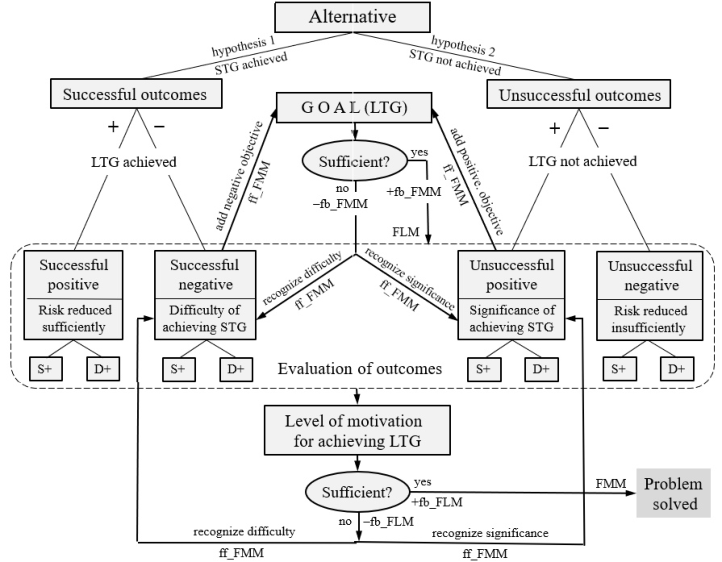
Figure 2 presents the self-regulation model of problem-solving for suffi- cient risk reduction and demonstrates the application of rules SR1-SR4 of self-regulation (Yemelyanov, 2019). If the level of motivation for achieving LTG is sufficient (positive feedback +fb_FLM), then the problem is solved (SR3). If the level of motivation is insufficient (negative feedback -fb_FLM), then feedforward control (ff_FMM) of forming the mental model must be activated to recognize difficulty or significance of behavioral successful- negative or unsuccessful-positive outcomes; subsequently, the corresponding negative or positive objective must be added to LTG (SR4). If the men- tal model is sufficient (+fb_FMM), then the level of motivation is formed (SR1). If the mental model is insufficient (-fb_FMM), then feedforward con- trol (ff_FMM) of forming the mental model must be activated to recognize difficulty or significance of behavioral successful-negative or unsuccessful- positive outcomes; subsequently, the corresponding negative objective must be added to LTG (SR2).
In the process of self-regulation, the mental model with an uncertain goal is specified by adding new criteria of success: negative objectives from successful-negative outcomes (difficulty) and positive objectives from unsuccessful-positive outcomes (significance). For difficulty, “mitigate this difficulty”must be added as a negative objective to the LTG to specify it in the
Figure 2: Self-regulation model of problem-solving for sufficient risk reduction.
24 Yemelyanov and Yemelyanov
following way: “reduce the risk, while mitigating this type of difficulty.” For significance, “apply this significance” must be added as a positive objective to the LTG to specify it in the following way: “reduce the risk, while applying this type of significance.”
It is worth noting that even when solving a problem, the factor of diffi- culty is a negative behavioral outcome, and this factor has a positive role by providing feedback control in self-regulation. Thus, this factor is consi- dered a successful outcome in problem-solving: if the problem is difficult but very significant, the individual might expend extra energy in an effort to find a solution to the problem, which may not be sufficient. However, when goals are set in an instrumentally rational way, successful negative outcomes become entirely behavioral, because personal beliefs and experiences now make up their difficulties. In this situation, the individual’s self-regulation leads them to a sufficient solution. When setting a goal in an instrumentally rational way, identifying sufficiency in achieving the main goal is required. For example, with the goal “reduce risk of heart attack and stroke,” “sta- tin side effects” is a cognitive successful negative outcome of taking statins. Whereas with the goal “reduce risk of heart attack and stroke sufficiently,” “statin side effects” becomes the behavioral outcome. Now the individual is able to self-regulate their decision regarding taking statins by applying the power of their beliefs that statin side effects can be relieved if, for example, “taking it easy when exercising” (Mayo Clinic).
Feedforward control ff_FMM uses personal beliefs and experiences to recognize difficulty or significance. In the application below, we demon- strate how personal beliefs and experiences make up material, physical, psychological, social, and religious significance or difficulty.
APPLICATION IN HEALTHCARE: CPR VS NO CPR Here we demonstrate how the self-regulation model was implemented in ED2-CPR-Choice, a web application designed for people with serious illness (i.e. heart or lung disease, cancer, etc.) to help them make a patient-centred and shared-with-clinician decision regarding attempting CPR (Yemelyanov, 2022). ED2-CPR-Choice complements existing CPR Decision Aids. Decision aids provide individuals with information on benefits, burdens, and alternatives to prepare them to make decisions that align with their goals, values, and preferences. ED2-CPR-Choice goes further and helps individuals to make these decisions.
There are two decision options in the event of cardiac arrest:
1. CPR – attempt CPR to restart the heart and breathing. 2. NO CPR – do not attempt CPR and provide care other than CPR to treat your symptoms and keep your comfortable; requires a do-not-resuscitate order (DNR).
The decision process is guided by cognitive statistical data regarding peo- ple’s risks of cardiac arrest, stroke, brain injury, broken breast bone, etc., as well as by behavioral factors that reflect their beliefs and experiences. Factor
Self-Regulation Problem Solving for Sufficient Risk Reduction 25
of difficulty and factor of significance are the two main behavioral factors. Both factors play an important role when deciding whether to attempt CPR. They determine the level of motivation for receiving CPR/NO CPR after cardiac arrest occurs.
Factor of difficulty (FD) reflects difficulty of receiving CPR/NO CPR. Location where this care is administered (hospital, community, or residen- tial setting), recipient’s severity of illness, and other factors make up the factor of difficulty. Factor of significance (FS) reflects significance of recei- ving CPR/NO CPR. Existing medical protocols and guidelines along with personal/religious beliefs and experiences determine FS. When people decide whether to attempt CPR, personal and religious beliefs are of great impor- tance. FD and FS are viewed as multidimensional factors, which encompass material, physical, psychological, social and spiritual well-being subfactors.
Proactive Problem Solving With ED2-CPR-Choice In the future risk event of cardiac arrest, select the better alternative between CPR and NO CPR in order to reduce the risk of not living as well as you can for as long as possible.
Determining risk Future risk event: cardiac arrest. Risk: risk of not living as well as you can for as long as possible.
Setting goals STG: receive medical treatment (CPR/NO CPR). LTG (goal): reduce the risk of not living as well as you can for as long as possible sufficiently.
Measuring advantages and disadvantages Hypothesis-1: cardiac arrest happens (alternative is successful from the perspective of achieving STG). Hypothesis-2: cardiac arrest doesn’t happen (alternative is unsuccessful from the perspective of achieving STG).
CPR
Hypothesis 1: cardiac arrest happens (+) Advantages (cognitive successful positive outcomes): chance to pre- vent immediate death or return to near previous function (even if small), etc. Measuring advantages from the perspective of LTG. (–) Disadvantages (behavioral successful negative outcomes): factor of difficulty (FD).Even if alternative CPR is successful (i.e. cardiac arrest hap- pens) and therefore has positive outcomes on risk reduction, there are still negative outcomes that present FD of receiving medical treatment after cardiac arrest occurs. Unlike positive outcomes, these negative outcomes are behavioral and reflect personal beliefs and experiences. For each of these beliefs/experiences to be considered a measurable disadvantage, they must be recognized by the user as one of the following types of difficulty: material, physical, psychological, social, or spiritual. For example, the belief that performing CPR causes physical damage to the chest area with
26 Yemelyanov and Yemelyanov
broken breast bones with the high risk of stroke and brain injury make up physical difficulty. Whereas the experience of performing CPR in front of relatives may be traumatic to them and thus makes up social difficulty. Measuring disadvantages from the perspective of LTG.
Hypothesis 2: cardiac arrest doesn’t happen (+) Advantages (behavioral unsuccessful positive outcomes): factor of significance (FS). Even if alternative CPR is unsuccessful (accident doesn’t happen) and therefore has negative outcomes on risk reduction, there are still positive outcomes that present FS of receiving medical treatment after cardiac arrest occurs. Unlike negative outcomes, these positive outcomes are behavioral and reflect personal beliefs and experiences. For each of these beliefs/experiences to be considered a measurable advantage, they must be recognized by the user as one of the following types of significa- nce: material, physical, psychological, social, or spiritual. Personal beliefs and experiences make up physical, psychological, and social significance, whereas religious beliefs make up the spiritual significance. For example, the belief that “life is sacred” makes up spiritual significance. Measuring advantages from the perspective of LTG. (–) Disadvantages (cognitive unsuccessful negative outcomes): concern about potential CPR outcomes after cardiac arrest occurs. Measuring disadvantages from the perspective of LTG.
NO CPR
Hypothesis 1: cardiac arrest happens (+) Advantages (cognitive successful positive outcomes): death with less likelihood of discomfort from tubes, procedures or fractured ribs; may be less traumatic for family members at the time your heart stops beating; and etc. Measuring advantages from the perspective of LTG. (–) Disadvantages (behavioral successful negative outcomes): factor of dif- ficulty (FD). For example, the belief that the location where NO CPR is administered (such as hospital, community, or residential setting) is not appropriate, combined with the belief that the recipient’s illness is severe, make up physical difficulty. Additionally, the experience “I have seen a family member with a Do Not Resuscitate order not receive other appropriate treatments (such as antibiotics)” also makes up physical difficulty. Measuring disadvantages from the perspective of LTG.
Hypothesis-2: cardiac arrest doesn’t happen (+) Advantages (behavioral unsuccessful positive outcomes): factor of significance (FS). For example, the belief that “my death is God’s will” makes up spiritual significance. Measuring advantages from the perspective of LTG. (–) Disadvantages (cognitive unsuccessful negative outcomes): concern that NO CPR automatically means no other treatment/care will be provi- ded after cardiac arrest occurs. Measuring disadvantages from the perspective of LTG.
Self-Regulation Problem Solving for Sufficient Risk Reduction 27
Resetting LTG LTG is specified by adding negative or positive objective to the goal;
a) for difficulty, “mitigate this difficulty” must be added as a negative obje- ctive to the LTG to specify it in the following way: “reduce the risk of not living as well as you can for as long as possible, while mitigating this type of difficulty”; b) for significance, “apply this significance” must be added as a positive objective to the LTG to specify it in the following way: “reduce the risk of not living as well as you can for as long as possible, while applying this type of significance”.
CONCLUSION
In this paper, we demonstrate that with instrumentally rational goal setting, where “reduce risk sufficiently” is an uncertain goal, self-regulation helps the individual apply their personal beliefs and experiences as criteria of success to find a sufficient solution to the problem. Within the process of self-regulation, the level of motivation sufficiency is regulated by the level of goal sufficie- ncy. Only when the goal is sufficiently clarified can it form a sufficient level of motivation for being achieved. A distinct feature of self-regulation is that it helps solve difficult problems where the factors of difficulty and signifi- cance are main regulators of a successful solution. In this case, difficulties are not only cognitive negative outcomes. If goals are set in an instrumen- tally rational way, the factor of difficulty forms behavioral successful negative outcomes. Following this, the negative outcomes form objectives to mitigate those difficulties, but this only happens when this mitigation is significant to the individual for achieving the goal. This demonstrates how difficulties motivate the individual to overcome them.
REFERENCES
Bedny, G., Karwowski, W., and Bedny, I. (2015). ApplyingSystemic-Structural Activity Theory to Design of Human-ComputerInteraction Systems, CRC Press. Taylor & Francis Group. Kotik, M. A. (1994). Developing Applications of “Field Theory” in MassStudies.
Journal of Russian East European Psychology, 2 (4), July-August, pp. 38–52. Simon, H. (1957), Administrative Behavior: A Study of Decision-MakingProcesses in Administrative Organization, second edition, New York: Macmillan. Yemelyanov, A. M. (2019). “Self-Regulation Model of Decision-Making,”in H.
Ayaz (Ed.), Advances in Neuroergonomics and Cognitive Engineering. Adva- nces in Intelligent Systems and Computing, 953, SpringerInternational Publishing, pp. 245–255. Yemelyanov, A. M., Bedny, I. S. (2020). “Instrumental and ValueRationality of the Self-Regulation Model of Decision-Making”. In H. Ayaz and U. Asgher (Eds.). Advances in Neuroergonomics and CognitiveEngineering. Advances in Intelligent Systems and Computing, Vol. 1201, Springer International Publishing, pp. 199–206. Yemelyanov, A. (2022). Express Decision. US Patent. No. 11, 358, 611, U. S. Patent
and Trademark Office.
LISTED IN THE AHFE DIGITAL BOOKSTORE CATALOGUE
Explore the complete digital volume
Neuroergonomics and Cognitive Engineering
Read this individual research paper free through the original publisher, or explore the full digital proceedings book.
ISBN 978-1-958651-78-0
Explore this ISBN in the AHFE Bookstore ↗Listed in the July 2026 bookstore catalogue; search by ISBN to confirm current availability · Digital book purchase optional