Manfred Dangelmaier, Wilhelm Bauer, Zimu Chen (2022). Interdisciplinary Communication and Advice under Uncertainty in a Pandemic. In: Global Issues: Disease Control and Pandemic Prevention. AHFE Open Access, vol. 24, pp. 29–36. https://doi.org/10.54941/ahfe1001356
Communication in a pandemic is difficult and complex. It is characterized by volatile situations associated with a high degree of uncertainty and, in some cases, social divergence in groups and societies. Orientation is expected, by politicians and individuals, from science. However, sciences are only fulfilling the expectations to a limited extent. We demonstrate that there are severe weaknesses in holistic and interdisciplinary communication in the pandemic and show that established tools from management are neglected and overlooked.We then analyze the specific needs of scientific reasoning in pandemic situations such as •a rational approach integrating both estimates and explicit evidence;•expressing and quantifying uncertainty; •considering interdisciplinary aspects in advice and decision making;•the ability to deal with ethical aspects;•simple updates with new findings and evidence.In a third step we compare from literature and own experience existing methods from management science for their suitability against those needs. We find that many of the interdisciplinary tools are deterministic, like Multi Criteria Analyses, and do not support uncertainty. The frequently adopted linear computation of utility values leads to ethical issues. Foresight methods like Delphi or Scenario methods deal with uncertainty and subjectivity. But they are not designed to integrate strong evidence. Strategic planning tools like roadmaps are comprehensible but disappoint in volatile situations. Probabilistic decision making with expected utilities is too complex and suffers from missing data. Heuristics at the other hand are simple but do not allow for comprehensive reasoning. We then argue in a fourth step to use probability in communication and to apply it to decision making in the pandemic. We propose a simple one-step method with a calculus based on Bayes’ theorem and calculate the probabilities of alternative courses of action being the best un der given conditios. With examples we show how arguments from various scientific disciplines can be integrated in decision making and adjusted as new evidence appears. Furthermore, we provide a role model and show by examples how scientists, scientific consultants and decision makers can cooperate and communicate using the method.We conclude that the method fulfils the identified needs to a high degree and is worth to be further developed. We show its epistemic and scientific limitations and give an outlook how likelihood functions may be used to replace negotiated likelihoods by parametric and model based values.
Communication and scientific advice in the COVID-19 pandemic are dif- ficult. The situations are dynamic and volatile, and advice must be given under time pressure. Data is lacking and the pandemic, initially understood as a public health issue, soon becomes an interdisciplinary matter because measures to be taken have not only effects but also side effects: businesses are impaired; domestic violence is on the rise; the education system does not work properly; child psychiatry shows alarming growth rates; ethical and legal issues come up; societies are dividing. How can we support decision making and communication in such situations?
THE ROLE OF SCIENCE IN DECISION MAKING
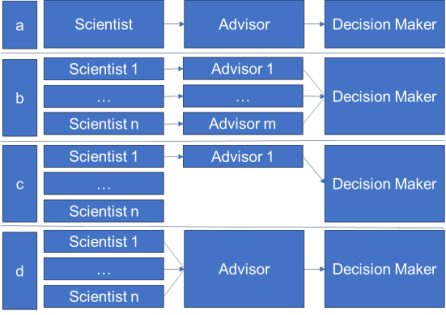
Figure 1 shows four variants (a-d) of a simple role model of science-based decision making. There are three basic roles: scientist, advisor and decision maker (a). Scientific knowledge is provided by scientists. Several domains and working groups contribute to a decision (b-d). Scientists are responsible for good scientific practice in their domain. Advisors collect information from the scientific domains, develop scientifically grounded options for action and recommend possible actions. They are responsible for the quality of work in these tasks. Decision makers must decide and are held responsible for their decisions. They can be individuals or groups, such as parliaments. In case of
Figure 1: Role models in science-based decision making.
model b the decision maker is confronted with advice from multiple advisors. The pieces of advice might be conflicting and even mutually exclusive, which would be confusing.
Therefore, decision makers, at least in Germany, seem to prefer a heuri- stic approach, which is represented by model c. They focus on the first or most relevant advisor. The Advisor 1 in the pandemic is the domain of public health together with epidemiology and virology (Expertenrat 2021a, 2021b). In fact, the reality is mirrored by both models b and c with Advisor 1 being the controlling actor with their arguments based on incidence, hospitalization, or Intensive Care Unit utilization rates. Other disciplines act more as warning voices, setting boundary conditions to action lines (Leopoldina 2021).
SUITABILITY OF DECISION SUPPORT METHODS AND TOOLS Scientific advice should treat the outcomes of natural and social sciences but also normative aspects from humanities, dealing e. g. with legal and ethical issues. Moreover, we expect that all arguments used are rational and based on evidence. Their connection to the given advice must be comprehensible and transparent. Furthermore, we would expect that all relevant evidence is considered. Taking the special circumstances of the pandemic into account, we require that the methods and tools can deal with volatility. That means that they are flexible and can be quickly adapted to match the needs of chan- ging situations and boundary conditions. Updates shall handle new evidence, the credibility of sources and/or the reliability or maturity of knowledge. Finally, the advisors shall be able to express their own uncertainty concer- ning their advice and communicate the degree of freedom left to the decision makers.
In decision theory a variety of methods has been developed to support deci- sions. Due to requirement of rational decision support, we focus on the nor- mative methods (Rapoport 1989) and consider Delphi Technique (Ngo et al. 2021; Tyrie et al. 2021), Scenario Technique (BMI 2020; Gausemeier et al.
Interdisciplinary Communication and Advice under Uncertainty in a Pandemic 31
Table 1. Estimated suitability of management methods for decision making in a pandemic on a 4-point scale (++,+,−,−−).
Table available in the original PDF paper.
Hierarchical Expected
Requirement Delphi Technique
Scenario Technique Utility Analysis
Utility Analysis + + + −
Handles interdisciplinary arguments
+ + − −
Handles normative (legal, ethical) aspects
− − + +
Based on evidence and rationality
− − − −
Comprehensible and transparent + + − − Applicable under volatility + − − − Simple and quick + + − −− Handles reliability of evidence or credibility of sources + + − − Updateable with new evidence − + + − Communicates uncertainty of the result
2009), Deterministic Utility Analysis (Saaty 1996; Zangemeister 1970) and Expected Utility Analysis (Mongin and Baccelli 2020).
Table 1 provides an overview of the suitability of the instruments in a pandemic situation based on the above criteria in our view. The negative ratings might partly explain, why some of the methods are not used more frequently in the pandemic. They either do not meet the standards of a sci- entific advisor or cannot handle volatility and uncertainty. Most of them are not simple and quick. An exception is the Scenario Technique which scales from very quick and dirty to very elaborated and time-consuming processes, and the Delphi Technique, which has a good benefit-effort ratio. The others are less suited for ad hoc work as required in the volatile situation of the pandemic.
BAYESIAN SINGLE PASS REASONING To better meet the above-mentioned requirements, we propose to use a method based on Bayesian reasoning (Bovens 2003) for ad hoc decision support. We target at the “probability that an action is the best among its alternatives” and call it “preferability”. A preferability of 1 means a recom- mendation of the action with certainty. A preferability of 0 means a certain recommendation not to implement this action. Values in between express uncertainty. We accept the Bayesian understanding of probability as a degree of belief. This is realistic in a pandemic situation because we are lacking quantified interdisciplinary models that would allow for a frequentist view of probability throughout. But we propose to use frequencies instead of subjective estimates whenever they are available.
Instead of following the Delphi approach asking people directly for prefe- rability we are using available evidence to estimate it. The calculus is given by
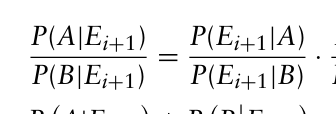
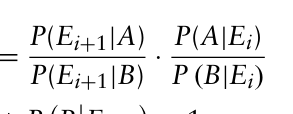
Bayes’ theorem. Its ratio form for two alternative actions A and B is shown by Equations 1 and 2.
P (B|Ei) (1)
Equation reproduced from the original PDF.Equation reproduced from the original PDF.
This means, that the ratio of preferabilities of alternative actions A and B is updated, under the condition that new evidence Ei+1 is available, by mul- tiplying the ratio of preferabilities of A and B under the old condition that only evidences E1 thru Ei are available by the likelihood ratio (LR) of the new evidence Ei+1, under the condition that A or B are optimal (Equation 1). Equation 2 is a normalization condition, which allows for calculating pre- ferabilities from the ratio. We propose to set the initial prior odd P(A)/P(B) before E1 to 1, the uninformed prior, if no reliable prior evidence provides a better estimate.
We call this approach to decision making Bayesian Single Pass Reasoning (BSPR) because it is based on Bayesian reasoning and allows to evaluate the alternatives in a single pass in contrast to Expected Utility approaches that require both, utilities of alternatives and probabilities of futures.
The method requires the following steps:
1. Formulate the decision problem/question 2. Identify relevant alternative courses of actions 3. Collect all relevant pieces of evidence from all relevant disciplines 4. Group dependent pieces of evidence to formulate the set of indepen- dent Ei 5. Estimate the likelihood ratios for the Ei 6. Calculate preferabilities P(A|Ei) and P(B|Ei) 7. Update with new evidence as it occurs Step 3 avoids bias by cherry-picking of evidence. Step 4 prevents from repeated consideration of the same or very similar evidence in the calculation, which would also lead to bias. Steps 1 thru 4 and 7 can be also used as a checklist for the quality of the work of any scientific advisor.
DISCUSSION AND EXAMPLE By design the method fulfils the requirements for scientific interdisciplinary advice in the pandemic: It is rational and based on evidence. It handles any type of evidence from any discipline. It is comparably simple and quick and thus comprehensible. It can be easily updated with new evidence. Credibi- lity of the source and scientific reliability of the evidence are directly taken into account when estimating the likelihood ratios. BSPR allows to express uncertainty of results and to quantify it.
The order of the evidence is irrelevant for the BSPR updates. Therefore, evidence and their LRs should not change over the process of iterative upda- tes. But Bayesian thinking accepts ignorance and even mistakes in its priors trusting that new evidence will correct the errors. However, sharp and rapid
Interdisciplinary Communication and Advice under Uncertainty in a Pandemic 33
changes in the considered system will cause the updated preferability values to lag behind the situation in those cases. The underlying model of the analy- sis depends heavily on the selection and formulation of the evidence. The set of Ei represents the knowledge of the current situation and constitutes, toge- ther with implicit background knowledge, the world model for the decision. It will therefore have a big influence on the assessment of the likelihoods and thus the calculated preferability of potential actions.
But how will subjective estimates of the LR differ? We answer by way of an example. A student of technology management researched evidence for a lockdown measure in a student project for his thesis during the fourth wave of Covid-19 in Germany (Table 2). He set up a panel of 31 students of 9 nationalities at an average age of 25 (SD = 3.8 y). They rated independently the likelihoods of 17 arguments Ei in a questionnaire with respect to the alternative hypotheses A “lockdown essential to fight the pandemic” versus B “lockdown not necessary”. A ten-point scale from 1 to 10 was used to rate likelihoods P(Ei|A) and P(Ei|B). Thus, LRi = P(Ei|A) : P(Ei|B) are restricted to the range 0.1 thru 10. The work took place during the rise of the fourth Covid-19 wave in late 2021.
The set of evidence consists of 17 elements and is interdisciplinary. The set is not exhaustive and was not approved by domain specialists. Some of the 10 arguments deal with the pandemic situation, 2 with social behavior, 1 is ethical, 2 are economic, and 2 name negative side effects on health. This means that more than half of the model is determined by the pandemic situ- ation, while interdisciplinarity is respected. The overall likelihood ratios (LR = Q LRi) per participant differ considerably. This can be due to different views but also due to misunderstanding the concept of likelihood. The par- ticipants were asked for P(Ei|A) and P(Ei|B) but might have assessed P(A|Ei) and P(B|Ei) instead. Table 3 shows preferability statistics for all participants. On average the panel is not strictly decided (overall preferability P = 0.67). 48% of the participants rated in favor of a lockdown (P > 0.95), 23% against it (P < 0.05).
Decision makers, being aware of BSPR would insist on presenting more options of actions (Step 1 and 2). They would require more recent and more evidence to be considered by asking for additional evidence from domain experts (Step 3). They would ask a scientific advisor, whether the evidence is independent (Step 4). They would feel happy to receive interdisciplinary advice but would replace or amend the laymen panel with an expert panel (Step 5). They would insist on regular updates (Step 7) and perhaps require the implementation of a “dashboard” with regularly updated preferabilities as a basis for their decisions and for communicating the background of their decisions.
CONCLUSION AND OUTLOOK We applied Bayesian reasoning to decision making in volatile and uncertain situations in a pandemic. We showed that the method fulfils requirements in such situations by design. We have demonstrated that it can be applied
Table 2. Average LR and standard deviation (SD) of Likelihood ratios of 17 pieces of evidence assessed by 31 persons for a lockdown.
Table available in the original PDF paper.
# Evidence/Argument (translated from German) LR SD
1.76 0.76
1 The easing policy was not conducive to epidemic control. 6.63 3.27 2 The epidemic fluctuated at a high level from mid-October to early December.
5.51 3.09
3 The number of new infections per day gradually declined after the December 3 lockdown.
5.35 3.00
4 Rapid tests are actually effective in only 58% of asymptomatic cases.
1.60 0.67
5 General vaccination has not yet started in Germany. 5.30 3.07 6 The human immune system is weaker in winter than in summer, making it susceptible to infection.
5.29 3.05
7 Covid-19 survives longer in cold conditions (temperature and UV exposure).
1.25 0.43
8 As Christmas approaches, the number of indoor parties will increase.
0.25 0.19
9 As the epidemic spreads, social consumption will shrink and food, tourism, cultural and economic activities will decline.
5.35 3.01
10 On March 3, the federal government started to loosen policies, and the number of new diagnoses rises again.
0.26 0.16
11 The majority of those infected have mild or no disease. The probability of survival for infected persons younger than 70 years is 99.95%.
0.65 0.28
12 The focus in the epidemic should be on protecting vulnerable people, not on equal distribution of medical resources.
0.24 0.17
13 The economic costs of mandatory blockade measures are far greater than the benefits of blockade.
2.24 2.00
14 The problem of failed and false viral tests on a large scale is common, resulting in the number of confirmed cases actually being higher.
0.65 0.22
15 Vacancies in buildings are increasing due to the advent of home-based work and schooling.
0.19 0.13
16 With the relaxation of measures and increased social interaction, people’s impaired cognitive functions can be quickly restored.
0.14 0.06
17 The lives of millions of children are more exposed to the Internet, and therefore they are at increased risk of harm.
Table 3. Preferability P of a lockdown (N=31).
Table available in the original PDF paper.
Average over all participants 0.67 Standard deviation 0.42 Share of participants with P > 0.5 0.71 Share of participants with P > 0.95 0.48 Share of participants with P < 0.05 0.23
Interdisciplinary Communication and Advice under Uncertainty in a Pandemic 35
to interdisciplinary decision-making using evidence and arguments from different kinds of sources.
BSPR shares epistemic shortcomings with other Bayesian applications. In particular, it is based on conditional independence of the evidence Ei, which is hard to prove in most cases. However, other rational decision approaches suffer from the same problem: they require independence of their decision criteria or orthogonality of their dimensions. We also share subjectivity with other methods in selecting the decision problem, choosing the alternative acti- ons, and selecting and grouping evidence. In defense of the BSPR, we can say that we have this in common with most research and scientific work.
What hurts most from the perspective of an empirical scientist is the subje- ctivity of likelihoods. In this paper we focused on an example with subjective ratings of a non-representative panel. We ended up at least with a collective opinion and its dispersion, which is more than a single person’s view. Expert panels should be addressed in further research to see if the ratings scat- ter less. Moreover, empirical scientists should consider providing decision makers with likelihoods based on data and simulation. What we got from simulation studies during the pandemic are scenarios and no probabilities or likelihoods. An objective for the future is switching to computed likelihoods based on data, grounded causal models, and simulation.
REFERENCES
BMI (2020) Wie wir COVID-19 unter Kontrolle bekommen: https://www.bmi.bund .de/SharedDocs/downloads/DE/veroeffentlichungen/2020/corona/szenarienpapi er-covid19.html. Accessed 11 February 2022 Bovens L (2003) Bayesian epistemology. Clarendon, Oxford Expertenrat (2021a) 2. Stellungnahme des Expertenrates der Bundesregierung zu
Covid-19: Ergänzende Erkenntnisse zur Omikron-Variante und notwendige Vorbereitungen des Gesundheitssystems auf die kommende Infektionswelle. https://www.bundesregierung.de/resource/blob/997532/1995094/0e24018c4c e234c5b9e40a83ce1b3892/2022-01-06-zweite-stellungnahme-expertenrat-data. pdf?download=1. Accessed 10 January 2022 Expertenrat (2021b) Erste Stellungnahme des Expertenrates der Bundesregierung zu COVID-19: Einordnung und Konsequenzen der Omikronwelle. https://www.bundesregierung.de/ resource/blob/997532/1992410/7d068711b8c1cc02f4664eef56d974e0/2021- 12-19-expertenrat-data.pdf?download=1. Accessed 27.12.201 Gausemeier J, Plass C, Wenzelmann C (2009) Zukunftsorientierte Unternehmensge-
staltung: Strategien, Geschäftsprozesse und IT-Systeme für die Produktion von morgen. Hanser, München, Wien Leopoldina (2021) Leopoldina advises politics and society on the coronavirus pandemic. https://www.leopoldina.org/en/press-1/news/ad-hoc-statement-coronavirus- pandemic/. Accessed 11 February 2022 Mongin P, Baccelli J (2020) Expected utility theory, Jeffrey’s decision theory, and the
paradoxes. Synthese <Dordrecht>. https://doi.org/10.1007/s11229-020-02691-3 Ngo SB, Clark PJ, Parr SE, Thomas AR, Dayal A, Sanker R, Hess BW, Stull DC (2021) Moral Injury during the COVID-19 pandemic: A delphi model survey of family medicine residents. Int J Psychiatry Med:912174211054385. https://doi.org/10.1177/00912174211054385 Rapoport A (1989) Decision Theory and Decision Behaviour: Normative and Descri-
ptive Approaches, 1st edn. Theory and Decision Library B, vol 15. Springer Netherland, Berlin
Saaty TL (1996) Multicriteria decision making: The analytic hierarchy process; planning, priority setting, resource allocation, 2nd edn. Analytic hierarchy process series, vol 1. RWS Publ, Pittsburgh, PA. Tyrie J, Knight C, Borras M (2021) Delphi Study to Understand Options Avai-
lable that will help to Identify, Address, or Mitigate the Impact of COVID-19 on Children Under Age 5. https://gov.wales/sites/default/files/statistics-and- research/2021-12/delphi-study-to-understand-options-available-that-will-help- to-identify-address-or-mitigate-the-impact-of-covid-19-on-children-under-age- 5.pdf. Accessed 10 January 2022 Zangemeister C (1970) Nutzwertanalyse in der Systemtechnik: Eine Methodik zur multidimensionalen Bewertung und Auswahl von Projektalternativen. Wittemann in Komm, München
LISTED IN THE AHFE DIGITAL BOOKSTORE CATALOGUE
Explore the complete digital volume
Global Issues: Disease Control and Pandemic Prevention
Read this individual research paper free through the original publisher, or explore the full digital proceedings book.
ISBN 978-1-958651-00-1
Explore this ISBN in the AHFE Bookstore ↗Listed in the July 2026 bookstore catalogue; search by ISBN to confirm current availability · Digital book purchase optional