Udo-ernst Haner, Wilhelm Bauer (2024). Colleague, Copilot, Companion, Controller – Roles of AI in Work Systems. In: Human Factors in Design, Engineering, and Computing. AHFE Open Access, vol. 159, pp. 1792–1799. https://doi.org/10.54941/ahfe1005746
We initially present some findings on the importance of artificial intelligence for current HFE research based on a bibliometric study of the proceedings of the most recent annual conference of the Human Factors / Ergonomics Society in Germany (GfA, 2024). Given that importance we discuss the duality of AI as a tool and a player in work systems and based on extant research suggest that the aspects of hierarchy and emotion are considered when designing roles for AI. Using these aspects as dimensions we span a portfolio and suggest ‘colleague’, ‘copilot’, ‘companion’, and ‘controller’ as potential roles for AI in work systems thereby contributing to the discussion and analysis of yet to be properly defined “AI-infused” work systems.
The history of work, work organization, and work systems is a history of technology development, innovation, and progress, too. With technological progress, humans used new or improved technologies for their purposes thereby integrating them into the work systems of their time, benefited from the respective productivity gains while moving on into the next (technology and work systems) evolution cycle.
Particularly relevant for economic progress are general-purpose technologies due to being enabling technologies for many applications in a wide range of sectors thereby fostering widespread productivity gains (Bresnahan & Trajtenberg, 1995). Artificial intelligence (AI), particularly generative pretrained transformers, has already been assessed to be a general- purpose technology (“GPTs are GPTs”, Eloundou et al., 2024) comparing to the transformational might of a steam engine or semiconductors.
With the availability of AI at everyone’s fingertips and its use for many different tasks, applications, and purposes AI has having significant impact on how work is being (re-)organized, although most work systems that aim at including AI are still in transformation. When implementing AI in organizations conscious decisions about human-machine collaboration are needed (Wahlström et al., 2024).
Colleague, Copilot, Companion, Controller – Roles of AI in Work Systems 1793
Even when considering AI a general-purpose technology, the introduction of AI is fundamentally different compared to that of any other technology before. There is not just another tool being introduced into work systems, rather, AI is potentially changing the nature of the work system. Humans (potentially) lose their unique and distinguishing feature of being the only intelligent players or masters within that system. With AI the new “work system elements”can behave different than preprogrammed robots, assuming roles that previously were pre-assigned to humans, and self-act in a non- deterministic manner. This makes a fundamental reassessment of “AI- infused” (Ismatullaev & Kim, 2024) work-systems necessary discussing the roles that AI can have within such systems.
In the first part of this paper, we present some findings on the importance of AI in human factors / ergonomics (HFE) research in Germany and its links to other major research themes. Further, we discuss work systems and the roles that AI might be attributed within such systems. After briefly discussing existing human – AI collaboration frameworks, we address the aspects of hierarchy relevance and emotion presence in the human-AI relationship. Based on these we suggest a categorization of roles for AI in work system thereby contributing to the discussion and analysis of yet to be properly defined “AI-infused” work systems.
AI #1 KEYWORD IN GERMAN HFE CONFERENCE The topic of artificial intelligence gains relevance within the field of human factors/ergonomics. The research interest in this ‘emerging topic in work design’ (Brandl & Nitsch, 2022) is increasing, e.g. in Germany “with the establishment of funded large-scale work science competence centers to test a wide variety of AI applications, analyze their effects on employees and work organization, and derive evidence-based work design recommendations” (ibid, p. 1495).
Though not the only reason, the above-mentioned research funding has most likely contributed to “artificial intelligence” being the most frequently used author keyword within all publications of the most recent annual conference of the Human Factors/Ergonomics Society in Germany (GfA, 2024), a bibliometric analysis of the respective proceedings reveals (Haner et al., 2024). Out of the 208 full-papers that were accepted and published in the proceedings of this most important HFE conference in the German- speaking realm, 29 (14%) had listed “artificial intelligence” as an author keyword, thereby leading that frequency ranking.
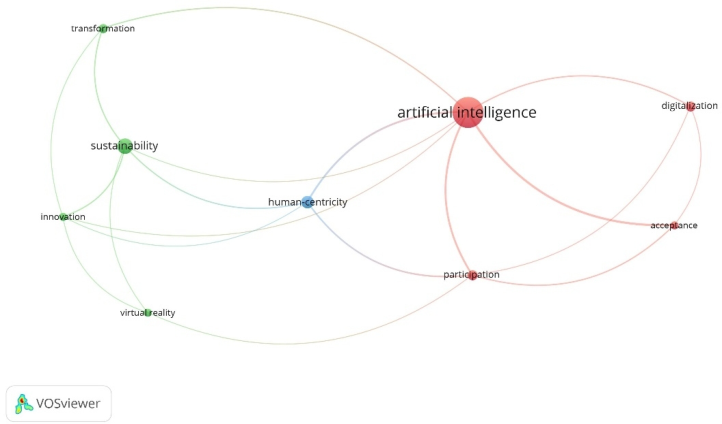
The bibliometric analysis also identified the co-occurrences of author keywords, displaying frequent linkages between pairs of keywords and consequently research topics. Figure 1 displays the co-occurrences pairs within the Top 10 author keywords of the GfA 2024 conference (Haner et al., 2024). The figure just displays 9 author keywords, the tenth (“workload”) did not occur in combination with any of the other 9, therefore not being part of the network.
More importantly though, the network displays that “artificial intelligence” co-occurred with almost all other Top 10 ranked author keywords within the publications of the GfA 2024 conference.
1794 Haner and Bauer
Figure 1: Top 10 author-keyword co-occurrence network GfA 2024. (Haner et al., 2024, [own translation]; analysis and graphics with VOSviewer).
Whether this ranking position of AI as a research topic within HFE is temporary or permanent remains to be seen. But the bibliometric analysis shows that AI is currently addressed in the context of strategic goals within organizations relating to sustainability, transformation, and innovation (thereby strengthening the strategic relevance of HFE, cf. Haner & Hölzle, 2024), with respect to operational issues, relating to participation, digitalization, and technology acceptance, and in connection to normative issues of HFE, relating to human-centricity.
This breadth of topics that AI relates to in HFE research suggests that the future of work can become unthinkable without artificial intelligence. AI will change the nature of work and the ways of working in most domains. The scope of these changes within work systems is not fully assessed yet.
TOOL OR PLAYER: THE DUALITY OF AI IN WORK SYSTEMS According to the definition adopted by the International Ergonomics & Human Factors Association, HFE is defined as “the scientific discipline concerned with the understanding of interactions among humans and other elements of a system, and the profession that applies theory, principles, data, and methods to design in order to optimize human well-being and overall system performance” (IEA, 2024).
A system of particular interest in which these interactions take place is the work system where a person performs a task using tools and technologies within a physical environment under organizational conditions (Carayon, 2009; Smith & Carayon-Saintfort, 1989). This “core” work system model can be expanded by extending the perspective from an individual to a group or team, by adding a process perspective considering input and output
Colleague, Copilot, Companion, Controller – Roles of AI in Work Systems 1795
elements, by including overall work goals (beyond a specific task), and by considering more extensively environmental influences on the system (cf. Schlick et al., 2018). Further complexity is added to work systems by blurring organizational, geographical, cultural, and temporal boundaries leading to interactions between systems (Carayon, 2006).
Any change in technology will affect the entire work system, including the worker (Carayon, 2009). In this sense, artificial intelligence as a tool or technology is not different to the introduction of other technologies into work systems.
What makes introducing AI into work systems different is that AI can be both, a tool, or a player. In contrast, traditional work system models distinguish clearly between acting persons and used tools and technologies. AI in its duality is blurring this distinction.
As a tool in the work system, AI supports and assists humans in fulfilling their tasks, improving their productivity (e.g., Noy & Zhang, 2023). AI might also augment human capabilities by providing competencies previously unavailable to the human in the work system. It is this augmentation function that is expected to exert the most important impact on future work (Gmyrek et al., 2023).
As a player in a work system, AI might initiate activities – alone or in combination with humans (cf. Muller & Weisz, 2022, Shneiderman, 2020). It is this latter joint engagement that is the basis for the ‘Collaborating Humans and AIs framework’ to better explain diverse human-AI interactions in complex work systems (Muller & Weisz, 2022) where the activity share of humans and AIs in their collaborations might vary over time, and where the amount and intensity of joint activity might vary over time, too.
Beside this task-oriented collaboration, AI might engage in social activities keeping company to humans becoming collaborative social robots – ‘cosbots’ (Cusano, 2023). Consequently, these AI-enabled cosbots must empathize with humans since they are sharing spaces and activities with them (ibid).
As a collaboratively and socially initiating and engaging player, AI is increasingly perceived as an autonomous element within work systems, engaging in symbiotic interactions with humans (Hölzle et al., 2024). It thereby compares to the role of the human-intelligent workforce, challenging its uniqueness.
ROLES OF AI IN WORK SYSTEMS When elaborating and analyzing AI-infused work systems, it becomes necessary to address the human–AI relationship by elaborating the roles of AI (in relation to humans). The type of activity, task-oriented or social, the intensity, degree and share of collaboration however seem not sufficient for explaining the human–AI relationship in work systems.
In prior research metaphoric expressions for framing cooperation or delegation in human-robot interaction were identified, leading to concepts like “friend”, “partner” or “ally” in case of collaboration, and to concepts of “boss”, “ruler”, or “king” in case of delegation (Kuhn et al., 2020). This indicates that the distribution of power, i.e., hierarchy, in the human–AI
1796 Haner and Bauer
relationship is of significance to humans in such collaborative situations. Findings that negative perceptions of AI can be mitigated when the collaboration indicates human control over AI (Haupt et al., 2024) and that the higher the intelligence of AI the more likely it is that its direct interaction with human team members in hybrid intelligent teams will lead to conflicts (Chen et al., 2023) corroborate the relevance of hierarchy in the human- AI relationship. While analyzing the extremes of the hierarchical spectrum might seem particularly tempting from a theoretical perspective – the human controls the AI or the AI controls the human –, sharing and jointly exercising control in temporal cognitive work might be similarly relevant for practical applications (e.g. Lundberg et al., 2021).
Another stream of research addresses emotional aspects of the human-AI relationship. The introduction of innovative technologies in work systems can trigger emotional responses by the affected workers. These emotional responses can arise within a work system but can also be introduced into the system through environmental factors, e.g., through a societal sentiment towards a particular technology. These kinds of sentiments and emotional responses have arisen already at earlier instances, particularly when general-purpose technologies have entered the different realms of work: when mechanization reshaped agriculture, automation changed industrial production, and digitalization affected initially the knowledge work and service sectors. In all cases worries and fears arose.
The case of AI is in this respect similar, but also different: because of AI’s distinct abilities resembling human intelligence, emotions of the affected collaborating humans are being amplified. Particularly negative emotions related to the threat to various aspects of human life, including jobs, resources, identity, uniqueness, and value (Allesandro et al., 2024) are provoked. Also, when AI interferes in human decision-making, behavioral aspects of the human-agent team like trust, handling of disagreements, or learning become particularly important (Dunning et al., 2023). In this respect, a recent literature review on factors affecting acceptance of “AI- infused systems” finds that dominant technology acceptance models need to be expanded to adequately reflect users’ attitudes, trust and perceptions (and thereby emotions) as a factor in response to AI in work systems (Ismatullaev & Kim, 2024).
That emotional aspects matter when designing interactions with AI was also shown, when AI chatbot responses were preferred over physician responses by the patients and rated particularly higher for both quality and empathy (Ayers et al., 2023). However, only through longitudinal studies the role of emotions in Human-AI collaboration can be fully understood (Knickrehm & Reichmann, 2023).
Considering the relevance of AI for HFE research and considering the above-mentioned research streams, we assess that the role of AI in work system needs further attention in research and suggest that the aspects of hierarchy and emotions are being considered when designing and attributing roles to AI in work systems.
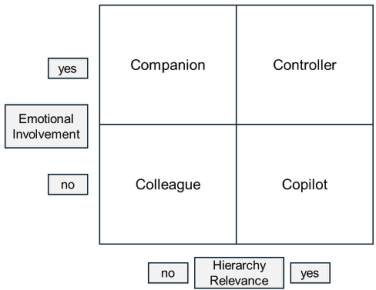
As a start we suggest a categorization of AI roles in work systems. In human-AI relationships we distinguish between roles where hierarchy
Colleague, Copilot, Companion, Controller – Roles of AI in Work Systems 1797
matters or not and between roles where emotional activation becomes relevant or not (Figure 2). Thereby we create a portfolio of roles that already nominally should express the differences among each other:
AI is considered a ‘colleague’ aiming at collaborative success, when hierarchical considerations in the human–AI relationship are as absent as emotional activation is.
AI is considered a ‘copilot’ offering support, when no specific emotions arise, and the human oversees the AI.
AI is considered a ‘companion’ providing sparring, when hierarchical considerations are absent but emotional activation towards the AI is present.
AI is considered a ‘controller’ or supervisor, when both hierarchy status and emotional activation towards the AI is present.
We deliberately do not distinguish between positive and negative emotions in the human, since both manifestations are in principle feasible, although we assume, that one is more prevalent than the other (positive emotions in the case of companion and negative emotions in the case of controller).
We encourage further research and discussion on the emerging and expanding roles of AI in current and future work systems. Due to the resemblance of AI to human intelligence we expect an intensification of the symbiotic relationship of humans and AI (Hölzle et al., 2024) which requires a thorough understanding and deliberate design of AI and its roles within work systems.
Figure 2: Portfolio of AI roles in work systems.
CONCLUSION
We have presented ‘artificial intelligence’ as the top-ranked author keyword in current HFE research in the German-speaking realm. Given the potential of AI we discussed the duality of AI as a tool and a player in work systems. Based on extant research we suggest further research to understand the aspects of hierarchy and emotion in the human–AI relationship. Using these
1798 Haner and Bauer
aspects as dimensions we span a portfolio and suggest ‘colleague’, ‘copilot’, ‘companion’, and ‘controller’ as potential roles for AI in work systems thereby contributing to the discussion and analysis of yet to be properly defined “AI-infused” work systems.
REFERENCES
Alessandro, G., Dimitri, O., Cristina, B., & Anna, M. (2024). The emotional impact of generative AI: negative emotions and perception of threat. Behaviour & Information Technology, 1–18. https://doi.org/10.1080/0144929X.2024. 2333933 Ayers, J. W., Poliak., A., Dredze, M., Leas, E. C., Zhu, Z., Kelley, J. B., Faix, D. J.,
Goodman, A. M., Longhurst, C. A., Hogarth, M., Smith, D. M. (2023): Comparing Physician and Artificial Intelligence Chatbot Responses to Patient Questions Posted to a Public Social Media Forum. JAMA Intern Med; 183(6), 589–596. https://doi.org/10.1001/jamainternmed.2023.1838 Brandl, C., Nitsch, V. (2022). Future of work in Germany: Socially sustainable value creation in digitalized and artificial intelligence-supported work systems. Work: a journal of prevention, assessment & rehabilitation. 72(4), 1493–1496. https: //doi.org/10.3233/WOR-223639 Bresnahan, T. F., Trajtenberg, M. (1995). General purpose technologies ‘Engines
of growth’? Journal of Econometrics, Volume 65, Issue 1, Pages 83–108, https://doi.org/10.1016/0304-4076(94)01598-T Carayon, P. (2006). Human factors of complex sociotechnical systems. Applied Ergonomics. Volume 37 (4), 525–535. https://doi.org/10. 1016/j.apergo.2006.04.011 Carayon, P. (2009). The balance theory and the work system model...twenty years later. International Journal of Human-Computer Interaction, 25(5), 313–327. https://doi.org/10.1080/10447310902864928 Cusano, N. (2023). Cobot and Sobot: For a new Ontology of Collaborative and
Social Robots. Found Sci 28, 1143–1155 https://doi.org/10.1007/s10699-022- 09860-2 Dunning, R. E., Fischhoff, B., Davis, A. L. (2023). When Do Humans Heed AI Agents’ Advice? When Should They? Human Factors, Vol. 66 (7), 1914-1927. https://doi.org/10.1177/00187208231190459 Tyna Eloundou, T., Manning, S., Mishkin, P., Rock, D. (2024). GPTs are GPTs:
Labor market impact potential of LLMs. Science. Vol. 384 (6702), 1306–1308. https://www.science.org/doi/epdf/10.1126/science.adj0998 GfA (2024). Arbeitswissenschaft in-the-loop: Mensch-Technologie-Integration und ihre Auswirkung auf Mensch, Arbeit und Arbeitsgestaltung. Proceedings of the 70. Congress of the Gesellschaft für Arbeitswissenschaft e. V., Stuttgart/Germany, March, 6–8, 2024. St. Augustin: GfA-Press Gmyrek, P., Berg, J., & Bescond, D. (2023). Generative AI and jobs: a global analysis
of potential effects on job quantity and quality. ILO. https://doi.org/10.54394/FH EM8239 Haner, U.-E., Braun, M., Hölzle, K. (2024). Die “fehlende Mitte” der Arbeitsforschung / The missing middle in work research. wt Werkstattstechnik online, 114(6), 334–343 https://doi.org/10.37544/1436-4980-2024-06-86
Colleague, Copilot, Companion, Controller – Roles of AI in Work Systems 1799
Haner, U.-E., Hölzle, K. (2024, accepted for publication). Strengthening the Strategic Relevance of HFE through Linkages to Innovation Management. Proceedings of the 22nd Triennial Congress of the International Ergonomics Association (IEA), Jeju, South Korea, August 25–29, 2024 Haupt, M., Freidank, J., Haas, A. (2024). Consumer responses to human-AI
collaboration at organizational frontlines: strategies to escape algorithm aversion in content creation. Review of Managerial Science. https://doi.org/10.1007/ s11846-024-00748-y Hölzle, K., Haner, U.-E., Braun, M. (2024). “Arbeitswissenschaft-in-the-loop” – Mensch-Technik-Integration und ihre Auswirkung auf Mensch, Arbeit und Arbeitsgestaltung. In Proceedings of the 70. Congress of the Gesellschaft für Arbeitswissenschaft e. V., (GfA 2024) Stuttgart/Germany, March, 6–8, 2024. St. Augustin: GfA-Press IEA International Ergonomics & Human Factors Association (2024). What Is
Ergonomics (HFE)? https://iea.cc/about/what-is-ergonomics, last accessed June 30, 2024 Ismatullaev, U. V. U., Kim, S.-H. (2024). Review of the Factors Affecting Acceptance of AI-Infused Systems. Human Factors, Vol. 66 (1), 126–144 https://doi.org/10. 1177/00187208211064707 Knickrehm, C., Reichmann, D. (2023). The Role of Emotions in Human- AI Collaboration. International Conference on Information Systems, ICIS 2023: “Rising like a Phoenix: Emerging from the Pandemic and Reshaping Human Endeavors with Digital Technologies”2023. Hyderibad, India. December, 10–13, 2023 Kuhn, M., Pollmann, K., Papadopoulos, J. (2020). I’m Your Partner – I’m
Your Boss: Framing Human-Robot. Collaboration with Conceptual Metaphors. In Proceedings of the ACM/IEEE International Conference on Human-Robot Interaction (HRI’20). ACM, Cambridge, UK https://doi.org/10.1145/3371382. 3378250 Lundberg, J., Arvola, M., Lundin Palmerius, K. (2021). Human Autonomy in Future Drone Traffic: Joint Human–AI Control in Temporal Cognitive Work. Frontiers in Artificial Intelligence. Sec. AI for Human Learning and Behavior Change. Volume 4 - 2021 https://doi.org/10.3389/frai.2021.704082 Muller, M., Weisz, J. D. (2022). Extending a Human-AI Collaboration Framework
with Dynamism and Sociality. In 2022 Symposium on Human-Computer Interaction for Work (CHIWORK ‘22), June 8–9, 2022, Durham, NH, USA. ACM, New York, NY, USA, Article 111, 12 pages. https://doi.org/10.1145/ 3533406.3533407 Noy, S., Zhang, W. (2023). Experimental evidence on the productivity effects of generative artificial intelligence. Science. Vol 381, Issue 6654, pp. 187–192 https: //doi.org./10.1126/science.adh2586 Schlick, C., Bruder, R., Luczak, H.: Arbeitswissenschaft. 4. Auflage. Wiesbaden:
Springer Vieweg, 2018. https://doi.org/10.1007/978-3-662-56037-2 Shneiderman, B. (2020). Human-centered artificial intelligence: Reliable, safe & trustworthy. International Journal of Human–Computer Interaction 36 (6), 495–504 https://doi.org/10.1080/10447318.2020.1741118 Smith, M. J., Carayon-Saintfort, P. (1989). A balance theory of job design for stress
reduction. International Journal of Industrial Ergonomics, 4 (1989), pp. 67–79 Wahlström, M., Tammentie, B., Salonen, T.-T., Karvonen, A. (2024). AI and the transformation of industrial work: Hybrid intelligence vs double-black box effect. Applied Ergonomics, Volume 118. https://doi.org/10.1016/j.apergo.2024.104271
LISTED IN THE AHFE DIGITAL BOOKSTORE CATALOGUE
Explore the complete digital volume
Human Factors in Design, Engineering, and Computing
Read this individual research paper free through the original publisher, or explore the full digital proceedings book.
ISBN 978-1-964867-35-9
Explore this ISBN in the AHFE Bookstore ↗Listed in the July 2026 bookstore catalogue; search by ISBN to confirm current availability · Digital book purchase optional