Christian Vocke, Wilhelm Bauer (2022). Status quo and quo vadis: creativity techniques and innovation methods for generating extended innovation processes. In: Human Factors and Systems Interaction. AHFE Open Access, vol. 52, pp. 373–379. https://doi.org/10.54941/ahfe1002178
The digital transformation of entire economic sectors and occupational profiles as well as the introduction of new forms of human-machine collaboration through the increased use of cognitive systems require completely new approaches. The key to success in coping with this change, which can be seen in all industries, is to break up old structures and venture something new. The ability to adapt and innovate is becoming a central success-critical factor in entrepreneurial activity. In order to continue to achieve market success and ensure sustainable growth in an extremely dynamic and disruptive environment, companies and organizations are called upon to proactively shape change. In addition to the establishment of flexible working models and agile processes, the increased generation and integration of knowledge into and around technical systems in the course of targeted competence development of employees is indispensable. The introduction and use of technical systems thus must go hand in hand with the flexibilization of innovation and collaboration processes as well as the development of employee skills in order to generate the currently missing socio-technological link – for companies´ added value and for the benefit of people. In this paper, the authors present an overview of currently used creativity techniques and innovation methods and work out the strengths and weaknesses of the respective tools. Furthermore, the resulting need for action for the optimization of innovation processes in the interaction of established techniques and possibilities of cognitive systems is presented.
The competitiveness of enterprises depends in particular on their innova- tive strength. In times of digitalization and ever shorter innovation cycles, companies are faced with the challenge of questioning their way of thinking, processes and structures, including their own products and services as well as business models, constantly developing them further and, if necessary, fun- damentally revising them. The basis for this is the analysis, integration, and transfer of knowledge – as the central asset of the future – within companies and in cooperation with partners.
Due to new technologies, algorithms, interconnectedness and big data, our working world and business are getting more and more digitalized and tran- sparent for all stakeholders. It is no longer only about marketing strategies to influence consumers, company branding to retain employees or to identify ways to improve processes or automate the manufacturing. Nowadays not only the integration and utilization of innovative technologies and business models matter, but it is also essential to understand the interdependencies and impacts on the fundamentals of innovation management, the interaction between the determinants, technology, and people (Förster-Metz et al. 2018). With the digital transformation not only representing a technical upheaval, also agile organisational and increasingly interdisciplinary forms of coope- ration arise through data-driven work and more intensive networking thus become innovation drivers themselves.
CREATIVITY TECHNIQUES AND METHODS FOR PROBLEM SOLVING Current research on innovation puts creativity at the heart of business. The success of new product development efforts depends to a great extent on the creativity of the underlying ideas. Creativity is commonly defined as the production of new ideas (“Exploration”) that are both original and valuable, and innovation is the implementation of these ideas into new products and processes (“Exploitation”). Hence, creativity is viewed as the first stage of an innovation process, followed by implementation. (Revilla and Rodríguez- Padro, 2018).
Creativity techniques can contribute to stimulating thought processes in the search for solutions and to widening the range of solutions. These can thus increase the probability that an optimal solution for a given task will be found. The difficulty lies in developing exactly the ideas that drive companies forward and can also be implemented by employees – often the problem is not quantity, but quality (Mioskowski and Meyer, 2013).
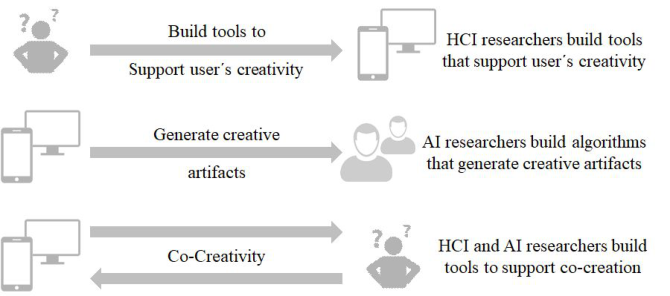
Basically, there are five types of common creative techniques (Fig. 1). These can briefly be characterized according to the following formative idea-generating principles:
Free association techniques: Mutual free association in the group.
Structured association techniques: Mutual association in the group within a given structure.
Confrontation techniques: Confrontation with unproblematic aspects. Elements of the creative process for generating ideas are recreated.
Configuration techniques: Systematic modification and confrontation.
Imagination techniques: Developing of inner images.
During application the strict separation of the divergent phase (idea gene- ration) and the convergent phase (idea evaluation and selection) must be observed for all creativity techniques.
In the 1990s, computer programs have already been developed for the application of creativity techniques, which can provide assistance e.g., in the recording, analysis and evaluation of ideas (Mioskowski and Meyer, 2013). These, however, were often limited to the processing and visualization of the
Status Quo and Quo Vadis: Creativity Techniques and Innovation Methods 375
Figure 1: Main trends in creative systems (Karimi et al. 2018).
human input. Understood as fundamentally from human input dependent, the following key promising potentials and basic restrictions of the respe- ctive techniques overall can be identified from the authors’ point of view as presented below.
Key promising potentials:
Identification and determination of current and future-oriented needs and requirements based on intuitive association.
Bringing in ideas regardless of their value or applicability and easily picking up and combining them.
Networked thinking due to interdisciplinary composition of the partici- pants and through the involvement of external experts.
Consideration of a multitude of factors with influence on new products, services, or business models.
Improving transparency and acceptance of new solutions through joint development.
Key basic restrictions:
Lack of innovative approaches, newness, and uniqueness (participants only looking at the problem from one perspective, working on one solu- tion only or ideas often very close to already existing and solutions and easy to realize without any revolutionary changes).
Danger of excessive systematization for systemic pronounced techniques.
Subjective objectivity of participants (one person’s behavior can affect the ability of the entire group to act creatively).
Necessity of guidance to change thinking style due to little prior experie- nce of the participants from educational background of making decisions based upon openness and risk taking.
High expenditure in personnel, organisational and time terms.
A further interesting question can be seen in the following (Olander, 2018): Is creativity a personality trait a human is born with, or can you learn to become creative? The suggestion is that there are important common condi- tions in a learning situation that aims to enhance creativity by practice and by
376 Vocke and Bauer
a set of different methods to be followed. These methods consist of steps that steer the user towards divergent thinking and convergent thinking in relation to the specific method’s different phases. However, teaching creativity does not only involve teaching people methods but teaching creativity by change of mind-set: from goal-oriented to open-minded and curious. To overcome the presented restrictions of common creativity techniques, furthermore, agile practices with the creation of self-reliant, self-managing teams have been promoted in a targeted manner. These can complement the traditional orga- nisational structure. Interdisciplinarity plays a major role in the performance of such teams. The interdisciplinary exchange must be recognized, establi- shed and filled with new life as an innovation driver. Small steps that build on each other with manageable risk and resource deployment help to gain experience, build competencies and find out what works for enterprises.
For this purpose, development methodologies are commonly used in cre- ative and innovative professional settings. By applying “Design thinking” human users can go beyond the typical “analysis – design – implementation – testing” process, to reinterpret it with the “emphasize – define – ideate – prototype – testing” (Coral and Fronza, 2018). Scenario methods, as a fur- ther example, lead to holistic stories illustrating visions of possible futures or aspects of possible futures for new products, services or business models (Sarpong, 2016). Furthermore, gamification may be used as one possible way to support collective creativity since it increases amusement, engagement and immersion in activities (Satu and Hyypiä, 2019).
Nowadays – with the complexity of problems transcending the individual human mind – computational systems supporting collective creativity based on artificial intelligence (AI) technologies are developed performing creative tasks in collaboration or isolated. Such creative systems can enable a wide range of tasks with similarly wide variety of roles for human participants (Fig. 1).
There are three main strategies emphasizing the role of humans in creative systems: (a) fully autonomous systems, (b) creativity support tools, and (c) co-creative systems shortly presented below (Karimi et al. 2018):
Fully autonomous systems are built to generate creative artifacts that are judged by users to be creative. These systems are based on a variety of technologies, from corpus-trained statistical learning techniques to pro- duction rules, to evolutionary approaches or planning based systems, all designed to produce output that is judged as creative by some evaluation process.
Creativity support systems are tools and applications that are built to support the user’s creativity. These can be defined as tools that develop the creative thought of users and allow them to be both productive and innovative supporting simplicity, wide range of exploration, and different paths and styles.
Co-creativity enables computers and humans to collaborate with each other and build shared creative artifacts. It involves different types of col- laboration (e.g., division of labor, assistantship, or partnership) between multiple parties where at least one of the parties is an AI agent. In these
Status Quo and Quo Vadis: Creativity Techniques and Innovation Methods 377
systems, each agent must perceive other agents’ contributions and express its own creative ideas through autonomous action.
In co-creativity, there are more than one participant contributing to the cre- ative process, but often the specific contribution of each participant cannot be delineated (Jordanous, 2017). Especially co-creative systems in the author’s opinion promise considerable added value in generating ideas and solving problems combining the strengths of humans and computational systems based on AI.
ENHANCED INNOVATION PROCESSES BY SOCIO-TECHNOLOGICAL INTEGRATION New technologies, such as data analytics, cognitive systems, and AI, as well as data-based business models and platforms, are changing our value crea- tion systems from the ground up. It can be approached as disruption in a very dedicated way. And disruption means that everything must and will be completely different, completely new afterwards. Enterprises therefore are called upon to contribute to overcoming the diverse challenges by means of innovations.
Whether manufacturers, logistics enterprises or health care organizations: digitalization is penetrating more and more areas and changing the tasks and activities of workers (Bauer et al. 2017). Rule-based and repetitive tasks are increasingly performed or supported by machines, e.g., by usage of assistive exoskeleton robotics in industrial work settings (Constantinescu et al. 2018).
But this applies not only to blue-collar workers, but also many areas of the white-collar workers’ work. For example, cognitive language assistants will have the potential to supplement knowledge work in a targeted manner and provide significant support for decision making. This way also innovation will change considerably – both in strategic and operative perspectives.
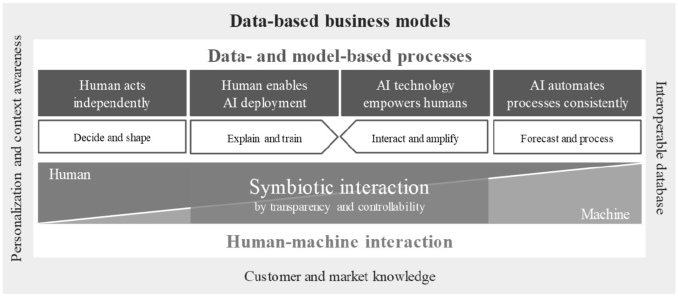
It is therefore foreseeable that the need for new forms of human-machine collaboration will increase considerably heading for a new division of labor and within innovation processes between people and technology according to specific strengths. To secure these strengths sustainably, transformation can be seen as an opportunity and act decisively. Learning algorithms and big data in combination with human creativity enable organizations to optimize their business and better predict and control their processes and applications (Vocke and Bauer, 2019, Vocke et al. 2019). Enterprise information which in the past was mainly based on human knowledge or only accessible digitally in limited ways now can be captured, shared, and enriched via co-creative com- putational systems and assistive technologies can increase human capabilities and productivity (Fig. 2).
Nevertheless, optimized interaction and collaboration between humans and machines still needs further research to design and evaluate enhanced innovation processes for generating new ideas and implementing innovative hybrid working scenarios based on a methodology representing the main objective of our research work (Vocke et al. 2019).
The hybrid approach as the core of this methodology is defined as fol- lows: “hybrid” means that human and technical intelligence are acting in a
378 Vocke and Bauer
Figure 2: New rules for human-machine interaction and collaboration.
co-creation. The identified key questions underlying the methodology and supporting the design of the specific innovation process are as follows:
What are the main criteria for the specific strategic or operative innovation process (aims and metrics)?
How can innovation in the specific phase be supported (creativity techni- ques/innovation methods and/or computational tools)?
Which actor dominates the evaluation (humans or technical systems/ agents)?
What is the suitable structure (successive or collaborative)?
What is the impact of AI in the specific innovation process (development and/or application)?
Between which innovation phases feedback is appropriate for the purpose of continuous process improvement and how is it designed?
CONCLUSIONS AND FUTURE WORK Enterprises must continuously optimize their existing business models and at the same time allow and promote new products, services and organisational developments. The digital transformation of strategic and operative proces- ses by the establishment of new hybrid forms of human-machine interaction and collaboration represents a pioneering development which is still at the beginning.
The methodological approach should make a significant contribution to raising existing potentials and enabling enterprises to realise them in a demand-oriented and comprehensible way.
REFERENCES
Bauer W., Schlund S. and Vocke C. (2017) Working life within a hybrid world – how digital transformation and agile structures affect human functions and incre- ase quality of work and business performance. In: 8th International Conference on Applied Human Factors and Ergonomics (AHFE 2017) and the Affiliated Conferences, AHFE 2017, Los Angeles USA.
Status Quo and Quo Vadis: Creativity Techniques and Innovation Methods 379
Constantinescu C., Todorovic O. and Ippolito D. (2018). Comprehensive modelling and simulation towards the identification of critical parameters for evaluation of exoskeleton-centered workplaces. In: 12th CIRP Conference on Intelligent Com- putation in Manufacturing Engineering, CIRP ICME 18, Neapel, Italy, Procedia CIRP, Volume 79, 2019, Pages 176-179, open access. Corral L. and Fronza I. (2018). Design thinking and agile practices for software engi-
neering. Association for Computing Machinery. SIGITE’18, October 3-6, 2018, Fort Lauderdale, FL, USA. Förster-Metz US. Marquardt K., Golowko N., Kompalla A. and Hell C. (2018). Digital transformation and its implications on organizational behavior. Journal of EU Research in Business, Vol. 2018, Article ID 340873, DOI: 10.5171/2018.340873. Jordanous A. (2017). Co-creativity and perceptions of computational agents in co-
creativity. Karimi P., Grace K. and Maher M.L., Davis N. (2018). Evaluating creativity in computational co-creative systems. Mioskowski H. and Meyer J.-E. (2013). Unternehmen brauchen Ideenprofis! Wie
sich geniale Ideen mit System entwickeln lassen. Ideenmanagement 4. Olander E. (2018). Teaching creativity by change of mind-set: from goal-oriented to open and curious. International Conference on Engineering and Product Design Education 6 & 7 September 2018, EPDE2018/1209. Revilla E. and Rodríguez-Padro B. (1997). Building ambidexterity through creativity
mechanisms: Contextual drivers of innovation success. In: Research Policy 47 (2018). p. 1611–1625. Sarpong D. (2016). Scenario planning: Methodologies, methods and shifting conceptual landscape. International Journal of Foresight and Innovation Policy. 10. 10.1504/IJFIP.2015074397. Satu P. and Hyypiä M. (2019). Innotin game supporting creativity in innovation
activities. Journal of Business Research 96 (2019), p. 26–34. Vocke C. and Bauer W. (2019). Work in the age of artificial intelligence – challenges and potentials for the design of new forms of human-machine interaction. AHFE 2019. In: 10th International Conference on Applied Human Factors and Ergono- mics (AHFE 2019) and the Affiliated Conferences, AHFE 2019, Washington D.C. USA. Vocke C., Constantinescu C. and Popescu D. (2019). Application potentials of arti-
ficial intelligence for the design of innovation processes. 29th CIRP Design 2019 (CIRP Design 2019).
LISTED IN THE AHFE DIGITAL BOOKSTORE CATALOGUE
Explore the complete digital volume
Human Factors and Systems Interaction
Read this individual research paper free through the original publisher, or explore the full digital proceedings book.
ISBN 978-1-958651-28-5
Explore this ISBN in the AHFE Bookstore ↗Listed in the July 2026 bookstore catalogue; search by ISBN to confirm current availability · Digital book purchase optional