Christian Vocke (2025). Far beyond knowledge – How hybrid intelligence is fundamentally changing our work and economy by enhanced innovation processes. In: Artificial Intelligence and Social Computing. AHFE Open Access, vol. 163, pp. 129–140. https://doi.org/10.54941/ahfe1006044
Artificial intelligence (AI) – as both a technology and scientific discipline – is bringing about a significant transformation in the realm of work. On one hand, AI systems provide organizations with a multitude of opportunities to enhance efficiency and cost-effectiveness in their processes. On the other hand, organizations are faced with significant challenges when it comes to selecting the appropriate AI technologies and functions for specific use cases, as well as addressing the need for new forms of human-machine interaction (HMI) and collaboration (HMC). The digital transformation of strategic and operative processes, through the introduction of new hybrid forms of HMI and HMC, is an innovative and pioneering development that is still in its early stages. During the presentation, the potentials and limitations as well as the impact of cognitive systems on the business of the future will be presented and the success-critical factors that need to be considered when designing new forms of human-machine collaboration will be highlighted based on a by the author developed methodology – hybrid intelligence will path the way towards sustainable and enhanced innovation processes in the era of AI.
The rapid advancement of digital technologies is leading to significant changes in our economies and societies. This progress, particularly in AI and robotics, big data and business analytics, as well as augmented and virtual reality (AR and VR), is enabling better connectivity and improved data analysis. Thus, organizations are anticipating increased productivity and opportunities for optimized performance through the adoption and integration of these innovative technologies. It is important to note that these technologies not only involve machines or intelligent algorithms performing tasks but also introduce new forms of HMI and HMC. These interactions play a crucial role in placing humans at the centre of design and development activities.
Recently, especially generative AI applications such as ChatGPT from OpenAI, have generated a great deal of attention and controversy among
the general public, but especially among academics and organizations. With their rapid development, large language models (LLMs) contribute to new ways of working and research activities and open up new possibilities for more efficient data handling and enhanced knowledge generation.
Since AI has mostly been on autopilot, now next-generation copilots will (try to) work alongside humans, freeing them from routine tasks and fostering innovation. Organizations deploying AI expect a push in creativity as well as productivity gains. At the same time, a platform shift to AI is taking place (Chui et al., 2023). Thus, economies and societies are at the beginning of a journey seeking for new ways combining human skills, experience and creativity with outcomes generated by AI tools and systems – but it is still a long way to create the desired interplay. On the one hand, the great public attention fuels high expectations with regard to the application possibilities. On the other hand, however, it can also obscure a realistic assessment of the possibilities and limits of such AI systems and their social – as well as economic and ethical – implications (Albrecht, 2023).
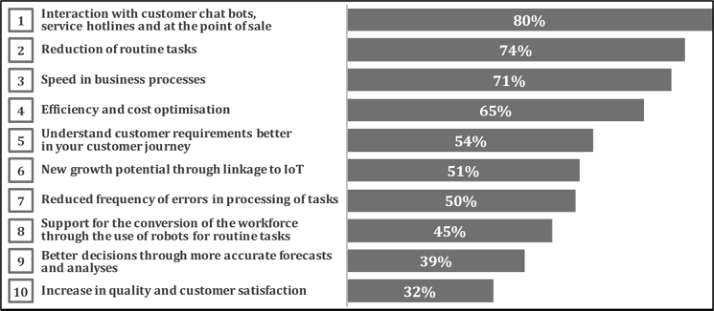
IMPACT OF AI ON FUTURE BUSINESS AND WORK By 2030, AI has the capacity to contribute an additional 13 trillion US dollars to global value creation (Heinen et al., 2017). The CEO’s perspective on the impact of AI on business strategy reflects a growing awareness of this potential (PWC, 2018). In this context, both strategic and operational objectives are of importance to enable efficiency in processes and customer- centricity primarily (see Figure 1).
Figure 1: Business opportunities of AI (adapted from DIHK, 2023).
Historically, any innovation that enhances the productivity of capital in production also has a direct or indirect influence on labor. Likewise, AI is expected to have a substantial impact on occupations and activities through three primary channels (Heinen et al., 2017):
Replacement of human work: This involves machines taking over and performing activities, even in dynamic and evolving environments.
Far Beyond Knowledge – How Hybrid Intelligence is Fundamentally Changing 131
Increased efficiency through intelligent input: Intelligent algorithms replace processes that support the actual value creation, leading to improved efficiency.
Creation of new tasks for organizations and employees: Computer programs and machines executing standardized tasks enable the creation of new value-adding processes, opening up new opportunities for organisations and employees.
Consequently, when it comes to generative AI it has to be stated that tools like ChatGPT and co. are not ready (yet) to replace workers. These tools can support employees, but they can’t replace them entirely. Certainly, AI, if used carefully, can help employees to be much more productive, whether it’s at the help desk, in accounting or programming. Yet many experts insist that AI is no threat to human ingenuity and creativity. Indeed, AI is very effective in making real people more productive. But still it has to be noted that while humans will likely remain in jobs that fall within those categories, that do not mean those professions are totally insulated from the ascent of AI. In short, seeking roles in dynamic, shifting environments that include unpredictable tasks is good way to stave off job loss to AI – at least for a while. AI-supported automation offers significant potential in relieving individuals of repetitive tasks and facilitating knowledge-intensive activities, thereby enhancing productivity and fostering innovation. This can be achieved through automated data collection and analysis, hypothesis development, model creation, and verification.
LIMITATIONS AND POTENTIALS OF CURRENT AI In a wide range of real-world scenarios, we have seen more examples of smart machines augmenting human work rather than fully automating it, and this trend is expected to continue in the foreseeable future. While AI systems may excel in research labs or controlled applications, they still require human assistance in real-world work settings. For the moment, however, it is important not to expect more of AI than it can deliver although the systems are more and more optimized or are able to improve themselves (Davenport and Miller, 2022). Some of the important limitations are described below (see Table 1). The AI revolution therefore is going differently than expected: Programs like ChatGPT are still in their beginning – but the goals of organizations like OpenAI are aiming at creating computer programs that can learn any task. AI rather can be understood as a tool to drive forward processes and tasks involving knowledge, language and creativity.
Table 1: Selected limitations of AI at the workplace human (Davenport and Miller, 2022).
Table available in the original PDF paper.
Limitation Explanation Creating new knowledge
Need for humans to create new knowledge before it
and transferring it to a system
can be transferred to an AI system for AI will not be able to extract and appropriately organize work-relevant knowledge from experienced human brains anytime soon.
Continued
132 Vocke
Table 1: Continued Limitation Explanation
Table available in the original PDF paper.
Evaluating and choosing
AI is good at taking an initial stab at a decision, but
the absolute best option
when that decision is consequential, humans often need to weigh in and make a final judgment. Framing problems, and
AI cannot frame the problem to be solved in the first place or find data to address that problem.
then training and coaching Understanding context AI does not yet understand the broader context in which the business and the task to be performed are taking place. Understanding emotional
AI systems can provide recommendations but are
situations and needs
unable to consider emotional needs related to special occasions.
ChatGPT and co., are thus far from “thinking” machines. Rather, these tools can predict what humans find coherent, but do not “understand”. On the contrary, the people who consume the output usually make all the implicit assumptions necessary for it to make sense (Fruhlinger, 2022).
Thus, organizations, will still need humans to manage data – both regular employees who create data and use it, and data management professionals whose job it is to architect, protect, and curate it. The automation of highly structured and frequently executed data management tasks with the assistance of AI is an inevitable development, whether in the present or near future. This advancement is generally beneficial for data management and its stakeholders, although it may lead to significant changes or even the elimination of certain low-level data management positions.
METHODOLOGY FOR ENHANCED INNOVATION PROCESSES BY SOCIO-TECHNOLOGICAL INTEGRATION New technologies, such as AI, cognitive systems and data analytics, as well as databased business models and platforms, are changing the value creation systems from the ground up. It can be approached as disruption in a very dedicated way. In addition, disruption means that everything must and will be completely different, completely new afterwards. The global digital ecosystem faces nothing less than a reinvention if AI applications continue to progress as they have in recent times. The search engine business, social media, and even services and jobs in many traditional industries face powerful upheavals as intelligent software takes over more and more tasks previously performed by humans. Accordingly, it is crucial for organizations that have shaped the network economy to defend their leading positions in the age of AI. Moreover, it is not only the existing network giants that are fighting for the best model when it comes to AI.
Introduction
Organizations face the challenge of continuously optimizing their existing business models while also fostering innovation in new products, services,
Far Beyond Knowledge – How Hybrid Intelligence is Fundamentally Changing 133
and organizational developments. However, achieving a balance between efficiency and flexibility, as well as between strategic and operative activities, can be a complex task. How can organizations successfully navigate this balancing act? By harnessing learning algorithms, big data, and the power of human creativity and insights, organizations can optimize their businesses and gain improved predictability and control over their processes and applications. Previously, organizational information relied heavily on human knowledge or was limited in its digital accessibility. However, with the advent of co-creative computational systems and assistive technologies, this information can now be captured, shared, and enriched – thereby enhancing human capabilities and productivity. Nonetheless, there is still a need for further research to promote optimized interaction and collaboration between humans and machines.
This research aims to design and evaluate enhanced innovation processes that generate new ideas and implement innovative hybrid working scenarios. The main objective of the doctoral research is the developed methodology centred around this hybrid approach. In this context, “hybrid” signifies the co-creation of human and technical intelligence. The digital transformation of strategic and operative processes, through the introduction of new hybrid forms of HMI and HMC, is an innovative and pioneering development that is still in its early stages. The methodology developed in this context plays a crucial role in unlocking the existing potentials and enabling organisations to effectively harness them in a demand-oriented and transparent manner.
Scientific Objectives and Hypotheses The overall objective of the doctoral research is the development of a methodology combining human skills and capabilities with potentials of AI solutions – focusing generative AI – aiming at establishing new forms of human-machine collaboration for the design of enhanced innovation processes. The application of the methodology – in form of a hybrid approach – enables organizations to adjust and optimize their innovation projects in the early phases building the basis for achieving their intended strategic and operative goals towards competitive advantage and accelerated pathbreaking ways of inventing. In the following, the underlying assumptions of the methodology developed in the doctoral research are presented based on five theses. These theses incorporate the aforementioned developments and insights.
1. The benefits of AI are predominantly achieved when a synergy of it with human skills and capabilities (e.g., creativity, critical thinking, experience) is realized. 2. Hybrid intelligence brings in a symbiosis of human capabilities and experience with context-sensitive output and recommendations of cognitive artificial systems aiming at synchronizing real-time operations as well as strategic actions in a visionary manner. 3. Co-creation between humans and AI accelerates and optimizes processes in operational as well as strategic perspectives while significantly
134 Vocke
increasing the social and domain-specific innovation lowering costs and time spent, increasing quality and productivity. 4. Future innovation processes are based on (internally) generated and stored knowledge, enriched by new knowledge from globally available information that is collected in a context-sensitive and user-aware mode using AI. 5. Humans will not be substituted by AI – rather AI algorithms and systems will primarily take on work that is time-consuming and undemanding, for example, searching for, sorting and summarizing information and making recommendations.
That is why humans are responsible for making valuable judgments and far-reaching decisions also in the future. Furthermore, humans – in contrast to AI systems – are better in communicating with colleagues and customers, gaining trust and confidence, acting empathically or developing strategic visions. In addition, it has to be noted that AI will have an impact to create sustainable businesses being one of the current top issues in today’s economies with organizations forced by politics to focus on the legal usage of their data and raw material. To navigate through the overwhelming amount of information available and mitigate potential risks such as mass surveillance or manipulation, it is crucial to have intelligent machine support that offers a diverse range of capabilities. However, to prevent abuse and alleviate concerns, it is essential to establish effective and transparent regulations.
Material and Method Today more than ever organizations are looking to AI technology in order to solve their unique business challenges and are seeking automated AI support – but still these systems and solutions are just one part of a holistic approach: Three identified key fields of action and requirements are as follows:
Socio-technological integration: Bridging existing gaps of current AI solutions (see also technical limitations and potentials of AI) and enhancing established operations and processes requiring the reimagination of processes and structures, the deduction of AI-specific strategies, and the establishment of AI governance.
Human acceptance of technologies: Incorporating new AI technology and systems as a supplement to human capabilities and skills to meet the requirements of hybrid ways of working.
Ethical, legal and social implications (ELSI): Employing AI in collaborating with humans in a synergy focusing the identification of AI with regard to an increase of productivity and product/process quality (see also EU regulation on AI implications (European Parliament, 2020).
Certain organizations have embraced a structured approach by establishing dedicated teams to investigate the potential of generative AI in unlocking untapped value and enhancing efficiency. While current efforts may prioritise productivity gains and address technical constraints, a forthcoming revolution in business-model innovation holds the promise of delivering competitive advantages and fostering new ways of co-creativity
Far Beyond Knowledge – How Hybrid Intelligence is Fundamentally Changing 135
through hybrid intelligence. The implication for organizations is to define and implement a generative AI strategy focusing on how generative AI will impact their organisations and their industries (Candelon, 2023). This strategy and its implementation in different steps of an innovation process is centred on three key challenges involving short- and long-term considerations based upon the following questions: Which innovations can be implemented with employees using the seemingly infinite but also kind of uncertain input AI delivers identifying the right uses cases? How can the technology-driven transformation be managed and how are employees’ roles re-defined? How to manage the fact that AI models produce false or biased output (hallucinations)?
Once organizations have obtained answers to these questions, they must collaborate with their technology teams to make strategic decisions regarding whether to fine-tune existing language and learning models or train a custom model. Generative AI and ML algorithms, powered by robust logic and statistical analysis of data, have the capability to semi-automate or enhance decision-making processes. This empowers employees to work more autonomously while enabling managers to focus on team dynamics and goal setting. Consequently, generative AI, acting as a first-draft content generator, has the potential to augment various roles by increasing productivity, performance, and creativity. It is important to recognize that the impact of AI in this context represents a critical success factor for culture and workforce management – particularly within the realm of HR.
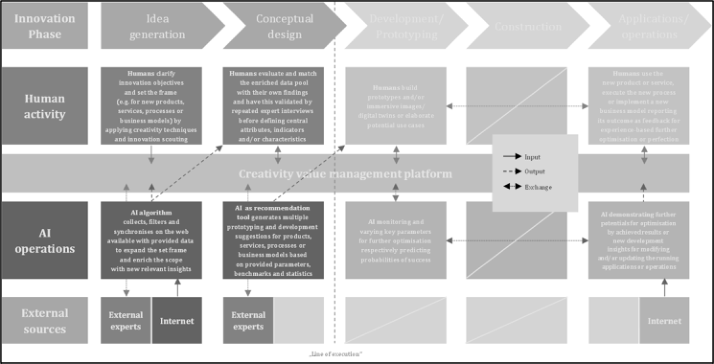
Developed Methodology In order to enable organizations to achieve competitive advantages and process innovations an integrated methodology has been developed by the author combining human and artificial intelligence in means of hybrid intelligence based on co-creation that can be applied in different phases of the innovation process (see Figure 2).
The core of this holistic methodology consists of the permanent human-machine interplay leading to in-depth knowledge about intended developments, solutions, and strategies. For this purpose, the combination of the application of creativity techniques and those for strategic management resorting human skills, capabilities and experience with AI machine learning models is the crucial key for success. The essential characteristics, sequence or dynamic combination of human activities, AI operations and knowledge obtained from external sources as well as a future-oriented platform for sustainable creativity value management (CVM) conceived and introduced by the author are described in detail below referring to the two initial phases of an innovation process the doctoral research is focusing on. The concrete application and further illustration of the added value of the methodology has been provided by the description of three use cases successfully conducted by the author for validation purposes with different organisations in various industries. Finally, options for the design of the subsequent phases of the innovation process “construction” and “applications/operations” are briefly added.
Phase 1 “Idea generation”: The first phase “idea generation” of an innovation process according to the developed methodology consists of the following activities and interrelations between humans (employees and external experts), AI and the connecting CVM platform proposed by the author:
Human activity: In a first step, organizations’ employees clarify innovation objectives and set the frame (e.g. for new products, services, processes or business models) by applying creativity techniques and innovation scouting. The gained knowledge can also be enriched by using search algorithms. At this point, the author would like to point out, that an optimization of internet search can be achieved enhancing the search algorihms by the functionality to detect similarities by analysis between search terms, which would significantly increase the search space as well as the number of target-oriented hits and thus search results. In this way, users and organizations as a whole could also benefit from new correlations and conclusions identified and presented by algorithms for topic-related research and innovation activities.
AI operations: AI algorithms respectively systems, for example ChatGPT, collect, filter and synchronize on the web available with provided data to expand the set frame and enrich the scope with new relevant insights. LLMs developed and owned by organizations are enriched by this and serve as the basis for further data handling and evaluation.
External sources: External experts in the respective design area from science and technology are consulted in order to obtain their opinions and to enrich the generated findings in a targeted manner and to validate them at the same time, for example, based on a Delphi study.
The CVM platform serves for matching, validating and ranking human input and AI outcomes constantly being updated by further research activities and gathered topic-related insights within further phases of the innovation process. Thus, the CVM platform unlocks benefits
Far Beyond Knowledge – How Hybrid Intelligence is Fundamentally Changing 137
of digitalization by increasing collaboration value and combining configuration lifecycle management (CLM) with product – or service – lifecycle management (PLM) towards holistic product or service models in terms of end-to-end processing. The platform, for example, provides configurators and configuration data across the entire value chain for planning, manufacturing or digital maintenance. Furthermore, it supports the reduction of AI-generated hallucinations as a key benefit.
Customer involvement (optional): One way of taking customer expectations and preferences into account and using them as input for the further refinement of new products, services or business models is to integrate a chatbot on the company’s website, which on the one hand answers and evaluates customer search queries to identify topics of top priority and on the other hand monitors and weighs product or service configurations for further considerations and ongoing optimizations.
By the previously described interaction between humans and AI monitored and supported by the CVM platform, a maximum of initially relevant knowledge regarding the specific innovation project and its focus as well as transparency is achieved. A key advantage of this approach is that the human-generated insights are stored in an organization’s own platform, which ensures the necessary data protection and data security. A further advantage of the described interaction results from the performance of the AI system – it delivers a large amount of input in a timely manner due to an immensely large database (internet) and computing power – even if, as described above, not all suggestions may be applicable – this is mitigated by the CVM platform as previously described.
Phase 2 “Conceptual design”: The second phase “conceptual design”of an innovation process according to the developed methodology is characterised by the following interplay of human activities, AI and external sources:
Human activity: Humans evaluate and match the – by AI outcomes and external experts’ input – enriched data pool with their own findings and have this validated by repeated expert interviews before defining key attributes, indicators and/or characteristics for the intented product, service, process or business model to be created respectively generated.
AI operations: AI as recommender generates multiple prototyping and development suggestions for products, services, processes or business models based on provided parameters, benchmarks and statistics.
CVM platform: The findings (human input and AI outcomes as well as external information concerning the certain topic), which have been further concretized compared to the first innovation phase, are incorporated into the CVM platform. This ensures an integrated and balanced view, which in turn serves as a basis for further optimization within the subsequent innovation processes, for example in terms of prototyping or reconfiguration.
Compared to a solely AI-based solution, humans – based on their knowledge and experience – in the role of the evaluator and final decider ensure that the insights/outcomes generated in this process step and being
138 Vocke
fundamental for further innovation work are correct and topic-specific. Any hallucinations or misinformation on the part of the AI can thus be eliminated supported by the CVM platform. The combined data from human input and AI outcomes are approved and doublechecked with this procedure helping to efficiently handle the significant increase in the complexity of products and processes and also to greater risks in terms of product quality, transparency and availability. Organizations in the European manufacturing industry being confronted with constantly growing customer requirements, expectations and legal regulations or certifications achieve valuable support this way. For example, pressure from intense competition in global markets, where high quality and fast product or service availability are required at a favourable price, can be reduced. Moreover, mechanical and plant engineering – in particular forced to offer more variants and customization options from the outset in order to address the largest possible number of customers while reducing time-to-market and development costs – are enabled to generate breakthrough innovations resulting in competitive advantage.
Subsequent innovation phases (not focused within doctoral research): Within the third innovation phase “development/prototyping” of an innovation process humans elaborate potential use cases, build prototypes and/or immersive images/digital twins evaluating them, for example by simulations.
The advanced AI model of the CVM platform is used for monitoring and varying key parameters in real-time for further optimization respectively predicting probabilities of success at this point with the LLM being updated within the subsequent innovation phases “construction” and “applications” for further improvement. In addition to boosting statistical significance benchmarks helping to identify risk mitigation and optimize decision-making on the operative as well as on the strategic level can be generated. Moreover, end-to-end processing – starting with the customer inquiry and quotation, through engineering, production, logistics and service contracts, can be handled in a largely automated and error-free manner this way.
CONCLUSION
In the coming years, machines will increasingly exhibit creativity and become indispensable sparring partners for humans, particularly within organizations. Generative AI will be a source of competitive advantage, generating revolutionary ideas and transforming production and knowledge work. Exploring these opportunities early on can lead to better results in innovation processes. It is important to note that effective strategy often relies on anomalies and unique approaches, rather than solely on what is generally effective or commonly observed. While tools like ChatGPT lack the ability to derive useful counterfactuals through analogical reasoning, and even if LLMs were capable of asserting all facts rather than linguistic correlations within limited data sets, they will still have limitations. Experienced strategists recognize the need to be skeptical of “facts” and understand that even if a statement is considered robustly true, there are always alternative ways to frame problems and solutions. By aiming to shape circumstances to bring
Far Beyond Knowledge – How Hybrid Intelligence is Fundamentally Changing 139
about a new goal, strategies create new facts. Such tools are, therefore, no substitute for the cultivation of strategic minds (Stadler and Reeves, 2023).
The method developed as the key objective of the doctoral research makes a significant contribution to exploiting the potential of AI solutions while minimising their current weaknesses and – for the reasons stated and validations carried out – represents a so far unique hybrid approach, which – in contrast to the full automation often proclaimed by technology companies, but also by some research institutions – emphasizes human-centredness and proves its irrefutable advantages for the design of future innovation processes. Consequently, human creativity is complemented by AI while being protected from it at the same time. It is likely that in the future the most successful ideas will come not only from bright minds, but also from those who are best able to steer machines in the desired direction. Due to the fact that analyses take place retrospectively, it has to be stated that organizations generally are not entirely exempt from misperceptions. In fact, an initiative might appear to be on track until it becomes obvious that it is not – this challenge can successfully be faced by implementation of the unique CVM platform with AI enabling organizations to adjust initiatives and targets based on real-time information and end-to-end processing as well as adapting to changes in external conditions fostering resilience. As an outlook these findings can be highlighted for further improvement and future-oriented scientific impact: Firstly, active human-centric design and avoidance of unintended side effects has to be ensured. Second, inclusion und further development with regard to ongoing research activities in the field of hybrid intelligence have to be advanced. And last but not least, the establishment and implementation of governance and regulations setting explicit rules is indispensable – here especially aspects in terms of ELSI play an important role.
“If the facts don’t fit the theory, change the facts” (Albert Einstein).
REFERENCES
Albrecht, S. (Office of Technology Assessment at the German Bundestag): ChatGPT and other computer models for language processing – Basics, application potentials and possible implications. URL: https://www.bundestag.de/ resource/blob/944148/ 30b0896f6e49908155fcd01d77f57922/20-18-109- Hintergrundpapier-data.pdf, April 21st, 2023 (Last Access: July 14th, 2023). Candelon, F., Gupta, A., Krayer, L. and Zhukov, L. (2023): The CEO’s guide to
the generative AI revolution. URL: https://www.bcg.com/publications/2023/ceo- guide-to-ai-revolution (Last access: July 14th, 2023). Chui, M., Hazan, E., Roberts, R., Singla, A., Smaje, K., Sukharevsky, A., Yee, L.
and Zemmel, R. (2023): The economic potential of generative AI – The next productivity frontier. URL: https://www.mckinsey.de/∼/media/mckinsey/ locations/ europe%20and%20middle%20east/deutschland/news/presse/2023/ 2023-06-14% 20mgi%20genai%20report%2023/ the-economic-potential- of-generative-ai-the-next-productivity-frontier-vf.pdf (Last access: July 14th, 2023).
140 Vocke
Davenport, T. H. and S. M. Miller, S. M. (2022): What machines can’t do (yet) in real work settings. MITSloan Management Review URL: https://sloanreview.mit.edu/ article/ what-machines-cant-do-yet-in-real-work-settings/ (Last access: July 14th, 2023). European Parliament (2020): The ethics of artificial intelligence: Issues and initiatives. URL: https://www.europarl.europa.eu/RegData/etudes/STUD/2020/ 634452/ EPRS_ STU (2020)634452_EN.pdf (Last access: July 14th, 2023). Fruhlinger, J. (2023): What is Generative AI? URL: https://www.cio.de/ a/was-ist-
generative-ai, 3614061 (Last access: July 14th, 2023). German Chamber of Industry and Commerce [DIHK] (2023): Digitalisation is treading water – The IHK survey on digitalisation. URL: https://www.dihk.de/ resource/blob/91516/aac9a26dea81dc7c1bc1e5f28b6105e8/dihk-digitalisierungs umfrage-2022-2023-data.pdf (Last access: July 14th, 2023). Heinen, N., Heuer, A. and Schautschick, P. (2017): Artificial intelligence and human
labour: Implications for companies and economic policy. Economic Service, 97: 714. URL: https://doi.org/10.1007/s10273-017-2203-5 (Last access: July 14th, 2023). PricewaterhouseCoopers [PwC] (2018): Artificial intelligence as an innovation accelerator in enterprises – Confidence and trust in artificial intelligence. Stuttgart. Stadler, C. and Reeves, M. (2023): Research Highlight: Three lessons from
chatting about strategy with ChatGPT. URL: https://sloanreview.mit.edu/ article/three-lessons-from-chatting-about-strategy-with-chatgpt/?utm_source=ne wsletter&utm_medium= email&utm_content=where%20it%20falls%20short& utm_campaign=Enews%20BOTW%20 (Last access: July 14th, 2023).
LISTED IN THE AHFE DIGITAL BOOKSTORE CATALOGUE
Explore the complete digital volume
Artificial Intelligence and Social Computing
Read this individual research paper free through the original publisher, or explore the full digital proceedings book.
ISBN 978-1-964867-39-7
Explore this ISBN in the AHFE Bookstore ↗Listed in the July 2026 bookstore catalogue; search by ISBN to confirm current availability · Digital book purchase optional