Jay Kalra, Bryan Johnston, Zoher Rafid-Hamed, Patrick Seitzinger (2025). Stethoscope to Algorithm: Equipping Tomorrow’s Doctors for Artificial Intelligence Driven Healthcare. In: Artificial Intelligence and Social Computing. AHFE Open Access, vol. 163, pp. 210–218. https://doi.org/10.54941/ahfe1006207
1 Department of Pathology and Laboratory Medicine, College of Medicine, University of Saskatchewan, Saskatoon, Canada; Royal University Hospital, Saskatchewan Health Authority, 103 Hospital Drive Saskatoon, Saskatchewan, S7N 0W8, Canada ↗↗↗
2 Department of Pathology and Laboratory Medicine, College of Medicine, University of Saskatchewan, Saskatoon, Canada ↗
3 Department of Pathology and Laboratory Medicine, College of Medicine, University of Saskatchewan, Saskatoon, Canada; Department of Internal Medicine, College of Medicine, Saskatoon, Saskatchewan Canada ↗
4 Department of Pediatrics, Saskatchewan Health Authority, 103 Hospital Drive, Saskatoon, Saskatchewan, S7N 0W8, Canada ↗
Artificial Intelligence (AI) is transforming the delivery of patient-centred healthcare in Canada and around the globe. As the next generation of healthcare providers completes their medical education, it is critical to equip them with both digital literacy and the skills to effectively integrate AI into patient-centered care. In Canada, medical education is guided by the CanMEDS framework, which has recently transitioned to a competency-based medical education (CBME) model. CBME emphasizes outcomes-based learning, focusing on patient-centered care through direct observation and assessment of Entrustable Professional Activities (EPAs). These EPAs are specific, observable, and measurable units of professional practice, underpinned by milestones that track progression and facilitate continuous feedback to learners. The CBME framework is divided into four stages—transition to discipline, foundation, core, and transition to practice—and is structured around seven CanMEDS roles: Medical Expert, Communicator, Collaborator, Leader, Health Advocate, Scholar, and Professional. Despite the growing influence of AI in healthcare, there is a notable absence of AI-specific competencies for critically evaluating AI tools, interpreting AI-generated outputs, and safely and ethically integrating AI into clinical decision-making. To address these gaps, we propose the integration of AI-specific competencies into the CanMEDS framework. This integration should adopt a constructivist approach, leveraging active learning, case-based scenarios, simulations, and real-world experiences to prepare learners for the complexities of AI in clinical practice. These AI-specific competencies can be adapted for undergraduate medical education and tailored to align with the Royal College’s subspecialty groups, including imaging-based, internal medicine, surgery, pediatrics, critical care, obstetrics and gynecology, psychiatry, and other specialized areas. Central to this approach is the incorporation of feedback loops from both learners and instructors to ensure a sustained focus on patient-centered care. While concerns about cognitive load exist with the introduction of AI-specific competencies, AI’s generative capabilities can be harnessed for self-assessment and reflective practice, potentially mitigating this challenge. Through an exploration of global efforts to integrate AI into medical education, we identified gaps within the current CanMEDS framework and evaluated existing EPAs for Royal College subspecialties using Generative AI. Our findings highlight opportunities to embed AI competencies across training stages and milestones. Preliminary results suggest that the optimal strategy for integrating AI into the CanMEDS framework focuses on the core stage of resident training and the role of the Medical Expert. Rather than creating a new role centered on digital literacy and AI, we recommend augmenting the existing CanMEDS framework to incorporate these competencies. By leveraging the flexibility of the CanMEDS framework, we aim to establish AI-specific competencies that are measurable, progressive, and conducive to longitudinal learning and continuous feedback. This integration will prepare the next generation of healthcare providers to use AI safely and effectively in their practice while maintaining a patient-centered focus.
Stethoscope to Algorithm: Equipping Tomorrow’s Doctors for Artificial Intelligence 211
INTRODUCTION
Technology’s role in healthcare is expanding, requiring a careful balance between risk management and meeting patient needs. Advances in technology, demographic shifts, and evolving patient expectations are shaping the future of medicine (Seitzinger et al., 2021). Artificial Intelligence (AI) is transforming healthcare in Canada, introducing complex ethical challenges that must be addressed in medical education. To keep pace with these advancements, it is essential to integrate AI-specific competencies into existing CanMEDS roles, fostering digital literacy among healthcare professionals (Malerbi et al., 2023). AI-driven ethical dilemmas intersect with the core principles of biomedical ethics—autonomy, beneficence, non- maleficence, and justice—highlighting the need for structured residency training (Harishbhai et al., 2024). This study explores how case-based learning in biomedical ethics can be used to develop AI-related competencies while aligning with CanMEDS frameworks.
AI’s impact is particularly significant in imaging-based specialties such as Diagnostic and Molecular Pathology, Diagnostic and Clinical Pathology, and Diagnostic Radiology. These fields benefit from AI’s ability to enhance precision, streamline workflows, and support clinical decision-making (Lee et al., 2019). However, competency-based medical education (CBME) frameworks lack structured AI integration training. This study identifies the unique opportunities and challenges faced by imaging-based residencies compared to other medical disciplines, underscoring the need to develop specialized AI competencies for these specialties.
As healthcare evolves, strategies must adapt to meet the needs of increasingly complex patient populations. AI’s implementation requires careful consideration to mitigate risks and unintended consequences (Poalelungi et al., 2023). While AI systems can enhance clinical practices, they also have the potential to amplify biases and inequities in healthcare delivery (Ueda et al., 2024). The excitement surrounding AI innovations can sometimes lead to unrealistic expectations, making balancing optimism with a clear understanding of AI’s limitations essential. Medical educators must equip learners with the digital literacy necessary to effectively navigate an AI-driven healthcare landscape. When applied correctly, AI can enhance both efficiency and quality in patient care.
LEVERAGING AI IN MEDICINE Every advancement in healthcare comes with advantages and challenges, and AI is no exception. Traditional healthcare models rely heavily on human expertise for pattern recognition and disease diagnosis. Studies have shown a 12.7% discrepancy between clinical and autopsy diagnoses, with 10.2% of cases revealing that knowledge of the correct diagnosis could have altered patient management (Kalra et al., 2020). Up to 90% of diagnostic errors also stem from cognitive biases, including premature conclusions and faulty information synthesis (Graber et al., 2005). The increasing complexity of healthcare, coupled with time constraints on physicians, has contributed to physician burnout and patient safety concerns (Seitzinger et al., 2021).
These findings highlight the need for innovative diagnostic tools to enhance healthcare quality.
AI has demonstrated its ability to increase workflow efficiency without compromising accuracy (Paiva and Prevedello, 2017). Unlike humans, AI systems do not suffer from fatigue, and automated programs can operate continuously, reducing interpretation bias and improving diagnostic output (Pesapane et al., 2018). AI-powered systems can serve as valuable clinical assistants, helping identify potential medical errors before they occur. By automating routine tasks, AI can allow physicians to focus on patient- centered care, which may help alleviate burnout (Kalra et al., 2021). However, while AI’s benefits are compelling, its implementation raises ethical and logistical concerns.
CHALLENGES AND RISKS The rise of AI in healthcare presents significant ethical and accountability challenges. AI may sometimes conflict with fundamental medical ethics principles, including autonomy, justice, beneficence, and non-maleficence (Farhud and Zokaei, 2021). AI systems can reflect and even magnify existing biases in healthcare, potentially exacerbating disparities in patient care. The excitement surrounding AI innovations can lead to overconfidence in their capabilities, increasing the risk of unintended consequences (Ueda et al., 2024).
A growing body of research has examined AI’s moral and ethical complexities (Habli et al., 2020; Beil et al., 2019). One major concern is the difficulty of obtaining fully informed consent from patients when AI-driven decisions are not easily explainable. Because AI operates within predefined parameters, it may yield different outcomes for each patient, making transparency in medical decision-making more challenging (Felländer-Tsai, 2020). AI’s accuracy depends on the quality of its training data, meaning that errors or biases in the data can directly affect patient care. Critics argue that AI lacks the human qualities necessary for holistic medical care, such as emotional intelligence and the ability to interpret contextual cues in clinical situations (Song et al., 2023). Many worry that an overreliance on AI could diminish medicine’s empathetic, human-centered nature. If not carefully implemented, AI could deepen health disparities, reduce patient autonomy, and depersonalize healthcare (Kalra et al., 2021).
MEDICAL EDUCATION Healthcare educators face the critical challenge of preparing learners across all disciplines to navigate an increasingly technological and rapidly evolving field. A key component of this preparation is fostering digital literacy, equipping learners with the ability to effectively utilize new tools while understanding their limitations. As early as 2001, the Institute of Medicine highlighted the need for healthcare professionals to integrate technology into clinical practice to enhance the quality of care (Snyder et al., 2011). However, many current healthcare providers have not received formal education in emerging technologies, contributing to hesitancy in adopting complex
Stethoscope to Algorithm: Equipping Tomorrow’s Doctors for Artificial Intelligence 213
systems such as AI in patient care. Much of today’s medical education remains outdated, lacking the necessary training to keep pace with the rapid advancements in healthcare practices (Paranjape et al., 2019). To bridge this gap, medical school curricula must be reevaluated and restructured to prioritize digital literacy. A significant barrier to AI adoption among healthcare providers is not only a lack of knowledge but also concerns over AI’s imperfections and reliability (Chan and Zary, 2019).
As technology continues to transform healthcare systems, accessible educational models are essential for both current and future providers. Empowering clinicians with the necessary digital competencies can enhance workplace efficiency and improve patient outcomes (Kalra et al., 2021). Traditionally, medical trainees relied on direct patient interactions to develop clinical competencies. However, advancements in virtual and augmented reality now offer new opportunities for learners to practice skills in immersive, simulated environments. The integration of AI into these platforms enables real-time, adaptive medical tutoring, guiding trainees through lifelike clinical scenarios. Research has demonstrated that AI-assisted virtual reality training enhances medical competencies and provides accurate skill assessments (Winkler-Schwartz et al., 2019). To ensure that healthcare professionals are adequately prepared for the demands of modern practice, medical education must evolve alongside technological advancements. A forward-thinking curriculum that embraces AI and digital learning tools will be essential in shaping the next generation of clinicians.
CONSTRUCTIVIST APPROACH - INTEGRATING AI INTO MEDICAL EDUCATION A constructivist approach to medical education is critical to effectively integrate AI-specific competencies into the CanMEDS framework. Constructivism emphasizes active learning, where learners build their knowledge through hands-on experiences combined with critical reflection (Krive et al., 2023; Lawson, 2024). In this approach, learners are provided with opportunities to engage directly with AI tools, interpret their outputs, and critically evaluate their utility in clinical practice. These methods are pragmatic and prioritize real-world relevance over theory. Medical professionals at any stage of learning will be encouraged to understand how AI can complement their clinical decision-making rather than replace it (Elhaddad and Hamam, 2024). For instance, medical trainees can explore the strengths and limitations of AI systems by applying them to clinical cases, comparing AI-generated insights with their own assessments. This reflective process not only deepens understanding but also cultivates the analytical skills needed to identify potential biases or errors in AI outputs. Such an approach ensures that future healthcare providers are equipped to integrate AI safely and effectively while maintaining a focus on patient-centered care.
AI EDUCATIONAL MODEL FOR HEALTHCARE PROVIDERS The Institute of Medicine report in 2001 indicated that to increase the quality of healthcare provided, health clinicians required the ability to utilize
technology in healthcare settings (Snyder et al., 2011). Healthcare staff should also be provided with education and training to improve their ability to use technology present in health care settings. Empowering healthcare providers with knowledge will not only improve the efficiency in the workplace but also increase the quality of care delivered to patients. The rapid advancement of technology in healthcare systems requires an educational model that can be accessed by current healthcare providers. Previous studies have stated that current medical education systems lack the training necessary to keep up with ever-evolving changes in healthcare practices (Chatzistamou, 2024). Medical educational systems are transitioning to incorporate technology to a greater extent than in previous years. Medical education will require continuous re-evaluation and adaptation to ensure students gain the appropriate digital literacy to function in an era of AI in medicine.
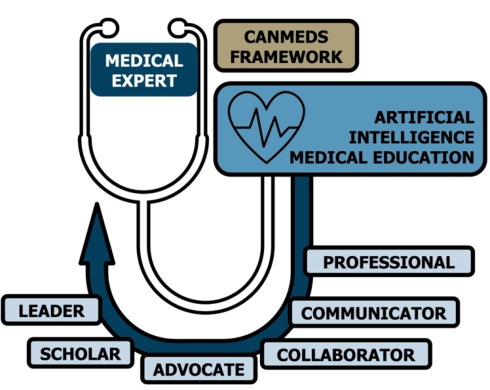
CanMEDS FRAMEWORK The CanMEDS framework, established by the Royal College of Physicians and Surgeons of Canada, is the cornerstone of medical education, ensuring that trainees develop competencies beyond clinical expertise (Royal College, 2005). As AI becomes increasingly integrated into healthcare, the necessity of incorporating AI-related competencies into this framework has become evident. The current CanMEDS framework emphasizes seven key roles: Medical Expert, Communicator, Collaborator, Leader, Health Advocate, Scholar, and Professional (Royal College, 2005). However, the rapid expansion of AI technologies necessitates a re-examination of these roles to ensure that future physicians are equipped with the necessary digital literacy and AI-related skills to practice safely and effectively in an AI-enhanced environment (see Figure 1).
Figure 1: Fostering digital literacy in medical education through the CanMEDS framework.
Stethoscope to Algorithm: Equipping Tomorrow’s Doctors for Artificial Intelligence 215
Integrating AI-specific competencies within the Medical Expert role is particularly crucial. Physicians must be trained to critically evaluate AI-generated data, understand algorithmic biases, and integrate AI insights into clinical decision-making without compromising patient-centered care. Furthermore, the Leader role must be expanded to incorporate AI governance, ensuring that future physicians can navigate ethical considerations, advocate for responsible AI implementation, and contribute to institutional policies that regulate AI use in healthcare (Alami et al., 2024). The Health Advocate role should also address digital health equity, preparing physicians to recognize and mitigate AI-driven disparities in healthcare delivery (Silcox et al., 2024).
Several global medical education initiatives have already begun addressing these gaps. For example, the United Kingdom’s General Medical Council has introduced AI literacy within its postgraduate training programs (Ganapathi and Duggal, 2023). At the same time, the American Medical Association has proposed AI-related learning objectives for medical students (Paranjape et al., 2019). By adapting lessons from these initiatives, the CanMEDS framework can evolve to meet the demands of AI-driven healthcare while maintaining its foundational principles.
COMPETENCY BASED FRAMEWORK Competency-Based Medical Education (CBME) has revolutionized medical training by shifting from time-based learning to outcomes-based assessments (Alharbi, 2024). This approach ensures physicians acquire essential clinical skills before advancing through the training stages. Integrating AI into CBME requires defining Entrustable Professional Activities (EPAs) that explicitly incorporate AI-related competencies.
A key challenge in AI integration within CBME is determining the level of AI proficiency required at various training stages. Early medical education should introduce foundational AI concepts, such as data interpretation and bias recognition, while residency training should emphasize practical AI applications in diagnostics, treatment planning, and workflow optimization (Chan and Zary, 2019). In surgical training, for instance, AI-assisted simulation platforms have already demonstrated significant benefits in skill acquisition and procedural competency (Winkler-Schwartz et al., 2019). Additionally, competency assessment in an AI-integrated curriculum must leverage AI-driven tools for real-time feedback and adaptive learning. AI can analyze trainee performance metrics, identify areas for improvement, and tailor educational interventions accordingly. However, to prevent over- reliance on AI in training assessments, a balanced approach combining AI-driven insights with human mentorship is essential (Davenport and Kalakota, 2019). Including AI-specific EPAs in CBME can ensure trainees develop essential AI literacy skills while maintaining a patient-centered approach.
ACTIVE LEARNING STRATEGIES A PATH FORWARD Active learning is essential for building confidence and proficiency in AI integration. Case-based scenarios, simulations, and real-world experiences
offer learners practical, hands-on opportunities to engage with AI tools in a controlled, low-risk environment (Sauder et al., 2024; Wu et al., 2024). For instance, simulations can mimic real-life clinical challenges, allowing learners to explore how AI systems function as decision-support tools without jeopardizing patient safety. Case-based learning enables trainees to assess complex scenarios, comparing traditional diagnostic methods with AI-enhanced approaches (Table 1). These scenarios may involve interpreting medical imaging with AI assistance, triaging patients based on AI-generated predictions, or navigating the ethical dilemmas posed by black- box algorithms. By interacting with a variety of cases, learners can cultivate a nuanced understanding of AI’s potential applications and limitations across different specialties (Guraya, 2024). These experiences play a crucial role in bridging the gap between theoretical knowledge and practical application, ensuring learners are equipped for the complexities of AI-driven healthcare.
Table 1: Integrating AI-competencies into CanMEDS roles via medical ethics case studies.
Table available in the original PDF paper.
AI Concept Case Topic CanMEDS Roles Key Competencies Transparency -Clinical Decision-Making
-Medical Expert -Communicator -Collaborator
-Explain algorithmic processes to patients -Interpret AI output Bias -Diagnostic Algorithms
-Health Advocate -Leader-Scholar
-Maintaining human oversight -Error reporting systems
-Identify dataset biases -Advocate for diverse datasets Safety -Treatment Recommendations
-Medical Expert -Leader -Professional
Informed Consent
-AI-assisted Diagnostics
-Communicator -Medical Expert -Collaborator
-Disclose role of AI in patient care -Document AI usage Patient Privacy
-Professional -Leader -Scholar
-Data Sharing and Algorithmic Learning
-Balancing innovation with confidentiality -Manage reidentification Resource Allocation
Integrating biomedical ethics case studies into residency education bridges critical gaps in the CanMEDS framework, equipping residents with the skills necessary to address the ethical complexities of AI-enhanced healthcare. This approach ensures that future physicians are not only proficient in technical competencies but also prepared to uphold the ethical standards of their profession. Future efforts will focus on the implementation of these case studies and evaluating their impact on residency training. Imaging-based residency programs face unique demands in integrating AI competencies compared to other specialties. By embedding AI into their curricula, these programs can bridge critical gaps in the CBME framework, ensuring
Stethoscope to Algorithm: Equipping Tomorrow’s Doctors for Artificial Intelligence 217
residents are prepared to navigate AI-driven diagnostic environments. Future research should focus on piloting AI-integrated competency frameworks and evaluating their impact on clinical decision-making, ethical AI use, and patient outcomes.
REFERENCES
Alharbi N. S. (2024). Evaluating competency-based medical education: A systematized review of current practices. BMC medical education, 24(1), 612. Alami, H., Lehoux, P., Papoutsi, C., et al. (2024). Understanding the integration of artificial intelligence in healthcare organisations and systems through the NASSS framework: A qualitative study in a leading Canadian academic centre. BMC Health Serv Res 24, 701. Beil, M., Proft, I., and van Heerden, D., et al. (2019). Ethical considerations about
artificial intelligence for prognostication in intensive care. ICMx 7, 70. Chan, K. S., Zary, N. (2019). Applications and Challenges of Implementing Artificial Intelligence in Medical Education: Integrative Review. JMIR medical education, 5(1), e13930. Chatzistamou I. (2024). Does Medical Education Require Radical Change? Journal
of medical education and curricular development, 11, 23821205241300944. Davenport, T., Kalakota, R. (2019). The potential for artificial intelligence in healthcare. Future healthcare journal, 6(2), 94–98. Elhaddad, M., Hamam, S. (2024) ‘AI-Driven Clinical Decision Support Systems: An
Ongoing Pursuit of Potential’, Cureus [Preprint]. Farhud, D. D., Zokaei, S. (2021). Ethical Issues of Artificial Intelligence in Medicine and Healthcare. Iranian journal of public health, 50(11), i–v. Felländer-Tsai L. (2020). AI ethics, accountability, and sustainability: Revisiting the
Hippocratic oath. Acta orthopaedica, 91(1), 1–2. Ganapathi, S., Duggal, S. (2023). Exploring the experiences and views of doctors working with Artificial Intelligence in English healthcare; a qualitative study. PloS one, 18(3), e0282415. Graber ML, Franklin N, and Gordon R. (2005). Diagnostic error in internal
medicine. Arch Intern Med, 165(13), 1493–9. Guraya, S. Y. (2024) ‘Transforming simulation in healthcare to enhance interprofessional collaboration leveraging big data analytics and artificial intelligence’, BMC Medical Education, 24(1), pp. 941, s12909-024-05916-y. Habli, I., Lawton, T., and Porter, Z. (2020). Artificial intelligence in health care: accountability and safety. Bulletin of the World Health Organization, 98(4), 251–256. Harishbhai Tilala, M., Kumar Chenchala, P., Choppadandi, A., et al. (2024). Ethical
Considerations in the Use of Artificial Intelligence and Machine Learning in Health Care: A Comprehensive Review. Cureus, 16(6), e62443. Kalra, J., Markewich, D., and Seitzinger, P. (2020). Quality assessment and management: An overview of concordance and discordance rates between clinical and autopsy diagnoses. In: Lightner, N., Kalra, J. (eds.) Advances in Human Factors and Ergonomics in Healthcare and Medical Devices. Advances in Intelligent Systems and Computing, vol 957. Springer, Cham. Kalra, J., Rafid-Hamed, Z., and Seitzinger, P. (2021). Artificial Intelligence and
Humanistic Medicine: A Symbiosis. In: Kalra, J., Lightner, N. J., Taiar, R. (eds) Advances in Human Factors and Ergonomics in Healthcare and Medical Devices. Vol 263. Springer, Cham.
Krive, J., Isola, M., Chang, L., et al. (2023). Grounded in reality: Artificial intelligence in medical education, JAMIA Open, 6(2), p. ooad037. Lawson McLean, A. (2024). Constructing knowledge: The role of AI in medical
learning, Journal of the American Medical Informatics Association, 31(8), pp. 1797–1798. Lee, L. I. T., Kanthasamy, S., Ayyalaraju, R. S., et al. (2019). The Current State of Artificial Intelligence in Medical Imaging and Nuclear Medicine. BJR open, 1(1), 20190037. Malerbi, F. K., Nakayama, L. F., Gayle Dychiao, R., et al. (2023). Digital Education
for the Deployment of Artificial Intelligence in Health Care. Journal of medical Internet research, 25, e43333. Paiva, O. A., Prevedello, L. M. (2017). The potential impact of artificial intelligence in radiology. Radiologia brasileira, 50(5), V–VI. Paranjape, K., Schinkel, M., Nannan Panday, R., et al. (2019). Introducing
Artificial Intelligence Training in Medical Education. JMIR medical education, 5(2), e16048. Pesapane, F., Volonté, C., Codari, M., et al. (2018). Artificial intelligence as a medical device in radiology: Ethical and regulatory issues in Europe and the United States. Insights Imaging 9, 745–753. Poalelungi, D. G., Musat, C. L., Fulga, A., et al. (2023). Advancing Patient Care:
How Artificial Intelligence is Transforming Healthcare. Journal of personalized medicine, 13(8), 1214. Sauder, M. Tritsch, T., Rajput, V., et al. (2024) Exploring Generative Artificial Intelligence-Assisted Medical Education: Assessing Case-Based Learning for Medical Students, Cureus [Preprint]. Seitzinger, P., Rafid-Hamed, Z., and Kalra, J. (2021). Global Trends in Clinical
Practice and Healthcare Delivery: Opportunities for Growth and Innovation. In: Kalra, J., Lightner, N. J., Taiar, R. (eds) Advances in Human Factors and Ergonomics in Healthcare and Medical Devices. Silcox, C., Zimlichmann, E., Huber, K., et al. (2024). The potential for artificial intelligence to transform healthcare: Perspectives from international health leaders. npj Digit. Med. 7, 88. Snyder, C. F., Wu, A. W., Miller, R. S., et al. (2011). The role of informatics
in promoting patient-centered care. Cancer journal (Sudbury, Mass.), 17(4), 211–218. Song, Y., Tao, D., and Luximon, Y. (2023). In robot we trust? The effect of emotional expressions and contextual cues on anthropomorphic trustworthiness. Applied ergonomics, 109, 103967. The Royal College of Physicians and Surgeons of Canada. (2005). The CanMEDS
2005 Physician Competency Framework: Better standards, better physicians, better care. Ottawa, ON, Canada. Ueda, D., Kakinuma, T., Fujita, S., et al. (2024). Fairness of artificial intelligence in healthcare: Review and recommendations. Japanese journal of radiology, 42(1), 3–15. Winkler-Schwartz, A., Yilmaz, R., Mirchi, N., et al. (2019). Machine Learning
Identification of Surgical and Operative Factors Associated with Surgical Expertise in Virtual Reality Simulation. JAMA network open, 2(8), e198363. Wu, Y., Zheng, Y., Feng, B., et al. (2024). Embracing ChatGPT for Medical Education: Exploring its Impact on Doctors and Medical Students, JMIR Medical Education, 10, p. e52483.
LISTED IN THE AHFE DIGITAL BOOKSTORE CATALOGUE
Explore the complete digital volume
Artificial Intelligence and Social Computing
Read this individual research paper free through the original publisher, or explore the full digital proceedings book.
ISBN 978-1-964867-39-7
Explore this ISBN in the AHFE Bookstore ↗Listed in the July 2026 bookstore catalogue; search by ISBN to confirm current availability · Digital book purchase optional