Jay Kalra, Bryan Johnston (2026). Assessing Digital Readiness in Diagnostic and Clinical Pathology: A Human Factors Approach. In: Healthcare and Medical Devices. AHFE Open Access, vol. 211, pp. 1–8. https://doi.org/10.54941/ahfe1007463
The practice of diagnostic and clinical pathology (DCP) is rapidly changing given recent advancements in imaging technologies and the application of diagnostic algorithms through artificial intelligence (AI). Proficiency in digital literacy is critical for both laboratorians and diagnosticians to safely and effectively interact with these new technologies as diagnostic pathology enters the digital era. This transformation raises many important questions regarding the human factors and ergonomic considerations including workload, situation awareness, usability, and cognitive load. To date, compared with algorithm-development studies, relatively little formal research has focused on the interface between the diagnostician and AI-augmented diagnostic systems within routine practice. This paper proposes a human factors-informed digital readiness framework for diagnostic and clinical pathology that maps the interfaces among hardware, software, and end users, with particular attention to cognitive workload, usability, and alignment with existing clinical workflow practices. One critical gap that continues to emerge is that no assessment tool to determine the digital readiness of existing diagnostic pathology workflows is currently available. In the absence of such standards, this emerging field risks fragmentation and inconsistent implementation. We advocate for the development of best-practice frameworks for digital readiness that are explicitly grounded in human factors and ergonomics principles applicable to urban centres, and extensible to rural and remote healthcare environments. This framework represents a foundational model intended for prospective validation and implementation across diverse diagnostic medicine practice environments.
Diagnostic and Clinical Pathology (DCP) is entering a period of significant digital transformation, driven by rapid advancements in imaging technologies and the integration of artificial intelligence (AI) into routine diagnostic workflows (Johnston and Kalra, 2025; Kalra et al., 2025). Whole-slide imaging, algorithm-assisted detection of metastases, and automated grading of core biopsies are becoming increasingly feasible, shifting the diagnostic landscape toward hybrid human-AI systems. As these tools become integrated Received February 15, 2026; Revised April 9, 2026; Accepted April 28, 2026; Available online July 20, 2026
2 Kalra and Jhonston into daily practice, pathologists and laboratorians are expected to interpret digital images, manage algorithmic outputs, and maintain diagnostic accuracy within a workflow that is no longer manual but digital with AI-automations (McGenity et al., 2024).
These developments bring renewed attention to the human factors that shape successful adoption of digital technologies. Diagnostic work in pathology relies on high levels of visual discrimination, sustained attention, and the coordination of multiple parallel information streams. Introducing digital systems into this environment alters cognitive workload, affects situational awareness, and places new demands on usability, ergonomics, and workflow alignment (Wosny et al., 2023). While algorithm-development studies continue to accelerate, research examining the diagnostician’s interface with AI-augmented systems, especially within the realities of daily clinical service, remains comparatively limited (Sebastian et al., 2026).
Digital pathology also raises important considerations related to privacy, data security, and data sovereignty, as digital slides and algorithm-processed images constitute protected health information. Ensuring compliance with local regulatory frameworks is essential, yet regulatory readiness alone does not guarantee usability or diagnostic safety (Kalra and Johnston, 2025). A key gap in the field is the absence of validated tools to assess the digital readiness of existing pathology workflows. Without such assessment, laboratories risk fragmented implementation, inconsistent user experience, and avoidable workflow disruptions.
This paper proposes a human factors-informed digital readiness framework for DCP that maps the interfaces among hardware, software, end users, and clinical workflows. By identifying ergonomic, cognitive, and organizational determinants of readiness, this work aims to support the development of scalable, human-factors-centered readiness frameworks suitable not only for urban academic environments but also for rural and remote laboratory settings. This work provides a foundational framework to guide implementation of safe, equitable, and ergonomically optimized digital pathology adoption.
BACKGROUND AND CLINICAL CONTEXT Pathology workflows are uniquely sensitive to digital transformation because diagnostic accuracy depends on the integration of multiple tightly coupled tasks across the pre-analytic, analytic, and post-analytic phases. Digital systems alter each stage of this sequence. At the hardware level, pathologists transition between microscopes, high-resolution monitors, scanners, and multi-display workstations. At the software level, users must navigate image viewers, laboratory information systems, digital annotation tools, and algorithmic overlays (Ardon et al., 2023). These shifts introduce new interaction patterns that differ from conventional optical microscopy, demanding a different set of cognitive, ergonomic, and workflow competencies.
Digital pathology adoption is also uneven across practice settings. Urban academic centres may have robust information technology (IT) support,
Assessing Digital Readiness in Diagnostic and Clinical Pathology 3 dedicated digital pathology teams, and the infrastructure required for whole slide imaging and AI integration. In contrast, community, rural, and remote settings often depend on hybrid workflows that combine digital and optical methods, variable bandwidth, and smaller teams with broader scopes of responsibility (Daniel et al., 2025). In these environments, digital pathology must integrate into existing resource constraints rather than replace them. A human-factors-grounded readiness framework must therefore be sensitive to these contextual differences.
The transition to digital workflows is occurring alongside increasing service demands, workforce shortages, and rising expectations for diagnostic turnaround time. As a result, digital readiness is not solely a technical specification; it is a measure of whether people, processes, and environments are prepared to adopt digital tools without compromising safety, efficiency, or diagnostic quality (Fraggetta et al., 2021). Understanding readiness requires mapping the full ecosystem in which diagnostic work occurs.
METHODS - FRAMEWORK DEVELOPMENT APPROACH A conceptual human-factors framework developmental approach was used to construct a digital readiness model across the diagnostic pathology workflow. This method draws on established human-factors constructs, including cognitive workload, usability, workflow integration, situational awareness, and physical ergonomics, to assess the alignment between digital systems and the tasks, users, and environments of pathology practice (Choudhury, 2022; Sujan et al., 2019).
Sources informing this assessment included published literature on digital pathology and AI-assisted diagnostics, human factors frameworks commonly applied in clinical environments, prior research examining digital literacy and diagnostic reasoning, and experiential knowledge from pathology practice in academic and community settings. This conceptual mapping approach is appropriate given the early stage of digital pathology adoption and the absence of validated readiness measurement tools in the field.
HUMAN FACTORS DETERMINANTS OF DIGITAL READINESS Cognitive Readiness
Digital pathology introduces new cognitive demands as users navigate large digital images, manage multiple visual streams, and interpret algorithm-generated outputs. Users must transition between different visual representations of tissue (optical versus digital) and maintain situational awareness across multiple screens, viewers, and toolsets (Khatab et al., 2024). Poorly aligned interfaces may increase cognitive load, slow diagnostic processing, and produce fatigue, particularly for trainees, who often encounter digital systems earlier and with less formal training than attending staff.
Ergonomic readiness encompasses workstation configuration, monitor quality, seating, lighting, and scanner placement. Suboptimal physical environments degrade visual discrimination and increase musculoskeletal strain, which in turn affects diagnostic performance. Digital work requires prolonged screen engagement and frequent mouse-based navigation, adding new ergonomic demands not present in microscope-based workflows. Variability in ergonomic design across sites contributes to inconsistent user experience and potential fatigue-related error.
Workflow Readiness Digital pathology must integrate into the sequential nature of diagnostic work, from slide generation to sign-out. Bottlenecks such as delayed slide scanning, slow image rendering, or poorly integrated digital viewers disrupt workflow continuity. Misalignment between digital tools and laboratory information systems forces users to switch between platforms, increasing friction and reducing efficiency. In hybrid environments that combine optical and digital workflows, readiness gaps can introduce additional complexity (Eloy et al., 2021).
Organizational Readiness Organizational readiness includes IT capacity, leadership support, training availability, governance structures, and resource allocation. Differences in institutional investment lead to markedly different readiness profiles. Some centres have dedicated digital pathology teams, while others depend on general IT support unfamiliar with diagnostic workflows (Ferreira et al., 2023). Without coordinated organizational planning, digital adoption can become fragmented, resulting in inconsistent implementation and variations in diagnostic safety.
Educational Readiness Digital literacy among diagnosticians and laboratory staff varies widely. Many clinicians were trained in microscope-dominant environments and have not received structured preparation in digital workflows, image navigation, or algorithmic decision support. Trainees, conversely, may adopt digital tools rapidly but with limited oversight, raising concerns about workload, safety, and competency validation. Educational readiness therefore requires structured curricula, competency-based assessment, and training that reflects local workflow realities (Hassell et al., 2011).
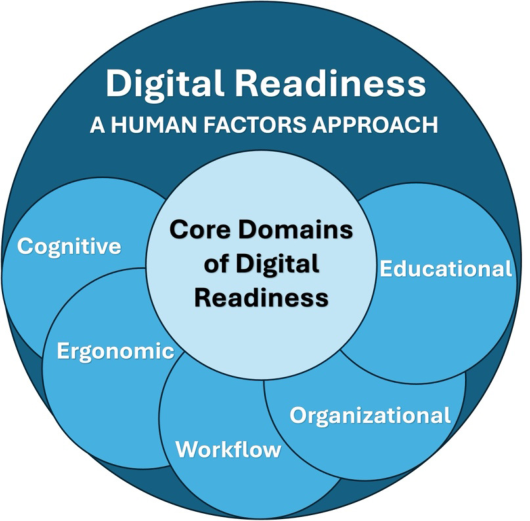
These five domains are conceptualized as interacting system conditions that collectively enable safe AI-augmented diagnostic practice, as illustrated in Figure 1.
Figure 1: Human factors domains underpinning digital readiness across diagnostic medicine workflows.
DISCUSSION
Digital pathology is advancing more rapidly than the systems needed to support its safe integration. This proposed framework demonstrates that digital readiness is multidimensional and varies significantly across cognitive, ergonomic, workflow, organizational, and educational domains. Without a structured readiness assessment, digital adoption may increase cognitive load, introduce new ergonomic challenges, or disrupt established workflows (Khatab et al., 2024). These risks are particularly salient for residents and early-career pathologists, who frequently adopt new technologies ahead of attending staff and therefore encounter digital demands at earlier developmental stages.
Our previously described CanMEDS-CARES model provides a useful conceptual bridge for operationalizing the educational domain of digital readiness within competency-based medical education (Johnston and Kalra, 2025). While the present framework identifies educational readiness as a system condition, encompassing training capacity, digital literacy, and competency development, the CARES model clarifies how these capacities could be enacted in practice. By emphasizing communication, autonomy, respect, equity, and safety, CARES situates digital education not merely as technical skill acquisition, but as patient-centered professional competency within AI-augmented diagnostic environments. As summarized in Table 1, the educational domain of digital readiness aligns most closely with the
6 Kalra and Jhonston Scholar and Professional roles within the CanMEDS-CARES framework, reinforcing the importance of reflective practice, ethical reasoning, and accountable engagement with AI-supported diagnostic tools. In this way, CARES complements human-factors-informed readiness assessment by translating system readiness into observable, assessable professional behaviours aligned with CanMEDS roles. When embedded within educational readiness, the CARES framework supports medical learners in developing not only proficiency with digital tools, but also with the ethical reasoning, accountability, and reflective practice required for safe and equitable diagnostic care.
Human-factors-informed readiness assessment reframes digital adoption challenges not as user-level deficiencies but as gaps in system-level design (Sujan et al., 2022). By focusing on the interaction between people and their work environments, human-factors principles help identify modifiable barriers to adoption and support the design of safer, more usable digital systems.
This approach also underscores the importance of equity in digital transformation. Rural and remote sites require flexible, scalable frameworks that accommodate bandwidth constraints, staffing patterns, and hybrid diagnostic workflows (Daniel et al., 2025). Without such flexibility, digital pathology risks widening existing divides in access to diagnostic expertise.
Table 1: Human factors domains of digital readiness and their relationship to CanMEDS-CARES competencies in AI-augmented diagnostic workflows.
Table available in the original PDF paper.
Digital Readiness Domain Primary Human Factors Focus CanMEDS-CARES Roles Supported Medical Expert, Scholar Cognitive Readiness Cognitive load, situational awareness
Organizational Readiness Governance, infrastructure Leader, Health Advocate Scholar, Professional Educational Readiness Training, competency development
OPERATIONALIZING THE DIGITAL READINESS FRAMEWORK To implement the framework practically, digital readiness can be assessed across the five domains using qualitative or quantitative indicators, with checklist-based criteria scored to indicate readiness. A scoring approach might include: Level 1: Emerging, Level 2: Developing, Level 3: Operational, and include indicators by each domain such as:
Cognitive: formal training, AI interpretation guidance, load mitigation strategies
Workflow: laboratory information system and viewer integration, scanning capacity, workflow protocols
Organizational: IT support, AI governance, and budget for new equipment
Educational: digital literacy curricula, AI training, feedback mechanisms This approach helps identify high-risk areas and plan interventions before AI adoption, and validation studies can link these scores to efficiency, errors, or satisfaction.
IMPLICATIONS FOR PRACTICE A structured readiness framework can support more predictable digital pathology implementation, enabling laboratories to anticipate challenges related to cognitive workload, ergonomic setup, and workflow integration. In academic centres, readiness assessment can guide curriculum design and competency development. In community, rural, and remote settings, readiness frameworks can support tailored implementation strategies that respect local constraints and minimize disruption to service delivery. By aligning human- factors principles with clinical workflow realities, laboratories can reduce implementation risk and promote safer, more efficient adoption.
CONCLUSION
Digital transformation in diagnostic pathology requires more than technological investment; it requires evaluating whether people, environments, and workflows are prepared to integrate new tools safely and effectively. A human-factors-informed assessment of digital readiness provides a foundation for developing best-practice frameworks that support safe, equitable, and sustainable digital pathology adoption across diverse practice settings. This framework provides a structured foundation for future empirical validation studies assessing diagnostic accuracy, workflow efficiency, and user experience in digitally-enabled pathology environments.
REFERENCES
Ardon, O., Labasin, M., Friedlander, M., Manzo, A., Corsale, L., Ntiamoah, P., Wright, J., Elenitoba-Johnson, K., Reuter, V.E., Hameed, M.R., Hanna, M.G., 2023. Quality Management System in Clinical Digital Pathology Operations at a Tertiary Cancer Center. Lab. Invest. 103, 100246. https://doi.org/10.1016/j. labinv.2023.100246 Choudhury, A., 2022. Toward an Ecologically Valid Conceptual Framework for
the Use of Artificial Intelligence in Clinical Settings: Need for Systems Thinking, Accountability, Decision-making, Trust, and Patient Safety Considerations in Safeguarding the Technology and Clinicians. JMIR Hum. Factors 9, e35421. https://doi.org/10.2196/35421 Daniel, M., Nowak, K., Vajpeyi, R., Clarke, B., Evans, A., Carment-Baker, C., Weiser, K., Martin, M., Girard, N., Fyfe, K., Zeidan, S., Bruce, C., Yousef, G.M., 2025. From Microscopes to Monitors: Unique Opportunities and Challenges in Digital Pathology Implementation in Remote Canadian Regions. Diagnostics 15, 1983. https://doi.org/10.3390/diagnostics15161983
8 Kalra and Jhonston Eloy, C., Vale, J., Curado, M., Polónia, A., Campelos, S., Caramelo, A., Sousa, R.,
Sobrinho-Simões, M., 2021. Digital Pathology Workflow Implementation at IPATIMUP. Diagnostics 11, 2111. https://doi.org/10.3390/diagnostics11112111 Ferreira, I., Montenegro, C.S., Coelho, D., Pereira, M., Da Mata, S., Carvalho, S., Araújo, A.C., Abrantes, C., Ruivo, J.M., Garcia, H., Oliveira, R.C., 2023. Digital pathology implementation in a private laboratory: The CEDAP experience. J. Pathol. Inform. 14, 100180. https://doi.org/10.1016/j.jpi.2022.100180 Fraggetta, F., L’Imperio, V., Ameisen, D., Carvalho, R., Leh, S., Kiehl, T.-R.,
Serbanescu, M., Racoceanu, D., Della Mea, V., Polonia, A., Zerbe, N., Eloy, C., 2021. Best Practice Recommendations for the Implementation of a Digital Pathology Workflow in the Anatomic Pathology Laboratory by the European Society of Digital and Integrative Pathology (ESDIP). Diagnostics 11, 2167. https://doi.org/10.3390/diagnostics11112167 Hassell, L.A., Fung, K.-M., Chaser, B., 2011. Digital slides and ACGME resident competencies in anatomic pathology: An altered paradigm for acquisition and assessment. J. Pathol. Inform. 2, 27. https://doi.org/10.4103/2153-3539.82052 Johnston, B., Kalra, J., 2025. Introducing the CARES Model: Integrating Artificial
Intelligence, Medical Education, and Patient-Centered Care. Presented at the AHFE HAWAII International Conference (AHFE HAWAII 2025). https://doi. org/10.54941/ahfe1006960 Kalra, J., Johnston, B., 2025. Regulation of Artificial Intelligence in Healthcare – A Global View. Presented at the AHFE HAWAII International Conference (AHFE HAWAII 2025). https://doi.org/10.54941/ahfe1006966 Kalra, J., Johnston, B., Rafid-Hamed, Z., Seitzinger, P., 2025. Stethoscope to
Algorithm: Equipping Tomorrow’s Doctors for Artificial Intelligence Driven Healthcare. Presented at the 16th International Conference on Applied Human Factors and Ergonomics (AHFE 2025). https://doi.org/10.54941/ahfe1006207 Khatab, Z., Hanna, K., Rofaeil, A., Wang, C., Maung, R., Yousef, G.M., 2024.
Pathologist workload, burnout, and wellness: connecting the dots. Crit. Rev. Clin. Lab. Sci. 61, 254–274. https://doi.org/10.1080/10408363.2023.2285284 McGenity, C., Clarke, E.L., Jennings, C., Matthews, G., Cartlidge, C., Freduah- Agyemang, H., Stocken, D.D., Treanor, D., 2024. Artificial intelligence in digital pathology: a systematic review and meta-analysis of diagnostic test accuracy. Npj Digit. Med. 7, 114. https://doi.org/10.1038/s41746-024-01106-8 Sebastian, M., Batra, H., Saini, M.L., Kearney, S., Sherry, L., Alexanian, S., Cohen,
M., Weber, W., Lennerz, J., Parwani, A.V., 2026. Applications and challenges of utilizing digital pathology and AI-enabled workflows in clinical trials. J. Pathol. Inform. 100542. https://doi.org/10.1016/j.jpi.2025.100542 Sujan, M., Furniss, D., Grundy, K., Grundy, H., Nelson, D., Elliott, M., White, S., Habli, I., Reynolds, N., 2019. Human factors challenges for the safe use of artificial intelligence in patient care. BMJ Health Care Inform. 26, e100081. https://doi. org/10.1136/bmjhci-2019-100081 Sujan, M., Pool, R., Salmon, P., 2022. Eight human factors and ergonomics principles
for healthcare artificial intelligence. BMJ Health Care Inform. 29, e100516. https://doi.org/10.1136/bmjhci-2021-100516 Wosny, M., Strasser, L.M., Hastings, J., 2023. Experience of Health Care Professionals Using Digital Tools in the Hospital: Qualitative Systematic Review. JMIR Hum. Factors 10, e50357. https://doi.org/10.2196/50357
LISTED IN THE AHFE DIGITAL BOOKSTORE CATALOGUE
Explore the complete digital volume
Healthcare and Medical Devices
Read this individual research paper free through the original publisher, or explore the full digital proceedings book.
ISBN 978-1-964867-87-8
Explore this ISBN in the AHFE Bookstore ↗Listed in the July 2026 bookstore catalogue; search by ISBN to confirm current availability · Digital book purchase optional