Louise Moody, Mark Reeves, Avril D. McCarthy, Jamie Healey, Ali Ali, Wendy Tindale, Krishnan Padmakumari Sivaraman Nair (2026). From Design to Trial: Understanding lived experience and the role of SHAPES in Home-Based Therapy for Post-Stroke Elbow Spasticity. In: Healthcare and Medical Devices. AHFE Open Access, vol. 211, pp. 143–153. https://doi.org/10.54941/ahfe1007477
1 Centre for Arts and Creative Cultures, Coventry University, Coventry, UK; Devices for Dignity: The NIHR HealthTech Research Centre in Long-Term Conditions Sheffield Teaching Hospitals NHS Foundation Trust, Sheffield, UK ↗
2 Clinical Engineering, Sheffield Teaching Hospitals NHS Foundation Trust, Sheffield, UK ↗
3 Clinical Engineering, Sheffield Teaching Hospitals NHS Foundation Trust, Sheffield, UK; Devices for Dignity: The NIHR HealthTech Research Centre in Long-Term Conditions Sheffield Teaching Hospitals NHS Foundation Trust, Sheffield, UK ↗
4 Department of Neurosciences, Sheffield Teaching Hospitals NHS Foundation Trust, Sheffield, UK
This research explores the lived experience of using the ShefStim APS device and a new form of transcutaneous electrical stimulation (TENS) known as Sheffield Adaptive Patterned Electrical Stimulation (SHAPES) for post stroke elbow spasticity (PSES). Spasticity is a common outcome following a stroke, leading to stiffness, discomfort, fatigue, and reduced upper limb mobility. There is a need for early, accessible, and cost-effective treatments. The ShefStim APS is a small, wearable, battery powered stimulator secured to the upper arm using a bespoke sleeve, designed to activate sensory nerves through TENS and SHAPES and reduce PSES. A partially double blind Randomised Controlled Trial (RCT) is underway to evaluate efficacy and cost effectiveness. As part of the study, experiential semi-structured interviews have been conducted to understand ease of use and acceptance of the device in real world home settings. Thematic analysis of 15 interviews indicates broadly positive user experiences, with participants reporting comfortable stimulation sensations, straightforward device operation, and acceptable wearability of the sleeve. Participants insights suggest areas for further refinement, particularly improving donning and doffing for one handed use, offering greater variation in sleeve sizing, and optimising the hydrogel interface to support easier placement and removal. If the final RCT outcomes reinforce these findings, addressing these ergonomic considerations should enhance independent use, reduce reliance on caregivers, and improve overall user experience and adoption.
Around 100,000 people are affected by stroke per year, with 1.3 million stroke survivors in the UK (Stroke Association 2018). A common complication of stroke is spasticity which affects 25%−43% of stroke survivors (Morone et al., 2023). Spasticity is “disordered sensory-motor control, resulting from an upper motor neuron lesion, presenting as intermittent or sustained involuntary activation of muscles” (Pandyan et al., 2005 p5). It is characterised by stiffness, fatigue, discomfort, and painful spasms often affecting the elbow and wrist joints. It can significantly restrict joint motion, and may progress to permanent muscle shortening, limiting mobility and leading to reliance on caregiver support (Ashford et al., 2022). Physiotherapy and medications can help but can be costly and have side-effects.
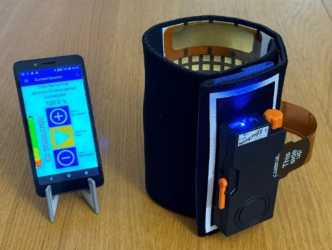
This research explores the experiences of participants using a body-worn device developed to reduce post-stroke elbow spasticity (PSES). A small, lightweight, battery-powered stimulator (ShefStim APS) has been developed that is worn on the arm (Reeves et al., 2025, Healey et al., 2024). The device consists of a small box containing stimulator electronics, linked to an 8 by 8 array of 64 cathode electrodes and a single large anode, overlaid with a bespoke hydrogel layer. The device is positioned and secured on the upper arm with purpose-made sleeve. This sleeve has a Velcro panel with fabric hinges that is folded to secure the system over the tricep muscle. Once positioned correctly, it stimulates sensory nerves using gentle electrical pulses via the electrodes to reduce muscle spasticity.
The system can be programmed to apply this stimulation to different groups of electrodes at different times and provide moving patterns of sensation. The device provides 2 forms of stimulation: Transcutaneous Electrical Nerve Stimulation (TENS) and a new form of stimulation Sheffield Adaptive Patterned Electrical Stimulation (SHAPES) (Reeves et al. 2025). A randomized control trial (RCT) is currently underway as part of the NIHR funded Sheffield Adaptive Patterned Electrical Stimulation (SHAPES) project (Ali et al., 2024) to determine efficacy and cost-effectiveness. Trial participants with PSES are randomised (1:1:1) to one of 3 arms: Standard care (no electrical stimulation), TENS (conventional fixed location electrical stimulation) and standard care, or SHAPES (adaptive patterned electrical stimulation) and standard care to determine which is most effective. For the trial, double blinding is achieved by obscuring the stimulation method from both the participant and the prescriber. Alongside the RCT we are exploring the lived experiences of device usage and considering technology acceptance.
Device Acceptability The ShefStim device is intended to be used by patients in their homes, either independently or with informal caregiver assistance. Early testing (Reeves et al., 2000, Slovak et al., 2016) has shown benefits including a reduction in spasticity, toleration of the intervention and no significant adverse effects. Through the current project we have advanced the device design (McCarthy et al., 2022), and through the associated RCT are considering the acceptability of the medical device from the perspective of participants with PSES. Usability and acceptability are fundamental to the development
From Design to Trial: Understanding Lived Experience and the role of SHAPES 145 and provision of effective and safe medical devices, and to achieving appropriate use and positive health outcomes (Moody, 2015). The usability and acceptability of the ShefStim device and bespoke arm-sleeve have been considered through a number of different approaches including co-design and iterative development of designs and prototypes; expert clinical review and assessment; and usability testing to assess ease of use of specific elements of the device (e.g. the controls and sleeve design) (McCarthy et al., 2022).
Research in respect to post-stroke, upper limb rehabilitation has applied the Technology Acceptance Model (TAM) (Davis et al., 1989) to consider the acceptance of rehabilitation technology (e.g. Bhattacharjya et al., 2021). The original TAM model posits two key factors that influence a user’s decision to accept and use a technology: ‘perceived usefulness’ and ‘perceived ease of use’. In the context of the ShefStim device, perceived usefulness is considered as the degree to which a person believes that using the device would help improve their spasticity. Perceived ease of use is the extent to which the user believes that the device is straightforward to use and reduces barriers to acceptance. Through the project we are considering both elements but here we provide early findings in respect to ‘perceived ease of use’. We aim to explore the lived experience of using ShefStim at home, to capture perceptions of ease of use and consider potential barriers to acceptance.
METHOD
As part of the device trial participants are invited to take part in semi- structured interviews. After a 6-week period of using the device or receiving standard care, participants are offered an optional ‘experiential’ interview designed to capture perceptions of the therapy they received (perceived usefulness) and their views on the perceived ease of use and potential of the self-managed device. ‘Perceived usefulness’ will be considered at a later date; the partially blind nature of the RCT does not enable us to distinguish the TENS and SHAPES datasets at this stage.
Trial Design: 3-arm Randomised Control Trial The device trial is being conducted with UK Health Research Authority (HRA) ethical approval (Ref: IRAS 309757) and UK regulatory permissions (Ref: MHRA CI-2022-0005). Through the trial, 297 people with PSES will be randomised to one of 3 arms: Standard care, TENS and standard care or SHAPES and standard care. Participants in the SHAPES and TENS arms of the trial wear the device and an electrode array on the triceps area of the upper arm for 60 minutes each day over a 6-week period. The array is held in position using a bespoke arm sleeve, with the stimulator attached to the outer surface (see Figure 1).
Figure 1: The ShefStim device, arm sleeve and mobile phone interface.
The equipment used in the TENS and SHAPES arms looks the same, but the stimulation varies, providing either TENS with stimulation in a fixed location, or SHAPES, where there is spatial and temporal variation in the stimulation pattern. The participant, therapist and interviewer do not know which type of stimulation the participant received. Outcome measures are completed at baseline, end of treatment (after 6 weeks) and then at follow-up points 6-weeks, 12-weeks and 24-weeks after the end of treatment. The effect of treatment on PSES is measured using the patient reported Numerical Rating Scale for Spasticity (NRS-S) (Farrar et al., 2008). Arm motor function and quality of life are also measured along with a parallel health economic evaluation.
Recruitment Trial participants are identified from acute stroke wards, stroke rehabilitation wards, community stroke rehabilitation centres, physiotherapy services, the stroke spasticity clinic and the Functional Electrical Stimulation clinic at Sheffield Teaching Hospital. Inclusion criteria included being aged 18 to 100 years; be 2-26 weeks after stroke; experience weakness of elbow extension of Medical Research Council grade 4 or below; and have spasticity of elbow, of grade-1 or more on the Modified Ashworth Scale (MAS) of elbow flexion. All participants recruited to the trial, were also offered an optional interview about their experience.
Interview Procedure The semi-structured interview schedules were informed by the literature and developed through consultation with the project team. They offered a flexible structure to explore views and enabled discussion of issues as they were raised. There were 19 prompting questions exploring experiences of the treatment, stimulator design and usability (for those that used one), and the perceived impact of the treatment received. The interviews were undertaken by telephone. The participants were briefed on the purpose of the interview and informed consent sought when they were invited to join the RCT and verbal consent was sought again ahead of the interview commencing.
From Design to Trial: Understanding Lived Experience and the role of SHAPES 147 Analysis
After the first 20 interviews were completed, the interview audio-recordings were transcribed verbatim and analysed using thematic content analysis to identify initial patterns within the data (Braun and Clarke, 2006). Transcripts were coded to identify relevant aspects and repeated patterns across the data set were identified to generate themes. Quotations have been selected to illustrate the initial set of themes. Participants experience of SHAPES and TENS were analysed together to consider device and sleeve ease of use. As the RCT is ongoing and partially blind, a comparison between SHAPES and TENS will be considered on trial completion.
RESULTS
Interim results are presented, with further data and analysis expected on the completion of the RCT (after January 2028). 20 participants were interviewed between 26th September 2023 and 8th August 2025. The interviews lasted between 15 and 60 minutes in duration. Of the 20 interview participants, 15 had used the ShefStim device for 6 weeks (8 participants receiving SHAPES and 7 receiving TENS) and 5 participants had received standard care only (no device). Here the focus is on interviews undertaken with the 15 participants using the ShefStim device. The age of the participants ranged between 41 and 81 years (mean 62 years); 11 were male and 4 female. They all identified as White-British. For 5 out of the 15 participants their dominant arm had been affected by the stroke.
Ease of Donning and Doffing The device is secured to the arm via the bespoke arm sleeve (as seen in Figure 1). The electrode array is held in the correct position on the triceps area, with the stimulator box attached to the outer side of the sleeve. The sleeve is pulled up the arm and secured via a Velcro panel (referred to as a strap by some participants). The interview findings suggested the sleeve and Velcro panel secured the device sufficiently for the stimulation to be administered. Most participants reported some difficulties putting on, positioning and securing the device correctly. For some, this was resolved with practice, but for 9 out of 15 participants some caregiver support was required.
“It is quite difficult to hitch up the arm when you can only use the one hand to fasten it up and get into position because of the fact that it’s got the simulation device weighting it down on one side”.
“It is quite a fiddle to get it in the right position and then tighten the Velcro.
But, you know, I managed it quite easily after a day or two, but it is quite a
fiddle because of the balance”
All of the participants, whose dominant arm had been affected by the stroke gained additional support from a caregiver in donning the device. Pulling the sleeve up or down the arm (donning and doffing) was found to be
difficult in cases where participants had restricted movement in their arm as a result of the stroke. Those with less capacity to lift and position the arm to which the device was being applied, found it hard to position the electrode correctly and secure the sleeve.
“Mmm, you needed three hands really, and all I had available was one, obviously… Yeah, I either use my chin to secure it or if I was sat I was able to use my knee and hold the array in the right position while I secured the
strap with my left hand, so tricky”.
“only having one arm, I couldn’t put it in place…My wife administered it to me because only having one arm, I couldn’t put it in place…”.
Through the Velcro panel it was aimed to provide a solution that could potentially be secured with one hand. Whilst, considered straightforward by some participants, it presented others with challenges, for example keeping the panel tight while securing the Velcro, applying sufficient force to undo the panel and ensuring the Velcro did not adhere to other materials/clothing.
“The one thing that’s just sticking in my mind was the Velcro. It was very,
very tight to pull off”.
“The Velcro kept catching to everything”.
Fit for All The sleeve was developed so that a single size could be cut down to the length required to fit each individual participant when the device was first set up for them. However, there was no way to adjust the width of the sleeve. The dimensions were guided by data drawn from Adultdata (Peebles and Norris, 1998) and Older Adultdata (Smith et al., 2000). Whilst the fit was appropriate for many, some found the sleeve too tall on the inner arm from the armpit to elbow crease.
“If you could consider making the sleeve slightly shorter because it tended to get in the way of my elbow joint and in the shoulder as well so really my upper arm could have done with being a bit longer…”.
“it was really going underneath my armpit, and really uncomfortable, but it
wasn’t too bad, you know?”.
Comfort and Wearability The device was used to administer the stimulation for 60 minutes per day for 6 weeks. Participants typically chose to administer the treatment while they were at home, sitting and watching television. None of the interviewed participants reported finding the stimulation uncomfortable.
From Design to Trial: Understanding Lived Experience and the role of SHAPES 149 “Yeah, it was a slight tingling sensation. It’s not unpleasant.
I didn’t mind that”
“It were more like a tickling sensation on my arm ..it was much milder, much less invasive on me physically”
Wearing the device and sleeve as a unit was found to be comfortable: “It wasn’t cumbersome in any way.. I was quite comfortable
with wearing it”.
It was not considered to be too heavy during use, but some found that the bulkiness of the sleeve and device had an impact on their clothing choice: “I don’t think I’d have been able to get it on with my jumper on”
The device incorporates a specific patterned hydrogel which provides a focused interface between the electrode array and the skin and prolongs the life of the electrode arrays (Reeves et al. 2025). Initial feedback suggests that this approach is comfortable as well as being practical for use in their home environment. Some participants found the hydrogel affected the ease of donning and doffing the device: “I kind of lined it up on my arm but it was hard to get it into that position
with the stickiness..It was just quite hard to get it as high as I needed it as well because the gel sticks to your arm, and it was almost
sucked on like a suction”
“The only thing that I didn’t like at first but I got used to it were the stickiness when I was taking it off. …It were just pulling at her skin”.
Intuitive Controls and Displays The level of stimulation could be controlled through buttons on the device and through a mobile telephone interface. Both were considered by the participants to be easy to use, with 14 of the participants controlling the device themselves.
“Well, it was really simple, once you understood the routine, and that was very clearly explained to me when I received the machine about
turning it on” “the interface was good, the layout of the software
on the device was good”
The only reported control issues to date related to Bluetooth connectivity between the device and the mobile phone. Where these could not be resolved by turning the device on and off, the participants were able to seek technical support from the research team. Five participants reporting seeking additional guidance.
Overall the device as a form of treatment was considered straightforward by the participants: “Once it was on, there was no problem. I just ignored it for an hour”
“I felt it was rewarding .., easy thing to do and getting results, no pain, the minimum amount of work and the simplicity of it was good.”
DISCUSSION
The SHAPES project has sought to embed a human-centred design approach through the device development and evaluation (McCarthy et al., 2022). The experiential interviews described here have explored the perceived ease of use of the ShefStim device, and where further design development could improve future adoption. Participants’ experience of 6 weeks of device usage within their own homes provides real-world context to inform our understanding of likely acceptance beyond lab-based usability testing. The initial findings highlight some important considerations regarding the usability, wearability, and overall acceptability. The results highlight positive reflections on the perceived ease of use, with earlier co-design activities and usability testing proving effective in establishing user requirements and enabling some barriers to use to be addressed (McCarthy et al., 2022). While the device was generally considered positively, some challenges remain for further consideration.
The donning and doffing of the sleeve without caregiver support was problematic for some. Many stroke survivors experience impairment on one arm, and tasks requiring two-arm coordination, and in this case the lifting and positioning of the affected arm can be particularly difficult. A participant described the process of donning the device as needing “three hands”. For some, the task improved with practice, others remained dependent on caregiver assistance. Velcro is widely used in medical and assistive devices offering a secure and adjustable fastening (Brummel-Smith & Dangiolo, 2009). Its use here was intended to support onehanded application. However, maintaining tension whilst securing the Velcro panel and applying the force and finger dexterity to release it remained challenging. The level of adhesion offered was difficult to unfasten for those with limited dexterity, grip strength, or reliant on onehanded operation. The patterned hydrogel also created some challenges due to its stickiness, adherence to the skin and the fine handling needed for placement and removal may warrant further refinement.
Our findings echo research identifying challenges post stroke with dressing, and with donning and doffing stroke rehabilitation devices due to limitations in strength, coordination, and restricted arm mobility (Purton et al., 2020, Lambelet et al., 2020). The findings point to the need for strokespecific ergonomic considerations. For ShefStim, that may mean reducing the overall mass, re-considering the weight distribution, and reviewing adhesive properties.
From Design to Trial: Understanding Lived Experience and the role of SHAPES 151 The arm sleeve was produced in one size informed by anthropometric datasets. While the length of the sleeve was individually adjusted to fit, for some the height of the sleeve from armpit to elbow was a concern. This may in part reflect post-stroke muscle atrophy which is unlikely to be adequately reflected in the data sources that the anthropometric data was drawn. The sleeve and stimulator were not perceived to be too heavy, although some noted the bulkiness. Amongst our sample, clothing choices were made to accommodate the device, but comfort and convenience in this respect are likely to be important to wider acceptance and long-term adherence (Stuart et al., 2024) and so reducing bulk would be advantageous.
Participants considered the controls (e.g. intensity settings) on the device and the accompanying mobile phone interface as straightforward and intuitive. Familiar conventions, minimalistic design, effective training and clear instructions enabled the participants to feel content with device operation. Minor issues related to Bluetooth connectivity were managed with research team support, highlighting the importance of reliable digital connectivity and remote troubleshooting to minimise user frustration as well as effective training.
Our analysis of the full dataset at the end of the RCT will explore the effectiveness of the stimulation and perceived usefulness of the device. Here we have just considered usability and comfort. The RCT and interview participants were at the early stages of recovery (2–26 weeks) and were all able to adhere to 6 weeks of treatment. Participants reported the stimulation as “tingling” or “tickling” and without pain. This is encouraging, as the tolerability of the stimulation is likely to be critical to acceptance.
Anecdotally, the interviewees were highly motivated to find a solution to their PSES. It is important to acknowledge that their motivation to engage with the RCT, and their broader openness to technology may influence the reported experiences. More recent models of technology acceptance recognise that adoption is shaped not only by perceived usefulness and ease of use, but also by behavioural intention, social influence, and emotional and motivational factors (Venkatesh, 2000; Yin et al., 2022). In some cases, use of the device for 6 weeks did require caregiver support, often a partner with whom the participants were co-habiting. This is in line with research highlighting how important social and emotional support is to recovery after a stroke (Kruithof et al., 2013). As our research continues, the social and motivation elements will be explored more extensively, and particularly in respect to inclusion. Wider and more inclusive participation in research development and evaluation is needed to ensure rehabilitation technologies reflect the needs, capabilities, and preferences of diverse user groups to support wider adoption (Baines et al., 2022).
CONCLUSION
This research has contributed some early insights into the experience of stroke survivors use of the armworn ShefStim device. The acceptability of stimulation sensations, perceived ease of use including the comfort of the sleeve, and simplicity of the interface are encouraging for the potential uptake of the system for homebased therapy. Should the final dataset on completion
of the RCT provide similar results, further development of the device should prioritise improvements in donning and doffing processes for participants with significant unilateral impairment, offer increased variability in sleeve dimensions, and consider potential refinements to the hydrogel interface. By addressing these ergonomic issues, there is the potential to enhance independent usage, reduce reliance on caregivers, and further improve the lived experience for those living with PSES.
ACKNOWLEDGMENT
The authors wish to acknowledge the participants who have shared their time, views and experiences during the evolution and delivery of the SHAPES project as well as the wider research team. This project is funded by the National Institute for Health and Care Research (NIHR) Invention for Innovation (i4i) program (Award ID: NIHR201642). The views expressed are those of the authors and not necessarily those of the NIHR or the Department of Health and Social Care. The research was carried out at the NIHR HealthTech Research Centre in Long Term Conditions (Devices for Dignity).
REFERENCES
Ali, A., McCarthy, A.D., Reeves, M., Healey, J., Moody, L., … & Nair, K.P.S., (2024).
Sheffield Adaptive Patterned Electrical Stimulation (SHAPES) Therapy for Post Stroke Arm spasticity: study protocol for a 3-arm, a partially blinded, randomised controlled trial. BMC Neurology, 24(1), p. 437. Ashford, S., Singer, B., Rose, H., & Turner-Stokes, L. (2022). The impact of spasticity and contractures on dependency and outcomes from rehabilitation. Journal of the International Society of Physical and Rehabilitation Medicine, 5(3), 97–104. Baines, R., Bradwell, H., Edwards, K., Stevens, S., Prime, S., Tredinnick-Rowe, J., ...
& Chatterjee, A. (2022). Meaningful patient and public involvement in digital health innovation, implementation and evaluation: a systematic review. Health Expectations, 25(4), 1232–1245. Braun, V., & Clarke, V. (2006). Using thematic analysis in psychology. Qualitative Research in Psychology, 3(2), 77–101. Broderick, M., O’Shea, R., Burridge, J., Demain, S., Johnson, L., & Bentley, P. (2023).
Examining usability, acceptability, and adoption of a self-directed, technology- based intervention for upper limb rehabilitation after stroke: cohort study. JMIR Rehabilitation and Assistive Technologies, 10, e45993. Brummel-Smith, K., & Dangiolo, M. (2009). Assistive technologies in the home. Clinics in Geriatric Medicine, 25(1), 61–77. Davis, F. D., Bagozzi, R. P., & Warshaw, P. R. (1989). Technology acceptance model. J
Manag Sci, 35(8), 982–1003. Farrar, J. T., Troxel, A. B., Stott, C., Duncombe, P., & Jensen, M. P. (2008). Validity, reliability, and clinical importance of change in a 0–10 numeric rating scale measure of spasticity: a post hoc analysis of a randomized, double-blind, placebo- controlled trial. Clinical Therapeutics, 30 (5), 974–985. Healey, T. J. Reeves, M. L. McCarthy, A. D. and Sheffield Teaching Hospitals NHS
Foundation Trust (2024) International Patent Application: PCT/GB2024/051519— Electrical Stimulation System (Publication Number: WO2024256828)
From Design to Trial: Understanding Lived Experience and the role of SHAPES 153 Kruithof, W. J., van Mierlo, M. L., Visser-Meily, J. M., van Heugten, C. M., & Post,
M. W. (2013). Associations between social support and stroke survivors’ health- related quality of life:a systematic review. Patient Education and Counseling, 93(2), 169–176. Lambelet, C., Temiraliuly, D., Siegenthaler, M., Wirth, M., Woolley, D. G., Lambercy, O., ... & Wenderoth, N. (2020). Characterization and wearability evaluation of a fully portable wrist exoskeleton for unsupervised training after stroke. J. NeuroEng. Rehabil., 17(1), 132. McCarthy, A.D., Moody, L., Reeves, M.L., Healey, T.J., Good, T., Sproson, L.,.. A &
Nair, K.P.S.,(2022). Usability engineering in practice: developing an intervention for post-stroke therapy during a global pandemic. J. Med. Eng. Technol., 46(6), pp. 433–447. Moody, L. (2015). User-centred health design: reflections on D4D’s experiences and challenges. J. Med. Eng. Technol., 39(7), 395–403. Morone, G., Baricich, A., Paolucci, S., Bentivoglio, A. R., De Blasiis, P., Carlucci,
M., ... & Smania, N. (2023). Long-term spasticity management in post-stroke patients: issues and possible actions—a systematic review with an Italian expert opinion. Healthcare (Vol. 11, No. 6, p. 783). MDPI. Pandyan, A., Gregoric, M., Barnes, M. P., Wood, D., Wijck, F. V., Burridge, J., ... & Johnson, G. R. (2005). Spasticity: clinical perceptions, neurological realities and meaningful measurement. Disability and Rehabilitation, 27(1-2), 2–6. Peebles, L., & Norris, B. (1998). ADULTDATA: the handbook of adult anthropometric
and strength measurements: data for design safety London: Dept of Trade and Industry. Purton, J., Sim, J., & Hunter, S. M. (2021). The experience of upper-limb dysfunction after stroke: a phenomenological study. Disability and Rehabilitation, 43(23), 3377–3386. Reeves, M. L., Chotiyarnwong, C., Nair, K. P. S., Slovak, M., Healey, T. J.,... & Baster,
K. (2020) Caregiver delivered sensory electrical stimulation for post stroke upper limb spasticity: A single blind crossover randomized feasibility study. Health and Technology, 2020; 10, 1265–1274. Reeves, M. L., Healey, T. J., & McCarthy, A. D. (2025). Simulating the use of discontinuous patterned hydrogel to improve inter-electrode resistance on electrode arrays. Artificial Organs. https://doi.org/10.1111/aor.15030 Slovak M, Chindo J, Nair K, Reeves M, Heller B, Barker A. (2016). Sensory Barrage
Stimulation in the Treatment of Elbow Spasticity: A Crossover Double Blind Randomized Pilot Trial. Neuromodulation. 2016; 19:220–6. Smith, S., Norris, B., & Peebles, L. (2000). OLDER ADULTDATA: The Handbook of Measurements and Capabilities of the Older Adult: Data for Design Safety. London: Dept of Trade and Industry. Stroke Association. (2018) State of the Nation:Stroke Statistics Vol. 56, Int. Affairs. Stuart, S., de Kok, M., O’Searcoid, B., Morrisroe, H., Serban, I. B.... & van den Brand,
J. (2024). Critical Design Considerations for Longer-Term Wear and Comfort of On-Body Medical Devices. Bioengineering, 11(11), 1058. Yin, Z., Yan, J., Fang, S., Wang, D., & Han, D. (2022). User acceptance of wearable intelligent medical devices through a modified unified theory of acceptance and use of technology. Annals of Translational Medicine, 10(11), 629.
LISTED IN THE AHFE DIGITAL BOOKSTORE CATALOGUE
Explore the complete digital volume
Healthcare and Medical Devices
Read this individual research paper free through the original publisher, or explore the full digital proceedings book.
ISBN 978-1-964867-87-8
Explore this ISBN in the AHFE Bookstore ↗Listed in the July 2026 bookstore catalogue; search by ISBN to confirm current availability · Digital book purchase optional