Grażyna O'Sullivan, Louise Moody, Janet Saunders Andreja Čurin, Marjan Leber (2022). ERGO WORK - Creating the Best Places to Work. In: Advances in Ergonomics In Design, Usability & Special Populations: Part II. AHFE Open Access, vol. 19. https://doi.org/10.54941/ahfe1001236
"Social Cohesion" is one of the seven main objectives of the Europe 2020 Strategy, and including disabled people in the labour market is a key element. There are challenges associated with providing fit for purpose workplaces and job design for full inclusion of people with disabilities. Ergonomics as a discipline has a key role to play. This paper describes the premise behind, and initial research undertaken within the 10 partner, European funded project "ERGO WORK - joining academia and business for new opportunities in creating ERGOnomic WORKplaces". The picture across Europe is variable in terms of workplace inclusion, and in the application of ergonomics and universal design. The project aims to encourage cooperation between universities, businesses and other organizations to improve learning, teaching and knowledge transfer in respect to ergonomic workplace design for disability. In the long term, the impact of the project is intended to be improved equal employment opportunities, enhanced understanding of universal design and principles for providing quality working environments in Europe. This paper describes the project rationale and some preliminary data from a scoping study to understand the provision for disability made in workplaces across Poland, Slovenia and the UK. Future work is outlined.
The financial crisis of 2008 has resulted in significant unemployment. In November 2013 an estimated 26.553 million (12.1%) in the EU were unemployed (European Commission Eurosat 2014). For people with disabilities the situation is worse; in developing countries, 80% to 90% of working age are unemployed; in industrialized countries the figure is between 50% and 70% (UN Enable 2014).
In the UK almost one in five persons has a disability. The employment rate of working disabled employees is 47.8% compared with 75.9% of non-disabled people, and disabled people are nearly 4 times as likely to be unemployed or involuntarily out of work as non-disabled people (Papworth Trust 2012). In the UK, the Equality Act 2010 covering disability (as well as age, sexual orientation, religious beliefs etc) legally protects people from discrimination in the workplace and in wider society. It requires equal treatment in access to employment; and employers and service providers are obliged to make reasonable adjustments to the workplace to overcome barriers experienced by disabled people. Reasonable adjustments should be made in a range of ways for example through workplace furniture, training, adjusted hours, changes to policies, and provision of assistive technology.
In a time of high unemployment, employers are generally less interested in fulfilling employees’ individual needs. This trend is especially visible in poorer European countries for example in Poland where employees are often underpaid with poor job agreements (Kiełbasiński 2014). In a situation where non-disabled employees are struggling, with many agreeing to work in very unfavourable conditions, disabled persons are even more challenged to enter the labour market. In Poland, discrimination against Persons with Disabilities (PWD) (12.2% of the population) has been tackled in numerous ways, however whilst their role is seen to be increasing, PWD are still largely invisible in public (Bojarski 2012). There are about 3.4 million people with disabilities in Poland, of whom
2.1 million are of working age; only 465,000 (27.3%) work (GUS 2011). Companies in Poland with at least 25 employees are legally obliged to employ a minimum of 6% of people with disabilities. Failure to do so results in a fine to the Państwowy Fundusz Rehabilitacji Osób Niepełnosprawnych (National Fund for Rehabilitation of People with Disabilities), however, most employers pay the fine. According to the data gathered by the above-mentioned Fund, in 2012 there were 237,000 disabled employees registered; 166,400 worked in special companies of protected work, and only 70,400 in the open labour market (Kołodziejska 2012).
Workplace Ergonomics As well as the availability of employment opportunities, people with disabilities can be restricted from entry to jobs through the suitability and design of both the workplace and the job itself. An aging workforce will add to the level of impairment and disability to be catered for (Shrey and Hursh 1999, Stubbs 2000).Increasing rates of disability and the associated costs mean the application of more innovative and cost effective approaches to ensure the workplace is fit for purpose for a range of needs is increasingly important (Amick et al. 2000). There is a need for improved understanding across Europe of how ergonomics can be applied in this context to enhance the employment prospects of people with disabilities and enable companies to be socially responsible and cost-effective.
The understanding of ergonomics and human factors, and how it can be applied and translated into workplace practice (Caple 2010) is variable across Europe. As a subject, Ergonomics is incorporated in different discipline to varying extents, from full undergraduate and Master’s degree programs in Ergonomics, to smaller modules and assignments in various established disciplines such as engineering, design, psychology etc. However, specialist taught knowledge in relation to disability and workplace adaptation may still be limited and not reach businesses where it can be applied to support disabled workers.
Ergonomists seek to design work to ensure that it fits the needs of the individual (Stubbs 2000). The application of ergonomics in a company setting may require specific, adapted equipment, as well as the skills to discern a specific user’s needs and ensure the technology is suitable and acceptable to the user. Managing the change and being open to adaptation, which might involve for example adjusting tasks, access or pace of work etc is important. Other disciplines of study, for example Management may benefit from greater inclusion of Ergonomic content, as once at work, graduates are likely to be in a position to influence the inclusion of people with disabilities, and impact work and job design.
Much of the literature in the area focuses on the prevention of disability at work and interventions to prevent and manage injury and encourage return to work (Franche et al. 2005, Amick et al 2000). There is a paucity of research considering the provisions and adaptations made across companies and European countries in respect of workplace adaptation and the availability of subject specific knowledge in relation to making reasonable adjustments to the workplace and job design for PWD.
The ERGO WORK Project ERGO WORK (www.ergo-work.eu) is a European (EC and LLP – Erasmus programme) project seeking to improve the ergonomic design of jobs and workplaces for people with disabilities. It involves the collaboration of 10 partners across 6 European countries – Poland, Slovenia, the UK, Spain, Italy, and Belgium. It is focused specifically on developing and testing new teaching material around the design of jobs and workplaces for those with disabilities. The resulting ergonomics based content may be a future element of programmes in engineering, design, occupational health or business.
“Social Cohesion” is one of the seven main objectives of the Europe 2020 Strategy, and the promotion of health is an integral part of smart and inclusive growth objectives (European Agency for Safety and Health at Work 2013). Therefore, the European Agency for Safety and Health at Work (EU-OSHA) aims to determine research priorities in occupational health and safety (OSH), which will assist in achieving the goals of the Europe 2020 Strategy. In order to achieve this goal, several horizontal activities have been identified:
- mainstreaming OSH research in other research disciplines, especially in economics, general health and environment
- transferring OSH research results to the workplace in a satisfactory and efficient way - fostering intervention research, which plays an important role in the development, implementation and evaluation of OSH interventions at different levels - emphasizing the importance of OSH communication and especially risk communication, above all in the area of new technologies, in order to deliver adequate information to different target groups in time and in an appropriate form - fostering prevention through design, which will significantly minimise the work-related hazards and risks - emphasizing inclusive growth, fostering a higher-employment economy, in which one of the identified initiatives entitled “agenda for new skills and jobs” aims to improve job quality and working conditions.
The above mentioned actions and efforts are aimed at strengthening the labour market in general, which can significantly benefit from inclusion of PWD. The multidisciplinary field of ergonomics can support inclusion through improved design and adaptation of workplaces tailored to the needs of PWDs. By improving education in this field, and consequently workplace design, European workplaces will provide a more inclusive working environment for people with disabilities.
It is intended that through improved education, and as a result better design, European workplaces will provide a more inclusive working environment for people with disabilities. It is argued, that currently the teaching of Ergonomics and approaches to the inclusion of persons with disabilities lack strong cooperation and knowledge exchange between students, Academia, Schools, Vocational Educational Training system and Business. There is potential for stronger collaboration and more effective education in Ergonomics related to the employment of people with disabilities. The ERGOWORK project therefore aims to demonstrate and test mechanisms for achieving this, through a pilot programme testing ergonomic knowledge exchange.
In summary the ERGO WORK project aims to:
improve cooperation between academic and business communities in relation to workplace design and inclusive employment of people with disabilities;
improve learning and teaching contents within the field of ergonomics in order to develop relevant expertise;
support equal employment opportunities, universal design and a high-quality working environment for all employees, including people with disabilities.
The first phase of work within the ERGOWORK programme involves an assessment of the current position through an online survey. The survey aims to analyse company and employee attitude, interest and needs concerning work places adaptation for PWD in each of the partner countries. The findings will be used to assess and map the current position and make recommendations for the development of taught content in ergonomics that will foster collaboration with industry and benefit workplaces for all.
METHOD
An online survey was developed to ascertain the needs and views of a range of stakeholders. The anonymous web- based survey enabled efficient collection and analysis of data from a larger, dispersed sample. It offered the advantages of minimizing social desirability and interview bias, whilst allowing quantification of results. The research method and tools were approved by the Coventry University Ethics Committee.
Participants The survey was distributed throughout the networks of the 6 partner countries. Here the results from just Poland (PL), Slovenia (SL) and the United Kingdom (UK) are discussed as part of the preliminary analysis. The survey was completed by 291 participants across the three countries. The sample included management, company employees, and those working in a range of organization and Higher Education Institutions (HEIs) as summarized in Figure 1below.
What type of organisation do you work for?
No Answer
Charity/ Non-profit organization
Government, policy making, or public sector organization
University / Higher Education institution
UK Slovenia Poland
Company - Small business
Company - Medium sized
Company - Large corporate
Figure 1. A summary of the type of organisations for which the participants worked
Figure available in the original PDF paper.
The survey was completed by both participants with and without a disability, with similar proportions in all 3 countries (see Figure 2)
Do you have a disability?
Yes No Prefer not to say No Answer
Poland Slovenia UK 0%
Figure 2. The percentage of participants with a disability.
Figure available in the original PDF paper.
Procedure The survey was run using Bristol Online Surveys online software. This allows for easy distribution of the survey through a web link across Europe. The survey was translated into each partner language, but the questions and structure was consistent throughout to allow comparability of results and easy collation of responses.
Following a brief demographics section (12 questions), the survey consisted of a further 61 questions. These were not completed by all respondents; the questions were grouped based on whether or not the participant had a disability and their job role. The majority of the questions were multiple-choice, with 13 open questions asking for more detailed responses. Completion took approximately 20 minutes.
Analysis The results were collated in the UK. As this was an exploratory survey investigating experience, attitudes, and perceptions, descriptive statistics rather than tests of statistical inference were undertaken to compare responses from the 3 countries. Here the results are combined from those with and without disabilities, and across types of organization and job role. This initial analysis focuses on comparing the responses from the 3 countries.
RESULTS
Those participants who recognized themselves as having a disability were asked how well they were accommodated for in their workplace. The results are summarized in Figure 3. Participants in Slovenia appear to feel least accommodated for. The UK respondents were the least negative about workplace accommodation.
Disabled people are not well accommodated in terms of workplace design...
Figure 3. The percentage of disabled participants who felt well accommodated in their workplace All participants were asked to indicate how well their workplace accommodates people with disabilities. The results in Figure 4 show that for each country, the most frequent response was ‘fairly well’. Overall employees in the UK appear to regard their workplace as more accommodating than employees in Poland giving more responses as ‘fairly well’ and ‘very well’.
Figure available in the original PDF paper.
How well does your workplace accommodate people with disabilities?
UK
Slovenia
Poorly Not well About average Fairly well Very well
Poland
Figure 4. Participant views on how well PWD are accommodated for
Figure available in the original PDF paper.
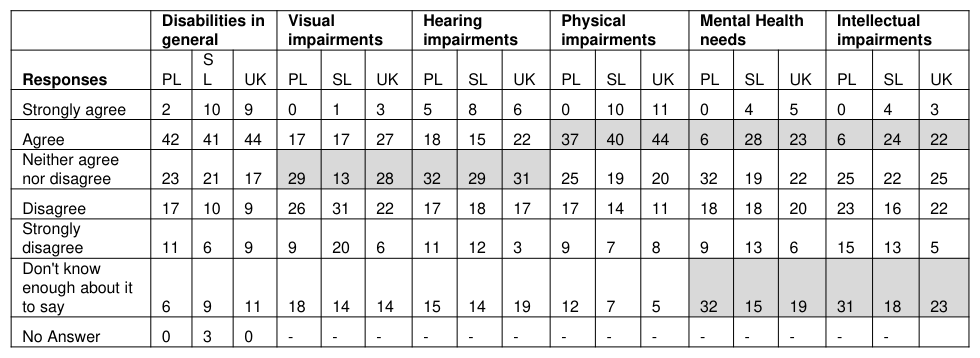
The country responses were compared for how well adjustments are made at work for specific disabilities. Participants were asked to what extent they agreed that their workplace was well adapted for specific disabilities. The results in terms of percentages are summarized in . Some of the overall trends are highlighted in grey.
Table 1. The extent the workplace is felt to be well adapted for disabilities (% of responses) in each country Disabilities in general
There is a large amount of variability in the responses. The response ‘neither agree nor disagree’ appears to be most popular across countries and conditions in terms of sensory impairments (hearing and visual). Participants were in agreement that adaptations are made for physical difficulties. For mental health needs and intellectual impairments, the picture is very mixed, with more agreement that adaptations are made in Slovenia and Poland but with a high number of respondents indicating they do not feel they know enough about the issue.
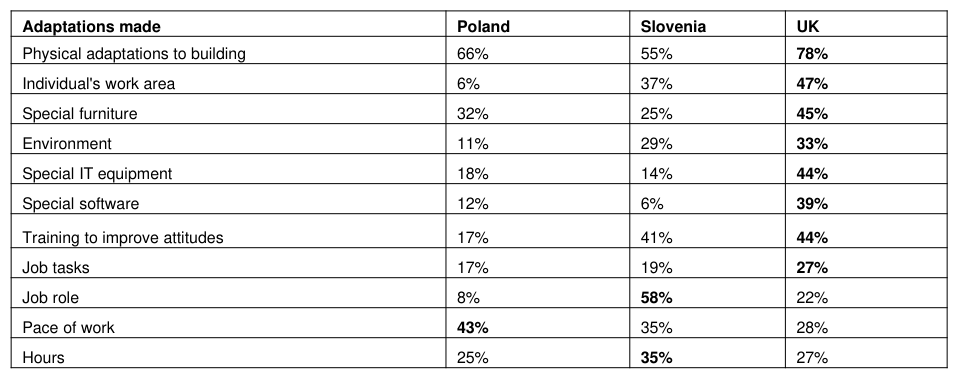
Participants were asked to indicate the adaptations that have been made for disabled people. This covered both physical adaptations for example adaptations to the building, equipment and software, and changes to the job design for example the tasks, role, pace of work, hours etc. The percentage of participants from each country that recognized each type of adaptation as having been made in their workplace are summarized in Table 2. In most cases, the UK participants recognize more of the adaptations associated with workplace design.
Table 2. The extent adaptations are believed to be made in each country Adaptations made Poland Slovenia UK
Questions were asked to gauge participant’s familiarity and awareness with the concept of ergonomics. The results are shown in Figure 5. There was clearest understanding of the concept in the UK. This may be influenced by the academic / HEI influence on the sample. The Polish sample provided the largest percentage of completions indicating limited understanding of the term.
How familiar are you with the concept of Ergonomic Design?
Very familiar, could explain to others (1)
Somewhat familiar, but could not explain it to others (2)
UK Slovenia Poland
Have heard the term but do not fully understand it (3)
Have not heard this term before today (4)
No Answer
Figure 5. The extent participants are familiar with ergonomics
Figure available in the original PDF paper.
Participants with disabilities were asked to consider whether the design of the workplace is a barrier to employment opportunities. The graph shown in Figure 6. The percentage of disabled participants who felt the workplace is a barrier to employment indicates that over 60% of disabled participants from all countries agreed or strongly agreed.
The UK views varied the most in response to this question, in that 26% of respondents disagreed with the statement whilst 63% agreed.
The design of the workplace is still a barrier to employment opportunities for disabled people
Figure 6. The percentage of disabled participants who felt the workplace is a barrier to employment Employers were asked whether they believed their workplace was hard to adapt (see Figure 7. The percentage of employers who felt the workplace was hard to adapt. for disabled people. Polish employers (of which there were only 4) were unsure. Slovenians almost equal agree / disagree, whilst the UK employers disagreed.
Figure available in the original PDF paper.
Our workplace is specialised and difficult to adapt for disabled people
Poland (4) Slovenia (47) UK (18)
Figure 7. The percentage of employers who felt the workplace was hard to adapt.
Figure available in the original PDF paper.
DISCUSSION
Although further analysis is needed, an initial comparison of the results from three of the partner countries, Poland, Slovenia and the UK has been presented here. Across countries, more than half of the respondents believe that their workplace has been adapted well for PWD. However, participants with disabilities do not feel well accommodated for in the workplace. From the perspective of PWD, those in Slovenia and Poland felt less accommodated for than those in the UK. It is argued therefore, that more work needs to done to make adaptations that suit user needs.
A generalized view of the findings suggests that there is least adaptation of the workplace for the disabled in Poland. Most adaptation is perceived to have happened in the UK. Most recognizable adaptations to the workplace for physical and sensory disabilities were made in the UK. For mental health needs and intellectual impairments, the picture is very mixed, with more agreement that adaptations are made for these types of difficulties in Slovenia and Poland.
The UK also seems to lead in terms of the physical adaptations to the workplace. Interestingly Slovenians recognized that changes to the job role and hours to suit the needs of PWD were made, whilst the Polish were recognized for adaptations to the pace of work. Further exploration of the data and the broader context is needed to understand these differences and see where there might be practices that can be transferred between countries.
The results point to insufficient knowledge about adaptations to work places with participants frequently identifying that they do not have sufficient knowledge to make a judgment. Similarly the awareness and knowledge of Ergonomics is relatively low. This finding supports the rationale behind the ERGO WORK project and is something that the project seeks to address within the partner networks.
Participants with disabilities were asked to consider whether the design of the workplace is a barrier to employment opportunities. A large proportion felt it was. When employers were asked whether they believed their workplace was hard to adapt there was uncertainty from the Polish and Slovenian respondents. This may further support the premise that there is insufficient knowledge about ergonomics and the types of adaptation that can be made for PWD to increase their employment options. Closer examination of the data is required to know whether this is a cultural attitude or to do with industry sector.
There are limitations to the data as it stands. The sample is small and variable across countries and employee groups. It is aimed to increase the size of the cohort studied and incorporate data from the other three partner countries: Belgium, Spain and Italy. A more comprehensive analysis, will consider the views of employers, and the views of employees both with and without disabilities to make recommendations as to how workplace design might be improved and how knowledge and good practice might be shared.
FUTURE WORK
ERGO WORK and Corporate Social Responsibility Adapting work places to suit varying employees’ physical and mental needs as well as disability is challenging. However, the growing number of people with disabilities and the aging population make it an increasing priority for individual and economic benefit. It requires not only a high degree of specialist knowledge and openness to adaptation, but also a true social responsibility from companies. Despite the European Union policy and support for Corporate Social Responsibility (CSR), social responsibility is often treated superficially as a marketing tool, and not as the main instrument of introducing important change concerning mutually advantageous collaboration between a company and its key stakeholders. Without a radical change in this attitude, fulfilling a wide range of needs of both non-disabled and disabled employees seems unlikely.
CSR can be described as “a concept whereby companies integrate social and environmental concerns in their business operations and in their interaction with their stakeholders on a voluntary basis” (Green Paper on CSR, p. 6). The phrase “on a voluntary basis” gives many managers the impression that they do not have to have socially responsible policy and performance. The last document by the European Commission outlines CSR without the voluntary element, and instead holds companies responsible for the impact of their decisions and overall performance, as well as maximizing the creation of shared value.
Even though the roots of Corporate Social Responsibility concept can be found earlier, CSR has been implemented by some companies since the 1960s. Since then, there has been only limited development and change in the overall attitude of most organizations to their stakeholders, and social trust to business. 15 out of 27 EU Member States have national policy frameworks to promote CSR, and only 2,500 out of 45,000 big European enterprises have a
CSR program (Communication, 2011). The reality of various companies shows that the CSR concept encounters many problems, connected both with its understanding and its implementation.
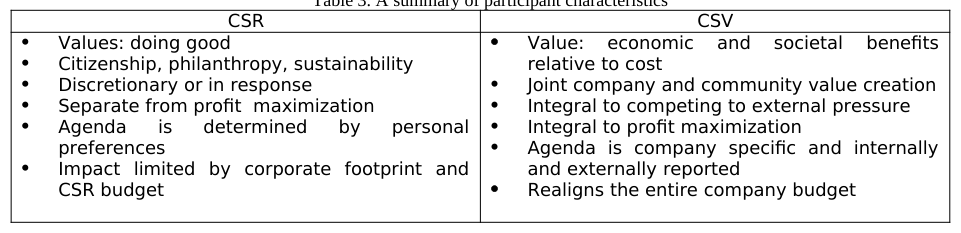
The concept of creating shared value (CSV) grew out of disappointment with CSR practice, and Porter and Kramer place it in opposition to CSR, which in their opinion is limited, values and impact wise, and separate from a company’s profit (Porter & Kramer, 2011). The differing approaches are summarized below in Table 3.
Table 3. A summary of participant characteristics CSR CSV • Values: doing good • Citizenship, philanthropy, sustainability • Discretionary or in response • Separate from profit maximization • Agenda is determined by personal preferences • Impact limited by corporate footprint and CSR budget
To improve the inefficient working of CSR Porter and Kramer propose a concept of shared value which “can be defined as policies and operating practices that enhance the competitiveness of a company while simultaneously advancing the economic and social conditions in the communities in which it operates” (Ibidem, p.108). The authors produce great hope concerning CSV, and believe that it will blur the line between for-profit and non-profit organizations, form the connection between competitive advantage and social issues, diminish the traditional divide between the responsibilities of business and those of government and civil society; and create a better form of capitalism. Even though the value here is defined as “benefits relative to costs, not just benefits alone”, the main goal of the concept is to link values tightly with profit. This cannot be done efficiently without destroying the fundamentals of CSR, that is focusing on common good rather than short term benefits, followed by a sort of self- limitation rooted in deep understanding of interdependence.
When it comes to Social Cohesion, ergonomically designed places of work and changing attitudes to managing human resources to the full potential of each employee, requires a great deal of corporate social responsibility. It is not enough to prepare disabled people for work and design and appropriate equipment for them. Without employers making an effort to integrate them into their human resources and feeling responsible for this integration, the situation will not change and the percentage of employed PWD will be unsatisfactory in rich and developed countries, and marginal in poorer ones.
Knowledge Visits The ERGO WORK project was initiated through knowledge visits in the UK. These aimed to demonstrate to European partners, adaptation for disability that is made in the UK. A visit was hosted by Severn Trent Water (STW), Coventry, a private company which focuses on the provision, removal and treatment of water in the UK and internationally. It employs over 5,500 people ranging from scientists, maintenance workers, contact center staff, administrators to engineers.
The company demonstrated how it combines a CSR program with social inclusion, integration of PWD, a high quality work environment and work efficiency. They indicated a strong position on CSR and ergonomic design of work places, by indicating that the percentage of disabled employees at the company is not important, as all employees have needs. The needs of every employee are assessed and STW tries to fulfill them. It was also indicated that the cost of individual adaptation and practices (as well as a wide range of services for employees – from health diagnosis, treatment and rehabilitation of employees) is based on cost analysis and is considered a profitable investment.
The authors would argue that Severn Trent Water managed to avoid some of traps of unsuccessful CSR implementation. The first of them is partiality. Many companies decide to perform some CSR actions accidentally, which usually incurs costs and does not change the overall organizational performance. In contrast STW put CSR at the heart of their strategy. On their web page one can read: “At Severn Trent we believe that corporate responsibility (CR) should be integral to our business. It is not a single priority, but a part of every priority we have” (http://www.severntrent.com/responsibility). They also appear to avoid superficial implementation of CSR principles. The company has belonged to the Global Compact (GC) since June 2004 and fully adheres to the ten GC principles covering the areas of human rights, labour practice, environmental protection and anticorruption. However, STW does not limit itself to fulfilling them, but also extends their scope to their own Code of Conduct “Doing the right thing, the Severn Trent way”. Two of the stated principles: “Keeping everyone healthy and safe”, and “Supporting employees’ rights and diversity” correspond with creating ergonomic places of work for all employees. CSR implementation is demonstrated through Performance Measurement; STW measure the results of implementing CSR principles, from the volume of saved water, to employee motivation and lost time incidents, to prove that proper implementation of CSR is a sound investment.
The ERGO WORK project team over the next 18 months will further explore the role of ergonomic workplace design for disability within the context of CSR. The UK-based example of SWT is likely to provide transferable principles to guide development of inclusion in less wealthy European countries.
Ergonomics Curriculum Development As well as the Stakeholder survey outlined in this paper, the project will involve a detailed study of the ergonomics curriculum in Poland, Slovenia and the UK supplemented with a view on the other 3 partner countries. This will support the enhancement of existing curricula in ergonomics and the development of new material under the ERGO WORK Project. It is argued that both the teaching of ergonomics and approaches to the inclusion of PWD currently lacks close cooperation and knowledge exchange between students, academia, schools, vocational training systems and businesses. There is potential for closer collaboration and more effective education in the field. The ERGOWORK project aims to demonstrate and test mechanisms for achieving this goal through a pilot programme testing ergonomic knowledge exchange.
The University of Maribor in Slovenia, is a higher education institution with a wide range of study programmes covering the multidisciplinary nature of Ergonomics. The University of Siedlce, Poland is a good practice example with knowledge, experience and expertise in the field of disability. Together they will develop the curriculum. The European Association of Service Providers for Persons with Disabilities (EASPD) along with other project partners will contribute specific expertise and validate the ergonomic module content before it is tested through a pilot study. Coventry University will monitor, advise and evaluate the process.
It is envisaged that the new curricula developed will include 5 specific supplementary modules with specific content related to the needs of and workplace adaptation for: the blind and visually impaired, the deaf and hard of hearing, the physically impaired, persons with mental health needs and one module on management and universal design. An interdisciplinary group of experts from the fields of engineering, economy, sociology and psychology will be involved in the development of the curricula. In Slovenia, the 5-module course will be offered as elective, thus providing students from different fields of study with the opportunity to participate.
Four multidisciplinary groups consisting of students, professors and companies will be established to test the application of the curricula. They will work together on pilot projects implemented in Slovenia and Poland. Testing of the Supplementary Modules will be performed in real business environments, facing real business needs and challenges. In Slovenia this will involve multidisciplinary groups working on the development of a product and work program design, followed by new tailor made work places for PWD. In Poland it will focus mainly on the re- design/re-organisation of the existing work places that are not adapted yet to PWD. The pilots will involve close cooperation with, and the participation of PWD.
The primary goal of the project is to create an environment promoting sustainable cooperation among all relevant stakeholders and thereby an awareness of ergonomics in general, and with specific regard to workplace design for PWDs. It is intended that the results will contribute to future learning and teaching methods in respect to workplace ergonomics for PWD that can subsequently be transferred to industry. In order to achieve this goal, relevant systems and policy-making institutions at the European (EASPD) and national level will also be addressed.
CONCLUSION
The inclusion of persons with disabilities in the workplace is a European priority. The ERGO WORK project is focused on understanding barriers to inclusion, and tackling these through education and collaboration between academia and industry. The preliminary data presented here has shown a variable picture across the 3 European countries surveyed in terms of the adaptations made for people with disabilities. There is a need for better European collaboration and transfer of knowledge and practice in this area. The next stage of work will involve more extensive analysis of the survey data and application of the findings to the development of ergonomics curriculum content focused specifically on creating ergonomic workplaces for PWD.
REFERENCES
Amick, BC. Habeck, RV. Hunt, A. Fossel, AH, Chapin, A. Keller, RB, Katz, JN. (2000) Measuring the impact of organizational behaviours on the work disability prevention and management. Journal of Occupational Rehabilitation. Vol 10, Issue 1 pp21-38. Bojarski, L. (2012) Executive Summary: Country Report Poland 2012 on measures to combat discrimination. European network
of legal experts in the non-discrimination field. http://www.non-discrimination.net/countries/poland Caple, DC. (2010) The IEA contribution to the transition of Ergonomics from research to practice. Applied Ergonomics Vol 41, Issue 6 pp731-737. Communication from The Commission, EUROPE 2020 - A strategy for smart, sustainable and inclusive growth, Brussels,
3.3.2010, http://eur-lex.europa.eu/LexUriServ/LexUriServ.do?uri=COM:2010:2020:FIN:EN:PDF Freeman, R. and Liedtka, J, (1991), Corporate social responsibility: a critical approach – corporate social responsibility no longer a useful concept, Business Horizons, July-August Equality Act (2010) http://www.legislation.gov.uk/ukpga/2010/15/contents European Commission Eurosat, (2014) Unemployment statistics, http://epp.eurostat.ec.europa.eu/statistics_explained/index.php/Unemployment_statistics, (accessed 25. 01. 2014) European Agency for Safety and Health at Work, Priorities for occupational safety and health research in Europe: 2013-2020,
2013, https://osha.europa.eu/en/publications/reports/priorities-for-occupational-safety-and-health-research-in-europe-2013- 2020 Franche, R-L, Baril, R. Shaw, W, Nicholas, M. Loisel (2005) Workplace-Based Return-to-Work Interventions: Optimizing the Role of Stakeholders in Implementation and Research. Journal of Occupational Rehabilitation. Volume 15, Issue 4, pp 525-542 Green Paper, Promoting a European framework for Corporate Social Responsibility, Brussels, 18.07.2001 GUS- Central. Statistical Office - data for the end of 2011 http://www.stat.gov.pl/gus/index_ENG_HTML.htm Kiełbasiński, A, (2014), Dlaczego umowy śmieciowe są złe. Pięć grzechów głównych według “Wyborczej”, 13.01.,
http://wyborcza.pl/1,75478,15262523,Dlaczego_umowy_smieciowe_sa_zle__Piec_grzechow_glownych.html Kołodziejska, A. (2012), Niepełnosprawni a polski rynek pracy, http://rynekpracy.org/wiadomosc/763104.html, 28.03 Papworth Trust, Disability in the United Kingdom 2012, http://www.papworth.org.uk/downloads/disabilityintheunitedkingdom2012_120910112857.pdf , (accessed 25.01. 2014) Porter, M. Kramer, M. (2011) Creating Shared Value, Harvard Business Review OnPoint, Fall 2012. Severn Trent Water http://www.severntrent.com/responsibility (accessed Feb 2014) Shrey, DE. Hursch, NC. (1999) Workplace disability management: International trends and perspectives. Journal of Occupational Rehabilitation, vol 9 issue 1, pp45-59. Stubbs, DA. (2000) Ergonomics and Occupational Medicine: Future Challenges. Occupational Medicine, Vol 50, issue 4 pp277-
282 UN Enable – Disability and Employment, http://www.un.org/disabilities/default.asp?id=255, (accessed 25.01. 2014)
LISTED IN THE AHFE DIGITAL BOOKSTORE CATALOGUE
Explore the complete digital volume
Advances in Ergonomics In Design, Usability & Special Populations: Part II
Read this individual research paper free through the original publisher, or explore the full digital proceedings book.
ISBN 978-1-4951-2107-4
Explore this ISBN in the AHFE Bookstore ↗Listed in the July 2026 bookstore catalogue; search by ISBN to confirm current availability · Digital book purchase optional