Bartosz Kopka, Mariusz Żytniewski (2022). The System Ergonomics and Usability as a Measurement of the Software Agents Impact to the Organization. In: Advances in Ergonomics In Design, Usability & Special Populations: Part II. AHFE Open Access, vol. 19. https://doi.org/10.54941/ahfe1001217
The purpose of this article is to analyze the concept of ergonomics in theory of software agents and its use in the construction of agent systems that supports the knowledge based organizations. In particular, the study will be focused on testing methods in context ergonomics of the agent society and their use in the analysis of the impact of agents on the business processes in the organization. Modern organizations require knowledge-based construction solutions, which in conditions of pervasive communications will support the processes occurring in them. Such solutions can be software agents. However, to assess their impact, it is necessary to define metrics that would indicate how much software agents support organization. Undertaken research in this area indicates that various features of software agents cause that they should be treated on a higher level of abstraction compared to the currently used software solutions. One of the aspect that can be picked up is the area of the cognitive ergonomics. It focuses around mental processes such as perception, memory, reasoning, knowledge, and issues of human reliability and increasing human cognitive abilities. Cognitive Ergonomics can be seen in the context of the software agent interaction solutions for users. The implementation of the cognitive ergonomics in human-computer relationship can take place through the use of agent technologies, such as anthropomorphic agent-system. Available literature does not define sufficiently the construction methodologies of the agent systems in the context of the presented issues of cognitive ergonomics. As a result, it becomes necessary to undertake research in the field of ergonomics and evaluation of impact on users as well as business processes in which they participate.
As will be presented in the paper the agent solutions can be the key element in supporting activities of modern organizations especially in the area of organizational knowledge management. Equipped with properly prepared knowledge, software agents can support or replace end users. However in order to do this they must interact with users conveying to or collecting from them significant information or knowledge. This process requires an appropriate preparation of the agent's interface in the context of its ergonomics, so that the agent solution become useful for it.
In the present paper the problem of applying conceptions of ergonomics of information systems in the context of agent-based solutions has been depicted. Presented in the paper theoretical aspects, concerning software agents and societies created by them, show the complexity of research problems and the possibility of applying such solutions for the purpose of supporting business processes in the organization, especially in the context of helping its Ergonomics In Design, Usability & Special Populations II members. In this context, in the present paper, the relation between ergonomics of software agents and the notion of usability has been presented, pointing out the three main areas of analysis.
On the basis of the study of the literature their crucial factors have been pointed out. The typology defined in such a way enabled to evaluate the hitherto undertaken research in the area of the usage and the influence of the software agents on the user, indicating its selective form. The aim of the present paper is the analysis of the research concerning research methods applied in the evaluation of agent based solutions in the context of ergonomics and usability for the end user.
THE CONCEPT OF A SOFTWARE AGENT Information systems are currently an important part of most modern organizations. The aim of the modern information technology management, focused on creating enterprise value, is to support the realization of the business strategy by this technology. The use of dynamically developing computer science in processes of raising skills and competencies, and the management of information is also becoming more common.
For this purpose, organizations with a high degree of technological advancement reach for the so-called software agents (Piorunkiewicz and Żytniewski 2013). Agents constitute the best response to the rapid increase in the amount of information available in the Internet. Wooldridge assumed that the software agent is a closed computer system located in a certain environment, having the ability to act in a flexible way in this environment, its actions consist in the fulfillment of the objectives for which it was created.
Reviewing the most popular definitions of “software agent” Franklin and Greasser proposed the following synthesis: “The autonomous agent is a system situated within and part of an environment, that senses and acts on it, over time, in pursuit of its own agenda and so as to affect what it senses in the future. ” (Franklin and Graesser 1996) In different definition (IBM, 1997) agent system is understood as a “Intelligent agents are software entities that carry out some set of operations on behalf of a user or another program with some degree of independence or autonomy, and in doing so, employ some knowledge or representations of the user’s goals or desires".
Despite the lack of a precise typology, different types of software agents can be found in a wide range of research projects as well as in attempts to implement practical usages. According to Paprzycki one of the possible ways of dividing the realm of existing usages is to differentiate: agents as tools for personalization, the use of agents associated with the software development for distributed systems and the use of agents for modeling complex systems.
In contrast, H.S. Nwana (Nwana, 1996) divided software agents in accordance with the above mentioned typology of features, and he distinguished the following categories:
collaborative agents - supporting the organizational structure;
interface agents - for the users of information systems, with particular emphasis on electronic business systems;
information/internet agents - search for information for a potential user;
hybrid agents - use different methods of acquiring knowledge, utilize principles of heterogeneous knowledge bases;
smart agents - (smart as a synonym of the word intelligence) - agents supporting the work of users - not replacing them;
mobile agents - an agent representing a bridge in the processes of communication between other agents and conventional software.
At present, the requirements put in front of agents are so diverse, that within the process of natural evolution, the idea of using multiple agents working together within one multi-agent platform appeared. On the one hand, such an approach allows for the implementation of the postulate of openness and flexibility (the platform can be expand on additional agents at any time), on the other hand, it allows to keep all the agents within one platform, making i.a. safety management easy. Presented in this paper concepts of software agents is mainly connected to the category of Ergonomics In Design, Usability & Special Populations II
Nwana interface agents and hybrid agents, but also can be applied to other different types.
SOFTWARE AGENTS AND THEIR USAGE IN ORGANIZATIONS On the basis of knowledge and mechanisms of artificial intelligence the agent system can generate suggestions, recommendations for further user’s actions, which are presented by the interface agent . Additionally, the system can take autonomous actions dependent on the scope of the competence conferred on it by the user.
As has already been mentioned, software agents can be found in many areas of life ranging from robotics, where mechanisms of artificial intelligence are used in situations, in which it is necessary to secure the system for the possibility of acting independently in the case of the absence of contact with the supervising unit, through solutions focused on entertainment, having the ability to simulate the actions of a human being in the form of chatterbots, to systems supporting decision-makers in an organization where software agents can be a part of early warning systems.
Multi-agent system is a system composed of communicating and cooperating with each other agents pursuing common goals. On the basis of knowledge and mechanisms of artificial intelligence such a system can generate suggestions, recommendations for further user’s actions, which are presented by the interface agent. Additionally, the system can take autonomous actions dependent on the scope of the competence conferred on it by the user. Methodologies for designing societies of software agents must describe the characteristics of the organizational environment in which they operate, they should also include information about organizational structures and existing standards.
As has been indicated in the definition of software agent, one of its elements is the knowledge it has, and that knowledge concerns the status of the agent together with the environment in which it is located. Multi-agent systems offer a method of dealing with complex environments, which are characterized by high volatility and uncertainty of information (Luck et al., 2003) and therefore, they may be considered as an excellent tool supporting the process of knowledge management in the organization. In this context, the agent as part of the information systems of the organization may fundamentally change the nature of knowledge management, both in the way the knowledge management systems are built and the way in which organizations are analyzed and modeled.
On the one hand, the technical aspect of these concepts can lead to the development of advanced functionalities of knowledge management systems, e.g. personalization of knowledge presentation and matching supply and demand of knowledge (Żytniewski, 2013). On the other hand, the rich representative functions of agents as actors of modeling allow for more accurate and efficient treatment of complex organizational processes. Frequently (Maedche et al., 2001), information technologies, designed to support knowledge management processes, are focused on the comprehensive use of the knowledge of the organization and try to ensure the completeness of the distribution of relevant information.
Technically, the process is usually supported by a centralized approach, divided into: knowledge of the people, the knowledge about the processes and domain knowledge, which is represented by and maintained in the form of a global repository, which serves as a source of satisfaction of employee’s information needs. These repositories can be organized e.g. by global ontologies (Staab and Maedche, 2000) and can be accessible via e.g. corporate portals.
Information systems are currently an important part of most modern organizations. They influence on the results of operations, on the organization itself, as well as on the people within the organization,. "... there is a growing importance of an integrated approach to construction of information management systems. In a complex and comprehensive way, this concept conceives economic events and processes occurring both on the market and within the organization (Olszak and Sroka, 2001) ... " .Agents constitute the best response to the rapid increase in the amount of information available in the Internet (Paprzycki, 2003).
At present, literature (Żytniewski, 2013) devoted to the above presented solutions allows to differentiate three basic typologies of software agents used in organizations:
Interface agent (agent conducting a dialogue with the user) - operates in isolation from other software agents; has the ability to integrate with other information systems of the organization.
Homogeneous agent system - agents have a mechanism for communication with other agents; the solution uses certain standards of communication; it has the ability to adapt the knowledge of other agents for its needs.
Heterogeneous agent system - units having a variety of roles, features and knowledge bases. Their task is to work together in order to realize the adopted by the organization/user goals.
Early analysis of human interaction with technology recognized replacing human operators with technology in performing routine functions. Functions were statically assigned to people or technology. Static division of labor between people and technology by the designer was defined as the automation.
Over the years, more and more subtle forms of automation have evolved and researchers have described multiple levels of automation (Sheridan 1987), and types of automation (Lee, Sanquist 2000) along with combinations of types and levels.
The economic - technological changes (taking action under conditions of incomplete / inaccurate information, unpredictability and dynamism of environmental action) taking place at the turn of the twentieth and twenty-first century require analysis and modeling tools that go beyond the traditional techniques of automation. Operator interaction with technology and nonlinear dynamics of automation is associated with the paradigm of their own human-computer interaction and the development is undertaken in the context of the use of software agents.
The proper functioning of the new model of economy and knowledge-based organizations requires changes and the use of new information technologies. Being a part of an organization's information systems, the software agent or multi-agent system due to their capacity for independent action can support business processes in organizations, in particular the processes related to the processing of knowledge. Therefore, to undertake studies on the analysis of the impact of agents on the end-user is one of the key aspects of the research on the theory of software agents. In organizations, the impact of agents on users may contribute to the improvement of key indicators of business processes in which they participate and the way it affects the participants in its course. As a result, the agent software can be regarded as one of the participants in the process of replacing or assisting the decision-makers.
In the case of multi-agent systems, they tend to be equated with the concept of societies, organizations of software agents (Pitt et al. 2001). Software agents are then treated as "a social entity with a specific structure. Their task is to realize emerging goals "(Fasli, 2007).
In such an environment, software agents act on behalf of a person or institution (Artikis, 2001) and are modeled by human for the purpose of fulfilling entrusted actions. Multi-agent systems offer a method of dealing with complex environments, which are characterized by high volatility and uncertainty of information (Luck et al., 2003) and therefore, they may be considered as an excellent tool supporting the process of e.g. knowledge management in the organization.
The use of society agents in knowledge management processes can be viewed in two ways. In the first case, the agent is used for modeling the environment of the organization in which the knowledge management is used. Alternatively, software agents can also be exploited to provide the services or functionalities connected with knowledge management systems. In the second case, agents are classified according to the degree of sociability (Van Elst et al., 2004).
Many researchers have examined the use and impact on users of anthropomorphic agents. These studies have produced results related to the visual representation (interface) of the agent, such as: appearance, gender, gesture, etc., and agent’s interactions e.g. the use of speech synthesis in the relationship with the user, a sense of agent's humor, proactivity, etc.; Research has shown that the anthropomorphization of the agent causes a feeling of social presence for users (Walker et al., 1994).
In addition, the experience of interaction, a sense of presence and sociability increases when the visualization of the agent resembles a human, not the abstract form (King et al., 1996). Such an interaction of the agent in the context of the relationship with the user is associated with cognitive ergonomics - which relates to perception, memory, reasoning and knowledge acquisition as for the above mentioned human - computer interaction .
Such an ergonomics can be considered as “the ability to locate, find and use information for effective and efficient operation" (Senge et al., 1994), but as will be shown in the next section, such a look at ergonomics in the context of agent based solutions is insufficient.
THE CONCEPT OF ERGONOMICS IN THE CONTEXT OF AGENT BASED TECHNOLOGIES.
It can be indicated that “ergonomics deals with the relationships between a human and their occupation” (IEA, 2014). In the context of agent solutions, such a definition is insufficient. Studies on the human - computer interaction made possible to lay a new direction of research - the aforementioned cognitive ergonomics. As a research direction, it operates in areas such as human-computer interaction (HCI), human reliability analysis (HRA), safety engineering, risk management (IEA, 2014).
Cognition used in the name indicates emphasis on human knowledge and understanding. It tries to help users understand the objects to solve problems, to fit the human skills and cognitive needs. Cognition, as such should not be interpreted unduly narrow. The issue associated with understanding aspects of adoption, emotions, and behavior must also be taken into account. (van der Veer, 2008) Cognitive ergonomics focuses on information systems, information technology, multimedia as the main subjects of research. The thematic literature shows that „…label “Cognitive Ergonomics” seems to be used mainly in Europe. For the same domain of applied science several alternative labels prevail in the Western world, like “Human- Computer Interaction”, “User Centered Design”, and “Usability Engineering”. Depending on who is using any of these labels, there may be subtle differences in meaning. Again, there are extremes that aim at curing local problems (e.g., focusing on help systems or instructions), or, alternatively, at envisioning and designing future smart, or adaptive, environments…” (van der Veer, 2008)
Cognitive ergonomics is the scientific basis for the design of user interfaces. Early design approaches were based on: user input, user interface modeling, system design approach, and currently has shaped the design approach consisting in combining methodological organization of the knowledge, techniques and tools, initially based on different disciplines.
In contrast to HCI, it treats the working environment as a whole rather than a set of individual interactions, additionally, it takes into account, inter alia, organizational, historical factors.
Cognitive ergonomics uses so-called applied approach, it examines, inter alia, the degree of coupling between the components of the organization, the level of causality and the degree of human intentionality in making decisions. It also analyzes the competences and limitations of the employee in his interaction with the work environment including those related to Human Computer Interaction (HCI) (e.g. errors, strategies, cognitive load).
From the point of view of ergonomics of agent solutions, it is necessary to determine what aspects should be taken into account in the process of its measurement and evaluation. As will be indicated in this article, hitherto undertaken research in this area does not take the presented subject matter in a comprehensive way. This is due to the fact that the ergonomics of the system, perceived here as its usability can be regarded as a link between several factors which allow to determine its level comprehensively.
Principles of ergonomics should be applied in software development and data processing. This last recommendation on the software includes all of the previously mentioned and many other principles formulated in terms of software ergonomics.
All these rules have one overall objective - to ensure effectiveness, efficiency and user’s satisfaction. These three properties constitute the measures of software utility (the quality of use). ISO 9241 Part 11 describes measures of utility and examples of the possibilities of their determination.
Effectiveness specifies whether the actions performed by the agent give the expected results, i.e. whether the agent is able to achieve the purpose for which it was created. For example, in the case of interface agent, whether it is able to complete the task or sufficiently assist in carrying out these tasks. In the case of the effectiveness, the authors assume that the basic indicator is the percentage of the task realization and the level of the acquired knowledge.
Performance allows to specify whether the agent pursuing its goals makes it efficiently enough (in terms of time, costs or other incurred expenses) in relation to expectations or in relation to other agents pursuing the same goal. As a measure of performance authors accepted the Speed of response, Error prevention and correction, the Continuous and informative feedback Consistency.
Satisfaction is a measurement of satisfaction which may include other factors beyond the effectiveness and efficiency of the system. These may be situations in which users are free from discomfort and when they define their attitude towards the product or its use. These may be subjective factors associated with feelings of people involved in the interaction with the agent. Authors assumed that satisfaction should be seen as: Compatibility with users’ expectations, Visual clarity, Flexibility and control and User support.
These parameters must be considered in two different contexts. The first is the approach of showing that the agent software replaces the decision-maker in his activities. Then the measure of the agent’s action is its effectiveness and performance, while the user of such a system can be analyzed only by satisfaction parameter. This approach may take place in the context of the community of agents, where tasks are entrusted to agents implementing the process. On the basis of completed tasks the user as a passive participant of the realized process can determine his level of satisfaction. Then the parameters of efficiency and productivity contribute to the improvement of the implementation of the business process in which he is involved, and can be used in the immediate assessment. What is characteristic in the context of business processes is the recipient for whom such a process must be directed. The third measure of satisfaction which refers back to him and allows for determining the quality of the process from the point of its recipient.
The second approach can refer to a situation in which the user agent supports the activities within the business process that it carries. Then ergonomics must be considered as the resultant of these parameters in relation to human and agent and must result from the cooperation of human and agent system. In this case, the efficiency and effectiveness of the agent on the provided information and knowledge translates into efficiency, effectiveness and satisfaction of the user, who is participating in a business process. In this case, the agent does not have a direct impact on the business process in which the involved person uses its services, it is only indirect.
In the context of agent systems’ ergonomics an important factor beyond the measures of usability is the knowledge. The success of knowledge-sharing depends on the level of trust and relationships between members of the community and the type of the dominant culture in society. Technology can facilitate the exchange of knowledge, but this trust allows for the implementation of this process. Exchange of knowledge therefore assumes that the seekers and owners must be able to find each other and agree to the terms of the exchange. In addition, the value of the element of knowledge cannot be determined a priori, but depends on many factors, and knowledge and information request cannot be satisfied by simple exchange of finished "product", but require a process by which the owner will develop the knowledge to answer questions sought by the applicant. This points to the need for cooperation with the computerized maintenance management systems in order to: help users through the generation and application of knowledge "just in time" and "just enough", to prevent information overload and stimulate the exchange of relevant knowledge in a dynamic environment of cooperation.
The authors assume that the need to transfer / exchange of knowledge is understood in the context of the organization and ergonomics agent systems can be defined as knowledge complexity.
Dourish (Dourish, 2001) argues that the cognitive approach to this kind of interaction can be used for analysis and deeper understanding of the human – computer interactions, thus it can condition the design of the future interactive systems. Dourish shows how this perspective can shed light on the foundational underpinnings of current research on embodied interaction. He looks in particular at how tangible and social approaches to interaction are related, how they can be used to analyze and understand embodied interaction, and how they could affect the design of future interactive systems.
Various studies have consistently shown that users unwittingly and automatically apply the principles of social interaction with the computer, e.g. , people assign gender stereotypes to computers (Nass et al., 1995), identify the computer as part of a team (Nass et al. 1996), they may be under the influence of courtesy or flattery flowing from the computer (Fogg and Nass, 1997) they may provide socially appropriate responses to the computer (Moon and Nass, 1998). Research on anthropomorphic machines suggests that they are able to elicit a positive affective reactions influencing the users (Bailenson et al., 2001).
Examining the impact of computer systems on a human being, Gong (Gong, 2008) received a more positive response from the users about the social assessment, competences and integrity in the case of anthropomorphic solutions.
On the basis of this, it can be concluded that the use of ergonomic agent systems with anthropomorphic interfaces would be the optimal solution for the human – computer combinations functioning in the organization. Unfortunately, the possibility of realization is strongly limited by various problems.
PROBLEMS WITH MODELING OF ERGONOMICS OF SOFTWARE AGENTS’ SOCIETIES In the literature devoted to the problems of agent solutions, the research on software agent ergonomics seems to be insufficient. Most frequently for the evaluation of computer systems, indicators defined by the software utility, are used. The software utility is understood as the usefulness for the user and the efficiency of the tasks performance, for which it is intended. In the context of the organization and business use, the knowledge, that anthropomorphic agent system possesses, is also becoming important. Agent embedded in the organization collaborates and supports users in certain work environment, but in order to ensure the increase of efficiency, it must have the knowledge of the field, which it supports, this is the condition that forces the use of cognitive ergonomics.
The authors assume that the agent's knowledge is an important factor in the context of its ergonomics, and therefore postulate examining it on a par with the elements outlined above. Just after gathering, codification and implementation of knowledge the agent becomes an equal user’s partner. Knowledge in an organization can be either overt or hidden, another division is occurring on individual knowledge (expertise) and group. (Jordan and Henderson, 2008) It should also be noted that users and interested parties in acquiring the knowledge of an agent acting in an organization can pursue contradictory objectives and targets, therefore, it becomes necessary to model the roles that will be served, and hence also his knowledge. It can therefore accept the proposal of Norman (Norman 2005) in which the activity of the system in the context of the available technological support is linked to the objectives, which in turn will depend on the users and stakeholders and their actual needs.
On the basis of the conducted surveys, a number of examples of research on aspects of the impact of agents on users can be enumerated in this field.
Dourish (2001) conducted a sociological study in the field of HCI and mutual interactions between computer systems and users. These studies were sociological, in the context of usability they allowed to conduct the research on users’ satisfaction, however, the research on other elements of the usability was not conducted.
Like already mentioned Dourish, researchers Nass, Fogg, and Moon (1995) also undertook research in the field of usability, their studies had a form of a research experiment and were focused on issues related to the user’s satisfaction. The assumption made by the authors of the study was the thesis that people are willing to interact and create relationships with computers (teammates). Prepared research experiment concerned the interaction of man and the computer. The results allowed us to conclude that the subjects who were told that they are mutually dependent on the computer treated it as a team member.
The study also shows that the impact of the computer in the team is the same as the impact on the team with another man.
As a result, the respondents in terms of interdependence began to see the computer as more similar to themselves, have also begun to see themselves as collaborators, and become more open to influences from the computer, and the information derived from them to evaluate the data of higher quality and reliability, obtained by friendly relationship.
The studies of Bailenson / Blascovich / Beall / Loomis team (Bailenson et al., 2001) were directed to issues of the user’s satisfaction as well. The study was an experiment - testing the reactions of users to behaviors of an anthropomorphic agent. Research experiment conducted by mentioned authors was to put the participants in a three- dimensional virtual environment in which an anthropomorphic agent functioned. Under the guise of the tasks based Ergonomics In Design, Usability & Special Populations II on memory usage they interacted with the agent.
As a result, it was found that the actions taken by the agent are seen as interpersonal actions taken by humans (eg, maintaining eye contact, keeping a distance during the contact), which was not observed when interacting with objects of similar size and shape other than anthropomorphic agent.
Research undertaken by Gong (Gong, 2008) shifted the research area from satisfaction to the effectiveness. Studies had a form of a research experiment during which users cooperate (they solved problem tasks) with agents with different degrees of interaction (responsive agents) and anthropomorphization. The study was to verify the assumption that more anthropomorphic agents induce more social reactions in interaction with people.
Computer represented four levels of anthropomorphism: low, medium, high, and images of real people.
Social reactions were evaluated by users and taken into account the competence and credibility of the agent and the degree of socialization and humanization. So in the context of ergonomic and usability the study included mainly the effectiveness and satisfaction, while in terms of performance, it was focused on Continuous and informative feedback. Research on the speed of response and consistency of the agent's knowledge was not undertaken.
Research carried out by King and Ohya (1996) focused around Sociability level / cooperation satisfactory and on visual side of influence of agents (whether cooperation with anthropomorphic agents is more attractive to users or not) on users. Research of Catrambone / Stasko (Stasko et al. 2002) were focused on efficiency and effectiveness, that is: on solving problem tasks in cooperation with the software agent. User’s satisfaction survey was limited only to measure of Compatibility with users' expectations. Usefulness in this research was evaluated via both the performance and satisfaction dimensions. Authors hypothesized that user reactions to the agent would vary as a function of the objectiveness of task. A task that required the user to debate the merits of his or her opinion might lead the user to feel the agent had more of a personality (for good or for bad) compared to a task in which the user made use of the agent more as a reference tool . Authors made also thesis that “…users might find the agent to be more useful in its role as a reference source rather than as an entity that provides opinions…” Indicated studies related to the aspect of agent’s socialization, its impact on users and the group, relate to the postulates made early on ergonomics software agents, however, referring to some of its aspects.
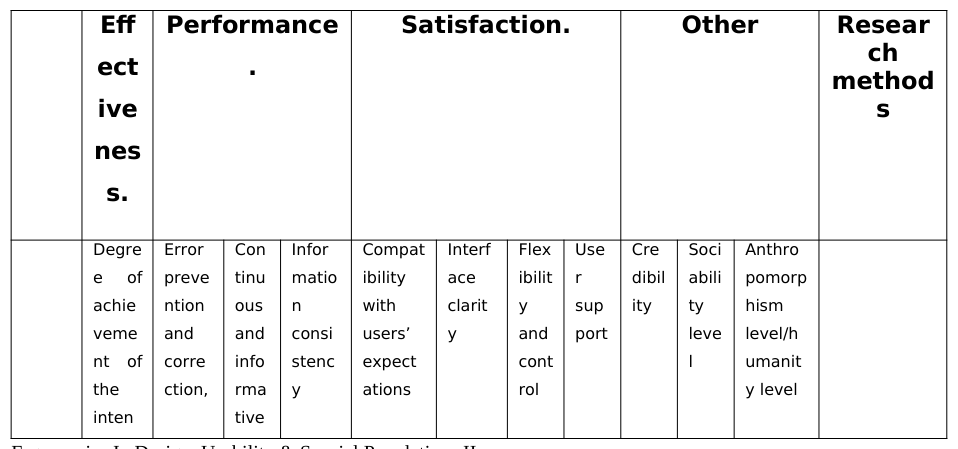
Summary of the described research is presented in table 1.
Table 1: Summary of research in the field of ergonomics / usability of agent-based software (based on Nielsen 1993 and own research)
The conducted studies showed that from the point of view of comprehensive look at the ergonomics of agent systems in the context of their usability, hitherto undertaken research methods included only selected aspects of the assessment process of ergonomics of software agents.
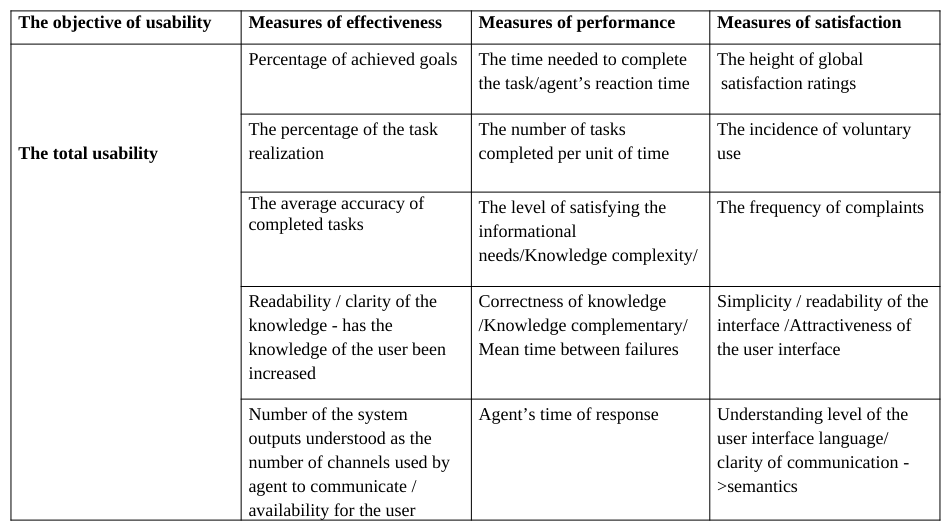
Table 2 shows possible indicators that may be used in the process of measuring the components utility indicated here.
Table 2: Examples of measures of usability (based on norm EN ISO 9241-11, Lewis, Rieman, 1994 and own research) The objective of usability Measures of effectiveness Measures of performance Measures of satisfaction
The most frequently mentioned principles of software ergonomics called heuristics include, among others:
feedback (for every action there should be a reaction or information from the system)
availability (providing tools and information according to the user’s needs)
simple and natural dialogue (simple dialogue in accordance with a simple sequence of performed activities)
the use of the user's language (the use of language, symbols from the user’s environment)
reducing the load on short-term memory (no need to memorize a lot of information)
confirmation of actions (information of a result of actions)
elimination of errors (reducing the number of errors to a minimum) (Lewis and Rieman, 1994).
Due to the comparison of ergonomics of the system agents with the aspect of its usability, and the indication of areas of possible criteria for the evaluation of agents, taken in this paper attempt to synthesize these approaches allows for a more complex look at the ergonomics of agent systems, concerning the construction of research methods of agents in this field.
Unfortunately, none of the analyzed by the authors studies fully relate to the significant factor of ergonomic agent systems which is knowledge. This gives an assumption to conduct further scientific study taking into account the knowledge that an agent should have, such as knowledge about the user, knowledge of the presented problem, contextual knowledge about the course of the conversation, knowledge of the organization, as well as becoming a point for the development of methodologies for designing ergonomic agent systems defined not only by measures of utility, but also taking into account the knowledge they represent.
Each aspect of knowledge supports particular tasks and operations. Certain knowledge structures are universal building blocks for achieving high performance, regardless of what specific business function is at hand. Neglecting any aspect of knowledge means lower productivity, rework, miscommunication, frustration, or delays. Learning processes advance knowledge competencies that make up the collective intelligence of an organization. Understanding how learning and performance link to the Knowledge Archetype helps people to be more responsive to the evolving environment.
CONCLUSIONS
At present, agent-based technology became one of the solutions that can support end users by providing them with knowledge about the processes taking place in their environment. Currently created solutions equipped with codified knowledge and communication mechanisms with humans often use the Internet medium. For this purpose, the paper presents the theory of software agents, multi-agent systems and the concept of ergonomics, which in some respects can be equated with the usability of such a system.
In particular, these considerations will be taken in relation to the support of the knowledge management processes, which represent a key element for the construction of agent solutions to support modern organizations. In the final part of the paper, in terms of complexity of the used research methods, the analysis of the described in the literature studies in the field of ergonomics of agents was conducted.
Undertaken studies have shown that from the point of view of modeling the interaction between the human and the software agent, it becomes possible to identify the concept of ergonomics of the agent with its usability.
Such an approach allows to examine ergonomics by taking into account three factors: the degree of achievement of the intended objectives by the user with the usage of software agent (effectiveness), agent’s performance and satisfaction reached by the user during the interaction with the agent. In particular, the first two factors may also be used in the context of the evaluation of ergonomics of the society of agents in order to evaluate interactions between agents in the system.
On the basis of the functional analysis concerning the possible criteria for assessing the ergonomics of the agent system, the analysis was used for the purpose of determining the scope of hitherto conducted studies in this area.
This analysis revealed the lack of a holistic view on the aspect of ergonomics of agents in the hitherto conducted research.
There is no reference to the key aspect of the creation of software agents in the context of modern organizations based on knowledge, the knowledge of software agent, which in the opinion of the authors is a key aspect of any identified here criterion for assessing the effectiveness. Assessment of the knowledge of software agent in the context of its ergonomics will constitute a subsequent subject-matter of the study of authors.
Acknowledgements: The issues presented constitute authors’ research into the aspect of modeling software agent societies in knowledge- based organizations. The project was financed from the funds of National Science Centre 2011/03/D/HS4/00782 .
REFERENCES
Artikis, A, and Pitt, J. (2001) ”A Formal Model of Open Agent Societies”. In: Proceedings of the 5th International Conference on Autonomous Agents. Bailenson, J.N., Blascovich, J., Beall, A.C. and Loomis, J.M.(2001) Equilibrium theory revisited: Mutual gaze and personal
space in virtual environments. Presence: Teleoperators & Virtual Environments, 10 (6). 583-598 and Hinds, P.J., Roberts, T.L. and Jones, H. Whose job is it anyway? A study of human-robot interaction in a collaborative task. Human-Computer Interaction, 19 (1). pp. 151-181 Dignum V., Dignum F., Meyer JJ.,[Equation or mathematical symbol available in the original paper PDF] “An agent-mediated approach to the support of knowledge sharing in organizations” The Knowledge Engineering Review [Equation or mathematical symbol available in the original paper PDF][Equation or mathematical symbol available in the original paper PDF]Vol [Equation or mathematical symbol available in the original paper PDF][Equation or mathematical symbol available in the original paper PDF] pp.[Equation or mathematical symbol available in the original paper PDF]– [Equation or mathematical symbol available in the original paper PDF][Equation or mathematical symbol available in the original paper PDF] Dourish Paul, (2001) Where the Action Is: The Foundations of Embodied Interaction. MIT Press Fasli M. (2007) "Agent Technology for e-Commerce" John Wiley & Sons, Ltd. Fogg, B.J. and Nass, C. (1997) Silicon sycophants: The effects of computers that flatter. International Journal of Human
Computer Studies Franklin S., Graesser A. (1996), Is it an Agent, or just a Program?: A Taxonomy for Autonomous Agents, Procedings of the Third International Workshop on Agent Theories, Architectures, and Languages, Springer-Verlag Gong, L. (2008) How social is social responses to computers? The function of the degree of anthropomorphism in computer
representations. Computers in Human Behavior, 24 (4). Pp. 1494-1509. IBM, 1997 http://www.ibm.com International Ergonomics Assciation - http://www.iea.cc/ International Standard ISO (EN) 9241, Ergonomic requirements for office work with visual display terminals (VDTs) Jordan, B., Henderson, A.(1995): “Interaction Analysis: Foundations and Practice”; The Journal of the Learning Sciences, 4, 1 pp., 39-103 King, W. J., Ohya, J. (1996) The Representation of Agents: Anthropomorphism, Agency and Intelligence. In Proceedings of CHI
(1996) pp. 289-290. Lewis C., Rieman J. (1994), Task centered user interface design A Practical Introduction Luck, M, McBurney, P and Preist, C, (2003), Agent Technology: Enabling Next Generation Computing: A Roadmap for Agent Based Computing. AgentLink II. Maedche A., Staab S., Stojanovic N., Studer R., and Sure Y.,(2001) SEAL – A framework for developing SEmantic Web
PortALs. Lecture Notes in Computer Science, 2097:1–22, 2001. Moon, Y. and Nass, C. (1998) Are computers scapegoats? Attributions of responsibility in human-computer interaction.
International Journal of Human-Computer Studies, 49 (1). pp. 79-94. Nass, C., Fogg, B.J. and Moon, Y. (1996) Can computers be teammates? International Journal of Human Computer Studies, 45(6). pp. 669-678. Nass, C., Moon, Y., Fogg, B.J., Reeves, B. and Dryer, C.(1995) Can computer personalities be human personalities? Conference
companion on Human factors in computing systems, ACM, pp. 228-229 Nielsen J. (1993) Usability engineering Morgan Kaufmann Norman, D.A. (2005),: “Human-centered design considered harmful”; Interactions, 12, 4 pp.14-19 Nwana H.S. (1996) Software Agents: An Overview, Knowledge Engineering Review Olszak C., Sroka H. (2001), Integrated informatics systems in managment, Wydawnictwo AE Katowice pp. 34 – 36 Paprzycki M., (2003) Software agents as a methodology of software, Computer Science Department, Oklahoma State University, pp. 3-6. Pitt J., Mamdani A, Charlton P. (2001) "The open agent society and its enemies: a position statement and research programme"
Telematics and Informatics, 18(1), pp.67-87 Senge P.M., Roberts C., Ross R.R., Smith B.J.,(1994) The Fifth Discipline Fieldbook. Strategies and Tools for Building a Learning Organization, Currency Book, Nowy Jork - Londyn - Toronto
Soltysik-Piorunkiewicz A., Żytniewski M. (2013) „Software Agent Societies for Process Management in Knowledge-Based Organization” 14th European Conference on Knowledge Management, ACPI, pp.661-669 Staab S. and Maedche A. (2000) Knowledge portals: Ontologies at work. The AI Magazine, 22(2), pp. 63–75 Van der Veer G. (2008) Cognitive Ergonomics in Interface Design – Discussion of Moving Science Journal of Universal
Computer Science, vol. 14, no. 16 (2008), pp. 2614-2629 Stasko J. Catrambone R. Xiao J. (2002) Anthropomorphic Agents as a User Interface Paradigm: Experimental Findings and a Framework for Research in: Proceedings of the 24th Annual Conference of the Cognitive Science Society van Elst, L, Dignum, V and Abecker, A, (2004), ‘‘Towards agent-mediated knowledge management’’ in L van Elst, V Dignum
and A Abecker (eds) Agent-Mediated Knowledge Management: Selected Papers (Lecture Notes in Artificial Intelligence), Berlin: Springer. Walker, J. H., Sproull, L., Subramani, R.(1994) Using a Human Face in an Interface.Proceedings of CHI pp. 85-91. Żytniewski M. (2013) „The development of the concept of software agent societies” European Space of the Electronic Communication Publishing House of the Szczecin University pp.481-489 Żytniewski M. (2013) “Application of the software agents society in the knowledge management system life cycle” Cognition
and Creativity Support Systems , Publishing House of the University of Economics in Katowice, pp. 191-201
LISTED IN THE AHFE DIGITAL BOOKSTORE CATALOGUE
Explore the complete digital volume
Advances in Ergonomics In Design, Usability & Special Populations: Part II
Read this individual research paper free through the original publisher, or explore the full digital proceedings book.
ISBN 978-1-4951-2107-4
Explore this ISBN in the AHFE Bookstore ↗Listed in the July 2026 bookstore catalogue; search by ISBN to confirm current availability · Digital book purchase optional