Tuğra Erol, Cyriel Diels, James Shippen, Dale Richards, Chris Johnson (2022). Effects of Appearance on the Perceived Comfort of Automotive Seats. In: Advances in Ergonomics In Design, Usability & Special Populations: Part II. AHFE Open Access, vol. 19. https://doi.org/10.54941/ahfe1001226
Automotive seat comfort is becoming one of the major aspects in distinguishing companies from their competitors. We here explored the role of the visual appearance of automotive seats in the perception of initial seat comfort. Unlike discomfort, the concept of comfort is regarded a highly subjective and multi-faceted phenomenon. This paper addressed the possibility of improving the perception of comfort through the mere manipulation of the visual appearance in otherwise identical automotive seats. In addition, the study explored gender differences in sensitivity to the effects of visual appearance and perceived comfort. The results showed that the visual appearance of physically identical seats had a large and statistically significant effect on perceived comfort. Furthermore, the effect of visual appearance on perceived comfort was found to be considerably larger for female participants. The results are discussed in the context of potential underlying mechanisms relating visual appearance to aesthetics, positive affect, perceived ergonomic quality, and product personality. Suggestions for future studies are provided with regards to visual design parameters and their effect on the perception of automotive seat comfort.
In the context of European emission targets (e.g. EU, 2008), car manufacturers are actively exploring methods to reduce vehicle weight. Significant gains can be obtained by replacing traditional, and relatively heavy, automotive seats with lighter, thinner designs. This move towards lightweight seats should however not come at the expense of reduced driver comfort. In addition, these developments also mean that automotive seat comfort is becoming an increasingly important attribute for car manufacturers to distinguish themselves from their competitors (Kolich, 2008).
To date, seat design has traditionally targeted ergonomic and economic optimisation (Zenk, Franz, & Bubb, 2008). Research in this area has primarily focussed on eliminating driver discomfort as opposed to achieving an optimised level of comfort. Discomfort in seats is typically associated with factors such as seat-occupant interface pressure distribution, temperature and humidity, muscle activity, and vibration transmissibility (Vink, 2005). These seat performance measures are then linked to the subjective perceptions of occupants using questionnaire ratings (Kolich, 2008). Partly because these measures are standardized and relatively straightforward to assess and quantify, seating research in the automotive industry has focused on discomfort.
Although it may be tempting to regard discomfort and comfort as the extremes of a single construct, it is now widely recognised that comfort and discomfort should be treated as two different constructs. In a seminal paper by Helander and Zhang (1997), it was pointed out that there is a clear differentiation of descriptors used by participants between comfort and discomfort. Rather than being a simple bi-polar phenomenon, Helander and Zhang suggested a discontinuity between comfort and discomfort. They proposed that the perception of discomfort was associated with descriptors relating to fatigue, pain, and circulation, whereas comfort was associated with aesthetics, a sense of relaxation, refreshment and well-being. Furthermore, discomfort was described as a time-related phenomenon with the level of discomfort increasing over time. In contrast, comfort was regarded as time independent. Helander and Zhang further argued that if discomfort factors dominate, comfort factors would not be able to be experienced. Thus, comfort will not be automatically experienced when there is an absence of discomfort. Vink (2005) also indicated that discomfort was more related to physical characteristics, whereas comfort was more related to experience, emotion, unexpected features, and luxury. When there is an absence of discomfort, nothing is experienced and in order to notice comfort, more should be experienced (Vink, 2005). In line with the above studies, Shen & Vertiz (1997) also argued that comfort and discomfort can co-exist with regards to automotive seating comfort.
Because comfort is regarded as a highly subjective and multi-faceted phenomenon associated with idiopathic experiences and emotions, comfort can be affected by numerous subjective factors, also referred to as soft factors, such as smell, noise, and service level (Vink & Hallbeck, 2012). Bubb and colleagues reported an experimental study in which, for the first time, changes in the visual appearance were shown to affect participants’ perception of comfort in otherwise identical automotive seats (Bubb (2008) and Mergl, Führlinger& Bubb (2008)). Specifically, Bubb and colleagues investigated Ansitz Komfort, the perception of comfort within the first minute of settling into a seat. This term appears to share considerable overlap with the term transient comfort used by Shen and Vertiz (1997) which they used to refer to the perception of comfort following physical adjustment in posture on initial contact with the seat. Returning to the study conducted by Bubb and colleagues, the first phase of the study investigated comfort preference for different cushion stiffness levels followed by a pairwise comparison of seats that differed in terms of stiffness. Surprisingly, even though participants were able to judge which of the two seats was stiffer, there was no difference in overall comfort: half of the participants preferred the stiffer seat, whereas the other half preferred to softer seat. Since physical differences in seat design failed to lead to changes in the perception of comfort, the second phase of their study investigated what other factors could influence transient comfort. With reference to Helander’s (2003) publication entitled Forget about ergonomics in chair design? Focus on aesthetics and comfort!, Bubb and colleagues subsequently explored the effect of the seat’s visual appearance on perceived comfort. Pairwise comparisons were conducted whereby participants were asked to state their preference in terms of comfort for a pair of physically identical automotive seats that differed only in their aesthetic appeal, i.e. an “ugly” seat was created by fitting it with an unattractive pattern. Although Bubb and colleagues failed to report any details of the actual visual design, their results unequivocally showed that under these conditions, the ugly seat was also rated as less comfortable. With both seats covered up, an expected 50-50 split in preference ratings was observed. However, with the design visible to participants, 10% of the participants changed their mind and rated the “ugly” seat as less comfortable. Interestingly, the size of the shift in comfort rating was found to be larger than that observed for the differences in actual seat stiffness. In other words, the effect size of visual appearance was larger than that of the physical seat characteristic stiffness (Mergl, 2008).
The main aim of this study was to replicate the findings by Bubb and colleagues and demonstrated the robustness of the effect of visual appearance on seating comfort. Secondly, we measured seating comfort on a 7-point Likert scale to obtain a more fine-grained measure of comfort compared to simple preference ratings. Finally, to explore variations within the customer base, we explored differences in perceived comfort between male and female participants. Zenk et al. (2008) suggested that there are essential gender differences when considering the “design evaluation” of car seats where women were found to be more demanding in terms of car seat design. It was hypothesised that female participants would be more sensitive to the visual appearance which, in turn, would be reflected in more pronounced differences in comfort ratings. Finally, we conducted post-trial interviews to gain a preliminary understanding of the underlying mechanisms regarding the relationship between seat appearance and perceived comfort.
Method
Participants A total of 18 participants (9 male, 9 female) took part in the study. Participants’ mean age was 33,8 (min=22, max=52, SD= 9,6). 8 male and female participants and an age range of 20-30 years. The remainder 10 participants were over 31 years. At least 3 years driving experience was required for participation. The mean number of years participants held a valid driving licence was 12,28 (SD=10,7). None of the participants were experts on the topic subject.
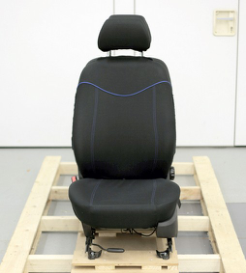
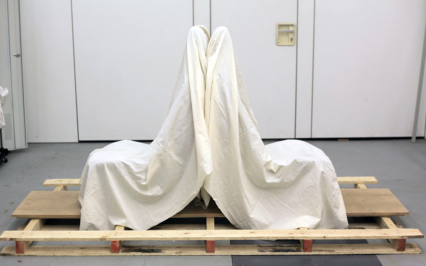
Seats The seats used in this study were the front driver and passenger seat of a mid-segment Sedan (Ford Mondeo Mk3). The seats were covered with two visually different commercially available seat covers: the “Streetwise accessories” (henceforth referred to as the “Black seat”) and “Ultimate speed” (henceforth referred to as the “Grey seat”), as depicted in figure 1. Both seat covers were made of the same material (foam) and had the same thickness (2mm). The covers were tightly fitted to the original contour of the seats. Both seats were securely fitted onto a pallet with the H-point positioned at 340 mm from the pallet floor, which substituted the vehicle floor. In the “blindfolded” condition the seats were covered with white covers (see figure 2). The drape covers were made out of white cotton cloth sheet. Both seats were tilted at an angle of 21° throughout the experiment and participants were instructed not to make any seat adjustments.
Figure 1. Experimental seats employed: Black seat (left) and Grey seat (right)
Metrics In terms of methodology, Helander (2003) suggested that pairwise comparisons of chairs lead to a better discriminability between chairs. One reason for this had been stated to be that memory trace of the proprioceptive states last for only few seconds (Helander, 2003). Pairwise comparisons have been suggested to be better in terms of quick assessment and keeping the fading impression of the last chair for comparison, the dependent variable being the overall comfort of the seat .Overall comfort was rated on a 7-point Likert scale (1=not at all, 7=extremely) which has been adopted from the Sohlman & Staaf (2006). Using a forced-choice paradigm, participants were also asked to indicate which of the two seats they preferred in terms of seating comfort (see also Mergl et al., 2008).
Experiment Design & Set-up The seats were tested under static conditions in a laboratory environment in two stages. In the first stage the seats were covered with white cotton sheets in order to hide the visual appearance. Participants were invited to sit on the covered seats for one minute each and were asked to rate their overall comfort feeling on the 7-point Likert scale after having sat in each seat. The participants were not allowed to manipulate the position of the seats in any way or use their hands to touch the seats in order to control for haptic or tactile sensations (see Zenk et al., 2008). Following the comfort ratings for both seats, participants were then asked to indicate which of the two seats they preferred in terms of “comfort”. In the second stage of the study, the procedure was repeated but this time with the seats uncovered exposing the visual design. The sitting sequence was counterbalanced across participants by repositioning the seats in between the two assessment stages, enabled by the wheels attached to the pallet. Following the comfort ratings in both covered and draped conditions, short interviews were undertaken in order to explore the underlying reasons and motivations for participants’ seat preferences.
Statistical analysis
None of the data passed the tests for normality and therefore non-parametric statistics were employed, i.e. Wilcoxon’s Signed rank tests.
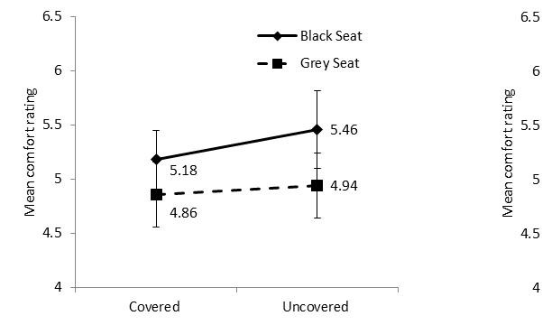
Figure 3 (left) shows the mean comfort ratings for both seats when covered in drapes and when visible, i.e. uncovered. It can be seen that comfort was rated to be similar with the seats covered but was rated higher with the seats visible and this was particularly true for the black seat. The covered black seat has a mean overall comfort rating value of 5.1778 (SD =0.75) whereas the grey seat with cover has an overall comfort mean value of 4.86 (SD= 1.34). When the designs were exposed the mean rating for the black seat increased to 5.46 (SD =1.13) whereas the grey seat had a mean comfort rating of 4.94(SD =1.29). Wilcoxon Signed ranks tests indicated no significant difference when the seats were covered, Z= -0.690, N-ties= 15, p=.49 (2-tailed). However, in the uncovered condition, the comfort rating for the black seat was found to be higher than the grey seat and this difference was found to be statistically significant (Z= -2.336 ,N-Ties = 11, p<.02 (2-tailed).
Figure 3. Mean (SEM) Comfort ratings as a function of seat and visibility (left) and seat and gender (right)
Figure 3 (right) shows the comfort ratings as a function of seat design and gender. It becomes apparent that the female participants were more sensitive to the difference in seat design when compared to the male participants. Wilcoxon Signed ranks tests revealed that female participants rated the comfort for the black seat (mean =5.94, SD=0.81) significantly higher than for the grey seat (mean=5.17, SD=1.09) ( Z= -1.983, N-Ties=16, p<0.5), whereas no significant difference was found for the male participants between the black seat (mean= 4.98, SD=0.81) and Ergonomics In Design, Usability & Special Populations II grey seat (mean =4.71, SD=1.09) (Z=- 1.095, N-Ties=13 p=0.27).
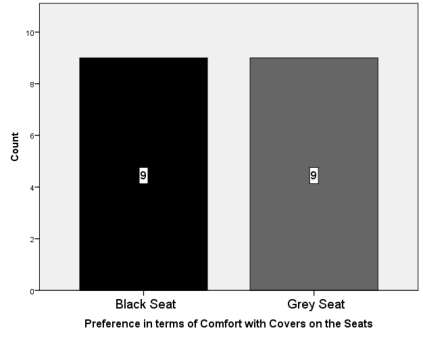
Preference Counts The number of participants preferring the black or grey seat for each of the two conditions is shown in figure 4. The left graph shows that the participants exposed to the covered seats had an equal preference in terms of seat comfort. In the uncovered condition exposing the visual design, the preference ratings dramatically swayed towards the black seat with 14 out of 18 participants preferring the black seat in terms of comfort. Only four participants (3 male, 1 female) preferred the grey seat in terms of comfort in the uncovered condition.
Figure 4. Number of participants preferring the black and grey seat in the covered (left) and uncovered
(right) conditions.
Comments by the participants In the post-trial interviews, most of the participants (10) who preferred the black seat in terms of comfort reported that the seat appeared “neater”. Certain design features such as the blue stitch lines were also said to make the seat look “sportier” and more appealing. Five participants reported that the black seat felt more comfortable, solid, supportive, fitting and protected. In terms of comfort four participants stated that there was “not much of a difference” between the seats. In contrast, the four participants who chose the grey seat had mentioned that it looked “old fashioned” and specifically in a “classical way” which had influenced their preference and comfort rating. One of the participants who expressed a preference for the grey seat referred to the black seat as “looking cheap”. Four participants said that thought “the black seat is significantly bigger than the grey one”. Six participants mentioned that the black seat looked “sportier” leading them to believe it was “stiffer and more solid”.
When asked to indicate “what has affected your preference in terms of comfort?” most participants reported their answers in terms of “I liked the seat”, “I felt comfy in it”, “I felt fitted”. Twelve participants reported that the appearance of the seats had an effect on their preference and comfort rating. Three participants commented that “these are ordinary seats” yet they did rate the seats as highly comfortable as measured by the 7-point Likert scale. When asked what they had would expect from an ultimate comfortable seat, five participants indicated a leather seat as their preferred choice. Six participants referred to an ideal seat as a little bit firmer and not too much relaxing as to aid with staying awake and for safety purposes. Three participants stated that they would make their choice based on “functional use” such as “this seems to be less prone to get dirty” specifically in terms of the black seat cover. At the very end of the assessment, the identical nature of the seats was revealed to the participants, which was met with particular surprise. Most (11) participants reported that they were sure the two seats differed in terms of size and shape.
DISCUSSION
The aim of this study was to explore the effects of visual design on perceived seating comfort. The method of the study focused on the initial first minute of sitting, in line with previous experimental studies by Mergl et al. (2008) and Bubb (2008). In terms of preference counts the previous studies showed a 10% shift to the visually more attractive seat from the somewhat “uglier” seat. With 78% (14 out of 18) of the participants preferring the black seat in terms of comfort, the effect of visual appearance was found to be even stronger in the current study. In addition to the preference counts, we also employed a more finely grained overall comfort rating compared to previous studies, in that participants were asked to rate their comfort on a 7-point Likert scale. Again, clear differences were found in perceived comfort between the black and grey seats with the seats visible, but no differences were found with the seats covered. In summary, the results of this study indicate that the visual appearance has a significant effect on the perception of initial comfort. This supports Helander’s (2003) statement that aesthetics are more important than ergonomics, provided basic ergonomic requirements are met.
It is evident that the experimental procedure was successful in making participants believe that different seats were being tested. Put differently, participants were unaware of the underlying hypothesis, the effect of changes in visual design on comfort. The interviews following the comfort assessments revealed that participants were genuinely surprised to hear that the seats were identical in terms of the physical characteristics such as shape, stiffness and reclining angle. Indeed, most participants (11) thought the seats differed physically. In the post-trial interviews, participants concurred that aesthetics of the seats influenced their preferences. This reinforces the conclusion that perceived comfort can only really be maximized when taking into account the “likes” and “dislikes” of consumers (Kolich, 2008).
The results of the current study, as well as those of Bubb and colleagues, raise the question how mere changes in visual appearance affect not only (1) perceived comfort, but also (2) the perceived physical shape of a seat. As discussed by Zenk et al., (2008) the perceived “sportiness” of the seat is dependent on seat type and overall layout and not related to the qualities of the seat. Kamp (2012) suggested that the physical seat contour design aspects have an influence on the character of the experience, such as “sporty” and “luxurious”. In this study, seats differed only in visual design, participants referred to seats as a “passenger car” seat associated with relaxed feelings, or hard and stiff for a “sporty seat”, despite having no differences in terms of physical aspects. Therefore we can hypothesise that the perceived comfort and perceived physical shape is affected by the visual design aesthetics. This would suggest that the visual design of the seat somehow mediates a perception on overall affect on comfort, which may affectively bias the perception of comfort. This affective biasing has previously been reported by Zhang et al. (1996) in the context of office chairs and sitting. It was claimed that the seat “impressions” can amplify or alternatively bias the perception of the comfort. Confirming these previous findings, during the interviews in the current study, participants gave statements referring to aesthetic elements of the seats such as pattern and stitch, which in turn influenced their feelings towards the seats.
Creusen and Schoormans (2005) suggested “six different roles of product appearance” in consumers’ minds. Based on the post-trial interviews we suggest that perhaps with the exception of “attention drawing”, the following five roles may have played a role in our participants’ perception of seat comfort: communication of aesthetic, symbolic, functional, ergonomic quality and categorisation. Most participants commented on the aesthetic appeal of the two seats with a clear preference for the black design. Terms such as “cheap” and “ordinary” imply a referral to symbolic roles whereas comments such as “less dirt accumulation” and “better fitting” appear to refer to utilitarian-functional roles. The effect of visual design cues on the perceived ergonomic quality of seats may induce expectations regarding the sitting experience. In this context, as indicated by Creusen & Schoormans (2005), the ergonomic product value and categorization processes in relation to the “seat typology” may also be governing the initial response to the seats.
Finally, a gender effect as predicted by Zenk et al. (2008) was also replicated in that female participants were shown to be more sensitive to the visual design and subsequent seat comfort ratings. One outcome from this finding is to suggest that “female oriented” seat designs can be explored. How such affective variables can be transferred into physical design parameters is a point of debate as there is no evidence in literature of seat comfort based on gender. Also, during the post-trial interview it was revealed that there was a general sentiment shared by the participants in that due to the nature of car purchasing any particular seat would come with the car that one chose to purchase. Therefore seat design is considered to be a pre-determined (included in the package) forced choice when buying.
From this it can be suggested that the brand make, segmentation and purchase price tag are probable bias points for any consumer in question, regardless of gender. Due to the environment within which the present study was conducted these factors were missing and presented the participants with a somewhat artificial contextual setting. The interplay of these factors can be investigated in future studies.
CONCLUSIONS
Consumer expectation for automobile seat comfort is high and demanding (Kolich, 2008). There is an increasing demand for the customer-specific development of “comfort” with the need for recyclable and lighter seats. Therefore it is particularly important to make a good lasting impression on the first experience of a potential customer. As suggested by Vink (2005) “comfort is a pleasant state or relaxed feeling of a human being in reaction to its environment”(p.14) and that “expectations” (or attitudes) are often linked to comfort (Vink & Hallbeck, 2012). The significance of the validation of the effect of visual appearance on seating comfort is apparent since seat comfort plays an important role in the overall impression of a vehicle and ultimate purchase decision (Kolich,2008). When we consider seat design to offer optimal physical support, the differences between the perceptions of seat comfort can be manipulated solely by visual design cues rather than manipulating the physical structure of the seat. This underlines the fact that consumers operate with an aesthetic bias that can perceive a seat to be more or less comfortable based solely on their like or dislike for a particular seat (Kolich, 2008). The current findings also highlight the need that seat comfort cannot be fully quantified without this understanding of the consumer. In order to assess the appearance factors in future studies, a questionnaire has to include valid and reliable factors with regard to visual and emotional responses to quantify comfort aspects. It is therefore important to develop a theoretical model on the initial impression of the seat and define the meaningful dependent variables that quantify the subjective perceptions of automobile seat comfort. It is possible that the dimension of comfort perception of seats is assessable even without sitting in seats and based solely by visual examination. The integration of such parameters into human modelling software such as “Technomatrix Jack” would improve determination of comfort parameters beyond positional and dimensional simulations. The question is how such affective variables can be translated in to customer requirements which in turn can be transformed into physical design parameters: from emotions to design. The relation between aesthetics, visual metric cues and overall comfort is of particular interest for future research.
Tugra Erol is currently a PhD student in the Department of Industrial Design, Coventry School of Art & Design, Coventry University. This paper is part of the PhD research of Tugra Erol and the research is not funded or influenced by commercial parties. REFERENCES Bubb, H., & Estermann , S. (2000). Influence of forces on comfort feeling in vehicles SAE International.
doi:10.4271/2000-01-2171 Bubb, R. (2008) Sitting comfort. Paper presented at IQPC aircraft interior innovation. 11 November 2008. Hamburg. Burgermeister. T (2006), Objektivierung des "Ansitzkomforts"-Validierung , Unpublished semester work for degree, Technische Universität München Lehrstuhl für Ergonomie , München Creusen, M. E. H., & Schoormans, J. P. L. (2005). The different roles of product appearance in consumer choice.
Journal of Product Innovation Management, 22(1), 63-81. De Looze, M.,P., Kuijt-Evers, L., & Van Dieën, ,JAAP. (2003). Sitting comfort and discomfort and the relationships with objective measures. Ergonomics, 46(10), 985-997. doi:10.1080/0014013031000121977 Helander, M. G. (2003). Forget about ergonomics in chair design? focus on aesthetics and comfort! Ergonomics,
46(13-14), 1306-1319. doi:10.1080/00140130310001610847 Helander, M. G., & Zhang, L. (1997). Field studies of comfort and discomfort in sitting. Ergonomics, 40(9), 895-
915. doi:10.1080/001401397187739 Kamp, I. (2012). The influence of car-seat design on its character experience. Applied Ergonomics, 43(2), 329-335.
doi:http://dx.doi.org/10.1016/j.apergo.2011.06.008 Kolich, M. (2008). A conceptual framework proposed to formalize the scientific investigation of automobile seat comfort. Applied Ergonomics, 39(1), 15-27. doi:http://dx.doi.org/10.1016/j.apergo.2007.01.003 Mergl,C. Führlinger,L. Bubb, H. (2008) Eine experimentelle Studie zur Objektivierung des Ansitzkomforts
Mergl,C. (2006), Entwicklung eines Verfahrens zur Objektivierung des Sitzkomforts auf Automobilsitzen, Unpublished masters thesis for master’s degree, Herbert Utz Verlag, München Shen , W., & Vertiz , A. M. (1997). Redefining seat comfort SAE International. doi:10.4271/970597 Sohlman,H& Staaf H. (2006). A Subjective Evaluation of Seat Comfort: Identifying Factors of Comfort and
Discomfort in Truck Seats. Unpublished masters thesis for master’s degree, Liköpings Universitet, Linköping, Sweden. UK Government (2008) Climate change act 2008 Printed in the UK, Controller of Her Majesty’s Stationery OYce and Queen’s Printer of Acts of Parliament Retrieved from: http://www.legislation.gov.uk/ukpga/2008/27/contents Vink, P. (2005). Comfort and design principles and good practice. Boca Raton, FL: CRC Press. Vink, P., & Brauer, K. (2011). Aircraft interior comfort and design. Boca Raton: CRC Press. Vink, P., & Hallbeck, S. (2012). Editorial: Comfort and discomfort studies demonstrate the need for a new model.
Applied Ergonomics, 43(2), 271-276. doi:http://dx.doi.org/10.1016/j.apergo.2011.06.001 Zenk, R., Franz , M., & Bubb , H. (2008). Emocard -“ an approach to bring more emotion in the comfort concept.
SAE Int.J.Passeng.Cars - Mech.Syst., 1(1), 775-782. doi:10.4271/2008-01-0890 Zhang, L., Helander, M., & Drury, C. (1996). Identifying factors of comfort and discomfort in sitting. Human
Factors: The Journal of the Human Factors and Ergonomics Society, , 377-389. doi:doi: 10.1518/001872096778701962
LISTED IN THE AHFE DIGITAL BOOKSTORE CATALOGUE
Explore the complete digital volume
Advances in Ergonomics In Design, Usability & Special Populations: Part II
Read this individual research paper free through the original publisher, or explore the full digital proceedings book.
ISBN 978-1-4951-2107-4
Explore this ISBN in the AHFE Bookstore ↗Listed in the July 2026 bookstore catalogue; search by ISBN to confirm current availability · Digital book purchase optional