Naseem Ahmadpour, Jean-Marc Robert, Gitte Lindgaard (2022). Impact of the Seat on Aircraft Passenger Comfort Experience in the Cabin Interior. In: Advances in Ergonomics In Design, Usability & Special Populations: Part II. AHFE Open Access, vol. 19. https://doi.org/10.54941/ahfe1001275
The aircraft seat has been shown to impact passenger comfort experience in the cabin interior. A previous study defined passenger comfort experience in the cabin in terms of eight experiential themes. This study first investigated the possibility of differentiating passenger comfort and discomfort experience in economy class based on participants’ rating of those themes. No significant differences were found between the two concepts. Second, themes that were found to be most connected to the seat and participants’ respective concerns were highlighted. The theme ‘physical wellbeing’ was mentioned most frequently, followed by ‘peace of mind’, and ‘proxemics’. These three accounted for more than 70% of passengers’ seat experience. Among those, only the physical experience correlated with participants’ height, suggesting that to improve the passengers’ comfort experience, design efforts should go beyond the physical fit of the seat to the occupant’s body and explore passenger’s concerns for ‘peace of mind’ and ‘proxemics’.
Aircraft seat design is required to meet a number of standards and safety regulations. In addition, manufacturing light-weight seats is of crucial importance for reducing aircraft fuel consumption and consequently environmental impacts. Moreover, airline policies for the number of seats that should be accommodated in the aircraft cabin impose more restrictions on seat design in terms of size. Consequently, seat design for commercial aircrafts is very important for the airline and aerospace industry due to its significant influence on passenger comfort and wellbeing (Vink et al., 2012) as well as for purchasing decisions (Brauer, 2004). Therefore, given those limitations, it is becoming increasingly challenging to design seats that provide a safe, comfortable and pleasurable experience for the occupants.
Comfort is often described as a personal and subjective state (De Looze et al., 2003) of physical, physiological and psychological harmony (Slater, 1985). A new approach towards comfort emphasizes that peoples’ experience (Vink et al., 2005; Ahmadpour et al., 2014a) and perception (Vink and Hallbeck, 2012) of a product or system highly influences their comfort. The terms “comfort experience” was coined as a result (Vink et al., 2005), characterized by going beyond ergonomics and physical interaction (Helander, 2003) and taking a holistic and hedonic approach (Hancock et al., 2005) in delivering pleasurable experiences.
Ergonomics In Design, Usability & Special Populations II
Research on seat comfort is readily informed by this new view of comfort. Several studies have provided valuable information and conceptualized the experiential aspects of seat comfort with respect to seat functionalities. Examples are the association of aesthetics, relief, wellbeing and relaxation with office chair comfort (Helander and Zhang, 1997) and pleasure with car seat comfort (Coelho and Dahlman, 2002). Kamp (2012) showed that a perfect car seat elicits pleasant emotions with a minimal level of arousal and discussed the occupant’s experience of ‘relaxedness’. However, the literature offers limited information about similar descriptions of aircraft seats and their experiential aspects from the passengers’ point of view.
Some studies (Helander and Zhang, 1997; Helander, 2003) differentiate chair discomfort from comfort, characterizing the former in terms of fatigue, restlessness, pain and stress. An often-cited model (De Looze et al., 2003) adopted this view and outlined the theoretical underpinnings of comfort and discomfort including the impact of emotion and expectation on the positive aspects of comfort and wellbeing. This argument has not been discussed before in relation to aircraft seat comfort Despite the growing number of studies on comfort experience, research on the experiential aspects of aircraft seat comfort in the flight context is scarce. Acquiring such knowledge could help designers learn about various aspects of passenger reactions to the seat, enabling them to conceive of innovative concepts contributing to a positive experience. The objective of this paper is, therefore, twofold. First it will examine the possibility of differentiating passengers’ comfort experience from discomfort in the economy class of commercial flights and second, it will identify the experiential aspects of aircraft passenger comfort experience that are linked to the seat on board those flights.
BACKGROUND
An initial empirical study (Ahmadpour et al., 2014a) surveyed 155 passengers of commercial flights, collected their written flight reports with regard to their comfort experiences and generated eight subjective themes that described passengers’ perceptions of the aircraft cabin interior features (e.g., seat) and their respective concerns. These themes and concerns are shown in Figure 1 below, organized by importance for comfort. The themes ‘peace of mind’ and ‘physical wellbeing’ were identified as the most important themes and ‘association’ as the least important.
Figure 1. Aircraft passenger concerns and comfort themes
Figure available in the original PDF paper.
The theme ‘peace of mind’ signifies the main psychological aspect of passenger comfort which is achieved when Ergonomics In Design, Usability & Special Populations II one’s concerns regarding feeling secure, tranquil, and/or relief are met. For instance, one passenger described a comforting experience of having everything she needed by her side (i.e., security) while another passenger linked his comfort to feeling calm when not exposed to any excessive noise. ‘Physical wellbeing’ exemplifies passengers’ experience of physical impacts on his/her body; the level of comfort experienced depends on how much bodily support the passenger receives and how energetic they feel.
‘Proxemics’ is related to one’s experience of personal space in relation to other people around him/her (Hall, 1966). In the aircraft interior, this concept is related to a passenger’s concern for having a level of autonomy and control over personal affairs and immediate space as well as experience of privacy. For instance one passenger described an experience of comfort as having proper separation from his neighbor thereby avoiding any physical contact with him.
‘Satisfaction’ is described in terms of the environment’s instrumentality in helping the passenger to achieve certain goals. Consequently a level of comfort could be experienced according to how they perceive the accessibility of the objects they use (e.g. entertainment unit, seat control), the adequacy of cabin features (e.g., level of seat recline), or their qualities. In other words, satisfaction is linked to the passenger’s expectations and how well they are met. The theme ‘pleasure’ goes beyond passenger expectations, relating a sense of comfort to experiencing positive surprises as well as to the favorable ambience of the cabin (e.g., warm, welcoming) and stimulation (e.g., entertaining).
The ‘social’ theme describes the inter-personal social interactions in the flight context, how tolerable they are for passengers and whether they offer empathetic human connections (e.g., a helpful flight attendant). ‘Aesthetics’ aspects were described relative to passengers’ concerns for cleanliness of the cabin and its style (e.g., colors). The theme ‘association’ denotes a familiar experience that evokes certain memories or symbolizes a desired experience. For instance one passenger found the seat similar to a comfortable “hair salon chair” (evocation). Another passenger mentioned that, despite travelling in economy class, the service was “as good as the first class” (symbolism).
Furthermore, the study uncovered 22 context features in the aircraft interior (e.g., seat, legroom, temperature, In- Flight Entertainment, etc.), which they attributed to those comfort themes, and prioritized them based on the frequency with which they were mentioned. The seat was identified as the central determinant of the passenger comfort experience by impacting seven of the eight themes, leaving out the theme ‘pleasure’.
METHOD
Participants A convenience sample of 27 participants (15 male) was obtained. Of those, 20 were aged 18-34 and the rest 35-55. The mean height 174 (150-193 cm) and none had any disabilities. All participants had more than five flight experiences in the past. They were informed that they would be asked to share information about their economy class flights in the past two years. A total of 54 reports were thus obtained, of which 44 (81%) concerned long flights (more than 4 hours long) and the rest were short flights (less than 4 hours long).
Questionnaire Respondents were contacted by email and provided with a link to an online questionnaire (on Google Forms). The questionnaire consisted of eight questions inquiring about age, gender, height, disability, total number of previous flights (never/1-5 times/more than 5 times), a detailed description of an experience of comfort, and another of discomfort in economy class flights. Then the respondents were requested to rate the influence of each of the eight themes on those described experiences on a 5-point scale (slightly influential to highly influential). Each theme and its’ respective concerns were defined with a short description. It was also mentioned that if a theme had no impact on their experience, they should leave the scale blank. Finally a comment section was provided for participants to specify any aspect of their experience that was not mentioned in the list. At the end they were informed that they would be contacted for a follow-up one-on-one interview requesting more in-depth information about their responses.
Ergonomics In Design, Usability & Special Populations II
Interview Each interview was conducted within 14 days of their online reports having been submitted. At the beginning of an interview, an operational definition of comfort was given as follows: “a pleasant state of wellbeing, ease, and physical, physiological and psychological harmony between a person and the environment”. This was followed by a definition of discomfort as: “a state where one experiences hardship of some sort which could be physical, physiological or psychological”. Moreover, respondents were asked to specify whether they reported long or short flights in each report, as this question was missing from the initial questionnaire. During the interview, the principal researcher took notes and audio recorded the interview.
The interview involved prompting respondents to give more details about their reports including their feelings, attitudes, concerns and reactions to the environmental features including the seat. To understand why a certain aspect was experienced, a technique similar to the so-called “laddering technique” (Jordan, 2000) was adopted where the interviewee was asked why a certain description was given and the probing continued until their concerns and feelings were revealed. The interview ended with a review of the ratings by the respondents who gave separate reasons for each rated theme and had an opportunity to change their ratings based on the clarifications that were offered by the interviewer for each theme.
ANALYSIS AND RESULTS The data analysis included investigation of features that influenced passenger comfort and discomfort to some extent. However, we only report those related to the seat in this paper. A comprehensive report is in preparation.
Differentiating comfort and discomfort experience In order to examine whether comfort and discomfort were rated differently within each theme, a Wilcoxon Signed Rank test was performed on the ratings. Significant differences was found for only two themes, namely for ‘physical wellbeing’ and ‘pleasure’ (p<0.001 for each). Given that six of the eight themes did not demonstrate any differences in the ratings, it was decided to analyze all eight concepts in the same manner.
The average ratings (and standard deviation) of each theme in comfort and discomfort reports separately are listed in Table 1. It is clear that the theme ‘pleasure’ was rated the highest in reports of comfort experiences whereas the themes ‘physical wellbeing’ received the highest rating in reports of discomfort experience. The theme ‘peace of mind’ was similarly rated the second highly influential theme in both groups of reports, acknowledging the impact of psychological wellbeing on comfort experience. The theme ‘association’ was similarly rated in both groups as the least influential. Given that it was decided to not treat comfort and discomfort as two different phenomena, the combined effect was calculated by deriving the average (and standard deviation) of those mean ratings for each theme was calculated, as displayed in the last row of Table 1. It is worth noting that the results fully confirmed the rank order of comfort themes elicited in the previous study (see Figure 1) where ‘peace of mind’ and ‘physical wellbeing’ received the highest ratings for their influences on passenger comfort followed by ‘proxemics’, ‘satisfaction’, ‘pleasure’, ‘social’, ‘aesthetics’, and ‘association’ respectively.
Table 1. The mean ratings (1=slightly influential, 5=highly influential) of eight themes in comfort and discomfort reports; separately and combined (N=27).
Table available in the original PDF paper.
Ergonomics In Design, Usability & Special Populations II
Impact of the seat on comfort experience Next a content analysis was conducted on respondents’ (dis)comfort reports. For the present purpose, the analysis focused on descriptions in which the seat was mentioned in relation to an aspect of the experience, i.e., one of the eight themes. Overall some 18 (67%) participants mentioned the seat at least once in their reports in relation to an experience of (dis)comfort; N=11 male, N=13 aged 18-34 years old and N=5 aged 35-55 years of age, and with a mean height of 174 (152-193, SD=10) cm.
Next the themes that were demonstrated in those seat-related descriptions were identified from the verbatim interview transcripts. It must be noted that the seat could be counted several times in a reports if it was mentioned in relation to different themes. For instance when a respondent mentioned the seat once in relation to its social aspect and another time in relation to its impact on his physical wellbeing, it was counted twice. The results yielded 52 seat-related descriptions.
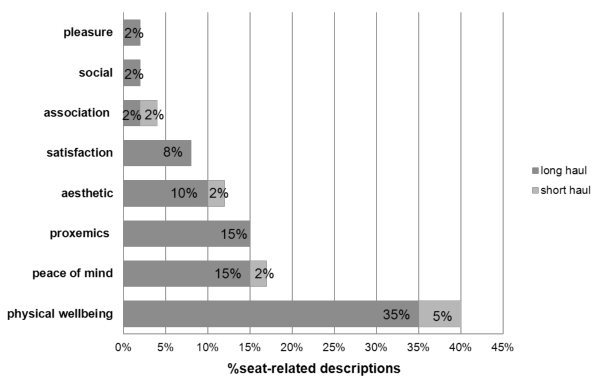
The seat was most frequently mentioned in relation to descriptions of ‘physical wellbeing’ (21 description, 40%) and least frequently with regard to pleasure and social (1 description, 2%) themes. The themes ‘physical wellbeing’, ‘peace of mind’ and ‘proxemics’ combined accounted for 72% of the descriptions. These are shown in Figure 2. Examining the flight length of these revealed that 46 (88.5%) seat descriptions were related to long haul (>4hr) flights and only 6 (11.5%) to short haul (<4hr) flights. The percentage of seat-related descriptions relative to long and short flight type was calculated for each theme as shown in in Figure 2 below.
To understand the impact of respondents’ height on their seat-related ratings of comfort themes, a Pearson Product Moment correlation was performed on height. Significant correlation (p<0.05, r= 0.4) was found between respondents’ height and ratings on the theme ‘physical wellbeing’ only. This implies that a person’s height is mainly linked to the seat’s perception of physical wellbeing.
Figure 2. Distribution of seat descriptions among the eight comfort themes (N=27, total Ergonomics In Design, Usability & Special Populations IIEquation reproduced from the original PDF.
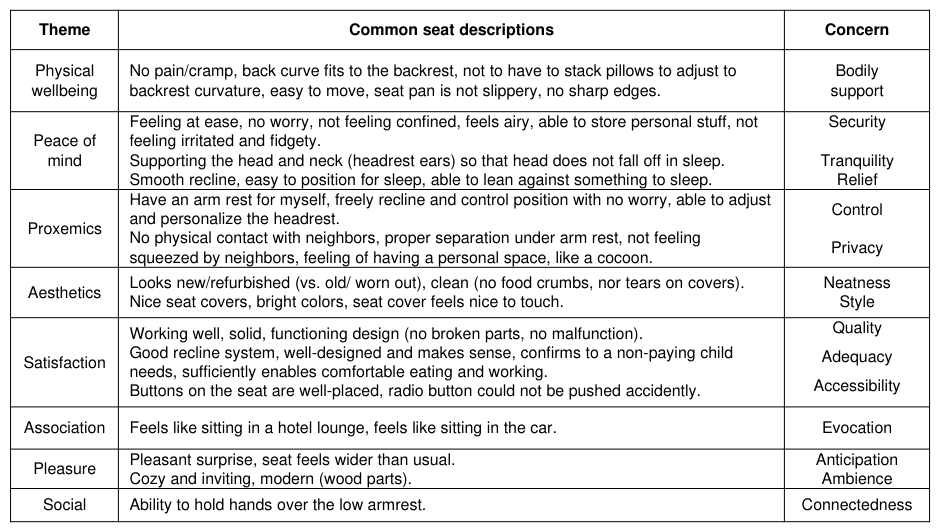
Finally the results were examined to identify the common descriptions of the seat in relation to each theme and their respective concerns. These are summarized in Table 2. In comparison to the list of concerns presented earlier in the introduction, it was shown that the ‘physical wellbeing’ experience of the seat was mainly related to the bodily support (leaving out the concern for energy), e.g., the fit of the backrest to the spine curve and not experiencing cramps and pains. The concern for symbolism and association to an (commonly unattainable) experience of a higher value was not observed in the ‘association’ theme; however, being reminded of other familiar situations such as being in the car or a hotel lounge was mentioned. Moreover, the seat was mentioned in relation to an experience of feeling connected to another person (e.g., holding hands with a spouse), but the experience of tolerance was not mentioned with regard to its ‘social’ aspects.
Table 2. Most common descriptions of the seat in relation to each theme and its respective concerns Theme Common seat descriptions Concern
DISCUSSION
This study employed in-depth interview techniques (such as laddering) following the completion of an online questionnaire to acquire first hand insight into the passengers’ in-flight experiences, in particular to the seat. During the interviews, it was ensured that participants had a clear understanding of each theme and that their previous ratings corresponded well to their concerns and experiences. Those ratings revealed that passenger comfort and discomfort in response to the interior of commercial aircrafts could not be differentiated in the same manner as office chairs (Helander, 2003; De Looze et al., 2003). It was clear, however, that by enhancing passengers’ experience of pleasure (e.g., exceeding their anticipations, providing a nice ambience, or a form of intellectual stimulation) these contributed most to improving their comfort, while being physically uncomfortable diminished their comfort more than any other theme. This confirms the significant differences in the ratings of the ‘pleasure’ and ‘physical wellbeing’ themes. Moreover, the analysis of respondents’ ratings (comfort and discomfort reports combined) validated the priorities of the eight comfort themes from the previous study (Ahmadpour et al., 2014a) for economy class, i.e., the themes ‘peace of mind’ and ‘physical wellbeing’ were rated the most influential on passengers’ overall comfort.
Ergonomics In Design, Usability & Special Populations II
It must be noted that the flight context is very influential on passengers’ interaction with the seat in that it imposes a number of physical limitations and alters inter-personal passenger interactions (as well as the flight crew) in the cabin interior. Therefore, the underlying themes of passenger comfort experience are more diverse than office chair comfort and demand the consideration of ‘proxemics’, ‘satisfaction’, ‘association’ and ‘social’ themes in addition to wellbeing, relaxation, aesthetics and pleasure aspects of those chairs (Helander and Zhang, 1997; Coelho and Dahlman, 2002).
In a previous study, Ahmadpour et al. (2014a) suggested that the seat is central to all themes of passengers’ experience of comfort except ‘pleasure’. Those results were confirmed in the present study in which the impact of the seat on passengers’ comfort experiences was investigated through analysis of their reports. Similar to the overall comfort experience, three themes of ‘physical wellbeing’, ‘peace of mind’, and ‘proxemics’ respectively were mentioned most frequently in relation to the seat, suggesting their importance for the evaluation of the seat experience in economy class. The seat was mentioned least in relation to ‘pleasure’, confirming the previously shown impact of entertainment and service on this experience in Ahmadpour and colleagues’ earlier study. The impact of the seat on the ‘social’ experience of economy class was also found minimal, even though the previous study attributed the seat and neighbors to the social experience. This could be due to the focus on economy class in this study. Furthermore, compared to the previous study, the concern for energy in the ‘physical wellbeing’ theme did not feature prominently here. This does not contradict the previous study which specified the air quality as the main determinant of passenger’s feeling of being energetic, rather than the seat.
The correlation of respondents’ height with only ‘physical wellbeing’ theme has two implications. First, the bodily fit of the seat has a higher value for taller passengers’ comfort. Second, given that physical comfort accounts for only 40% of seat comfort (see Figure 2), it is important to acknowledge the role of other aspects such as ‘peace of mind’, ‘proxemics’ and ‘aesthetics’ in defining the comfort experience of the seat in economy class. Improving those latter experiential aspects of the seat should go beyond the mere consideration of physical ergonomics aspects (e.g., fit to passenger’s bodily measurements) and include passengers concerns for security, tranquility, relief, privacy and personal space as well as visually pleasing designs.
For instance, examining the common concerns of respondents highlights a concern for the activities and attitudes towards the seat particularly in relation to the headrest. Respondents demanded a better physical fit of the headrest to their working posture (to achieve a better bodily support) but mentioned it also in relation to their habitual positions for “leaning” against something while sleeping (enabling them to relax), a better adjustability option (to control their positions as they wish) and a better quality in terms of material (that are soft but not cheap), maintenance and functionality. Moreover, passengers’ increasing use of electronic gadgets such as laptops and tablets necessitates a seat design that accommodates those instruments (for instance by customizing a suitable tray design) and adapts to passenger’s working postures and habits with them.
It must be realized that above propositions do not contradict the importance of the physical ergonomics for the seat design. A previous study (Vink and Brauer, 2011) highlighted passengers’ needs for better fit of the aircraft seat to the body and various recommendations were made accordingly. However, our study suggests that a characterization of seats based on subjective themes provides an indication of passengers’ experience and could perhaps provide an opportunity to design for more positive experiences. In the field of automotive design, Kamp (2012) similarly suggested to go beyond the physical aspects to improve car seat comfort. She associated occupants’ perception of the seat characteristics (e.g., luxurious) and emotions to a number of design characteristics, e.g., side support, and examined their experiences. It was concluded that even with a lack of physical support on the sides, a car seat could generate an experience of relaxedness due to its favorable character (Kamp, 2012).
The frequent mention of ‘proxemics’ in relation to the seat demands a special attention to this theme. Proxemics was realized as passengers’ impression of the personal space, a sense of control over that space and its adjustments (e.g., recline and headrest mechanism) as well as the recognition of passenger privacy in the seat. The literature had specified that the optimum personal space (in daily interactions) is the spherical space around a person with a 45cm diameter (Hall, 1966). In the aircraft interior, Ahmadpour et al. (2014a) showed that while the 0.71-0.81m legroom in economy class generally complies with such specification, passengers’ lateral distance from one another is usually less than 45cm. Future research should provide more information about how passenger’s sense of privacy could potentially change due to various measures of personal space. In our interviews with respondents, a common complaint was directed toward physical contact with neighbor’s arms and legs. Proper separation of passengers in Ergonomics In Design, Usability & Special Populations II those areas could potentially improve their sense of privacy. Respondents also mentioned their wish to communicate their status with others in a non-verbal manner, for instance by turning on a “do not disturb” sign or light.
In another study, Ahmadpour et al. (2014b) pointed to the role of the aircraft seat in eliciting several groups of emotions relative to the passengers’ goals and expectations (e.g., disappointed, satisfied, relieved), wellbeing (e.g., joy, feeling good), and attraction (e.g., liking). They argued that these emotions emerge when passengers appraise a situation as being significant for their personal concerns. It was suggested then, that improving the seat design and consequently comfort requires more information about passengers’ concerns. This information is partly provided in this paper. For instance we showed that the seat is connected to passengers’ satisfaction in terms of their concerns for adequacy (for achieving goals and performing certain activities like eating, working), quality, and accessibility. The impact of the seat on wellbeing emotions is similar to that of the themes ‘physical wellbeing’ (feeling good physically) and ‘peace of mind’ (experiencing joy and calmness) and their respective concerns (as was shown in previous section) should be noted accordingly. Finally the seat was clearly linked to the perception of ‘aesthetics’ suggesting that passenger’s concerns for neatness and style could generate various levels of attraction responses. This information contributes to a better understanding of passengers’ needs and their criteria for evaluating the seat experience in the flight context.
Finally a note on the limitations of this study is important. This study was performed with the intention of exploring the content and nature of passenger comfort in relation to the seat in the economy class. The disproportional number of participants who reported their experiences on long haul flights prevents us from drawing any firm conclusions in that regard. Future research should overcome this restriction by surveying a larger sample of participants. Furthermore, this study motivates more investigation into the impacts of the seat design and its particular characteristics on its occupant’s comfort experience.
CONCLUSION
The possibility of differentiating aircraft passengers’ comfort and discomfort based on the ratings of their underlying themes was examined. It was concluded that, for the economy class, these two phenomena do not differ and are underpinned by the same set of themes. The relationship between the seat and the themes of the passenger comfort experience was examined. We conclude that, although all comfort themes were mentioned in relation to the seat to some extent, three themes of ‘physical wellbeing’, ‘peace of mind’, and ‘proxemics’ were most prominent and followed the same trend as the overall comfort experience. It is proposed to use this information in designing aircraft seat concepts to enhance passenger comfort and employ them as a measure for evaluating their comfort experience.
REFERENCES
Ahmadpour, N., Lindgaard, G., Robert, J-M., Pownall, B. (2014a). The thematic structure of passenger comfort experience and its relationship to the context features in the aircraft cabin. Ergonomics (In press). Ahmadpour, N., Lindgaard, G., Robert, J-M. (2014b). Aircraft interior comfort and emotions. KEER’14: International
Conference on Kansei Engineering and Emotion Research 2014, Linköping, Sweden. Brauer, K. (2004). Convenience, comfort and cost: the Boeing perspective on passenger satisfaction. [PowerPoint slides] In: the Aircraft Interior EXPO’ 04, March 30- April 1, 2004, Hamburg. Coelho, D. A., Dahlman, S. (2002). Comfort and pleasure. In: P.W. Jordan, W.S. Green, (Eds.), Pleasure with products: beyond
usability (pp. 321-331). London: Taylor and Francis. De Looze, M.P., Kuijt-Evers, L.F.M., Van Dieen, J. (2003). Sitting comfort and discomfort and the relationships with objective measures. Ergonomics, 46 (10), 985-997. Hall, E.T. (1966). The Hidden Dimension. NY: Anchor Books. Hancock, P.A.,Pepe, A., Murphy, L. (2005). Hedonomics: the power of positive and pleasurable ergocomics. Ergonomics in
Design: The Quarterly of Human Factors Applications January 2005 vol. 13 no. 1 8-14. Helander, M.G., Zhang, L. (1997). Field studies of comfort and discomfort in sitting. Ergonomics. 40 (9), 895-915. Helander, M. G. (2003). Forget about ergonomics in chair design? Focus on aesthetics and comfort. Ergonomics, 46:13-14, 1306- Ergonomics In Design, Usability & Special Populations II
1319. Slater, K. (1985). Human comfort. IL: Charles Thomas. Vink, P., Overbeeke, C.J., Desmet, P.M.A. (2005). Comfort Experience. In: P. Vink (Ed.), Comfort and design: principles and good practice (pp. 1-12) FL: CRC Press. Vink, P., Brauer, K. (2011). Aircraft interior comfort and design. FL: CRC press. Vink, P., Hellbeck, S. (2012) Editorial: comfort and discomfort studies demonstrate the need for a new model. Applied
Ergonomics, 43 (2), 271-276.
Ergonomics In Design, Usability & Special Populations II
LISTED IN THE AHFE DIGITAL BOOKSTORE CATALOGUE
Explore the complete digital volume
Advances in Ergonomics In Design, Usability & Special Populations: Part II
Read this individual research paper free through the original publisher, or explore the full digital proceedings book.
ISBN 978-1-4951-2107-4
Explore this ISBN in the AHFE Bookstore ↗Listed in the July 2026 bookstore catalogue; search by ISBN to confirm current availability · Digital book purchase optional