Justin Nelson, Timothy Heggedahl, Justin Morgan, Samuel Johnston, Jenna Cotter (2025). Does Military Experience Influence Strategic Decision-Making with Respect to Geographical Headquarter Placement. In: Intelligent Human Systems Integration (IHSI 2025): Integrating People and Intelligent Systems. AHFE Open Access, vol. 160, pp. 157–162. https://doi.org/10.54941/ahfe1005821
Intelligence, Surveillance, and Reconnaissance (ISR) operations leverage five key disciplines to facilitate and support the detection of our adversaries defensive posture, battle rhythm pattern, and headquarter location. These disciplines include geospatial intelligence (GEOINT), measurement and signature intelligence (MASINT), signals intelligence (SIGINT), imagery intelligence (IMINT), and human intelligence (HUMINT). However, understanding when to utilize the appropriate discipline for intel collections can be extremely challenging. To combat this issue, the 711th Human Performance Wing at Wright-Patterson AFB developed Intrage. Intrage is a strategic decision-making game developed to augment and enhance intel analysts understanding of ISR operations. The objective is to identify the location of the opposition’s headquarters on a fictional map. Moreover, previous literature has discovered that behavioral characteristics learned through experience can significantly influence decision-making outcomes. Therefore, a study was conducted to determine if there is a correlation with respect to headquarter placement based on military experience when provided a fictional map. The findings provided underlying evidence that participants with military experience centralized their headquarter location compared to participants with no military experience (p=0.02). This discovery will support the maturity and development of Intrage and provide behavioral characteristics which can be used to predict future military actions.
Intelligence, Surveillance, and Reconnaissance (ISR) operators are tasked to support and streamline the processing, exploitation, and dissemination (PED) of collected intelligence to aid future military direction. Collected intelligence can be derived from multiple disciplines which includes geospatial intelligence (GEOINT), measurement and signature intelligence (MASINT), signals intelligence (SIGINT), imagery intelligence (IMINT), and human intelligence (HUMINT) (Clark, 2013). From the collected intelligence, intel analysts can identify essential of information (EEIs) that can enhance
situational awareness and provide our warfighters an advantage in the battlefield (Nelson, 2024; Nelson, 2023).
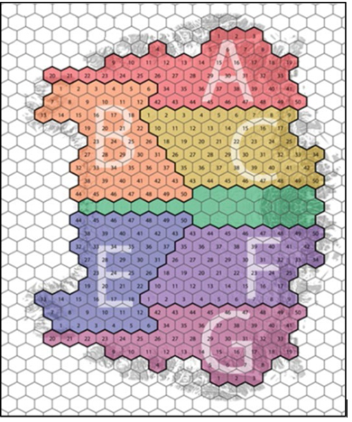
It is critical that our intel analysts understand the benefits and risks associated with each intelligent discipline and when and how to utilize a specific discipline to capture vital information on our adversaries. As you could imagine, this can be an extremely stressful and challenging. To combat this issue, the 711th Human Performance Wing at Wright-Patterson Air Force Base with ISR subject matter expert (SME) support developed Intrage. Intrage is a two team strategic decision-making game that was developed with the premise of accelerating an analysts understanding of ISR operations. The objective of the game is to identify the location of your opponent’s headquarters on a fictional map (see Figure 1). The map is divided into three geographical regions. The northern region of the map contains Regions A, B, and C. The southern region of the map (opponents territory) contains Regions E, F, and G. In the middle of the map is neutral territory controlled by Allies (shown in Green). To begin the game, the operator will first select a single quadrant within the northern region to place their headquarters (i.e., Region A, B or C). After the headquarters has been placed on the map, the operator will be able to conduct intel collections on the southern region. The collections can utilize single or multiple intel disciplines based on available resources.
Figure 1: Geographical representation of the fictional map for Intrage.
Previous literature has discovered that military experience significantly influences decision-making outcomes with respect to performance (Jensen et al., 2020), risk assessment (Godwin et al., 2015), and working memory (Jha et al., 2010). These behavioral characteristics all play a critical role in the gameplay of Intrage. Therefore, our research team was interested in determining if there was a correlation with respect to headquarter placement based on military experience when provided a fictional map.
Does Military Experience Influence Strategic Decision-Making 159
METHODS AND MATERIALS Study Participants
The study protocol was approved by the U.S. Air Force Research Laboratory (AFRL) Institutional Review Board (IRB). The goal of this effort was to determine if a correlation exists with respect to headquarter placement based on military experience when provided the fictional map of Intrage. Two groups of 25 participants completed the research study (Group 1–25 military participants / Group 2–25 non-military participants). Participants were excluded from the study if they did not meet the following criteria: must be 18 years old or older, speak fluent English, retain basic computer skills, and be located within the U.S. All participants completed the task online via a Qualtrics survey link.
Procedures Each participant was provided with an overview of the study objectives and instructed to place their headquarters within a single quadrant in the northern region of the map (i.e., Region A, B or C). Following the completion of the task, each participant was provided a demographic questionnaire to capture age, gender, and education for post-hoc analysis. In addition, each participant was provided with the need for cognition (NFC) survey to assess the individual’s engagement and enjoyment in effortful cognitive activities (Petty et al., 2009).
Hypothesis Within the literature, it has been discovered that military experience plays an influential role in decision-making assessments and outcomes. Based on this information, we have developed two hypotheses. The first hypothesis is that the group with military participants will display greater density of headquarter placement within a specific region (i.e., Region A, B or C) compared to the group with non-military participants. The second hypothesis is that the group with military participants will display greater centralized density of headquarter placement with respect to the northern geographical region compared to the group with non-military participants.
Data Analysis Data analysis was performed using R Statistical Analysis Software (R version 4.1.2). R is an open-source programming language with downloadable packages from the Comprehensive R Archive Network repository. R can perform statistical computation, data modelling, and visual representation on ingestible datasets. To test our hypotheses, an analysis of variance (ANOVA) was conducted comparing headquarter location with respect to geographical location (i.e., Region A, B, and C) and spatial analysis to evaluate geographical centralization of headquarter placement (i.e., annular polygon regions).
RESULTS
To begin, we will discuss the results for the first hypothesis that the group with military participants will display greater density of headquarter placement
within a specific region (i.e., Region A, B or C) compared to the group with non-military participants. As shown in Table 1, there was not a statistically significant difference between groups for headquarter placement within a specific region (p = 0.60). Sixteen of the twenty-five military participants placed their headquarters in Region A (64%), four of the twenty-five military participants placed their headquarters in Region B (16%), and five of the twenty-five military participants placed their headquarters in Region C (20%). Moreover, thirteen of the twenty- five non-military participants placed their headquarters in Region A (52%), seven of the twenty-five non- military participants placed their headquarters in Region B (28%), and five of the twenty-five non-military participants placed their headquarters in Region C (20%).
Table 1. Analysis of variance (ANOVA) comparing geographical region locations and groups (military vs. non-military).
Table available in the original PDF paper.
Source df SS MS F p-value Region Location Between-Conditions 1 0.18 0.18 0.27 0.60 Within-Conditions 48 31.60 0.66 Total 49 31.78
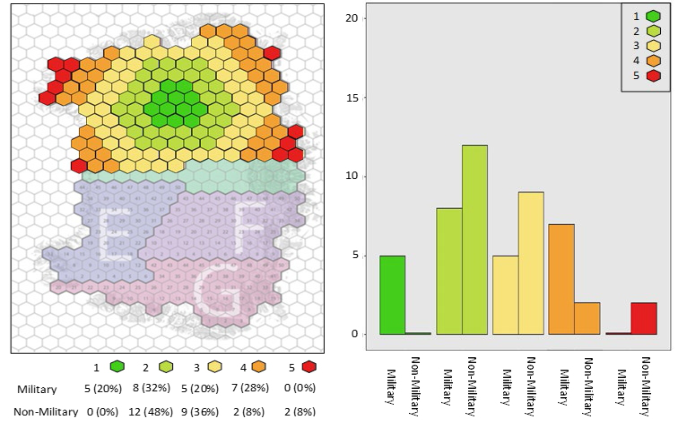
Statistical Significance at alpha level of 0.05 Next, we will discuss the results for the second hypothesis that the group with military participants will display greater centralized density of headquarter placement with respect to the northern geographical region compared to the group with non-military participants. The northern region was separated into five polygons. The most interior polygon was assigned a numerical value of one. The subsequential annular polygons increased from two to five as the geographical location approached the border. As shown in Table 2, there was a statistically significant difference detected for the most interior polygon between groups with respect to headquarter placement (p = 0.02). Five of the twenty-five military participants placed their headquarters in the most interior polygon (20%) compared to zero of the twenty-five non-military participants (0%) (see Figure 2). There was not a statistically significant difference detected for the sequential annular polygon regions.
Table 2. Analysis of variance (ANOVA) comparing centralized geographical locations and groups (military vs. non-military).
Table available in the original PDF paper.
Polygon Source df SS MS F p-value Between-Conditions 1 0.50 0.50 6.25 0.02 1 Within-Conditions 48 4.00 0.08 Total 49 4.50
(Continued)
Does Military Experience Influence Strategic Decision-Making 161
Table 2. Continued Polygon Source df SS MS F p-value
Figure 2: Geographical representation for centralized headquarter placement between groups.
In addition, a post-hoc analysis was conducted to determine if there was a correlation between demographics (i.e., age, gender, education level) and need for cognition scores with respect to headquarter placement. It was discovered that there was not a correlation between demographic characteristics and headquarter placement nor on need for cognition scores and headquarter placement.
CONCLUSION
Intelligence, Surveillance, and Reconnaissance (ISR) operations provides the groundwork in aiding future military direction and guidance. Therefore,
the 711th Human Performance Wing at Wright-Patterson AFB developed Intrage to augment, enhance, and expedite an operators ability to understand which intel discipline can and should be utilized to collect critical information on their adversaries. Throughout the gameplay, we were interested in determining if a correlation exists with respect to behavioral characteristics and decision-making assessments – particularly in headquarter placement. The findings from the study discovered there was a correlation between behavioral characteristics (i.e., military experience) and headquarter placement. The group with military participants displayed a significantly higher centralized density of headquarter placement in the most interior polygon compared to the non-military participant group. Moreover, only the non-military participant group placed their headquarters on the furthest annular polygon regions (i.e., closest to the border). These discoveries will be assessed and taken into account as the development and maturity of Intrage evolves in an effort to reduce predictability and consistency between novice and expert gameplayers. In addition, future research will be conducted to assess the gameplay of Intrage in an effort to model optimal performance metrics, implementation of intel collections, and operator profiles based on behavioral characteristics.
ACKNOWLEDGMENT
The views, opinions, and/or findings contained in this paper are those of the author and should not be interpreted as representing the official views or policies, either expressed or implied, of the Air Force, Air Force Research Laboratory or the Department of Defense.
REFERENCES
Clark, R., 2013. Perspectives on intelligence collection. Journal of US Intelligence Collection, 20, 47–52. Godwin, H., Liversedge, S., Kirkby, J., Boardman, M., Cornes, K., and Donnelly, N.,
2015. The influence of experience upon information-sampling and decision- making behaviour. Visual Cognition, 23(4), 415–431. Jensen, A., Bernards, J., Jameson, J., Johnson, D., and Kelly, K., 2020. The benefit of mental skills training on performance and stress response in military personnel. Frontiers in Psychology, 10, 2964. Jha, A., Stanley, E., Kiyonaga, A., Wong, L., and Gelfand, L., 2010. Examining
the protective effects of mindfulness training on working memory capacity and affective experience. Emotion, 10, 54–64. Nelson, J., 2024. Are structured analytic techniques (SATs) the missing component in cognitive warfare? The future of ISR military operations. 15th International Conference on Applied Human Factors and Ergonomics (AHFE 2024), Nice, France, July 22–27, 2024. Springer. Nelson, J., Heggedahl, T., Frame, M., Maresca, A., and Schlessman, B., 2023. Building the future of intelligence, surveillance, and reconnaissance (ISR) collections: The development and evaluation of a collaborative ISR tool to support intel analysts. Intelligence and Security Informatics: IEEE International Conference on Intelligence and Security Informatics, ISI 2023, Charlotte, NC, UISA, Oct 2–3, 2023. Springer. Petty, R., Brinol, P., Loersch, C., and McCaslin, M., 2009. The need for cognition.
Handbook of Individual Differences in Social Behavior, 318–329. The Guilford Press.
LISTED IN THE AHFE DIGITAL BOOKSTORE CATALOGUE
Explore the complete digital volume
Intelligent Human Systems Integration (IHSI 2025): Integrating People and Intelligent Systems
Read this individual research paper free through the original publisher, or explore the full digital proceedings book.
ISBN 978-1-964867-36-6
Explore this ISBN in the AHFE Bookstore ↗Listed in the July 2026 bookstore catalogue; search by ISBN to confirm current availability · Digital book purchase optional