Justin Nelson, Anna Maresca, Bradley Schlessman (2024). Can Structured Analytic Techniques enhance Intelligence, Surveillance, and Reconnaissance (ISR) Assessments when providing Incremental Information. In: Intelligent Human Systems Integration (IHSI 2024): Integrating People and Intelligent Systems. AHFE Open Access, vol. 119, pp. 219–229. https://doi.org/10.54941/ahfe1004486
Structured Analytic Techniques (SATs) have been incorporated within academia over the past several decades in an effort to enhance decision-making outcomes. Although, little research has focused on the effect of SATs within an operational environment such as Intelligence, Surveillance, and Reconnaissance (ISR) Mission Sets. The objective of this study was to evaluate the effectiveness of SATs when providing a vague narrative to human operators. Differences in response accuracy were investigate when a SAT was coupled with a narrative based on two different information workflow methodologies (i.e., complete narrative all at once or the narrative divided into incremental sections). Moreover, six groups of 25 participants each (N=150) were randomly assigned to one of three analytic techniques and provided a narrative with all the information all at once or the information provided in incremental sections. The SATs implemented were the Method for Defining Analytical Questions (MDAQ), which was developed in-house by our ISR subject matter experts (SMEs), a Scaffolding approach, and a Control approach. The findings provided evidence that implementing the MDAQ approach when given incremental information significantly improved performance compared to all other group configurations (p<0.05). This discovery will not only support ISR tool development, training exercises, and technology transition but could be beneficial in enhancing human computer interactions and human decision-making across other domains within academia and industry.
ISR Background The ability of military operators to effectively collect, interpret, and respond to adversary ground movement patterns relies heavily within the Intelligence, Surveillance, and Reconnaissance (ISR) domain. Decisions made within an ISR environment can influence the success or failure of a mission, the safety and well-being of military personnel, and the ability to command and maintain military superiority. However, with the continual advancements in
adversary disruptive technology, deceptive functionality, and imagery jam- ming technologies, ISR data collections may not capture or contain the critical information needed to inform strategic planners on future planning guidance.
ISR data collections from systems of electro-optical/infrared (EO/IR) sen- sors can range from full-motion video (FMV) coverage, synthetic aperture radar imagery (SAR), and distributed heatmapping which all play a criti- cal factor in supporting strategic future decision-making capabilities. During these various data collection procedures, there are critical variables that can provide additional information to support the operators’ decision which are known as Essential Elements of Information (EEI). If EEIs are correctly iden- tified by the operators, they can provide underlying evidence and justification to inform future decisions with non-biased rationale. Moreover, military EEIs can provide valuable information on assets, vulnerabilities, current and future threats, and controls. EEIs can be assessed based on the reliability and creditability of the information gathered to determine if additional col- lections are required to make an informed decision with high confidence. However, there are specific instances where additional data collections are not feasible or a decision needs to be made within a small time window. At these instances, Structured Analytic Techniques (SATs) and cognitive reasoning becomes the foundation that support decisions moving forward (Coulthart, 2017).
SATS: Supporting Decision-Making SATs have been widely used within academia over the past several decades as a support system to enhance critical thinking and logical reasoning when con- fronted with complex situations (Gioia and Thomas, 1996). Early method- ologies discovered that following a structured approach could significantly improve detection of relational associations between variables of interest, augment logical methods of reasoning, and support empirical observations and testing (Pennington and Hastie, 1998). Although, within the literature, there have been discoveries that challenge the effectiveness of SATs and their benefit to improve decision-making competency (Chang et al., 2018). Nev- ertheless, the implementation of SATs has gained interest across a multitude of domains. More recently, SATs has become an area of interest for strategic military operations in an effort to support warfighters decision-making and planning capabilities (Borg, 2017). Heuer, a retired CIA agent, discovered through his operational and analytical experience that the Analysis of Com- peting Hypotheses (ACH) could be leveraged as a cornerstone for intelligence assessments and reduce confirmation bias (Heuer, 1999).
ACH is a process where analysts can identify a set of hypotheses for a given problem statement, evaluate each hypothesis by developing consistent and inconsistent evidence, reassess the hypotheses based solely on the evidence obtained, and reject of accept the hypothesis (Dhami et al., 2019). Although incorporating ACH in a military setting has been shown to improve the cur- rent analytic process of intelligence and counterintelligence assessments, there are limitations associated with ACH. One of the biggest limitation is that
Can Structured Analytic Techniques Enhance ISR Assessments 221
analysts generally do not obtain situational awareness across the Joint All- Domain Command and Control (JADC2) environment which significantly hinders their ability to develop adequate hypotheses to support the ques- tion at hand. Another limitation, with respect to the ISR domain, is that the development of hypotheses does not support the breakdown of high-level Priority Intelligence Requirements (PIRs) into Essential Elements of Infor- mation (EEI) and further into smaller subcomponents. For these reasons, our research objective was to determine if a specific SAT or a hybrid-approach could enhance the detection of EEIs relating to a high-level question resulting in improved performance accuracy.
Finding the appropriate SAT that specifically supports ISR analysts break- down PIRs into EEIs and its subcomponents is no easy task. However, one technique within the literature stood out more than others. Scaffolding encourages operators to divide a given task into manageable and achievable subtasks (Sidky, 2019). This is accomplished by partitioning the task into a problem statement, generating and selecting possible solutions, justifying the selection, and testing and evaluating the results which is comparable to the ACH approach (Xun and Land, 2004). Scaffolding has been shown to enhance an operators’ performance when apportioned ill-defined and com- plex analytic problem sets, similar to those ISR analysts must evaluate and decipher, by inciting the operator to create theoretical outcomes based upon a solution framework (Stender and Kaiser, 2015). This strategy augments critical thinking, inductive reasoning, and metacognition which may trans- late into ISR operations when considering a problem statement, generating EEIs, justifying the reasoning, and providing solution sets with associated confidence ratings (Warli et al., 2021). Based on this information from the lit- erature, Scaffolding appears to be an appropriate SAT to support ISR analysts identify EEIs leading to greater efficacy in prediction assessments.
Although there is strong evidence that Scaffolding appears to be the best ‘fit’ for ISR analysts focusing on EEI identification for prediction assessments, developing a unique hybrid-SAT may provide the greatest performance enhancement. Therefore, ISR subject matter expert (SMEs) developed the Method for Defining Analytical Questions (MDAQ). MDAQ is depicted as a structured approach to assess, process, hypothesize, and deliver a decision with high confidence. MDAQ was formulated based on ISR SMEs experi- ence and knowledge, ACH, and Scaffolding with the premise of gather EEIs within a problem set guided by key indicators. MDAQ is a continual process allowing the operator to deep-dive into the problem statement and produce several EEIs and indicators.
Information Workflow: How Information Is Perceived It has been widely publicized that SATs have been shown to improve cog- nitive processes and decision-making competency when evaluating complex problem statements. However, another issue that ISR analysts face is how collected intelligence is obtained. When information is obtained all at once, it can be extremely challenging for an operator to remain vigilant and focused while interpreting and analyzing the content. Obtaining all the information
at once can result in cognitive impediment which occurs when an operator reaches their information throughput capacity also known as information overload (Nelson et al., 2015). At this point, the operator can no longer process and effectively respond to the critical information provided (Nelson et al., 2016). This can lead to EEIs being inadvertently overlooked and poor decision-making recommendations. On the other hand, when information is obtained in incremental sections, operators become more focused on parsing and detecting subtle descriptors and indicators (Ade and Deshmukh, 2013). Therefore, providing content incrementally has the opportunity to improve information throughput, attention to detail, and EEI detection.
The psychological process of sorting through and identifying critical components of collected intelligence within a military setting has similar characteristics to a vague or ambiguous narrative where there is missing or incomplete information. In both instances, an operator will subconsciously follow the four phases of the decision-making process (i.e., intelligence phase, design phase, choice phase, and implementation phase) (Chiheb et al., 2019). For a military setting, these phases correlate to the operator determining the EEI, identifying indicators and observables to support the EEI, and providing an educated recommendation and justification for future military direction with high confidence to their leadership. For an ambiguous narrative, these phases correlate to defining the problem statement, collecting and identifying supporting components to the problem statement, and providing a solution. Based on the review of the literature, there is a knowledge gap in understand- ing if SATs, based upon information workflow methodologies, can enhance detection of EEIs resulting in improved performance. Therefore, the objec- tive of this study was to evaluate the effectiveness of SATs on performance accuracy when providing an ambiguous narrative in incremental or complete sections.
METHODS AND MATERIALS Study Participants
In order to adequately evaluate SATs and information workflow, an appro- priate sample size must be represented. A power analysis was conducted to determine the sample size for the study based on a desired significant level, effect size, and statistical power. Previous literature has discovered a signifi- cant performance improvement when implementing a Scaffolding approach during cognitive assessments (Belland et al., 2007). In this study, a pairwise comparison of 0.27 for pooled standard deviation of subjects and a mean difference of 0.23 was identified in the analysis. Using a standard power of 0.80, a sample calculation was performed resulting in a sample size of 25. Participants were recruited from Amazon’s Mechanical Turk (Mturk) which is a crowdsourcing platform where surveys and research studies can be hosted and completed for human intelligence tasks. Participants were required to be 18 years old or older, speak fluent English, be located within the United States, possess basic computer skills, have no prior experience with SAT research studies, and obtain a minimum of a 95% accuracy rate on Mturk. As well, additional demographic and screening questionnaires were
Can Structured Analytic Techniques Enhance ISR Assessments 223
provided following the study to gather insight for statistical and correlation analysis with respect to age, gender, education, and video game experience.
Experimental Design A between-subjects experimental design was selected in order to mitigate learning effects from the task. Based on the power analysis of 25 participants per condition, a total of 150 participants were randomly assigned to one of three SATs (Scaffolding, MDAQ, Control) and obtained the information all at once or in incremental sections (i.e., all content divided into 5 subsections) as shown below:
Scaffolding with Incremental Sections (ScaffoldingINC)
Scaffolding with Complete Sections (ScaffoldingALL)
MDAQ with Incremental Sections (MDAQINC)
MDAQ with Complete Sections (MDAQALL)
Control with Incremental Sections (ControlINC)
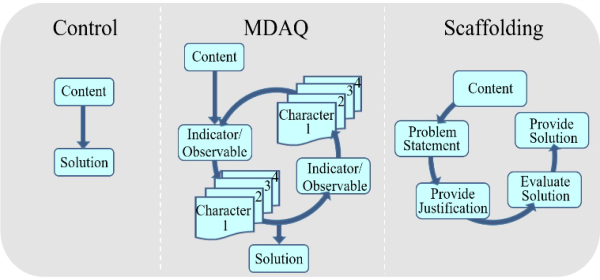
Control with Complete Sections (ControlALL) Each of the SATs followed a specific structured approach with the premise of enhancing cognitive decision-making capabilities resulting in higher solu- tion accuracy. Participants assigned to the Scaffolding group were required to read through the content and develop a problem statement, generate solutions, provide justification and reasoning, and select the most promis- ing solution to the problem statement. Participants assigned to the MDAQ group were required to read through the content and develop an indicator and/or observable to support their assessment. Indicators and observables are bits of information that provide insight and relational associations to a person, place, or event. The development of indicators and observables can strengthen the justification and rational of the participants final deci- sion. MDAQ is a continual process where participants have the ability to develop and associate several indicators and observables until they suspect they have identified all the critical bits of information. Lastly, if participants were assigned to the Control group, they were required to read through the content and provide a single solution (see Figure 1).
Figure 1: Schematic information workflow process for each SAT.
In addition to the assigned SAT conditions, participants were coupled with two information workflow methodologies (i.e., all or incremental sections). If participants were given all the content all at once, they would read the information and follow the structured approach assigned (i.e., Scaffolding, MDAQ, Control). Following this process, the participants would provide a single solution. If participants were given the content in incremental sec- tions, they would read through the first section and follow the structured approach assigned. Following the first increment, the participants would provide a single solution. This process was repeated for each of the five sec- tions. The purpose of the incremental sections was to enhance the detection of subtle indicators and observables to support EEI identification and solution accuracy.
Performance Task: ISR Adjacent The task was selected and reformatted from an online mystery-solving game ‘The Haunted Portrait’ (5minutemystery.com). The task provides an opportu- nity for online participants to engage in an immersive storyline that requires critical thinking to detect and decipher subtle clues such as EEIs and indi- cators. The participants’ objective was to provide the correct solution to the storyline. Within the story, there are main characters. For each main character, there was only one EEI/indicator. Therefore, depending on the users’ analytic approach, they could easily become overwhelmed or distracted resulting in overlooking these critical clues. The narrative was selected and supported by our in-house ISR SMEs as being similar to actual ISR ana- lysts work in regards to identifying information as to be used as a proxy. The narrative displays similar characteristics that are essential to complex ISR mission environments such as critical thinking, future decision-making, logical reasoning, and problem solving.
Data Analysis Statistical analysis was conducted using R Statistical Analysis software (R version 4.1.2). An analysis of variance (ANOVA) was performed evalu- ating performance based on (1) Structured Analytic Techniques and infor- mation workflow methodologies (2) Structured Analytic Techniques and incremental EEI. A pairwise comparison of information workflow was per- formed for each SAT to evaluate response time using two-tailed two-sample t-tests.
RESULTS
The results for the study were analyzed focusing on three sections: perfor- mance accuracy based on Structured Analytic Techniques and information workflow methodologies, performance accuracy based on Structured Ana- lytic Techniques and incremental EEI, and pairwise comparison of informa- tion workflow for each Structured Analytic Technique in relation to response time.
First, we will discuss the findings for performance accuracy based on SATs and information workflow methodologies. As shown in Figure 2, there was
Can Structured Analytic Techniques Enhance ISR Assessments 225
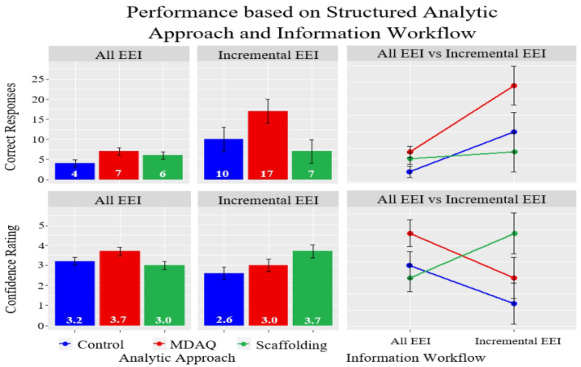
a statistically significant difference in performance accuracy for MDAQINC compared to all other conditions (F1,48=4.11, p<0.05). MDAQINC resulted in 68% solution accuracy (17/25), ControlINC resulted in 40% solution accuracy (10/25), ScaffoldingINC and MDAQALL resulted in 28% solution accuracy (7/25), ScaffoldingALL resulted in 24% solution accuracy (6/25), and ControlALL resulted in 16% solution accuracy (4/25) (see Table 1).
With respect to confidence, there was a statistically significant difference between conditions (F5,144=5.20, p<0.01). ScaffoldingINC and MDAQALL displayed the highest confidence in their prediction solution (3.7 out of 5.0). This was followed by ControlALL (3.2 out of 5.0), MDAQINC and ScaffoldingALL.
Table 1. ANOVA depicting correct responses for SATs and information workflow methodologies. Statistical significance alpha level of 0.05.
Table available in the original PDF paper.
ANOVA comparing Analytic Technique and Information Workflow Condition Comparison Performance F p
ControlALL vs MDAQAll 4(16%) vs 7(28%) 1.03 0.32 ControlALL vs ScaffoldingALL 4(16%) vs 6(24%) 0.48 0.49 ControlALL vs ControlINC 4(16%) vs 10(40%) 3.69 0.06 ControlALL vs MDAQINC 4(16%) vs 17(68%) 18.43 <0.01 ControlALL vs ScaffoldingINC 4(16%) vs 7(28%) 1.03 0.32 MDAQALL vs ScaffoldingALL 7(28%) vs 6(24%) 0.10 0.75 MDAQALL vs ControlINC 7(28%) vs 10(40%) 0.78 0.38 MDAQALL vs MDAQINC 7(28%) vs 17(68%) 9.16 <0.01 MDAQALL vs ScaffoldingINC 7(28%) vs 7(28%) 0.00 1.00 ScaffoldingALL vs ControlINC 6(24%) vs 10(40%) 1.45 0.23 ScaffoldingALL vs MDAQINC 6(24%) vs 17(68%) 11.62 <0.01 ScaffoldingALL vs ScaffoldingINC 6(24%) vs 7(28%) 0.10 0.75 ControlINC vs MDAQINC 10(40%) vs 17(68%) 4.11 0.05 ControlINC vs ScaffoldingINC 10(40%) vs 7(28%) 0.78 0.38 MDAQINC vs ScaffoldingINC 17(68%) vs 7(28%) 9.16 <0.01 An Analysis of Variance (ANOVA) was conducted comparing Structured Analytic Techniques (SATs) and Information Workflow for Solution Accuracy. Statistical Significance at an alpha level of 0.05.
(3.0 out of 5.0), and ControlINC (2.6 out of 5.0). It is important to note that the confidence scale was from 0 to 5 where 0 represents low confidence and 5 represents high confidence.
Next, we will discuss the findings for performance accuracy based on SATs and incremental EEI. Increment 1 displayed a statistically significant differ- ence in performance accuracy with 8 out of the 25 participants providing the correct solution for MDAQ compared to 1 out of 25 participants providing the correct solution for Control (F1,48=7.4, p<0.01). Increment 2 displayed a statistically significant difference in performance accuracy with 15 out of the 25 participants providing the correct solution for MDAQ compared to 5 out of 25 participants providing the correct solution for Scaffolding (F1,48=9.6, p<0.01). Increment 3 displayed a statistically significant difference in per- formance accuracy with 16 out of the 25 participants providing the correct
solution for MDAQ compared to 7 out of 25 participants providing the cor- rect solution for Scaffolding (F1,48=7.2, p<0.01). Increment 4 displayed a statistically significant difference in performance accuracy with 14 of the 25 participants providing the correct solution for MDAQ compared to 7 out of the 25 participants providing the correct solution for Scaffolding (F1,487.2, p<0.01). Increment 5 displayed a statistically significant difference in per- formance accuracy with 17 out of the 25 participants providing the correct solution for MDAQ compared to 7 out of the 25 participants providing the correct solution for Scaffolding (F1,48=9.2, p<0.01) (see Table 2). It is impor- tant to note that both groups (i.e., all, incremental) received the same content, however the incremental group received the content in 5 subsections.
Figure 2: Correct responses for SATs and information workflow methodologies. Statistical significance alpha level of 0.05.
With respect to confidence, there was a statistically significant difference between MDAQ compared to Control (F1,48=4.3, p = 0.04) and MDAQ compared to Scaffolding (F1,48=4.2, p = 0.05) for Increment 2. There was a statistically significant difference between MDAQ compared to Control (F1,48=4.3, p = 0.04) and MDAQ compared to Scaffolding (F1,48=6.2, p = 0.02) for Increment 3. There was a statistically significant difference between MDAQ compared to Control (F1,48=7.3, p = 0.01) and MDAQ compared to Scaffolding (F1,48=4.0, p = 0.05) for Increment 4. There was a statistically significant difference between MDAQ compared to Con- trol (F1,48=13.1, p<0.01) and MDAQ compared to Scaffolding (F1,48=5.0, p = 0.03) for Increment 5. There was not a significant difference in confidence ratings between groups for Increment 1.
Lastly, we will discuss the findings for response time based on Struc- tured Analytic Techniques and information workflow methodologies. An analysis of variance (ANOVA) was conducted and displayed a statistically significant difference for response times between condition (F5,144=7.6,
Can Structured Analytic Techniques Enhance ISR Assessments 227
Table 2. ANOVA comparing SATs by increments for solution accuracy. Statistical significance alpha level of 0.05.
Table available in the original PDF paper.
ANOVA comparing Analytic Technique by Increments Increment 1 Condition Comparison Performance F p Control vs MDAQ 1(4%) vs 8(32%) 7.35 0.01 Control vs Scaffolding 1(4%) vs 4(16%) 2.00 0.16 MDAQ vs Scaffolding 8(32%) vs 4(16%) 1.75 0.19 Increment 2 Condition Comparison Performance F p Control vs MDAQ 9(36%) vs 15(60%) 2.94 0.09 Control vs Scaffolding 9(36%) vs 5(20%) 1.57 0.22 MDAQ vs Scaffolding 15(60%) vs 5(20%) 9.60 <0.01 Increment 3 Condition Comparison Performance F p Control vs MDAQ 12(48%) vs 16(64%) 1.28 0.26 Control vs Scaffolding 12(48%) vs 7(28%) 2.13 0.15 MDAQ vs Scaffolding 16(64%) vs 7(28%) 7.20 0.01 Increment 4 Condition Comparison Performance F p Control vs MDAQ 9(36%) vs 14(56%) 2.01 0.16 Control vs Scaffolding 9(36%) vs 7(28%) 0.35 0.55 MDAQ vs Scaffolding 14(56%) vs 7(28%) 4.20 0.05 Increment 5 Condition Comparison Performance F p Control vs MDAQ 10(40%) vs 17(68%) 4.11 0.05 Control vs Scaffolding 10(40%) vs 7(28%) 0.78 0.38 MDAQ vs Scaffolding 17(68%) vs 7(28%) 9.16 <0.01
An Analysis of Variance (ANOVA) was conducted comparing Structured Analytic Techniques (SATs) by Increments for Solution Accuracy. Statistical Significance at an alpha level of 0.05.
p<0.01). As a result, a two-tailed two-sample t-test was performed compar- ing Structured Analytic Techniques and information workflow for a pairwise comparison. ControlALL was statistically significant compared to MDAQINC (F1,48=16.2, p<0.01), MDAQALL (F1,48=24.1, p<0.01), ScaffoldingINC (F1,48=23.1, p.01), and ControlINC (F1,48=5.9, p = 0.02) for response time. ScaffoldingALL was statistically significant compared to MDAQINC (F1,48=9.3, p<0.01), MDAQALL (F1,48=9.6, p<0.01), and ScaffoldingINC (F1,48=9.0, p<0.01) for response time. ControlINC was statistically signif- icant compared to MDAQINC (F1,48=7.0, p<0.01), MDAQALL (F1,48=5.3, p = 0,02), and ScaffoldingINC (F1,48=4.9, p = 0.03). Moreover, the ControlALL condition spent the least amount of time on the task at approxi- mately 14.5 minutes followed by ScaffoldingALL at approximately 19.5 min- utes, ControlINC at approximately 21.5 minutes, ScaffoldingINC at approxi- mately 29 minutes, MDAQALL at approximately 30 minutes, and MDAQINC at approximately 36.5 minutes. Although there was no statically significant difference, almost every condition showed shorter response time when the participants’ prediction was incorrect compared to when their prediction was correct. Therese factors are important to take into consideration when involv- ing real-world ISR situations because the decisions and recommendations
may have serious consequences on future military direction. In addition, there was no statistically significant difference with respect to gender, age, educa- tion, and video game experience between Structured Analytic Techniques and solution accuracy.
CONCLUSION
Intelligence, Surveillance, and Reconnaissance (ISR) operators are being continually tasked to identify and evaluate key indicators and Essential Ele- ments of Information (EEIs) to support leadership-driven Priority Intelligence Requirements (PIRs). These EEIs support operational decision-making capa- bilities by providing the commander with supportive information in order to make a high confident decision in a timely manner. As you could image, ISR operators are under a tremendous amount of stress to filter through vague datasets and ensure accurate and relational intel is being disseminated to leadership.
This research study focused on probing SATs coupled with information workflow methodologies to enhance rational and analytical thinking when providing a vague narrative. The findings provided underlying evidence that MDAQ coupled with incremental sections of information could significantly improve detection of EEIs leading to improved solution accuracy. Moreover, previous literature has shown that the Scaffolding approach can enhance the decision-making process resulting in improved decision accuracy. Yet, we did not observe these enhancements in this study. The reason may be that the information provided in the storyline was extremely vague and ill-defined in order to replicate tasks similar to those an ISR analyst may observe. Future research should include multiple dialogues with varying readability and com- prehension difficulty levels to get a better understanding on the efficacy of SATs across complex tasks.
Nevertheless, we are advancing in the right direction in an effort to sup- port and improve operational training and education, structured analytic techniques and methodologies, and accurately detecting EEIs in situations related to ISR processing, exploitation, and dissemination (PED). It is vital that we continue to refine and develop tools that can support our analysts and optimize performance in order to protect national security.
ACKNOWLEDGMENT
The views, opinions, and/or findings contained in this paper are those of the author and should not be interpreted as representing the official views or policies, either expressed or implied, of the Air Force, Air Force Research Laboratory or the Department of Defense.
REFERENCES
Ade, R., and Deshmukh., P., 2013. Methods for incremental learning: A survey.
International Journal of Data Mining & Knowledge Management Process, 34(4), 119.
Can Structured Analytic Techniques Enhance ISR Assessments 229
Belland, B., Walker, A., and Kim, N., 2017. A bayesian network meta-analysis to synthesize the influence of contexts of scaffolding use on cognitive outcomes in STEM education. Review of Educational Research, 87(6), 1042–1081. Chang, W., Berdini, E., Mandel, D., and Tetlock, P., 2017. Restructuring struc-
tured analytic techniques in intelligence. Intelligence and National Security, 33, 337–356. Chiheb, F., Boumahdi, F., and Bouarfa, H., 2019. A new model for integrating big data into phase of decision-making process. Procedia Computer Science, 151, 636–642. Coulthart, S., 2017. An evidence-based evaluation of 12 core structured analytic
techniques. International Journal of Intelligence and CounterIntelligence, 30(2), 368–391. Dhami, M., Belton, I., and Mandel, D., 2019. The analysis of competing hypotheses in intelligence analysis. Applied Cognitive Psychology, 33(6), 1080–1090. Gioia, D., and Thomas, J., 1996. Identity, image, and issue interpretation: Sense-
making during strategic chance in academia. Administrative Science Quarterly, 370–403. Heuer, R., 1999. Psychology of intelligence analysis. Center for the Study of Intelligence Nelson, J., McKinley, R., McIntire, L., Goodyear, C., and Walters, C., 2015. Aug-
menting visual search performance with transcranial direct current stimulation (tDCS). Military Psychology, 27(6), 335–347. Nelson, J., McKinley, R., Phillips, C., McIntire, L., Goodyear, C., Kreiner, A., and Monforton, L., 2016. The effects of transcranial direct current stimulation (tDCS) on multitasking throughput capacity. Frontiers in Human Neuroscience, 10, 589. Pennington, N., and Hastie, R., 1998. Reasoning in explanation-based decision
making. Cognition, 49(1-2), 123–163. Sidky, G., 2019. Developing students’ writing through scaffolding techniques in a workshop. Journal of Language Teaching and Research, 10(5), 963–971. Stender, P., and Kaiser, G., 2015. Scaffolding in complex modelling situations. ZDM,
47(7), 1255–1267. Warli, P., Rahayu, P., and Cintamulya, I., 2021. Scaffolding as a strategy to help student difficulties in proving group problems. Journal of Physics, 012037. Xun, G., and Land, S., 2004. A conceptual framework for scaffolding ill-structured
problem-solving processes using question prompts and peer interactions. Educa- tional Technology Research and Development, 52(2), 5–22.
LISTED IN THE AHFE DIGITAL BOOKSTORE CATALOGUE
Explore the complete digital volume
Intelligent Human Systems Integration (IHSI 2024): Integrating People and Intelligent Systems
Read this individual research paper free through the original publisher, or explore the full digital proceedings book.
ISBN 978-1-958651-95-7
Explore this ISBN in the AHFE Bookstore ↗Listed in the July 2026 bookstore catalogue; search by ISBN to confirm current availability · Digital book purchase optional