Debra Henneberry, Dimitrios Ziakkas (2025). The role of Artificial Cognitive Systems in the Implementation of the Aviation Fatigue Risk Management Systems. In: Intelligent Human Systems Integration (IHSI 2025): Integrating People and Intelligent Systems. AHFE Open Access, vol. 160, pp. 132–140. https://doi.org/10.54941/ahfe1005818
Aviation Fatigue Risk Management Systems (FRMS) are crucial for ensuring operational safety by systematically monitoring and mitigating the risks associated with human fatigue in complex and high-demand aviation environments. This paper explores the integration of Artificial Cognitive Systems (ACS) into FRMS, focusing on how these intelligent systems can enhance human decision-making and fatigue management, contributing to improved safety and efficiency in aviation operations. ACS possess the capability to process vast amounts of real-time data and make context-aware decisions, enabling more accurate identification of fatigue risks through predictive analytics, pattern recognition, and human-machine interaction. ACS can complement traditional fatigue management methods in the aviation sector by continuously assessing physiological data, work schedules, environmental conditions, and operational demands to dynamically adapt fatigue risk mitigation strategies. These systems can proactively alert pilots, air traffic controllers, ground staff, and flight crews when fatigue thresholds are reached, enhancing the overall effectiveness of FRMS. This paper analyzes key methodologies and frameworks—including the International Civil Aviation Organization’s Fatigue Risk Management guidelines and regulations by the European Union Aviation Safety Agency (EASA) and the Federal Aviation Administration (FAA)—to illustrate how ACS can be integrated into current fatigue risk systems while adhering to international safety standards. Additionally, we will examine worldwide case studies where ACS has been applied in fatigue monitoring and management within the aviation industry, highlighting the impact of AI-powered decision support systems in reducing fatigue-related incidents and accidents. The analysis also addresses the human factors implications of implementing ACS within FRMS, emphasizing the balance between human oversight and machine-driven recommendations. Understanding the relationship between human cognitive limitations and the capabilities of ACS is critical in ensuring that these systems enhance, rather than hinder, human performance. Through a human-centric approach, ACS can help reduce workload, improve situational awareness, and ultimately provide more reliable fatigue risk management without leading to over-reliance on automated systems. In conclusion, this paper will propose a framework for integrating ACS into FRMS, demonstrating how artificial intelligence-driven solutions can complement human expertise to reduce fatigue-related risks, improve safety, and create a more resilient aviation system. By focusing on both technological advancements and challenges related to human factors, this paper provides a comprehensive roadmap for the future of fatigue risk management in aviation.
The Role of Artificial Cognitive Systems in the Implementation 133
INTRODUCTION
Aviation safety is a critical concern in both commercial and military sectors, where operational performance and human well-being are directly influenced by fatigue. Fatigue-related incidents have contributed to several aviation accidents, prompting regulatory bodies to implement stringent Fatigue Risk Management Systems (FRMS). These systems assess, manage, and mitigate human fatigue risks to ensure operational safety and efficiency (Fletcher, 2007). However, traditional FRMS often face limitations in real- time monitoring and personalized intervention. Artificial Cognitive Systems (ACS) can play a transformative role, leveraging artificial intelligence (AI) and machine learning (ML) to improve the detection and mitigation of real- time fatigue risks (Ziakkas et al., 2023). Integrating ACS into existing FRMS presents a promising avenue for enhancing aviation safety. By providing real- time, context-aware insights into fatigue risks, ACS can augment human decision-making and enable more effective fatigue management (Petrilli et al., 2006). Before examining the various functions that ACS can fulfill in FRMS, it is crucial to comprehend the current regulatory framework and how these rules affect the execution of FRMS.
Several international organizations oversee aviation safety regulations, each contributing to fatigue risk management guidelines. These organizations include the International Civil Aviation Organization (ICAO), the International Air Transport Association (IATA), the Federal Aviation Administration (FAA), and the European Union Aviation Safety Agency (EASA) (EASA, 2016).
ICAO is a specialized agency of the United Nations responsible for setting global aviation safety standards, including fatigue management. ICAO introduced its FRMS as part of Annex 6 to the Chicago Convention, which sets operational safety standards for airlines. ICAO’s FRMS guidelines encourage using data-driven approaches to monitor, assess, and mitigate fatigue risks by relying on objective physiological measures and predictive models (ICAO, 2016a). These guidelines promote a performance-based approach, allowing operators to demonstrate compliance with safety objectives through adaptive, real-time monitoring rather than prescriptive rules (Hopkins, 2010). ICAO’s framework emphasizes flexibility, acknowledging that fatigue risk management must consider various factors such as time zones, crew scheduling, and environmental conditions (ICAO, 2016b). ACS can enhance compliance with ICAO guidelines by providing real-time fatigue assessments and precise mitigation strategies (Petrilli et al., 2006). IATA represents the airline industry globally and supports implementing aviation safety standards, including fatigue management. While not a regulatory body, IATA plays a key role in helping airlines develop fatigue management programs aligned with ICAO’s FRMS framework (IATA, 2015). It advocates for adopting best practices and data-sharing among airlines to improve fatigue risk mitigation. IATA’s best practices align with ACS, which can process operational and biometric data to detect fatigue patterns. By
134 Henneberry and Ziakkas
combining IATA’s practices with ACS, airlines can create more proactive and effective fatigue management strategies (Walker et al., 2008).
The FAA is the United States regulatory authority overseeing civil aviation. FAA regulations include strict duty times and rest periods for flight crews under 14 CFR Part 117, which is a prescriptive approach to fatigue risk management (FAA, 2012). However, recognizing the limitations of rigid regulations, the FAA also allows for customized FRMS as long as they ensure equivalent or better safety outcomes than traditional duty-time limits. ACS can be pivotal in FAA-compliant FRMS, offering real-time monitoring of physiological and operational data to manage fatigue risks dynamically (Ziakkas et al., 2023). This integration supports more nuanced, context- sensitive fatigue management aligned with FAA standards (FAA, 2012).
EASA regulates aviation safety across the European Union. Identical to the FAA, EASA has prescriptive flight time limitations (FTL) and recommends using FRMS following the regulation (EU) No 965/2012, (EU, 2012). EASA’s FRMS guidelines emphasize scientific principles in assessing fatigue, such as sleep science and circadian rhythms (EASA, 2016). EASA stresses continuous fatigue monitoring, positioning ACS as a critical enabler for adaptive FRMS. ACS aligns with EASA’s emphasis on scientific methods, processing real-time data from various sources to predict fatigue levels and recommend timely interventions (Ziakkas et al., 2023).
Selected case studies demonstrate the potential of integrating ACS into FRMS. The National Aeronautics and Space Administration’s Ames Research Center has used ML algorithms to analyze sleep patterns and predict performance degradation in pilots and air traffic controllers, demonstrating the effectiveness of AI-driven systems in managing fatigue (Flynn-Evans et al., 2016). These examples highlight ACS’s ability to improve fatigue detection accuracy, which is critical for reducing fatigue-related incidents and enhancing safety (Barger et al., 2014).
METHODOLOGY
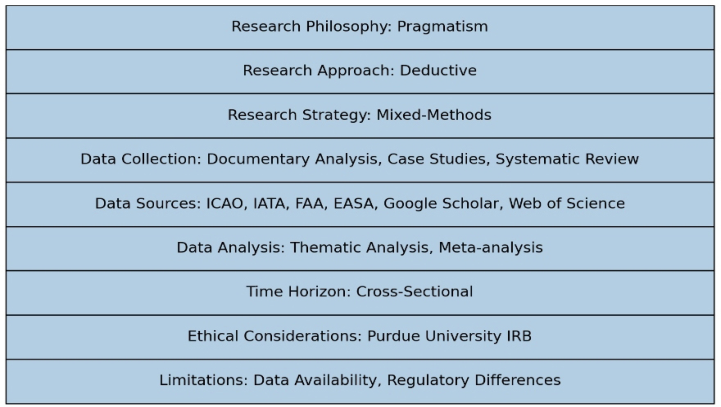
This research adopts the Saunders Research Onion framework, which provides a systematic approach to conducting research by addressing various layers such as philosophy, approach, strategy, choices, time horizons, and techniques (Saunders et al., 2019). This section outlines the methodology employed in this study, specifying the data collection, analysis, and interpretation processes concerning the integration of ACS into FRMS in aviation. The methodology incorporates a literature review analysis using diverse sources, including crucial aviation regulatory bodies like ICAO, IATA, EASA, and FAA, and scholarly databases like Google Scholar and Web of Science (Figure 1).
The study adopts a pragmatism research philosophy, particularly suited for interdisciplinary research combining technical advancements in AI with human factors in aviation fatigue management. The pragmatism approach allows the application of multiple methodologies to solve real-world problems, ensuring that quantitative and qualitative insights are utilized to understand the implications of ACS in FRMS. The deductive approach
The Role of Artificial Cognitive Systems in the Implementation 135
was selected, as the study begins with existing theories and guidelines related to fatigue risk management, such as those provided by ICAO, IATA, FAA, and EASA. These guidelines form the foundation upon which ACS can be integrated into existing FRMS. By applying these frameworks, the research tests hypotheses regarding the effectiveness of ACS in mitigating fatigue-related risks and enhancing decision-making in aviation.
Given the complexity of integrating ACS into aviation operations, this study employs a mixed-methods strategy, combining quantitative and qualitative data. Quantitative data were gathered through a systematic review of existing fatigue-related research, focusing on physiological data, work schedules, environmental conditions, and ACS applications. Qualitative data were collected through case studies of airlines and aviation authorities that have implemented AI-powered fatigue management systems.
Figure 1: Methodology overview of the AI integration in aviation fatigue risk management.
The literature review for this research focused on existing studies and guidelines provided by regulatory bodies such as ICAO, IATA, FAA, and EASA as follows:
The ICAO’s Manual for the Oversight of Fatigue Management Approaches (ICAO, 2016a) and relevant annexes were reviewed to understand global fatigue management guidelines and how ACS can enhance compliance.
IATA’s fatigue risk management recommendations and collaborative research initiatives with airlines were analyzed to identify best practices (IATA et al., 2015).
FAA documents, including Advisory Circulars on Safety Management Systems and fatigue risk management, were used to examine US regulatory approaches to fatigue (FAA, 2013).
136 Henneberry and Ziakkas
The EASA’s Flight Time Limitations (EASA, 2016) and their scientific principles for fatigue monitoring were reviewed to understand how European guidelines incorporate fatigue science.
Google Scholar and Web of Science: These databases provided peer- reviewed articles on fatigue management systems, human-machine interactions, and the role of AI in enhancing decision-making in high- stakes environments such as the aviation ecosystem.
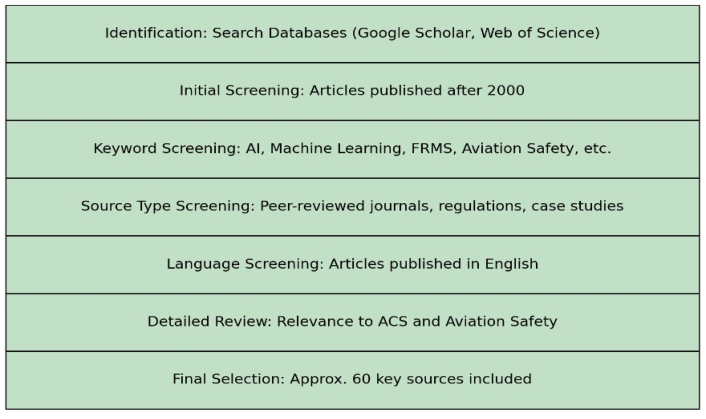
The research utilizes the thematic analysis for qualitative data gathered from case studies and documentary analysis. The thematic analysis identifies key patterns related to integrating ACS into FRMS and how AI systems enhance or challenge human oversight in fatigue management. A meta- analysis was performed to evaluate the overall efficacy of ACS in managing fatigue risk across several studies. The methodology for the literature review into aviation FRMS is presented in Figure 2.
Figure 2: Methodology for literature review into aviation FRMS.
ANALYSIS This study adhered to the ethical guidelines provided by Purdue University’s Institutional Review Board (IRB) for the responsible use of data. Data from the case studies and literature were anonymized and handled with confidentiality. The availability of real-time data on the implementation of ACS in aviation is limited due to the novelty of these systems. Additionally, different regulatory frameworks across regions (e.g., FAA, EASA) posed challenges in standardizing the integration of ACS into FRMS.
The analysis followed the following phases:
Phase 1: Identification of potential sources through keyword searches.
The Role of Artificial Cognitive Systems in the Implementation 137
Phase 2: Screening based on date, relevance, and language.
Phase 3: Detailed reading of abstracts and conclusions to determine the applicability to the research questions.
Phase 4: Full-text review for selected articles to extract data relevant to ACS applications in FRMS.
This systematic approach ensures that the literature review is comprehensive and focuses on the most pertinent and authoritative sources, contributing significantly to the understanding of ACS’s role in enhancing aviation fatigue risk management.
The literature review for the project on the integration of ACS into FRMS in aviation operations focuses on the following inclusion criteria:
Date of Publication: Journals and studies published after 2010 were considered to ensure that the data and methodologies are relevant to current technology and regulations.
Language: Articles published in English to ensure accessibility and comprehensibility for an international readership.
Five hundred twenty articles, documents, and reports were initially identified using the databases above and the specific keywords.
One hundred twenty sources remained viable after applying the inclusion criteria, mainly focusing on relevance to ACS and aviation safety.
A thorough content review narrowed the focus to 60 sources that provide significant insights into the role of ACS in FRMS and aviation safety.
FINDINGS The integration of ACS into Aviation FRMS represents a significant advancement in enhancing aviation safety. This analysis explores how ACS can be effectively implemented to support decision-making and reduce fatigue-related risks in aviation, utilizing data-driven insights from recent literature and case studies. The keywords guiding this analysis include AI, ML, EASA, FAA, ICAO, Biometrics, FRMS, and ACS.
The research findings follow the guidelines and regulations set by EASA, FAA, and ICAO for the implementation of ACS in FRMS, as follows:
EASA: The European Union Aviation Safety Agency has begun integrating ACS guidelines into its operations, focusing on harmonizing AI applications within safety management systems across member states (EASA, 2024).
FAA: In the United States, the Federal Aviation Administration is actively researching the impact of AI in improving predictive models of fatigue and has initiated several pilot programs to test the effectiveness of these systems in operational environments (FAA, n.d.).
ICAO: The International Civil Aviation Organization has provided a framework for integrating AI technologies into global aviation standards, promoting an international consensus on using ACS for fatigue management (ICAO, 2024).
138 Henneberry and Ziakkas
The following findings illustrate how different implementations can impact the effectiveness of fatigue management strategies.
AI and ML Applications: AI in aviation has evolved from basic automation to more complex systems capable of learning and adapting to changing conditions. ML algorithms are particularly effective in identifying patterns and anomalies in large datasets, including physiological data from pilots and crew, which indicate fatigue.
Predictive Analytics: ACS employs ML algorithms to analyze historical data and predict potential fatigue risk before it becomes critical. By analyzing patterns in pilot duty times, sleep quality, and previous incidents, these systems can forecast periods where the risk of fatigue is elevated.
Pattern Recognition: This involves identifying the signs of fatigue based on biometric data such as heart rate variability, eye movements, and micro- expressions. Advanced image recognition and sensor technologies allow real- time monitoring and assessment of crew members’ physical and psychological states.
Biometric Monitoring and Human Factors: The biometrics play a crucial role in monitoring and managing fatigue in the following areas:
Physiological Monitoring: Wearable devices collect data on physiological indicators, such as heart rate, which ACS analyzes to detect fatigue. These devices are becoming more sophisticated, providing more accurate and timely feedback.
Cognitive Performance Metrics: Cognitive behavior analysis through AI helps assess the mental state of pilots and crew and determine when cognitive fatigue sets in, which is crucial for preventing fatigue-related errors.
The above areas suggest integrating ACS in FRMS can significantly improve fatigue management through personalized strategies and real-time interventions. However, the success of these systems heavily relies on the accuracy of the data collected and the ability of the organization to implement these insights effectively.
CONCLUSION
Integrating ACS into aviation FRMS marks a significant shift in how the aviation industry approaches fatigue-related safety risks. By leveraging the power of AI and ML, ACS can process vast amounts of real-time biometric, environmental, and operational data to predict, monitor, and mitigate fatigue risks more effectively than traditional methods. These systems enhance human decision-making by providing timely, context-aware insights that help reduce the likelihood of fatigue-related incidents, thus improving overall aviation safety and operational efficiency (Ziakkas & Plioutsias, 2024).
As demonstrated by the literature review, the implementation of ACS has yielded positive results in operational performance and pilot well- being. However, the successful integration of these systems depends on high-quality data inputs, continuous system updates, and the ability of
The Role of Artificial Cognitive Systems in the Implementation 139
aviation organizations to adapt these insights into actionable strategies. Moreover, while ACS offers advanced capabilities in fatigue management, human oversight remains crucial to ensure a balanced interaction between man and machine, preventing over-reliance on automation. The proposed framework for integrating ACS into FRMS provides a comprehensive roadmap for enhancing aviation safety. It addresses both the technological opportunities and the human factors challenges, ensuring that AI-driven solutions complement, rather than replace, human expertise. By adopting a human-centric approach, the aviation industry can foster a more resilient and proactive fatigue risk management system, ultimately setting a new standard for safety in global aviation operations.
ACKNOWLEDGMENT
The authors thank faculty members of Purdue University and Human Factors analysts from HF Horizons for their invaluable feedback and contribution to this work.
REFERENCES
Barger, L. K., Flynn-Evans, E. E., Kubey, A., Walsh, L., Ronda, J. M., Wang, W., Wright, K. P., Jr, & Czeisler, C. A. (2014). Prevalence of sleep deficiency and use of hypnotic drugs in astronauts before, during, and after spaceflight: an observational study. The Lancet. Neurology, 13(9), 904–912. https://doi.org/10.1016/S1474-4422(14)70122-X Commission Regulation (EU.) No 965/2012 - Air operations | EASA. (2012, October 5). https://www.easa.europa.eu/en/document-library/regulations/commi ssion-regulation-eu-no-9652012 European Union Aviation Safety Agency. (2016). ORO. FTL.205 Flight Duty
Period (FDP). https://understandingeasa2016ftl.wordpress.com/easa-ftl/oro-ftl/or o-ftl-205-flight-duty-period-fdp/ European Union Aviation Safety Agency. (2023, May 10). EASA Artificial Intelligence Roadmap 2.0 - A human-centric approach to AI in aviation. https://www.easa.europa.eu/en/document-library/general-publications/easa-artif icial-intelligence-roadmap-20 European Union Aviation Safety Agency. (2024). Investigation and prevention of accidents and incidents in civil aviation. https://www.easa.europa.eu/en/regulati ons/investigation-and-prevention-accidents-and-incidents-civil-aviation Federal Aviation Administration. (January 4, 2012.) 14 CFR Part 117 – Flight and
Duty Limitations and Rest Requirements: Flightcrew Members. https://www.ecfr .gov/current/title-14/chapter-I/subchapter-G/part-117 Federal Aviation Administration. (2013). Advisory Circular 120-103A: Fatigue Risk Management Systems for Aviation Safety. Federal Aviation Administration. (n.d.) Accident & Incident Data. Retrieved
October 20, 2024, from https://www.faa.gov/data_research/accident_incident. Fletcher, A. (2007). The past, present and future of Fatigue Risk Management Systems in Australian General Aviation. Flynn-Evans, E., Gregory, K., Arsintescu, L., & Whitmire, A. (2016). Risk of
Performance Decrements and Adverse Health Outcomes Resulting from Sleep Loss, Circadian Desynchronization, and Work Overload. National Aeronautics and Space Administration. https://humanresearchroadmap.nasa.gov/Evidence/rep orts/Sleep.pdf
140 Henneberry and Ziakkas
Hopkins, A. (2010). Working paper 72: Risk management and rule compliance decision making in hazardous industries. https://www.processsafety.com.au/free- downloads/working-papers International Air Transport Association, International Civil Aviation Organization,
& International Federation of Air Line Pilots Association. (2015). Fatigue management guide for airline operators (2nd ed.). https://www.icao.int/safety/ fatiguemanagement/FRMS%20Tools/FMG%20for%20Airline%20Operators% 202nd%20Ed%20(Final) %20EN.pdf International Civil Aviation Organization. (2016a). Doc 9966: Manual for the oversight of fatigue management approaches (2nd ed.). https://www.icao. int/safety/fatiguemanagement/FRMS%20Tools/Doc%209966.FRMS.2016% 20Edition.en.pdf International Civil Aviation Organization. (2016b). Annex 13 to the Convention
on International Civil Aviation: Aircraft accident and incident investigation (11th ed.). https://ffac.ch/wp-content/uploads/2020/10/ICAO-Annex-13-Aircraft -Accident-and-Incident-Investigation.pdf International Civil Aviation Organization. (2024). Artificial intelligence (AI).
https://www.icao.int/safety/Pages/Artificial-Intelligence-(AI).aspx Petrilli, R. M., Roach, G. D., Dawson, D., & Lamond, N. (2006). The sleep, subjective fatigue, and sustained attention of commercial airline pilots during an international pattern. Chronobiology International 23(6), 1357–1362. doi: 10.1080/07420520601085925 Saunders, M., Lewis, P., & Thornhill, A. (2019). Research methods for business students (8th ed.). Pearson Education Limited. Walker, M. B., & Bills, KM. (2008). Analysis, causality and proof in safety
investigations. (ATSB Aviation Research and Analysis Report – AR-2007-053, March 2008). Australian Transport Safety Bureau. Ziakkas, D., Vink, L.-S., Pechlivanis, K., & Flores, A. (2023). Implementation guide for artificial intelligence in aviation: a human-centric guide for practitioners and organizations. HF Horizons. Ziakkas, D., & Plioutsias, A. (2024). Artificial intelligence and human performance
in transportation. CRC Press. https://doi.org/10.1201/9781003480891
LISTED IN THE AHFE DIGITAL BOOKSTORE CATALOGUE
Explore the complete digital volume
Intelligent Human Systems Integration (IHSI 2025): Integrating People and Intelligent Systems
Read this individual research paper free through the original publisher, or explore the full digital proceedings book.
ISBN 978-1-964867-36-6
Explore this ISBN in the AHFE Bookstore ↗Listed in the July 2026 bookstore catalogue; search by ISBN to confirm current availability · Digital book purchase optional