Dimitrios Ziakkas, Konstantinos Pechlivanis (2024). The Role of Artificial Intelligence in Transportation Safety Management Systems: The Aviation Safety II Case study. In: Safety Management and Human Factors. AHFE Open Access, vol. 151, pp. 1–9. https://doi.org/10.54941/ahfe1005296
The aviation industry, renowned for its stringent safety standards, is increasingly embracing the Safety II approach, which focuses on understanding why operations succeed under varying conditions. This paper explores the transformative role of Artificial Intelligence (AI) in augmenting the Safety II approach in aviation. Traditional safety models, predominantly reactive, emphasize preventing what goes wrong (Safety I). In contrast, Safety II is proactive, aiming to enhance what goes right, thereby increasing overall system resilience.This research begins by delineating the core principles of Safety II and its relevance to aviation safety. It underscores the limitations of human cognitive capabilities in comprehending complex, dynamic aviation environments and the potential for AI to overcome these challenges. The paper then systematically examines how AI technologies, can be leveraged to advance the Safety II approach in aviation.A key focus is integrating AI in analyzing vast quantities of operational data (e.g., flight data, maintenance records, and crew reports) to identify patterns indicative of safe and risky operational practices. The paper discusses AI's role in developing predictive models to forecast potential safety issues, enabling preemptive action.Further, the paper delves into the use of AI in enhancing real-time decision-making. AI algorithms can provide pilots and air traffic controllers with advanced decision support, offering insights drawn from a confluence of data sources that human operators might overlook. This capability is crucial in complex, rapidly evolving situations where timely and informed decisions are paramount for safety.Another significant aspect explored is the training and simulation domain. AI-driven simulations enable more realistic, adaptive training scenarios that can prepare aviation personnel for a broader range of operational contingencies, aligning with the Safety II paradigm of enhancing capacity to succeed under variable conditions.The paper also addresses the challenges and ethical considerations in implementing AI in aviation safety. Issues such as data privacy, algorithmic transparency, and the need for robust, fail-safe AI systems are critically analyzed. The potential for AI-induced overreliance and skill degradation among aviation professionals is also discussed, emphasizing the need for balanced human-AI interaction.In conclusion, this paper posits that AI, with its superior data processing and pattern recognition capabilities, is pivotal in realizing the full potential of the Safety II approach in aviation. It highlights the transformative impact AI can have on enhancing aviation safety by identifying and mitigating risks and reinforcing successful practices and decision-making processes.
The rapid progress of Artificial Intelligence (AI) has greatly altered various sectors, including transportation safety management systems. The aviation sector, renowned for its rigorous safety regulations and unwavering com- mitment to preventing accidents, has progressively used artificial intelligence (AI) technologies to bolster its operational safety procedures (Ziakkas et al., 2023a). This paper examines the crucial part of artificial intelligence (AI) in trans- forming Transportation Safety Management Systems (SMS), with a specific emphasis on the aviation industry. The analysis is illustrated through the case study of Aviation Safety II, encompassing many elements such as air- craft operation, air traffic control, maintenance, and emergency response systems. The International Civil Aviation Organization (ICAO), International Air Transportation Association (IATA), European Aviation Safety Agency (EASA), and the Federal Aviation Administration (FAA) have historically taken the lead in promoting and implementing safety measures (ICAO, 2023).
The emergence of AI has expanded the boundaries of data processing capabilities, predictive analytics, and decision-making processes, presenting unparalleled prospects for reducing risks and improving safety measures. The incorporation of AI in aviation safety management is a groundbreaking and transformational influence that is revolutionizing the industry’s approach to ensuring safety and operational effectiveness (Gotcheva et al., 2021).
Since 2018, there has been a noteworthy upsurge in the adoption of AI-driven solutions in the aviation industry refining the precision of flight data analysis and promptly identifying potential safety risks (Barrera, 2022). Moreover, the integration of AI in predictive maintenance has had a signifi- cant impact on aviation safety. This technology allows airlines to proactively tackle maintenance problems before they convert safety issues (Bowen et al., 2000). AI algorithms in air traffic management have shown promise in optimiz- ing aircraft paths, minimizing the risk of mid-air collisions, and efficiently handling complicated airspace dynamics (Shire, 2018).
This paper focuses on the Aviation Safety II case study, which offers a comprehensive examination of a safety management system powered by arti- ficial intelligence that was applied to the aviation ecosystem worldwide. The extended literature review demonstrates the practical implementation of arti- ficial intelligence (AI) in the real-time monitoring of safety and the process of making decisions. The research provides useful visions into the effective use of AI to improve aircraft safety by analyzing the results and lessons learned from this implementation (Ziakkas et al., 2023b).
Transportation Safety Management Systems: The Transition From Aviation Safety I to Aviation Safety II The evolution of Transportation Safety Management Systems (SMS) in the aviation industry marks a significant transition from a reactive, incident- driven approach (Aviation Safety I) to a proactive, data-driven paradigm
The Role of Artificial Intelligence in Transportation Safety Management Systems 3
(Aviation Safety II). This transition reflects a comprehensive shift in address- ing safety and leveraging technological advancements, especially in artificial intelligence (AI) and data analytics, to predict and prevent potential safety incidents before they occur.
Aviation Safety I: The Traditional Approach Aviation Safety I is characterized by its reactive nature, primarily focus- ing on learning from historical incidents to improve safety measures. While effective in its time, this approach is limited by its reliance on after-the- incident/accident analyses and human-driven investigations. Arblaster (2018) identified this approach’s primary challenge is its restricted capability to prevent incidents before they occur. The dependency on historical data with- out predictive analytics often results in a lag in response to emerging safety threats.
The Advent of Aviation Safety II Aviation Safety II signifies a paradigm shift, emphasizing proactive risk man- agement, predictive analytics, and real-time decision-making. The integration of AI and advanced data analytics has been pivotal in this transition, enabling the industry to respond to incidents and anticipate and prevent them. The increasing complexity of aviation operations, coupled with advancements in AI and machine learning, has driven the transition. AI’s capability to process enormous volumes of data and recognize patterns undetectable to the human eye has been a game-changer, paving the way for Aviation Safety II (Ge et al., 2019).
METHODOLOGY
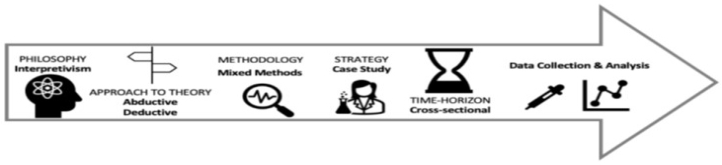
The Purdue research aims to assess the impact of Artificial Intelligence on the Transportation Safety Management Systems (TSMS) through the uti- lization of qualitative and quantitative methodologies. This study used an interpretivism research methodology to investigate the application of human- centered design in the field of SMS. The Purdue research team examines the impact of human-centered design and AI on the integration of Safety II in the existing SMS. The lean approach is crucial since it eradicates super- fluous design stages. This approach enables cost-effective and time-efficient implementation of AI in the transportation ecosystem. Figure 1 illustrates the utilization of AI in the implementation of Safety II. This graphic is derived on the Research Onion concept (Saunders, 2019).
In Yin’s (2014) study, it is argued that focusing on a single research environment with many dimensions, known as AI, can lead to effective problem-solving and the generation of specialized insights that are tailored to the specific operational framework, such as the Aviation ecosystem -Safety II. Purdue’s research proposal primarily focuses on gathering and analyzing primary data related to the SMS and aviation Safety II.
4 Ziakkas and Pechlivanis
Figure 1: Artificial intelligence implementation in safety II research methodology.
Integrating Artificial Intelligence (AI) into Transportation Safety Man- agement Systems (TSMS) signifies revolutionary progress in aviation safety. Adopting advanced AI techniques has significantly driven the transition to Aviation Safety II, which emphasizes a proactive and predictive approach to safety management. The analysis and findings sections present the cre- ation of AI integration tools designed explicitly for TSMS. They focus on the methods, difficulties, and approaches involved and is supported by signifi- cant academic research and industry reports from January 2018 to February 2023.
ANALYSIS Safety II is a concept more commonly discussed in academic and profes- sional safety literature and may not be explicitly labeled as such in an airline’s public communications. Airlines typically discuss their safety prac- tices regarding technological advancements, training, and proactive risk management, but they might not categorize their practices explicitly under “Safety I” or “Safety II.” The following comparison table (Table 1) presents the identified differences between Aviation Safety I and Aviation Safety II.
Table 1. Comparison table of safety I and safety II (Ziakkas et al., 2022).
Table available in the original PDF paper.
Aspect Aviation Safety I Aviation Safety II Focus Learning from past incidents Preventing future incidents Nature Reactive Proactive and Predictive Data Utilization Dependent on historical data Real-time data analysis and historical data Technological Integration
Minimal, primarily manual processes
High, integration of AI and advanced analytics Risk Management
Risk assessed after incidents Continuous risk assessment and management Incident Response
Post-incident analysis and corrective action
Real-time monitoring and preemptive action Predictive Capabilities
Limited, relies on historical trends
Advanced, utilizes AI for prediction and prevention
Table 1 contrasts the traditional reactive approach of Aviation Safety I with the proactive, data-driven, and technologically integrated approach of Aviation Safety II.
The Role of Artificial Intelligence in Transportation Safety Management Systems 5
The International Civil Aviation Organization (ICAO) is a “specialized agency of the United Nations that promotes the safe and orderly develop- ment of international civil aviation. ICAO sets standards and regulations for aviation safety, security, efficiency, regularity, and environmental protection” (ICAO, 2024). While ICAO has not formally adopted the term “Safety II” in its official documentation or standards, the principles that underpin Safety II are aligned with ICAO’s progressive approach towards aviation safety. Safety II focuses on understanding and enhancing the factors that lead to success- ful operations, moving beyond the traditional focus on failure and accident prevention -Safety I (Ziakkas et al., 2023a).
However, it’s important to note that ICAO’s approach is comprehensive and not exclusively defined within the framework of Safety II terminology. It encompasses a wide range of safety initiatives and strategies to promote the highest possible safety level in the global aviation industry.
On the other hand, IATA is committed to improving aviation safety, and has a number of initiatives and programs that reflect a proactive approach to safety management:
IATA Operational Safety Audit (IOSA)
IATA Safety Audit for Ground Operations (ISAGO)
Data-Driven Approach
Safety Training Moreover, the European Union Aviation Safety Agency (EASA) does not explicitly label its safety management approach as “Safety II.” However, the principles and practices promoted and implemented by EASA align closely with the proactive and systemic characteristics of the Safety II approach (EASA, 2023a).
EASA advocates for a robust and proactive safety management system (SMS) within its regulatory framework, emphasizing risk identification, mit- igation, and promoting a positive safety culture. Critical elements of EASA’s approach that align with Safety II principles include (EASA, 2023b):
Comprehensive Safety Management
Data and Analysis
Continuous Improvement
Safety Promotion Finally, the Federal Aviation Administration (FAA) doesn’t explicitly cate- gorize its safety management practices under the “Safety II” label. However, the FAA’s approach to aviation safety embodies many principles consistent with Safety II, focusing on a proactive, systemic, and data-driven strategy to ensure safety in aviation.
Critical aspects of the FAA’s approach that align with Safety II principles include:
Safety Management Systems (SMS).
Data Collection and Analysis.
Partnerships and Collaboration.
Continuous Improvement and Adaptability.
6 Ziakkas and Pechlivanis
The following table (Table 2) outlines various AI applications in aviation along with their descriptions:
Table 2. Table of safety I and safety II (Ziakkas et al., 2022).
Table available in the original PDF paper.
AI Application Description Predictive Maintenance Utilizes AI to predict maintenance needs, reducing downtime and preventing malfunctions. Flight Operations Optimization Optimizes flight paths, fuel usage, and overall operational efficiency using AI algorithms. Passenger Experience Enhancement
Enhances customer service, personalizes travel experiences, and streamlines check-in and boarding processes. Air Traffic Management Improves airspace efficiency, manages traffic flow, and enhances safety through AI-driven decision-making. Safety and Risk Assessment Assesses and manages risks in real-time, identifying potential safety hazards before they occur. Cargo and Baggage Handling Automates and optimizes the handling and tracking of cargo and baggage, improving efficiency and reducing errors. Crew Management and Scheduling
Optimizes crew scheduling, ensures compliance with regulations, and improves crew satisfaction and efficiency.
The above-mentioned applications (Table 2) showcase the diverse roles that AI plays in enhancing various aspects of aviation, from operational effi- ciency and safety to passenger experience and Crew Resources Management (CRM). Table 3 presents a summary of applied AI case studies in the aviation ecosystem globally.
Table 3. Applied AI case studies in the aviation ecosystem (Ziakkas et al., 2023b).
Table available in the original PDF paper.
Domain Area Description/Function References AI Application/Brand Airbus Skywise Predictive Maintenance Uses AI to predict maintenance events and optimize aircraft maintenance schedules.
Airbus official website/product brochures GE Aviation Digital Flight Operations Optimization
Provides AI-driven solutions for flight efficiency, fuel management, and navigation.
GE Aviation official website/product brochures SITA Baggage AI Baggage Handling Employs AI for baggage tracking, management, and reduces baggage mishandling rates.
SITA official website/product brochures Amadeus AI Travel Assistant
Passenger Experience
AI-powered tool for personalized customer interactions, bookings, and travel updates.
Amadeus official website/product brochures NATS Aimee Air Traffic Management
AI platform to analyze flight data and optimize air traffic control operations.
NATS official website/product brochures IBM Watson Aviation
Safety and Risk Assessment
Offers AI-driven solutions for risk assessment and operational safety enhancements.
IBM official website/product brochures Sabre Crew Manager
Crew Management and Scheduling
Provides AI-based optimization for crew scheduling, ensuring efficiency and compliance.
Sabre official website/product brochures
The Role of Artificial Intelligence in Transportation Safety Management Systems 7
FINDINGS Significant technological and methodological advancements mark the move towards Aviation Safety II. These developments aim to integrate data-driven insights into every aspect of aviation safety management. The following areas - domains of AI influence the implementation of Safety II in the aviation ecosystem.
AI Algorithms The ongoing research should focus on enhancing AI algorithms to improve their accuracy and efficiency (Ziakkas et al., 2022). This entails enhancing current models and delving into novel paradigms within the field of artificial intelligence.
Human-AI Collaboration Establishing efficient collaboration between human operators and AI systems is essential. According to Pechlivanis (2022), forthcoming tools should pri- oritize enhancing human decision-making, with the objective of establishing AI as a dependable support system rather than a substitute.
Predictive Analytics in Maintenance One of the hallmarks of Aviation Safety II is using predictive analytics in maintenance. Research by Plioutsias (2022) underscores how AI-driven predictive maintenance can significantly reduce unplanned downtime and prevent incidents related to equipment failure.
Real-Time Risk Assessment The capability to assess and manage risks in real time is another critical aspect of Aviation Safety II. Studies by Arblaster (2018) have shown how AI can continuously analyze data from various sources to provide real-time insights, allowing for immediate and informed decision-making. While the transi- tion to Aviation Safety II presents numerous benefits, it also poses specific challenges that must be addressed to realize its full potential.
The Purdue research team identified the following challenges: Integration With Legacy Systems
Integrating advanced AI tools with existing legacy systems remains a chal- lenge. Walker (2018) note the importance of ensuring that new technologies are well-suited and can enhance the capabilities of existing systems without causing disruptions.
Data Privacy and Ethical Considerations With the increased reliance on data, ensuring privacy and addressing ethical considerations is paramount. The continuous evolution of technology and the increasing emphasis on safety suggest that the transition to Aviation Safety II is just the beginning. Future trends and research are possible to focus on
8 Ziakkas and Pechlivanis
further enhancing AI capabilities, improving human-AI collaboration, and developing more robust, real-time decision-making frameworks.
CONCLUSION
In conclusion, transitioning from Aviation Safety I to Aviation Safety II in the realm of TSMS represents a significant leap towards a safer, more effi- cient aviation industry. This shift, driven by technological advancements and a proactive stance toward safety management, sets a new standard in risk assessment and incident prevention. As the industry continues to navigate this transition, addressing the associated challenges and harnessing the full potential of AI will be crucial in shaping the future of aviation safety.
ACKNOWLEDGMENT
The authors thank faculty members of Purdue University and Human Factors analysts from HF Horizons, for their invaluable feedback contributing to this work.
REFERENCES
Arblaster, M. (2018). Safety Regulation of Air Traffic Management. Elsevier EBooks.
https://doi.org/10.1016/b978-0-12-811118-5.00005–9. Aircraft Powerplants, ninth edition, Wild, Thomas W., ebook - amazon.com.
(n.d.-a). https://www.amazon.com/Aircraft-Powerplants-Ninth-Thomas-Wild- ebook/dp/B078XQVRT6 Barrera, D. L. (2022). ICAO and the Aviation Authorities. Springer Series in Reliability Engineering. https://doi.org/10.1007/978-3-030-90263-6_1. Bowen, Brent D., and Chien-Tsung Lu. “Advocating the Implementation of an Airline
Safety Information System.” Public Works Management & Policy, 2000, https: //doi.org/10.1177/1087724x0052001. EASA. (2023a). Artificial Intelligence Roadmap 2.0: Human-centric approach to AI in aviation. EASA. (2023b). EASA Concept Paper: guidance for Level 1 & 2 machine learning
applications Proposed Issue 02. Ge, J., Xu, K., Wu, C., Xu, Q., Yao, X., Li, L., Xu, X., Sun, E., Li, J.
S., & Li, X. (2019). What is the object of safety science? Safety Science. https://doi.org/10.1016/j.ssci.2019.06.029. Gotcheva, Nadezhda, et al. “Systems Thinking Applied to Safety Culture Approach in Finland.” Elsevier EBooks, 2021, https://doi.org/10.1016/b978-0-08-102845- 2.00004–1. ICAO Safety Management Manual DOC 9859. SKYbrary Aviation Safety. (n.d.).
https://skybrary.aero/articles/icao-safety-management-manual-doc-9859. Saunders, M., Lewis, P., & Thornhill, A. (2019). Research Methods for Business Students Eighth Edition. In Research Methods for Business Students. Pearson Education Limited. Shackelford, S. J. (2020). Shire, Mohammed I., et al. “The Application of System Dynamics Modelling to Sys-
tem Safety Improvement: Present Use and Future Potential.” Safety Science, 2018, https://doi.org/10.1016/j.ssci.2018.03.010. Walker, K., Hawkes, C., Poore, W., & Carvalho, M. (2018). Industry Safety Data, What is it Telling Us? https://doi.org/10.2118/190545-ms.
The Role of Artificial Intelligence in Transportation Safety Management Systems 9
Yin, R. (2014). Case Study Research: Design and Methods (5th ed.). SAGE Publications. Ziakkas, D., Plioutsias, A., & Pechlivanis, K. (2022). Artificial Intelligence in aviation
decision making process. The transition from extended Minimum Crew Opera- tions to Single Pilot Operations (SiPO). In T. Ahram, J. Kalra, & W. Karwowski (Eds.), Artificial Intelligence and Social Computing. AHFE (2022) International Conference. https://doi.org/http://doi.org/10.54941/ahfe1001452. Ziakkas, D., Pechlivanis, K., & Keller, J. (2023a). The implementation of Artificial Intelligence (AI) in Aviation Collegiate education: A simple to complex approach. Proceedings of the 6th International Conference on Intelligent Human Systems Integration (IHSI 2023) Integrating People and Intelligent Systems, February 22–24, 2023, Venice, Italy. https://doi.org/10.54941/ahfe1002863. Ziakkas, D., Vink, L.-S., Pechlivanis, K., & Flores, A. (2023b). Implementation Guide
for Artificial Intelligence in Aviation: A Human-Centric Guide for Practitioners and Organizations.
LISTED IN THE AHFE DIGITAL BOOKSTORE CATALOGUE
Explore the complete digital volume
Safety Management and Human Factors
Read this individual research paper free through the original publisher, or explore the full digital proceedings book.
ISBN 978-1-964867-27-4
Explore this ISBN in the AHFE Bookstore ↗Listed in the July 2026 bookstore catalogue; search by ISBN to confirm current availability · Digital book purchase optional