Craig Foster, Katie Plant, Rich McIlroy (2024). Progress towards the prediction of adaptation in the safety of UK air traffic control. In: Safety Management and Human Factors. AHFE Open Access, vol. 151, pp. 125–135. https://doi.org/10.54941/ahfe1005309
Transportation Research Group, Faculty of Engineering and Physical Sciences, Boldrewood Campus, University of Southampton, Burgess Road, Southampton, SO16 7QF, UK ↗
Safety is stated as the primary objective for organisations charged with managing systems, services, infrastructure and manufacturing across a range of industrial domains where there is a risk of harm or of accidents that could affect the users of those services or products. Therefore, the control of risk is a fundamental objective for ensuring safe system performance. A key source of risk in such systems is change and the importance of assessing the risks from change is part of a comprehensive framework for safety management.The traditional approach to risk assessment has focused on engineering design, component reliability and apparent human behaviour and its limitations. This has served the safety industries well; however, in the last 20 years, new theories, ideas, and disciplines of safety have emerged to address the evolving nature of risk.As many systems have become safer, by existing metrics based on accidents and failure rates, yet also become more complex and intractable, the challenge for safety management has become one of explaining how accidents are successfully avoided and how organisations maintain safety over extended periods of time despite operations appearing to be inherently risky. Termed a fourth age of safety or the ‘adaptive age’ of safety, there is now increasing recognition of adaptation as being at the heart of safety management.The adaptive age of safety identifies the key role of people in complex sociotechnical systems and that through their interactions and work, the people in the system together create a shared meaning of what safe work is. It recognises that, because of their capacity to adapt, people are an asset not a weakness and that in complex sociotechnical systems ‘people create safety’.In the adaptive age, one of the core research challenges is the evolution of the risk assessment to support the needs of identifying both risks resulting from adaptation, and any potential unintended consequences, alongside assessing risks to the adaptive capability that is necessary and recognised as being a core component for the production of safety in complex sociotechnical systems.The question this paper addresses is whether pre-existing, safety-reinforcing adaptations can be uncovered, and how risks from future adaptation (e.g., as a result of a change) and impacts to existing adaptive capacity can be predicted, prior to implementation of a change. Thus, whether risk assessment practices can be supported with approaches that explicitly address adaptation.This paper presents the results of a programme of work to develop an approach to exploring adaptation in a predictive manner and adds to the literature on HF methods development. The described approach focuses on the people at the heart of safety production by unlocking the experiences, strategies and skills of subject matter experts through a directed, semi-structured interview that is inspired by, and builds upon, existing HF techniques. The approach achieves a number of goals for prospective hazard identification, and we believe could be readily integrated into safety management processes in use in industry whilst retaining flexibility and avoiding disproportionate changes to existing hazard analysis processes.
Safety is stated as the primary objective for organisations charged with man- aging systems, services, infrastructure and manufacturing across a range of industrial domains where there is a risk of harm or of accidents that could affect the users of those services or products. Therefore, the control of risk is a fundamental objective for ensuring safe system performance. A key source of risk in such systems is change and since the Flixborough disaster (a 1974 chemical plant explosion where the investigation highlighted a poorly designed and untested bypass modification, for a detailed discussion see (Dallat et al., 2018; Rasmussen, 1997)) the control of the risks from change
through a comprehensive and structured assessment has become a funda- mental component of a safety management system (Hassel and Cedergren, 2023). For the purposes of this discussion, we define a risk assessment as the activity of controlling the safety of changes to systems and explicitly exclude the activity of steady-state risk assessments (but note that the monitoring of safety performance is another core safety management activity). In conduct- ing a risk assessment, two objectives are specified: hazard identification – the determination of what could go wrong; and safety risk assessment with mit- igation – the understanding of the likelihood and consequence of the hazard and the mitigation of its effects.
The traditional approach to risk assessment focused on engineering design, component reliability and apparent human behaviour and its limitations. This has served the safety industries well; however, in the last 20 years, new theories, ideas, and disciplines of safety have emerged to address the evolving nature of risk and the increasing complexity and interconnectivity of systems. As such, safety science, the Human Factors (HF) discipline and safety man- agement have continued to develop theory, models, methods and practices to support the industrial practitioner (Salmon et al., 2022; Waterson et al., 2015). As many systems have become safer, by existing metrics based on accidents and failure rates, yet also become more complex and intractable, the challenge for safety management has become one of explaining how acci- dents are successfully avoided (e.g., Safety 2) and how organisations maintain safety over extended periods of time despite appearing to be inherently risky (High Reliability Organisation (HRO) Theory) (Hollnagel, 2014; Weick and Sutcliffe, 2015). Thus, a fourth age of safety has evolved, termed the ‘adap- tive age’ (Borys et al., 2009), that recognises adaptation as being at the heart of safety management and that system performance is an emergent property of the activities and functions of both social and technical elements (Dekker, 2011; Leveson, 2004; Rasmussen, 1997). The adaptive age of safety identifies the key role of people in complex sociotechnical systems (STS) and that through their interactions and work the people in the system together create a shared meaning of what safe work is. It recognises that, because of their capacity to adapt, people are an asset not a weakness, that in complex STS ‘people create safety’ (National Air Traffic Services, 2019; Vincent, 2011), it challenges the notion of human error (a term the safety community is increasingly recognising as inherently limiting) (Dekker et al., 2013, 2011) and that organisations should appre- ciate the role adaptive capacity plays in managing complexity (Malakis and Kontogiannis, 2023; Woods, 2023). We define adaptation as the continuous, real-time, demand compensations made to address goals that conflict and the trade-offs that are required through self-organisation, informal practices and strategies (Foster et al., 2019; Holling, 1973; Reiman et al., 2015).
The limitations of traditional reductionist methods, that are widely adopted in the HF field, for tackling the challenges of complex STS is a topic of ongoing discussion in the literature (Holman et al., 2020). Thus, in the adaptive age, one of the core research challenges is the evolution of the risk
Progress Towards the Prediction of Adaption in the Safety of UK Air Traffic Control 127
assessment to support the needs of identifying both risks resulting from adap- tation, and any potential unintended consequences, alongside assessing risks to the adaptive capability that is necessary to produce safety in complex STS. For example, Foster et al. (2022, 2020) describe the unintended consequences that resulted from a well-intentioned safety management intervention to address a known risk in UK air traffic control and subsequently showed that HF methods, used in an exploratory way, provide post-hoc explana- tions and rationalisations of the resulting issues and uncovered the hidden adaptive capabilities that were unintentionally impaired. Whilst post-hoc rationalisations are useful for lessons learning, for organisations managing safety risks in complex STS in the adaptive age, there is a pressing need for models, methods and techniques that can support proactive and preventative risk assessment of, and to, adaptation in the context of industrial practice and complement organisational safety management processes (Hassel and Cedergren, 2023). The question this paper poses is whether pre-existing, safety-reinforcing adaptations can be uncovered, and how risks from future adaptation (e.g., as a result of a change) and impacts to existing adap- tive capacity can be predicted, prior to implementation of a change. Thus, whether risk assessment practices can be supported with approaches that explicitly address adaptation.
This paper presents the progress of an ongoing programme of work with the objective of developing an approach to exploring adaptation in a pre- dictive manner and adds to the literature on HF methods development. The approach focuses on the people at the heart of safety production by unlock- ing the experiences, strategies and skills of subject matter experts (SMEs) through a directed, semi-structured interview that is inspired by, and builds upon, existing HF techniques. The approach shows promise towards achiev- ing the goals for prospective hazard identification, and we believe could be readily integrated into safety management processes in use in industry whilst retaining flexibility and avoiding disproportionate changes to existing hazard analysis processes.
METHOD GOALS The overall goal of any hazard identification approach is to uncover and identify potential sources of risk early to allow action to be taken to control the subsequent risk. Here we adopt a view that accords with the principles of Resilience Engineering and Safety 2 in that any exploration of adaptation should consider both failure in a traditional safety sense (i.e., what could go wrong?) alongside a success-based approach (i.e., that also asks how do things go right in everyday operations?). However, it is also necessary to appreciate the compelling arguments of Leveson (2020a) that efforts in improving the safety of systems must focus on design and preventing hazards. Thus, the overall goal is for a methodology that asks open questions about preventing failure and identifying hazards from the change alongside explor- ing hazards to normal successful performance, how work is actually done
and safety is created; that explores both the positive and negative aspects of change and that can then be used to inform the design of the change.
When considering normal work, it is incumbent on the practitioner to work with the people in the system at the frontline who understand the work, perceive the signals, have the experience and know the strategies to help the practitioner uncover adaptation and adaptive capabilities. A survey by Carayon and colleagues highlighted the extensive use of interviews, sur- veys, focus groups and observations for data collection across a range of a mixed-method studies (Carayon et al., 2015). Since the frontline is generally busy delivering operational services, their efforts in the risk process should be directed to where it is most valuable and efficient. Therefore, a form of facilitated exploration led by a safety practitioner who can subsequently take the gathered data to construct models and conduct analysis off-line for later re-validation could achieve a proportionate use of resources.
Systems thinking theories have achieved a broad consensus across the safety science literature. The Systems Thinking Tenets of Grant at al. (2018) and developed by Salmon and colleagues (2022) provide a core set of system behaviours that are believed to be linked to accidents in complex STS. Whilst in the original formulation of the tenets “adaptation was removed because of its broad scope” (Grant et al., 2018, p. 102), any approach towards under- standing adaptation should be systemic in its approach and be grounded in systems theory. The adaptation factors and the validation with case studies such as the 9/11 airspace closure response (Foster et al., 2019), maladaptive effects that constrained preexisting adaptive capabilities (Foster et al., 2022, 2020) and an organisational response to COVID-19 (Foster et al., 2024) indi- cates the basis for a deductive theory of adaptation grounded in the literature that can form the basis of a methodology to address the breadth of scope of adaptation within systems theory.
A number of practical industrial requirements are also identified. Industrial application of HF methods should provide an “implicit guarantee” of struc- ture and repeatability (Holman et al., 2020, p. 5) and structured methods provide the foundation for HF research with hundreds of methods avail- able (Stanton et al., 2013). Whilst it is possible to select a method that is explicitly appropriate to the problem-at-hand, the costs of training may be disproportionate to the perceived, and uncertain, benefit from switch- ing method. Therefore, an inertia is created that drives a research-practice gap where prior experiences and the cost to change impair the deployment of the latest methods (Aven, 2023). A possible way of addressing this is to develop a new approach in such a way that it fits within existing risk manage- ment and hazard analysis methods. This sets a direction towards the earliest stages of hazard assessment: the preliminary hazard identification step, usu- ally applied after the scope and boundaries of the system-under-analysis are drawn. If the hazards from and to adaptation can be identified early enough, this can steer the direction of subsequent, and more effortful, hazard analysis that uses whatever method is already in use. For example, an organisation may have invested in a bow-tie methodology of risk assessment and it could
Progress Towards the Prediction of Adaption in the Safety of UK Air Traffic Control 129
be disproportionate to re-train potentially many practitioners and SMEs in a new method. Yet seeding that existing method with an alternative input that reframes and expands the nature of hazards or the considerations of the change (i.e., even prior to the start of the change process itself) could be both proportionate (requiring little extra work and limited training) and cost effective (if it highlights issues that call into question the change and avoids poor changes or costly rework).
A further industrial requirement is that the results of the approach should present actionable information for design (Leveson, 2020b) or normative guidance (e.g., in a style such as HRO) that can be used to better inform the change or be implemented by organisations without, however, depriv- ing the analysis of the depth and subtlety of the concept of adaptation and adaptive capacity.
INTERVIEW-BASED PREDICTIONS WITH CDM Air traffic controllers operate to risk assessed, well documented, trained and practiced procedures to cope with the high pressure, complex, ever- changing operation. To address the complexity of work, a degree of flexibility is available to controllers such that a range of operating techniques can be deployed to address the prevailing circumstances whilst still operating within an assured procedural envelope. An emergent, informal practice to resolve a potentially difficult conflict of aircraft trajectories and achieve a task and flight efficiency (but which existed within the assured envelope of procedures, processes and competence) was explored for this case study. This complex practice, it was discovered, had evolved and spread across the operation from controller to controller through word-of-mouth as an effective adapta- tion. A procedural change was proposed that would formalise this practice. But, in formalising it, it potentially removed the dynamic adaptive flexibility available to controllers and raised the possibility of maladaptive effects.
In a previous historic case study, the Critical Decision Method (CDM) (Klein et al., 1989) was found to unlock historic, detailed, contextual, sub- ject matter expertise and situate a discussion of adaptation and adaptive capacity allowing further analysis with HF methods alongside the adaptation factors (Foster et al., 2020). To predict and assess the implications, includ- ing maladaptation, of the formalisation of an adapted strategy, a shadow risk assessment using CDM as the data gathering step, was run in parallel with the standard risk assessment process. An experienced controller valid for the relevant control sector was recruited and a semi-structured interview was conducted using CDM and the standard probes as described by O’Hare (see, for example, Stanton et al., 2013). This CDM interview explored the proposed change and identified the complex circumstances of the informal strategy. To then explore the specific adaptation effects that could be present, the CDM-gathered material was translated into adaptation terms by taking the gathered materials and aligning and expanding on the data using the adaptation factors and their definitions (Foster et al., 2019).
The CDM step with the adaptation translation achieved the data gather- ing stage of the adaptation methods framework (Foster et al., 2022) but this material needed to be analysed using another a method in the framework. For this case study Cognitive Work Analysis (CWA) was used to compare the informal, work-as-done strategy prior to the change against the work-as- prescribed post-change procedure. CWA can describe how experts typically use their experience to avoid workload through rapid situational identifica- tion, assessment, and choice of option. The CWA for the change illustrated that the change was effectively a persona for the ‘expert’ in CWA decision lad- der terms. The formalisation acted as a shortcut for the controller skill-based steps present in the pre-change informal strategy. However, whilst explaining the nature of the change, the work of understanding the possible adaptations (for example, what does the initiating controller do with the extra capac- ity created by reducing their workload with the new stream-lined procedure, what impact is there on other controllers and their adaptive capacities) was not directly challenged by the CWA. Despite this, the use of CDM, the trans- lation to adaptation terms and then the connection to CWA suggested that: a) semi-structured interview techniques can unlock expertise and the lived experience to describe adaptations in normal work performance and possi- ble future work; b) direct application of the adaptation factors would appear to be more efficient than reframing standard CDM probe results; c) connect- ing adaptation data to an existing HF method as a seed or starting point is possible for prediction; and, d) the need for SMEs in all aspects of the risk assessment was required to situate and support the analysis since in this case, and likely in many others, the safety practitioner is not a frontline operator with in depth knowledge of the conduct of work and the expertise to predict future changes or impacts to normal work. Similar results were also identified with before and after CDM interviews of a second minor change.
The predictive case studies suggested that a more specific adaptation-style set of CDM-style, semi-structured interview probes built on the adaptation factors could better support and more efficiently aid the safety practitioner in capturing current and potential adaptations and impacts on adaptive capacities for later use in a range of HF techniques and methods.
DEVELOPMENT OF ADAPTATION PROBES AND TESTING The nine adaptation factors emerged from a grounded and expansive review of the safety literature across multiple domains. The initial application of the adaptation factors was to investigate the UK air traffic control response to the closure of US airspace after the 9/11 terrorist attacks (Foster et al., 2019). This successfully used the language of the adaptation factors directly as prompts to explore the circumstances of the case study. Similarly, the exploration of the maladaptive effects after the introduction of a small proce- dural change also used the adaptation factors directly to successfully explore some of the circumstances and effects (Foster et al., 2020).
Building on these results, a re-review of the original adaptation literature was conducted to create a mindmap of words, statements, terminology, and thematic ideas that described each of the factors. These terms were then
Progress Towards the Prediction of Adaption in the Safety of UK Air Traffic Control 131
collated and iteratively refined to form a set of open and neutrally-worded questions with accompanying keywords for each adaptation factor.
To evaluate and iteratively improve the candidate question set and probe keywords, a series of workshops and focus groups is being conducted with controllers and risk assessment experts at NATS. These workshops have dis- cussed the potential value of the approach and whether it was useful as part of the formal NATS risk assessment process. The groups also discussed the cost/resource effectiveness of the approach and the appropriate step to introduce these questions in the lifecycle of a change project.
Firstly, an initial review with three SMEs in risk assessment practices for procedural hazard assessments and project HF assessments identified refine- ments to reduce the complexity of the language and rationalise the number of questions. This group confirmed the face validity and potential utility of the questions as part of the initial hazard identification step in the procedures risk assessment process.
The second stage was a pilot study with an air traffic controller who had not been involved in the development to date. This replicated the activities of a hazard assessment of a new procedure using documentation that would typically be available at the start of the process. These described a fictitious uncrewed aerial vehicle (UAV) trial procedure in airspace around an airport. The example procedure is designed for training facilitators and controllers in the risk assessment process and is intentionally flawed to contain poor design elements that introduce hazards. A constructed procedure is necessary as real procedural changes are generally well designed and have no hazards. The constructed procedure was generic enough that it could be interpreted by SMEs despite them not have specific expertise, for example, by being based at a different airport than the one in the procedure.
The controller was provided with an overview of the study goals, the ini- tial draft questions and keywords/guidewords and the materials describing the procedure. They were invited to review the material and were asked to work through the adaptation questions to identify potential hazards in the procedure. A follow-up discussion was then held to review the results and the use of the questions.
The controller listed 10 potential hazards, and these were compared to a model answer by the first author and one of the process instructors inde- pendently. Their consolidated review suggested that the 10 potential hazards described by the controller covered five of the six model answer hazards. This is not unusual as generally a course cohort being trained with this procedure does not find all the hazards. It was noted that the one hazard that was missed is generally not missed by course participants. One concern raised by the instructor was that the example procedure is quite technical and engineering focussed, for example, discussing the possibility of power and performance issues on the UAV. However, the general themes of five of the hazards were captured albeit at a level of detail that would require further refinement. Lastly, the controller identified a phrasing in the procedure that it was remarked was a ‘subtle ambiguity’ that is not generally appreciated suggesting a good depth of thought and enquiry.
The pilot study achieved its goal of demonstrating the possible utility and the subjective feedback from the follow-up discussion provided encourage- ment. It was also noted that the selected procedure was not necessarily a useful stress test of the adaptation probes due to the technicality of the haz- ards. However, it was reasonably representative of the types of procedures that would expect to be risk assessed. This study also identified further lan- guage and tone improvements, for example, to be more neutral and sensitive in questions around rules and violations.
The final, and ongoing, stage is to conduct more detailed workshops with air traffic controllers to incrementally develop the probe questions and fur- ther evaluate the language for understandability, inclusivity, openness and practicality. To test the utility of the questions, the controllers will be pre- sented with the original historic case study of the minor NATS procedural changes that had maladaptive effects as if it was a new procedure and asked to identify hazards using the probe questions. The selected controllers were all recruited to NATS after 2014 to minimise the likelihood of prior knowledge of this procedural change.
METHOD DESCRIPTION As is common with systems thinking methods, and building on the approach of CDM, the general steps for application of the questions are:
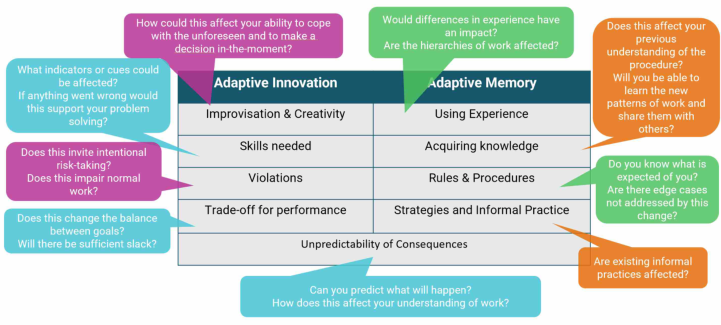
1. Prepare/Select Probes & Guidewords based on the Adaptation Factors (Foster et al., 2019). 2. Assemble team of SMEs (if using a workshop) including participants with frontline experience and relevant understanding of the conduct of normal work. 3. Describe the change or reason for the assessment in sufficient detail to situate the participants in the changed circumstances. Identify any preexisting hazards. 4. Describe the purpose of the assessment to the participants outlining the description of adaptation and the use of the questions and keywords. 5. Work with the participants in a semi-structured way to: a. Identify potential impacts that could result in future adaptations or maladaptations by working through the selected questions/keywords for each adaptation factor and/or using open questions about the change such as “What if…”, “How could…” based on the factor keywords. b. Expand the discussion to consider existing adaptive capacities that manage preexisting risks and which could be impaired or enhanced by the proposed change. c. Describe any consequential hazards for later analysis.
6. Capture the results, possibly structuring into a table alongside the fac- tors, for use as inputs into a supporting analysis technique to determine risk (likelihood and severity), evaluate acceptability, determine controls and mitigations and describe further areas for analysis. 7. Review the application of the questions and refine for future use.
Progress Towards the Prediction of Adaption in the Safety of UK Air Traffic Control 133
Figure 1: Adaptation factors and example questions & prompts.
LIMITATIONS AND NEXT STEPS The activities to improve the question set and demonstrate their face validity for identifying hazards as part of the initial stages of a formal risk assessment process are ongoing. Depending on the availability of controllers recruited post-2014, further workshops will be held using the original case study. These may also include bias checking workshops that do not use the questions to check whether it is the questions that are adding value to the process. This historic case study explores maladaptive effects from a change, further workshops may include the examination of changes that resulted in positive reinforcement of adaptive capacities. The examination of the probes is limited to the air traffic control domain in the UK and minor procedural changes. It would benefit from analysis with other industries and more complex changes e.g., equipment change.
CONCLUSION
The changing nature of risk, and the growing recognition of adaptation as being a source of safety in complex STS, requires approaches to risk man- agement that can uncover the threats to pre-existing adaptive capacities alongside the potential for maladaptive effects. An interview-based approach to predicting adaptive effects has been described that could seed hazard anal- ysis methods in use in the safety-related industries without disproportionate retraining or other costs that create the research-practice gap. This approach shows initial promise based on results from workshops and focus groups using realistic changes from UK air traffic control.
ACKNOWLEDGMENT
The authors would like to acknowledge the support of NATS staff past and present. This work is also part of a PhD project part-funded by NATS.
REFERENCES
Aven, T., 2023. On the gap between theory and practice in defining and understanding risk. Saf Sci 168, 106325. https://doi.org/10.1016/j.ssci.2023.106325 Borys, D., Else, D., Leggett, S., 2009. The fifth age of safety: The adaptive age. J
Health Serv Res Policy 1, 19–27. Carayon, P., Kianfar, S., Li, Y., Xie, A., Alyousef, B., Wooldridge, A., 2015. A systematic review of mixed methods research on human factors and ergonomics in health care. Appl Ergon 51, 291–321. https://doi.org/10.1016/j.apergo.2015.06.001 Dallat, C., Salmon, P. M., Goode, N., 2018. Identifying risks and emergent risks
across sociotechnical systems: The NETworked hazard analysis and risk man- agement system (NET-HARMS). Theor Issues Ergon Sci 19, 456–482. https: //doi.org/10.1080/1463922X.2017.1381197 Dekker, S. W. A., 2011. Drift into failure, Farnham: Ashgate. Dekker, S. W. A., Cilliers, P., Hofmeyr, J.-H., 2011. The complexity of failure
- Implications of complexity theory for safety investigations, Safety Science. https://doi.org/10.1016/l.ssci.2011.01.008 Dekker, S. W. A., Nyce, J. M., Myers, D. J., 2013. The little engine who could not: “Rehabilitating”the individual in safety research. Cognition, Technology and Work 15, 277–282. https://doi.org/10.1007/s10111-012-0228-5 Foster, C. J., Plant, K. L., McIlroy, R. C., 2024. The never-ending night shift: Insights
into organisational adaptation during COVID-19. Foster, C. J., Plant, K. L., Stanton, N. A., 2022. Maladaptation in air traffic management: Development of a Human Factors methods framework. Human Factors and Ergonomics in Manufacturing & Service Industries. https://doi.org/10.1002/ hfm.20974 Foster, C. J., Plant, K. L., Stanton, N. A., 2020. A very temporary operating instruc-
tion: Uncovering emergence and adaptation in air traffic control. Reliab Eng Syst Saf 208, 107386. https://doi.org/10.1016/j.ress.2020.107386 Foster, C. J., Plant, K. L., Stanton, N. A., 2019. Adaptation as a source of safety in complex socio-technical systems: A literature review and model development. Saf Sci 118, 617–631. https://doi.org/10.1016/j.ssci.2019.05.035 Grant, E., Salmon, P. M., Stevens, N. J., Goode, N., Read, G. J., 2018. Back to the
future: What do accident causation models tell us about accident prediction? Saf Sci. https://doi.org/10.1016/j.ssci.2017.12.018 Hassel, H., Cedergren, A., 2023. Enabling and Impeding Factors for Organizational Adaptive Capacity – A Review of the Literature 204–211. https://doi.org/10.3850/ 978-981-18-5183-4_r06-02-345-cd Holling, C. S., 1973. Resilience and Stability of Ecological Systems. Annu Rev Ecol
Syst 4, 1–23. https://doi.org/10.1146/annurev.es.04.110173.000245 Hollnagel, E., 2014. Safety-I and safety-II: The past and future of safety management.
The Binary-Based Model (BBM) for Improved Human Factors Method Selection. Hum Factors. https://doi.org/10.1177/0018720820926875 Klein, G. A. G. A., Calderwood, R., MacGregor, D., 1989. Critical decision method for eliciting knowledge. IEEE Trans Syst Man Cybern 19, 462–472. https://doi.or g/10.1109/21.31053 Leveson, N. G., 2020a. Safety III : A Systems Approach to Safety and Resilience. MIT
Engineering Systems Lab 110. Leveson, N. G., 2020b. Safety III : A Systems Approach to Safety and Resilience. MIT Engineering Systems Lab 110.
Progress Towards the Prediction of Adaption in the Safety of UK Air Traffic Control 135
Leveson, N. G., 2004. A new accident model for engineering safer systems. Saf Sci 42, 237–270. https://doi.org/10.1016/S0925-7535(03)00047-X Malakis, S., Kontogiannis, T., 2023. Team adaptation and safety in aviation. Saf Sci
158, 105985. https://doi.org/10.1016/j.ssci.2022.105985 National Air Traffic Services, 2019. The NATS Safety Strategy for 2030. Rasmussen, J., 1997. Risk management in a dynamic society - A modelling problem.
Saf Sci 27, 183–213. https://doi.org/10.1016/S0925-7535(97)00052-0 Reiman, T., Rollenhagen, C., Pietikäinen, E., Heikkilä, J., 2015. Principles of adaptive management in complex safety-critical organizations. Saf Sci 71, 80–92. https://doi.org/10.1016/j.ssci.2014.07.021 Salmon, P. M., Hulme, A., Walker, G. H., Waterson, P., Neville, A., Salmon, P. M.,
Hulme, A., Walker, G. H., Waterson, P., Neville, A., 2022. Towards a unified model of accident causation : refining and validating the systems thinking safety tenets. Ergonomics 0, 1–14. https://doi.org/10.1080/00140139.2022.2107709 Stanton, N. A., Salmon, P. M., Rafferty, L. A., Walker, G. H., Baber, C., Jenkins, D. P., 2013. Human factors methods: A practical guide for engineering and design, 2nd edition, Human Factors Methods: A Practical Guide for Engineering and Design, 2nd Edition. Ashgate Publishing Ltd. https://doi.org/10.1080/00140139. 2014.948659 Vincent, C., 2011. The essentials of patient safety. BMJ Books 1–53. https://doi.org/
10.1002/9781444323856 Waterson, P., Robertson, M. M., Cooke, N. J., Militello, L., Roth, E., Stanton, N. A.,
2015. Defining the methodological challenges and opportunities for an effective science of sociotechnical systems and safety. Ergonomics 58, 565–599. https://do i.org/10.1080/00140139.2015.1015622 Weick, K. E., Sutcliffe, K. M., 2015. Managing the unexpected: Sustained performance in a complex world, 3rd ed. John Wiley & Sons. Woods, D. D., 2023. Resolving the Command–Adapt Paradox: Guided Adaptability
to Cope with Complexity, in: Le Coze, J.-C., Journé, B. (Eds.), Compliance and Initiative in the Production of Safety: A Systems Perspective on Managing Tensions & Building Complementarity, SpringerBriefs in Applied Sciences and Technology. Springer Nature Switzerland. https://doi.org/10.1007/978-3-031-45055-6
LISTED IN THE AHFE DIGITAL BOOKSTORE CATALOGUE
Explore the complete digital volume
Safety Management and Human Factors
Read this individual research paper free through the original publisher, or explore the full digital proceedings book.
ISBN 978-1-964867-27-4
Explore this ISBN in the AHFE Bookstore ↗Listed in the July 2026 bookstore catalogue; search by ISBN to confirm current availability · Digital book purchase optional