Maria Hagl, Robert Hunger, Jana Meier, Shruthi Shetty, Michael Finke, Tim Ruediger, Marco Temme (2026). Competent, not Necessarily Confident: Insights from a Simulator Study on ATCO Readiness on Non-Endorsed Sectors. In: Human Systems Engineering and Design (IHSED2026): Future Trends and Applications. AHFE Open Access, vol. 237, pp. 389–401. https://doi.org/10.54941/ahfe1008178
Conventionally, air traffic controllers (ATCOs) in upper airspace control centers must undergo sector-specific endorsement to operate them. This implies high training costs and limiting operational flexibility during staff shortages. Given the strict selection and education process, as well as operator experience, ATCOs may be capable of safely handling non-endorsed sectors with similar characteristics. Additionally, they could benefit from further training and competency expansion. To investigate this, an experience-based allocation tool was developed by the German Aerospace Center and tested at Maastricht Upper Area Control Centre (MUAC). The study evaluated ATCOs’ mental stress as well as self-assessments of mental workload, situation awareness, performance of air traffic management (ATM) flow, and job satisfaction. 17 executive ATCOs participated in a human-in-the-loop simulation at MUAC, completing reference run on endorsed sectors and test runs on both non-endorsed sector predicted ‘able’ or ‘not able’ by the experience-based allocation tool. Traffic scenarios varying in intensity included nominal and non-nominal conditions and covered adverse weather conditions, military activities, and emergencies. Although expected differences were found between endorsed sectors and non-endorsed sectors, human factors indicators remain within the predefined acceptable operational limits. One of the identified challenges for successful future implementation represents the observed competence-confidence gap, as ATCOs expressed concerns about the new endorsement method.
The qualification and training of air traffic controllers (ATCOs) are time-consuming and cost-intensive processes (Finke et al., 2024). Most air navigation service providers (ANSPs) rely on structured selection and continuous training of their operational staff. ANSPs in Europe (International Federation of Air Traffic Controllers’ Associations (IFATCA)) and North America (Wallace, 2024) are increasingly reporting a shortage of ATCOs leading to capacity and demand constraints during periods of high traffic, as sectors cannot be divided or must be collapsed. In light of these challenges, a few research initiatives have explored
Received June 11, 2026 Revised July 2, 2026 Accepted July 19, 2026 Available online September 25, 2026
more flexible deployment concepts for ATCOs (Finke et al., 2024). The project ‘Increased Flexibility of ATCO Validations – V3’ (IFAV 3, SESAR Joint Undertaking, 2026), investigates operational feasibility of allowing unit-endorsed ATCOs to operate sectors without a formal sector endorsement. More specifically, the German Aerospace Center has developed an experience-based allocation tool to support more flexible sector allocation within air traffic service units (ATSUs) (Meier et al., 2025a). The present paper reports insights from a simulator study conducted at the Maastricht Upper Aera Control Centre (MUAC), where the experience-based allocation tool was applied for the first time.
General Overview of the Experience-Based Allocation Tool The tool is designed as a decision-support for supervisors, indicating whether and how ATCOs may operate safely and efficiently in a given sector at a given time. In air traffic management (ATM), efforts to link airspace capacity to ATCOs’ workload using complexity analysis with equations and weighted factors exist (Flynn et al., 2003; EUROCONTROL, 2006). However, these approaches do not comprehensively assess capabilities across ATCO experience. To close this gap, the German Aerospace Center proposes linking sector-specific demand requirements with experience-based controller competency profiles. The approach is structured into three main components: monitoring, prediction, and buffering.
Monitoring focuses on continuously assessing each ATCO’s competency profile using historical experience data (e.g., radar recordings, training records, etc.). As a foundational methodology for the assessment, the so-called Upper Airspace Skill-Level Index (UASLI) (Meier et al., 2024) composed of several criteria (e.g., traffic diversity, sector complexity, military activities, etc.), calculates a standardized competency value for each ATCO. Prediction involves determining the minimum required competency level to operate a specific sector during a defined time period (Meier et al., 2025b). This prediction is also based on the UASLI framework and considers expected traffic demand and sector complexity. By comparing these requirements with the monitored competency levels of individual ATCOs, the system determines whether an ATCO is suitable for assignment. Meeting or exceeding the predicted requirement results in an ‘able’ categorization for the sector during the given time frame; otherwise, the category ‘not able’ is assigned, and no authorization is foreseen. To prevent overly conservative or unstable assignment decisions, Competency Requirement Flexibility (CRF) acts as a controlled buffer (Temme et al., 2025). Without such a mechanism, ATCOs would be systematically assigned to slightly less demanding traffic situations than their demonstrated capability, leading to a gradual decline in measured competency over time. The CRF introduces a positive adjustment margin based on selected parameters, configured so that they can only increase the effective competency level, which in return might have several human factors implications.
Competent, Not Necessarily Confident: Insights From a Simulator Study 391 Human Factors Implications of Experience-Based Allocation
As ATCOs are assigned to non-endorsed sectors with demands that slightly exceed their nominal competency level, they may experience increased cognitive demand. Accordingly, slight increases in mental workload (MWL) and mental stress, as well as reductions in situation awareness (SA) are anticipated outcomes and not necessarily expected to degrade operator performance, provided that they remain within acceptable operational limits. MWL broadly focuses on the “ratio of available resources to the demand of the task” (Tierney et al., 2025, p. 2), for a more granular definition see Longo et al. (2022). Neither under- nor overload is a desired state for operator performance (Brookhuis and de Waard, 2000). A so-called ‘red line’ of workload (Grier et al., 2008; Wickens, 2008; Hart and Wickens, 1990) is difficult to quantify (Grier, 2015) but can be drawn in overload (Wickens and Tsang, 2015), i.e., when operators cannot adjust their strategy to compensate for demands that exceed capacity (Young et al., 2015; Welford, 1978; Wickens, 2008). In capacity-based theories of attention, increasing task demands require greater mental effort and are associated with elevated levels of arousal (Kahneman, 1973). At high arousal, increased energy mobilization can hinder attention and goal-directed behavior rather than boosting performance (Gaillard, 2008). However, high-workload situations do not necessarily provoke stress reactions in individuals (MacDonald, 2003; Gaillard, 1993; Gaillard and Wientjes, 1994), and MWL and stress are distinct concepts (Gaillard, 1993). Stress is conceived as an individual, psycho-physiological operator state and reaction to events across different timescales (Cohen et al., 2016; Crosswell and Lockwood, 2020; Gaillard, 1993). Nevertheless, if an operator works under high workload over an extended period, stress reactions may occur (Gaillard, 1993) and degrade ATCO performance (Zeier, 1994). Alongside acceptable levels of MWL and stress, sufficient SA is crucial for safe air traffic management (ATM) (Endsley, 1995, Stanton et al., 2001). SA, can be conceptualized “as an internalized mental model of the current state of the operator’s environment” (Endsley, 2012, p. 553) integrating perception, comprehension, and projection of relevant information (Endsley, 1988). Loss of SA has been associated with operational errors in ATM (Durso et al., 1998; Jones and Endsley, 1996). While acceptable levels of MWL, stress and SA can indicate operational feasibility and safety, they do not necessarily imply a successful implementation of experience-based sector allocation. Successful implementation additionally depends on positive evaluations by the affected stakeholders (Alexandre et al., 2018; Dunphy and Herbig, 1995). In this context, the perception of their own performance in terms of safe, orderly and expeditious flow of air traffic (Faber, 2009) is crucial. Perceived safety indicates whether ATCOs consider the concept operationally acceptable. ‘Orderly’ and ‘expeditiously’ closely relate to perceived self-efficacy, insofar as they reflect an individual’s confidence in their ability to manage and resolve complex traffic situations effectively. Self-efficacy refers to the extent to which individuals believe they can cope with challenging situations (Bandura and Adams, 1977). Higher
self-efficacy has also been linked to well-being (Maggiori et al., 2016) and job satisfaction across various occupational domains (Canrinus et al., 2012; Wu et al., 2012; Judge et al., 2007). Lastly, long-term acceptance of experience- based allocation depends on ATCOs perceiving the new endorsement method not detrimental to their job satisfaction.
Within the experience-based allocation framework and given the potential human factors implications discussed above, it is hypothesized that MWL and mental stress will increase. Furthermore, SA and perceived performance are assumed to decrease across the endorsed, non-endorsed ‘able’, and non- endorsed ‘not able’ conditions. All of the above-mentioned constructs are expected to remain within acceptable operational limits in the non-endorsed ‘able’ condition, defined by mean ratings on the favorable side of the scale (accounting for reverse items) and the absence of significant deviations in heart rate variability (HRV) from the reference run (baseline).
METHOD
Participants, Study Framework, and Study Design N = 19 ATCOs were recruited for the study via purposive sampling at MUAC. The final sample consisted of N = 17 participants (3 female), as two ATCOs were excluded for not completing all simulation runs. Their age ranged from 24 to 55 years (M = 36.2; p50 = 39.0). The study was conducted in a real-time simulation environment at MUAC training center. To ensure realistic work conditions for the participating executive ATCOs, they managed traffic interacting with pseudo-pilots and ATCOs in surrounding sectors. Each ATCO completed five simulation runs (approximately 40 min/run): two in sectors for which they held a unit endorsement (endorsed condition, reference runs with medium and high traffic intensity), and three in sectors for which no unit endorsement was held (non-endorsed condition, solution runs). The non-endorsed scenarios were selected based on the experience-based allocation tool’s decision ‘able’ or ‘not able’. Scenarios were designed to represent realistic summer traffic conditions, including varying levels of traffic complexity, adverse weather conditions, emergency situations, and military activities. The study received approval from an institutional ethics committee that was independent of the project.
Measured Variables and Measurement Material Before each simulation run, anticipated performance of ATM services was assessed via three tailored items on (1) safe, (2) orderly, and (3) expeditious air traffic management (Faber, 2009) on a scale from 1 (strongly disagree) to 6 (strongly agree). After each simulation run, perceived performance of ATM services was again evaluated by ATCOs, followed by a set of standardized questionnaires to assess the operators’ MWL and SA. Regarding MWL, we asked three tailored questions based on a definition by Longo et al. (2022), evaluated on a scale from 1 (strongly disagree) to 6 (strongly agree): (1) strong
Competent, Not Necessarily Confident: Insights From a Simulator Study 393 mental resource engagement for providing ATM, (2) ability to apply effective coping strategies for standard ATC tasks, and (3) perceived ability to provide ATM-services over a normal working period. SA was evaluated via SASHA (Dehn, 2008) on a scale from 0 (never) to 6 (always). During simulation, we measured ATCOs’ heart rates with a Polar H10 chest strap (Polar Electro Oy, Kempele, Finland). HRV was analyzed with Kubios (Tarvainen et al., 2014), with root mean square of successive differences (RMSSD) as the selected parameter for mental stress (Sammito et al., 2024), and log- transformed. After ATCOs completed all five simulation runs, they filled out a questionnaire asking about the estimated probability (0-100%) that job satisfaction would be negatively affected by the new endorsement method, along with a justification of their rating and questions on preferred training type and content to support successful implementation of the method.
RESULTS
Hypotheses were tested using linear mixed models, followed by pairwise comparisons of adjusted predictions. P-values were adjusted for multiple comparisons (Šidák, 1967). Due to the large number of pairwise comparisons, results are reported in a condensed form. Selected results are described in the text for illustrative purposes, while full details are provided in Table 1 and, if available, in the corresponding graphs and tables in each subsection. For constructs measured via tailored questionnaires, we refrained from calculating an aggregated score and analyzed each item individually.
n-endorsed (1) vs. n-endorsed (0) .23 .41 .36 1.13 .59 −.45 1.27 MWL2 “I was generally able to apply effective strategies to cope with standard ATC tasks.”
n-endorsed (1) vs. n-endorsed (0) .40 −.08 .14 −.54 .93 −.42 .27 MWL3 “I could have managed traffic effectively over the duration of a normal work period.”
SA (aggregated SASHA score) ***endorsed vs. n-endorsed (1) .10 −1.16 .22 −5.24 .001 −1.68 −.63
***endorsed vs. n-endorsed (0) .10 −1.45 .19 −7.59 .001 −1.91 −.99 n-endorsed (1) vs. n-endorsed (0) .10 −.29 .23 −1.29 .49 −.83 .25 PERF1 “I was able to carry out my ATC tasks safely.”
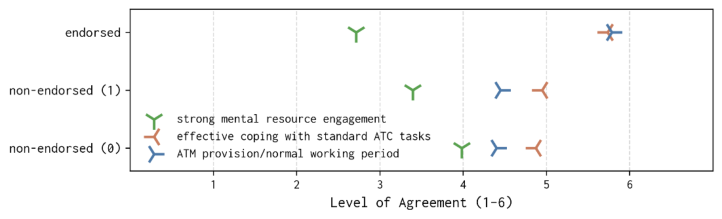
Perceived Mental Workload and Observed Heart Rate Variability The analysis of MWL shows a coherent pattern across conditions in line with our hypotheses (see Table 1, Figure 1, and Table 2), even though the effects are not always significant. For example, ATCOs in the non-endorsed sectors indicated that they had to engage their mental resources more strongly to manage traffic effectively (MWL1). For this item, MWL increased by .78 scale points from the endorsed (M = 2.79; SD = 1.43) to the non-endorsed ‘able’ (M = 3.47; SD = 1.47); however, this difference is not statistically significant (SE = .35; z = 2.24; p = .07). In contrast, MWL1 increased significantly by 1.19 from endorsed to non-endorsed ‘not able’ (M = 4.06; SD = 1.29; SE = .30; z = 3.96; p < .001). The difference between the two non-endorsed conditions was not significant (c = .41; SE = .36; z = 1.13; p = .59). Similarly, ATCOs rated themselves as significantly more capable of applying effective coping strategies for standard ATC tasks (MWL2) and significantly more able to manage traffic effectively over the course of a normal working period (MWL3) in the endorsed condition than in either non-endorsed condition. No significant differences were observed between the non-endorsed ‘able’ and non-endorsed ‘not able’ conditions for either measure.
With regard to the second part of the hypothesis, results indicate that the observed increases in MWL did not translate into excessive workload levels. As expected, mean ratings in the endorsed and non-endorsed ‘able’ conditions remained within the predefined acceptable operational limits. Contrary to expectations, this was also true for the non-endorsed ‘not able’ condition.
Figure 1: Mean scores of perceived MWL items; per condition (1) = ’able‘, (0) = ’not able‘.
Complementary to MWL findings are results regarding mental stress (see Table 1 and Table 2). HRV decreased only negligibly from the endorsed to the non-endorsed conditions, and the differences were not significant. Consequently, and consistent with the MWL findings, RMSSD remained within acceptable operational limits, even in the non-endorsed ‘not able’ condition.
Table 2: Descriptive statistics for studied variables per condition (1) = ‘able’; (0) = ‘not able’.
Table available in the original PDF paper.
Endorsed n-Endorsed (1) n-Endorsed (0) M SD p50 M SD p50 M SD p50
Perceived Situation Awareness The analysis of perceived SA shows a coherent pattern across conditions in line with our hypotheses (see Table 1 and Table 2). More precisely, SA significantly decreased by 1.16 scale points from the endorsed (M = 5.54; SD = .51) to the non-endorsed ‘able’ (M = 4.39; SD = 1.08). The difference is significant (SE = .22; z = –5.24; p < .001). SA significantly decreased by 1.45 from endorsed to non-endorsed ‘not able’ (M = 4.08; SD = .92) (SE = .19; z = –7.59; p < .001). The difference between the two non-endorsed conditions was in the hypothesized direction, but not statistically significant (c = –.29; SE = .23; z = – 1.29; p = .49).
As hypothesized, mean ratings in the endorsed and non-endorsed ‘able’ conditions remained within the predefined acceptable operational limits. Surprisingly, this was also true for the non-endorsed ‘not able’ condition.
Finally, the results show that SA was significantly correlated with all MWL items. ‘Strong mental resource engagement’ (MWL1) showed a strong negative correlation with SA (r = –.72; p < .001). The ability to apply ‘effective coping strategies to cope with standard ATC tasks’ (MWL2) was strongly correlated with SA (r = .72; p < .001), as was projected ATM ‘over the duration of a normal work period’ (MWL3; r = .72; p < .001).
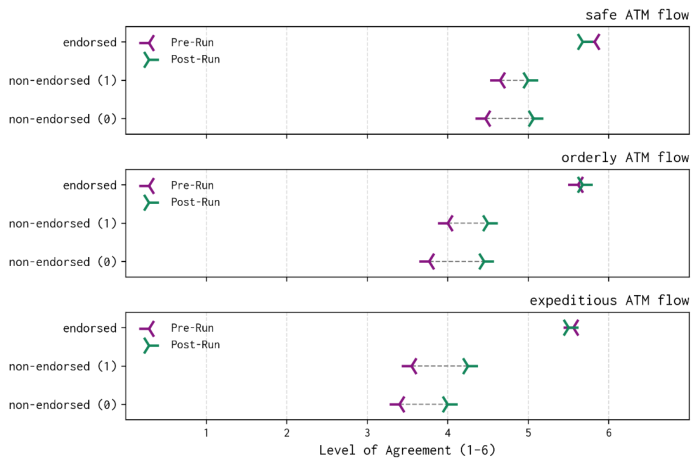
Perceived ATM-Performance Descriptive results on perceived ATM performance1 are listed in Table 2 and visualized in Figure 2 indicate five main patterns.
Figure 2: Anticipated and post-estimated mean values for the performance of ATM services in terms of safe, orderly, and expeditious ATM flow. (1) = ‘able’; (0) = ‘not able’.
First, the delta between anticipated and post-estimated performance in terms of safe, orderly, and expeditious ATM flow is negligible for endorsed sectors, whereas larger deltas are observed for non-endorsed sectors. Second, ATCOs rated their anticipated performance systematically lower than their post-simulation evaluation. Third, generally, performance perceptions decreased from endorsed to non-endorsed ‘able’ and further to non-endorsed ‘not-able’ sectors. A significant difference is observed between endorsed and 1No objective safety events were attributable to ATCO performance at any point of time in any condition. These objective safety event metrics (not within the scope of this paper) provide an external reference for situating the reported performance perceptions of safety.
Competent, Not Necessarily Confident: Insights From a Simulator Study 397 non-endorsed conditions for all three performance indicators, no significant differences are found between the non-endorsed sectors ‘able’ and ‘not able’ (for details, see Table 1). Fourth, within non-endorsed conditions, a systematic decline is observed from safe to orderly to expeditious ATM flow, whereas ratings remain relatively stable at a relatively high level in endorsed sectors from ‘safe and orderly ATM flow’ (M = 5.68; SD = .91 respective .53) to ‘expeditious ATM flow’ (M = 5.50; SD = .71). Lastly, perceived safe and orderly ATM flow in non-endorsed sectors is not estimated to be substantially impaired in either the ‘able’ or ‘not able’ condition.
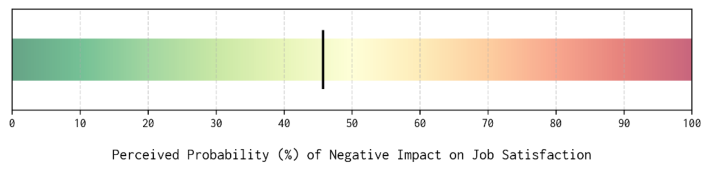
Perceived Impact on Job Satisfaction N = 13 ATCOs (n = 4 missing) rated the perceived probability that their job satisfaction might be negatively affected by the new endorsement method. Results present a fairly differentiated picture, with an average perceived probability of 45.8% negative impact on job satisfaction (see Figure 3; p50 = 45.0; Min = 10; Max = 100).
Figure 3: Perceived negative impact of the new endorsement method on job satisfaction.
From analyzed comments (n = 8; 61.5%; equally assigned non-endorsed ‘able’ and ‘not able’), on why the new endorsement method might nsegatively impact job satisfaction, four major themes were generated: (a) reduced comfort (n = 2; 25.0%), (b) higher insecurity and less self-assurance (n = 3; 37.5%), (c) fear of impact in non-nominal conditions and unexpected situations (n = 2; 25.0%), (d) perceived reduced operational proficiency and efficiency (n = 3; 37.5%). More precisely, these ATCOs indicated that working on a non-endorsed sector would make them feel “less comfortable” and “less self- assured” about their competencies. Potentially missing “knowledge of the non-native sectors” might lead to greater uncertainties with ATCOs feeling “less comfortable” and “insecure”, particularly in non-nominal conditions or unexpected situations. One ATCO worried that working across more sectors would, over time, reduce time spent in each, potentially leading to reduced proficiency and a perceived thinning of expertise. Another noted that a lack of “practical knowledge” might decrease operational efficiency and affect traffic handling.
CONCLUSION
This study investigated ATCOs’ operator state during and subjective assessment after operating non-endorsed sectors following the decision of the experience-based allocation tool.
As hypothesized, ATCOs reported higher MWL when operating non- endorsed sectors. This finding is expected and desired according to the CRF mechanism (Temme et al., 2025). In fact, it is essential to expose ATCOs to slightly more demanding situations to maintain and further develop competencies and prevent competency degradation. In this context, an increase in MWL should not necessarily be interpreted as a negative outcome, especially since it remained within acceptable operational limits. Complementary HRV results support these findings. Despite higher subjective MWL ratings, no significant reductions in RMSSD were observed between conditions. Consequently, there is no evidence in this study that increased demands led, in line with past research (Gaillard, 1993; Gaillard and Wientjes, 1994; MacDonald, 2003) to mental stress. Combined, these findings suggest that the experience-based allocations challenged ATCOs without pushing them beyond their coping capacities.
Perceived SA decreased as hypothesized from the endorsed condition to the conditions non-endorsed ‘able’ and non-endorsed ‘not-able’. However, it remained within acceptable limits across all conditions.
Perceived ATM performance followed the same overall trend. ATCOs anticipated lower performance in non-endorsed sectors and reported lower levels of safe, orderly, and expeditious ATM flow than in endorsed sectors. The strongest reductions were observed in orderly and expeditious ATM flow, whereas perceived safety remained comparatively high. This aligns with the observation that no safety events attributable to ATCO performance occurred during the simulation runs. In summary, the findings suggest that operating non-endorsed sectors may be perceived as somewhat less efficient, though this needs to be verified by analyzing the ATM simulation data in more detail against objective criteria.
The most critical finding concerns the answers we received for a perceived potential negative impact on job satisfaction along with comments explaining why. While the experience-based allocation tool categorized ATCOs as competent in operating the assigned non-endorsed sectors and, again, no operational safety concerns became apparent, almost half of participants were not confident in the method. Reported concerns centered on reduced comfort, lower self-assurance, uncertainty in non-nominal situations, and fears of declining proficiency due to the allocation across a larger number of sectors. Interestingly, the setup of the study and results on MWL, mental stress, and perceived and actual safety of ATM flow do not reflect these concerns. In fact, the simulation scenarios included a range of operationally demanding situations including adverse weather, military activities, and emergency events, yet no safety issues attributable to ATCO performance were observed. Likewise, neither subjective nor physiological measures indicated signs of excessive MWL or even any indication of mental stress. Concerns regarding declining proficiency also contrast with the intended function of the CRF mechanism, which was specifically invented to prevent competency loss.
As a first limitation to this study, these findings should not be understood as evidence that such concerns are unfounded. The study was based on individual simulation runs of limited duration, it remains unclear how repeated exposure to non-endorsed sectors across shifts, weeks, and months
Competent, Not Necessarily Confident: Insights From a Simulator Study 399 may affect MWL, mental stress, SA, performance, job satisfaction, and other variables that might impair operational safety and the operators’ well-being long term. Future research should therefore adopt a longitudinal approach to understand potential human-factors implications of repeated exposure to flexible sector allocation over weeks and months. Research should be initially conducted in simulation environments and subsequently under operational conditions. Given that experience-based sector allocation has not yet received approval for operational implementation, a promising opportunity to gather additional real-world evidence may lie on-the-job training on sectors for which ATCOs train to be endorsed. A second limitation is that the UASLI- based competency model was applied comprehensively for the first time in this study and had not yet undergone calibration or parameter weighting optimization. Future work should therefore focus on refining the model and evaluating the predictive accuracy in operational environments. While slight descriptive differences between the condition non-endorsed ‘able’ and ‘not able’ are visible, these effects did not reach statistical significance and remain negligible. The limited differentiation between the two conditions suggests that the tool’s current configuration may have been overly conservative. Further research is needed to determine whether alternative parameter settings provide better distinction between conditions.
To conclude, the findings indicate first promising steps towards increasing operational flexibility via an experience-based allocation concept from a human performance perspective. For successful implementation, the challenges now lie in refining the experience-based allocation tool and verifying whether it meets operational requirements. If proven safe and effective, the focus should be set on increasing ATCO acceptance of, and confidence in, the new endorsement method.
ACKNOWLEDGMENT
The IFAV3 project has received funding from the SESAR 3 Joint Undertaking under grant agreement No. 101114683 under the European Union’s Horizon Europe research and innovation programme.
REFERENCES
Alexandre, B., Reynaud, E., Osiurak, F. & Navarro, J. 2018. Acceptance and acceptability criteria: A literature review. Cognition, Technology & Work, 20, 165–177. Bandura, A. & Adams, N. E. 1977. Analysis of self-efficacy theory of behavioral
change. Cognitive Therapy and Research, 1, 287–310. Brookhuis, K. A. & De Waard, D. 2000. Assessment of drivers’ workload: Performance and subjective and physiological indexes. Stress, workload, and fatigue. CRC press. Canrinus, E. T., Helms-Lorenz, M., Beijaard, D., Buitink, J. & Hofman, A. 2012. Self-
efficacy, job satisfaction, motivation and commitment: exploring the relationships between indicators of teachers’ professional identity. European Journal of Psychology of Education, 27, 115–132. Cohen, S., Gianaros, P. J. & Manuck, S. B. 2016. A Stage Model of Stress and Disease.
Perspectives on Psychological Science, 11, 456–463.
Crosswell, A. D. & Lockwood, K. G. 2020. Best practices for stress measurement: How to measure psychological stress in health research. Health Psychology Open, 7, 2055102920933072. Dehn, D. M. 2008. Assessing the Impact of Automation on the Air Traffic Controller:
The SHAPE Questionnaires. Air Traffic Control Quarterly. Dunphy, S. & Herbig, P. A. 1995. Acceptance of innovations: The customer is the key! The Journal of High Technology Management Research, 6, 193–209. Durso, F. T., Truitt, T. R., Hackworth, C. A., Crutchfield, J. M. & Manning, C. A.
1998. En route operational errors and situational awareness. The International Journal of Aviation Psychology, 8, 177–194. Endsley, M. 1995. Toward a Theory of Situation Awareness in Dynamic Systems.
Human Factors: The Journal of the Human Factors and Ergonomics Society, 37, 32–64. Endsley, M. R. 1988. Design and Evaluation for Situation Awareness Enhancement.
Proceedings of the Human Factors Society Annual Meeting, 32, 97–101. Endsley, M. R. 2012. Situation Awareness. In: Salvendy, G. (ed.) Handbook of Human Factors and Ergonomics. John Wiley & Sons, Inc. Eurocontrol 2006. Complexity Metrics for ANSP - Benchmarking Analysis. Brussels,
Belgium. Faber, C. 2009. Safe, orderly and expeditious flow of air traffic. Hinsight 8.
Eurocontrol Safety Magazine. Finke, M., Hunger, R., Tyburzy, L., Meier, J. & Jameel, M. 2024. Using tool support to enable a more flexible deployment of Air Traffic Controllers to Sectors, Deutsche Gesellschaft für Luft-und Raumfahrt-Lilienthal-Oberth eV. Flynn, G., Benkouar, A. & Christien, R. 2003. Pessimistic Sector Capacity Estimation.
EEC Note. Gaillard, A. W. 1993. Comparing the concepts of mental load and stress. Ergonomics, 36, 991–1005. Gaillard, A. W. K. 2008. Concentration, Stress and Performance. In: Szalma, J. L. &
Hancock, P. A. (eds.) Performance under Stress. Milton, United Kingdom: Taylor & Francis Group. Gaillard, A. W. K. & Wientjes, C. J. E. 1994. Mental load and work stress as two types of energy mobilization. Work & Stress, 8, 141–152. Grier, R., Wickens, C., Kaber, D., Strayer, D., Boehm-Davis, D., Trafton, J. G. &
St. John, M. 2008. The Red-Line of Workload: Theory, Research, and Design. Proceedings of the Human Factors and Ergonomics Society Annual Meeting, 52, 1204–1208. Grier, R. A. 2015. How High is High? A Meta-Analysis of NASA-TLX Global Workload Scores. Proceedings of the Human Factors and Ergonomics Society Annual Meeting, 59, 1727–1731. Hart, S. G. & Wickens, C. D. 1990. Workload Assessment And Prediction. In: Booher,
H. R. (ed.) Manprint: An Approach to Systems Integration. Dordrecht: Springer Netherlands. International Federation Of Air Traffic Controllers’ Associations (IFATCA).
Available: https://www.ifatca.org/wp-content/uploads/ifatca_pr_eur_staff_ shortage_170423.pdf [Accessed]. Jones, D. G. & Endsley, M. R. 1996. Sources of situation awareness errors in aviation.
Aviation, Space and Environmental Medicine, 67, 507–512. Judge, T. A., Jackson, C. L., Shaw, J. C., Scott, B. A. & Rich, B. L. 2007. Self-efficacy and work-related performance: The integral role of individual differences. Journal of Applied Psychology, 92, 107–127. Kahneman, D. 1973. Toward a theory of mental effort. Attention and effort, 13–27. Longo, L., Wickens, C. D., Hancock, G. & Hancock, P. A. 2022. Human Mental
Workload: A Survey and a Novel Inclusive Definition. Frontiers in Psychology, Volume 13 - 2022.
Competent, Not Necessarily Confident: Insights From a Simulator Study 401 MacDonald, W. 2003. The impact of job demands and workload on stress and
fatigue. Australian Psychologist, 38, 102–117. Maggiori, C., Johnston, C. S. & Rossier, J. 2016. Contribution of Personality, Job Strain, and Occupational Self-Efficacy to Job Satisfaction in Different Occupational Contexts. Journal of Career Development, 43, 244–259. Meier, J., Temme, M. M., Hunger, R. & Finke, M. 2024. Upper Airspace Skill-Level
Index for Smart Competency Monitoring. DLR-IB-FL-BS–2024–71. In: (DLR), G. A. C. (ed.). Braunschweig, Germany. Meier, J., Temme, M. M., Hunger, R. & Finke, M. Unlocking Potential: Enhancing Air Traffic Controller Deployment Through Dynamic Competency-Based Rostering. 2025 AIAA DATC/IEEE 44th Digital Avionics Systems Conference (DASC), 14–18 Sept. 2025 2025a. 1–10. Meier, J., Temme, M. M., Hunger, R. & Finke, M. 2025b. Upper Airspace Skill-Level
Index for Minimum Competency Level Prediction. DLR-IB-FL-BS-2025-43. In: (DLR), G. A. C. (ed.). Braunschweig, Germany. Sammito, S., Thielmann, B., Klussmann, A., Deußen, A., Braumann, K.-M. & Böckelmann, I. 2024. Guideline for the application of heart rate and heart rate variability in occupational medicine and occupational health science. Journal of Occupational Medicine and Toxicology, 19, 15. Sesar Joint Undertaking. 2026. IFAV 3 [Online]. Available: https://www.sesarju.eu/
projects/IFAV3 [Accessed June 11th 2026]. Šidák, Z. 1967. Rectangular Confidence Regions for the Means of Multivariate Normal Distributions. Journal of the American Statistical Association, 62, 626–633. Stanton, N. A., Chambers, P. R. G. & Piggott, J. 2001. Situational awareness and
safety. Safety Science, 39, 189–204. Tarvainen, M. P., Niskanen, J.-P., Lipponen, J. A., Ranta-Aho, P. O. & Karjalainen, P. A.
2014. Kubios HRV–heart rate variability analysis software. Computer methods and programs in biomedicine, 113, 210–220. Temme, M.-M., Meier, J., Hunger, R., Finke, M., Abdellaoui, R., Shetty, S. & Cicvara, A. D. 2025. Development of technical and procedural requirements to support a system of flexible endorsement for upper airspace air traffic controllers. Deutscher Luft-Und Raumfahrtkongress 2025 (DLRK 2025). Tierney, M., Adeyemi, E. O. & Bommer, S. 2025. A Systematic Literature Review:
Cognitive Workload Assessment in Human Factors Research. Advances in Human-Computer Interaction, 2025, 9313239. Vivienne Wu, S.-F., Lee, M.-C., Liang, S.-Y., Chuang, Y.-H., Lu, Y.-Y. & Wu, M.-P.
2012. Self-efficacy, professional commitment, and job satisfaction of diabetic medical care personnel. Contemporary Nurse, 43, 38–46. Wallace, G. 2024. FAA still short about 3,000 air traffic controllers, new federal numbers show. CNN, May 24. Welford, A. T. 1978. Mental Work-load as a Function of Demand, Capacity, Strategy
and Skill. Ergonomics, 21, 151–167. Wickens, C. & Tsang, P. 2015. Workload. In: D. A. Boehm-Davis, F. T. D., J. D. Lee (ed.) Handbook of human-systems integration. American Psychological Association. Wickens, C. D. 2008. Multiple resources and mental workload. Human Factors, 50,
449–455. Young, M. S., Brookhuis, K. A., Wickens, C. D. & Hancock, P. A. 2015. State of science: Mental workload in ergonomics. Ergonomics, 58, 1–17. Zeier, H. 1994. Workload and psychophysiological stress reactions in air traffic
controllers. Ergonomics, 37, 525–539.
FIND THE COMPLETE VOLUME IN THE AHFE DIGITAL BOOKSTORE
Explore the complete digital volume
Human Systems Engineering and Design (IHSED2026): Future Trends and Applications
Read this individual research paper free through the original publisher, or explore the full digital proceedings book.