Chittayong Surakitbanharn, Arik-Quang Dao, Steven Landry, Nobuaki Minato (2021). Understanding the Human Factors Limitations of Automated Conflict Resolution through Air Traffic Controller Solicitation. In: Advances in Human Aspects of Transportation: Part I. AHFE Open Access, vol. 15. https://doi.org/10.54941/ahfe100612
Automated conflict resolution is one of the most mature ideas available in the attempt to meet the high capacity air traffic demand expectations of NextGen. However, automated conflict resolution algorithms that are mathematically optimal may not be globally optimal when human factors dimensions are considered. In order to better understand the limitations of conflict resolution algorithms from a human factors dimension, air traffic control from Southern California TRACON are interviewed about current operations and potential future operations with automated conflict resolution. The focus of these interviews are twofold. The first focus is on understanding the tacit knowledge required for operations in the presence of hazardous weather conditions, a time when controller workload demands are particularly exacerbated. The second focus is to understand situations where mathematically optimal automated conflict resolution solutions may not be globally optimal from a human factors perspective. The contribution of this work is a summarization of human factors points of consideration for future design of air traffic control operations and automated conflict resolutions.
Next Generation Air Transportation System (NextGen) is currently being developed in the United States to meet anticipated higher air traffic capacity goals of the future. However, a major impediment in achieving these higher traffic air capacity goals is overcoming controller workload limitations (Prevot, Homola, Martin, Mercer, & Cabrall, 2012). As controllers reach their workload limits, which can be particularly exacerbated in the presence of convective weather (Krozel, Capozzi, Andre, & Smith, 2003), delays become part of the National Airspace System (NAS) ("Research and Innovation Technology Administration | Bureau of Transportation Statistics," 2011). In order Human Aspects of Transportation I (2021) to overcome the impediment of weather, new technologies and procedures associated with trajectory based operations are being formalized (Vu et al., 2012) as well as evaluated in order to increase efficiency in the air and on the ground in an attempt to reduce overall delays (Federal Aviation Administration, 2013). One proposal to reduce controller workload stems from the introduction of automated weather conflict resolutions (Erzberger, Lauderdale, & Chu, 2010; Krozel, Penny, Prete, & Mitchell, 2004; Love, Chan, & Lee, 2009). However, the current state of automated weather conflict resolutions, as well as other automation technologies, are still limited in their ability to effectively integrate human operators (Landry, 2011).
In order to effectively transition air traffic control (ATC) operations to future states that incorporate certain levels of automation, an understanding of human factor elements critical to the transition should first be established (Homola et al., 2010). At a higher level, these human factors elements include safety critical functions and roles of the human operator (Landry, 2012). At a lower level, these human factors elements include tacit knowledge required of ATC (Malakis & Kontogiannis, 2013) to manage a sector as well as perception and projection of future system states (Shorrock, 2007). The presence of these questions leads this research to inquire with ATC about current (and potential future) operations to survey plausible human factor elements that current automated conflict solutions may fail to account.
The aim of this research is to utilize a series of meetings with ATC to understand whether the correct questions are being asked (and answered) in the process of integrating automated conflict resolution and human operations into NextGen. The purpose of this paper is not to draw generalizable conclusions, but to raise discussion for potentially important points in the push towards NextGen operations by examining the feasibility of future operational concepts in a real world environment.
The first point of focus during the ATC meetings relates to how well the automated conflict resolution solutions replicates and/or improves upon current controller performance by trying to understand the tacit knowledge required for operations. This is done by first questioning ATC about how proposed automation solutions reflect real life situations in the Terminal Radar Approach Control (TRACON) environment. The second point of focus relates to potential situations where a mathematically optimal solution may not be globally optimal from a human factors perspective. Both focus points are intertwined with pilot and controller preferences and performance as well as corporate policies.
This paper first overviews the relevant operational concepts, then discusses the methodology and context of the environment in which ATC was interviewed. The remainder of the paper investigates potential discourses between the introduction of automated separation assurance and actual ATC operations as well as provides recommendations for future studies.
BACKGROUND: THE SHIFT TOWARDS NEXTGEN Automated Conflict Resolution
Current automated conflict resolutions utilize a shortest path calculation (Erzberger et al., 2010) or safest path calculation to direct aircraft around weather. The path calculated is a geometrically optimal solution for avoiding conflict with respect to weather and other aircraft. However, extending conflict resolution algorithms to include human factors elements, such as pilot or ATC preference, for a given route needs to also be considered (DeLaura, Robinson, Pawlak, & Evans, 2008) to improve the effectiveness of resolutions for the NAS. Such resolutions for the NAS should be able to minimize delays and increase airspace capacity while maintaining an acceptable level of safety.
One such preference may extend to pilot and company policies (Surakitbanharn, Dao, Landry, & Minato, 2013). For example, a cargo aircraft may be more willing to fly closer to a weather cell whereas an aircraft carrying passengers may have a propensity to avoid weather cells. In the case that both aircraft were to utilize the same algorithm, a mathematical optimality with respect to rerouting around the weather may exists however a global optimality that accounts for pilot and controller preference may be defied. That is, in a “shortest path” situation a pilot that is trying to avoid weather may be brought in too close for comfort and in a “safest path” situation a pilot Human Aspects of Transportation I (2021) that has a higher propensity for risk may be incurring too much delay.
ATC daily operation of a given airspace may provide ATC insight into the preference of different aircraft and companies (if any exists) through the emergence of patterns in behavior. Thus, one goal of this research is to understand the types of preferences that exists among different pilots, aircraft, and companies as well as develop an understanding of how this preference will be effected in shifting towards future operations.
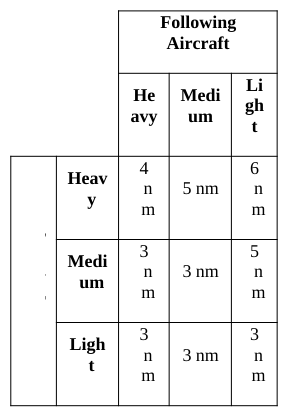
Aircraft Sequencing The need to account for ATC preferences in the shift towards future operations is equally important as ATC will be on one operating end of new technology. One point of operations, where preferences may be held, are in the process of aircraft arrival sequencing. Current operations utilize a first-come, first serve (FCFS) practice to sequence arrival aircraft. In actual practice, ATC may have certain preferences (within acceptable limits) that prioritize certain arrival configurations over others. One such example would be the sequencing of heavy-jets behind a light-jets when possible to reduce the required miles-in-trail separation for wake turbulence. Doing so may result in an arrival sequence that is able to fit more aircraft in a given space constraint. The separation standards are seen in Table 1 below.
Table 1: ICAO separation standards Following
Figure 1 below demonstrates two arrival sequences and the respective miles-in-trail required for wake turbulence separation for each configuration. The figure shows that certain arrival configurations are more conducive to higher capacity of aircraft than others.
Human Aspects of Transportation I (2021)
Figure 1. Example of separation spacing on arrival sequencing.
Figure available in the original PDF paper.
Additional sequencing research has also shown that certain arrival sequencing configurations are more conducive to reducing fuel burn (Andreeva-Mori, Suzuki, & Itoh, 2013a, 2013b). As arrival sequencing that shifts away from FCFS is already being studied and proposed from an efficiency standpoint, it is important to consider whether configured arrival sequences would be acceptable in an operator environment (Andreeva-Mori et al., 2013a). Thus, another goal of this research is to account for ATC preferences that may exists in arrival sequencing as well as other situations.
Knowledge Gap It is important that maturing NextGen technologies meet not only the proposed technical requirements, such as increased efficiency of airspace, but also the user requirements of both ATC and pilots. One such way to meet user requirements is to incorporate feedback from the users of the developed systems (i.e. ATC and pilots) to check that the proposed technical solutions for NextGen are also acceptable from a human factors perspective. This approach takes a look into ATC and pilot preferences in current operational application and provides insight for future technological iterations.
METHODOLOGY: ATC INTERVIEW This research sought to replicate previous interview techniques with ATC which utilized an unstructured interview format to allow ATC to explore their personal accounts (Shorrock, 2007). The justification in utilizing Shorrock’s interview method lies in that the research seeks in-depth insight into automated conflict resolution technologies that has not been formally reported elsewhere.
A senior air traffic controller (over 20 years of experience) from Southern California Terminal Radar Approach Control (SCT) was interviewed over three meetings in February 2014 about TRACON operations. Each discussions lasted approximately 30 min to 60 min. Two meetings occurred offsite from SCT, and one meeting occurred onsite at SCT with visuals and audio of live ATC operations in the afternoon.
During the session at SCT, notes were taken on live situations that related to the two focus points 1) situations that required tacit knowledge to understand the particular actions in the airspace 2) situations where mathematically optimal solutions (shortest path, safest path) may not have been globally optimal from a human factors perspective. Furthermore, notes were taken down on additional situations that possibly foreshadow the effectiveness of future NextGen operations.
RESULTS
Described in this section are the observed and identified situations during the meeting at SCT that relates to the requirements of tacit ATC knowledge; situations in which mathematically optimal situations may not be globally optimal, as well as situations that may foreshadow the effectiveness of future operations.
Requirements of tacit knowledge
Aircraft arriving on the RNAV (GPS) Runway 17 approach into Gillespie Field (KSEE) creates a 20 minute ground delay for northwest bound aircraft from KSEE.
Northwest departures from KSEE climb on a 320 degree heading which runs head on with GPS 17 arrivals into Human Aspects of Transportation I (2021)
KSEE. Departing aircraft can be turned westbound to avoid arrival traffic once they reach their minimum vectoring altitude (MVA), however the airspace west of KSEE is under military control requiring an extra degree of coordination. Resultantly, departing aircraft are faced with a 20 min ground delay when there is inbound traffic on the GPS 17 approach.
There are situations where aircraft from different destinations and of different types (operator and aircraft make) will try to arrive simultaneously.
Two cargo aircraft, one a heavy jet and another a light aircraft, were observed arriving into San Diego Lindbergh Field (KSAN) from different destinations. ATC explained the preference of these two arrivals to time the proximity of arrivals into KSAN as close to each other as possible. A plausible explanation for this preference was to reduce the required time of workers and delivery trucks on the ground waiting to receive and load the cargo for delivery.
Patterns exists with certain airlines and/or aircraft types to fly with an expected set of behaviors.
Certain airlines and/or aircraft types were described as having a history of operating under certain patterns of behavior. An example of such behavior includes aircraft of one airline having a propensity for maintaining higher speeds within the TRACON and when sequencing for arrivals. In turn, ATC has to space and sequence these aircraft with anticipation for this behavior.
Confliction points with military, general aviation, and government agencies with the ability to impose temporary flight restrictions (TFRs) within the airspace are known to ATC.
Certain areas within the airspace are prone to traffic confliction, in turn requiring special attention from ATC. Additionally, certain areas within the airspace were reported to have an increased likelihood of TFRs imposed, such as from local government agencies with the proper authority.
Mathematically optimal solutions not globally optimal
Sequencing aircraft to reduce miles-in-trail is preferential in the presence of congested arrival traffic.
From a controller perspective, sequencing aircraft to reduce miles-in-trail separation for wake turbulence is preferred in certain situation so that more aircraft can be squeezed into arrivals and unused airspace is minimized.
Effectiveness of future operations
There are situations where aircraft does not (or cannot) comply with orders.
A large part of ATC responsibility in the arrival sequencing environment is slowing aircraft down to ensure compliance with instructions to maintain separation. However, certain situations exists where aircraft do not (or cannot) comply. Oftentimes, the incompliant aircraft is the one that receiving the penalty. However, situations exists where actions of an incompliant aircraft results in a compliant aircraft being penalized.
In an arrival sequencing situation, an incompliant aircraft may be penalized in the case that they are unable to slow to an assigned speed and risk creating a loss of separation (LOS) with the lead aircraft. In this case, the incompliant aircraft would be removed from the arrival sequence and re-sequenced for arrival.
Conversely, if a leading aircraft is issued a restriction to hold a speed to the final approach fix (FAF) and the aircraft does not comply with their restriction, ATC has no choice but to remove the compliant trailing aircraft from the arrival sequence to prevent LOS. In this case, the non-guilty party is penalized. Nevertheless, in both situations ATC has to create an additional opening in the arrival sequence to accommodate the aircraft that has been pulled out of sequence.
Human Aspects of Transportation I (2021)
DISCUSSION
Current automated conflict resolutions in the TRACON environment offer geometrically optimal solution to aircraft, however this solution may not be sufficient in reaching the capacity goals of NextGen. The meetings with ATC brought up several points that need to be considered in the shift towards future operations.
Minimize Unused Airspace First, by definition an efficient utilization of airspace requires a minimization of unused airspace. However, an automated conflict resolution around weather that only calculates shortest path or safest path while maintaining FCFS priority may sequence aircraft for arrivals in such a manner that unused airspace is not minimized. This inefficiency may cause delays in the system because an optimal number of aircraft cannot be sequenced, or it may increase the controller workload whom may have to toggle through or override automation proposals to find one that best fits their preference.
The need to consider an arrival order alternative to FCFS is further exacerbated by the introduction of a Super classification of aircraft (i.e. Airbus A380) that requires an additional level of wake turbulence separation minima beyond current standards. The introduction of a Super category could potentially lead to an increase in unused airspace to ensure trailing aircraft are safe from wake turbulence. Thus, future air traffic systems may be unable to meet capacity goals without considering alternatives to FCFS Furthermore, insight is needed into how well proposed arrival sequence configurations that optimize fuel efficiency compares to how controllers sequence aircraft.
Tacit Knowledge to Manage Airspace Secondly, airspace and aircraft behavior, although dynamic in nature, may still operate within certain behavioral patterns and boundaries. The meetings with ATC reiterates that certain aircraft, airlines, or routes may be prone to certain behaviors and that a unique solution may be required for every case to satisfy preferences and priorities. For example, in the case that aircraft prefer their landing times close to each other, a rerouting solution in which the considered aircraft may incur more delay but are scheduled in together may be of preference to the pilots and companies versus one that separates the arrivals. Regardless of whether system behaviors are associated to the nature of the airspace, such as areas prone to TFRs, or perhaps the nature of the system operators, such as certain aircraft tendencies of not slowing down, having this knowledge helps ATC project future system states.
In the shift towards the inclusion of automation, it is important to understand how an automated system accounts for these system nuances. Even in the current system where ATC are able to negotiate with pilots, there already exists a certain level of incompliance. Nevertheless, the presence of humans allows a negotiation process to overcome an operator’s inability (whether intentional or not) to accommodate certain preferences and requirements. In the presence of an automated system, this negotiation and accommodation not only needs to exists, but it also needs to be vetted to ensure that future system states are predictable to both the automation and the human operator.
Effectiveness of Best Equipped, Best Served Finally, although there has been recent push towards new technologies and procedures, it is essential to tests and monitor these novel concepts in the real world environment, as well as get feedback from users, to ensure that actual benefits exists. As learned from the meeting with ATC, the 20 min ground delay for northwest departure traffic from KSEE was non-existent prior to the introduction of the GPS 17 approach into KSEE. In the case of the GPS 17 approach into KSEE, an introduction of additional spacing among aircraft on final may actually reduce the overall system delay since an opening could be made to release outbound traffic. This leads to further questions about the validity of the “best equipped, best served” train of thought for future operations, and furthermore whether the novel technologies and procedures actually perform as promised.
Human Aspects of Transportation I (2021)
CONCLUSION AND FUTURE WORK This research utilizes feedback from ATC at one TRACON about day-to-day operations and is meant to serve as a guide of potentially relevant topics in the attempt to understand how the shift to NextGen procedures and technologies compare with current operations. It was found that there are certain cases in current operations that deal with pilot and controller preference that future automated solutions do not account for. Furthermore, it was found that the addition of certain technologies and procedures can potentially add to delays, as shown in the example of introducing a RNAV GPS approach at KSEE.
Future work should expand the inquiry to multiple controllers from multiple centers to understand the systemic behavioral patterns across different control centers. With respect to minimizing unused airspace, future studies could focus on calculating the potential unused airspace when utilizing FCFS versus a sequencing that is more in line with controller preferences. This work could also include the amount of delay introduced into the arrival environment from the re-sequencing or aircraft due to incompliant behavior. Furthermore, future interviews should include exploratory interview analysis techniques (i.e. counts of how often certain topics are brought up) in order to quantify and numerically analyze the importance of certain topics.
REFERENCES
Andreeva-Mori, A., Suzuki, S., & Itoh, E. (2013a). Rule derivation for arrival aircraft sequencing. Aerospace Science and Technology, 30(1), 200-209. doi: http://dx.doi.org/10.1016/j.ast.2013.08.004 Andreeva-Mori, A., Suzuki, S., & Itoh, E. (2013b). Sequencing of Arrival Aircraft with Operational Constraints IAENG
Transactions on Engineering Technologies (pp. 65-79). DeLaura, R., Robinson, M., Pawlak, M., & Evans, J. (2008). Modeling Convective Weather Avoidance in Enroute Airspace.
Paper presented at the 13th Conference on Aviation, Range, and Aerospace Meteorology, New Orleans, LA. Erzberger, H., Lauderdale, T. A., & Chu, Y.-C. (2010). Automated Conflict Resolution, Arrival Management and Weather Avoidance for ATM. Paper presented at the 27th International Congress of the Aeronautical Sciences, Nice, France. Federal Aviation Administration. (2013). NextGen Implementation Plan. Washington, DC: Retrieved from
https://www.faa.gov/nextgen/implementation/media/NextGen_Implementation_Plan_2013.pdf. Homola, J., Prevot, T., Mercer, J., Brasil, C., Martin, L., & Cabrall, C. (2010). A controller-in-the-loop simulation of groundbased automated separation assurance in a NextGen environment. Paper presented at the Proceedings of the ENRI International Workshop on ATM/CNS (EIWAC 2010). Krozel, J., Capozzi, B., Andre, T., & Smith, P. (2003). The Future National Airspace System: Design Requirements Imposed by
Weather Constraints AIAA Guidance, Navigation, and Control Conference and Exhibit: American Institute of Aeronautics and Astronautics. Krozel, J., Penny, S., Prete, J., & Mitchell, J. (2004). Comparison of Algorithms for Synthesizing Weather Avoidance Routes in Transition Airspace AIAA Guidance, Navigation, and Control Conference and Exhibit: American Institute of Aeronautics and Astronautics. Landry, S. J. (2011). Human centered design in the air traffic control system. Journal of Intelligent Manufacturing, 22(1), 65-72. Landry, S. J. (2012, 2012). Intensity Control: A Concept for Automated Separation Assurance Safety and Function Allocation in
NextGen. Love, J., Chan, W., & Lee, C. (2009). Analysis of Automated Aircraft Conflict Resolution and Weather Avoidance 9th AIAA Aviation Technology, Integration, and Operations Conference (ATIO): American Institute of Aeronautics and Astronautics. Malakis, S., & Kontogiannis, T. (2013). A sensemaking perspective on framing the mental picture of air traffic controllers.
Applied Ergonomics, 44(2), 327-339. doi: http://dx.doi.org/10.1016/j.apergo.2012.09.003 Prevot, T., Homola, J. R., Martin, L. H., Mercer, J. S., & Cabrall, C. D. (2012). Toward Automated Air Traffic Control— Investigating a Fundamental Paradigm Shift in Human/Systems Interaction. International Journal of Human-Computer Interaction, 28(2), 77-98. Research and Innovation Technology Administration | Bureau of Transportation Statistics. (2011). Retrieved October 16th,
2011, from http://www.transtats.bts.gov/OT_Delay/OT_DelayCause1.asp Shorrock, S. T. (2007). Errors of perception in air traffic control. Safety Science, 45(8), 890-904. doi: http://dx.doi.org/10.1016/j.ssci.2006.08.018 Surakitbanharn, C., Dao, A.-Q., Landry, S. J., & Minato, N. (2013). An evaluation of non-Pareto optial solutions for automated Human Aspects of Transportation I (2021) weather conflict resolution. Paper presented at the Asia-Pacific International Symposium on Aerospace Technology, Takamatsu, Japan. Vu, K.-P. L., Strybel, T. Z., Battiste, V., Lachter, J., Dao, A.-Q. V., Brandt, S., . . . Johnson, W. (2012). Pilot Performance in
Trajectory-Based Operations Under Concepts of Operation That Vary Separation Responsibility Across Pilots, Air Traffic Controllers, and Automation. International Journal of Human-Computer Interaction, 28(2), 107-118. doi: 10.1080/10447318.2012.634761
Human Aspects of Transportation I (2021)
LISTED IN THE AHFE DIGITAL BOOKSTORE CATALOGUE
Explore the complete digital volume
Advances in Human Aspects of Transportation: Part I
Read this individual research paper free through the original publisher, or explore the full digital proceedings book.
ISBN 978-1-4951-2097-8
Explore this ISBN in the AHFE Bookstore ↗Listed in the July 2026 bookstore catalogue; search by ISBN to confirm current availability · Digital book purchase optional