D. Germanàa, S. Spadaa, G. Lombardib, A. Baraccoc, M. Coggiolac, F. Sessad, L. Ghibaudoa (2022). Pushing and Pulling Risk Assessment in Fiat Group Automobiles Industrial Reality: Methods to Analyze Critical Operative Conditions According to ISO 11228-2 Principles. In: Advances in Ergonomics In Design, Usability & Special Populations: Part II. AHFE Open Access, vol. 19. https://doi.org/10.54941/ahfe1001225
Publisher statistics will load when you open Metrics.
AHFE OPEN ACCESS OPEN ACCESS CONFERENCE PROCEEDINGS PAPER
Pushing and Pulling Risk Assessment in Fiat Group Automobiles Industrial Reality: Methods to Analyze Critical Operative Conditions According to ISO 11228-2 Principles
The Italian legislation, D.Lgs 81/08, requires employer to make the assessment of every risk the worker is exposed to, including the risk of biomechanical overload of musculoskeletal structure due to Manual Material Handling. In particular, the Italian legislation recalls international ISO standard of 11228 series as reference to Manual Material Handling risk assessment. More in deep, ISO 11228-2 is the reference standard to the risk assessment of pushing and pulling tasks. According to this standard, the risk assessment can be carried out using two analysis levels, each one characterized by a specific method. The first level analysis is deeply used in the industrial reality, it allows a fast screening of risk factors and it is based on an evaluation checklist and tables coming from Snook&Ciriello psychophysical tables. Psychophysical tables reports experimental force values based on risk factors of load, environment and operator characteristics. Effectively, the risk level is assessed by a comparison between measured initial and maintenance forces and the corresponding force values reported in Snook & Ciriello tables. Snook&Ciriello tables are a collection of experimental data (psychophysical data) and this is the main limitation in their use because of they don’t cover all conditions that could be present in the complex industrial reality as the automotive contest is. Therefore, Fiat Group Automobiles (FGA) has internally developed a conservative method to analyze pushing and pulling tasks, according to ergonomics principles mentioned in the legislation requirements and shared with Occupational Doctors. This method allows to assess the risk of biomechanical overload of pushing and pulling tasks, when the critical operative conditions of the task are not explicitly comparable to the discrete value of psychophysical tables. The developed method is based on standardize procedure to experimentally measure initial and maintenance forces as well as to statistically elaborate the experimental data. The application of this procedure allows to have repeatable and comparable experimental data, where an interpretability of the current legislation in open, because of ISO standard does not give detailed and unambiguous information to acquire and statistically manage the experimental forces data. Finally, a case study of FGA methodology application will be illustrated.
At today, one of the most important ergonomic challenges is to actively contribute into the design of objects, services and workplaces in order to respect human limitations as well as to increase the use of human capabilities. Ergonomic goal is to reduce work-related musculoskeletal disorders (MSDs) by adapting the task to fit the person, instead of forcing the person to adapt to the task.
It’s important to take into account that MSDs are a significant problem for European countries. With regard to the Italian situation and reference to the annual report of INAIL (Italian Workers' Compensation Authority) the number of denounced MSDs cases has rapidly increasing in the last seven years (figure 1).
MSDs Cases 2006-2012 (sou
60000
Denounced MSDs cases
50000
40000
Figure 1. Italian denounced MSDs in the last seven years (reference INAIL Annual Report, 2012)
Figure available in the original PDF paper.
It should be remembered that, with reference to the Oxenburgh productivity model, one day of absenteeism cost up to 3.5 times one day’s pay when all the direct and indirect costs are included (Oxenburgh, 2004). So European countries are sustaining a great social cost for MSDs; the total cost of accidents at work and occupational illness ranges for most countries from 2.6 to 3.8% of Gross National Product (GNP); in particular focuses on the cost, Italy is sustaining is 3.2% of GNP (INAIL Annual report, 2012).
For the protection of health and safety of workers, Italy adopted the ‘Testo Unico in materia di Salute e Sicurezza nei luoghi di lavoro’ (TU). TU shows perfect compliance to European Directives requirements. The TU is , in the field of Italian law, the group of all laws included in the Decreto Legislativo number 81(issued April, 9, 2008). The TU is addressed to every public or private company with a minimum of one worker, so it must be applied by micro- small enterprises as well as big companies. The aim of the new law is to improve health, safety and hygiene in the workplace, in order to reduce the whole incidents costs occurring in the workplace and, consequently, decreasing the social costs and conforming the minimum security levels.
TU importance lies in the transition from the concept of physical protection to the concept of psychophysical protection of worker. A new health concept is introduced. The strict definition of health, reported in the 2 nd article, is the state of complete physical, mental and social wellness, consisting not only in absence of illness or infirmity. The VI title concerns the manual material handling tasks. Manual material handling activities may involve biomechanical overload for workers, especially at dorso-lumbar section. In particular, The 167th article specifies the application field of this title. The term manual material handling covers transport operations or supporting of a load by one or more workers, including the operations of lifting, putting down, pushing, pulling, carrying or moving a load. The characteristics of the tasks may carry out biomechanical stress risks, in particular at back-lumbar sector, as well as osteoarticular structures, musculo-tendinous and neurovascular diseases.
The 168th article reports that employers have to adopt organizational measures and introduce pieces of equipment to avoid the manual material handling. If it’s not possible, the article gives indication of the methods to adopt for the risk evaluation of the manual material handling. Activities recalled in for the manual material handling definition are: lifting, carrying, pushing, pulling and high repetitive handling of low loads.
In the automotive industrial reality, which Fiat Group Automobiles (FGA) belongs, manual material handling is a common task that involves pushing and pulling activities, for example, the activities of internal logistics (enslavement of the line on non-motorized trolleys). Hence, it is of great importance, for FGA, defining a clear methodology for the risk assessment of pushing and pulling activities, consistent and compliant to international standards and to ensure a conservative approach to health protection of workers.
ISO 11228-2, that is the reference legislation for this kind of activities however, while still providing the general principles and methods to analyze the commonest work situations, does not lead in detail the application of the proposed methods. This article presents the methodology for the assessment of risk by pushing and pulling activities drawn from FGA to define a detailed procedure, suited to operative conditions of production lines.
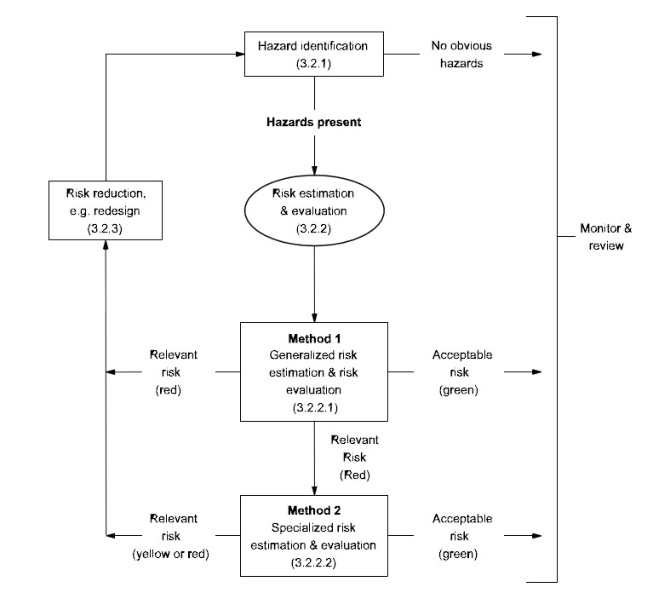
ISO 11228-2 STANDARD: APPLICABILITY FIELD AND OPERATIONAL LIMITS The ISO 11228-2 standard proposes two methods for pushing and pulling activities risk assessment as reported in figure 2.
Figure 2. Risk assessment model of pushing and pulling activities (ref. ISO 11228-2)
Method 1 is pointed out to a generic risk assessment and involves two steps:
application of a checklist for the identification of all risk factors related to the task,
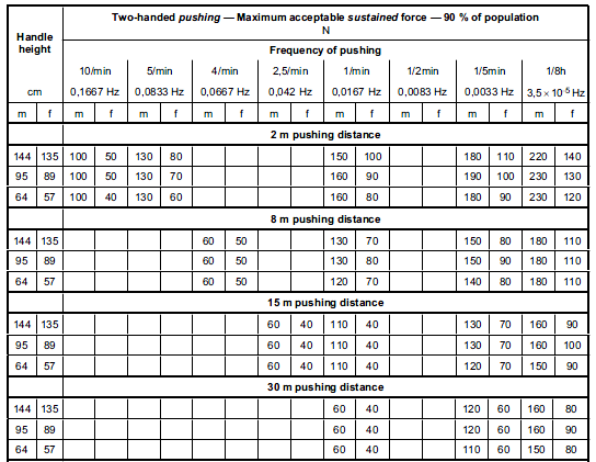
comparison between experimentally measured values of pushing and pulling activities and recommended values mentioned in ISO standard tables. Tables provide limit values of the maximum acceptable initial (static frictional resistance) and sustained (sliding frictional resistance) forces in case of pulling/pushing activities (figure 4).
Method 1 is therefore applicable just in case of population with characteristics as similar as population of reference tables. The application of this method allows classifying the risk assessment into two levels: acceptable (green) and unacceptable (red).
Method 2 is recommended for detailed analysis and, if Method 1 is not appropriate, because of it is a 2nd level method. Also, Method 2 consists of two steps:
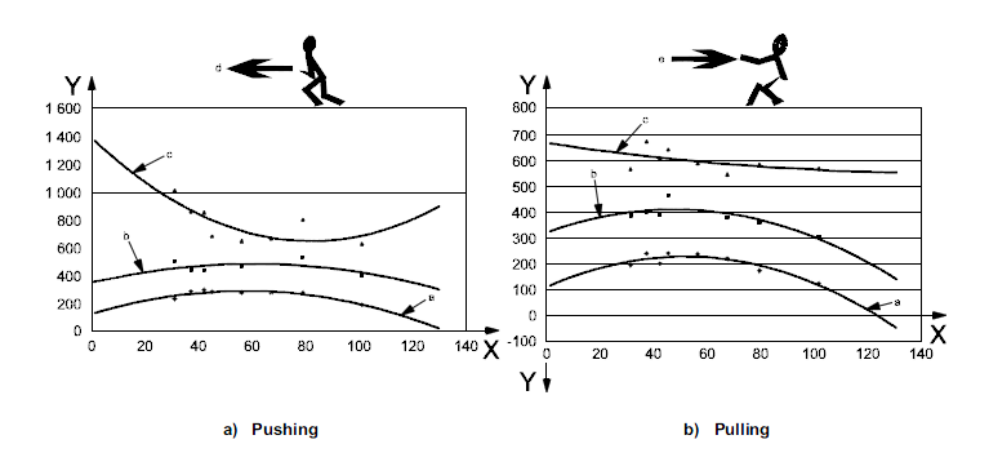
experimental determination of acceptable force limits as function of task and characteristics of working population (see figure 3);
comparison between experimentally measured values of pushing and pulling activities and force limit previously determined.
The result of the comparison is classified on three levels of risk : acceptable (green), acceptable under certain conditions (yellow) and unacceptable (red).
In the industrial reality, Method 2 is difficult to apply, especially for the aspect of providing and updating data on force limits related to the specific working population.
Figure 3. Examples of data elaboration of force limits relating to a specific population (reference ISO 11228-2)
On the other hand, the application of Method 1 presents the limit of the comparison to recommended values which, referring to specific operating conditions; do not have continuous coverage for all the circumstances that may occur in an industrial complex reality.
The tables, recalled in Method 1, are based on research of Drs. Snook S. and Ciriello V. at the Liberty Mutual Research Institute for Safety (figure 5). Their research, based on psychophysical methodology, analyzes and evaluates lifting, lowering, pushing, pulling and carrying tasks. The results of research provided important information about capability and limitations of workers and design of manual material handling tasks to reduce low back disability. The psychophysical methodology includes measurements of oxygen consumption, heart rate and anthropometric characteristics. Instead all others task variables such as frequency, size, distance etc., were controlled by the experimenter. The subjects were asked to make adjustments to the weight/ force so that they would be able to “work all day as hard as possible on an ‘incentive basis’ without straining or becoming unusually tired, weak, out of breath or overheated.” (Ciriello, 1983; Ciriello, 1990; Ciriello, 1993).
The tables, published in literature, provided for each type of actions (pushing, pulling and carrying) the maximum acceptable weights and forces for 10, 25, 50, 75 and 90 percent of the male and female adult healthy population. Other variables relating to the type of action has to be taken into account: frequency, height of the handle from floor and covered distance.
Figure 4. Example of limit value table mentioned in standard ISO 11228-2Figure 5. Example of Snook & Ciriello psychophysical tables
Figure available in the original PDF paper.
The acceptable force values shown in the tables are to be compared to the effective measured forces. It is important to note that pulling/pushing forces are not the same as the weight of objects being pushed and pulled because of trolley and floor characteristics have to be considered. Pushing and pulling forces are directly measured by dynamometers. Moreover, the force required for handling any wheeled device involves several components: starting (initial), stopping, turning and maintaining its motion (i.e., sustained).
FGA has therefore opted for an approach compliant to Method 1 of the standard, but has defined a methodology with standardized procedures for the experimental investigation of forces, analysis of results and the calculation of risk.
RISK ASSESSMENT METHOD DEVELOPED BY FIAT GROUP AUTOMOBILES
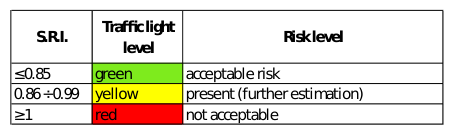
The method of risk assessment of pushing and pulling tasks, developed by Fiat Group Automobiles, is based on the calculation of the synthetic risk index (S.R.I); that is complaint to the risk multiplier, mr, mentioned in Method 2 of ISO 11228-2 relating to the traffic light classification of risk level. The S.R.I is the ratio between experimentally measured force value and the limit value reported on psychophysical tables published by Snook and Ciriello in 1991 [ 3] . The S.R.I is classified in three traffic light levels: green, yellow and red (Table I).
Table1. S.R.I traffic light risk levels
Each evaluation consists into two indices: one related to the initial force and one related to the maintenance force according to the gender of operator.
Procedure of forces experimental measurement
The standard procedure, developed by Fiat Group Automobiles for the measurement of pushing and pulling forces, refers to D Annex of standard ISO 11228-2; but it offers detailed operational guidelines. The procedure consists in 30 acquisitions of forces, of which 15 acquisitions made with wheels transversely oriented to motion direction and 15 acquisition made with straight wheels to motion direction. During the acquisition, the load on trolley must be equal to the maximum expected capacity.
The manual material handling must take place along a path of at least 5m on a smooth floor; the task should be performed at a very low speed and in a constant way. The operator performing the task should engage an upright posture, with both hands placed on trolley and the motive force should be direct to the front of. Forces applied to set the object in motion and forces applied to keep the object in motion are acquired by an electronic dynamometer that allows to record forces.
To determine the value of the force initial and maintenance to be used in SRI calculation among the 30 values obtained from measurement test; an elaboration of data is needed. Measurement are accepted only if they deviate of 15%, at most, from the average value obtained taking into account maximum and minimum measured value. Among acceptable measurement, the highest value is chosen as initial force and the average value as maintenance force.
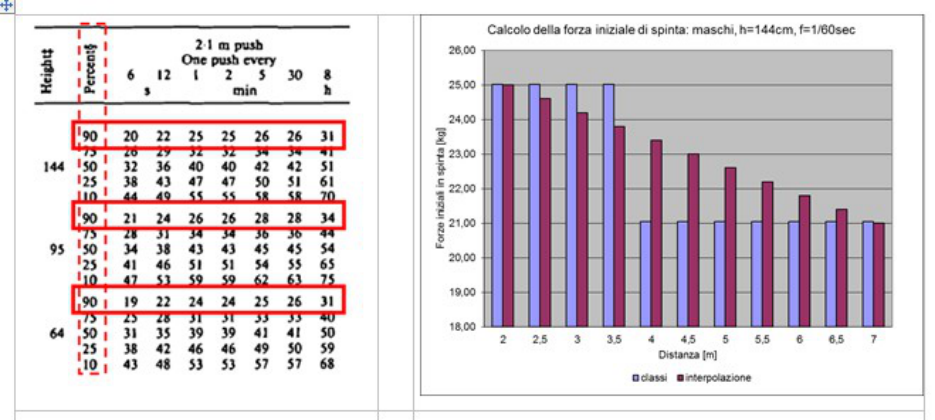
Determination of the Strength Limit Values From Snook and Ciriello Psychophysical Tables Limit values reported in Snook and Ciriello tables originates from experimental studies on musculoskeletal load, pain, endurance and fatigue associated to pushing and pulling tasks. The values of force are classified according to the task (pushing or pulling), force (initial or maintenance), operator gender, distance, height handles, frequency and percentage of the population sample that can be protected using force limit. The proposed method, with the aim of protecting 90% of adult and healthy working population, is based on the more conservative data tables (Fig. 1).
Figure 6. Procedure of force values interpolation
Taking into account the experimental origin of Snook and Ciriello tables, only discrete values of distance, handles height and frequency were collected.
To cover industrial cases that fall into different conditions of distance, handle height and frequency, two approaches have been studied:
the first approach based on the concept of class,
the second approach based on linear interpolation.
The first approach divides the values of the risk factors into discrete intervals (classes), and associates to each class an experimental force value mentioned in Snook and Ciriello tables. For examples, in Snook and Ciriello tables only force values related to 2m and 7m distances are available. According to the first method distances between 2m and 3,5 m were characterized with force values relating to 2 m; instead higher distance values (from 3.5 m to 7 m) were characterized with force values relating to 7m.
This kind of approach leads to an inevitable underestimation / overestimation of the risk; directly proportional to the class amplitude. The second approach, instead, based on a linear interpolation between near classes (on hands height, frequency, distance), provides a wide coverage of data, providing a smaller approximation of data. Figure 6 shows the trend of the initial pushing force, for male population, modifying the distance in the range of 2 to 7m calculated according to the two approaches (keeping constant hands height to ground, at 144cm, and frequency, as 1 handling at minute). It’s possible to notice the force trend by step generated by the first approach (blue data in figure 6), on the other hand the continuous force trend generated by the second approach (purple data in figure 6). The approximation given using the first approach is inadequate and not enough conservative toward operator health. Starting from these considerations FGA has opted for the second approach based on linear interpolation
CASE STUDY A comparison among results of a real working task of FGA industrial reality coming from application of Method 1 reported in ISO 11228-2 standard and method developed by FGA will be lead. The object of risk assessment is manual material handling of a hand track used in transport of containers with a maximum weight of 700kg (stable load). The initial situation consists of handle at h= 103cm, that allows power grip with both hands in symmetrical and comfortable trunk and upper limbs posture. The working area provides a smooth, flat floor, adequate space for maneuvering in corners and good visibility were guaranteed. The task frequency is 1 movement every 2.5 min and the distance covered by the trolley is 6 m. Initial and maintenance forces were measured according to the procedure before described. To apply the method 1 of ISO were selected values of the forces recommended by the tables mentioned in the standard (ref. A.5.1, A.5.2, A.5.3, and A.5.4). Of course the application of these tables implies a degree of approximation because of data lacking corresponding to the operating conditions in study.
The force limit values coming from the application of FGA method are based on linear interpolation (Fig.6). The analysis of results of the risk assessment in accordance ISO standard shows a risk for the female working population but only in the initial application of force. The application of FGA method shows the presence of risk for female working population also for maintenance force, and, in any case, also for the male working population is necessary to analyze in deep the task because of the risk is in yellow traffic light level (figure 7).
Figure 7. Results coming from application of method1 and FGA interpolation approach.
Figure available in the original PDF paper.
CONCLUSIONS
The authors, carried out several tests on different tools of transport and variable operating conditions, and it was observed that the method internally developed allows a more detailed and conservative than Method 1 mentioned in ISO 11228-2. The method developed by FGA addresses improvement actions on tested objects and working tasks. The experimental tests have shown that the risk of underestimating is more probable when the experimentally measured forces are high, in particular when the forces exceed 16-17 kg for the initial force and 6 - 7kg for the maintenance force.
REFERENCES
Annaul INAIL Report,2012. INAIL website: http://bancadati.inail.it/prevenzionale Ciriello V. M., Snook S. H. (1983). A study of size, distance, height and frequency effects on manual handling tasks.
Human Factors, 25:5. Ciriello V. M., Snook S. H., Blick A. C., Wilkinson P.L. (1990). The effects of task duration on psychophysically determined maximum acceptable weights and forces. Ergonomics 33:2, 187-200. Ciriello V. M., Snook S. H., Hughes G. (1993) Further studies of psychophysically determined maximum acceptable weights and
forces. Human Factors 35:11, 175-186. ISO 11228-2:2004, “Ergonomics – Manual handling – Part 2: Pushing and pulling” Snook, S.H., Ciriello, V.M., “The design of manual tasks: revised tables of maximum acceptable weights and forces”, in: Ergonomics, 34, 1991, pp. 1197–1213.
LISTED IN THE AHFE DIGITAL BOOKSTORE CATALOGUE
Explore the complete digital volume
Advances in Ergonomics In Design, Usability & Special Populations: Part II
Read this individual research paper free through the original publisher, or explore the full digital proceedings book.
ISBN 978-1-4951-2107-4
Explore this ISBN in the AHFE Bookstore ↗Listed in the July 2026 bookstore catalogue; search by ISBN to confirm current availability · Digital book purchase optional