Louise Moody, Adele Long, Avril McCarthy (2021). Design for Health and Dignity: User and Stakeholder Involvement in Design for Urinary Continence. In: Advances in Human Aspects of Healthcare. AHFE Open Access, vol. 13. https://doi.org/10.54941/ahfe100472
Fully understanding stakeholder needs is important. For each project the participants, methods and timing of involvement should be considered (Vink et al 2008). Methods of engaging stakeholders and users are numerous, but case study examples demonstrating consultation in practice for incontinence product development are not frequently reported. The authors have been involved in a number of user-centred design projects that have been undertaken to enhance the health and dignity of patients and users in the UK. These projects have involved different levels of stakeholder and user involvement in the product development and evaluation process. This paper will describe two case studies focussed on product design for urinary continence management. This is an area in which stakeholder and user engagement is important but can be challenging to achieve. The way in which stakeholders were involved and the resulting impact is described.
Fully understanding user needs and wants at an early stage of medical device development is essential for market success (Turner 2010). User-centred design and participatory approaches are often advocated for the design of new health technology and implementation of service improvements, with most organisations recognising the value of user and wider stakeholder involvement in communicating their goals and reducing risk of market failure (Owen and Goldberg 2010). Through a user-centred approach, the user and stakeholder are a critical part of the process and may directly participate in the design process (Abras et al. 2004, Sanders 2005). Methods of engaging stakeholders and users are numerous, but case study examples demonstrating consultation in practice for incontinence product development are not frequently reported. This is a particularly challenging space, where historically there has been limited funding and technical development, coupled with an understandable reluctance from patients who have incontinence to discuss their needs.
End-user involvement has been indicated as important to improve care and encourage confidence and independence amongst users of incontinence products (Fader 2003). There has been on-going academic debate regarding the amount of user involvement that is appropriate (Harrison and Mort 1998, Ives and Olson 1984, Kujala 2003, Sanders 2005). Where user acceptance of the product is essential, and in the case of incontinence closely linked to good health, user involvement in the design process is critical but not always achieved (Ives and Olson 1984). Kaulio (1998) refers to user involvement at 3 levels: design for customers, design with customers and design by customers. Methods of involvement can vary from co-creation workshops, to traditional research methods such as focus groups, individual interviews or questionnaires.
Device users are only one group of stakeholders and usually wider involvement is needed (Owen and Goldberg 2010, Curry et al. 1999). It is important to consider which participants should be involved and in what way for example, carers and family, service providers, community and hospital-based clinicians, manufacturers, procurement agencies etc all have an influence on the adoption of healthcare products and services (Vink et al. 2010). Some stakeholders may remain peripheral to the development but may have a significant contribution to make when the device is closer to market.
The cost- benefit tradeoffs are always going to be a key consideration in the involvement of stakeholders, which may extend the design process with accompanying financial implications (Vredenburg et al. 2002, Kujala 2003). There is however much evidence that early involvement saves, and in fact can generate money, though this can be hard to quantify (Bias and Mayhew 1994, Karat 1993). The design process can be iterative, complex, lengthy, constrained and expensive, so it is not surprising, that during the development of a medical device stakeholder consultation can sometimes be viewed as an additional complication and is paid lip-service to or even ignored. However, determining who has interest and can affect the progress of a new technology is vital to its eventual take up and market success.
The authors have been involved in a number of projects focused on improving the health and dignity of those managing incontinence as a daily challenge. Effective products are essential to ensure dignity, independence and engagement with healthy behaviors in terms of continence self-management. The projects have involved different levels of user involvement in the product development and evaluation process. Here two case studies are described. In both, the need for stakeholder input was recognized by the as an integral part of the device development process to ensure product success. The stakeholder group, and how and when they were to be consulted, varied for the 2 projects.
CASE STUDY 1: NOVEL BLADDER DRAINAGE DEVICE The product
The novel urinary drainage device was designed to be inserted through the patient’s abdomen, forming a 'port' through which the bladder is emptied using an intermittent catheter1. It aims to reduce the complications associated with the major surgery that is required by other treatments, and offer the advantages of intermittent catheterisation including a reduced risk of urinary tract infection, and discreet and dignified bladder emptying. It also aims to incorporate some of the benefits of draining the bladder through the abdomen rather than the urethra, such as less need for dexterity and mobility, no risk of damage to the urethra, and greater freedom for sexual activity.
Stakeholder involvement The device development involved stakeholder input through the formation of several groups; the development team, advisory group and wider stakeholder consultation.
The Development Team included clinicians, scientists, engineers, designers and a manufacturer. To be assured of widespread market adoption, the device would require acceptance by surgically trained clinical staff who would be the initial prescribers; healthcare professionals who would be caring for patients using the product in the community; and patients and carers who would be using, or assisting in the use of the device. To achieve this wider stakeholder representation, a project Advisory Group was formed. This comprised clinicians in secondary and primary care, researchers with a track record of innovation in the field, and patients.
1 episodic introduction of a catheter into the bladder to drain any residual urine Human Aspects of Healthcare (2021)
The Development Team articulated proposed design ideas to the Advisory Group and with their assistance design ideas were narrowed down to those concepts that were deemed fit for purpose. Based on the feedback, the design specification and the risk analysis amended accordingly. This served to identify where the most critical clinical and patient requirements would present the greatest technical, financial and management challenges through the project.
The first basic prototype was developed several months into the project and the Advisory Group met with the Development Team to give their feedback. This meeting proved pivotal to further development. Despite discussion and a level of consensus at the initial meeting, each member of the Development Team and Advisory Group had taken away their own image of what the device would look like and how it would function. The differences in perspective and expectation reflected the different roles of each stakeholder. This highlights the importance of achieving good communication and understanding between all participants and keeping technical or clinical jargon to an absolute minimum.
After this meeting, the prototype was further refined taking in the comments of the Advisory Group, and then subjected to pre-clinical tests to establish its functionality and verify some of the performance claims that were to be made.
Wider stakeholder consultation Once a suitable prototype had been produced and the intellectual property protected, wider stakeholder consultation was undertaken. The first step in this process was to identify individuals and organizations who could be influential in the acceptance and use of the device and who had not been represented in the Advisory Group. From the process of identifying stakeholders, five predominant groups emerged: commercial competitors, product purchasers, and policy and guidance makers, users who are healthcare professionals and users who are patients or carers. The relative ability of these groups to impact on the adoption of a new product was assessed. In the case of clinicians and patients it was felt that wider consultation outside the Advisory Group was desirable as the requirements of these groups were complex and variable. At this stage the primary concern was with adoption within the NHS in the UK.
The method of stakeholder engagement was semi-structured interviews. These were conducted face-to-face by independent researchers, and in some cases a prototype device was shown. The interview method was seen as preferable to focus groups or postal questionnaires due to the complexity, and potential sensitivity of the topic. Interviewees were targeted either for the position they held, or for their interest in the clinical area. A pragmatic decision was made not to attempt to reach saturation or to formally analyze into themes, as it would not yield value for money information.
Purchasers and Influencers Bodies responsible for purchasing for the NHS and organizations with a role in influencing the adoption of new products were identified. Representatives from the NHS Supply Chain, NHS Purchasing Consortium, NHS Prescription Services and a Hospital department agreed to give feedback on the purchase of the product. Representatives from the NHS Technology Adoption Centre, Life Sciences Innovation and NHS National Innovation Centre agreed to give their view on how the product would be assessed for its value to the NHS. Purchaser and influencer interviews were conducted, following provision of a background document explaining the function of the device and where it would be used in the patient pathway. These interviews resulted in a provisional cost for the device. Cost-effectiveness was considered paramount, with cost savings being required across the NHS. Patient benefit was also considered to be important and would be taken into account by purchasers. It was stressed that the device must be seen to be addressing a real NHS challenge or unmet need, and that this must be well articulated. Healthcare professional backing was also considered important, and it can support and speed up adoption if the device is considered to be filling an unmet patient need, although this is viewed as secondary to cost. In addition, the NHS was seen to be moving towards standardization and that this could result in a reduction in the variety of products available on prescription.
Healthcare professionals and patients Nine health care professionals from adult and pediatric, secondary and primary care institutes were interviewed. These represented consultant, junior doctor and nursing staff groups. All were able to prescribe the device or were responsible for managing patients who would use the device. Four patients, for whom the product was a potential option, also gave feedback. The interviews were conducted with a prototype of the device as an aid. They focused primarily on the safety, functionality and aesthetics of the specific device.
As well as some very specific and highly pertinent individual comments, common themes emerged relating to the design of the device. Some healthcare professionals were aware that cost was now a key factor in adoption and a few had come across barriers to using new or more expensive products. Most were aware of their ability to request new products and the process required within their Trust to do this. Some patients found it difficult to give feedback on a prototype that was not an absolute copy of the final product. Aesthetics were considered extremely important and having a ‘non-functional’ model was challenging for them to assess. At the end of the process, a summary report was sent to stakeholders to inform them of the general clinical and patient feedback and how their contribution had impacted on the device development.
Findings The composition of the Advisory Group and their enthusiasm and willingness to communicate proved invaluable in keeping the design of the device on track. It enabled the product designers to concentrate on the essential user aspects from a clinical and patient perspective. The production of a basic prototype early on in the process provided a more tangible expression of the concept and revealed the differences in opinion that had not surfaced during initial discussion. It also highlighted the areas of most technical challenge. Seeking wider clinical and patient opinion on a second phase prototype gave a greater level of confidence to the Development Team that any major benefits and flaws had been identified. The Advisory Group saw its main objective as having a product that met as many of the user (clinical and patient) requirements as possible.
This case study highlighted that purchasers and influencers had a completely different perspective from clinicians and patients. These groups were not shown the device, but only told what it would do and how it would replace or supplement existing products. The overwhelming focus was on cost. It was clear that a higher purchase cost would be a barrier unless savings elsewhere in the healthcare delivery system could be demonstrated. Patient benefit was indicated as being important but only if it could be assessed using a QALY (quality-adjusted life year) measure. There was little or no mention of patient choice as being a reason for adoption.
The market assessment and patient pathway analysis indicated a product cost limit that it was felt could be tolerated in the market. This had an impact on choice of materials and design as the cost of manufacture became as issue. The choice of concept initially had been primarily driven by the cost and complexity of device regulation, and the cost of manufacture and materials put constraints on the design and its features. In view of the stakeholder assessment in which purchasers were considered to yield higher levels of power and influence than healthcare professionals or patients, this focus on cost was a rationale decision. This had implications for users who wanted the product to meet their requirements regardless of cost. It is not unreasonable to deduce that while cost-focused product development may place new products competitively in a market where the purchaser is different to the beneficiary and cost control is paramount, where users have choice and the ability to pay, products that closely deliver their expectations may be more successful. The worst outcome is a compromise that means the final product does not meet purchaser or user needs.
CASE STUDY 2: CATHETER PROTOTYPE Case study 2 summarizes user involvement in the development of a novel urinary catheter prototype. This project aimed to develop a new medical device to reduce some of the problems associated with the traditional Foley catheter that has been in use since 1935. The aim of the 12 month project was to produce a final prototype design with a novel deployment and retention mechanism to be taken forward to manufacture and future clinical evaluation.
The multi-disciplinary development team The development team for this device involved clinical representation, urinary continence research specialists, scientists, engineers, a manufacturer of continence products and a usability specialist. The group were involved directly in the design, prototyping, scientific and usability testing and offering clinical guidance. The team met regularly during the project to review design iterations and review the results of the testing.
User involvement At this stage of the development, it was considered most important to have the involvement of clinical staff in the design process. As in the previous case study to be assured of widespread market adoption, the device would require acceptance by clinical staff and healthcare professionals who would be the initial prescribers of the device and regularly carry out the catheterization of patients. Future patient and carer involvement is planned, but it was felt that a reasonable level of development work was needed first to produce prototypes with which patients could relate to.
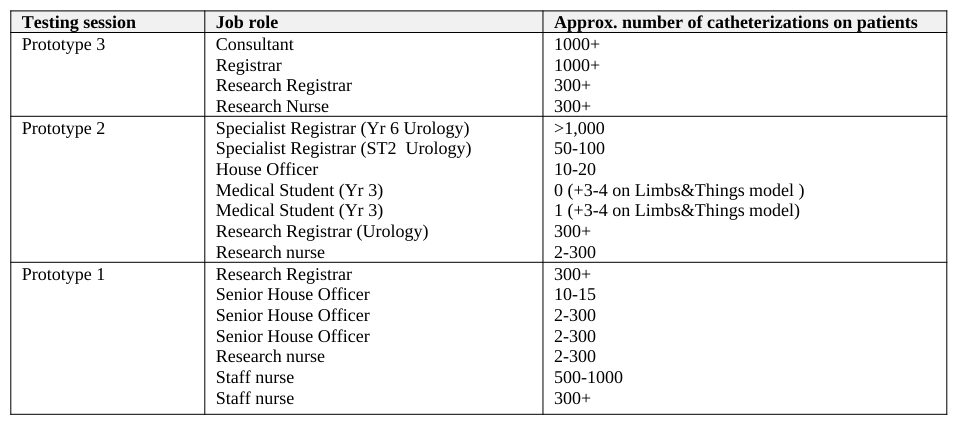
Over the twelve month period three usability workshops were held to review the design prototypes in terms of their usability and suitability for use. As is often the case in healthcare design projects, the participants were selected based on job role and experience and also availability due to clinic times. It was ensured that they represented a range of experience levels in terms catheterization. The participants are summarized below in Table 1. The aim was to ensure a safe and optimized design clinically, before investments were made to involve recipients of the device who would have limited involvement in the deployment of the device.
Table 1. A summary of participant characteristics
Usability testing Usability testing is a well-known method in product development for examining how easy to use an emerging product and its components are to use. Employing users in the assessment process can be seen as a way to obtain objective data about the product / device. Usability testing was undertaken therefore with the Catheter prototype in a simulated environment. The testing involved examination and operation of the iterations of the catheter prototype models. Functional unused prototypes were used. A male Limbs & Things Catheterization Trainer was used to test the prototypes as pictured in Figure 1. The established anatomical model facilitates the demonstration and practice of urethral (and supra-pubic) catheterization and provided a consistent test environment.
Figure 1 Limbs & Things model and testing set-up (http://www.limbsandthings.com/global/products/advanced-catheterization-trainer/)
The catheterization model and prototypes were employed in ‘think aloud’ task walkthroughs to provide a structured and task-oriented approach to evaluating the prototypes. The participants without instructions initially, were asked to walk-through catheter insertion, deployment and removal in the simulated environment and highlighted specific usability issues. The information and instructions for the catheter were then also considered. Semi-structured questions on the ease of use of the prototype compared to the existing Foley catheter, the perceived advantages and limitations of the design, and identification of necessary improvements were employed.
Findings Across the prototype development and three usability evaluation sessions, a range of feedback was collected about the device. Some of this was positive about the potential the device offered. Perhaps more usefully, much of it was critical and led to significant product improvements. For example feedback was given about the risk of infection posed by design features, as well challenges to a new used to ‘working out’ how to deploy and remove the device using the novel mechanism. As practicing clinicians, many design solutions for the usability issues identified were also provided by the participants, leading to a co-design approach to the development.
The participants whilst all being from a clinical urology background ranged significantly in their experience of catheterization. This was important to be able to assess the ease with which the device might be adopted by new and experienced user if introduced. The importance of visual cues to indicate method of use and prevent errors was clear. Early iterations of the design led the participants to perform a certain sequence of actions in the incorrect order. Design suggestions made by the participants reduced the likelihood of this is the final prototype.
User acceptance of the catheter design is important, but also of important consideration was how design features could lead to it being used incorrectly resulting in product wastage. Poor positioning of a catheter, or its failure to stay in place could have catastrophic results for the patient. These issues were important to explore in the early product development stages to ensure that investment was not made in a device with fundamental flaws.
The user involvement and multidisciplinary development team enabled a product risk assessment to be carried out. A number of risks were identified with the product, which could be mediated through design. For example identification of weak points that could be addressed through material changes and softening of edges to reduce the likelihood of tissue damage in patients. Consideration of risk also allowed assessment of the cost: benefit ratio of the new product versus existing solutions on the market.
Having developed an effective prototype that has undergone scientific and usability testing, it is the intention to take the catheter to patient review and clinical testing in the future.
DISCUSSION
It is essential to have user and broader stakeholder involvement in the design process to ensure effective and accepted solutions. A stakeholder group that represents different perspectives and that can be asked to give feedback at any stage throughout the development of a new product is an important consideration in healthcare where stakeholders can be diverse in their needs. It is also important to seek wider stakeholder opinion, balancing the need to have a tangible product to discuss, with not having invested too much on development to that stage. Having a clear and thorough risk assessment helps to keep projects well managed and controlled, but cannot eliminate the unexpected, nor make the challenge of meeting all stakeholder requirements any easier.
Cost is perhaps the single biggest driver, and the cost of full scale manufacture will impact on the final design. Unfortunately cost is often considered in the short term (e.g. cost / item) and does not adequately take into account the long term savings of improved incontinence management to the health service, or the savings made by embedding user involvement throughout the design process.
Depending on the stage of product development, involving end-users in the design of incontinence products is essential. It requires a high level of confidence and trust on the part of the patient to discuss their personal circumstances and experiences within this context. It is challenging for the design team to communicate design thinking to non-designers whilst often not being able to readily demonstrate and test the product. Furthermore involving users in health research in the UK involves necessary but complex and time-consuming applications to ethical approval committees. Often these processes are focused on clinical trials and are less tailored to user- centered design work. There is a need to explore further into how best to bring people together to work in multi- disciplinary teams including users and stakeholder to work in this neglected area.
REFERENCES
Abras, C. Maloney-Krichmar, D., Preece, J.(2004) User-centred Design. In Bainbridge, W. Encyclopedia of Human-Computer Interaction. Thousand Oaks: Sage Publications Bias, G. and Mayhew, D. (Eds) (1994). Cost-Justifying Usability. Academic Press, NewYork. Curry, A. Stark, S. Summerhill, L. (1999) Patient and stakeholder consultation in healthcare, Managing Service Quality, Vol. , no
5, pp.327 – 336 Fader, M. (2003) Review of current technologies for urinary incontinence: Strengths and limitations. Proceedings of the Institution of Mechanical Engineers, Part H: Journal of Engineering in Medicine, vol 217 no.4, pp233-241 Harrison, S. and Mort, M. (1998), Which Champions, Which People? Public and User Involvement in Health Care as a
Technology of Legitimation. Social Policy & Administration, vol 32 pp60–70. Ives, B. Olson, MH.(1984) User Involvement and MIS Success: A Review of Research Management Science Vol. 30, No. 5 pp.
586-603 Karat (1993) Cost-benefit and business case analysis of usability engineering. SIGCHI’93. Kaulio MA. (1998) Customer, consumer and user involvement in product development: A framework and a review of selected methods Total Quality Management.vol 9, no 1 pp 141-149 Kujala, S (2003) User involvement: A review of the benefits and challenges. Behaviour & Information Technology 22(1). P1-16 Owen R, Goldberg N. (2010) Responsible innovation: a pilot study with the U.K. Engineering and Physical Sciences Research
Council. Risk Anal . vol 30 no 11:pp1699-707 Sanders, EBN. (2005) From user-centred to participatory design approaches. In Frascara, J. Design and the Social Sciences.
London: CRC Press. Turner K. (2010) Ask the Experts: The effective use of focus groups. EMDT 2010 vol 1, no 9: 44-47. Vink, P. Imadac, A.S.Zinkd K.J. (2008) Defining stakeholder involvement in participatory design processes Applied Ergonomics 39 (4), pp 519–526. Vredenburg, K., Mao, J-Y., Smith, PW. Carey, T. (2002) A survey of user-centered design practice. Proceedings of the SIGCHI
conference on Human factors in computing systems: Changing our world, changing ourselves. pp 471-478 Human Aspects of Healthcare (2021)
ACKNOWLEDGEMENTS
This work was funded by the Technology Strategy Board and National Institute for Health Research Invention for Innovation Programme (i4i) Future Product Development Funding Stream 1. The authors also wish to acknowledge the numerous researchers, advisors and stakeholders who contributed to the development of these products.
LISTED IN THE AHFE DIGITAL BOOKSTORE CATALOGUE
Explore the complete digital volume
Advances in Human Aspects of Healthcare
Read this individual research paper free through the original publisher, or explore the full digital proceedings book.
ISBN 978-1-4951-2093-0
Explore this ISBN in the AHFE Bookstore ↗Listed in the July 2026 bookstore catalogue; search by ISBN to confirm current availability · Digital book purchase optional