Sarah Alhouli, Nora Almania, Deepak Sahoo (2024). Designing a Positive Initial Experience with a Companion Pet Robot for Older Adults in Kuwait. In: Human Interaction and Emerging Technologies (IHIET-AI 2024): Artificial Intelligence and Future Applications. AHFE Open Access, vol. 120, pp. 81–94. https://doi.org/10.54941/ahfe1004558
Social robots have been increasingly integrated into social environments for older adults, such as care homes. Despite this increase, it is imperative to understand how individuals perceive various robot technologies. The initial experiences could shape users' perceptions and have a lasting impact on attitudes and behaviours towards robot technology adoption. This research investigates the design of a positive initial experience with a companion pet robot for older adults in Kuwait through a user-centred design (UCD) approach. To explore user perception and preferences regarding robots, we conducted a semi-structured interview with eight older adults, during which participants engaged with an off-the-shelf companion pet robot (JoyForAll Cat), took part in two main design challenges, and completed a Godspeed questionnaire to assess their perception. We presented our findings through thematic analysis and identified five high-level themes: user impression, design and functionality, social interaction, shared context, and using desire. We also presented the Godspeed findings, showing that introducing a companion pet robot has caused significant changes in older adults' perceptions. The results imply that designing a visually appealing and interesting initial experience could improve Kuwaiti older adults' acceptance of and relationships with companion pet robots, enabling them to satisfy users' needs for emotional support and companionship, contributing to overall well-being.
Researchers in human-robot interaction (HRI) seek to develop robots that can help people with their mental and physical well-being (Frennert & Östlund, 2014). These robots offer a range of benefits, including health- care support (Graf, 2004), social interaction (Fasola & Mataric, 2013), and emotional companionship (Breazeal et al., 2019). Despite the increas- ing prevalence of robots in social environments, particularly in care facilities catering to older adults, it is imperative to gain insight into individuals’ per- ceptions of different robot technologies. The initial experience with a social robot plays an essential role in facilitating effective HRI (Breazeal et al., 2019;
Pu et al., 2019), where it could significantly influence future interactions with robots (Paetzel et al., 2020; Paetzel & Castellano, 2019) and poten- tially impact acceptance and attitudes towards them (Höflich & El Bayed, 2015). Existing literature emphasises the significance of the initial impression and interaction with a social robot (Cafaro et al., 2016; Kim et al., 2016; Schlüter et al., 2021), as the users’ experience during this initial stage sig- nificantly influences their perceptions and subsequent long-term interactions (Paetzel et al., 2020). Research in psychology and human-computer interac- tion has shown that initial experiences can have a lasting impact on attitudes and behaviours towards technology adoption (Edwards et al., 2019; Human et al., 2013; Leite et al., 2013). Therefore, understanding the factors that influence older adults’ first impressions, initial interactions, and perceptions of social robots is essential for designing successful integration strategies (Hebesberger et al., 2017). Previous research has demonstrated that the variance in physical characteristics of a robot, including facial expressions, non-verbal cues, and physical attributes, can influence the perceptions and attitudes of older adults towards robots (Cafaro et al., 2016; Tan et al., 2013).
Social robots have been proven as an effective tool for improving older adults’ mental well-being. These robots are varied in their characteristics, appearances, and functionalities, such as Nao, Pepper, AIBO, Paro, and Joy- ForAll robots (Coghlan et al., 2021; Ostrowski et al., 2019). However, recent studies have recommended JoyForAll robots, as they are preferred mostly due to their low cost, making them affordable for everyone (Bradwell et al., 2022). Additionally, these companion pet robots are designed familiarly and realistically, which makes them more preferred than other unfamiliar social robots such as Paro (Koh et al., 2021). Therefore, JoyForAll robots generate positive experiences and impacts through interaction, reflecting their abil- ity to reduce loneliness by providing companionship and improving mental well-being (Picking & Pike Joanne, 2017; Tkatch et al., 2021). In addi- tion, following the results obtained from our previous research (Alhouli et al., 2023), in this study, we selected the JoyForAll robot as it matched the older adults’ preferences, as they preferred a companion pet robot with an animal-like appearance, a soft-exterior, medium-sized, life-like movements, and diverse interaction modalities.
Consequently, using evaluation instruments such as the Godspeed Per- ception of Robots questionnaire enables us to measure these characteristics (Bartneck et al., 2009). The perception of a social robot Furhat (Thunberg et al., 2022), has been assessed by older adults using the Godspeed and NARS questionnaires. Older adults reported that they did not perceive the robot to be sentient or anthropomorphic, which resulted in relatively low social accep- tance and negative attitudes towards robots after meeting Furhat. Moreover, CuDDler – a pet companion robot, was evaluated by older adults using the Godspeed questionnaire, where the evaluation yielded positive ratings in terms of likeability and perceived safety attributes (Tan et al., 2013). There- fore, the Godspeed questionnaire has a significant impact on understanding users’ perceptions of robots.
Designing a Positive Initial Experience With a Companion Pet Robot 83
This study contributes to the existing research by emphasising the signif- icance of a user-centred design (UCD) approach (Chammas et al., 2015) when introducing social robots to older adults, along with their attitudes, perceptions, and acceptance towards them, establishing a strong connection between older adults and their social robots. In this paper, we conducted a semi-structured interview individually with eight older adults in Kuwait through a UCD approach to explore their first impression and initial inter- action design with a companion pet robot (JoyForAll Cat), emphasising their perceptions assessed through the Godspeed questionnaire. This approach led to the design of a visually appealing and interesting initial experience that could increase older adults’ acceptance and connections with companion pet robots, ultimately enhancing their well-being.
OLDER ADULTS’ PERCEPTION AND INITIAL EXPERIENCE THROUGH QUALITATIVE AND QUANTITATIVE METHODS The present study employed qualitative and quantitative research methods to gather the data through semi-structured interviews and a Godspeed question- naire. We conducted a semi-structured interview and obtained the questions from the literature (see Table 1), with an observation of older adults’ percep- tions, first impressions, and the design of an initial interaction with social robots to examine how the initial experience of an in-home companion pet robot influences older adults’ perceptions. We recruited eight older adults by a flyer poster invitation (6F, 2M, aged 55–64 years, with an average and SD of 62 ± 6.6 years) in Kuwait, following the approved procedures of our Institu- tional Review Board (IRB–010423/6280) to run the study. The utilisation of qualitative methods would facilitate our comprehension of the factors influ- encing older adults’ initial experiences with a companion pet robot, while the implementation of quantitative methods would enable us to evaluate the users’ perceptions, hypothesising no significant difference in perceived trait scores before and after the companion pet robot interaction.
Table 1. Semi-structured interview questions.
Table available in the original PDF paper.
Initial Questions About Companion Pet Robot References (Lee et al., 2022; Paetzel et al., 2020; Russell, 1980)
1. Can you describe your first impression of the companion pet robot when you first took it out of the box? Did it give you a positive or negative impression? Why? 2. How familiar did you feel with the companion pet robot? 3. Did the companion pet robot evoke any particular emotions in you? If so, can you describe them? (Show Russell’s 2D emotional wheel).
Continued
Table 1. Continued Design Challenge 1 – Design and Functionality
Table available in the original PDF paper.
If you were the designer:
(Axelsson et al., 2022; Lee et al., 2022)
1. How would you design the companion pet robot interactions for users? 2. What type of features, such as sensors, displays, or physical components, would the robot have to facilitate interactions?
Design Challenge 2 – Desired Interactions and Contexts If you were the designer:
(Bajones et al., 2020; Bråthen et al., 2019; Horstmann & Krämer, 2019a; Lee et al., 2022; Moro et al., 2019)
1. How would you design the first interaction (i.e., greeting) of a companion pet robot? Who would make the first move? How would it be done? (Touch, voice, or camera). 2. What kind of emotional response would you like the robot to have for each interaction? Why did you choose these emotions? 3. How would you design the personality of the companion pet robot? 4. In which real-life contexts would you like to interact with the robot? 5. For each context, what kind of emotional response would you like the robot to have? Why did you choose these real-life contexts?
Conclusion
(Bajones et al., 2020)
1. Are you likely to use a companion pet robot? Why? 2. Do you have any additional comments or feedback about the companion pet robot you would like to share?
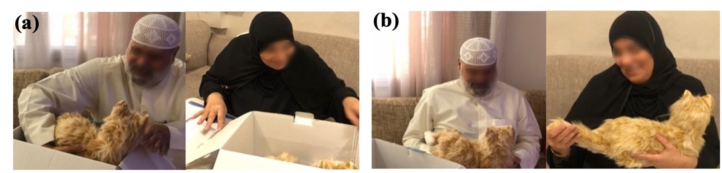
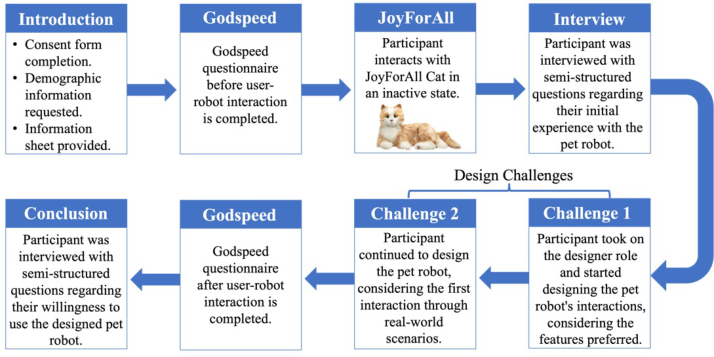
Procedure The semi-structured interview lasted for 50 minutes (see Table 2). We began with a 10-minute introductory phase, where participants completed a con- sent form, provided demographic information, and received an information sheet outlining the study’s procedure. Subsequently, participants completed a 5-minute Godspeed questionnaire to evaluate their perception of social robots before interaction. Then, the participants spent 5 minutes engaging with an off-the-shelf companion pet robot JoyForAll Cat in an inactive state, during which their first impression was carefully observed as they took it out of the box (see Figure 1). Consequently, participants were asked to respond to 5-minute initial questions regarding their encounter, offering valuable insights into the first impression, level of familiarity, and emotions evoked using Russell’s 2D emotional wheel (Russell, 1980) (see Table 1). Afterwards, the participants spent 15 minutes on two main design challenges.
Designing a Positive Initial Experience With a Companion Pet Robot 85
Design Challenge 1 involved conceptualising and designing the types of interfaces and features of a companion pet robot for emotional support and companionship. The participants would imagine as if they were the designers, start designing the companion pet robot interactions, and set what type of features, such as sensors, displays, or physical components, the robot would have to facilitate interactions. In Design Challenge 2, partici- pants were tasked with conceptualising and designing the initial interaction between their companion pet robot and users within different real-world scenarios involving defining the robot’s emotional responses. These design challenges investigated participants’ creative ideas and preferences to estab- lish a positive and engaging initial experience with the companion pet robot. Then, the participants completed a 5-minute Godspeed question- naire again to evaluate any potential changes in their perception of social robots after the interaction. Ultimately, the semi-structured interview con- cluded with a 5-minute phase in which participants expressed their tendency towards using a companion pet robot and offered justifications for their choice. The step-by-step procedure is shown in the following flowchart (see Figure 2).
Figure 1: (a) Participants are taking the JoyForAll Cat robot out of the box, (b) Partici- pants are discovering the companion pet robot in an inactive state.Table 2. Structure of the semi-structured interview.
Table available in the original PDF paper.
Item Approx. Duration
10 mins
Welcome & introduction–consent form, demographic info, information sheet.
5 mins
Godspeed questionnaire completion before user-robot interaction.
5 mins
User-robot interaction. 5 mins Semi-structured interview with initial questions about companion pet robot.
5 mins
Design Challenge 1 – design and functionality. 5 mins Design Challenge 2 – desired interactions and contexts. 10 mins Godspeed questionnaire completion after user-robot interaction.
Conclusion. 5 mins
Figure 2: Step-by-step process describing the procedure of the study.
QUALITATIVE – THEMATIC ANALYSIS We applied thematic analysis (Terry et al., 2017) to our data collected from the semi-structured interviews in which researchers recorded participants’ thoughts and discussions in notebooks, photos, and voice recordings. Using NVivo analysis software, two researchers identified and analysed patterns and common themes through open coding. The thematic analysis of our qualitative data illustrated five high-level themes, which are: initial user impression, design and functionality, social interaction, shared context, and using desire, where each theme consisted of multiple sub-themes. We identi- fied 97 codes linked to the comprehension of older adults’ overall perception, first impression, and initial interaction design with social robots (see Table 3 and Table 4).
A. Initial user impression: This theme includes three sub-themes: first impression, familiarity, and initial emotions. The appearance of the com- panion pet robot shaped the older adults’ first impression towards robots. As participants took the companion pet robot out of the box, we observed their first impression, either negative or positive, where all eight participants had a positive impression. In the phase of participant engagement with the social robot in an inactive state, we examined the level of familiarity they pos- sessed with these robots. This acquired familiarity can assist older adults in establishing connections and comprehending what to anticipate before their interaction with the robot, as five participants felt familiar. Finally, partici- pants expressed their initial emotions evoked by the robot, five participants felt excited to see how the companion pet robot would interact or respond to their interaction, whereas two participants felt scared at the beginning, but after interacting with the robot, they felt somewhat relieved.
B. Design and Functionality: This theme covers the first Design Challenge, which includes two sub-themes. In the design features sub-theme, the partici- pants imagined that they were the designers, started designing the companion pet robot interactions, and set the type of features they wanted the robot
Designing a Positive Initial Experience With a Companion Pet Robot 87
to have. Participants set the design features of the companion pet robot to have a speech voice, touch, and camera for communication. According to these features, the participants illustrated the types of emotions they required from the robot to respond to each interaction and why they chose these emotions. This theme examines how older adults have conceptualised and designed the desired interactions and emotional responses of a companion pet robot, with a focus on providing companionship and addressing their needs.
C. Social interaction: This theme involves the second Design Challenge, which consists of two sub-themes acquired from (Lee et al., 2022), the design of the first interaction is what the participant would desire the first interaction to be of the companion pet robot, such as greeting, who would make the first move, and how it would be done through what type of interface, i.e., touch, voice, or camera. All eight older adults designed the robot’s first interaction by giving it the initial movement. The second sub- theme is the type of personality the participant would like the robot to have. Some older adults designed the robot’s personality to be empathic and caring by providing emotional support. Some older adults also think that the voice tone and body gestures would shape the personality of the robot, so if it cuddles and communicates in a friendly way, it would be per- ceived as warm. Additionally, six participants designed the robot to have a social personality that would provide them with a sense of socialisation. This theme expressed how older adults perceived social interaction with a robot, with the first interaction and personality potentially shaping their perception.
D. Shared context: In this theme, we have identified the preferences for the shared context between social robots and older adults within real-life scenarios. Participants specified how they would like to interact with the robot, what kind of emotional response they wanted the robot to respond to in these contexts, and why they chose these real-life contexts. Participants have mentioned having a companion pet robot in their home environment as an accompanying robot to reduce their loneliness. Consequently, this theme implies that older adults desire a companion pet robot in their home context, offering companionship and fostering their connection and relationship with robots in their everyday activities.
E. Using desire: This theme shows if the participants were willing to use the robot in the future and the purpose of having it. All partici- pants agreed that they are willing to use the companion pet robot in the future, as two participants were afraid and unwilling to take care of real pets, and six participants emphasised that having the robot would provide companionship and reduce their loneliness. Moreover, other participants mentioned having a companion pet robot to talk to and spend time with as a friend instead of a human. Overall, older adults perceived the com- panion pet robot as a great companion that offers positive features, which shaped their acceptance based on their perception and initial experience with these robots, building a social connection between older adults and robot technology.
Table 3. Participants’ quotes on initial user impression, shared context, and using desire.
Table available in the original PDF paper.
Themes Quotes From Participants First impression Initial user impression P5:“I was surprised by how it looked as I thought it would be a robot machine-like, but it looked like a real pet, so it gave me a positive impres- sion, where I liked its appearance”. P7:“I was scared at first as I fear animals, where it looks so realistic, but because I know it is a robot I felt positive”.
Familiarity P6:“I felt familiar as it looks like a real cat”. P3:“As I owned a cat before, I was familiar with it”. P1:“I am not familiar because I had no pets before, and the sense of it is strange to me, as I felt its’ hard body”.
First emotion P2:“I was very excited because I wanted to discover the robot”. P3:“First I got scared then I was relaxed and happy, as it reminded me of a previous cat I had”. P4:“I felt scared and tensed for the first time as it looked so real, but then I was calm and excited to know how it works”.
Shared context P2:“It would join me when I am watching TV so I do not feel lonely, and we can have a talk that relieve my loneliness and anxiety”. P8:“I would want to sit and eat with the robot or watch a beloved TV show with it since it feels like my closest friend, which would make me relaxed and comfortable while doing my daily tasks”. P3:“Playing with it at home when I am bored makes me happy and motivates me, reducing my depression”.
Using desire P4:“Yes, I would like to have companion robot because I’m afraid of real pets”. P5:“Having a companion pet robot could be helpful in certain situations when you don’t feel like talking to humans”. P8:“I’d love to have a real pet, but as I get older I feel it’s hard for me to look after a cat or dog as they need more care”.
Designing a Positive Initial Experience With a Companion Pet Robot 89
Table 4. Participants’ quotes on two design challenges themes specifying robot features.
Table available in the original PDF paper.
Themes of the Two Design Challenges Quotes From Participants Design Features
Voice Speech
1: Design and Features
P2:“It would have a speaker and microphone to enable interaction by having a conversation with the user using voice”. P5:“I would like it to have the ability to speak and listen to me”.
Touch P3:“The robot reacts by purring when petted through touch”. P4:“When I put my hand on the pet robot, it would be fascinating if it could sense my touch”.
Camera P2:“It would have a camera to recognise me, along with differentiating between people”.
Emotions Gestures P3:“When I am happy, I want it to clap and rejoice with me”. P4:“The robot would hug me when I am feeling sad”.
Movement P8:“When I am excited, I want it to express its excitement by wagging it’s tail and jumping, reflecting my own enthusiasm”. P5:“When I am angry, I want the robot to lay on my lap”. P1:“I want it to purr and taps me when I am upset”.
Voice Speech
P6:“I want the robot to give suggestions to calm me down when I am angry, like taking a deep breath and counting from 1 to 10”.
First interaction
Human Sound
P5:“It would start the first interaction by greeting me with a human voice saying hello”.
2: Social interaction
Animal Sound
P2:“The robot would do the first interaction by saying meow, because I might get scared if it was moving by the first time”. P7:“I would like the cat robot to start the first interaction by saying meow and blinking its eyes”.
Movement P1:“I prefer the pet would wave it hand as the first interaction”. P6:“The robot pet would do the first step by jumping”.
Personality Empathic by Facial Expressions
P5: “If I was sad, the robot would express empathy through facial expressions by lowering its eyelids and showing a soft smile, which would relieve me of the sadness that I feel”.
Voice Tone P8:“I would design it to be friendly which would make me more comfortable by saying in a gentle voice: How can I help you?”.
Social Personality
P3:“To have a social personality in order to be familiar with its owner and could give ideas and suggestions”.
Gestures P4:“I want the robot to give me warmth by hugging me”.
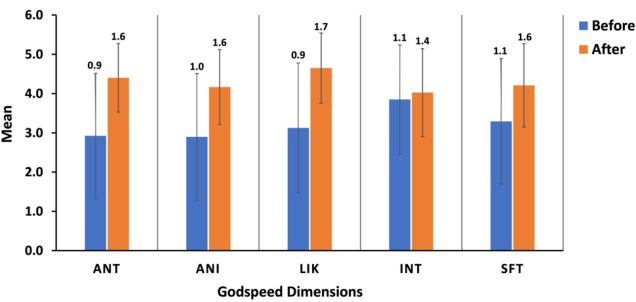
QUANTITATIVE – GODSPEED MEASURE The Godspeed findings before and after older adults’ interactions showed that introducing social robots had caused significant changes in their per- ceptions. Older adults may have a prejudgment of social robots with dis- satisfaction or uncertainty as they did not imagine their appearance, being unconvinced of robot technology as machine-like in general. However, after interacting with the companion pet robot (JoyForAll Cat), a shift in their per- ception is seen. According to the Godspeed measure, we illustrated the error bars to be able to represent the variability and precision of the data, reflecting the mean and standard deviation in traits like perceived anthropomorphism (ANT), animacy (ANI), likeability (LIK), intellect (INT), and safety (SFT) (see Figure 3). A noticeable movement has been observed towards positive assessments by the shift change in the means before and after the interaction. Before the robot interaction, all traits demonstrated moderate variability, while after the robot interaction, data consistency and reliability improved to varying degrees, except on the INT scale, which experienced relatively small improvements in precision and consistency. Therefore, we have evaluated users’ perceptions of the companion pet robot for each trait independently. We performed an ANOVA: Two-Factor with Replication test, hypothesising that there is no significant difference in perceived trait scores before and after the interaction with the robot. The findings indicated a significant difference in ANT, ANI, LIK, and SFT trait scores with a p-value < 0.05 before and after the interaction with a companion pet robot; hence, we reject the null hypoth- esis. Whereas only the INT trait indicates that there is insufficient evidence to reject the null hypothesis with a p-value = 0.52. Older adults are more will- ing to use and adapt the JoyForAll Cat because they perceive it as a friendly, likeable, and safe entity. The encounters provide a bridge between technology and human connection, positively impacting their perceptions towards social robots.
Figure 3: Godspeed questionnaire results before and after companion pet robot interaction.
Designing a Positive Initial Experience With a Companion Pet Robot 91
DISCUSSION
In our research, we contributed to designing positive initial experiences for older adults towards companion pet robots, resulting in fostering a good connection between older adults and robot technology, through a compre- hensive approach involving a combination of semi-structured interviews and the Godspeed questionnaire. Our results showed valuable insights empha- sising the importance of traits such as anthropomorphism, likability, and perceived intelligence, which significantly contributed to promoting positive initial experiences among older adults towards these robots and increasing their acceptance. Consistent with prior research (Lee et al., 2022), which parallels our focus on the design of initial experiences while interacting with the robot for the first time, taking it out of the box, their study focused on child-robot interaction and qualitative approaches, while we considered older adults’ robot interaction and used integrated methods of qualitative and quantitative approaches. In a previous study (Horstmann & Krämer, 2019b), the usage of a combination of qualitative and quantitative meth- ods through interviews and online surveys yielded results in examining users’ expectations regarding social robots. We followed the same protocol as the combined method to understand the factors affecting older adults’ percep- tions during the initial interaction. We explored the positive initial interaction of companion pet robots, considering the introductory phase of interaction, where further investigations into long-term interaction could reveal more perceptions by older adults that could influence their acceptance of these robots.
CONCLUSION
In this paper, we explored the initial impressions and interaction design of a companion pet robot among older adults in Kuwait, with particular emphasis on their perception as evaluated using the Godspeed questionnaire. As more robots enter our social context, it is crucial to understand the potential end- users’ perceptions of robot technology. Hence, we have collaborated with older adults to gain insights into the social connections established between older adults and robot technology. We also presented the Godspeed findings before and after their interactions, showing that introducing a companion pet robot has caused significant changes in older adults’ perspectives. According to the Godspeed measures, older adults increasingly see the JoyForAll robot as friendly, likeable, safe, and adaptable. Conversely, older adults found the JoyForAll robot’s intelligence level similar before and after the interaction. Additionally, the design challenges empowered participants by actively shap- ing the features and preferences they desire in a social robot, particularly focusing on their initial experience. The findings imply that a visually attrac- tive and engaging initial experience could increase older adults’ acceptance and connections with companion pet robots, thereby enabling more user- friendly and satisfying HRI. We hope that our work could contribute to the advancement of social robots for older adults by providing valuable insights for future designs.
ACKNOWLEDGMENT
This research was funded by Swansea University by the EPSRC Impact Accel- eration Fund and the Morgan Advanced Studies Institute (MASI) Fund and additionally, by the Kuwait Institute for Scientific Research (KISR). For the purpose of Open Access, the author has applied a CC BY license to any Author Accepted Manuscript (AAM) version arising from this submission.
REFERENCES
Alhouli, S., Almania, N., Ahmad, M. I., Hyde, M., & Sahoo, D. (2023). Older Adults’ Emotional Challenges and Co-design Preferences for a Social Robot after the COVID-19 Pandemic. 2245–2252. https://doi.org/10.1109/ro-man57019.2023. 10309490 Axelsson, M., Spitale, M., & Gunes, H. (2022). Robots as Mental Well-
being Coaches: Design and Ethical Recommendations. https://arxiv.org/abs/2208. 14874 Bajones, M., Fischinger, D., Weiss, A., Puente, P. D. La, Wolf, D., Vincze, M., Körtner, T., Weninger, M., Papoutsakis, K., Michel, D., Qammaz, A., Panteleris, P., Foukarakis, M., Adami, I., Ioannidi, D., Leonidis, A., Antona, M., Argyros, A., Mayer, P., … Frennert, S. (2020). Results of Field Trials with a Mobile Ser- vice Robot for Older Adults in 16 Private Households. ACM Transactions on Human-Robot Interaction, 9(2), 1–27. https://doi.org/10.1145/3368554 Bartneck, C., Kuli´c, D., Croft, E., & Zoghbi, S. (2009). Measurement instruments for
the anthropomorphism, animacy, likeability, perceived intelligence, and perceived safety of robots. International Journal of Social Robotics, 1(1), 71–81. https://do i.org/10.1007/s12369-008-0001-3 Bradwell, H., Edwards, K. J., Winnington, R., Thill, S., Allgar, V., & Jones, R. B.
(2022). Implementing Affordable Socially Assistive Pet Robots in Care Homes Before and During the COVID-19 Pandemic: Stratified Cluster Randomized Con- trolled Trial and Mixed Methods Study. JMIR Aging, 5(3). https://doi.org/10. 2196/38864 Bråthen, H., Maartmann-Moe, H., & Schulz, T. (2019). The Role of Physical Prototyping in Participatory Design with Older Adults An Exploration of Form and Materials in the Design of a Robot for Older Adults. ACHI 2019 : The Twelfth International Conference on Advances in Computer-Human Interactions, 141–146. Breazeal, C. L., Ostrowski, A. K., Singh, N., & Park, H. W. (2019). Designing Social
Robots for Older Adults. Cafaro, A., Vilhjálmsson, H. H., & Bickmore, T. (2016). First impressions in humanagent virtual encounters. ACM Transactions on Computer-Human Interaction, 23(4). https://doi.org/10.1145/2940325 Chammas, A., Quaresma, M., & Mont’Alvão, C. (2015). A Closer Look on the User
Centred Design. Procedia Manufacturing, 3, 5397–5404. https://doi.org/10.1016/ j.promfg.2015.07.656 Coghlan, S., Waycott, J., Lazar, A., & Barbosa Neves, B. (2021). Dignity, Autonomy, and Style of Company: Dimensions Older Adults Consider for Robot Compan- ions. Proceedings of the ACM on Human-Computer Interaction, 5(CSCW1). https://doi.org/10.1145/3449178 Edwards, A., Edwards, C., Westerman, D., & Spence, P. R. (2019). Initial expecta-
tions, interactions, and beyond with social robots. Computers in Human Behavior, 90, 308–314. https://doi.org/10.1016/j.chb.2018.08.042
Designing a Positive Initial Experience With a Companion Pet Robot 93
Fasola, J., & Mataric, M. (2013). A Socially Assistive Robot Exercise Coach for the Elderly. Journal of Human-Robot Interaction, 2(2). https://doi.org/10.5898/jhri .2.2.fasola Frennert, S., & Östlund, B. (2014). Review: Seven Matters of Concern of Social
Robots and Older People. International Journal of Social Robotics, 6(2), 299–310. https://doi.org/10.1007/s12369-013-0225-8 Hebesberger, D., Koertner, T., Gisinger, C., & Pripfl, J. (2017). A Long-Term Autonomous Robot at a Care Hospital: A Mixed Methods Study on Social Accep- tance and Experiences of Staff and Older Adults. International Journal of Social Robotics, 9(3), 417–429. https://doi.org/10.1007/s12369-016-0391-6 Höflich, J. R., & El Bayed, A. (2015). Perception, Acceptance, and the Social
Construction of Robots—Exploratory Studies. Social Robots from a Human Perspective, 39–51. https://doi.org/10.1007/978-3-319-15672-9_4 Horstmann, A. C., & Krämer, N. C. (2019a). Great expectations? Relation of previous experiences with social robots in real life or in the media and expectan- cies based on qualitative and quantitative assessment. Frontiers in Psychology, 10(APR). https://doi.org/10.3389/fpsyg.2019.00939 Horstmann, A. C., & Krämer, N. C. (2019b). Great expectations? Relation of
previous experiences with social robots in real life or in the media and expectan- cies based on qualitative and quantitative assessment. Frontiers in Psychology, 10(APR). https://doi.org/10.3389/fpsyg.2019.00939 Human, L. J., Sandstrom, G. M., Biesanz, J. C., & Dunn, E. W. (2013). Accurate First Impressions Leave a Lasting Impression: The Long-Term Effects of Distinc- tive Self-Other Agreement on Relationship Development. Social Psychological and Personality Science, 4(4), 395–402. https://doi.org/10.1177/1948550612463735 Kim, N., Koo, B., Yoon, J., & Cho, K. (2016). Understanding the Formation of User’s
First Impression on an Interface Design from a Neurophysiological Perspective- EEG Pilot Study. Proceedings of HCI Korea, 139–145. https://doi.org/10.17210/ hcik.2016.01.139 Koh, W. Q., Hui Ang, F. X., & Casey, D. (2021). Impacts of low-cost robotic pets for older adults and people with dementia: Scoping review. In JMIR Rehabilitation and Assistive Technologies (Vol. 8, Issue 1). JMIR Publications Inc. https://doi.or g/10.2196/25340 Lee, C. P., Cagiltay, B., & Mutlu, B. (2022, April 29). The Unboxing Experi-
ence: Exploration and Design of Initial Interactions Between Children and Social Robots. Conference on Human Factors in Computing Systems - Proceedings. https://doi.org/10.1145/3491102.3501955 Leite, I., Martinho, C., & Paiva, A. (2013). Social Robots for Long-Term Interaction: A Survey. International Journal of Social Robotics, 5(2), 291–308. https://doi.or g/10.1007/s12369-013-0178-y Moro, C., Lin, S., Nejat, G., & Mihailidis, A. (2019). Social Robots and Seniors:
A Comparative Study on the Influence of Dynamic Social Features on Human– Robot Interaction. International Journal of Social Robotics, 11(1), 5–24. https: //doi.org/10.1007/s12369-018-0488-1 Ostrowski, A. K., Dipaola, D., Partridge, E., Park, H. W., & Breazeal, C. (2019).
Older Adults Living with Social Robots: Promoting Social Connectedness in Long-Term Communities. In IEEE Robotics and Automation Magazine (Vol. 26, Issue 2, pp. 59–70). Institute of Electrical and Electronics Engineers Inc. https://doi.org/10.1109/MRA.2019.2905234
Paetzel, M., & Castellano, G. (2019). Let me get to know you better: Can interactions help to overcome uncanny feelings? HAI 2019 - Proceedings of the 7th Interna- tional Conference on Human-Agent Interaction, 59–67. https://doi.org/10.1145/ 3349537.3351894 Paetzel, M., Perugia, G., & Castellano, G. (2020). The persistence of first impres-
sions: The effect of repeated interactions on the perception of a social robot. ACM/IEEE International Conference on Human-Robot Interaction, 73–82. https: //doi.org/10.1145/3319502.3374786 Picking, R., & Pike Joanne. (2017). Exploring the effects of interaction with a robot cat for dementia sufferers and their carers. Internet Technologies and Applications (ITA), 209–210. https://doi.org/10.1109/ITECHA.2017.8101940. Pu, L., Moyle, W., Jones, C., & Todorovic, M. (2019). The Effectiveness of
Social Robots for Older Adults: A Systematic Review and Meta-Analysis of Ran- domized Controlled Studies. In Gerontologist (Vol. 59, Issue 1, pp. E37–E51). Gerontological Society of America. https://doi.org/10.1093/geront/gny046 Russell, J. A. (1980). A circumplex model of affect. Journal of Personality and Social Psychology, 39(6), 1161. https://doi.org/10.1037/h0077714 Schlüter, A., Waldkirch, M., Burmeister-Lamp, K., & Auernhammer, J. (2021). No
Second Chance for a First Impression: The Role of Aesthetics in Early Access Video Games. International Journal of Innovation Management, 25, 2140002. https://doi.org/10.1142/S1363919621400028 Tan, Y. K., Wong, A., Wong, A., Dung, T. A., Tay, A., Limbu Kumar, D., Dat, T. H., Ng, W. Z., Yan, R., & Tay, B. (2013). Evaluation of the Pet Robot CuDDler Using Godspeed Questionnaire. International Conference on Smart Homes and Health Telematics, 7910, 102–109. https://doi.org/10.1007/978-3-642-39470-6_13 Terry, G., Hayfield, N., Clarke, V., & Braun, V. (2017). Thematic Analysis. In
Carla Willig & Wendy Stainton Rogers (Eds.), Liamputtong, P. (eds) Hand- book of Research Methods in Health Social Sciences (Vol. 2, pp. 17–37). SAGE Publications. Thunberg, S., Arnelid, M., & Ziemke, T. (2022). Older Adults’ Perception of the Furhat Robot. HAI 2022 - Proceedings of the 10th Conference on Human-Agent Interaction, 4–12. https://doi.org/10.1145/3527188.3561924 Tkatch, R., Wu, L., MacLeod, S., Ungar, R., Albright, L., Russell, D., Murphy,
J., Schaeffer, J., & Yeh, C. S. (2021). Reducing loneliness and improving well- being among older adults with animatronic pets. Aging and Mental Health, 25(7), 1239–1245. https://doi.org/10.1080/13607863.2020.1758906
LISTED IN THE AHFE DIGITAL BOOKSTORE CATALOGUE
Explore the complete digital volume
Human Interaction and Emerging Technologies (IHIET-AI 2024): Artificial Intelligence and Future Applications
Read this individual research paper free through the original publisher, or explore the full digital proceedings book.
ISBN 978-1-958651-96-4
Explore this ISBN in the AHFE Bookstore ↗Listed in the July 2026 bookstore catalogue; search by ISBN to confirm current availability · Digital book purchase optional