Hanzhang Dong (2024). A cross-cultural contextual study of Wong Kar-wai’s films driven by online reviews. In: Human Interaction and Emerging Technologies (IHIET-AI 2024): Artificial Intelligence and Future Applications. AHFE Open Access, vol. 120, pp. 123–132. https://doi.org/10.54941/ahfe1004562
With the development of science and technology, the distance between people in space is getting smaller and smaller, and economic globalization has been a historical inevitability. At the time of accelerating globalization, the film and television industry, as a part of the economy, cannot escape the impact of globalization. Moreover, compared with other industries, film and television works often carry more cultural connotations. How should filmmakers cope with the cultural differences in storytelling, create cross-cultural works, and get the same or different word-of-mouth feedback from different cultural groups? In the current multi-cultural context, Wong Kar-wai can be said to be one of the representative figures. In his films, From "Carmen", "Ashes of Time" and "Days of Being Wild" to "Chungking Express", "In the Mood for Love" and "The Grandmaster", Wong Kar-wai has been widely understood and accepted in different cultural and social contexts. This article start with online comments and study the elements of cross-cultural film creation in the context of globalization according to data mining technology. Research methods and processes: Firstly, data acquisition and pre-processing are carried out. The data source of online comments needs to be determined before crawling the review data. For the research objects selected in this study, the relevant sections of online movie rating websites, online movie platforms and social attribute platforms with large audiences were chosen as data source. For example, metascore has a weighted average of many movie reviews from well-known critics, which is highly reliable. Then, the key step in text mining is word segmentation. It's the process of breaking a sentence into several words. Accurate word segmentation can improve the efficiency and accuracy of subsequent text mining. After the word cloud is established, attribute features of the comments are extracted and classified, and the factors that highly affect the acceptance and empathy of Wong Kar-wai's film works in the cross-cultural context are summarized. Finally, combined with the study of his film scenes and narrative structure, the research focuses on the following factors:1.Theme selection: Explore universal themes, such as love, loneliness, loss and dreams. These themes are cross-cultural, and people face similar issues and emotions across cultures.2.Narrative structure: Such as non-linear narrative structure, which not only increases the complexity of the film, but also provides the audience with space to think and interpret, so that audiences from different cultural backgrounds can interpret the film in different ways.3.How emotions are expressed: Wong Kar-wai's films emphasize the emotions and inner world of characters, which is a universal emotional experience that can touch people's emotions across cultural boundaries.4.Character complexity: Complex and multi-dimensional characters with unique personalities, desires and inner conflicts enable the audience to immerse themselves in understanding the inner journey of these characters, regardless of their cultural background.5.The beauty of cultural elements: Different cultural elements, such as the backgrounds and traditions of China Mainland, Hong Kong, or elsewhere. Although these elements sometimes have a specific impact on the story, they are usually presented in an aesthetic and emotional way that allows the audience to enjoy the film without knowing the cultural details.6.Aesthetic of sight and sound: Films have a distinctive vision and sound style. Create memorable movie atmospheres. This visual and aural allure can transcend the language barrier and touch the hearts of the audience.In a word, the reason why Wong Kar-wai's films can be accepted and understood by people in cross-cultural contexts will be explored in a more specific way along the above directions, and the methods of film creation will be explored under the background of multi-context globalization.
Since its inception, the film has been regarded as an art form accepted by the public. Compared with other industries, film and television works often carry more cultural connotations. Audiences are important participants in the creation, dissemination and practice of culture. The development of globalization has resulted in a diversified cultural context. In cross-cultural communication, the transmitter and receiver are in different cultural back- grounds and environments, so it is easy to produce cultural misinterpretation and incomprehension in the process of “decoding”. In the cross-cultural context, Wong Kar-wai (born in 1958 in Shanghai, Hong Kong film direc- tor, producer and screenwriter) rooted in the post-modern context, deeply reveals the current state of mind of Hong Kong people, and the film has obvious contemporary characteristics and humanistic concern in the level of meaning. In terms of narrative strategy, the film is clearly characterized by
postmodernism, with a large number of monologues and exquisite images and tones as the distinctive features of the film. The film is rooted in a post-modern context, and he has a very deep understanding of his own city and era, and he has found an appropriate way to express his life experi- ence in such a special external environment. The inorganic and symbolic nature of the modern city in his films makes his work often one in which the content is hidden in the form and style, or rather, the style itself is sometimes his content. The characters in his films are marginalized; they often have no clear identity, their names are just a code name or even a number, and what they focus on is their emotions. The film has a clear con- temporary character and humanistic concern at the level of meaning. For audiences from cross-cultural backgrounds, the commonality of emotions and inner consciousness creates a sense of shock and authenticity. Based on the feedback given by the audience, this paper analyzes why Wong Kar-wai’s movies can successfully accomplish the communication in cross-cultural context.
THE CONCEPT OF ONLINE REVIEWS The concept of an online review of a film is a description or evaluation of the film posted by the viewer on an internet platform. The posted reviews are public and can provide reference for viewers who want to see the film and can also form communication among viewers who have seen the film. Online reviews are posted by viewers who have seen the film, so they are objective and impartial relative to the publicity released by it. The text con- tent of online reviews can be stored and accumulated for a long time, which can provide people with a huge amount of information resources. The text information of the reviews objectively reflects the audience’s acceptance of the film. However, not all comments are valuable, and due to the anonymity, non-face-to-face contact, and low communication costs of the Internet, the quality of comments often varies. Therefore, it is important to identify valu- able information in online review texts in a timely and effective manner. The number of online comments usually indirectly reflects the number of viewers of a film. Meanwhile, due to the word-of-mouth effect of online comments, viewers may think that the more online comments a film has, the more watchable it may be. It has an important impact on the willingness to watch.
Wong Kar-wai, a contemporary Hong Kong filmmaker whose work style specializes in unique aesthetics of light and shadow, has won several Hong Kong Film Awards and European Film Awards, as well as a number of major international film awards, including the César Film Awards, New York Film Critics Circle Awards, and National Society of Film Critics Awards. Audiences of different cultural backgrounds have been receptive to his works. It reflects the cross-cultural context. In this paper, we will select three of Wong Kar-wai’s works, Days of Being Wild, Chungking Express, and In the Mood for Love, and find out the reasons for the wide acceptance of his works by collecting and categorizing labels from online reviews.
A Cross-Cultural Contextual Study of Wong Kar-wai’s Films Driven by Online Reviews 125
ONLINE REVIEWS APPLIED TO THE CROSS-CULTURAL CONTEXTUALIZATION OF WONG KAR-WAI’S FILMS Selection of the Sample Corpus
The corpus sample for the study was taken from film reviews on the IMDb (Internet Movie Database, or IMDb) website. It was created in 1990, IMDb is a world-class Internet film database of movie actors, movies, TV shows, TV stars and movie productions, and is the most detailed movie database ever created: it includes a multitude of information about the movie, its actors, its length, a description of its content, its rating, and its reviews. The most used rating for movies is the IMDb rating. The comprehensive breadth of sources, both for films and audiences, is the main reason why this study selected the corpus of reviews from this site as feedback from people of different cultural backgrounds.
The time period for sample selection is 2017-2023, and 2017 was cho- sen as the start of the sample capture because the three selected films were released earlier, and the last five years of data were chosen in consideration of the cycle of viewing as well as updating of information.
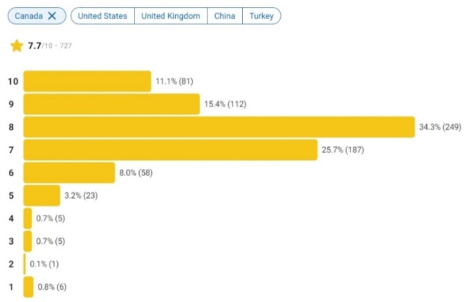
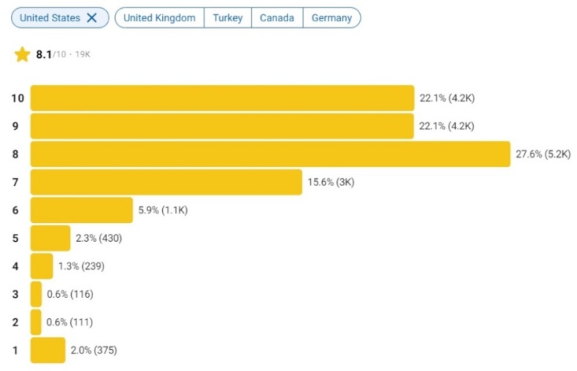
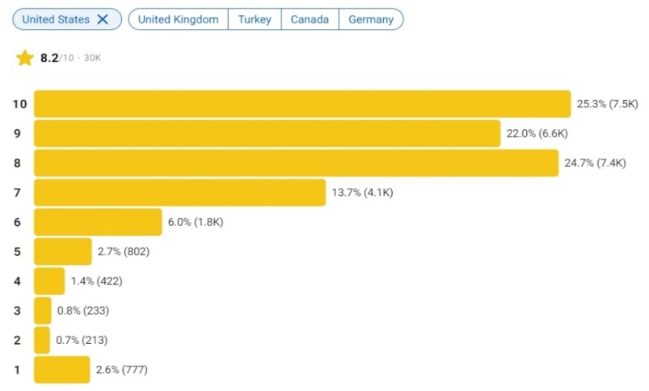
Data Acquisition and Preprocessing First, the ratings of the three films were collected from IMDb. In order to be more objective, a bar chart is used to organize the percentage of positive and negative sentiment and whether it comes from a wide range of regions. From this bar graph you can also see the approximate proportions of the various score bands and where the raters are coming from and whether such ratings are widespread. The key is that the method of calculating IMDb’s scores isn’t just to do an average, it will take into account the time distribution curve of the rate voting, the number of voters, whether the voter is a regular voter or not, whether they have spent some time watching the movie on the official website, and other weightings. Try to maintain objectivity.
Figure 1: User ratings of Days of Being Wild (adapted from IMDb).
Ratings of Days of Being Wild are overwhelmingly in the high range, with largely positive sentiment and high acceptance. The audience that
126 Hanzhang
participated in the valid polls in order of country has a wide range of cross-cultural contexts. The other two films share the same characteristics.
Figure 2: User ratings of Chungking Express (adapted from IMDb).Figure 3: User ratings of In the Mood for Love (adapted from IMDb).
Going one step deeper, specific online reviews for each of the three movies are obtained from IMDB, containing audience reviews, external media reviews, and critic reviews. By locating the review area, relevant review information is extracted, including username, review content, and source. Cumulatively, 676 English comments from viewers about the three films are collected, with a total word count of 53,125. 5 comment information is selected for each film, including 3 viewer comments, 1 external media comment, and 1 critic comment, forming 3 tables. As an example.
A Cross-Cultural Contextual Study of Wong Kar-wai’s Films Driven by Online Reviews 127
Table 1. Days of Being Wild for online reviews of movies.
Table available in the original PDF paper.
User ID Reviews IMDb
garry This film seems really dark from the beginning till the end. I like the symbol of the no-leg bird and the man it presents. I think that pain is the thing that people can’t avoid in the whole life. This film also present about the desire and search for identity of characters. When people was born, they had a responsibility for those. rooprect Wong Kar-Wai makes films you can feel in your bones. That’s partly down to the general atmosphere he creates but after watching this one, I found myself thinking specifically about how fantastic he is at creating a sense of location and place, both physically and emotionally. pulpficat Sadness and loneliness become characters in their own right, weaving their way through the lives of the protagonists like silent companions. This film isn’t just a narrative; it’s a lyrical meditation on the human experience of isolation-a delicate portrait of hearts yearning for connection in a world that often feels detached.
External Reviews San Francisco Chronicle
Every shot is perfectly composed and compelling, with light and shadow manipulated to maximum effect.
Metacritic Reviews Washington Post Desson Thomson
Wong works the elements of his aesthetic — music, beautiful people and emotion — into a mood that so overtakes you it’s nearly impossible to emerge from his films without feeling slightly drunk. Its themes of passion, heartbreak and the inexorable passage of time are eternal
Table 2. Chungking express for online reviews of movies.
Table available in the original PDF paper.
User ID Reviews Date IMDb
jollyolly From a cinematic point of view, the film is visually stunning with its dynamic camera movements, vivid colors, and use of fast-paced editing techniques. dvlbr In addition to the use of visual and auditory elements, the film also uses narration as a storytelling technique. The voice-over narration is used to provide insight into the character’s inner thoughts and emotions, adding a layer of depth to the story. Kamp This movie is well made and well structured. The acting is great and believable. The soundtrack doesn’t distract from the movie.
External Reviews A Mighty Fine Blog It’s a glorious moment that encapsulates the impressionistic style of Wong Kar-wai’s films; seemingly simple and banal moments that tell the story of someone’s entire life, if only we learn to view them in the right way.
Metacritic Reviews
04/26/2018
Austin Chronicle
The performances here are irresistible, thrilling in their invention and spontaneity,
128 Hanzhang
Table 3. In the Mood for Love for online reviews of movies.
Table available in the original PDF paper.
User ID Reviews Date IMDb
jeremy It’s visually amazing. I was surprised by how limited all the locations were, too. Scenes don’t often take place outside of confined rooms, or streets that we only see small parts of, but there are constantly new ways of showing these locations so that visually, things never get boring. Experience for the audience, making them feel like they are a part of the story. mikecalla Elegant and restrained, with a narrative pace to match. A film with sensitivity and understated qualities that is rare in these times of clichéd plots. The beautifully subdued photography, saturated in rich luxurious colors, and for lack of better words, each frame is filled with an air of tension. Tedg The excellent use of mis-en-scene gives the film just the right amount of feel needed to flesh out the complicated nature of the characters’ relationship.
External Reviews RogerEbert.com The movie is physically lush. The deep colors of film noir saturate the scenes: Reds, yellows, browns, deep shadows. One scene opens with only a coil of cigarette smoke, and then reveals its characters. In the hallway outside the two apartments, the camera slides back and forth, emphasizing not their nearness but that there are two apartments, not one.
Metacritic Reviews A feast for the eyes and succor for the soul.
Philadelphia- Inquirer
High Frequency Vocabulary Analysis According to the IMDb review text, it can be seen that love, light, disori- entation, atmosphere, darkness, thirst, quest, legless bird, emotion, sadness, loneliness, delicacy, elegance, neon, bar, detachment, perfect composition, aesthetic elements, music, emotion, vivid colors, handheld camera, off- screen voice, fragmented narrative, vision, alley, humidity, oriental colors, cheongsam, stoic passions, metaphors, smoke, stars, Dreams, complex- ity, bilinear, character, peculiar, multifaceted. These are all high-frequency words. They are also the words that audiences in cross-cultural contexts feel most deeply. For the movie medium, they are related to themes, structure, emotional expression, character complexity, cultural elements, etc.
Table 4. Classification table of high-frequency vocabulary.
Narrative structure Two-line, fragmented, non-linear, complex layers, pictorial, metaphor...... Emotional expression Disorienting, lonely, sad, humid, emotional, handheld...... Character complexity Elegance, peculiarity, characterization, stoicism, desire...... Cultural elements Oriental colors, alleys, cheongsams, neon, humidity......
A Cross-Cultural Contextual Study of Wong Kar-wai’s Films Driven by Online Reviews 129
SUMMARIZE THE REASONS WHY WONG KAR-WAI’S FILMS ARE ACCEPTED IN THE CROSS-CULTURAL CONTEXT After collecting online comments and classifying high-frequency words, this paper summarizes the factors that affect the acceptance and empathy of Wong Kar-wai’s films in the cross-cultural context. Focus on the following factors:
1. Theme selection: Days of Being Wild New Wave films focus on the deep exploration of society and humanity, as well as the combination of artistry and commerciality, forming a unique Hong Kong film culture. In this film environment, Wong Kar-wai and his team decided to create Days of Being Wild, hoping to express their thoughts on love, freedom and fate through this work, and show the unique urban customs of Hong Kong. The Chungk- ing Express film is mainly set in Hong Kong’s Chungking Mansions, which is also the most representative of the impression of Hong Kong in the 1990s. Just as in the beginning of the film, there are many migrant workers from dif- ferent nationalities such as India and Pakistan gathered here all year round, thus showing the ethnographic scene of people from Southeast Asia, Africa and other countries gathering to work in Hong Kong under the influence of globalization. The different cultures brought by them through interper- sonal communication are integrated in Hong Kong, thus producing a unique local culture. And expressed through the film, they bring different cultures in the integration of Hong Kong. In the Mood for Love presents a novel, rich and implicit theme from a new perspective. It expresses “that time”, the contradiction between morality and emotion, the conflict between colonial culture and traditional culture in the 1960s, and the complexity and subtlety of human nature. The love story of Zhou Su and Su want to “love”but not to “love”makes people feel the complex relationship between humanity, society and morality, giving people a subtle regret and helplessness. Wong Kar-wai does not only position the content of the film on the love between men and women, but adds the color of The Times, national color and human conno- tation through a series of unique expression techniques, which is the success of this film. Wong’s films explore universal themes such as love, loneliness, loss and dreams. These themes are cross-cultural, and people face similar problems and emotions in different cultures.
2. Narrative structure. The narrative of traditional films generally goes through traditional stages such as beginning, process, conflict, climax and ending. However, Wong Kar-wai’s narration in his films does not abide by such a linear structure. He does not want to tell a complete story. His fundamental purpose is to present an atmosphere that may be deliberately ignored by people -- a state that reflects the authenticity of human nature. Wong Kar-wai’s films adopt a large number of “fragmental” narrative strate- gies. Looking at his films specifically, starting from the Days of Being Wild, Chungking Express, In the Mood for Love, and the overall sense of narrative is weak. The “fragmentary” narrative strategy occupies an important posi- tion. It is not difficult to find in these films that there is basically no context that can maintain the story plot and causal connection. Basically, they are composed of fragmented narrative fragments. Therefore, when people watch Wong Kar-wai’s movies, the reason why they are moved is often a shot, a
130 Hanzhang
look or a line in the movie. The application of monologue here is also an important artistic means. This “fragmentary” narrative strategy breaks the shackles of telling a complete story centered on people in the past, and peo- ple’s character, emotion, experience and so on are replaced by fragmented feelings. The structure of three films not only increases the complexity of the film, but also provides the audience with the space to think and explain, so that the audience of different cultural backgrounds can interpret the film in different ways.
3. Expression of emotions. Wong Kar-wai’s films emphasize the emotions and inner world of characters, which is a universal emotional experience that can touch people’s emotions across cultural boundaries. He often uses mono- logue to express the inner emotional world of the characters. In Chongqing Forest, the police 223 late at night to call friends to talk, but was rejected by friends one by one, and finally he chose to express his feelings in the mono- logue, the monologue said: “I don’t know when to start, in everything has a day, even the plastic paper will expire. I began to doubt that there is anything in this world that will not expire.” Monologues are an important feature of emotional expression in Wong’s films. He uses this one-way flow of emotion to show the isolation and silence of people, the alienation and isolation of people, as well as the lack and barriers of communication between people. Monologue is in line with the pursuit and demand of human nature, and is a means of expression for people to meet their own needs and realization.
4. Complexity of characters: Wong Kar-wai loves to portray the image of people on the edge of cities. Each character in his stories walks on the edge of society, with their own confusion and anxiety. Xu Zai, who died and was reborn in Days of Being Wild, cut off all the family relations that abandoned him and were abandoned by him, wandering alone in the continent of South America, with only a string wrapped around his fingertips, and only Li Yao- hui at the other end of the line. Complex and multi-dimensional characters with unique personalities, desires and inner conflicts enable the audience to immerse themselves in understanding the mental journeys of these characters, regardless of their cultural background.
The highly omitted characters are also designed to accentuate the main characters. In In the Mood for Love, besides the simplification of the plot, there is also the omission of the characters. In the whole film, except for the hero and heroine, there are only a few characters who are closely related to the theme, and almost no other miscellaneous characters appear. This way of omitting a large number of characters enhances the portrayal of the protag- onists and the development of their inner emotions. Undoubtedly, it plays a huge role in highlighting the psychological changes between the protagonists, and the audience is less disturbed.
5. Beauty of cultural elements: In In the Mood for Love, there seems to be nothing superfluous. Every shot, picture, dialogue, music and prop have irreplaceable symbolic meaning in the film. Props such as cheongsam and embroidered slippers in the film have both national characteristics and sym- bolic meaning. It not only adds ethnic flavor to the film, but also increases the implication of the theme. Su Lizhen’s beautiful cheongsam, which has been
A Cross-Cultural Contextual Study of Wong Kar-wai’s Films Driven by Online Reviews 131
changed 27 times, implies multiple layers of symbolic meaning, which invis- ibly conveys the information of the story and the emotional changes of the characters to the audience, and plays a role in shaping the artistic image. The cheongsam is a traditional Chinese dress, symbolizing nobility and elegance. The heroine in the film is dressed in a cheongsam style. Director Wong Kar- wai has cleverly chosen such a noble and elegant dress as the heroine’s only costume. In the film, the cheongsam symbolizes Su Lizhen’s noble personality. It is Su Lizhen’s “noble” personality, as well as the influence of traditional moral thoughts, that makes her unable to overcome herself and break the shackles of morality to pursue her true love. This is the main reason for their “silent love”.
Color and music are also important elements in Wong’s film aesthetics, and his films usually use highly saturated colors and strong tones to portray characters’ emotions and atmosphere. For example, Days of Being Wild is the representative of green, and color can not be interpreted simply from the visual point of view. From the psychological point of view, it is mentioned that “green is the color of a boy who has not yet got rid of his maternal identity”. This color also conforms to the emotional bond between the pro- tagonist and his biological mother and adoptive mother. Under the green tone, the entanglement of love and hate between men and women and the wavering emotional affiliation are vividly displayed, and it also expands our perceptual cognition and understanding of green in psychology. In Chungking Express, strong visual impact colors are used to express the lonely emotions of char- acters. Different characters correspond to different colors, alternating warm and cold tones. Gorgeous, gorgeous, colorful, grotesque image style, brings a kind of blurred, ambiguous, dreamlike feeling, which reflects the psycholog- ical distance between people, the inner estrangement and the lack of security. The director uses dim colors to shoot the bustling streets of Hong Kong, con- veying a sense of distance between the bustling city and people. Under this seemingly bustling street, people’s inner loneliness is concealed.
Music in Wong Kar-wai’s films has gone beyond the status of being attached to the film and become an important part of the film. The theme music In the Mood for Love is borrowed from the song Yume jis Thene from Japanese director Kiyoshun Suzuki’s Dream II by Japanese composer Shigeru Ume, who has long been well known in the field of Asian film soundtracks. The song appears seven times in the film, throughout the whole process of the hero and heroine meeting, acquainting, getting to know each other, and falling in love, and it is also the most impressive episode for the audience. When Maggie Cheung in cheongsam and handsome and elegant Leung pass each other at a mahjong table, the director adopts a slow motion approach, and the song is full of ambiguous mood, suggesting the emotional entan- glements that will happen between the two. It becomes imprinted in the audience’s mind. In In the Mood for Love, opera music elements are also used. Although dramatic elements appear several times in the film, the sound of dramatic music in the film is very low, intermittent, and almost absent. In this way, not only does it not overwhelm the audience, but also puts the visual picture in the main position. At the same time, it accurately reflects the era background of the decline of traditional cultural thoughts. The cultural
132 Hanzhang
soil of breaking through the constraints of traditional thoughts and bravely pursuing one’s own love has been looming.
Although these elements sometimes have a specific impact on the story, they are usually presented in Wong’s films in an aesthetic and emotional way, allowing the audience to enjoy the film without knowing the cultural details.
CONCLUSION AND OUTLOOK In the era of globalization, the trend of cross-cultural production, dissem- ination and consumption of films is becoming more and more significant. Whether Chinese films can benefit from the international market, under- standing the cross-cultural audience is the most important thing. Wong Kar-wai’s films have good cross-cultural characteristics. As a case study, they show us how to deal with them from the perspectives of theme to aesthet- ics. Taking culture as the basis is the root of cross-cultural communication, and taking people’s emotions and multiple expressions as the entry point is conducive to cross-cultural communication.
REFERENCES
Bettinson, G., (2014). The sensuous cinema of Wong Kar-Wai: Film poetics and the aesthetic of disturbance. Hong Kong University Press. Cai, Jiajin, (2006). The Desire Trilogy: On Wong Kar-wai’s films “In the Mood for
Love” and “2046”. Chinese and Foreign Literature, 35(2), pp. 11–40. Chan, F., (2012). From World Cinema to World Cinema: Wong Kar-wai’s Ashes of Time and Ashes of Time Redux. Theorizing World Cinema, pp. 93–110. Faridani, S., Bitton, E., Ryokai, K. and Goldberg, K., (2010), April. Opinion space:
a scalable tool for browsing online comments. In Proceedings of the SIGCHI Conference on Human Factors in Computing Systems (pp. 1175–1184). Mao Mingmin, ( 2008). Looking at the postmodern style in Wong Kar-wai’s films from “Chungking Express”. Film Literature, (8), pp. 71–71. Promkhuntong, W., (2019). Pilgrimage to a Memory Hole: Towards an Affective
Study of Fan Tourism in Asia via Angkor Wat and Wong Kar-wai’s In the Mood for Love. Plaridel, 16(2). Starostova, L. and Piskunova, L., (2016). Film-study as a source of formation of creative cross-cultural skills in multicultural context. Creativity Studies, 9(1), pp. 87–101. Xu, G. G., (2005). Where Has the Aura Gone? Reflections on Cultural Studies,
Neoliberalism, and Literature as the Auratic Event. Concentric: Literary and Cultural Studies, 31(2), pp. 15–39. Yeh, E. Y. Y. and Hu, L. W., (2008). Transcultural Sounds: Music, Identity, and the Cinema of Wong Kar-wai. Asian Cinema, 19(1), pp. 32–46.
LISTED IN THE AHFE DIGITAL BOOKSTORE CATALOGUE
Explore the complete digital volume
Human Interaction and Emerging Technologies (IHIET-AI 2024): Artificial Intelligence and Future Applications
Read this individual research paper free through the original publisher, or explore the full digital proceedings book.
ISBN 978-1-958651-96-4
Explore this ISBN in the AHFE Bookstore ↗Listed in the July 2026 bookstore catalogue; search by ISBN to confirm current availability · Digital book purchase optional