Anne Karrenbrock, Laura Brendel, Laura Popplow, Valerie Varney (2024). Acknowledging tacit knowledge: Outlining participatory workshops in a human-centered design process. In: Human Interaction and Emerging Technologies (IHIET-AI 2024): Artificial Intelligence and Future Applications. AHFE Open Access, vol. 120, pp. 1–11. https://doi.org/10.54941/ahfe1004550
The energy transition presents complex challenges that require multidisciplinary insights and innovative solutions. However, traditional research methods often overlook valuable tacit knowledge, hindering effective contributions from relevant social groups. To counter this, the inter- and transdisciplinary research project MEnergy – My energy transition, funded by the German Federal Ministry for Economic Affairs and Climate Action, aims to create inclusive environments where the citizens’ perspective and experience is acknowledged, unlocked, and visualized. Based on the Social Construction of Technology (SCOT), the project aims to harness this knowledge, including gaps in knowledge, in analog, digital, and virtual communication formats to inform citizens about the energy transition and its technologies. This is done in three incremental design cycles over three years. This paper focuses on the first design cycle, which identifies participants' existing knowledge, attitudes, and emotions toward the energy transition. This is achieved in two consecutive cocreation workshops with different target groups. The participants' tacit knowledge and ability to imagine positive energy transition narratives is captured in the first workshop. Through storytelling, visualization, and collaborative ideation, participants articulate their tacit knowledge and provide insights based on their experience and expertise. Building on this, the second workshop is designed with modular interactive learning units to capture and increase the participants’ dimensions of knowledge (What can I do?) and willingness to act (What will I do?). Visual tools and collaborative techniques facilitate sharing and representation of tacit knowledge, improving the researchers’ and participants’ understanding of challenges and solutions. The data collected, both material artifacts and observation logs, is analyzed and mapped.The findings suggest an urgent need for low-threshold, local opportunities for citizens to learn about the potential of renewable energy. Furthermore, many citizens struggle to visualize a successful energy transition and have instead internalized narratives of sacrifice and prohibition. Here, scientists and policymakers are challenged not only to develop long-term sustainable solutions but also to communicate them in an accessible way.
human-centered design to develop workshops where people can share their knowledge, experiences, and ideas. Through techniques like storytelling, visualization, and joint creation, the researchers aim to understand the chal- lenges and solutions. The paper highlights the importance of providing people with accessible information about renewable energy and finding ways to help them envision a successful energy transition.
INTRODUCTION
The energy transition is a fundamental societal transformation process that affects everybody, yet media and scientific communication focus mostly on technological advancements, as well as regulatory and legal matters. People are often expected to have the necessary knowledge to actively participate in the energy transition, but the need for and benefits of the energy tran- sition are rarely explained in accessible ways. Most people, however, have some knowledge about the energy transition through public discourse, inter- personal relations, individual experiences and/or educational or professional points of contact. However, this is highly context-dependent and varies enor- mously, not only between demographic groups but also within them. This form of knowledge is called tacit knowledge and will be defined later in detail.
The research project described in this paper addresses this issue by captur- ing this (missing) knowledge. Based on the results, it develops digital, virtual, and analog prototypes to make information about the energy transition tan- gible and understandable. This is in line with the Social Construction of Technology, which emphasizes the integral role of human values, needs, and perspectives in shaping technological development. By prioritizing human experience and input throughout the process, emerging technologies are better aligned with societal needs, driving adoption, increasing the overall impact of technological innovation, and advancing the energy transition.
Therefore, the researchers propose viewing the research project itself as a human-centered design (HCD) process. This iterative and integrated approach considers people and contexts as the starting point for research. Instead of considering people solely as end users and test subjects exposed to research in the form of pre-selected questions and areas of interest, the project aims to guide its research through a dialogic and interactive exchange with stakeholders.
Combining the above leads to the inherent questions of this paper: How can researchers collect and analyze data in the form of knowledge if said knowledge is highly contextual and subjective and thus difficult to retrieve? How can researchers enable participants to externalize that knowledge? In the following, a part of the research project is described that aims to achieve just that, namely two consecutive cocreation workshops that combine different participatory research methods.
In answering the above questions, the paper contributes to existing research on the energy transition and human-centered design by detailing how tacit knowledge can be made tangible in a research project (e.g. Mitchell, Harvey, Wood) and by outlining a concrete cocreation workshop, thereby adding practice to theory (e.g. Sanders, Sleeswijk Visser, Prahalad).
LITERATURE REVIEW: TACIT KNOWLEDGE AND HUMAN-CENTERED DESIGN Research often undervalues and underestimates tacit knowledge gained dur- ing the research process (Mitchell et al., 2022). Classical impact assessments reinforce this by rewarding results with explicit knowledge, leading to less research that yields implicit knowledge. This creates a system that defines and thus favors only a certain kind of project as impactful (McAdam et al., 2007). At the same time, the significance of tacit knowledge especially in scien- tific and technological discourse has been understood for decades (Rosenberg and Nelson, 1994). Some researchers even suggest that tacit knowledge is at the core of generating socially useful knowledge via dialogical sensemaking (Cunliffe and Scaratti, 2017). Mitchell et al. (2022) outline several solutions to this problem from literature, most of which share increased engagement, participation, and dialogic discourse as common ground for recognizing and utilizing tacit knowledge.
This less concrete form of knowledge is essential “to understand, appre- ciate and effectively design and manage complex technologies” (Murphy et al.) as is the case in the energy transition. Tacit knowledge is defined as “non-codifiable information that is acquired through the informal take-up of learned behaviors and procedures”(Howells, 1996) or more simply put as the knowledge that one possesses but is unable to put into words (Polanyi, 1966). Murphy et al. (2004) identified six characteristics of tacit knowledge from lit- erature: implicitness, experiential, interactiveness, show-how, context (social and cultural), non-measurable and personal. Typical examples are breathing, riding a bike, and being able to distinguish an oboe from a clarinet (Ehn, 1989). Most people can perform these tasks without conscious thought, but cannot explain to someone else how to perform them successfully.
Moreover, researchers should consider that tacit knowledge is transferred through socialization, demonstration, and imitation and is strongly depen- dent on the social and organizational contexts of the individual (Roberts, 2000). This kind of knowledge is crucial to understanding people’s experi- ences, insights, and needs. Still, since it lies in its nature to escape definition and quantitative analysis (Murphy et al., 2004) other research methods are needed to make this knowledge visible, and therefore discussable. Strate- gies to explicate this kind of knowledge focus mostly on externalization and socialization i.e. the sharing of images, metaphors, analogies, and concepts during social interactions (Nonaka and Konno, 1998).
Artifacts and prototypes can support this process of externalization. Bofy- latos and Spyrou (2017) discuss how material enables “the emergence of knowledge that is impossible to get otherwise”, describing design as “a process that revolves around knowledge acquisition with an end goal of embodying all the appropriate knowledge into an artifact”. Their research emphasizes the importance of material as “a trigger to create tacit knowl- edge” (Bofylatos and Spyrou, 2017). Other researchers have also explored how artifacts can help to minimize the tension between the high value and elusiveness inherent in tacit knowledge (Stenmark, 2000). Yet, most of this research explores tacit knowledge in organizational settings for example by researching a case study in product development (Kreiner, 2002) or analyzing
how an agent-based system in an intra-organizational web can capture tacit knowledge (Stenmark, 2000). However, research on everyday tacit knowl- edge especially about the energy transition is lacking. Hence, this paper poses the question: How can research make citizens’ knowledge of the energy transition, that they are not aware of possessing, visible, and in doing so, discussable?
To answer this question, we propose a human-centered design perspec- tive, more concretely a cocreation approach. Human-centered design is an umbrella term for different approaches and research streams. Yet, in litera- ture, the term is often used interchangeably with user-centered design. And while they share some characteristics, they differ in significant ways. User- centered approaches tend to focus on “optimizing the characteristics of the product, system or service based on a set of fixed preconceived cognitive plans and schema” (Giacomin, 2014) and limit the perspective of people to their role as users (Steen, 2011). This leads to an outcome suitable for only prede- termined patterns of use with limited interactivity, exploration, and learning (Giacomin, 2014). Thus, the understanding of human-centered design in this paper follows the definition by Krippendorff (2004) understanding HCD as a multidisciplinary activity that shifts away from technological determin- ism and object-centered design towards processes of human involvement. This paper outlines codesign or cocreation as one possible tool to achieve this1. Here, the research of Sanders et al is instrumental (e.g., Sanders and Dandavate, 1999; Sanders, 2000). She emphasizes that within codesign pro- cesses, everyday people are participants and co-creators, instead of customers or users contributing their everyday expertise to cooperate creatively. This method enables “diverse people with diverse backgrounds and skills […] to […] jointly explore and envision ideas, make and discuss sketches, and tin- ker with mock-ups or prototypes” (Steen, 2011). The facilitation of the joint creation of things leads to visual communication between the participants, researchers, and other involved stakeholders (Steen, 2011).
To summarize, tacit knowledge is unconscious, embodied, situational, con- textual, and can be made tangible by externalization and social interactions. This is in line with HCD which aims to center human needs and experiences in designing products, services, or (research) processes without predetermined characteristics, thereby allowing knowledge to surface that participants may not be aware of themselves (I.e. tacit knowledge). One method used in HCD is cocreation which encourages everyday people and contexts to jointly create visual representations of their knowledge, experiences, etc. The researchers propose that cocreation can therefore support externalizing and articulating tacit knowledge.
METHOD: PARTICIPATORY COCREATION WORKSHOPS The method section details two cocreation workshops that were conducted overall nine times in total. Workshop 1 was conducted five times and
1For a more comprehensive overview of HCD techniques and approaches see Giacomin 2014 and Steen 2011.
Acknowledging Tacit Knowledge: Outlining Participatory Workshops 5 Workshop 2 four times2. The total of 38 participants had different back- grounds and demographic characteristics ranging from 12-year-old pupils to students in their mid-twenties to homeowners in their 60s.
The first workshop aims to create artifacts to help externalize the partic- ipants’ tacit knowledge. The second workshop is based on this knowledge as well as the revealed knowledge gaps and introduces modular interac- tive learning units to capture and increase the participants’ dimensions of knowledge (What can I do?) and willingness to act (What will I do?).
Workshop 1: Capturing Tacit Knowledge The workshop consists of three parts facilitated by a moderator, with two observers present to document the process. Data collection during Workshop 1 involved field notes taken by observers and photographing and archiving participants’ work. The protocols were analyzed using the Rapid Analysis method. The participants’ work is coded and clustered according to Müller’s (2020) image cluster method. The results are analyzed with regard to the participant’s existing knowledge, areas of interest, and ability to imagine a successful energy transition. The workshop started with introductions in which each participant shared what they associate with the energy transition.
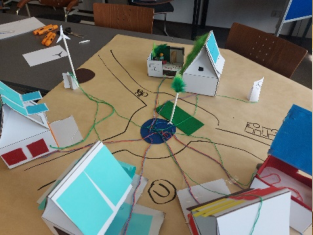
Cocreation Part 1. Participants were prompted to construct representa- tions of their present living conditions with a blank cardboard folding house. As an orientation, they were asked to focus on the questions: What produces and consumes energy in your house? To facilitate this creative process, a diverse array of materials including clay, paper, glue, felt, wool, wire, post- its, Playmobil figures, and feathers were provided. Following a 15-minute period, participants presented their creations verbally in the group. To ensure clarity and social interaction, the moderator, observers, and participants were encouraged to engage in open dialogue e.g. by asking each other questions.
Cocreation Part 2. Afterward, the participants were asked to design their living space with the same questions and conditions as in the first part, but in the year 2030 under the premise of a successful energy transition. Once again, following a 15-minute interval, participants presented their designs while offering responses to the aforementioned questions.
Cocreation Part 3. In the last phase, the participants were directed to create a community or neighborhood with their individual creations. The objective was to collectively determine energy producers and consumers, and assess the overall energy sufficiency of the established community. To facilitate this, participants were supplied with the same materials as before, coupled with a spacious cardboard landscape upon which to manifest their collective vision.
Workshop 2: Filling the Knowledge Gaps and Activating the Willingness to Act Similar to Workshop 1, a moderator and observers were part of the research team. Like the data from Workshop 1, the protocols were analyzed using the Rapid Analysis method, and the participants’ work was coded and clustered.
2In the following text, “Workshop 1” and “Workshop 2” are used as stand-ins for all the workshops in that category.
Based on the data analysis from Workshop 1, the researchers identified participants’ knowledge gaps and areas of interest. Interactive and mod- ular learning units were developed to address these. The focus was on surprising the participants to increase engagement and learning. In addition, the researchers provided just enough information to enable participants to develop their own options for action.
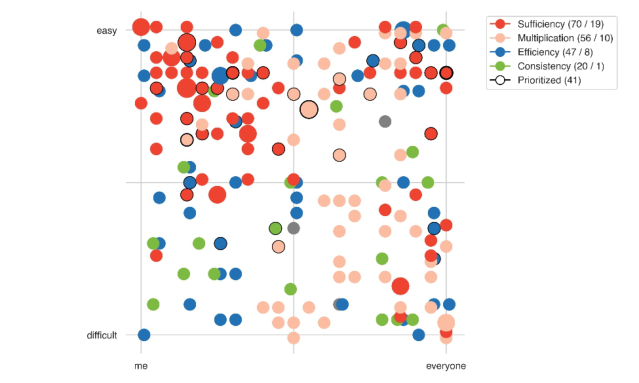
To start the workshop, the researchers asked participants what they could think of to help accelerate the energy transition. This allowed the researchers to capture a status quo of the participants’ knowledge before any input. These options were captured and mapped using a matrix with the axes “Me – every- one” and “easy – difficult” (see image 1). Then different inputs were given to the participants in the form of interactive learning units. A total of 12 learning units were developed, each lasting between 10 – 15 minutes3. The topics included the need for the energy transition, renewable energies, energy consumption in the household, jobs in the energy transition, social media, collective action, and others.
After each unit, the researchers asked the participants what actions could be derived from them (What can you do?), and added these new options to the matrix. Options ranged from “shorter showers” (clustered as me & easy) to “reduce bureaucracy” (clustered as everyone & difficult). This not only gathered participants’ knowledge but also made the impact of the individ- ual learning units measurable. In the end, the participants prioritized two options that they could realistically achieve on their own and in a group in the next few months (What will you do?). Image 1 shows two exemplary artifacts of the workshops in the form of a neighborhood jointly created by the participants from Workshop 1 and the matrix from Workshop 2.
Figure 1: Cocreation examples from Workshop 1 (left) and Workshop 2 (right).
RESULTS & DISCUSSION The data analysis revealed that generally, most participants had more knowledge about the energy transition than they previously assumed. Even
3Please note that due to the constraint of the paper, the individual learning units are not described in this paper. The authors plan to publish the material as an Open Educational Resources. Please contact us for more information.
participants that associated nothing with the energy transition in the intro- duction question built solar energy on their houses to represent a successful energy transition. In the future scenario, solar and wind energy were present in almost every house, while technologies such as hydropower and geother- mal energy were rarely shown. Therefore, most participants were aware that solar and wind energy are linked to the energy transition, but still had knowl- edge gaps regarding their benefits and harbored some misconceptions, e.g. that solar energy is not economical in Germany.
Unlike in the status quo scenarios, in the future scenarios, it was noticeable that fewer or no playmobile figures were used to represent people. Instead, there was a clear focus on different technologies. In addition, representations of actions like turning off stand-by were the exception. This may indicate that most people shift the responsibility for the energy transition to techno- logical advancement and not changes in lifestyle. The discussions between the participants also revealed that they struggled with the task of imagining a successful energy transition.
In addition, the artifacts and discussions revealed that almost all of the participants had limited awareness of energy in the home, for example, by not distinguishing between electrical energy and heat. Most had difficulty estimating energy quantities, i.e. how much 100 kWh could power. One of the most common misconceptions was that charging a smartphone uses much more energy than, say, blow-drying your hair. The researchers adapted by not only giving a numerical value (e.g., the total number of kWh a wind turbine produces), but by putting that value into a known context (e.g., the number of households a wind turbine powers).
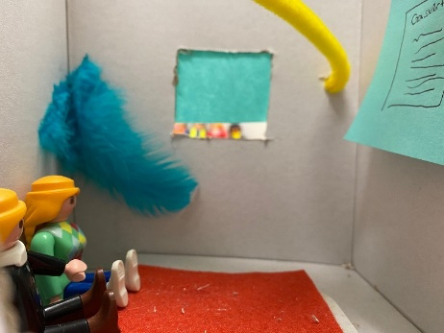
Moreover, energy costs and their reduction were a topic of discussion in all workshops, regardless of the income of the participant. Awareness of energy savings was thus present, but only out of a motivation to save money. This may not be surprising, considering that most of the workshops took place in the winter of 2022/2023, when energy costs increased significantly due to the Russian-Ukrainian war. Nevertheless, the researchers found that younger participants with lower incomes in particular lacked the means to deal with these rising costs. A symbol of this is image 2, in which a participant has a gas contract in his house that dominates the living room.
Image 3 shows the findings from Workshop 2 clustering the participants’ answers into four categories: efficiency, consistency, sufficiency, and multi- plication. Examples include options like: “Roof renovations and insulation improvement”, “Photovoltaic plants for tenants”, “Cold showers and no blow-drying”and “Join climate protests”. The participants collected the most options for action in sufficiency and the least in consistency. This may be because of the focus in both workshops on individual households. However, the participants collected options that concern nationwide policy changes and clearly put the responsibility on politics as well. This becomes appar- ent in examples like “No war”, “State-funded solar energy on all roofs”, “Revise construction law” and “Shorter political processes”. The discussions also indicate a general disappointment in politicians especially concerning legal regulations.
Figure 2: Symbolisation of rising energy costs based on the example of a participant’s gas contract.
Furthermore, a multiplication effect can be detected. It is the second most frequent category and with the second-highest prioritized options. Most par- ticipants were aware of the possibility to spread their knowledge in everyday life e.g. in school, with flatmates or family as shown in answers like “Share ideas on social media”, “Talk about the workshop”, “Get involved with the student council” and “Convince your colleagues”.
Figure 3: Matrix of Workshop 2 showing the options collected by the participants. The legend shows the total for each category and the number of prioritizations in that category.
Concerning tacit knowledge, it became evident that the participants were not aware of most of their knowledge about the energy transition; indicating that most people have a high amount of knowledge that is difficult to retrieve
regarding the energy transition. The artifacts created in the workshops (i.e. the houses and the matrix) and especially the process of creating and engag- ing with said artifacts, enabled the externalization of this knowledge. Adding to Bofylatos and Spyrou (2017) artifacts can not only be seen as a trigger to create tacit knowledge but also to capture it. In addition, as the literature sug- gests socialization activities, interactiveness, and joint creation were critical to capturing impactful data (e.g. Mitchell et al., 2022). The material helped in externalizing tacit knowledge, the nuances of said knowledge only became apparent in conversation with and between the participants. The researchers thus recommend allowing and actively supporting the dialogue between par- ticipants not only focusing on information exchange between researchers and participants. The research supports the argument by Visser et al. (2005) that different levels of knowledge can be accessed by different techniques. Gener- ative sessions that use creative techniques enable people to become aware of and express their experiences and in doing so, retrieve tacit knowledge.
CONCLUSION
The authors of this work raised the question of how tacit knowledge held by research participants can be externalized and thus made explorable by researchers. In contrast to explicit knowledge that is easily quantifiable and therefore “straightforward to communicate, store and distribute through books, websites, and other visual and written means” (Mitchell et al., 2022), this research highlighted the elusive nature of tacit knowledge. The outlined method is offered as a solution to visualizing said knowledge, as well as the underlying experiences, pain points, and gaps without relying solely on ver- balization. This way the workshops and their topics are more accessible to non-experts and participants who are not comfortable or able to verbalize their thoughts and experiences in the workshop language. This emphasizes the significance of capturing and incorporating tacit knowledge into design processes as well as general planning and decision-making processes.
In addition, the research emphasized that research needs to involve citizens early on. The findings indicate that most participants lack an understanding of the importance of the energy transition as well as a basic understanding of their everyday use of energy. It is mostly taken for granted, and therefore there is little awareness of conscious use. Participants struggled to imagine a successful energy transition, instead associating pessimistic narratives with renewable energies.
To summarize, participants should be seen as humans interacting with technology on an everyday basis, and therefore represent a vast collection of information and knowledge that remains mostly untapped. Citizens are gen- erally involved in research in their role as users or via conservative tools like surveys that only scratch at the surface of peoples’ knowledge. However, it is this knowledge that we as researchers and practitioners in the energy tran- sition need to understand to successfully communicate the importance and benefits of the transition, as well as develop and use technology that people can integrate into their everyday life without concerns. Researchers and poli- cymakers are challenged not only to develop long-term, sustainable solutions,
but also to work with citizens to generate knowledge, make it tangible, and create the capacity to act. By leveraging human-centered design processes, researchers can create an inclusive and innovative space for participants to share and visualize their tacit knowledge, leading to more contextually relevant strategies and sustainable outcomes (Mitchell et al., 2022).
ACKNOWLEDGMENT
The research team acknowledges the financial support of the German Fed- eral Ministry for Economics and Climate Action, which makes the research project possible.
REFERENCES
Bofylatos, Spyros/Spyrou, Thomas (2017). Meaning, knowledge and artifacts, giving a voice to tacit knowledge. The Design Journal 20 (sup1), S4422-S4433. https: //doi.org/10.1080/14606925.2017.1352938 Cunliffe, Ann L./Scaratti, Giuseppe (2017). Embedding Impact in Engaged Research:
Developing Socially Useful Knowledge through Dialogical Sensemaking. British Journal of Management 28 (1), 29–44. https://doi.org/10.1111/1467-8551. 12204. Ehn, Pelle (1989). Work-oriented design of computer artifacts. 2nd ed. Stockholm, Arbetslivcentrum. Giacomin, Joseph (2014). What Is Human Centred Design? The Design Journal 17
(4), 606–623. https://doi.org/10.2752/175630614X14056185480186. Harlow, Harold (2008). The effect of tacit knowledge on firm performance.
Journal of Knowledge Management 12 (1), 148–163. https://doi.org/10.1108/ 13673270810852458. Howells, Jeremy (1996). Tacit Knowledge, Innovation and Technology Transfer.
Technology Analysis & Strategic Management 8 (2), 91–106. https://doi.org/10. 1080/09537329608524237. Kemmis S, McTaggart R and Nixon R (2014) The Action Research Planner: Doing Critical Participatory Action Research. Singapore: Springer Singapore. DOI: 10.1007/978-981-4560-67-2. Kreiner, Kristian (2002). Tacit knowledge management: the role of artifacts.
Journal of Knowledge Management 6 (2), 112–123. https://doi.org/10.1108/ 13673270210424648 Krippendorff, Klaus (2004). Intrinsic motivation and human-centred design. Theoretical Issues in Ergonomics Science 5 (1), 43–72. https://doi.org/10.1080/ 1463922031000086717. Müller, Michael R. (2020). Image Clusters. A Hermeneutical Perspective on Changes
to a Social Function of Photography. https://doi.org/10.17169/FQS-21.2.3293. McAdam, Rodney/Mason, Bob/McCrory, Josephine (2007). Exploring the dichotomies within the tacit knowledge literature: towards a process of tacit knowing in organizations. Journal of Knowledge Management 11 (2), 43–59. https://doi.org/10.1108/13673270710738906. Mitchell, Vincent-Wayne/Harvey, William S./Wood, Geoffrey (2022). Where does all the ‘know how’ go? The role of tacit knowledge in research impact. Higher Education Research & Development 41 (5), 1664–1678. https://doi.org/10.1080/ 07294360.2021.1937066.
Murphy, Fiona/Stapleton, Larry/Smith, David (2004). Tacit Knowledge and Human Centred Systems. The Key To Managing The Social Impact Of Technology. Inter- national Multitrack Conference of Advances in Control Systems, University of Vienna (TUWien). Nonaka, Ikujiro/Konno, Noboru (1998). The Concept of “Ba”: Building a Foun-
dation for Knowledge Creation. California Management Review 40 (3), 40–54. https://doi.org/10.2307/41165942. Polanyi, Michael (1966). The Logic of Tacit Inference. Philosophy 41 (155), 1–18.
https://doi.org/10.1017/S0031819100066110. Roberts, Joanne (2000). From Know-how to Show-how? Questioning the Role of Information and Communication Technologies in Knowledge Transfer. Technol- ogy Analysis & Strategic Management 12 (4), 429–443. https://doi.org/10.1080/ 713698499. Rosenberg, Nathan/Nelson, Richard R. (1994). American universities and technical advance in industry. Research Policy 23 (3), 323–348. https://doi.org/10.1016/0048-7333(94)90042-6. Sanders, Elizabeth (2000). Generative Tools for Co-designing. In: Collaborative
Design, 3–12. Sanders, Elizabeth/Dandavate, Uday (1999). Design for experiencing: new tools. Proceedings of the First International Conference on Design and Emotion. Delft: Delft University of Technology. Steen, Marc (2011). Tensions in human-centred design. CoDesign 7 (1), 45–60. https:
//doi.org/10.1080/15710882.2011.563314. Stenmark, D. (2000). Turning tacit knowledge tangible. In: Proceedings of the 33rd Annual Hawaii International Conference on System Sciences, HICSS33: Hawaii International Conference on System Sciences, Maui, HI, USA, 4–7 Jan. 2000. IEEE Comput. Soc, 9. Visser, Froukje Sleeswijk/Stappers, Pieter Jan/van der Lugt, Remko/Sanders, Eliza-
beth B-N (2005). Contextmapping: experiences from practice. CoDesign 1 (2), 119–149. https://doi.org/10.1080/15710880500135987. Viteri, Juan P./Henao, Felipe (2023). A human-centered approach to regional off-grid electrification budgeting: the Colombian case. Sustainability: Science, Practice and Policy 19 (1). https://doi.org/10.1080/15487733.2023.2217043.
LISTED IN THE AHFE DIGITAL BOOKSTORE CATALOGUE
Explore the complete digital volume
Human Interaction and Emerging Technologies (IHIET-AI 2024): Artificial Intelligence and Future Applications
Read this individual research paper free through the original publisher, or explore the full digital proceedings book.
ISBN 978-1-958651-96-4
Explore this ISBN in the AHFE Bookstore ↗Listed in the July 2026 bookstore catalogue; search by ISBN to confirm current availability · Digital book purchase optional