Alessandra Rinaldi, Jonathan Lagrimino (2026). Towards an Inclusive, Human-Centered Micromobility Model: Design Perspectives for Pedal-Assisted Light and Active Vehicles. In: Universal Design and Design for Inclusion. AHFE Open Access, vol. 209, pp. 120–130. https://doi.org/10.54941/ahfe1008026
Urban mobility faces complex challenges that extend beyond decarbonisation, including traffic congestion, unequal access, and infrastructural constraints. In response, micromobility has been widely promoted as a low-emission and flexible transport solution. However, conventional micromobility vehicles, such as bicycles, e-bikes, and e-scooters, often exclude significant segments of the population due to physical, functional, and perceptual barriers. Within this context, pedal-assisted quadricycles emerge as a promising alternative, combining human propulsion with electric assistance to enable sustainable operation while potentially enhancing inclusivity and active mobility. This paper investigates the potential of pedal-assisted quadricycles as inclusive, accessible, human-centered light vehicles. An interdisciplinary team adopted a Research-through-Design (RtD) approach, integrating ergonomic analysis, accessibility requirements, and technological development into coherent vehicle configurations. The study resulted in two exploratory low-TRL quadricycle concepts aimed at improving stability, safety, comfort, and overall usability. These outcomes provide a structured design basis for future national and international research initiatives and highlight the value of interdisciplinary research in advancing inclusive light vehicles design. The findings demonstrate how technological innovation, when aligned with accessibility-oriented design, can broaden usability and contribute to a more equitable transition toward sustainable urban mobility systems.
Urban mobility systems are undergoing significant transformation, driven by the European Green Deal (European Commission, 2019) and international sustainability agendas, which identify transport decarbonisation as central to achieving climate neutrality. However, while achieving climate neutrality is a critical objective for urban mobility, it alone cannot resolve the sector’s persistent structural challenges, including congestion, inefficient spatial use, infrastructural pressures, and uneven access to transport services. For this reason, urban mobility must be approached as a systemic issue, shaped
Towards an Inclusive, Human-Centered Micromobility Model: Design Perspectives 121 by environmental constraints, evolving socio-demographic dynamics, and technological advancements requiring human-centered strategies that integrate inclusivity and accessibility to deliver equitable and efficient transport solutions for diverse urban populations (Hannon et al., 2019; Ramírez-Saiz et al., 2025; Soares et al., 2025).
Within this evolving scenario, micromobility has emerged as a key component of sustainable urban mobility. The term refers to light, low- energy vehicles with compact dimensions, suitable for short-distance urban travel. Their adoption has demonstrated measurable environmental benefits, including lower greenhouse gas emissions, reduced energy consumption, and alleviation of traffic congestion in densely populated areas (Abduljabbar et al., 2021). Beyond environmental performance, micromobility enhances the efficiency of urban transport networks by supporting first- and last-mile connectivity, integrating seamlessly with public transit, and enabling flexible, decentralized mobility patterns that complement mass transit systems while reducing reliance on private automobiles (Abduljabbar et al., 2021). Despite their growing adoption, current micromobility solutions, such as bicycles, e-bikes, and e-scooters, present significant limitations regarding inclusive accessibility. Design priorities that emphasize lightness, manoeuvrability, and performance often demand advanced balance, postural stability, and physical confidence, which can exclude a substantial portion of potential users. Certain users encounter barriers associated with mounting and dismounting, perceived instability, exposure to traffic, and limited protective features. In addition to these functional constraints, perceptual and psychological factors, including fear of falling, risk perception, and reduced confidence in vehicle controllability, further limit accessibility (Bozzi et al., 2021; Lee and Sener, 2023; Teixeira et al., 2023; Van Cauwenberg et al., 2019). This misalignment between the ergonomic and operational characteristics of existing micromobility vehicles and the diverse needs of urban populations highlights the urgency of developing more inclusive designs. As global demographics shift and populations age, the lack of accessible configurations risks perpetuating mobility inequities rather than alleviating them (Lin and Cui, 2021).
In response to the accessibility and usability limitations of conventional micromobility solutions, pedal-assisted quadricycles have emerged as a promising alternative, combining human propulsion with electric assistance to deliver sustainable, low-emission operation while supporting active mobility (La Regina et al., 2025). Their hybrid configuration, situated between traditional bicycles and cargo bikes and compact electric microcars integrates structural features such as four-wheel bases, semi-enclosed cabins, and modified seating positions. These design elements enhance stability, safety, and user comfort, reduce physical and perceptual barriers, and enable inclusive, adaptable urban transportation while maintaining low vehicle weight and promoting sustainable, health-oriented mobility patterns.
Building on this context, the present research investigates the potential of pedal-assisted quadricycles as inclusive, human-centered light vehicles. It examines how ergonomic design, accessibility principles, and technological innovation can be integrated into coherent solutions to overcome existing barriers and promote wider adoption of light vehicles. The study presents
122 Rinaldi and Lagrimino the outcomes of an interdisciplinary research initiative, in which a multi- disciplinary team collaborated through a structured Research-through- Design approach (Jonas, 2015), generating knowledge via iterative design development and critical reflection on artefacts.
Through this approach, two distinct low-TRL quadricycle concepts were developed, representing alternative yet complementary strategic responses to the challenges identified.
BACKGROUND AND RESEARCH CONTEXT Barrier-Based Framework for Inclusive Light Vehicles
Designing light vehicles from an accessibility and inclusion perspective requires a structured interpretative model capable of identifying and systematizing the factors that limit adoption across heterogeneous user groups. In previous research on inclusive micromobility design (Rinaldi and Lagrimino, 2024), a barrier-based analytical framework was developed to investigate the multidimensional obstacles affecting the use of light vehicles.
The model identifies three interrelated levels of barriers that influence adoption and sustained use of light vehicles: (i) health-related barriers encompass physical conditions that may limit consistent vehicle use, affecting both the ability to operate the vehicle and the perceived suitability of light vehicles for everyday mobility, (ii) transportation-related barriers concern the functional adequacy of light vehicles in supporting daily travel needs, and (iii) comfort and safety related barriers capture both objective and perceived aspects of vehicle interaction, such as prolonged postural discomfort, limited protection from environmental exposure, and usability challenges.
The theoretical grounding of this framework aligns with the perspective that sustainable mobility transition cannot be achieved solely through environmental performance improvements but must address the experimental and functional dimensions of vehicle interaction and user experience. Within the present study the framework functioned as a strategic design guide informing the exploration and development of pedal-assisted quadricycles.
Technical and Technological Opportunities Technical and technological innovation plays a crucial role in enhancing light vehicles performance. Research in energy generation and storage systems, in dynamic and in structural engineering, do not solely enhance measurable parameters such as range, energy efficiency, and stability, they also shape the experiential and functional dimensions of vehicle use. By reducing physical and cognitive effort required for operation, enhancing perceived safety, and enabling smoother, more predictable vehicle behaviour, these innovations contribute to expanding the accessibility and practical usability of light mobility solutions across heterogeneous user groups.
Within the domain of energy generation, vehicle-integrated photovoltaics (VIPV) represent a significant field of investigation (Oluwalana and Grzesik, 2025). By embedding photovoltaic modules into the vehicle body, VIPV systems enable solar energy harvesting to provide auxiliary power to battery,
Towards an Inclusive, Human-Centered Micromobility Model: Design Perspectives 123 thereby extending operational range (Belloni et al., 2024). Beyond the purely energetic contribution, such systems permit to enhance operational autonomy and reduce dependence on external charging infrastructure, reinforcing flexibility and reliability in daily use.
In parallel, research on energy storage systems has addressed both performance optimization and architectural integration challenges. Hybrid configurations combining lithium-ion batteries with supercapacitors have been explored to improve power management, enhance peak power delivery, and extend system lifespan, particularly in applications characterized by frequent start-and-stop cycles typical of urban micromobility (Laschi et al., 2022). At the same time, the architectural integration of these energy storage systems within the vehicle configuration has received increasing attention, as the placement, modularity, and charging strategies (Fixed or swappable) of the system significantly influence operational patterns, infrastructure dependency, and daily flexibility of use (Zhang et al., 2023).
Taken together, both the intrinsic characteristics of energy storage technologies and their integration within the vehicle architecture directly affect perceived autonomy, reliability, and continuity of operation making energy system design a key determinant of accessibility and practical usability.
Another key area concerns vehicle lightweighting and structural optimization, which can reduce energy demand and improve handling characteristics. In the context of pedalassisted light vehicles, research has shown that structural mass reduction and optimized frame design contribute to overall propulsion efficiency, load capacity, and manoeuvrability (Aiello et al., 2021). From a useroriented perspective, lighter configurations also enhance responsiveness and ease of use, particularly at low speeds and during frequent stopandgo movements.
Complementarily, advances in suspension systems and dynamic control strategies (Genç, 2024) not only enhance mechanical efficiency, improving damping performance and refined vehicle-road interaction, but also reduce vibration exposure, increase perceived stability, and improve comfort during prolonged use.
Overall, technical and technological innovation in light vehicle design cannot be understood as a purely engineering-driven process. Energy systems, structural solutions, and dynamic configurations collectively influence autonomy, comfort, safety perception, and operational continuity. The interdependence between technical performance and user experience underscores the necessity of an integrated and multidisciplinary approach in which engineering and design decisions co-evolve to support inclusive and sustainable mobility.
METHODOLOGICAL APPROACH RQ Formulation
Building upon the theoretical and technical insights discussed in the previous section, a structured set of three Research Questions (RQ) was defined to orient objectives and to frame the methodological organization of the research activities:
light vehicles capable of expanding accessibility and usability, reducing health, transportation, and comfort/safety related barriers? (ii) RQ2 - Which technical and technological innovations can enhance vehicle performance, operational efficiency, and environmental sustainability in pedal-assisted quadricycles? and (iii) RQ3 - How can design and engineering perspectives be integrated
within the development process so that technical performance and user experience evolve coherently and reciprocally?
Collectively, these questions frame quadricycle development as a systemic design challenge situated at the intersection of inclusion, sustainability, and technological advancement. The research is therefore positioned not as a purely formal exploration nor as an exclusively engineering-driven optimization exercise, but as an integrated investigation of accessibility, technical feasibility, and cross-disciplinary synthesis.
Research Activities Starting from RQ formulation, a multidisciplinary team was established to conduct the research activities, integrating expertise from Department of Architecture (DIDA), Department of Industrial Engineering (DIEF), and Department of Physics and Astronomy (FISICA) of the University of Florence.
The research was structured following a Research-through-Design (RtD) approach (Jonas, 2015), aimed at generating knowledge through the development and critical reflection on design artefacts. The overall research followed a design thinking process and was structured in four subsequent phases (Discover, Define, Develop and Deliver) according to the Double Diamond model (Viviani et al., 2024) Phase 1 - Discover: the starting exploratory phase was informed by the conceptual and technical insights outlined in the background section and involved two parallel and complementary lines of investigation. The first focused on formal and typological exploration, based on case study analysis of existing quadricycles, cargo bikes, microcars, and emerging light mobility solutions. Within this stream, the previously defined barrier-based framework (Rinaldi and Lagrimino, 2024), for inclusive light vehicles was employed as an analytical strategic tool to systematically evaluate accessibility and inclusivity features across the examined case studies. The second line of investigation addressed the selection and assessment of technical solutions to be integrated into the vehicle, including energy systems, structural configurations, and dynamic control strategies.
Phase 2 - Define: this phase marked the transition from the exploratory analysis to structured synthesis. Insights emerging from both the formal- typological and technical investigations were critically reviewed, compared, and systematized through interdisciplinary focus group sessions within the research team. The outcome of this phase was the formulation of a project brief, which consolidated research findings into a shared foundation for subsequent concept development.
Towards an Inclusive, Human-Centered Micromobility Model: Design Perspectives 125 Strategic brief: the brief translated research insights into explicit design criteria and technical constraints, establishing a shared foundation for the concept development phase. From a technical standpoint, two primary areas of intervention were identified: energy efficiency and autonomy, and dynamic performance and driving comfort. A base 3D model chassis configuration was developed to delimit the formal exploration while ensuring technical coherence. The main constraints included: (i) overall dimensions (L: 2400 mm, W: 1400 mm, H: 1500 mm), (ii) a minimum ground clearance of 200 mm, (iii) adoption of an automotive-type steering system with steering wheel, replacing handlebar-based control, (iv) integration of photovoltaic module into the vehicle roof with a surface area of 2 m², and (v) integration of a damping system based on 24” diameter wheels. From a user oriented perspective, the brief translated the barrier-based framework into structured design objectives across three domain: (i) health- related aspects, addressed through accessible entry/exit geometry, supportive seating posture, and reduced balance dependency, (ii) transportation-related needs, considered through load capacity, spatial organization, and adaptability to everyday use scenarios, and (iii) comfort and safety dimensions, including perceived and structural stability, environmental protection, ergonomic control interfaces, and overall driving confidence position.
Phase 3 - Develop: The Develop phase was structured as a four-step iterative process combining co-design exploration and interdisciplinary evaluation. An early-stage exploratory activity (Step 1) was coordinated by the IDEE Lab (DIDA) and involved young designers and researchers. The session adopted a Design Sprint methodology (Banfield et al., 2016), structured around rapid ideation and sketch-based exploration, with the aim of generating a diversified set of formal and functional proposals grounded in the strategic brief. The outputs of the co-design session were subsequently assessed through structured focus group discussion (Step 2) involving the research team partners of DIDA and DIEF. The most promising concepts, evaluated against technical constraints, feasibility and inclusivity considerations, were identified (Step 3) and further developed through an iterative refinement phase (Step 4) coordinated by IDEE Lab.
Phase 4 - Deliver: The final phase resulted in the definition of two concept (3D models, 2D drawings, renderings, and functional schemes) representing divergent interpretation of the design brief. The first solution (Vehicle 1- ASAP, As Sun As Possible) adopts a simplified and modular configuration, prioritizing material efficiency and constructive clarity. The second solution (Vehicle 2 – Hasselhoff) investigates a structurally integrated configuration, emphasizing spatial continuity and experimenting the use of composite materials.
RESULTS
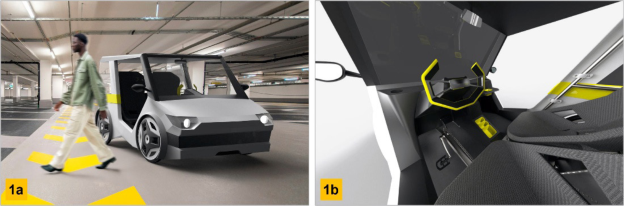
Vehicle Solution 1 – ASAP (As Sun As Possible) ASAP is a compact, highly rational two-seat pedal-assisted quadricycle. Its overall form is defined by a squarish, modular configuration, emphasizing constructive clarity, structural legibility, and material efficiency. The vehicle is
126 Rinaldi and Lagrimino conceived to emphasizing accessibility, usability, safety, and comfort through a compact footprint and a simplified overall layout (see Figure 1a).
The structural frame is based on an aluminium perimeter chassis articulated through strategically positioned cross-members: an upper transverse beam ensuring global rigidity, a lower perforated cross-plane designed for seat mounting and adjustment, a front structural element integrating the steering system, and a rear roll bar contributing to torsional stiffness and occupant protection. Lightweight plastic body panels are riveted directly to this frame, forming a partially enclosed shell that protects occupants from external agents while maintaining reduced mass. In this configuration, conventional doors are replaced by large oblique side openings combined with removable waterproof protective elements. This solution preserves constructive simplicity while enabling easy ingress and egress and providing partial protection from rain and road spray.
This hybrid construction balances robustness and simplified layout, while conveying a configuration comparable to that of a microcar in terms of spatial organization and architectural layout (see Figure 1a, 1b).
Externally, several components were developed in alignment with the project brief: (i) the lighting system follows automotive visibility standards, integrating front and rear lights and lateral reflectors to ensure visibility on all four sides in mixed urban traffic and low-light conditions, (ii) energy autonomy is supported by a roof-mounted photovoltaic panel fully integrated into the vehicle geometry contributing auxiliary energy input, and (iii) the wheels are equipped with basic damping solutions, achieving a balance between comfort, ground clearance and mechanical simplicity.
The interior layout prioritizes clarity and accessibility: (i) fully moulded and padded seats accommodate both driver and passenger, ensuring stable support and comfort, (ii) the upright seating configuration minimizes fatigue, enhances vehicle control, and improves forward and lateral visibility, (iii) pedals are provided exclusively for the driver, enabling active propulsion while leaving the passenger area unobstructed, (iv) the steering interface adopts a sporty automotive-style wheel integrating digital travel information and smartphone connectivity, supporting intuitive interaction and situational awareness (see Figure 1b).
Storage solutions are integrated without compromising accessibility. A modular internal containment system accommodates small personal items, while an externally accessible rear luggage rack enables safe and barrier-free loading and unloading.
Figure 1: Vehicle solution 1 – ASAP (as sun as possible), design by R. Dami, V. Sabba, and IDEE lab (DIDA, University of Florence).
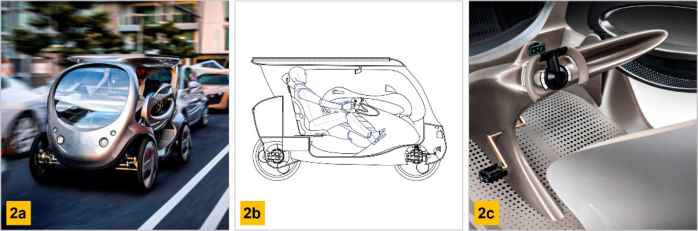
Vehicle Solution 2 – Hasselhoff Hasselhoff is a structurally integrated and tailored two-seat pedal-assisted quadricycle. Its formal language is organic and continuous, defined by rounded volumes and smooth transitions between chassis and body. The vehicle is conceived to explore accessibility, usability, safety, and comfort through a disruptive design approach (see Figure 2a).
The structural frame combines an aluminium base chassis providing primary load-bearing support and torsional rigidity through cross-members with carbon-fiber load-bearing body panels that define the external geometry and generate expansive, enveloping cabin volumes. Within this integrated configuration, upward-opening gullwing-style doors and a circular front windscreen are embedded in the continuous curved envelope, supporting optimized lateral footprint and extended forward visibility. Together, these elements define a semi-enclosed cabin articulated through structural and flowing surfaces, providing partial environmental protection while maintaining spatial continuity.
Externally, Hasselhoff shares several functional principles with ASAP while differentiating itself through material strategy and formal integration. The lighting system and wheel damping configuration follow the same functional logic adopted in Vehicle 1. The roof-mounted photovoltaic panel preserves approximately 2 m² of active surface for auxiliary power and is integrated within the curved roof geometry, locally interrupting its continuity (see Figure 2a).
The interior layout emphasizes spatial fluidity and essential organization: (i) adjustable seats with aluminium frames feature topologically optimized padding to enhance comfort while maintaining low mass, (ii) a semi-reclined driving position reduces postural fatigue and contributes to a more immersive, automotive-like driving experience, (iii) a perforated floor allows water drainage and simplifies maintenance in urban environments. In continuity with the configuration adopted in Vehicle 1 – ASAP, (iv) pedals are provided exclusively for the driver, encouraging active propulsion while maintaining a clear and unobstructed passenger area, and (v) the steering interface adopts a sporty automotive-style wheel integrating digital travel information and
128 Rinaldi and Lagrimino smartphone connectivity, ensuring continuity in interaction logic (see Figure 2b, 2c). Storage solutions are integrated without compromising accessibility, including side pockets within the doors and a rear luggage rack accessible from the exterior, enabling safe and barrier-free loading and unloading.
Figure 2: Vehicle solution 2 – Hasselhoff, design by A. Romano, L. Tormentoni, and IDEE Lab (DIDA, University of Florence).
CONCLUSION
This research explored the potential of pedal-assisted quadricycles as inclusive and human-centered light vehicles, discussing micromobility not only as a low-emission transport solution but also as a means to expand access to urban mobility for a wide range of users. The overarching objective was to investigate how design and engineering, when integrated through interdisciplinary collaboration, can generate solutions that address both environmental and social imperatives, fostering more equitable, sustainable, and active urban mobility systems.
The design of inclusive and human-centered light vehicles requires careful consideration of multiple interdependent factors. Vehicle architecture, seating configuration, user interaction, control interfaces, and spatial organization interact with energy systems, structural solutions, and dynamic performance. By adopting a Research-through-Design approach, the project generated knowledge artifacts that operationalize these interdependencies, showing how structural layout, material choice, and propulsion mechanisms are key determinants of accessibility, perceived safety, and comfort, while ergonomic and usability considerations guide technical and technological integration into the overall vehicle system.
The interdisciplinary methodology proved essential in bridging the gap between human-centered objectives and engineering constraints. The iterative development process highlights the value of combining formal design exploration with structured technical assessment to produce vehicle configurations that are simultaneously feasible, adaptable, and inclusive. By combining interdisciplinary design and engineering insights, this work
Towards an Inclusive, Human-Centered Micromobility Model: Design Perspectives 129 illustrates the potential of light vehicles to contribute to more equitable, sustainable, and accessible urban mobility systems.
Both concept vehicles, representing complementary design strategies, demonstrate how design choices are informed by the barrier-based framework (Rinaldi and Lagrimino, 2024), which provides a structured lens for evaluating obstacles to light vehicle adoption. First, quadricycle layout improves perceived stability and ease of use, helping to overcome health- related barriers, supporting users with reduced balance or confidence and promoting active, healthy mobility. Second, features such as accessible storage, passenger seating, and cabin organization, inspired by compact microcars, reduce transportation-related barriers, enabling everyday usability for diverse user groups. Third, protective elements, ergonomic driving positions, suspension systems, and perceptual design choices mitigate comfort and safety-related barriers, enhancing confidence, comfort, and perceived stability. By capturing the integration of design and technical insights, these low-TRL concepts function as foundational knowledge artifacts that can guide future research initiatives and funding projects, advancing inclusive, sustainable, and human-centered light vehicle design.
ACKNOWLEDGMENT
The authors would like to acknowledge: (i) the IDEE Lab team at the University of Florence; (ii) the young designers, PhD, Bachelor, and Master’s students in Design at the University of Florence, for their participation and support in design activities; (iii) Vangi, D., Zonfrillo, G., Gulino, M. S., Pugliese, L., Aiazzi, G., of Department of Industrial Engineering, and Bruzzi, M., of Department of Physics and Astronomy at the University of Florence for the cooperation in research activities.
The article is the result of the joint work of the authors; the contribution of each author is the following: Rinaldi, A., Methodological Approach and Results; Lagrimino, J., Introduction, Background and Conclusion.
REFERENCES
Abduljabbar, R. L., Liyanage, S., & Dia, H. (2021). The role of micro-mobility in shaping sustainable cities: A systematic literature review. Transportation research part D: transport and environment, 92, 102734. Aiello, G., Quaranta, S., Certa, A., & Inguanta, R. (2021). Optimization of urban
delivery systems based on electric assisted cargo bikes with modular battery size, taking into account the service requirements and the specific operational context. Energies, 14(15), 4672. Banfield, R., Lombardo, C. T., Wax, T. (2016). Design Sprint: una guida pratica per la creazione di grandi prodotti digitali. O’Reilly Media. Belloni, E., Bertolini, V., Faba, A., & Cardelli, E. (2024, June). A solar-powered
electric quadricycle: design, preliminary measurements, and modelling of the PV panels behavior. In 2024 IEEE 22nd Mediterranean Electrotechnical Conference (MELECON) (pp. 920–925). IEEE. Bozzi, A. D., & Aguilera, A. (2021). Shared E-scooters: A review of uses, health and environmental impacts, and policy implications of a new micro-mobility service. Sustainability, 13(16), 8676.
130 Rinaldi and Lagrimino European Commission. (2019). The European Green Deal (COM(2019) 640 final).
Publications Office of the European Union. Genç, M. O. (2024). Suspension system design for pedal-assisted cargo E-quadricycle. International Journal of Automotive Engineering and Technologies, 13(1), 23–32. Hannon, E., Knupfer, S., Stern, S., Sumers, B., & Nijssen, J. T. (2019). An integrated
perspective on the future of mobility, part 3: Setting the direction toward seamless mobilitydemand. Jonas, W. (2015). Research through design is more than just a new form of disseminating design outcomes. Constructivist Foundations, 11(1), 32–36. La Regina, R., Adinolfi, T., Pappalardo, C. M., & Guida, D. (2025, June). Definition
of the Functional Requirements for the Design of an Autonomous Light-Weight Pedal Assisted Urban Vehicle. In International Conference “New Technologies, Development and Applications” (pp. 474–485). Cham: Springer Nature Switzerland. Laschi, M., Corti, F., Lozito, G. M., Vangi, D., Gulino, M. S., Pugi, L., & Reatti, A. (2022, June). Simulation-based assessment of supercapacitors as enabling technology for fast charging in micromobility. In 2022 IEEE 21st Mediterranean Electrotechnical Conference (MELECON) (pp. 890–895). IEEE. Lee, K., & Sener, I. N. (2023). E-bikes toward inclusive mobility: a literature review
of perceptions, concerns, and barriers. Transportation research interdisciplinary perspectives, 22, 100940. Lin, D., & Cui, J. (2021). Transport and mobility needs for an ageing society from a policy perspective: Review and implications. International journal of environmental research and public health, 18(22), 11802. Oluwalana, O. J., & Grzesik, K. (2025). Solar-powered electric vehicles:
Comprehensive review of technology advancements, challenges, and future prospects. Energies, 18(14), 3650. Ramírez-Saiz, A., Baquero Larriva, M. T., Jiménez Martín, D., & Alonso, A. (2025).
Enhancing urban mobility for all: the role of universal design in supporting social inclusion for older adults and people with disabilities. Urban Science, 9(2), 46. Rinaldi, A., & Lagrimino, J. (2024). New Light Vehicles’ Solutions for Active, Sustainable and Inclusive Urban Mobility of Older Users. In Design For Inclusion. AHFE 2024 (pp. 82–92). Soares, B. O., & Glaser, M. (2025). Beyond infrastructure: Unpacking the complexity
of exclusion and implications for just mobility transitions. Journal of Transport Geography, 126, 104202. Teixeira, J. F., Diogo, V., Bernát, A., Lukasiewicz, A., Vaiciukynaite, E., & Sanna, V.
S. (2023). Barriers to bike and e-scooter sharing usage: An analysis of non-users from five European capital cities. Case Studies on Transport Policy, 13, 101045. Van Cauwenberg, J., De Bourdeaudhuij, I., Clarys, P., De Geus, B., & Deforche, B. (2019). E-bikes among older adults: benefits, disadvantages, usage and crash characteristics. Transportation, 46, 2151–2172. Viviani, S., Gulino, M. S., Rinaldi, A., & Vangi, D. (2024). An interdisciplinary
double-diamond design thinking model for urban transport product innovation: a design framework for innovation combining mixed methods for developing the electric microvehicle “leonardo project”. Energies, 17(23), 5918. Zhang, F., Lyu, H., Ji, Y., Wong, M., Kuai, C., & Fan, J. (2023). Battery swapping demand simulation for electric micromobility vehicles considering multi-source information interaction and behavior decision. Journal of Cleaner Production, 414, 137525.
LISTED IN THE AHFE DIGITAL BOOKSTORE CATALOGUE
Explore the complete digital volume
Universal Design and Design for Inclusion
Read this individual research paper free through the original publisher, or explore the full digital proceedings book.
ISBN 978-1-964867-85-4
Explore this ISBN in the AHFE Bookstore ↗Listed in the July 2026 bookstore catalogue; search by ISBN to confirm current availability · Digital book purchase optional