Alessandra Rinaldi, Jonathan Lagrimino (2024). New Light Vehicles’ Solutions for Active, Sustainable, and Inclusive Urban Mobility of Older Users. In: Design for Inclusion. AHFE Open Access, vol. 128, pp. 82–92. https://doi.org/10.54941/ahfe1004794
Among the actions planned to achieve the goal of the European Green Deal to become climate neutral by 2050 is accelerating the transition to sustainable and smart mobility [1]. The action indicates the need to put the user at the center and to reduce emissions by 90% by 2050 through the development of multimodal, automated, and connected mobility using clean and sustainable energy sources.While the transition to electric cars enables the reduction of fossil fuel consumption and urban pollution, on the other hand it does not alleviate urban traffic and parking problems, and presents a major challenge regarding the recycling of end-of-life vehicles and batteries.For this reasons micro-mobility solutions, which include a wide range of light vehicles such as e-bikes and e-scooters (shared and personal), represent an alternative with great potential capable of contributing to the creation of healthy and smart environments, balancing a low demand for physical effort with a substantial environmental benefit [2]. However, many studies highlight how these solutions are currently attractive primarily to a younger target [3] and within specific usage scenarios related to the tourism and recreational context [3] and last-mile connections for commuters [2]. Due to reduced physical performance, in fact, ease of travel by bicycle can be an insurmountable barrier for older users [4]. The same barrier also recurs in the case of e-scooters, for which skepticism and risk perception are even higher, mainly due to the balance control skills that the vehicle requires when being used [3], as well as road safety issues and inadequate infrastructure for micro-mobility.This means that a large share of users remain excluded from the solutions currently available, with a strong negative impact on the development of sustainable mobility, considering the fact that current demographic trends highlight the progressive increase in the number of elderly citizens in many countries around the world. Promoting micro-mobility as the most efficient urban and peri-urban mobility system in terms of emissions, energy and material consumption therefore implies a paradigm shift in the design of light vehicles, with a design for inclusion approach that overcomes the main issues limiting their deployment and leads to new functional solutions to better meet the needs of older user groups [5]. The paper presents some research results in this topic, which, starting from the identification of emerging needs and trends in urban and peri-urban mobility of older users with different lifestyles, investigates new scenarios of use, aimed at the inclusion of a wide range of users, in the development of light vehicles and the study of potential offered by artificial intelligence to make vehicles and people autonomous.With the aim of improving people's ability to move autonomously, sustainably and inclusively, three design solutions of light vehicles for people and goods, inclusive and unisex, were developed, all oriented at promoting an active and healthy lifestyle, and improving safety, independence and efficiency in user mobility at urban level. The projects presented in this paper were selected among the concepts that emerged within various Design Sprint sessions held with young designers and in one case developed for participation in a Horizon-CL5-2023-D5-01 project. References[1] European Commission (2019). Communication from the commission to the European Parliament, the European Council, the Council, the European Economic and Social Committee and the Committee of the Regions, The European Green Deal. [2] Zaffagnini, T., Lelli, G., Fabbri, I., & Negri, M. (2022). Innovative street furniture supporting electric micro-mobility for active aging. In Internet of Things for Human-Centered Design: Application to Elderly Healthcare (pp. 313-327). Singapore: Springer Nature Singapore.[3] Bozzi, A. D., & Aguilera, A. (2021). Shared E-scooters: A review of uses, health and environmental impacts, and policy implications of a new micro-mobility service. Sustainability, 13(16), 8676.[4] Van Cauwenberg, J., De Bourdeaudhuij, I., Clarys, P., De Geus, B., & Deforche, B. (2019). E-bikes among older adults: benefits, disadvantages, usage and crash characteristics. Transportation, 46, 2151-2172.[5] Phannil, N., & Jettanasen, C. (2021). Design of a personal mobility device for elderly users. Journal of Healthcare Engineering, 2021, 1-22.
Among the actions planned to achieve the goal of the European Green Deal to become climate-neutral by 2050 is accelerating the transition to sustainable and smart mobility (European Commission, 2019). Indeed, the decarboniza- tion of the transport sector is crucial to achieving the pre-set climate goals, which aim for a 90% reduction in greenhouse gas emissions over the next 30 years. In this regard, however, the initiatives do not only aim to incentivize the replacement of conventional vehicles with equivalent electrified vehicles but propose the development of innovative solutions for the mobility of goods and people that are systematically improved over current models.
The only transition to conventional electric vehicles would allow the reduc- tion of fossil fuel consumption in favour of more sustainable energy sources but would have a small impact on issues related to urban traffic and parking
New Light Vehicles’ Solutions for Active, Sustainable 83
difficulties. Moreover, it could be disadvantageous in terms of accessibility for a wide range of users or in terms of LCA (Shaheen et al., 2016, Hannon et al., 2019).
The actions planned by the European Community thus highlight the need for a paradigm shift in mobility policies, focusing on the development of new user-centred, multimodal, automated, and connected models of urban mobility that can promote sustainability but also safety, security, efficiency, availability, and accessibility for all, including the most vulnerable groups such as the elderly, people with reduced mobility and people with disabilities, as well as children (European Commission, 2021).
Among the solutions that have most emerged as a viable sustainable alter- native to traditional mobility are micro-mobility solutions, which include a wide range of light-weight devices already in use (Abduljabbar et al., 2021). The introduction of these solutions in urban areas has not only had a strong environmental impact (Teixeira et al., 2023), but has also resulted in benefits in the quality of people’s movement, reducing travel time on congested roads, facilitating access to traffic-restricted areas, and speeding up travel over short distances (Bozzi et al., 2021).
In particular, the use of bicycles and e-scooters, both shared and personal, has proven to be a solution with great potential, capable of contributing to the creation of healthy and smart urban spaces by balancing a low require- ment for physical effort with benefit for both the environment and the user (Zaffagnini et al., 2022).
However, many studies highlight how these solutions are currently attrac- tive mainly to the younger segment of the population, with an increasing reduction in the number of users as age grows (Van Cauwenberg et al., 2019, Teixeira et al., 2023). This scenario suggests that the lower involvement in micro-mobility solutions may be related, especially in the older segment of the population, to the higher probability of the occurrence of worsening physical performance and increased needs for real and perceived comfort and safety. In the choice of e-scooters, for example, skepticism and risk perception are very high because of the ability to control one’s balance that the vehicle requires during use (Bozzi et al., 2021). In addition to the driving difficulties, there are also persistent problems related to road safety and infrastructure that are not always adequate for the use of light vehicles, which only increases distrust of these solutions.
It would be reductive, however, to attribute this generational gap in the choice of micro-mobility for one’s urban travel only to a problem of “drivability”of the vehicle concerning specific psycho-physical requirements.
Several studies regarding the analysis of barriers to the use of micro- vehicles, such as e-bikes and e-scooters, indeed highlight how these solutions are targeted for the younger segment of the population, mainly because the functional features of these light vehicles better meet the satisfaction of the travel needs of this specific user category. Micro-vehicles are currently used within specific scenarios related to the tourism and recreational context (Bozzi et al., 2021) and first and last-mile commuter connections (Zaffagnini et al., 2022).
84 Rinaldi and Lagrimino
For example, in a survey of European cities on the use of sharing vehicles (bike sharing systems - BSS and e-scooter sharing systems - ESS), Teixeira et al. point out that the main discriminators for choosing these mobility solutions are i) proximity of the service to one’s location, ii) cost-effectiveness, iii) the need to speed up short trips, iv) health and environmental concerns.
In addition to these motivations, which are related to the satisfaction of essential travel needs, there is also an important playful component. In fact, it has observed that, one of the main reasons why people use BSS and ESS for their mobility is related to the fact that it is a fun and enjoyable activity for occasional travel alone or in groups (Texeira et al., 2023).
This overview suggests that the exclusion of some user groups, may be due to a missed interception of their travel needs that are not being satisfied by existing micro-mobility solutions. The literature review has partly answered this question by clarifying some of the reasons for non-use especially for older user categories.
To encourage micro-mobility and turn it into a substitute alternative to car travel for a wider user base, it is, therefore, necessary to investigate the needs of the categories that remain excluded from the usage of these solutions.
From this perspective, promoting micro-mobility as the most efficient urban and peri-urban mobility system in terms of emissions, energy, and material consumption implies a clear paradigm shift in the design of light vehicles, with a design-for-inclusion approach that overcomes the main issues that limit their diffusion and leads to new functional solutions to better meet the needs of adult and elderly population segments as well (Phannil et al., 2021). Satisfying the needs of the aforementioned categories of users is one of the main challenges in the implementation of sustainable urban mobility (Van Cauwenberg et al., 2019), also considering current demographic trends that predict an exponential increase in the aging population in many countries of the world over the next three decades (Luiu et al., 2018, Phannil et al., 2021). Starting from the identification of the needs, lifestyles, and emerging trends in urban and peri-urban mobility of older users, who are currently excluded from adopted and available solutions in the market, the research project presented in the paper investigates new usage scenarios aimed at the inclusion of a wide range of users in the development of light vehicles and the potential offered by artificial intelligence to make vehicles and humans autonomous.
To enhance people’s ability to move independently, sustainably, and inclu- sively, three inclusive and unisex light vehicle design solutions for people and goods have been developed, all oriented to promote active and healthy lifestyles and to improve safety, independence, and efficiency in user mobility at the urban level. The projects presented in this paper have been selected from concepts that emerged within several Design Sprint sessions held with young designers and, in one case, developed for the participation in a Horizon-CL5-2023-D5-01 project.
New Light Vehicles’ Solutions for Active, Sustainable 85
METHODOLOGICAL APPROACH The research activity has been conducted in three main macro-phases: the first phase focused on formulating the research questions relevant to the research topic (e.g., “How to include older users in the development of new sustainable micro-mobility solutions?”); the second phase aimed at explor- ing the possible areas of design intervention related to the research questions, using the design sprint and “how might we” method; and the third phase focused on implementing the most promising solutions that emerged in the previous phase.
Definition of Research Questions The research questions (RQs) have been developed from the evaluation of user needs concerning travel by micro-mobility light vehicles (e-bikes and e-scooters). This phase has been divided into three main activities: i) identi- fication of the target user cluster; ii) analysis of expressed and latent needs; iii) focus groups with experts aimed at the elaboration of the RQs.
User Cluster Identification Through the review of scientific literature on urban micro-mobility, it has been defined how and by whom the light vehicles currently available on the market, both private and shared, are used to satisfy personal travel needs. From this, it emerged that the current products mainly meet the needs of younger users, excluding the senior segment of the population.
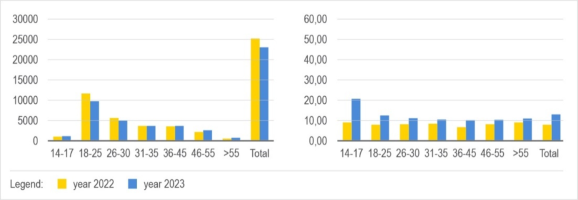
These issues have been confirmed by the data of the analysis conducted on Florence by many mobility service providers. Specifically, from the data provided by Bit Mobility, regarding the use of shared e-scooters in Florence, a drastic decrease emerges in the percentage of users for the >46 age group (1,547 in 2022; 1,741 in 2023) and for the >55 age group (380 users in 2022; 445 in 2023), compared to the 18–25 age group (9,563 users in 2022; 11,320 in 2023).
The same data also show that the number of rentals per user is constant between the different age groups, with an average of approximately 8–9 trips in 2022, and 10 in 2023 (see Figure 1), which validates the assumption of occasional use, referred to specific scenarios, as already introduced in the previous section.
Figure 1: Left: number of e-scooter users per year, divided by age groups. Right: aver- age number of e-scooter rentals per user in one year, divided by age groups (Bit Mobility, Florence, 2023).
86 Rinaldi and Lagrimino
User Needs Analysis The user needs analysis has been conducted on a specific cluster of users, identified as ‘non-users’ of e-bikes and e-scooters for their urban travel in autonomy, with an age >46 years. The survey has been carried out in the city of Florence by using ‘quick and dirty’ interviews involving a sample of 20 ‘non-users’.
The opinion of the ‘non-users’ made it possible to identify the main moti- vations regarding the ‘non-choice’ of light vehicles for their urban movement and to understand the circumstances in which they might have changed their decision (Fishman, 2016).
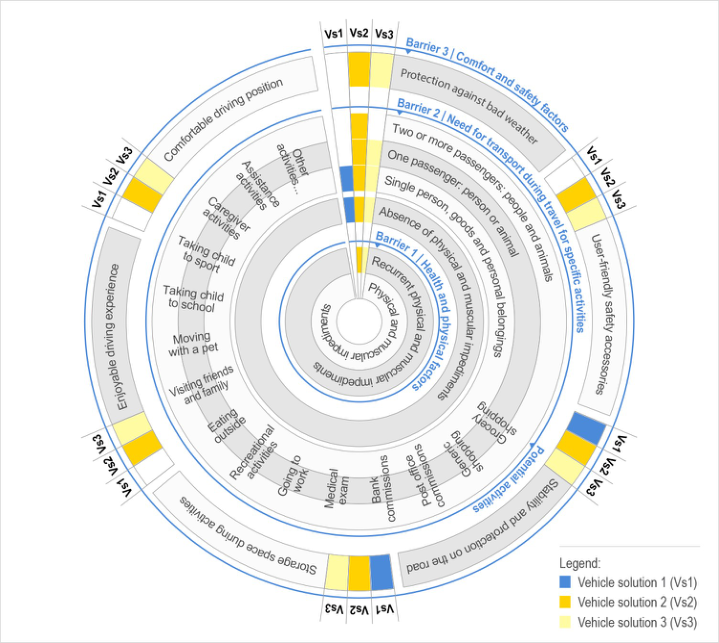
Thus, the objective of the interviews has been to identify the unmeet travel needs (UTNs) defined by Luiu, in a research study conducted to investi- gate the relationship between aging and mobility, as “the mobility needs that remain unmet due to the inability to achieve necessary or desired travel and activities” (Luiu et al., 2018). The interviews have revealed three main “barriers” to adopting e-bikes and e-scooters for one’s travel (see Figure 2).
Figure 2: The scheme represents the three levels of barriers identified during the interviews.
New Light Vehicles’ Solutions for Active, Sustainable 87
The first barrier is referred to health; some respondents consider their phys- ical condition as a barrier to using light vehicles consistently, listing joint pain and back pain, and reduced mobility of legs and feet among the most common reasons.
The second barrier concerns travel modes and, more specifically, “trans- portation” needs during one’s travels around the city. Asking respondents what activities they think they would not be able to accomplish using an e- bike or e-scooter has revealed that the main obstacle is “transporting”people, animals, and personal goods while moving with specific needs. Many respon- dents are in favour of using light vehicles for short solo trips (e.g., going to work, going to the post office, doing short commissions), but they show per- plexity when thinking about the possibility of moving with light vehicles to carry out those activities that in their habits include the presence of “passen- gers” (e.g., taking their children to school, caring for their elderly parents, doing family recreation, etc.).
The need to carry personal goods, such as grocery shopping, general shop- ping, and personal belongings in specific circumstances is also considered an important barrier to the use of these vehicles, because they are considered by respondents to be uncomfortable and have limited storage options compared to their cars.
Finally, multiple barriers have emerged concerning the perception of com- fort and safety in driving. In terms of safety, pedalling or riding on one’s e-scooter alongside motorized traffic, fear of falling or losing control has emerged as a major limitation. Some respondents have expressed concerns about riding posture, especially for the e-bike, which causes generalized dis- comfort at the contact points after prolonged use. The use of protective gear (such as a helmet) and the need to carry it with them at the end of the ride, as well as the absence of secure storage for personal belongings and the difficulty of parking the bike safely, are also barriers to use.
Focus Group and RQs Formulation The data that emerged in previous phases have been discussed within focus groups of experts in design, to elaborate the research questions (RQs) to be explored in the design sprint next step.
The RQs developed, one for each barrier, in the perspective of a smart city context, are the following:
RQ1: How to improve comfort in transporting people, goods, and animals by light vehicles through design?
RQ2: How can fatigue be reduced and the interaction with the city be increased when using micro-mobility solutions, through innovative light vehicle design?
RQ3: How can comfort, safety, inclusiveness, and general user experience be improved to increase the share of light urban mobility through design?
Exploration of Design Potential Areas The framework and RQs emerged from the analysis phase have been explored through co-design sessions involving young designers, and students from the
88 Rinaldi and Lagrimino
master’s degree program on design of the University of Florence, coordinated by IDEE Lab researchers. The co-design focused on sustainable mobility and the design of inclusive light vehicles for goods and people. Participants have been involved in several design sprint sessions to explore the emerging poten- tial of urban micro-mobility, through the development of product concepts and innovative design scenarios for light vehicles. The design sprint activity, as a process of designer investigation, originally includes a multi-step design process, articulated over a total of 3 (Banfiled et al., 2016) or 5 days (Knapp et al., 2016). The method described in this paper, is adapted to the activi- ties of the academic laboratory and it has been conducted in a single daily process (Rinaldi et al., 2023) divided as follows: i) idea generation through questions formulated through the How Might We (HMW) technique (10’); ii) creation of an affinity diagram by the HMW groups sharing (20’); iii) voting process about the preferred HMW (5’); iv) creation of the sketch- ing through Crazy8 technique (8’); v) sharing of the sketching and voting the Crazy8 results (20’); vi) re-elaboration of the sketched solutions (20’); vii) storyboard creation of the selected solutions (40’); viii) presentation and sharing of the final group results (20’); ix) preparation of the rapid prototype (60’); x) pitch presentation of the final elaboration (40’).
A total of 3 design sprint sessions have been completed; each session focused on exploring the three research questions developed. The partici- pants have been divided into groups, each worked on one of the proposed challenges.
Table 1 below provides an overview of the number of participants and the emergent concepts for each work session.
Table 1. Design sprint sessions and emergent design concepts.
Table available in the original PDF paper.
Sessions RQ Participants Results Session 1 2022 RQ1 12 Terrestrial drone that follows the user and improves walking RQ2 12 On-demand autonomous micro-shuttles for elders RQ3 13 E-scooter smart system to improve driveability and safety Session 2 2022 RQ1 13 Autonomous voice-controlled cargo robot RQ2 11 E-scooter with versatile and adaptable driving seat RQ3 11 Two-seats light vehicle with 3–4 wheels Session 3 2023 RQ1 12 E-cargo bike with semi-autonomous cargo box RQ2 12 Modular light vehicle formultiple passengers RQ3 12 E-scooter with transformable storage platform in the seat
New Light Vehicles’ Solutions for Active, Sustainable 89
RESULTS
Among the concepts that have emerged during the design sprint sessions, those considered most promising, after an analysis and voting activity, have been developed by the research team of the academic design laboratory and by some of the participants. The concepts have been implemented into the design of three inclusive pedal-assisted light vehicle solutions that explore unexpressed potentials of micro-mobility, defining new usage sce- narios. Specifically, the concepts of the vehicles are the following: i) e-bike equipped with a semi-autonomous driving cargo module (vehicle solution 1 – Vs1); ii) modular pedal-assisted little bus, for transporting multiple pas- sengers (vehicle solution 2 – Vs2); iii) two-seater pedal-assisted quadricycle with regenerative braking, which is a competitive and alternative solution to micro-cars (vehicle solution 3 – Vs3).
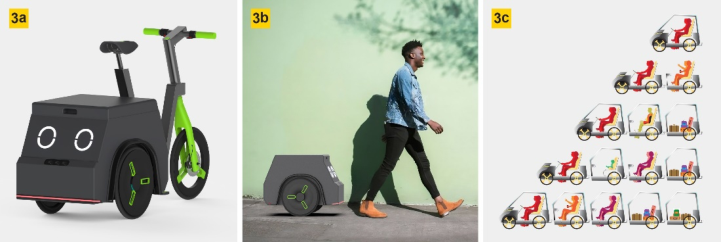
Vehicle Solution 1 The first vehicle developed is a three-wheels and pedal-assisted cargo bike, focused on implementing user safety and comfort and facilitating the trans- port of personal items. It is equipped with a cargo module located in the rear wheel axis, for the storage of small and medium-sized goods. The module is designed to support human activity and increase users’ autonomy in walking and cycling.
The vehicle explores the emerging potential in mobility related to the application of artificial intelligence technologies. The integration of the autonomous module into the e-bike allows for the implementation of pos- sible usage scenarios, enabling the reduction of efforts to transport goods during daily long-distance activities.
The cargo module, when unhooked from the vehicle, becomes autonomous and follows the user, during different activities, helping both for storage of goods and personal belongings and as seating for rest.
The layout of the cargo bike makes the vehicle more stable, allowing the user to remain effortlessly balanced. Furthermore, the autonomous module’s motor provides an important boost when driving, which allows the user to not feel the weight of the load (see Figures 3a, 3b).
Vehicle Solution 2 Starting with some of the concepts emerged during the design sprint ses- sions, the project named “Bus-Inno” has been implemented, in collaboration with the Department of Industrial Engineering (DIEF) of the University of Florence, for participation in the Horizon-CL5-2023-D5-01 research project call.
The vehicle consists of different modules that can be configured into multiple layouts. The main three-wheels module is the motorized module connected with a series of two-wheels, non-motorized, pedal-driven carts with an energy recovery system and drive belt.
The carts have different configurations and are extremely versatile for transporting a variable number of passengers adapting the vehicle to different
90 Rinaldi and Lagrimino
usage scenarios, such as tourism and urban transport of multiple passengers on-demand.
Each cart can transport two people, or it can be used to transport goods. The vehicle can be used with a variable number of carts, up to five, or even without carts for the needs of moving two people (see Figure 3c).
Figure 3: Vehicle solution 1 – Vs1 (3a, 3b), design by G. Lastrucci, IDEE Lab; vehicle solution 2 – Vs2 (3c), design by IDEE Lab with Dario Vangi.
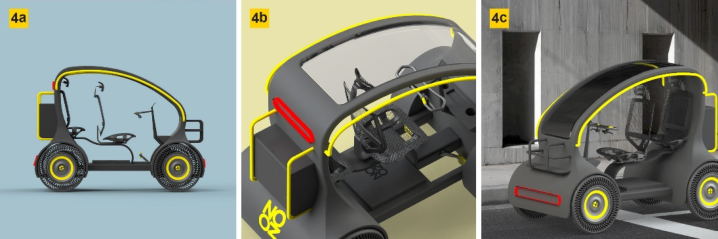
Vehicle Solution 3 The third solution of a light vehicle developed is a two-seater quadricycle with a regenerative pedalling mechanism. It is designed as an alternative to traditional electric micro-cars. The vehicle combines the benefits of active mobility, through the use of a pedal-assisted vehicle, with the comfort of a traditional vehicle through: i) the design of a comfortable driving posi- tion, which moves out of the classical sit-on configuration of pedal-assisted vehicles, proposing a sit-in layout, inspired by the world of cars, with an ergonomic seat and steering wheel; ii) the proposal of a carterized frame that allows the vehicle to “close”on several sides, protecting the user from adverse weather conditions; iii) the design of adding space for carrying personal goods.
Several studies show that bad sit-on posture during cycling can be the cause of health problems and physical discomfort (Diefenthaeler et al., 2008; Schwellnus et al., 2005). However, even the assumption of an appropri- ate posture is often not sufficient to prevent the manifestation of physical discomfort. Even simple use can be a factor that causes pain, especially if the cycling activity continues for a prolonged period (Azali et al., 2019). The proposal of a sit-in posture is part of this perspective, proposing a type of seat that better meets prolonged use of the vehicle by prevent- ing the incidence of any injuries. Finally, the two-seater layout becomes a resource to meet the needs of users traveling as a couple, from fami- lies (parents/children), to family caregivers who provide care to the elderly (see Figures 4a, 4b, 4c).
New Light Vehicles’ Solutions for Active, Sustainable 91
Figure 4: Vehicle solution 3 – Vs3 (4a, 4b, 4c), design by C. Pacini, G. Goti, IDEE Lab.
CONCLUSION
Exploring the potential of micro-mobility as a sustainable solution for urban mobility, focusing on the inclusion of a wide range of users has been the main objective of this research. The analysis has revealed a large percentage of users excluded from the most widespread micro-mobility solutions due to a multiplicity of barriers that limit the adoption of these vehicles (physical issues, particular transportation needs, perceptions of driving comfort, and safety).
The three solutions implemented are focused on increasing the share of light vehicles users, promoting an active and healthy lifestyle, and contribut- ing to the transition towards more sustainable and smart urban mobility. The design of more inclusive light vehicles, able to satisfy the needs of a wide range of users, including segments of the population currently excluded, has to take into consideration several design aspects, such as: i) the implementation of driving safety, both real and perceived, ii) the development of flexible systems to adapt to different user needs, iii) the versatility offered for the transport of goods and people, iv) the general implementation of comfort during the trip.
From this perspective, the digital technologies and the potential offered by artificial intelligence and automation systems can also give an important contribution to improving the vehicles’ usability and the user experience.
In conclusion, the design solutions investigated in this research answer the current needs of potential users excluded from micro-mobility and offer a vision of how the design of the future of light vehicles for urban mobility could be more inclusive, sustainable, and innovative.
ACKNOWLEDGMENT
The authors would like to acknowledge: i) all the participants of the design sprint activities who contributed in a significant manner to the develop- ment of the concepts presented in this paper; ii) prof. Dario Vangi for the cooperation in the implementation of the vehicle solution 2.
The article is the result of the joint work of the authors; the contribu- tion of each author is the following: Rinaldi A.: Methodological Approach and Results (solution 2, solution 3); Lagrimino J.: Introduction, Results (solution 1), and Conclusion.
92 Rinaldi and Lagrimino
REFERENCES
Abduljabbar, R. L., Liyanage, S., & Dia, H. (2021). The role of micro-mobility in shaping sustainable cities: A systematic literature review. Transportation research part D: transport and environment, 92, 102734. Azali, F. A. (2019). Postural Stability and Risk of Fall of Person with Trilateral
Prosthesis (Doctoral dissertation, University of Malaya (Malaysia)). Banfield, R., Lombardo, C. T., Wax, T. (2016). Design Sprint: una guida pratica per la creazione di grandi prodotti digitali. O’Reilly Media. Bozzi, A. D., & Aguilera, A. (2021). Shared E-scooters: A review of uses, health
and environmental impacts, and policy implications of a new micro-mobility service. Sustainability, 13(16), 8676. Diefenthaeler, F., Carpes, F. P., Bini, R. R., Mota, C. B., & Guimarães, A. C. S. (2008).
Methodological proposal to evaluate sagittal trunk and spine angle in cyclists: Preliminary study. Brazilian Journal of Biomotricity, 2(4), 284–293. European Commission (2021). Conclusioni del Consiglio sulla strategia della Commissione per una mobilità sostenibile e intelligente – Approvazione. European Commission (2019). Communication from the commission to the Euro-
pean Parliament, the European Council, the Council, the European Economic and Social Committee and the Committee of the Regions, The European Green Deal. Fishman, E. (2016). Bikeshare: A review of recent literature. Transport reviews, 36(1), 92–113. Hannon, E., Knupfer, S., Stern, S., Sumers, B., & Nijssen, J. T. (2019). An integrated perspective on the future of mobility, part 3: Setting the direction toward seamless mobility demand. Knapp, J., Zeratsky, J., Kowitz, B. (2016). Sprint: come risolvere grandi problemi e
testare nuove idee in soli cinque giorni. Simon e Schuster. Luiu, C., Tight, M., & Burrow, M. (2018). An investigation into the factors influencing travel needs during later life. Journal of Transport & Health, 11, 86–99. Phannil, N., & Jettanasen, C. (2021). Design of a personal mobility device for elderly
users. Journal of Healthcare Engineering, 2021, 1–22. Rinaldi, A., Busciantella-Ricci, D., & Viviani, S. (2023). Design for movability: a new design research challenge for sustainable design scenarios in urban mobility. In For Nature/With Nature: new sustainable design scenarios (pp. 1–20). Springer. Shaheen, S., & Chan, N. (2016). Mobility and the sharing economy: Potential to
facilitate the first-and last-mile public transit connections. Built Environment, 42(4), 573–588. Schwellnus, M. P., & Derman, E. W. (2005). Common injuries in cycling: Prevention, diagnosis and management. South African Family Practice, 47(7), 14–19. Teixeira, J. F., Diogo, V., Bernát, A., Lukasiewicz, A., Vaiciukynaite, E., & Sanna, V.
S. (2023). Barriers to bike and e-scooter sharing usage: An analysis of non-users from five European capital cities. Case Studies on Transport Policy, 13, 101045. Van Cauwenberg, J., De Bourdeaudhuij, I., Clarys, P., De Geus, B., & Deforche, B. (2019). E-bikes among older adults: benefits, disadvantages, usage and crash characteristics. Transportation, 46, 2151–2172. Zaffagnini, T., Lelli, G., Fabbri, I., & Negri, M. (2022). Innovative street furni-
ture supporting electric micro-mobility for active aging. In Internet of Things for Human-Centered Design: Application to Elderly Healthcare (pp. 313–327). Singapore: Springer Nature Singapore.
LISTED IN THE AHFE DIGITAL BOOKSTORE CATALOGUE
Explore the complete digital volume
Design for Inclusion
Read this individual research paper free through the original publisher, or explore the full digital proceedings book.
ISBN 978-1-964867-04-5
Explore this ISBN in the AHFE Bookstore ↗Listed in the July 2026 bookstore catalogue; search by ISBN to confirm current availability · Digital book purchase optional