Jonathan Lagrimino, Sara Viviani, Alessandra Rinaldi (2023). Implementation of Smart, Healthy, Age-friendly Environment through an Inclusive Robotic Air Purifier. In: Design for Inclusion. AHFE Open Access, vol. 75, pp. 38–48. https://doi.org/10.54941/ahfe1003325
A survey conducted in the United States estimates that people spend about 90% of their time inside buildings, mainly distributing activities in their homes and workplaces [1].The same lifestyle of being confined most of the time within enclosed spaces is also prevalent in Europe. This habit provides the opportunity and the right motivation to implement interventions that promote health and livability of the environments in which people live or work. In multiple fields of design discipline, this is translated into a focus on the development of quality indoor spaces that return comfortable environments for the inhabitants to organize, manage and modulate based on their needs and habits.The World Health Organization defines health as "a state of complete physical, mental and social well-being" [2]. Thus, inhabitant well-being can be measured not only in the satisfaction of basic human needs related to an individual's physical health, but also in all those intangible aspects related to the psycho-social sphere, such as perceived feelings of security, self-esteem, positivity, mood, and productivity [3].New design paradigms for a "healthy building" evaluate a multiplicity of factors that contribute to the determination of living comfort and the resulting qualitative perception of the inhabited space. These include the issue of Indoor Air Quality (IAQ) management. The "inhabitants" of an enclosed space usually turn out to be exposed not to a single agent, but to a mixture of substances that is generated by the concurrence of several triggers that combine into a potentially harmful mix for the occupants [4].Symptoms resulting from the effects of indoor pollution that are grouped under the acronym of BRI - Building-Related Illness - include specific pathological cases. In this regard the multiple studies on SBS - Sick Building Syndrome - are just one of the many concrete examples of the impact caused by a failure or fallacious management of the issue of indoor pollution [5].The evolving Coronavirus pandemic scenario has revolutionized people's habits, stimulating them to reflect on their condition as "inhabitants" forced to occupy enclosed spaces, suffering its negative influence. This reflection has been echoed by a strong awareness of aspects concerning indoor air quality highlighted also by the exponential increase in the market for air treatment devices. The growing attention to indoor air quality is part of the broader changement underway concerning the people's increasing sensitivity to issues relating to the care of their psycho-physical health in all its facets, from simply reducing risk factors to preventing aging.The paper presents a research project, titled APLU, which led to the development of an ion-generating robot that also has the function of a vacuum cleaner. A careful analysis of the state of the art in air purification devices revealed the lack of a holistic approach in the design of these products, whose function is often reduced to a mere assembly of components with embedded digital technologies. The main limitation that emerged is that the devices currently on the market are designed to be fixed, which entails limited coverage of the indoor space, as well as difficulty in interfacing and controlling by users, especially by elders.In this context, APLU aims to increase the usability of a purifier, in terms of effectiveness, efficiency and satisfaction, and to create an inclusive interface, through the integration of advanced technologies, related to the field of robotics and Internet of Things. The final result of the research through design is a robot able to move autonomously within the home, going to cover in its purification activity the entire space of the house based on its sensing capabilities.The transition from a static device to an independent robot in the management of its functions also meets the need to interface with the most fragile categories of users, who are more exposed to the dangers of pollutants. The research project therefore intends to: i) test and validate the possibility of minimizing the user's burden of managing the product; ii) increase its efficiency by equipping it with autonomous intelligence; iii) facilitate the interaction with the device by providing inclusive support and monitoring tools capable of relieving the work of users, especially the elderly; iv) test the acceptability by the elderly, often hostile to advanced technological solutions.
A survey conducted in the United States estimates that people spend up to 90% of their time inside buildings (Klepeis et al., 2001). The same lifestyle of being confined predominantly within enclosed spaces is also prevalent in Europe. In this regard, a study carried out in the United Kingdom highlights how inhabitants predominantly distribute their activities between personal houses (41%) and workplaces (34%) (Brown, 1983).
This diffuse habit provides the opportunity and motivation to implement interventions that promote the health and liveability of the environments in which people live or work (Sheldon, 2020). In multiple fields of the design discipline, this translates into a focus on developing quality interior spaces that return comfortable environments for inhabitants to organize, manage, and modulate according to their needs and habits. In fact, indoor environ- mental quality (IEQ) design has the potential not only to meet basic human needs but also, and more importantly, to help meet higher-level needs with
Implementation of Smart, Healthy, Age-Friendly Environment 39
the goal of protecting the health of inhabitants (Crandall et al., 1996). The World Health Organization (WHO) defines health as “a state of complete physical, mental and social well-being.” From this definition follows that the concept of “health”mustn’t be reduced only to which concerns the “physical” sphere of the individual but should be extended to all those intangible and subjective factors related to the psycho-social sphere; factors that, relating to living comfort, can translate, for example, into perceived feelings of security, self-esteem, positivity, and productivity (Ni et al., 2020).
The new design paradigms for a “healthy building” (Crook et al., 2010) evaluate a multiplicity of aspects that contribute to determine living com- fort (IEQ) and the resulting qualitative perception of inhabited space. These aspects certainly include the issue of indoor air quality (IAQ) management, which responds to the problem of indoor pollution. The “inhabitants” of an indoor space are usually exposed not to a single agent, but to a mixture of substances generated by the concurrence of several triggers that combine into a potentially harmful mix for the occupants (Awada et al. 2021). In fact, indoor air quality (IAQ) is affected both by contaminants from outside and by indoor sources as: i) building materials, ii) appliances, iii) excessive humi- dity, iv) occupants (pets and humans). Major pollutants that can be linked to the sources just listed include: i) organic gases (such as VOCs), ii) inor- ganic gases (such as ozone and radon), iii) particulate matter (such as mold, asbestos, etc.) (Heinsohn et al., 2003).
Symptoms resulting from the effects of indoor pollution, grouped under the acronym BRI - Building-Related Illness - include specific pathological pat- terns. In this regard, the numerous studies on SBS - Sick Building Syndrome - are just one of the many concrete examples of the impact caused by a lack or superficial management of indoor pollution (Crook et al., 2010). These pathologies show how acute “physical” symptoms such as asthma, throat and eye irritation or shortness of breath are directly associated with eleva- ted negative emotions, amplified aggressive behaviours, decreased attention and mental fatigue (Awada et al., 2021). The evolution of the Coronavirus pandemic scenario has revolutionized people’s habits, stimulating them to reflect on their condition as “inhabitants” forced to occupy enclosed spaces, suffering its negative influence.
This reflection has been echoed by a strong awareness towards the issue of indoor air quality management also evidenced by the exponential increase in the use of air treatment devices (Businesscoot.com, 2021) and sensors to detect pollutants (Awada et al., 2021). Among the countermeasures, in fact, building ventilation, and more specifically mechanical ventilation through the application of air filtration technologies, including portable air purifiers, appears to be among the most effective in providing and maintaining better IAQ by removing pollutants generated by indoor sources and thereby diluting the concentration of indoor contaminants (Awada et al. 2021).
People’s increasing attention to indoor air quality management, however, is not to be interpreted merely as an impulsive response to a passing need, but rather as one more step to the broader vision of changing related to the gradual increase in sensitivity to issues concerning the care of mental and
physical health in all its facets, from simply reducing risk factors to preventing aging (Coop R., 2021).
A careful analysis of the state of the art of air purification devices, condu- cted within the research presented in the following article, has revealed the lack of a holistic approach in the design of these products, whose function is often reduced to a mere assembly of components and technologies. The main limitation that has emerged is the predisposition of the devices to be statio- nary, with coverage limited to a portion of the indoor space, and a difficulty in interface and control by older users.
Aplu was born out of a reflection on this scientific context, and it has led to the development of an ion generating robot, which also functions as a vacuum cleaner. The project aims to increase the usability of a purifier, in terms of effectiveness, efficiency and satisfaction, and to create an inclusive interface, through the development of a new principle of operation, exploi- ting the integration of advanced technologies, related to the field of robotics and the Internet of Things.
The project has used the “research through design” approach to find inno- vative solutions for improving the usability in terms of inclusion and user experience, and for simplifying the interaction with an indoor air purification device.
Specially, Aplu’s project has had the following specific objectives: i) to increase the efficiency of the air purifier by equipping it with autonomous intelligence; ii) to test and validate the possibility of minimizing the user’s burden of managing the product; iii) to provide inclusive support and moni- toring tools that can ease the work of users, particularly the elderly; iv) to test acceptability by the elderly, who are often hostile to advanced technological solutions.
METHODOLOGICAL APPROACH The research project has used design thinking methodology, combined with a human centered approach. The design process has considered the user holi- stically, focusing on the following points: i) the effective design of a product that addresses the primary need of “having to purify the air”; ii) how the solu- tion can adapt to the user’s habits, activities, and lifestyle; iii) how the user can learn to use the solution. Innovation research has focused particularly on the emotional and relational component of the product-service system in interacting with users, whose positive or negative behavioural responses can drastically change the user experience (Tosi, 2020).
Below are presented the steps that has led to the definition of the final solution.
Preliminary Phase: State of the Art Analysis The first phase of research has been carried out mainly through the qualita- tive method of state-of-the-art analysis, a method already adopted in several research aimed to study the consumption of “smart technologies” (Ammari et al., 2019). Through the analysis of market benchmarks and innovative concepts, this preliminary in-depth study has allowed to understand the main
Implementation of Smart, Healthy, Age-Friendly Environment 41
technologies and the principle of operation of air purifiers, specifically going to understand: i) the basic mechanisms of the “technological product”; ii) the functioning of the applied purification technologies, defining their actual potential and comparing the differences in terms of mechanism and effecti- veness; iii) the necessary components for the design of an efficient device; iv) the strengths and criticalities related to the operation of the device.
Empathize Phase In parallel to the development of comprehensive User Research and the asses- sment, through the analysis of the context of use, of social, cultural, and technological reference variables, the qualitative method of state-of-the-art analysis has contributed to provide useful details regarding the identification of user tasks and needs in the operational context (Maguire, 2001).
The preliminary analysis of the state of the art, aimed at understanding all factors related to the technical aspect of the product, has provided the basis, in the empathize phase, for an exploratory approach to usability aspe- cts, with the attempt to understand: i) what are the types of users; ii) how existing products relate to the user; iii) how existing products relate to the context; iv) what is the degree of user satisfaction; v) what are the factors that can determine it; vi) what are the usability needs in relation to the context. This exploratory approach has occurred, more specifically, by focusing on the analysis of online reviews, that is a method already used in the context of Smart Objects (SO) (Gao et al., 2018). Thirty products have been analysed, with an average of 500 reviews per device, including ratings and comments, all extrapolated by the same e-commerce.
This exploratory approach has evolved in three consecutive phases: 1) open-coding phase in which reviews has been analysed in order to collect initial information regarding the user’s negative or positive experience with reference to some pre-selected air purifiers (light weight, ease of communica- tion, filter maintenance, portability, etc.); 2) axial coding stage in which the themes had emerged in previous stage has been placed within macro groups on the basis of their affinities; 3) concluding stage, in which the maximum level of abstraction of the collected data has been reached. This has allowed to define the macro themes to work on to develop the project.
Finally, the hierarchical task analysis method has been used to structure the amount of information collected. These have been distributed in the sequence of activities related to the interaction with the purification devices, from the purchase phase to the maintenance phase, up to the definition of the critical and strengths points, useful in the development of the design solution.
Define Phase The analysis of the state of the art has revealed the lack of a holistic approach in the design of air purification products, whose function is often reduced to an assembly of components and digital technologies and the intended use a mere “consequence” of form. This lack does not directly affect the absolute value of the product, but it influences the product’s performance in relation
to context and user experience. In fact, purification technologies taken indi- vidually, offer very high performance, with percentage values of pollutant particles removed from the inhaled air that can reach as high as 99% in the case of, for example, HEPA filters.
However, this is not enough to determine the successful performance of a purification device, whose result depends on a combination of three factors: 1) the choice of purification technology; 2) the flow rate of the device, i.e., the volume of air it is capable of filtering in a given time frame; 3) the design of the airflow path in and out of the device.
The lack of a holistic approach thus minimizes the importance of conside- ring the context of use of these products at the design stage. Confirming this, the devices currently available on the market are mainly designed to be stati- onary and are also rather bulky, which limits the operation of the purifier, in terms of coverage, to a circumscribed portion of the indoor space. Alternati- vely, smaller, easily transportable solutions can be found, but these generate other problems, since they have an even smaller coverage than fixed devices, with a very limited range.
As a result, the user is forced to continually move the device or purchase multiple devices with a burden in terms of economics and maintenance.
Critical issues have emerged from the empathize phase regarding the inte- raction aspect with the device, mainly concerning the control interface and remote management.
In an increasingly technological world, one of the most significant trends today is the Internet of Things (IoT), a network made up of objects that can collect data about their surroundings and communicate with other objects or the user. These Smart Objects (SO) are technological devices that can under- stand and interact with the environment by acquiring data and producing output, such as a task or interaction (Puntoni et al., 2021). They are also technological devices that differ from more traditional technologies in their ability to exercise autonomy, authority, and agency (Novak et al., 2019).
The latest generation of air purification devices can be considered Smart Objects, as they are generally conceived and designed to connect and share data with third-party devices such as home assistants or smartphones for the purpose of facilitating user management. The devices themselves are capa- ble of processing air quality data, translating it into information for the inhabitant.
Although SO are extremely useful in improving quality of life, including in relation to inhabiting one’s indoor space, it is evident that senior users tend to use technologies less than other social groups, leaving a digital divide emerging between older and younger generations (Anderson et al., 2017).
Research has identified the different barriers to technology adoption by senior users, such as: i) physical or cognitive difficulties, ii) lack of knowledge (LeRouge et al., 2013); iii) scepticism toward technology (Bianchi, 2021); and iv) viewing technology as a threat to one’s identity (C. Li et al., 2020).
Aplu has directed the design toward the idea of a purifier intended as SO, taking into consideration the barriers described above and thus, as Mostaghel argues, the need to solve the challenges faced by the elderly related to the effort of learning to use technology (Mostaghel, 2016).
Implementation of Smart, Healthy, Age-Friendly Environment 43
RESULTS AND DISCUSSIONS Air Purification in Aplu
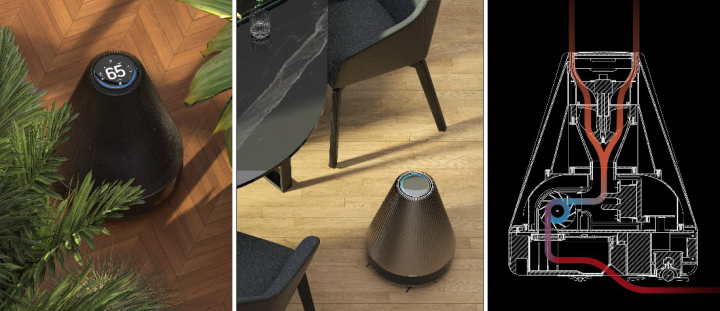
Aplu is the result of the transition from a static device to an independent robot in the management of its functions. This transition has been defined by reflecting on the concept of “movement” by exploiting the integration of advanced technologies, linked to the field of robotics and the Internet of Things. The result has led to the development of an air purifying robot (ion generator) which also has the function of a vacuum cleaner; a robot able to move independently inside the house, going to cover the entire indoor space in its air purification and surface cleaning activities thanks to the detection capabilities of specific sensors.
The integrated mechanism, that combines the functionality of a robot vacuum cleaner with an ion generator air purifier, results in three distinct wor- king modes of Aplu. The main mode, called “hybrid”, is determined by the simultaneous operation of the two functions: the air aspirated from the lower surface passes through a filter placed at the end of a small tank for collecting dust, then the sucked air flow is “ionized” and exited through a ring ope- ning located on the top surface of the device. The other two modes offer an alternative to the main hybrid solution in order to better manage the various circumstances of use of the product and reduce consumption to a minimum. In fact, it is possible that situations may arise in which it is not necessary for the product to work by exploiting both functions simultaneously, but by activating only one of the two autonomously.
A Tangible Robot for Intangible Information To design the product-user interaction has been essential to understand how people tend to approach the use of an SO. Some research, in this sense, has focused on the analysis of “consumption journeys” (Cho et al., 2019), highlighting how in the early stages of possession, users are com- mitted to experimenting with the innovative functions of the devices, while in the medium to long-term, enthusiasm and utilization may decrease
Figure 1: Design solution: aesthetics and schematization of the functioning of Aplu.
(Lopatovska et al., 2019). This happens for the most disparate reasons, rela- ted to the loss of interest, frustration or change in habits induced by the device (Cho et al., 2019), or because the initial phase of use is often characterized by an “experimentation” where users challenge the personality, knowledge, and intellect of SO (Sciuto et al., 2018).
It has been essential also to consider the emotional-relational aspect of the user. In fact, some research shows how the interaction between SO and users is more similar to the human one than to the traditional one between user and technology. This is because the exchange of information places the two interlocutors almost on the same level thanks to an increasingly less centra- lized interaction on a single device (Volpentesta, 2015) and to the sharing of the same communication languages (O’Leary et al., 2017).
The project has been developed to minimize the need for “forced” user interaction with the device, aiming to lead the latter towards a “natural” interaction by transforming the episodic use of the product in an integrated use in the daily life of users (Porcheron et al., 2018). This intention has taken its form in the following choices: i) to develop ad hoc sensors and connectivity with other SO that allow Aplu to be autonomous not only in movement, but also in programming and communicating movements to the user; ii) to design a clear and immediate interface that allows the user to control the “work” of the device, facilitating the reading of the information; iii) to develop a software for configuration and remote control of the Aplu work.
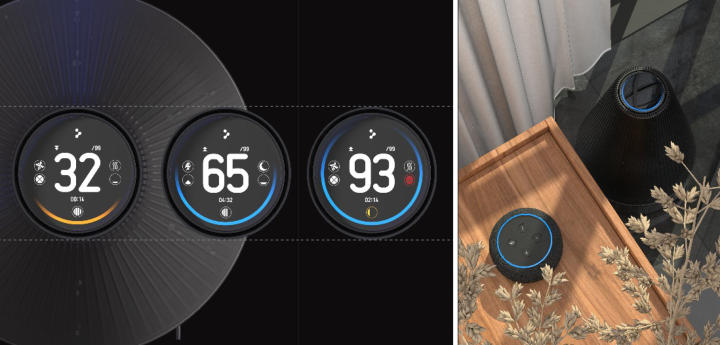
- Direct interaction between product and user) The design of direct inte- raction has highlighted the need to make the “invisible” problem of indoor pollution “tangible”, making the user perceive the actual work and useful- ness of Aplu. The result of the interface has derived from iterative usability tests, with a small number of users (3 elderly people; 1 caregiver; 2 expert designers). The interface has been conceived as a means of active, simple, and continuous communication. The choice of the position of the intera- ction display has proved to be crucial in the design of the direct product-user relationship and has made it possible to give the mobile device, that moves independently around the house, an even more “human”attitude. The display is in fact facing upwards, placed in the upper part of the device, framed by the empty ring space that allows the purified air to escape. This position allows an extremely natural and immediate interaction that permits the user to “simply look down”.
Finally, the design of the interface, on a circular surface, allows a centra- lized and hierarchical organization of the information to be transmitted to the user, facilitating the reading of the data. At the centre, the value of the IAQ provides the user with immediate feedback on the quality of the device’s work, around it, some icons summarize the essential information regarding the battery status and work settings. Finally, on the circumference of the display, a luminous ring indicates the remaining working time, calculated in real time by Aplu’s intelligence using the data collected by the sensors and the data shared by any other connected devices.
- Remote control as an opportunity for assistance and training) The multi- ple functions of the SO push designers to dedicate part of the planning to the
Implementation of Smart, Healthy, Age-Friendly Environment 45
Figure 2: Design solution: Aplu’s interface and interaction with other SO.
development of specific software which, in the complexity of a home auto- mation system, allows the user to manage and configure his own product, especially during the purchase phase. This phase of the design process has provided food for thought regarding the issue of user assistance and trai- ning. Bypassing the configuration phase, the development of software for the management of Aplu has become an occasion for “designing” user training. The information system developed by Aplu tries to provide knowledge that helps the inhabitant of the indoor space to improve personally, filling the need for “healthcare”, highlighted by current social trends (Coop R., 2021). This translates into a software that assists the user by providing him with infor- mation on the management of the natural ventilation of his indoor space, and information on how to remove pollutants detected and on their origin. The software also sends daily or weekly reports on the IAQ trend of the indoor space and provides information on the type of pollutants detected.
The data are a further step in the development of a “human” interaction and make the robot “friendly”, “paternal”, like a guardian of the house who wants to protect its inhabitants by instructing them in the exercise of new habits aimed at correcting wrong behaviours.
Remote control also turns out to be a valuable support tool for older cate- gories of users and provides the possibility of alleviating the workload of any caregivers (Sheldon, 2020), whether they are provided by healthcare person- nel or belonging to the family unit. The software provides remote access to useful resources for remote monitoring, control of air quality data and assi- stance in using it, confirming the fundamental role that the family unit and qualified persons have in enabling senior users to adopt and learn to use SO devices (Mostaghel, 2016).
CONCLUSION
The research project here presented has been conducted with a design thin- king approach, which led to the identification of technological opportunities,
latent needs of users in a “for all” perspective, allowing the development of a pilot project to test the validity of targeted solutions to elderly users. Some usability tests have been conducted on a small number of users, to validate solutions regarding to the interface and the acceptability of the advanced technological solution with autonomous intelligence. The project has achie- ved a TRL4 laboratory validation. The product provides information on the requirements and technical characteristics that can be achieved by integrating advanced technologies (IoT and robotics) to a purifier to make it inclusive and performing even for aged users. It constitutes valid basic research for the development of a higher TRL project, necessary in the future to test the validity of the solution also in operational contexts.
ACKNOWLEDGMENT
The authors would like to acknowledge the University of Florence for having supported the project and deposited the design patent.
The article is the result of the joint work of the authors; the contribu- tion of each author is the following: Lagrimino J. “Results and Discussion” and “Conclusions”; Viviani S. “Introduction”; Rinaldi A. “Methodological approach”.
REFERENCES
Ammari, T., Kaye, J., Tsai, J. Y., & Bentley, F. (2019). Music, Search, and IoT: How People (Really) Use Voice Assistants. ACM Transactions On Computer-Human Interaction, 26(3). Anderson, M., & Perrin, A. (2017). Technology use among seniors. Washington, DC:
Pew Research Center for Internet & Technology. Awada, M., Becerik-Gerber, B., Hoque, S., O’Neill, Z., Pedrielli, G., Wen, J., & Wu, T. (2021). Ten questions concerning occupant health in buildings during normal operations and extreme events including the COVID-19 pandemic. Building and Environment, 188, 107480. Bianchi, C. (2021). Exploring how internet services can enhance elderly well-being.
Journal of Services Marketing. Braines, D., O’leary, N., Thomas, A., Harborne, D., Preece, A. D., & Webberley, W. M. (2017). Conversational homes: a uniform natural language approach for collaboration among humans and devices. International Journal on Advances in Intelligent Systems, 10(3/4), 223–237. Brown, L. (1983). National radiation survey in the UK: indoor occupancy factors. Radiation Protection Dosimetry, 5(4), 203–208. Businesscoot.com (2021). The air purifier market | Italy. Report https://www.bu
sinesscoot.com/it/studio-di-mercato/il-mercato-dei-purificatori-daria-italia#:~: text=La%20crescita%20del%20mercato%20dei,la%20fine%20di%20questo% 20periodo. Cho, M., Lee, S., & Lee, K. P. (2019). How do people adapt to use of an IoT air purifier? From low expectation to minimal use. International Journal of Design, 13(3), 21–38. Coop, R. (2021). Consumi e stili di vita degli italiani di oggi e di domani.
Implementation of Smart, Healthy, Age-Friendly Environment 47
Crandall, M. S., & Sieber, W. K. (1996). The National Institute for Occupational Safety and Health indoor environmental evaluation experience. Part one: building environmental evaluations. Applied Occupational and Environmental Hygiene, 11(6), 533–539. Crook, B., & Burton, N. C. (2010). Indoor moulds, sick building syndrome and
building related illness. Fungal Biology Reviews, 24(3-4), 106–113. Gao, Y., Pan, Z., Wang, H., & Chen, G. (2018, October). Alexa, my love: analyzing reviews of amazon echo. In 2018 IEEE SmartWorld, Ubiquitous Intel- ligence & Computing, Advanced & Trusted Computing, Scalable Computing & Communications, Cloud & Big Data Computing, Internet of People and Smart City Innovation (SmartWorld/SCALCOM/UIC/ATC/CBDCom/IOP/SCI) (pp. 372–380). IEEE. Heinsohn, R. J., & Cimbala, J. M. (2003). Indoor air quality engineering: environ-
mental health and control of indoor pollutants. CRC press. Klepeis, N. E., Nelson, W. C., Ott, W. R., Robinson, J. P., Tsang, A. M., Switzer, P., ... & Engelmann, W. H. (2001). The National Human Activity Pattern Survey (NHAPS): a resource for assessing exposure to environmental pollutants. Journal of Exposure Science & Environmental Epidemiology, 11(3), 231–252. LeRouge, C., Ma, J., Sneha, S., & Tolle, K. (2013). User profiles and personas in the
design and development of consumer health technologies. International Journal of Medical Informatics, 82(11), e251–e268. Li, C., Lee, C. F., & Xu, S. (2020). Stigma Threat in Design for Older Adults: Exploring Design Factors that Induce Stigma Perception. International Journal of Design, 14(1). Lopatovska, I., Rink, K., Knight, I., Raines, K., Cosenza, K., Williams, H., … Mar-
tinez, A. (2019). Talk to me: Exploring user interactions with the Amazon Alexa. Journal of Librarianship and Information Science, 51(4), 984–997. Maguire, M. (2001). Methods to support human-centred design. International Journal of Human-Computer Studies, 55(4), pp. 587–634. Mostaghel, R. (2016). Innovation and technology for the elderly: Systematic litera-
ture review. Journal of Business Research, 69(11), 4896–4900. Ni, M. Y., Yao, X. I., Cheung, F., Wu, J. T., Schooling, C. M., Pang, H., & Leung, G. M. (2020). Determinants of physical, mental and social well- being: a longitudinal environment-wide association study. International Journal of Epidemiology, 49(2), 380-389. Novak, T. P., & Hoffman, D. L. (2019). Relationship journeys in the internet of
things: a new framework for understanding interactions between consumers and smart objects. Journal of the Academy of Marketing Science, 47(2), 216–237. Porcheron, M., Fischer, J. E., Reeves, S., & Sharples, S. (2018, April). Voice interfaces in everyday life. In proceedings of the 2018 CHI conference on human factors in computing systems (pp. 1–12). Puntoni, S., Reczek, R. W., Giesler, M., & Botti, S. (2021). Consumers and Artificial
Intelligence: An Experiential Perspective. Journal of Marketing, 85(1), 131–151. Sciuto, A., Saini, A., Forlizzi, J., & Hong, J. I. (2018). Hey Alexa, what’s up?”: Studies of in-home conversational agent usage. In Proceedings of the DIS. Sheldon Smart Habitat for the Elderly. (2020). Increasing adoption of solutions to
improve healthy and active ageing - A White Paper on Policy Implications and Recommendations. White Paper Tosi, F., & Tosi, F. (2020). Design for ergonomics (pp.31–45). Springer International Publishing.
Volpentesta, A. P. (2015). A framework for human interaction with mobiquitous services in a smart environment. Computers in Human Behavior, 50, 177–185. World Health Organization. (1948). Preamble to the Constitution of WHO as ado-
pted by the International Health Conference, New York, 19 June–22 July 1946; signed on 22 July 1946 by the representatives of 61 States (Official Records of WHO, no. 2, p. 100) and entered into force on 7 April 1948. The definition has not been amended since, 1948(3).
LISTED IN THE AHFE DIGITAL BOOKSTORE CATALOGUE
Explore the complete digital volume
Design for Inclusion
Read this individual research paper free through the original publisher, or explore the full digital proceedings book.
ISBN 978-1-958651-51-3
Explore this ISBN in the AHFE Bookstore ↗Listed in the July 2026 bookstore catalogue; search by ISBN to confirm current availability · Digital book purchase optional