Siyuan Huang, Pieter Desmet (2023). Needs Matter: A Detailed Typology of Fundamental Needs for Human-Centered Design. In: Creativity, Innovation and Entrepreneurship. AHFE Open Access, vol. 74, pp. 27–36. https://doi.org/10.54941/ahfe1003302
The relevance of human needs is generally recognized in human-centered design research and practice. However, a challenge of working with needs is that the word “need” can be interpreted in various ways, which can hinder effective communication and collaboration. Need typologies, in such cases, can serve as a shared language by providing an overview of distinct human needs. Building on a design-focused typology of thirteen fundamental needs, this paper introduces a detailed version in which two complementary but distinct facets explain each need. We envision this fine-grained vocabulary of basic human needs can support initiatives in human-centered design research and practice, particularly facilitating and enriching conversations among people from different backgrounds. Furthermore, we propose three directions for future research on this topic.
Do people need a plethora of social platforms? – or do they really need a sense of community? Do people need endless computer games or TV shows? – or do they really need some novelty and stimulation? In design practices, the word “need” is often used to represent something that is wanted, preferred, or required by end-users and/or other stakeholders. Throughout the design process, developing an understanding of users’ needs can serve various pur- poses. They can inform the developmental intention and design focus and translate to criteria for selecting and testing design ideas (e.g., Hassenzahl et al., 2010).
A challenge, however, is that the word “need” has multiple meanings and can be interpreted in various ways, which can hinder a desired shared understanding. This ambiguity impacts user research: when people express what they need, they may be unable to distinguish their needs from their wants, likes, expectations, and desires. Similarly, it affects collaborative design initiatives, especially involving different parties. For instance, when communicating needs within a design team, the same need concept can be interpreted, implemented, and assessed differently by various team mem- bers, such as project managers, developers, engineers, and product or UX
designers. Therefore, this lack of shared vocabulary often hinders effective communication and collaboration. To address this issue, several research- ers have indicated that need typologies (i.e., lists of needs) are helpful as a shared language, a source for design inspiration and innovation, a guideline for design development, and a conceptual basis for design evaluation (Von Hippel, 2001, Ozkaramanli et al., 2013, Khalid, 2006).
RESEARCH POSITIONING Desmet and Fokkinga (2020) introduced a design-focused need typology based on a narrative review of existing typologies in psychology. This typo- logy intends to facilitate a shared understanding and foster collaboration for human-centered design. It consists of thirteen fundamental human needs: Autonomy, Beauty, Comfort, Community, Competence, Fitness, Impact, Morality, Purpose, Recognition, Relatedness, Security, and Stimulation. In addition to the explanations for each of the thirteen basic needs, the typology lists 52 sub-needs. The need for Recognition, for instance, can be opera- tionalized into the need for appreciation, respect, status and prestige, or popularity. Likewise, the sub-needs for Purpose include but are not limited to the need for life goals and directions, meaningful activity, personal growth, and spirituality.
Despite sub-needs concretizing the typology by showing how a need concept can translate or manifest in situated needs, different people may hold different sets of sub-needs, which means that the number of possible sub- needs is uncountable. Therefore, any list of sub-needs would be principally incomplete. Thus, a key question here is how nuance can be added to the set of basic needs in a way that keeps the universality intact. In this manuscript, we do so by utilizing the concept of “need facets,” a term that was introdu- ced by motivation researchers (Reeve et al., 2003, Ng et al., 2011). The term need facet is used to refer to the different aspects or components of a single need that share a common foundation but also possess unique features (Van- steenkiste et al., 2020). By differentiating between various facets within the fundamental needs, we can gain a more nuanced understanding of each need while maintaining the simplicity and parsimony of the basic need framework. Table 1 summarizes the main differences between sub-needs and need facets in terms of their definitions, quantities, characteristics, and interrelationships.
Since its publication in 2020, the typology of thirteen fundamental needs has drawn significant interest from both academia and industry. There has been a particular emphasis on the demand for an operationalization that can stimulate and aid the implementation of this typology in design practice and
Table 1. The conceptual differences between need facets and sub-needs.
Table available in the original PDF paper.
Need facets Sub-needs Working definition Particular aspects of a need Examples of a need Quantity Finite Infinite Characteristics Universal and fundamental Individual and non-fundamental Interrelationship At the same level Can be organized into hierarchies
Needs Matter: A Detailed Typology of Thirteen Fundamental Needs 29
research. As a result, the current research was designed to develop a detailed version of the original typology, adding granularity to increase usability for design initiatives and starting points for need measurement. Building on the premise that basic needs are multifaceted concepts that can be further elabo- rated in terms of need facets, this study aimed to identify complementary but distinct facets for each of the thirteen fundamental needs.
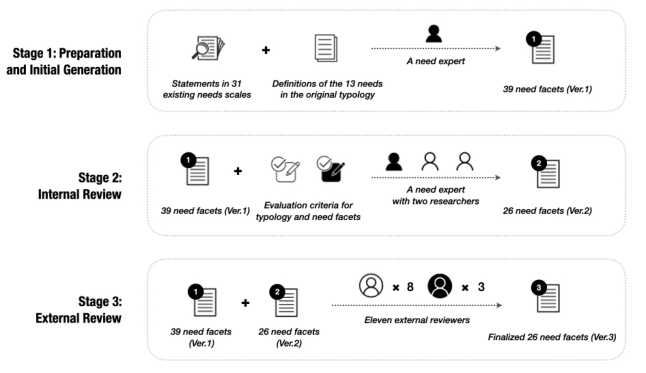
THE DEVELOPMENT PROCESS The detailed typology was developed through three main stages: (1) prepa- ration and initial generation, (2) internal review, and (3) external review. Figure 1 presents an outline of the entire process and we elaborate on each stage below.
Stage 1: Preparation and Initial Generation The first step in Stage 1 was to collect need statements from 31 existing scales. These scales measure varying states of fundamental need fulfillment (e.g., need satisfaction, frustration, support, and thwarting) in general situ- ations, specific life domains, or activities. Examples of the reviewed scales are the Basic Needs Satisfaction at Work Scale (Deci et al., 2001), the Psychological Need Satisfaction in Exercise Scale (Wilson et al., 2006), the Balanced Measure of Psychological Needs Scale (Sheldon and Hilpert, 2012), the Basic Psychological Need Satisfaction and Frustration Scale (Chen et al., 2015); a full list is available upon request. Next, we categorized all 665 need statements collected from existing sca- les according to the definitions of the thirteen fundamental needs. For most statements, this was straightforward since the source paper used the same terminology. We, however, reallocated some due to further review of the statements. For some, it was less straightforward because the source paper
Figure 1: The development of the detailed typology of basic needs involves three stages.
30 Huang and Desmet
used a different terminology than the thirteen fundamental needs (e.g., need for curiosity, self-actualization, or novelty). In those cases, the categoriza- tion was determined based on the statement itself. The main reason for this preparation was that the construct of a (need) factor for scale development reflects different aspects of a need. This review resulted in 9 (Purpose) to 159 (Autonomy) need statements per fundamental need. Table 2 uses the need for Comfort to show how we categorized need statements from different scales.
Based on the original definitions of the thirteen needs and the categorized 665 need statements, one need expert (the first author of the original typology paper) distilled three initial facets for each need and drafted definitions for all 39 facets (Ver.1). Similar to the need definition structure of the original typology, the definitions of need facets contain both positive and negative aspects. The need for Purpose, for example, was divided to:
Ambitions. Having life goals that give you a sense of direction and purpose, rather than not knowing where you want to go in life.
Personal growth. Being able to grow and develop towards reaching your full potential, rather than stagnating your personal growth.
Spirituality. Being connected to a deeper meaning in your life, rather than failing to find meaning in life.
Stage 2: Internal Review The second stage of development aimed at optimizing both the quantity and quality of the 39 need facets. First, the two researchers who classified the need statements in the first stage took a week to immerse themselves in the initial version of the need facets. Next, the two researchers with the need expert held an internal review session, where issues (such as potential overlaps of needs facets within or between needs) and modification proposals were discussed.
Given the objective to refine the facets to be conceptually distinctive while ensuring the entirety when bringing them together, we sought the help of two techniques. One is to use qualification criteria for assessing typologies, including inclusion, distinction, equivalence, and granularity (see Desmet & Fokkinga, 2020). The other is a set of requirements for basic needs since the decisive issue in determining need facets can be considered equivalent to the eligibility criteria for basic needs. Following the recommendations of Baumeister and Leary (2017), Ryan and Deci (2017), and Vansteenkiste et al.
Table 2. List of some of the statements we allocated to the need for Comfort.
Table available in the original PDF paper.
Study Need statement
Need Scale (Original need) Comfort UNeeds (Comfort) Wolf et al. (2022) During X, I felt that I don’t need to strain myself. NSTSSPE (Structure)
Liu and Chung (2017)
My teacher always makes it clear what he or she expects of me in class. PNSSPE (Relatedness)
Liu and Chung (2014)
I feel comfortable when being with the people in my physical education classes. NSBS (Structure)
Haerens et al. (2013)
My teacher gives an overview of the content and structure of the lesson.
Needs Matter: A Detailed Typology of Thirteen Fundamental Needs 31
Table 3. Four criteria for evaluating need facets.
Table available in the original PDF paper.
Criteria Explanation Inclusive Facets of a need should share a common foundation and taken together, encompass the whole of the corresponding need. Directional Each facet of a need can give rise to the satisfaction and frustration of the corresponding need. Distinct Within needs. A facet within a need should contain unique attributes and be distinctive from the other facet within the same need. Besides, the satisfaction of one does not depend on or derive from the frustration of the other in the same need. Between needs. A facet within a need should contain unique attributes and be distinctive from other facets of other needs. Besides, the satisfaction of one does not depend on or derive from the frustration of other facets in other needs. Pervasive Experiences associated with each facet can manifest in various cognitive, affective, and behavioral outcomes across situations.
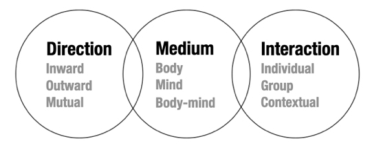
Figure 2: Three lenses aided in uncovering possible facets of the need concepts. (2020), we used four primary criteria to determine need facets (see Table 3 for details). Along with the qualification criteria, we also implemented three len- ses to change our perspectives in scrutinizing need concepts. Figure 2 shows the three lenses (direction, medium, and interaction) that we considered to represent the basic features of needs-satisfying events and activities.
After internal discussion, we conducted two rounds of revisions and for- mulated 26 need facets (Ver.2). In this version, each need contains two facets. Specifically, for facets that overlap in a single need, we consolidated them into one and complement facet. For facets overlap between needs, we revised the explanation and kept it within the most appropriate need. Take the need for Purpose again, the initial three need facets were modified to the following two facets:
Sense of direction. Having goals that give you a sense of purpose and dire- ction for your actions and development, rather than not knowing where you want to go or how to develop yourself.
Spirituality. Being connected to a deeper meaning in your life, rather than feeling empty and failing to find meaning in life.
Stage 3: External Review The goals of the external review were twofold: (1) to examine our refine- ments in Stage 2 and (2) to identify and resolve ambiguities in the current explanations of facets. For the first purpose, we merged facets from both versions (39 in Stage 1 and 26 in Stage 2) and removed overlapping ones (22 facets), resulting in a mixed version with 43 facets for an online survey- based review. A complete list of the 43 facets and explanations is available
32 Huang and Desmet
upon request. For the second purpose, we organized workshop discussions with the participants who took part in the online survey.
First, eleven experts familiar with needs-centered design were recruited to complete an online survey using Qualtrics (www.qualtrics.com). Eight of these experts were design researchers, and three were design practitioners. The survey design employed a “reverse mapping approach.” This means that participants were asked to match each facet to one of the basic needs. The survey was pilot tested with two design researchers not involved in the pro- ject to check the survey coherence, clarity, and response time. Participants first watched a short video introducing the thirteen basic needs. Each need was explained by four scenario clips and written explanations. Then, partici- pants were asked to assign each of the 43 facets to one of the corresponding basic needs. The facets were introduced with descriptions and participants could review the descriptions of the original typology at any time during the procedure.
The reverse mapping results revealed five significant mismatches (meaning over half of the participants associated the facet with other needs) among 43 pairs, two from Stage 1 and three from Stage 2. The two facets generated in Stage 1 but later removed in Stage 2 are interest and personal growth. Within this, only one participant correctly linked the facet interest to Beauty, and the others considered it should belong to Stimulation (n = 9) or Recognition (n = 1). Eight participants viewed the facet of personal growth (belongs to Purpose) to be in Autonomy (n = 2) and Competence (n = 6). For the three most significant mismatches from Stage 2, seven participants considered men- tal fitness more correlated to the need for Competence rather than Fitness. Similarly, six participants considered nurture (belongs to Relatedness) was more related to the need for Community (n = 4) or Security (n = 2), seven participants found comprehension (belongs to Competence) was more incli- ned to the need for Autonomy (n = 2), Comfort (n = 2), Security (n = 2), or Purpose (n = 1).
Next, we conducted four workshop discussions, including three sessions with design researchers (1, 3, and 4 participants) and one with practitioners (with 3 participants). The objective was to reflect on the survey results and identify (1) potential reasons for mismatches and (2) whether the facets refi- ned in the second round meet the four criteria (see Table 2). Each participant was presented with the survey results during the workshop, where the misma- tched pairs were also marked. Unlike the online survey, which only showed randomized definitions of items, we color-coded the item titles and explanati- ons for each need. Participants were asked to advise on each facet’s title and description modification to enhance clarity and mitigate possible overlaps. In addition, they commented on whether the two facets sustained in Stage 2 are sufficient to address the corresponding need. If not, they were invited to review facets included in Stage 1 and suggest changes.
A DETAILED TYPOLOGY OF FUNDAMENTAL NEEDS Finally, integrating the suggestions and comments from external reviews resulted in a final version of the detailed typology of thirteen fundamental needs, each explained by two complementary but distinct facets (see Table 4). The insights obtained in the study were not only used to optimize the need
Needs Matter: A Detailed Typology of Thirteen Fundamental Needs 33
Table 4. A detailed typology of thirteen fundamental needs for human-centered design.
Table available in the original PDF paper.
Definition Fundamental Needs Need Facets
Autonomy Feeling you are the cause of your actions, or you can express yourself freely, rather than feeling as though external conditions or other people determine your actions. Volition Feeling free to decide your course of action, rather than feeling restricted or having to do as you are told. Individuality Feeling free to express yourself in your own way, rather than having to conform or adapt. Beauty Feeling you are experiencing something appealing or harmonious, rather than feeling experiencing something unappealing or disharmonious. Appeal Feeling you are experiencing something aesthetically pleasing, rather than experiencing something aesthetically unpleasant. Harmony Feeling you are experiencing something harmonious or coherent, rather than experiencing something disorganized or chaotic. Comfort Feeling you are experiencing something easy, simple, or relaxing, rather than experiencing strain, difficulty, or overstimulated. Tranquility Feeling your mind is calm and relaxed, rather than feeling your mind is tense, stressed, or overstimulated. Bodily comfort
Feeling your body is comfortable and at ease, rather than feeling your body is uncomfortable, tense, or painful. Community Feeling you are part of a social group or entity with shared values or goals, rather than feeling you do not belong anywhere and have no social structure to rely on. Belongingness Feeling you are an accepted member of a group, community, or society, rather than feeling you are left out or excluded. Social harmony
Feeling you share common values or goals with members of your social group, rather than feeling disconnected or having conflicting values. Competence Feeling you have control over your environment and are able to develop your skills to master challenges, rather than feeling you are incompetent or ineffective. Self-efficacy Feeling you are able to understand and function effectively to reach your goals, rather than feeling unable to understand and function ineffectively. Personal growth
Feeling you are able to grow and develop your skills to deal with challenges, rather than stagnating or being unable to improve yourself. Fitness Feeling your body and mind are strong, healthy, or full of energy, rather than feeling your body and mind are sick, weak, or listless. Mental fitness Feeling you are mentally resilient or in positive mental status, rather than feeling mentally drained or in negative mental status. Physical fitness
Feeling you are physically strong or full of energy, rather than feeling physically weak or listless. Impact Feeling your actions or ideas have influence or contribute to something, rather than feeling you have no influence or do not contribute to anything. Influence Feeling you have influence in terms of what you say or do, rather than making no influence. Contribution Feeling your contributions are meaningful, rather than feeling your contributions are trivial or worthless. Morality Feeling you are in a moral place and able to act in line with your values, rather than feeling you are in an immoral place and your actions conflict with your values.
Continued
34 Huang and Desmet
Table 4. Continued.
Table available in the original PDF paper.
Definition Fundamental Needs Need Facets
Integrity Feeling you act in line with your moral standards, rather than violating your principles or values. Decency Feeling you are experiencing justice and fairness from the people around you or the system you belong to, rather than experiencing something unjustly or unfairly. Purpose Feeling you have a clear sense of what makes your life meaningful and valuable, rather than lacking direction, significance, or deep meaning. Sense of direction Spirituality
Feeling you have a sense of direction for your actions and development, rather than feeling aimless, lost, or having no goals. Feeling you are connected to a deeper meaning in your life, rather than feeling empty or failing to find meaning in life. Recognition Feeling you are appreciated for what you do or respected for how you are, rather than feeling you are disrespected, under-appreciated, or ignored. Appreciation Feeling you are appreciated or acknowledged for your contributions, rather than being taken for granted or criticized. Respect Feeling you are being respected and having a worthy position in your social group, rather than being ignored, ridiculed, or given a bad reputation. Relatedness Feeling you have warm, mutual, trusting relationships with people you care about, rather than feeling isolated or unable to make personal connections. Closeness Feeling you have friendly or intimate relationships with people you feel close to, rather than feeling isolated or unable to connect with people. Care Feeling you have relationships you can trust and rely on, rather than feeling no one genuinely cares about you or feeling helpless. Security Feeling your conditions or circumstances are stable and protect you from harm or threats, rather than feeling you are experiencing danger, risk, or uncertainty. Safety Feeling you are safe from risk, harm, or pain, rather than feeling alarmed or having to be on your guard. Stability Feeling you have stable life conditions, rather than worrying about unexpected changes or adversities. Stimulation Feeling you are mentally and physically stimulated by novel, varied, relevant impulses or stimuli, rather than feeling bored, indifferent, or apathetic. Mental stimulation Physical stimulation
Feeling you are mentally stimulated, challenged, or inspired, rather than feeling bored, monotonous, or numbing. Feeling you are experiencing bodily sensations that are engaging or vitalizing, rather than having no sensory or bodily excitement.
facets but also to improve the original definitions of the thirteen basic needs to ensure consistency and coherence across the complete list.
CONCLUSIONS AND FUTURE DIRECTIONS This paper developed a detailed typology of fundamental human needs, which can facilitate and enrich conversations about human needs among professionals from different backgrounds (or disciplines) in human-centered
Needs Matter: A Detailed Typology of Thirteen Fundamental Needs 35
design initiatives. In addition, this fine-grained vocabulary can serve as a starting point for operationalizing the design-focused need typology for design and research purposes. Here we propose three promising directions for future research: (1) Scrutinize under what conditions (such as life moments, activities, or human-product interactions) need satisfaction/frustration can be experienced, and the experiential qualities of those activities that determine different states of need fulfillment. (2) Develop design tools that support communicating, translating, and embodying the envisioned need-fulfillment-related qualities in the design and development process. (3) Develop measurement instruments such as psychometric scales for design framing and evaluation.
ACKNOWLEDGMENT
We want to express sincere gratitude to Tjaša Kermavnar for her contribu- tion to this study. We thank all participants for their valuable suggestions in refining this detailed typology. This research was supported by VICI grant number 453-16-009 of The Netherlands Organization for Scientific Research (NWO), Division for the Social and Behavioural Sciences, awarded to P.M.A. Desmet.
REFERENCES
Baumeister, R. F. & Leary, M. R. (2017). The need to belong: Desire for interpersonal attachments as a fundamental human motivation. In: Zukauskiene, R. (ed.) Interpersonal development. London: Routledge. pp. 57–89 Chen, B., Vansteenkiste, M., Beyers, W., Boone, L., Deci, E. L., der Kaap-Deeder, V.,
Duriez, B., Lens, W., Matos, L. & Mouratidis, A. (2015). Basic psychological need satisfaction, need frustration, and need strength across four cultures. Motivation and emotion, 39(2), pp. 216–236. Deci, E. L., Ryan, R. M., Gagné, M., Leone, D. R., Usunov, J. & Kornazheva, B. P.
(2001). Need satisfaction, motivation, and well-being in the work organizations of a former eastern bloc country: A cross-cultural study of self-determination. Personality and social psychology bulletin, 27(8), pp. 930–942. Desmet, P. & Fokkinga, S. (2020). Beyond Maslow’s pyramid: introducing a typology of thirteen fundamental needs for human-centered design. Multimodal Technologies and Interaction, 4(3), pp. 1–22. Haerens, L., Aelterman, N., Van den Berghe, L., De Meyer, J., Soenens, B. & Vansteenkiste, M. (2013). Observing physical education teachers’ need- supportive interactions in classroom settings. Journal of Sport and Exercise Psychology, 35(1), pp. 3–17. Hassenzahl, M., Diefenbach, S. & Göritz, A. (2010). Needs, affect, and inte-
ractive products–Facets of user experience. Interacting with computers, 22(5), pp. 353–362. Khalid, H. M. (2006). Embracing diversity in user needs for affective design. Applied ergonomics, 37(4), pp. 409–418. Liu, J. D. & Chung, P. K. (2014). Development and initial validation of the psych-
ological needs satisfaction scale in physical education. Measurement in Physical Education and Exercise Science, 18(2), pp. 101–122.
36 Huang and Desmet
Liu, J. D. & Chung, P. K. (2017). Factor structure and measurement invariance of the Need-Supportive Teaching Style Scale for Physical Education. Perceptual and Motor Skills, 124(4), pp. 864–879. Ng, J. Y., Lonsdale, C. & Hodge, K. (2011). The Basic Needs Satisfaction in Sport
Scale (BNSSS): instrument development and initial validity evidence. Psychology of Sport and Exercise, 12(3), pp. 257–264. Ozkaramanli, D., Fokkinga, S., Desmet, P., Balkan, E., & George, E. (2013). “Recreating AlaTurca: Consumer goal conflicts as a creative driver for innovation”, proceedings of qualitative research 2013, Brilliant transformations, Valencia, Spain. ESOMAR, pp. 73–84 Reeve, J., Nix, G. & Hamm, D. (2003). Testing models of the experience of self-
determination in intrinsic motivation and the conundrum of choice. Journal of educational psychology, 95(2), pp. 375–392. Ryan, R. M. & Deci, E. L. (2017). Self-determination theory: Basic psychological needs in motivation, development, and wellness, 2nd edn. New York, Guilford Publications. Sheldon, K. M. & Hilpert, J. C. (2012). The balanced measure of psychological
needs (BMPN) scale: An alternative domain general measure of need satisfaction. Motivation and Emotion, 36(4), pp. 439–451. Vansteenkiste, M., Ryan, R. M. & Soenens, B. (2020). Basic psychological need theory: Advancements, critical themes, and future directions. Motivation and Emotion, 44(1), pp. 1–31. Von Hippel, E. (2001). User toolkits for innovation. Journal of Product Innova-
tion Management: An International Publication of the Product Development & Management Association, 18(4), pp. 247–257. Wilson, P. M., Rogers, W. T., Rodgers, W. M. & Wild, T. C. (2006). The psychological need satisfaction in exercise scale. Journal of Sport & Exercise Psychology, 28(3), pp. 231–251. Wolf, S., Maas, F., Künzl, P., Hohm, A. & Hurtienne, J. (2022). UNeedS: Develo-
pment of Scales to Measure the Satisfaction and Frustration of 13 Fundamental Needs. MuC ‘22: Proceedings of Mensch und Computer 2022, September 4–7 2022 Darmstadt Germany. New York, NY, USA: Association for Computing Machinery, pp. 539–544.
LISTED IN THE AHFE DIGITAL BOOKSTORE CATALOGUE
Explore the complete digital volume
Creativity, Innovation and Entrepreneurship
Read this individual research paper free through the original publisher, or explore the full digital proceedings book.
ISBN 978-1-958651-50-6
Explore this ISBN in the AHFE Bookstore ↗Listed in the July 2026 bookstore catalogue; search by ISBN to confirm current availability · Digital book purchase optional