Leonardo Springer (2023). Fostering creativity to Design Students as a problem-solving process for climate change. In: Creativity, Innovation and Entrepreneurship. AHFE Open Access, vol. 74, pp. 11–16. https://doi.org/10.54941/ahfe1003300
According to the UN, creativity is a crucial factor to ensure a better world and recognized as a fundamental tool to further develop other abilities and problem-solving skills. Nevertheless, this requires individual curiosity, an open-mind, imagination, problem solving skills and a willingness to take action. Human activity is causing planetary climate change, thus causing destruction, and generating negative consequences for mankind. The explored question is whether creativity can address climate change issues, as regards to innovation, and consequently foster a preferred outcome. This approach provided insights on how students address a given challenge, using creativity and design innovation processes to address issues and create a viable outcome.The UN general secretary acknowledged that education encourages people to change attitudes and behaviours, helping them make informed decisions. This requires equity, inclusion, and relevance, towards the development of prosperous societies inhabiting a healthy planet. Whatever society invests on education, it will return onto society itself. In a classroom, young people can be taught the impact of global warming and learn how to adapt to climate change. Education empowers all people, but especially motivates the young to act. (Guterres, 2022).Designers are at the forefront of those able, and committed, to accomplish change. In addition, design education has significant importance addressing not only design issues but also climate change issues, fostering a viable sustainable change, towards the development of sustainable products and services. This, nonetheless, requires adaptation, resilience, and clear communication to a specific audience conveying a desired message. Design needs to incorporate sustainable practices, focusing on product life cycle, energy consumption, standardization, maintenance, repair, overhaul, reuse, and easy recycling. Thus, reducing waste and using the limited planetary resources.Design students learn by observing, listening, and mostly by doing, encouraged with good examples, hands-on experience, and supported with constructive feed-back. Active teaching methodologies require teachers to act as mediators, encouraging and challenging students to research and acquire knowledge thought applied practice, whereas individually or in group learning, constructing knowledge, exploring, in a process of creation, connection, and transformation.Mitigation of climate change requires global and local action, not only concerning greenhouse gases and natural resources management, but especially regarding complex social behaviours that require a shift towards sustainability.This exploratory research brings insight on higher education design students addressing changes and its implications with Problem Based Learning (PBL) methodologies, addressing design consequences, using creativity as a transformation tool in an interdisciplinary process in a fast-changing world that requires a paradigm shift.
Cultural and creative industries economy employ 12 million creative professi- onals contributing with 4% of the European Gross Domestic Product (GDP). Furthermore, generating roughly 3% of the global GDP. Creativity is nowa- days regarded as an essential socio-economic resource, a talent to devise new solutions and efficient production processes that increases productivity and therefore living standards, and consequently creating a major social impact.
Creativity is a cognitive process that allows individuals to address underl- ying issues in unconventional ways (Sawyer, 2013). Creativity, apart from artistic manifestations is a mindset that requires nonconformity (Runco, 2014) additionally expanding the idea as a socio-cultural behaviour. Small children that are not yet aware of the surroundings experiment with- out criticism, testing the senses, savouring, smelling, handling, and gazing, sometimes to their own harm, then also to their surprise and joy. Innocence and basic curiosity allow small children to perceive the surroundings without preconceptions, therefore an unbiassed perception of the surrounding.
In a Higher Education Institution (HEI), at ISEC Lisboa polytechnic, a group of 40 students were challenged to address a Sustainable Develo- pment Goal (SDG), creating a tangible idea, considering applied social and/or technological solutions, that remained affordable and desirable, designing, prototyping, and testing a new product and/or service.
The student group was especially diverse regarding sociocultural back- ground, distinct socio-economic and life experience, consisting of ex- students, workers, designer/entrepreneurs, teachers, managers, with an age- range from 17 to 37 years. Additionally, there were also students without any prior experience whatsoever.
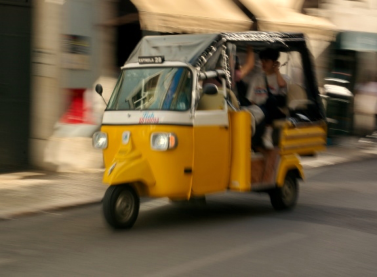
This two-month class PBL assignment, supported with online learning resources, required individual autonomy, thinking skills, research aptitudes, understanding of underlying issues, peer-assessment, ability to develop ideas, experiment, prototype, create a solution, thus learning by means of metaco- gnition, and innovate a specific issue of the SDG. An example presented to these students regarding creative solutions was the analogy of a NY Yellow Cab and a yellow Tuk-Tuk in Lisbon – Portugal (Fig. 1), both using yel- low colour as recognition principle, and performing a corresponding tourist transport service.
Fostering Creativity to Design Students as a Problem-Solving Process for Climate Change 13
THE CREATIVE MINDSET Phycologist Graham Wallas described in 1926 the creative process in four steps: Preparation, Incubation, Illumination, and Verification. Newer models are similar especially in the idea of preparation regarding problem identi- fication and problem construction (…) Csikszentmihalyi & Getzels 1971; Reiter-Palmon et al. 1997; Runco 1994a (Runco, M. 2014).
According to openai.com platform, the notion of creativity is the ability to think of something new and original or to solve existing problems. Problem based learning practices support a problem-solving mindset. Nevertheless, requires problem-identification, a skillset by itself that was not applied in this class setting.
The wide-reaching SDG topic is a valuable educational resource to raise awareness of human and environmental principles, and underlying issues, drawing attention to impeding social and environmental challenges that shape our world today. Planetary issues like climate change affect billions glo- bally, potentially cause irreversible change to the Earth ecosystem and thus its populations in a direct and indirect manner. Therefore, students were asked to devise a viable solution concerning one of the 17 Sustainable Development Goals.
After an induction on creative exercises and methods, students are encou- raged to carry out interdisciplinary research, raising awareness and develo- ping insight on global sociocultural issues inherent to SDG.
Encouraging students to question, reason, devise ideas, to create a service or product to overcome an SDG issue, occurs in a permissive and suppor- tive environment (Runco, 2014). One that is inspiring to assimilate new concepts, raise awareness, grow empathy, collaborate, accepting error as a learning process, and developing a problem-solving mindset that encourages and additionally empowers students to develop solutions.
The more you challenge your mind to learn the more your brain cells grow. Things that one would find very hard or even impossible – like speaking a foreign language or doing algebra – become easy, the result is a stronger, smarter brain (Dweck, 2017). A mindset requires the willingness to accept change, and the resilience to adapt to constantly changing environments.
The overall aim is to provide stimuli, knowhow to find appropriate infor- mation, develop skills and practices towards an autonomous learning process and rational application.
FROM PRACTICE TO MINDSET The starting point for any creation is a challenge that requires a solution. However, any idea requires the support of solid research, identifying issues and building from previous knowledge. SDG are a logical starting point as these issues were already identified and requiring novel solutions.
Present creativity and innovation curricula exercises stimulate students to address issues and develop a rationale regarding a specific SDG, considering opportunities to improve that depend on individual awareness and commi- tment to create consequential solutions, fostering a mental attitude towards action.
14 Springer
All mental activities, beside their immediate effects in the production of thought, have later effects in the production of mental habit and it is someti- mes convenient to consider the activity as means and the habit as end (Wallas, 1926). Learning requires a mindset that is stimulated with curiosity, applied research, new findings, accepting risk and error as a process, empathy, gene- rating divergence and improving resilience, acquiring the ability to improvise, prototyping (artifacts), iterating, with interdisciplinary collaborations to sup- port Human development and the sustainability of the planet. The world is changing, and education needs to adapt accordingly addressing a compre- hensive assortment of issues, from natural disasters to conflicts, and as of socio-cultural to climate change.
It is paramount to engage students in current matters, allowing them to express individual ideas in a collaborative context, demonstrating viewpoints, thus feeling engaged, accepting support and critique from peers and tutors, along with a commitment to take action, improving the environment and ensure quality of life (emotional, physical, material, and social well-being) for all.
At the start of the exercise, many students realised the complexity to address SDG issues, and decided to deal with a single goal or a small, inter- related cluster, demonstrating an ability to revaluate and do a conscious option.
During the assignment, online resources, class discussions, peer presenta- tions and critique allowed students to recognize flaws and further improve design proposals.
This opportunity to acknowledge unconventional reasoning, reformu- lating, and improving upon initial ideas, fostered a range of innovative solutions.
One of the tools presented to the students was a 9-step creative checklist. This straightforward approach meant to develop a critical thinking mindset towards problem-solving, used by students in a wide range of issues to create individual solutions.
The creative checklist:
1. Foster curiosity, ask questions, cooperate 2. Empathy, consider different perspectives 3. Research existing and unconventional solutions 4. Learn from observation to identify patterns and inconsistencies 5. Foster discipline, initiative, and resilience 6. Explore, discover, connect, create, develop, prototype, refine, test, repeat 7. Flexibility, adaptability, and manage uncertainty 8. Communicate ideas efficiently 9. Develop the ability to replicate the process in different circumstances On using the 9-step creative checklist many students devised online plat- forms, partially addressing SDG, but also ensuring a commercial sustainable solution, promoting individual accomplishments, and demonstrating deter- mination. After all, creativity is nowadays an interdisciplinary process to devise innovative solutions in a fast-changing world.
Fostering Creativity to Design Students as a Problem-Solving Process for Climate Change 15
Creativity is fundamentally a wide-ranging non-restrictive mindset, that allows individuals to generate solutions and create artistic manifestations.
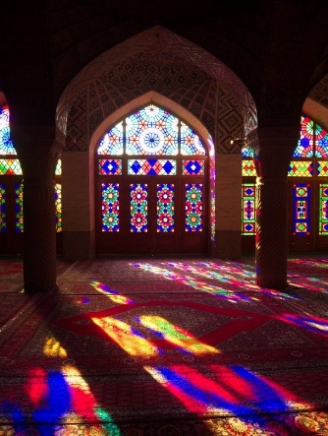
The Nasir ol Mulk Mosque in Shiraz, Iran (Fig. 2), built between 1876- 88, known locally as the Pink Mosque, displays a unique hand mounted stained-glass intricate geometric window mosaic, quite uncommon in mosque architecture and in this way remarkable. This artistic manifestation requires not only a creative mindset, but also the technical skill to produce the glass itself and to mount it appropriately, optimising sun exposure and light refra- ction at sunrise on to the interior of the mosque, an undertaking that requires a wide-ranging understanding of various subjects.
Figure 2: Stained-glass window mosaic – Nasir ol Mulk Mosque, Iran (author’s photo).
CONCLUSION
Human curiosity is essential to build a creative mindset. It also depends on previous acquired knowledge, an ability to connect dissimilar topics with an unbiassed attitude towards criticisms and failure, incorporating new elements, and creating new solutions or manifestations with added value.
Most problems nowadays are interdisciplinary and require a comprehen- sive understanding of multiple subjects that cannot be disassociated from each other. Consequently, this requires asking the right questions to obtain insights and create viable, integrated, and sustainable solutions.
In a HEI context, creativity and innovation is an introductory class in the digital marketing course, that encourages students to develop a mindset, fostering the ability to create original interpretations, transforming issues into opportunities and additionally solutions.
This heterogeneous group of 40 fresher students was given the task to select and address a specific SDG, and asked to come-up with ideas, pointing out specific issues, and develop a viable solution.
16 Springer
The more senior and resourceful students achieved insights and came up with original solutions. Nonetheless, most students replicated or adapted exi- sting solutions and redesigned a product and/or service employing creative methodologies to devise viable solutions.
Creative individuals observe the world in a distinctive manner. These indi- viduals ask unexpected questions in relation to unpredicted answers. It’s a mindset that requires building-up creative confidence and acknowledging that failure is a process to gain further understanding, and commitment to act.
This is usually the curious individual with an overall general knowledge, a specific area of interest and the ability to interconnect underlying issues (Springer, 2001). The creative potential lies in all individuals. Notwithstan- ding, this requires stimulus, be it conditioned behaviour or necessity towards finding solutions.
The world is facing a confluence of crises that threaten the very survival of humanity. Higher education institutions have the responsibility and structure to empower individual autonomy and accountability, fostering awareness, research, and reasoning skills, to build a resilient mindset to navigate an ambiguous fast-changing world. More than ever tutoring requires flexibility, understanding, and interaction regarding individual limitations and abilities towards an efficient learning.
REFERENCES
David Ogilvy (2009). Eternal Pursuit of Unhappiness: Being Very Good Is No Good, You Have to Be Very, Very, Very, Very, Very Good. Ogilvy & Mather Worldwide. Dweck, Carol (2017). Mindset: Changing The Way You think To Fulfil Your
Potential. Robinson. London https://education.gov.scot/improvement/learning-resources/what-are-creativity-skil ls/ https://en.unesco.org/creativity/sites/creativity/files/cultural_times.~_the_first_glob
al_map_of_cultural_and_creative_industries.pdf https://unric.org/en/using-creativity-and-innovation-to-make-the-world-better/ https://www.un.org/en/observances/creativity-and-innovation-day https://www.un.org/sustainabledevelopment/sustainable-development-goals/ https://www.youth.ie/articles/why-is-creativity-important-and-what-does-it-contrib ute/ International Confederation of Authors and Composers Societies (2015). Cultural
times. Runco, Mark A. (2014). Creativity: Theories and themes: Research, development, and practice. 2nd Ed. Academic Press. Sawyer, K. (2013). Zig Zag: The Surprising Path to Greater Creativity. Jossey-Bass.
Wiley. Springer, L. (2021). Creative Inspiration. In: Markopoulos, E., Goonetilleke, R. S., Ho, A. G., Luximon, Y. (eds) Advances in Creativity, Innovation, Entrepreneur- ship and Communication of Design. AHFE 2021. Lecture Notes in Networks and Systems, vol 276. Springer, Cham. https://doi.org/10.1007/978-3-030-80094-9_2 The first global map of cultural and creative industries. The-Sustainable-Development-Goals-Report-2022.pdf (un.org) Wallas, G. (1926). The Art of Thought. Butler & Tanner Ltd. London. https://archiv
e.org/details/theartofthought/page/n1/mode/2up
LISTED IN THE AHFE DIGITAL BOOKSTORE CATALOGUE
Explore the complete digital volume
Creativity, Innovation and Entrepreneurship
Read this individual research paper free through the original publisher, or explore the full digital proceedings book.
ISBN 978-1-958651-50-6
Explore this ISBN in the AHFE Bookstore ↗Listed in the July 2026 bookstore catalogue; search by ISBN to confirm current availability · Digital book purchase optional