Toshiya Sasaki (2023). How to set up design skills in IT companies. In: Creativity, Innovation and Entrepreneurship. AHFE Open Access, vol. 74, pp. 123–128. https://doi.org/10.54941/ahfe1003313
In recent years, businesses utilizing data and artificial intelligence are becoming more prevalent in society, and the design skills required in IT companies are changing. The purpose of this study is to propose a method for setting up design skills that takes into account changes in the design skills required by IT companies. After organizing the skills to be referred to when setting up design skills, this research conducted a workshop to validate how to set up design skills and discussed the evaluations from the workshop participants.
In recent years, businesses utilizing data and artificial intelligence are beco- ming more prevalent in society, and the design skills required in IT companies are changing. The purpose of this research is to propose a method of set up skills that takes into account changes in the design skills required of designers in IT companies.
The definition of design skills in this research is the ability to think and practice to create strategy, scope, structure, skeleton, and surface regarding all assets of an IT company.
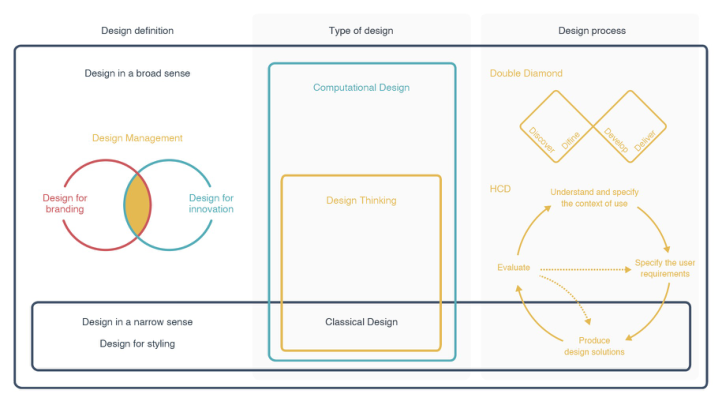
Organizing Design Skills For a comprehensive organization of design skills, the elements of User Expe- rience: strategy, scope, structure, skeleton, and surface, as defined by Jesse James Garrett were referenced. First, the concept of design was organized through a literature survey (see Figure 1). Then, design skills were organized by identifying the elements of design skills related to each element of User Experience.
The “Design Management” Declaration, compiled by the Ministry of Eco- nomy, Trade and Industry and the Japan Patent Office, states that design management contributes to a company’s industrial competitiveness through branding and innovation.
The Design in Tech Report 2018, published by John Maeda, states that there are three types of design: classical design, design thinking, and com- putational design, and that computational designers use all three types of design.
D.A. Norman states that the “Double Diamond Model”and “Human Cen- tered Design” are the tools of design thinking. The Double Diamond Model models the process of divergence and convergence in the problem finding and problem solving phases.
After organizing the concept of design, the elements of design skills were investigated in terms of the definition of design, types of design, and the design process, and organized into the following 10 skills (see Table 1).
How to Set Up Design Skills Considering that design skills can be classified in a variety of ways, the skills are set up in two steps.
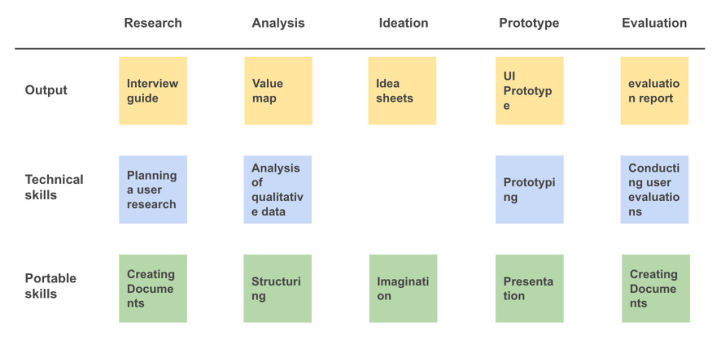
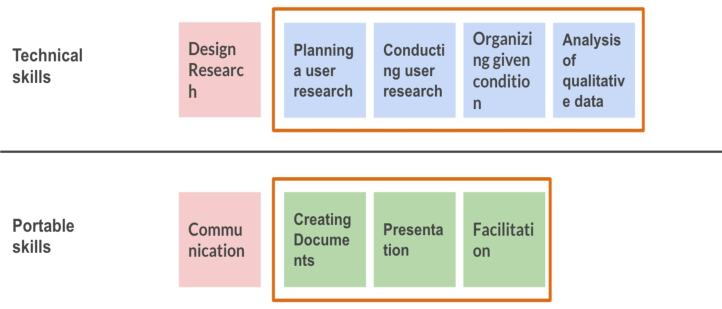
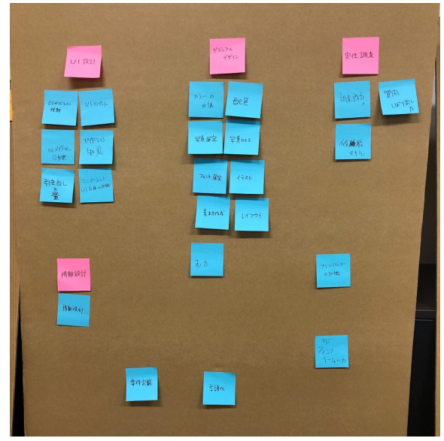
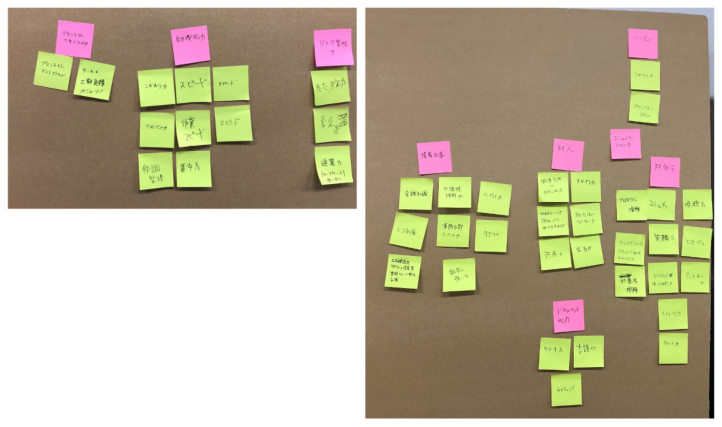
1) Identify for each workshop participant the outputs required for each step of the work and the technical and portable skills needed for the outputs (see Figure 2). Technical skills are the specialized skills of designers, while portable skills are those required regardless of the type of work. 2) Classify the skills identified by all workshop participants. Categorize the skills by technical skills and portable skills, and name the skills (see Figure 3).
METHODS
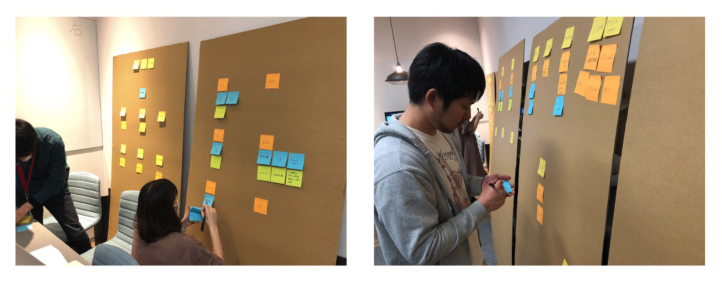
A one-hour workshop was conducted with one design manager and three designers from an IT company (see Figure 4). After the workshop, the par- ticipants rated their level of empathy for the set up skills on a 4-point scale.
RESULTS
The results of the workshop showed an average of 3.5 out of 4 points for the empathy for the skills set up (see Table 2).
How to Set Up Design Skills in IT Companies 125
Table 1. Organized design skills overview.
Table available in the original PDF paper.
Design skills Skills overview Conception Ability to go through trial and error until the concept is put into practice. Branding Ability to design a consistent user experience so that users can recognize the link between brand symbols and value. Computational Design
Ability to utilize new technologies and paradigms for products and services. Design Research Ability to research and analyze to understand stakeholder usage, essential requirements, products, and business. Prototyping Ability to create and evaluate prototypes to determine if product and service design proposals are suitable for users. User Test Ability to make evaluations to determine whether products and services are suitable for users. Visual Design Ability to visualize the appearance of products and services based on required specifications. Information Architecture
Ability to design structures that make it easier for users to understand information based on required specifications. Design Management
Ability to manage projects and teams to utilize design in management. Technical Communication
Ability to convey your thoughts so that others can understand to facilitate the project.
Figure 2: Examples of identifying outputs and skills based on work steps.
The following technical skills were set up (see Figure 5).
UI Design
Information Architecture
Visual Design
Qualitative Research
Branding
Workshop facilitation
Requirements Definition
126 Sasaki
Figure 3: Examples of skills classification.Figure 4: The scene of the workshop conducted.
Verbalization of design intent In addition, the following portable skills were set up (see Figure 6).
Use of Tools
Communication
Information Gathering
Documentation
Efficiency
Risk Management
Project Management
DISCUSSION
Workshop participants commented that they would have been able to cate- gorize the skills even more convincingly if the workshop had been longer, suggesting that allowing more time for the workshop may further increase the level of empathy for the design skills to be set up.
How to Set Up Design Skills in IT Companies 127
Table 2. Empathy and comments on set up design skills.
If we had more time, we could have made a more satisfactory classification.
Figure 5: Set up technical skills.
Among the design skills organized in this research, the ability to prototype, the ability to utilize technology such as computational design, and the ability to relate to conception were not set up in the workshop, and therefore, the design skills organized in this research could be referred to during the work- shop. Therefore, there is a possibility that more diverse design skills can be set up by referring to the design skills organized in this research during the workshop.
CONCLUSION
It may be possible to set up design skills in IT companies by classifying the skills after identifying the outputs, technical skills, and portable skills requi- red in each step of the work process, using the design skills organized in this research as a reference.
128 Sasaki
Figure 6: Set up portable skills.
REFERENCES
D. A. Norman. (2013). The Design of Everyday Things: Revised and Expanded Edition, NY: Basic Books. Human Centered Design Organization, (2022). HCD Specialty Qualifica- tion Competence Map (FY2022). https://docs.google.com/presentation/ d/1Ih3csqcwDGHD6Q0tCGurjdiXCgB_QQaE0ZmESACWN-c/edit# slide=id.g100eaeb2460_0_0 Jesse James Garrett. (2010). The Elements of User Experience: User-Centered Design
for the Web and Beyond, Second Edition, Berkeley, CA: New Riders. John Maeda. (2018). Design in Tech Report 2018. https://designintech.report/wpcontent/uploads/2019/01/dit2018as_pdf.pdf Ministry of Economy, Trade and Industry / Patent Office Study Group Considering
Industrial Competitiveness and Design. (2018). Declaration of “Design Manage- ment”. https://www.meti.go.jp/report/whitepaper/data/pdf/20180523001_01.pdf Noboru Konno, Ikujiro Nonaka. (2018). Methodology of Conceptual Power, Nikkei BP. Peter Merholz, Kristin Skinner. (2016). Org Design for Design Orgs: Building and
Read this individual research paper free through the original publisher, or explore the full digital proceedings book.
ISBN 978-1-958651-50-6
Explore this ISBN in the AHFE Bookstore ↗Listed in the July 2026 bookstore catalogue; search by ISBN to confirm current availability · Digital book purchase optional