Volker Gruhn, Markus Warg (2026). Service Ecosystem Engineering to Overcome Translational Gaps in Digital Transformation. In: The Human Side of Service Engineering. AHFE Open Access, vol. 221, pp. 12–22. https://doi.org/10.54941/ahfe1007704
Digital transformation initiatives continue to fail at rates between 70% and 95%, as technology‑driven efforts further densify already complex application landscapes instead of translating technological potential into realized value (Koczerga, 2024, Bughin et al., 2019). To systematically address these translational gaps (Sung et al., 2003, Woolf, 2008), this paper introduces Service Ecosystem Engineering (SESE) as a paradigm shift from technology‑dominated to structure‑dominated transformation strategies grounded in the centrality of service (Spohrer et al., 2022) and the Translational Service Research and Design Methodology (Warg et al., 2025). SESE adopts a unifying service language in which service provides the overarching grammar and services act as the primary structuring paradigm. Drawing on Service Dominant Architecture (SDA) as a reference structure, SESE organizes value-creation systems as actors, roles, processes, and services across five systems for interaction, data, participation, institutions, and operant resources. In doing so, SDA serves both as medium for service design and outcome of software engineering (Gruhn and Striemer, 2018). This SESE approach decouples value-creation systems from specific technologies, and enables pace‑controlled modernization, interoperability, and ecosystem‑wide value cocreation, helping organizations overcome translational gaps and evolve as learning organizations.
MOTIVATION AND PURPOSE Triggered by the megatrends of digitization and increasing interconnectedness the rationale of organizations shifts from scalable efficiency to scalable learning (Naisbitt, 1985). Learning organizations are understood as organizations that continually expand their capacity to create their future. For such organizations, it is not enough merely to adapt. Adaptive learning as modification of behaviour based on experience (Alcock, 2005) is important - indeed it is necessary. Adaptation, and the ability to change, are at the heart of all the varied meanings and definitions that have been applied to the term “learning” (Howe, 1980). But for a learning organization, adaptive learning must be joined by generative learning, learning that enhances the capacity to create value (Hagel et al., 2010; Senge, 1997).
Service Ecosystem Engineering to Overcome Translational Gaps 13 When embarking on digital transformation initiatives, organizations often strive to become learning organizations and for learning faster than their competition by easily adapting new technologies (McGowan and Shipley, 2020). But instead of building new value-creation paths and capacities they encounter translational gaps, understood as disconnects between the inherent value of technologies and the ability to realize this value within specific cultural and structural contexts (e.g., application landscapes). Frequently, the new technologies within these initiatives produce reverse effects by increasing technological density and their overlapping and, with it, complexity. The adherence to technology-driven roadmaps and target visions often falters when confronted with the next technological wave, consequently, failure rates in transformation projects remain alarmingly high, ranging from 70% to 95% (Koczerga, 2024; Bughin et al., 2019; Forth et al., 2020). The purpose of this paper is to systematically render these translational gaps, and their associated obstacles and frictions, visible, to derive indications for improving organizational learning. From this, the following reseach questions were derived: (1) How can external resources such as digital technologies be effectively adapted, mobilized and orchestrated across networks? (2) Through what systematic mechanisms can organizational capabilities and value-creation paths be intentionally designed, engineered and sustained over time? and (3) How can emergent properties and dynamic capabilities be purposefully cultivated to generate positive impacts and adaptive organizational value?
RESEARCH DESIGN AND METHODOLOGY Drawing on the Translational Service Research and Design Methodology (TSRDM) this study addresses translational gaps to develop approaches for bridging these gaps and answering the research questions in (Warg et al., 2025). TSRDM is rooted in the centrality of service and evolves a unifying service language - interpreting service as grammar and syntax, services as letters, patterns as words and architecture as sentences. The Methodology structures its iterative eight-step process around the three interlinked pillars “service research”, “translational space”, and “service design and engineering”. Thus TSRDM offers a framework for configuring steps, roles and services, thereby making translational gaps, frictions, linkages, and transitions visible with choices and decisions to be made at each of the eight steps (MacInnis, 2011; Jaakkola, 2020).
The eight TSRDM steps comprise: (1) identifying translational gaps, (2) conceptual clarification, (3) knowledge base development, (4) knowledge-driven solution design, (5) translation to practice, (6) design principles and patterns, (7) implementation research, and (8) outcomes research and knowledge building (Warg et al., 2025). Steps 5–7 operationalize the translational space in which services are exchanged between actors from different domains (Ostrom, 2010). The outline of this research follows the eight-step process of TSRDM.
Translational gaps in digital transformation denote the discrepancies between the potential of digital technologies and their realized value within organizations (Husain et al., 2025; Oludapo et al., 2024). Drawing on Vial’s (2019) framework of eight interrelated building blocks, digital transformation can be understood as a technology centered process initiated by technological disruptions that provoke strategic responses, structural changes, and organizational adaptations (Vial, 2019). These changes aim to reshape value- creation pathways but often encounter barriers related to organizational inertia, resistance, or legacy structures. Translational gaps emerge precisely at these transitional junctures between technological opportunity and organizational reality, hindering the full realization of digital potential. This work adresses two translational gaps: First, the Socioeconomic and Skills Gap captures the uneven distribution of digital readiness and capabilities across organizational units or social groups (Zablah et al., 2004; Haines et al., 2004). This gap often stems from unclear digital roles, divergent expectations, and skill deficiencies. Users accustomed to high-quality digital experiences in their private lives increasingly expect equivalent standards in their professional environments, a challenge that demands digital literacy, transparent leadership and inclusive transformation strategies (Benlian and Pinski, 2025).
Second, the Technology-to-Value Gap refers to the frequent misalignment between technological adoption and measurable performance outcomes. Despite implementing new technologies, organizations often struggle to realize meaningful strategic or operational improvements and value for internal and external customers. This failure frequently arises from integration difficulties, tightly coupled, monolithic IT landscapes, and persistent mismatches between digital solutions, existing business processes, and the interfaces connecting the organizational core to its external environment (Plekhanov et al., 2023; Imran et al., 2021; Omol, 2024). Analyzing these translational gaps is essential to grounding digital transformation research in real-world organizational challenges and to designing actionable pathways for sustainable, value-oriented learning organizations.
KNOWLEDGE BASE (TSRDM STEP 2-3) The paper draws on the centrality of service (Spohrer et al., 2022). Service is defined as the application of resources for the benefit of another actor or oneself (Vargo and Lusch, 2004; Spohrer et al., 2007), and is regarded as superordinate to resources and to the specific services they render (Penrose, 1959). This perspective transcends the traditional goods-services divide, in that activities render services, goods render services. Thus, moving the focus from production and means to utilization and beneficiary outcomes (Gummesson, 1995; Shostack, 1982; Norman, 2024). Aligned with TSRDM’s unifying service language, four complementary foundations are integrated: Service-Dominant Logic (S-D Logic), Service Science, the Viable Systems Approach (VSA), and Service Dominant Architecture (SDA). S-D
Service Ecosystem Engineering to Overcome Translational Gaps 15 Logic provides the narrative and process of value cocreation. In this process all actors are fundamentally doing the same, they integrate resources and engage in interacting and service exchange. This logic moves away from pre-designated roles (e.g. producer) to generic actors and actor-to-actor networks, implying that resources, at least in part, come from other actors. Understanding, learning and adaptation (e.g. of value propositions) are in the course of service for service exchange and interactions and for serving in a value network (Lusch and Vargo, 2010). Service ecosystems denote actor- environmental interaction and are defined as self-contained, self-adjusting systems of resource-integrating actors connected by shared institutional arrangements and mutual value-creation through service exchange (Vargo and Lusch, 2018). S-D Logic states that service is the basis of exchange, value is cocreated by many actors always including the beneficiary, resource integration enhances actor capability, value reflects improved well-being, and institutions and patterns evolve from recurrent interactions during resource integration and service exchange. Actions are guided and coordinated by institutions (Vargo and Lusch, 2004; Vargo and Lusch, 2016; Vargo et al., 2022). Service Science extends this S-D process logic by introducing networked structures of responsible actors as “service systems”. Service systems are defined as dynamic value co-creation configurations of resources to create benefit, including at least one operant resource that can act on other resources. Service systems are connected internally and externally to other service systems by value propositions. Every interaction can be considered as a changing, adapting and learning moment in the process of mutual value- creation (Spohrer et al., 2008; McGowan and Shipley, 2020; Spohrer et al., 2007). They are characterized as open, interacting service system entities that co-improve their states through voluntary and reciprocal resource exchange. With its systems orientation Service Science broadens the S-D Logic process perspective of value cocreation by considering that each integration or application of resources changes the nature of the service (eco) system network. Emergence, understood as the process through which a new whole of properties results from the interactive combination of constituent elements, for which the properties of the whole cannot be explained by the properties of the constituent elements alone. In this paper we use the term emergent property also to denote what emerges, e.g. habitual patterns and institutions in the course of repeated interactions (Deacon, 2006; Vargo et al., 2022).
The VSA deepens this by examining organizational viability within dynamic service ecosystems. Organizations, as open systems, sustain viability by aligning resource integration, goal orientation, and relationship governance with changing environments. Viability thus depends on the systemic coherence between structure, purpose, and coordinated feedback (Barile and Polese, 2010; Polese et al., 2018).
Service Dominant Architecture (SDA) operationalizes these service concepts through five interrelated systems: interaction, data, participation, institutions, and operant resources. In line with the “duality of structure” (Giddens, 1984), SDA as reference structure is simultaneously medium and outcome for the processes (e.g. value cocreation) and services it recursively organizes.
16 Gruhn and Warg As medium SDA enables the modeling of value-creation constellations including actors, roles, processes and services along the five systems; when instantiated by responsible actors who recursively assign and implement services to the five service systems, the medium becomes a tangible outcome, such as e.g. a digital service platform. In this context service platforms are understood as modular structures enabling responsive actors to connect other actors, integrate resources, and bundle them into value propositions, which generate benefits (e.g. value in use) when applied through interaction (Warg, 2018; Warg et al., 2019; Lusch and Nambisan, 2015). SDA enables co-production by connecting actors, sense-and-respond interactions, to utilize interaction as learning moments for data-driven insight generation, and to evolve institutional arrangements. As target structure SDA facilitates to build service density by accumulating services to the five SDA systems. Service density serves as prerequisite for service innovations understood as new combinations or combinatorial evolution of services (Arthur, 2009).
KNOWLEDGE BASED DESIGN (TSRDM STEP 4) Knowledge-based design translates the knowledge base into design principles as overarching guidelines indicating how to do something to reach a goal (Sein et al., 2011; Gregor et al., 2020). Table 1 links these principles directly to the two translational gaps, making their practical relevance explicit.
Table 1: Knowledge based design principles.
Table available in the original PDF paper.
Knowledge Based Design Principles
Translational Gaps: Frictions & Obstacles Socioeconomic and Skills Gap: Unclear digital roles
Divergent expectations Skill deficiencies
Service Resource integration (e.g. knowledge) Interaction Value propositions Value unfolds out of interactions embedded in networks Actor understanding evolves through repeated interaction
Technology-to-Value Gap: Integration difficulties Tightly coupled, monolithic IT
Persistent mismatches between digital solutions, business processes, and the interfaces
Learning as adaptation of value propositions Value cocreation Service (eco) systems Architectures as reference structures Resource liquefaction by decomposition of the services Operant resources Resource density as prerequisite for service innovations Service innovations as new combintions of resources Emergence Collectively, these solution mechanisms for overcoming the translational gaps underpin the evolution of adaptive, learning, and interoperable organizations as actors within service (eco) systems. Building on this knowledge base, the following chapter introduces Service Ecosystem Engineering (SESE) as an approach for operationalizing these mechanisms.
Service Ecosystem Engineering to Overcome Translational Gaps 17 Service Ecosystem Engineering (TSRDM Step 5-6)
Based on the elaborated design principles, Service Ecosystem Engineering (SESE) introduces a paradigm shift in digital transformation by proposing structure-dominated, rather than technology-dominated, approaches to digital transformation. SESE starts from SDA as a reference structure applicable to both service design and software engineering. Table 2 shows SDA as a set of five systems derived from design patterns. The systems become service systems when implemented by responsible actors.
Table 2: Services, design patterns & SDA.
Table available in the original PDF paper.
Design Pattern SDA System
Services & Capabilities derived from Design Principles
Coordination of actors and access to resources
System of Institutions
Actor coordination Guiding actions Emerge from recurrent interactions
System of Participation
Connecting actors for co-producing value propositions
Interaction (value in use & context) Service for service exchange
Data Management and Understanding
System of Data
Interaction generated understanding Databased knowledge Events as institutions driven actions
System of Operant Resources
Combination and orchestration of resources capable on acting on other resources
Operant resources Resource liquefaction Resource density Service innovations Emergence
Service Design and SDA In service design, service is engineered as precise processes rather than loosely described activities (Brettreich-Teichmann et al., 1998, Böhmann, 2004). Service design models the overall service entity, blueprints frontstage and backstage processes, and designs value constellations, including the identification and reconfiguration of actors, roles, and services, and the linkage to value propositions. SDA enables service design by offering a target structure for mapping value propositions, value constellations, actors, processes, and services to the five SDA systems. Thereby making visible how actors cocreate value through resource integration, interaction, and institutional arrangements. In SESE, service design thus becomes value-creation (eco) system design, working backwards (Bryar and Carr, 2021) specifying which actors and services are required where in the SDA and how they contribute
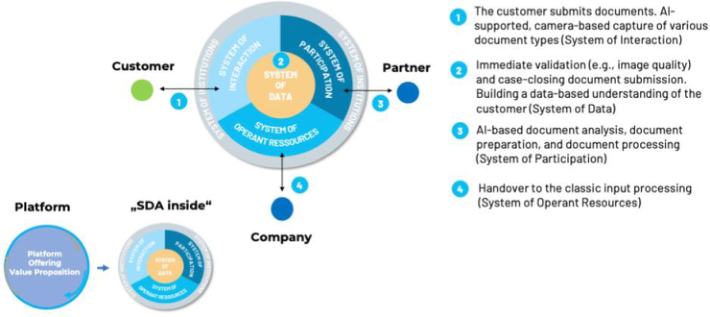
18 Gruhn and Warg to overcoming translational gaps in value-creation. Figure 1 demonstrates an example of SDA based service design. The company draws on SDA for configuring the value-creation system (e.g. in AI based document submission) including actor roles and the numbered process. The partner as co-producer of the value proposition (offering) is connected via. the system of participation. And the customers are mobilized to create their own value in use from the companies offerings via. the system of interaction (Normann and Ramirez, 1993; Shostack, 1982).
Figure 1: SDA based service design.
Software Engineering and SDA To implement such value-creation systems, SESE links service design with a compatible software engineering approach. Software engineering is about understanding the nature of software processes, finding appropriate architectures of software systems, and identifying the essential and value- creating activities in software development (Gruhn and Striemer, 2018). Choosing services as structuring paradigm of choice, this approach decomposes identified services to the atomic level required for implementation, supports different realization technologies in a technology-agnostic way, and manages realized services and other assets via platforms. Entry and exit criteria for services are defined - e.g. with the help of service catalogues - and monitored to keep the service landscape consistent, while generative AI techniques are systematically used for service realization, orchestration, and DevOps management.
Interoperability as key factor is understood as the ability of systems to exchange resources and access third-party functionality in ways that enable meaningful collaboration. Building on SDA, SESE distinguishes three interoperability modes for services: federated, unified and integrated (Chen, 2017). Federated services are the loosest form of interoperability between actors. These services are distributed, domain-owned services that manage their own data and expose clearly defined APIs, while maintaining domain autonomy. Unified services rely on a predefined common format at the meta level, which allows mappings between actors with SDA systems without
Service Ecosystem Engineering to Overcome Translational Gaps 19 full runtime integration. Integrated services operate on a shared, persistent format spanning all five SDA systems, enabling tightly coupled, mutually value-creation across the five SDA service systems. These services are specifically developed and comprise the assets of all SDA systems. They allow external actors, solutions, and services to be integrated and orchestrated e.g. to end-to-end processes enabling value in use.This SDA-based framing of interoperability allows SESE to identify, unbundle, and bundle translational services and patterns, manage them through catalogues and platforms, and dynamically adjust modernization paths without losing architectural coherence. The distinctive element of SESE is that service identification (service design) and service implementation (software engineering) operate on a unified platform in which the SDA structure is simultaneously medium and output.
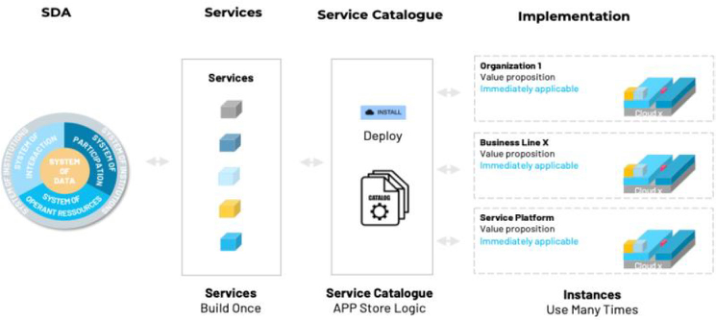
Figure 2: SDA based software engineering using the example of a service catalogue.
Figure 2 demonstrates how SDA as target structure provides mechanisms to represent and manage services using the example of a service catalogue. The services are assigned to the five systems, enabling them to be identified, documented, modelled as processes, and deployed.
FINDINGS (TSRDM STEP 7-8) Service Ecosystem Engineering (SESE) bridges translational gaps by redirecting digital transformation from technology-centric initiatives toward structure-dominated architectures grounded in SDA. It addresses the Socioeconomic and Skills Gap by overarching guidelines interpreting leadership as institutional work of organizing value-creation sstems and value propositions around beneficiaries’ value-in-use (Hastings and Meyer, 2020; Benlian and Pinski, 2025). It addresses the Technology-to-Value Gap by first designing actor (e.g. customer) journeys through SDA-based service design and only subsequently implementing services via software engineering, including service decomposition, resource liquefaction, and platform-based unbundling and rebundling of services. In this way, SESE enables interoperable, federated modernization paths that decouple value-creation from legacy technologies.
20 Gruhn and Warg With regard to the three research questions, SESE (1) adapts, mobilizes, and orchestrates external resources by configuring services along SDA systems; (2) designs and sustains organizational capabilities and value- creation paths through SDA-based design patterns, service catalogues, and pace-controlled modernization; and (3) cultivates emergent properties and dynamic capabilities by configuring SDA’s systems as open, adaptive service systems that turn shocks and disturbances into occasions for reconfiguration, learning, and value innovation.
CONCLUSION AND OUTLOOK The Service Ecosystem Engineering (SESE) approach links service design and software engineering to enable the purposive development of value-creation systems, initially independent of any specific technology. Building on SDA as a reference structure for both service design and software engineering, SESE marks a shift from technology-dominated initiatives to structure-dominated, service-based architectures that help organizations learn and evolve with each new requirement and use case.
SESE supports adaptive learning by configuring SDA-based service systems that can be iteratively reconfigured as actors, processes, and institutional arrangements respond to contextual change and perturbations. Generative learning and new organizational capacities emerge as services and service systems become capacities to create, e value-creation paths, literacy, and service innovations. In doing so SESE creates conditions for purposively shaping ecosystem properties, digital sovereignty and antifragility.
For research, SESE offers a structured lens to further investigate translational gaps, interoperability, and learning in service ecosystems. For practice, it suggests that sustainable digital transformation depends less on the next technology stack and more on structure-dominated reference architectures.
REFERENCES
Alcock, J. 2005. Animal Behavior: An Evolutionary Approach, Sinauer Associates.
Inc., Sunderland, Massachusetts. Arthur, W. B. 2009. The nature of technology: What it is and how it evolves, Simon and Schuster. Barile, S. & Polese, F. 2010. Linking the viable system and many-to-many network
approaches to service-dominant logic and service science. International Journal of Quality and Service Sciences, 2, 23–42. Benlian, A. & Pinski, M. 2025. The AI literacy development canvas: Assessing and building AI literacy in organizations. Business Horizons. Böhmann, T. 2004. Modularisierung von IT-Dienstleistungen: Eine Methode für das
Service Engineering, Wiesbaden, Deutscher Universitäts-Verlag. Brettreich-teichmann, W., Fähnrich, K.-P., Haischer, M. & Meiren, T. 1998. Service Engineering. Bryar, C. & Carr, B. 2021. Working Backwards: Insights, Stories, and Secrets from
Inside Amazon, Pan Macmillan. Bughin, J., Deakin, J. & O’Beirne, B. 2019. Digital transformation: Improving the odds of success. McKinsey Quarterly, 22, 1–5.
Service Ecosystem Engineering to Overcome Translational Gaps 21 Chen, D. 2017. Framework for enterprise interoperability. Enterprise interoperability:
INTEROP-PGSO vision, 1, 1–18. Deacon, T. W. 2006. Emergence: The Hole at the Wheel’s Hub¹. The re-emergence of emergence: The emergentist hypothesis from science to religion, 111. Forth, P., Reichert, T., De Laubier, R. & Chakraborty, S. 2020. Flipping the odds of
digital transformation success. Boston Consulting Group, 1, 35. Giddens, A. 1984. The constitution of society: Outline of the theory of structuration, Univ of California Press. Gregor, S., et al. 2020. Research perspectives: the anatomy of a design principle.
Journal of the Association for Information Systems, 21, 2. Gruhn, V. & Striemer, R. 2018. The Essence of Software Engineering, Springer Gummesson, E. 1995. Relationship Marketing. In: GLYNN, W. J. & BARNES, J. G.
(eds.) Understanding Services Management. John Wiley & Sons Ltd. Hagel, J., Brown, J. S. & Davison, L. 2010. The power of pull: How small moves, smartly made, can set big things in motion, New York: Basic Books. Haines, A., et al. 2004. Bridging the implementation gap between knowledge and
action for health. Bulletin of the World Health Organization, 82, 724–731. Hastings, R. & Meyer, E. 2020. No Rules Rules: Netflix and the Culture of Reinvention. Penguin, New York, NY. Howe, M. J. 1980. The psychology of human learning, New York: Harper & Row. Husain, L., et al. 2025. Bridging Implementation Gaps in Digital Health. Clinical
and Translational Science, 18, e70375. Imran, F., et al. 2021. Digital transformation of industrial organizations: Toward an integrated framework. Journal of change management, 21, 451–479. Jaakkola, E. 2020. Designing conceptual articles: four approaches. AMS Review,
1–9. Koczerga, M. 2024. Navigating the Digital Chasm. Scientific Journal of Bielsko- Biala School of Finance and Law, 28. Lusch, R. & Vargo, S. 2010. Service, value networks and learning. Journal of the
Academy of Marketing Science, 38, 19–31. Lusch, R. F. & Nambisan, S. 2015. Service Innovation: A Service-Dominant Logic Perspective. Mis Quarterly, 39, 155–175. Macinnis, D. J. 2011. A framework for conceptual contributions in marketing.
Journal of Marketing, 75, 136–154. Mcgowan, H. E. & Shipley, C. 2020. The adaptation advantage: Let go, learn fast, and thrive in the future of work, John Wiley & Sons. Naisbitt, J. 1985. Megatrends: 10 Perspektiven, die unser Leben verändern werden,
Heyne. Norman, D. A. 2024. Design for a better world: Meaningful, sustainable, humanity centered, MIT Press. Normann, R. & Ramirez, R. 1993. From value chain to value constellation: Designing
interactive strategy. Harvard business review, 71, 65–77. Oludapo, S., et al. 2024. Why do so many digital transformations fail? A bibliometric analysis and future research agenda. Journal of Business Research, 174, 114528. Omol, E. J. 2024. Organizational digital transformation: from evolution to future
trends. Digital Transformation and Society, 3, 240–256. Ostrom, E. 2010. Institutional analysis and development. Historical developments and theoretical approaches in sociology, 2, 261–288. Penrose, E. 1959. The Theory of the Growth of the Firm, Oxford University Press Plekhanov, D., Franke, H. & Netland, T. H. 2023. Digital transformation: A review
and research agenda. European management journal, 41, 821–844.
22 Gruhn and Warg Polese, F., Barile, S., Loia, V. & Carrubbo, L. 2018. The demolition of service scientists’
cultural-boundaries. In: MAGLIO, P. P., et al. (eds.) Handbook of Service Science, Volume II. Cham: Springer. Sein, M. K., et al. 2011. Action Design Research. MIS Quarterly Senge, P. M. 1997. The fifth discipline. Measuring Business Excellence. Shostack, G. L. 1982. How to design a service. European journal of Marketing, 16. Spohrer, Vargo, S. L., Caswell, N. & Maglio, P. P. The service system is the basic abstraction of service science. Proceedings of the 41st Annual Hawaii International Conference on System Sciences (HICSS 2008), 2008. IEEE. Spohrer, J., Maglio, P., Bailey, J. & Gruhl, D. 2007. Steps toward a science of service
systems. Computer, 40, 71–77. Spohrer, J., Maglio, P. P., Vargo, S. L. & Warg, M. 2022. Service in the AI era: Science, logic, and architecture perspectives, Business Expert Press. Sung, N. S., et al. 2003. Central challenges facing the national clinical research
enterprise. Jama, 289, 1278–1287. Vargo, S. & Lusch, R. 2016. Institutions and axioms: an extension and update of service-dominant logic. Journal of the Academy of Marketing Science, 44, 5–23. Vargo, S. L. & Lusch, R. F. 2004. Evolving to a New Dominant Logic for Marketing.
Journal of Marketing, 68, 1–17. Vargo, S. L. & Lusch, R. F. 2018. The SAGE handbook of service-dominant logic, SAGE Publications Limited. Vargo, S. L., Peters, L., Kjellberg, H., Koskela-Huotari, K., Nenonen, S., Polese, F.,
Sarno, D. & Vaughan, C. 2022. Emergence in marketing. Journal of the Academy of Marketing Science, 1–21. Vial, G. 2019. Understanding digital transformation: A review and a research agenda.
The Journal of Strategic Information Systems, 28, 118–144. Warg, M., Spohrer, J., Böhmann, T., Leitner, C., Carrubbo, L., Gruhn, V., Neuhüttler, J., Weiss, P. & Burmeister, M.-A. 2025. Translational Service Research And Design Methodology (TSRDM) https://www.ifsd.hamburg/TRANSLATIONAL- SERVICE-RESEARCH-AND-DESIGN-METHODOLOGY-TSRDM/ [Accessed 20251101]. Warg, M., Zolnowski, A., Frosch, M. & Weiß, P. 2019. From Product Organization
to Platform Organization. Naples Forum on Service. Ischia/Naples. Woolf, S. H. 2008. The meaning of translational research and why it matters. Jama. Zablah, A. R., et. al 2004. Customer relationship management implementation gaps.
Journal of Personal Selling & Sales Management, 24, 279–295.
LISTED IN THE AHFE DIGITAL BOOKSTORE CATALOGUE
Explore the complete digital volume
The Human Side of Service Engineering
Read this individual research paper free through the original publisher, or explore the full digital proceedings book.
ISBN 978-1-964867-97-7
Explore this ISBN in the AHFE Bookstore ↗Listed in the July 2026 bookstore catalogue; search by ISBN to confirm current availability · Digital book purchase optional