Anne Marie Schneider, Christian Powalla (2026). Applying TSRDM framework to Charité´s Fast Follower IT Strategy - Bridging Translational Gaps of Digital Transformation. In: The Human Side of Service Engineering. AHFE Open Access, vol. 221, pp. 87–94. https://doi.org/10.54941/ahfe1007712
This paper applies the Translational Service Research and Design Methodology (TSRDM) to Charité - University Medicine’s fast‑follower IT strategy, which aims to transform the organization into a digital, connected, adaptive, and learning university hospital. Charité positions digitalization as an enabler for improving care quality, patient experience, and staff relief - not as an end in itself - yet faces pronounced translational gaps between technological potential and realized value in practice. The study conceptualizes two core gaps in Charité’s digital transformation: the “technology‑to‑solution” gap and the “solution‑to‑value” gap.Using TSRDM’s eight‑step process, the research develops a service‑based knowledge base grounded in Service‑Dominant Logic, Service Science, and Service‑Dominant Architecture. It introduces a unifying service language and SDA‑based patterns that map services onto generic systems of interaction, participation, operant resources, data, and institutions, translating abstract service theory into reusable translational services, design principles, and platform architectures.Findings demonstrate how TSRDM systematically derives service concepts and translational services that address interoperability challenges for the technology‑to‑solution gap and enhance value‑in‑use, stakeholder engagement, and closed‑loop learning for the solution‑to‑value gap. By operationalizing Charité’s fast‑follower orientation, TSRDM enables the hospital to move from isolated “digital islands” to a scalable portfolio of interoperable, platform‑based digital services that can be rapidly adopted and adapted across contexts. The study concludes that TSRDM not only analyzes but actively strengthens Charité’s fast‑follower strategy by bridging translational gaps and advancing human‑centered digital innovation and well‑being.
Charité pursues an ambitious 2030 strategy to “rethink health” and to strengthen its position as a leading, highly networked university hospital that tightly integrates patient care, research, teaching, and regional as well as international collaboration. Digitalization is framed as a central enabler rather than an end in itself, expected to enhance process efficiency, patient Received February 6, 2026; Revised April 13, 2026; Accepted April 30, 2026; Available online July 20, 2026
88 Schneider and Powalla safety, care quality, and Charité’s role as an innovation driver in the healthcare system. This strategic agenda explicitly emphasizes translation, aiming to move research results and technological innovations more rapidly and systematically into routine care through structured translational pathways, shared platforms, and interdisciplinary centers (Heggen, 2025).
Charité’s IT strategy operationalizes this agenda through a fast-follower orientation and a Service Dominant Enterprise Architecture that together define Charité IT as digital, connected, adaptive, and learning. “Digital” refers to a platform-based core that systematically uses data, interoperability, and reusable services to support clinical and administrative processes at scale. “Connected” highlights tightly networked actors and systems across departments and external partners, enabling end-to-end service processes and co-created value propositions in care, research, and teaching. “Adaptive” characterizes the IT landscape’s ability to reconfigure resources and processes in response to new medical knowledge, regulations, and technologies, balancing exploitation (run, transform) with exploration (innovate), (McGowan and Shipley, 2020; Spohrer, 2021). “Learning” denotes both adaptive and generative learning capacities (Senge, 1997): Charité IT continuously builds data-based understanding of practice, feeds this back into design and governance, and expands its capability to create new, more effective digital service offerings over time.
In its strategy process, Charité IT deliberately chose a fast-follower strategy instead of a high-risk first-mover approach, asking whether it is more sensible to pioneer or to adopt proven solutions quickly once value creation paths are visible. Empirical strategy studies indicating that many first movers fail while a large share of fast followers succeed support this decision, so Charité IT focuses on robust adoption, scaling, and integration of mature digital solutions rather than speculative experimentation (Lieberman and Montgomery, 1998; Golder and Tellis, 1993; Skillicorn, 2022). Once committed, the organization competes primarily through process efficiency, scalable architectures, and cost-effective delivery models, supported by fast decision-making, short development cycles, and enabling governance that allows rapid piloting and iterative refinement with users.
Despite this framing, Charité faces pronounced translational gaps in its digital transformation. The first being the translational gap “technology to solution” as the disconnect between available or emerging technologies (e.g., AI, connectivity tools, digital platforms) and their configuration into solutions that fit Charité’s clinical, research, and administrative workflows. A second, equally critical translational gap is “solution to value,” as the disconnect between implemented digital solutions and the realization of their expected value for patients, internal customers and partners.
This paper follows a clear throughline: starting from Charité’s 2030 strategy and fast-follower IT orientation, it identifies the technology-to-solution and solution-to-value gaps as central obstacles to realizing digital value. Applying the Translational Service Research and Design Methodology (TSRDM), the study builds a service-based knowledge base, contributes to the evolvement of a unifying service language and Service-Dominant Architecture patterns, and derives translational services that systematically target these gaps. In doing so, it shows how Charité can move from fragmented “digital islands” to a
Applying TSRDM Framework to Charité´s Fast Follower IT Strategy 89 scalable, interoperable service platform that operationalizes its fast-follower strategy and advances human-centered digital innovation and well-being.
TRANSLATIONAL GAPS ON CHARITÉ´S DIGITAL TRANSFORMATION At Charité, the “technology-to-solution” gap describes the disconnect between available technologies and their configuration into interoperable, user-ready solutions embedded in clinical, research, and administrative workflows. It is fuelled by legacy landscapes, fragmented initiatives, and the difficulty of turning generic tools into coherent, end-to-end service offerings that support staff and patients. New technologies outpace the organization’s capacity to embed them into routines, causing misalignments between technical possibilities and user competences, slowing learning cycles, and weakening adaptive capabilities needed for fast following.
The “solution-to-value” gap denotes the disconnect between implemented digital solutions and the realization of expected value such as improved outcomes, efficiency, staff relief, or patient experience. Even technically functioning solutions often show low adoption, misaligned incentives, weak workflow integration, and limited measurement and feedback, so they remain local pilots or “digital islands” without impact at scale. As a result, organizational learning is constrained because solutions without visible value offer little basis for collective sense-making and refinement, limiting Charité’s ability to generalize and adapt practices across contexts.
The translational gaps constrain Charité’s intra-organizational interoperability, inter-organizational interoperability, and interoperability towards patients and staff. Intra-organizational interoperability suffers because the technology-to-solution gap produces fragmented, bespoke integrations between internal units and systems, so data, services, and processes do not flow smoothly across silos. This undermines reuse, standardization, and internal scaling, and makes each new solution feel like a one-off project rather than part of a coherent hospital platform.
Inter-organizational interoperability is impaired when the technology -to-solution gap prevents the emergence of robust, context-fit solution patterns, so partners and vendors cannot easily plug into stable interfaces, data models, and workflows. Joint design and long-term evolution are complicated by unclear requirements and misaligned expectations, slowing collaborations and limiting Charité’s ability to adopt and diffuse mature solutions from external ecosystems. In contrast, the solution-to-value gap primarily affects interoperability towards patients and staff: technically working tools do not consistently integrate into everyday routines or patient journeys, perceived usefulness, adoption and patient engagement stay low. Patients encounter channel breaks, duplicate data entry, and inconsistent information views, which reduces trust and limits the contribution of digital services to outcomes, experience, and workload relief.
Together, the two gaps erode Charité’s fast-follower position by weakening both rapid coproduction with external actors and the translation of solutions into sustainable user value. Instead of quickly plugging proven technologies into clear architectural and governance patterns, Charité faces slow, case-by-case integration and uncertain user impact, so initiatives
90 Schneider and Powalla risk remaining isolated “digital islands” rather than forming a scalable, interoperable portfolio that compounds learning and advantage.
RESEARCH DESIGN The study applies the Translational Service Research and Design Methodology (TSRDM) to systematically bridge translational gaps in digital transformation at Charité. TSRDM is selected for its capacity to conceptualize and implement translational services, architectures, and design patterns that promote connectivity and adaptive capacity within complex healthcare systems.
The research design follows a systematic, eight-step process of TSRDM (Warg et al., 2025), consistent with general methodological principles and research plans outlined by Flick (Flick, 2009) and Kothari (Kothari, 2004):
1. Objectives Definition, Translational Gap, and Problem Identification: Define and justify the specific translational gap, explaining why addressing it is valuable. 2. Perceptions, Methodological Considerations, and Research Design: Describe the perception of the challenge or translational gap based on the problem definition. Ideate objectives for a solution. Identify and align conceptual approaches and research designs to effectively model the challenge. 3. Knowledge Base: Build a knowledge base incorporating grand theories such as Service Dominant Logic and Service Science, which address the processes and structures of value co-creation, along with other relevant sciences, theories, models, and concepts. 4. Objective-Related Solution Mechanisms: Develop objective-related knowledge, mechanisms, models, or desired behaviors aimed at bridging the translational gap. 5. Translational Services and Architectures: Define translational services, including activities, functions, objects, triggers, design principles, design patterns, building blocks, systems, service systems, or architectures that facilitate fertilizing the interface between science and implementation. 6. Service Design and Engineering: Apply the translational services and architectures to service design, action design, engineering design, software engineering, service engineering, software design, artifacts, or tangible solutions to achieve targeted behaviors. 7. Definitive Design and Implementation: Research Describe the definitive design. Conduct implementation research or studies on proof of concepts, frameworks, models, instantiations, or implementations. 8. Outcomes and Ends, Service Demonstration: Research on outcomes and ends (valued states), service demonstration, and behavior evaluation, including findings and knowledge building.
These steps ensure a rigorous and iterative approach that aligns multidisciplinary collaboration and digital health innovation with the strategic and operational needs of Charité, thereby advancing its transformation into a digitally connected hospital.
KNOWLEDGE BASE In line with the TSRDM (Warg et al., 2025) process we elaborate a knowledge base for solving the frictions and deriving objectives related mechanisms. Service is picked as the central lens for our work because it captures how actors apply resources for the benefit of others, making it the basic unit of social and economic exchange and the core of value co-creation (Carrubbo et al., 2015; Vargo et al.; 2008, Spohrer et al., 2022). The knowledge base draws on services as structuring paradigm, a “unifying service language”, value cocreation, service systems, and Service Dominant Architecture (SDA).
The knowledge base is grounded in “services” as the primary structuring paradigm, shifting attention from products or technologies as ends in themselves to the services they render for actors. Building on Penrose’s (Penrose, 1959) classic insight that resources are better understood in terms of the services they can perform, this view is reinforced by Gummesson’s formulation that both activities and things “render services” (Gummesson, 1995) and by Norman’s (Heuer, 2024) observation that even physical goods, such as a cup, are purchased for the service they provide. In this paradigm, every product is interpreted as a carrier of services, and services become the elemental “letters and words” of a “unifying service language” that can be recombined to form higher-order patterns. By treating services as “letters”! or basic building blocks, TSRDM aligns with a long-standing move in service research to dissolve the traditional goods - services dichotomy and to adopt an actor-centric perspective on offerings. Offerings are understood as bundles of activities, goods, data, and technologies that render services and thus contribute to value. This provides a generative vocabulary for modelling and composing value constellations, because the focus shifts from selling outputs to configuring services that support utilization and experience in context.
TSRDM introduces a unifying service language that links research, design, engineering, and implementation by treating service as the core unit of analysis and design. Service, understood as the application of resources for the benefit of another, forms the semantic core, while concepts such as resource integration, value propositions, and institutional arrangements provide the grammar for composing services into journeys, processes, and architectures.
This language parallels natural language: semantics clarifies how services contribute to value cocreation, syntax specifies design and engineering rules for combining services, and pragmatics captures context- and actor-specific value. It is also conceived as a pattern language, inspired by architectural and software design patterns, turning theoretical insights from Service-Dominant Logic and Service Science into reusable translational services, patterns, and architectures that bridge the “valleys of death” between discovery and implementation.
SDA assigns services to five generic systems that act as design patterns for value cocreation and can be instantiated as digital service platforms. The Systems of Interaction, Participation, Operant Resources, Data, and Institutions jointly organize services and processes, enabling onboarding,
92 Schneider and Powalla resource recombination, data-driven adaptation, and institutional coordination. Together, these five SDA patterns operationalize the unifying service language and the grand theories of S-D Logic and Service Science within organizational and platform architectures, making value cocreation systematically designable, implementable, and improvable across contexts. In doing so, they turn abstract service theory into reusable, architecture-embedded mechanisms that help to address translational gaps in digital transformation.
TRANSLATIONAL SERVICES AND SDA PATTERNS This chapter applies the previously developed knowledge base to derive concrete translational services and patterns that bridge Charité’s translational gaps. Concepts such as services as structuring paradigm, service as basis of exchange, the unifying service language, value cocreation, and service systems are translated into interoperable design principles and SDA-based patterns. These translational services are then aligned with the two gaps - technology-to-solution and solution-to-value - to systematically address the identified frictions in Charité’s fast-follower strategy.
Table 1: Translational services and patterns for bridging gaps.
Table available in the original PDF paper.
Frictions for the Fast Follower Strategy
Service Concepts Translational Services & Patterns
- Value coproduction - Service (eco) systems - Unifying service language - Services as structuring
Assigning the services to SDA patterns of - participation services - institutional services - data services
interoperability - inter-organizational interoperability “Solution-to-Value Gap” - integration of solutions
- Value cocreation - Value in use
into patients journeys and administrative routines - customer engagement
Assigning the services to SDA patterns of - interaction services - institutional services - data services
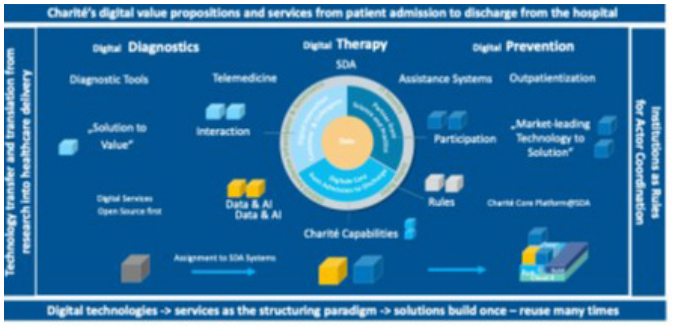
Building on these translational services and SDA patterns, the following target architecture illustrates how Charité’s digital value propositions are instantiated across diagnostics, therapy, and prevention along the full patient journey from admission to discharge. It shows how services, the unifying service language, and SDA systems (interaction, participation, data, institutions, operant resources) translate into concrete capabilities, platforms, and rules that systematically bridge the technology-to-solution and solution-to-value gaps in practice.
Figure 1: Translational services and patterns of Charité´s fast-follower strategy.
FINDINGS The systematic application of TSRDM shows that a unifying service language and SDA-based translational services are critical levers to operationalize Charité’s fast-follower strategy by directly targeting the technology-to-solution and solution-to-value gaps. By treating “service” as the central unit of analysis and design, TSRDM enables Charité IT to express technologies, workflows, and governance mechanisms as composable service configurations, which can be reused, standardized, and scaled across the Charité Core Platform.
TSRDM provides a structured, eight-step process that aligns actors from research, IT, and care delivery around shared translational objectives, making interoperability and value cocreation explicit design criteria rather than afterthoughts. For the technology-to-solution gap, TSRDM guides the derivation of service concepts, translational services, and SDA patterns (e.g., canonical APIs, reference journeys, onboarding pipelines) that increase intra- and inter-organizational interoperability and turn heterogeneous technologies into platformable, fast-deployable solutions.
For the solution-to-value gap, TSRDM emphasizes value-in-use, patient and staff experience, and closed-loop learning as integral parts of solution design, leading to patterns such as engagement and capability-building services, embedded workflow integration, and outcome-oriented feedback mechanisms. In combination, these translational services allow Charité to move from isolated pilots and “digital islands” to a coherent, SDA-based portfolio of interoperable services that can be replicated and adapted across contexts, which is essential for a fast-follower that competes on rapid adoption, scaling, and efficient delivery.
Overall, the findings indicate that TSRDM does not merely describe Charité’s fast-follower strategy but actively strengthens it: by systematically bridging translational gaps, TSRDM turns the strategy’s guiding ideas - digital, connected, adaptive, and learning - into concrete service architectures, governance mechanisms, and design patterns that accelerate the diffusion of mature solutions while safeguarding human well-being and workload relief for patients and staff.
ACKNOWLEDGMENT
The authors would like to express their sincere gratitude to Markus Warg for his invaluable support. His inspiration, ideas, and dedication have elevated Charité’s IT strategy to a new level. Without his contribution, this paper would not have been possible.
REFERENCES
Carrubbo, L., Bruni, R., Cavacece, Y. & Moretta Tartaglione, A. 2015. Service system platforms to improve value co-creation: Insights for translational medicine. Service Dominant Logic, Network and Systems Theory and Service Science: Integrating three Perspectives for a New Service Agenda. Flick, U. 2009. An introduction to qualitative analysis. London: Sage Publications. Golder, P. N. & Tellis, G. J. 1993. Pioneer advantage: Marketing logic or marketing
legend? Journal of marketing Research, 30, 158–170. Gummesson, E. 1995. Relationship Marketing: its Role in the Service Economy. In: Glynn, W. J. & Barnes, J. G. (eds.) Understanding Services Management. John Wiley & Sons Ltd. Heggen, M. 2025. Einblicke 2024 - Charité Jahresbericht 2024. In: Berlin, C. U.
(ed.). Heuer, S. 2024. A Tete a Tete with Don Normann. Think:Act, 09/2024, 75–77. Kothari, C. R. 2004. Research methodology: Methods and techniques, New Age International. Lieberman, M. B. & Montgomery, D. B. 1998. First-mover (dis) advantages:
retrospective and link with the resource-based view. Strategic management journal, 19, 1111–1125. Mcgowan, H. E. & Shipley, C. 2020. The adaptation advantage: Let go, learn fast, and thrive in the future of work, John Wiley & Sons. Penrose 1959. The theory of the growth of the firm. New York: Sharpe. Senge, P. M. 1997. The fifth discipline. Measuring Business Excellence. Skillicorn, N. 2022. First-Mover or Fast-Follower: Which is the right innovation strategy
for you? [Online]. https://www.ideatovalue.com/inno/nickskillicorn/2022/04/ first-mover-or-fast-follower-which-is-the-right-innovation-strategy-for-you/. Available: https://www.ideatovalue.com/inno/nickskillicorn/2022/04/first-mover- or-fast-follower-which-is-the-right-innovation-strategy-for-you/ [Accessed]. Spohrer, J. 2021. Service innovation roadmaps and responsible entities learning.
ITM Web of Conferences. EDP Sciences. Spohrer, J., Maglio, P. P., Vargo, S. L. & Warg, M. 2022. Service in the AI era: Science, logic, and architecture perspectives, Business Expert Press. Vargo, S. L., Maglio, P. P. & Akaka, M. A. 2008. On value and value co-creation: A
service systems and service logic perspective. European Management Journal, 26, 145–152. Warg, M., Spohrer, J., Böhmann, T., Leitner, C., Carrubbo, L., Gruhn, V., Neuhüttler, J., Weiss, P. & Burmeister, M.-A. 2025. Translational Service Research And Design Methodology (TSRDM) - A new Service Research and Design Methodology in exploration [Online]. Available: https://www.ifsd.hamburg/translational-service- research-and-design-methodology-tsrdm/ [Accessed].
LISTED IN THE AHFE DIGITAL BOOKSTORE CATALOGUE
Explore the complete digital volume
The Human Side of Service Engineering
Read this individual research paper free through the original publisher, or explore the full digital proceedings book.
ISBN 978-1-964867-97-7
Explore this ISBN in the AHFE Bookstore ↗Listed in the July 2026 bookstore catalogue; search by ISBN to confirm current availability · Digital book purchase optional