Peter Weiss (2026). Linking context to outcomes: Building transformational design patterns using Service Dominant Architecture (SDA). In: The Human Side of Service Engineering. AHFE Open Access, vol. 221, pp. 122–132. https://doi.org/10.54941/ahfe1007716
This paper contributes to the session Translational Service Research and Design Methodology (TSRDM). Translational gaps between scientific discoveries and applied service innovations pose significant social and economic challenges. In response to the social and economic challenges posed by "translational gaps", TSRDM (Warg et al., 2025) is adopted as a systematic approach to eliminating the obstacles associated with these gaps. Presented research is ongoing and expands previous research on Service Dominant Architecture (SDA) through conceptualizing and theorizing transformational mechanisms and incorporating them as justificatory knowledge for design theorizing into SDA framework and methodology.
Translational gaps between scientific discoveries and applied service innovations pose significant social and economic challenges. Presented research explores how appropriate service design methodology can incorporate insights from institutionalization processes which are closely linked to organizational learning. Our aim is to elaborate design principles and patterns to overcome existing transfer gaps in companies to introduce digital technologies in particular Generative Artificial Intelligence (GAI). Meanwhile various digital transformation (DT) frameworks exist and theoretical foundations of DT are evolving rapidly (Vial 2019; Hanelt et al., 2021; Krauss et al., 2020). However, organizations are still struggling to design and apply design artifacts to build their foundation of execution to implement their digital strategies. Observably, there is a lack of understanding why digital initiatives (such as GAI) fail and do not deliver expected outcomes. Hence, this research is conducted to addresses this research gap, and looking for explanations why related IT artifacts are not adopted by actors and organisational compartments and turned into new routines, practices and knowledge. Exploring institutional processes yields deeper insights in organizational change mechanisms linking context to outcomes (Hanelt et al., 2021). Subsequently, we deliver explanations and results on how organizations might overcome prevailing barriers and inertia to achieve required outcomes, in the following addressed as “translational gaps” Received February 12, 2026; Revised April 15, 2026; Accepted April 29, 2026; Available online July 20, 2026
Linking Context to Outcomes 123 caused by misconceptions related to turning technology investments through institutional processes (“objectification”) into new organizational capabilities (Scott, 2014: 144–151). Accordingly, the transition from “habitualization” to “objectification” is a key aspect to understand transformational mechanisms at work (Scott, 2014: 144–151). The remainder is organized as follows. First, we review relevant and selected digital transformation frameworks. Second, institutionalization mechanisms and processes are elucidated. In next step core elements of SDA are reviewed and presented. Finally, we conclude on yielded results and provide a future outlook.
RESEARCH METHODOLOGY AND OBJECTIVES Our research is contributing to Translational Service Research and Design Methodology (TSRDM) (Warg et al., 2025), a current joint initiative to develop an integrative translational framework. Grounded in the centrality of service (Spohrer et al., 2022), TSRDM integrates a “unifying service language” with a structured translational space of services, patterns, and architectures, organized into three pillars and an eight-step process. SDA (Warg et al., 2016) contributes to a “unifying service language” that provides a higher-order, domain agnostic grammar for aligning research, design, engineering, and implementation. This paper aims to prepare required alignment by highlighting how ongoing SDA research supports TSRDM. SDA was published in 2014 by Markus Warg (Warg 2025; Spohrer et al., 2022). Results are contributing to Pillar II and Pillar III and referring to the eight- step TSRDM process, in particular steps 4, 5 (translational space) and 6 (Service Design) (Warg et al., 2026).
DIGITAL TRANSFORMATION CHALLENGES New emerging technologies such as Artificial Intelligence (AI) and in particular Generative AI (GAI), but as well Metaverse, and more general SMACIT, are offering new opportunities for companies to build new capabilities and rethink existing value constellations (Feuerriegel et al. 2024; Banh and Strobel, 2023; Weber et al., 2025; Euchner, 2023; Manduchi et al., 2025). Digital technologies such as GAI triggers the emergence of new social practices and structural properties (Peters et al. 2009:348) through delivering mechanisms and routines to change organizational knowledge and to provide feedback stimulating cognitive processes and (heteropathic) resource integration patterns (Weber et al., 2025; Krüger et al., 2025). Often it is difficult and cumbersome in particular for incumbent companies to adopt and diffuse new emerging digital technologies as IT artifacts to their organization to spur DT. One explanation at hand is, that created IT artifacts (use cases) affect and change structural properties, and in consequence alter social practices by actors engaged in those structures (TSRDM Pillar III). Peters et al. (2009:354) argue that structures are a dynamic property of social practices and organizational learning. Studying and analysing related mechanisms creating effects on structuration processes promise to deliver more detailed insights concerning constraints and levers of respective individual and organizational learning practices within organizations (Peters et al., 2009:354). Hence,
124 Weiss in the remainder respective mechanisms and levers enabling adoption and diffusion of digital technologies in organizations are elucidated. Mechanisms create effects by triggering organizational change and in this way driving DT in organizations. Subsequently, such mechanisms are in focus and reviewed on basis of selected DT frameworks and literature.
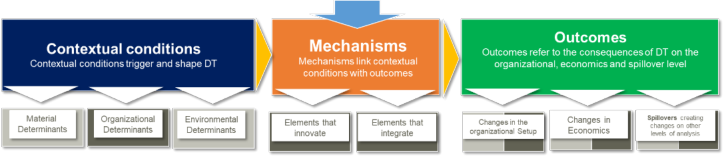
Linking Context to Outcome: Vial (2019), Hanelt et al. (2021:1165-67), and Krauss et al. (2020:1174) DT propose DT frameworks and are elucidating digital transformation drivers and levers in the context of organizational change as input and output variables linked via respective means or mechanism. A more detailed literature review and synthesis of various DT frameworks relevant for conducted SDA research can be found in (Warg, 2025). As shown in Figure 1, one of the key challenges of DT is to analyse, interpret and respond to contextual conditions triggering and shaping digital transformation (DT), namely material, organizational and environmental determinants (Hanelt et al., 2021). Mechanisms are describing how required effects are achieved under given contextual conditions (Scott, 2014:144) and are linking to respective outcomes. In the following, selected and relevant aggregated thematic patterns are presented as contributions to elaborate on justificatory knowledge and design theorizing (Weiß et al., 2023) in context of conducted SDA research (Warg, 2025; Spohrer et al., 2022). Objective is to initially conceptualize and respective SDA mechanisms as part of presented design theorizing. DT is the product of multiple evoked mechanisms that interact with and reinforce each other (Hanelt et al., 2021).
Figure 1: Digital transformation and organizational change: linking context to outcome (own illustration based on hanelt et al., 2021:1165).
Innovation and Integration: Hanelt et al. (2021) highlight “innovation” and “integration” as two main mechanisms (see Figure 1) that are generally used by organizations to overcome translational gaps (Hanelt et al., 2021: 1166). Innovation mechanisms involve elaborating novel strategies, such as digital business strategy and digital transformation strategy (Hanelt et al., 2021:1166; Vial, 2019). This includes both business and technology aspects how to apply “[…] resources, processes, and capabilities that are new to the organization” (Hanelt et al., 2021:1166). Integration mechanisms aim at aligning new capabilities, processes and resources to established ones. Organizations need to identify, concretize and conceptualize new capabilities, that allow to respond to contextual conditions and to elaborate on required outcomes to increase competitiveness to sustain in future digital markets (Vial, 2019; Hanelt et al., 2021; Krauss et al., 2020; Weber et al., 2025; Krüger et al., 2025). At this stage, organizations reflect on relevant strategic initiatives, for example on basis of innovative use cases, which are
Linking Context to Outcomes 125 concretized, prioritized and analysed with regard to resource allocation and needs. Accordingly, those use cases are at the core of a digital transformation roadmap. Furthermore, contextual conditions are translated into requirements informing the acquisition of new IT infrastructure capabilities. Those capabilities are building the foundation of execution for companies to implement and execute their digital strategies and linked strategic initiatives (Weill et al., 2002; Ross et al., 2006).
Organizational Design and Change Perspectives: Organizational change plays a salient role to pursue successfully DT. Hanelt et al., 2021:1168-72), propose based on a literature review aggregated “thematic patterns” to provide orientation and better understanding about peculiarities, dynamics and content of DT strategies and organizational change. DT requires new organizational designs, namely structure, systems and culture. The authors highlight in particular two thematic areas or patterns: (1) malleable organizational designs, and (2) digital business ecosystems. Hanelt et al. (2021:1161) argue that a shift towards “malleable organizational designs” is required “[…] to enable continuous adaptation” to changing contextual conditions.” Those designs rely on digital technologies and agile structures. There aim is to realize rapid adaptation to environmental changes, opportunities and threats (Hanelt et al., 2021:1168). Organizational designs are “[…] configurations of the formal organizational arrangements, including the formal structures, processes and systems that make up an organization” (Hanelt et al., 2021:1168). Secondly, digital business ecosystems promise as well increased adaptability by moving from hierarchical-oriented network structures towards “[…] more fragmented networks of strategic partnerships with external entities” (Hanelt et al., 2021:1170). This allows faster reaction to “turbulences” characterised by “conditions of unpredictability” in an organization’s environment. Potential causes are uncertainty about future customer needs and behaviour, emerging technologies, and perceived increasing competitive pressures and new value creation constellations on targeted markets (Hanelt et al., 2021, 1170). The authors further propose four distinct perspectives on DT providing an internally consistent account, namely (1) technology impact, (2) compartmentalized adaptation, (3) systemic shift, and (4) holistic co-evolution. These perspectives span a solution space and typology based on the dimensions “contextual scope” and “intra-organisational processes”. All perspectives are “[…] assuming organizational change in association with the widespread diffusion of digital technologies” (Hanelt et al., 2021:1173). Overcoming described challenges requires organizations to build “adaptive capacity” (Staber and Sydow, 2002:410). In particular, institutional diffusion theory shows potential to explain some of the perspectives such as “technology impact” by clarifying influencing factors why some IT artifacts such as software, new capabilities and social practices are diffusing the organizations and become institutionalized, and others are rejected (Scott, 2014; Hanelt et al., 2021:1179).
Institutionalization and Cultural Aspects: As motivated in previous paragraph, organizations need to identify mechanisms triggering dynamic processes of continuous learning and adjustment (Norman, 2001). “Adaptive capacity” is described as organizational capability coping with states
126 Weiss of uncertainty, ambiguity, complexity and unpredictability (Staber and Sydow 2002:410). “Organizations with adaptive capacity can reconfigure themselves quickly in changing environments […]” (Staber and Sydow 2002:410). Adaptive capacity is enabled by “double-loop learning” which leads to enhanced “organizational reflexivity” (Staber and Sydow 2002:410). Double-loop learning anticipates changes through reinventing organizational structures and systems by questioning and changing goals, ideologies, as well as developing new behaviours, rules, and social practices (Staber and Sydow 2002:410). Organizations having high level of adaptive capacity possess “dynamic capabilities” (Staber and Sydow 2002:411). Dynamic capabilities are defined as “[…] the firm’s ability to integrate, build, and reconfigure internal and external competences to address rapidly changing environments“ (Helfat und Peteraf 2003, S. 998, Teece 1997, S. 516). Dynamic capabilities imply a resource-based view. They involve adaptation and change, because they build, integrate, or reconfigure other resources and capabilities (Helfat und Peteraf 2003, S. 997). Organizational culture represents attitudes and beliefs that inform those behaviours including formal, stated norms as well as informal or implicit ways people work and socially interact (Scott, 2024:237). “[…] [S]tructuration refers to processes by which actors reproduce and transform social practices across time and space” (Staber and Sydow:412). Peters et al. (2009:347) argue that organizational and individual learning are strongly intertwined and existing interdependencies can be explained by structuration theory (Giddens, 1984).
INSTITUTIONALIZATION MECHANISMS AND PROCESSES Institutions can be understood either as process over time or set of social patterns or arrangements (Scott, 2014:143). (Scott, 2014:150) argues three general mechanisms to be evoked leading to institutionalization, namely (1) increasing returns, (2) commitments, and (3) objectification (Scott, 2014:144-151). Latter process is of particular interest as it illuminates how new solutions and social practices diffuse the organization. Studying institutionalization mechanism and processes allow deeper insights and explanation to understand barriers and misconceptions in service design initiatives as it illuminates how new solutions and social practices diffuse the organization for example with support of organizational learning processes to get permanent memory of the organization (Scott, 2014: 144-151). Institutional carriers play a salient role in innovation processes as they ensure that new digital technologies and related social practices are diffused across the organization and other organizational groups and units. Analysing and tracing carriers yield deeper insights and understanding how social practices and routines are changeable or maintained because they have influence on the outcome of institutional processes. As conclusion, carriers are concerned with “[…] how things become permanent […] bearing institutional elements, not simply objects or activities” (Scott, 2014:97). Key concepts of institutional carriers comprise symbolic and relational systems, activities and artifacts (Scott, 2014:151-179). Their purpose is to transport and maintain institutions. Scott (2014:148) argues that objectification requires social
Linking Context to Outcomes 127 consensus among organizational decision-makers “[…] concerning the value of a structure, and the increasing adoption by organizations on the basis of that consensus. The impetus for diffusion shifts from simple imitation to amore normative base. Figure 2 illustrates and summarizes described component processes of institutionalization and combines it with a use case- based development perspective. The innovation is viewed as possessing both general cognitive and normative legitimacy” (Scott, 2014:148). Figure 2 shows a “[…] multistage model of institutional processes that occur within but as well as between organizations” (Scott, 2014:148). “In response to contextual conditions (such as changes in political, technological, or market conditions), actors in organizations innovate, advancing new ideas, solutions and practices” (Scott, 2014:148). Referring to followed eight-step TSDRM process, use cases are a mean to evaluate IT artifacts (TSRDM step 8: outcomes and ends) by intervention in a real organizational context. To avoid digital silos and technical debt, an unifying, ubiquitous (domain) language needs to be used. In this context, translational service patterns and architectures (structures) are vital to create a translational space to overcome implementation barriers (silos). Use cases represent a distinct, separable application scenario in a specific domain. They produce new knowledge, contain and transport new social practices and technical solutions (such as IT artifacts) to be made permanent organizational memory by support of institutional processes. Respective mechanisms (“objectification”) are critical. Social practices and IT artifacts are diffused through support of institutional carriers, foremost symbolic systems (e.g. TSDRM unifying service language). Introduced “routines are learned and renewed in relational systems” (Scott, 2014: 144-151). Analysing use cases requires a thorough socio-technical analysis to understand underlying problems (Eekels and Roozenburg 1991, Nunamaker et al., 1990). In this context, identification and active involvement of organizational members in the use cases is crucial, but often not thoroughly addressed by organizations. Organizational members affected by the solution but excluded in the use case development are potential source of resistance and might create significant refusal on the micro-level to use the produced IT artefact (meso-level) or new solutions and social practices. Further, use cases yield new translational (design) patterns, as new digital technologies are translated through a unifying service language into new capabilities and practices by bringing the technology into the organizational context. Next section introduces Service Dominant Architecture (SDA) as mean to elaborate on solutions designs and build IT artifacts to diffuse new social practices and digital technologies in the organization.
Figure 2: Institutionalization: design principles and patterns (own illustration).
Figure available in the original PDF paper.
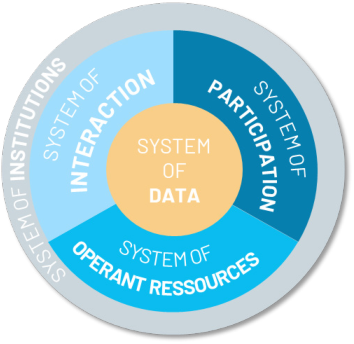
In the following, Service Dominant Architecture (SDA) is introduced and overviewed. SDA main building blocks are briefly summarized to allow a basic understanding of its core concepts. For a more detailed presentation of SDA it is referred to previous publications, namely (Warg, 2025; Warg et al., 2016; Warg et al., 2023; Spohrer et al., 2022; Weiß et al., 2018, 2023). SDA originates from a digital transformation endeavour of an insurance company in Germany. SDA serves as construction plan and organizing logic. SDA prioritizes “technical action and making” (Eekels and Roozenburg 1991:199) by value statements and supports learning processes (Peters et al., 2009:) to establish the right mindset to collaboratively elaborate on fit-for- purpose solutions designs (Nunamaker et al., 1990:94) and to drive DT in organizations. From a viewpoint of structuration theory (Giddens, 1984), SDA as mechanism creates effects by bringing a new organizing logic (structure of five service systems) to organizations with the aim enabling value co-creation through resource integration practices and actor engagement This organizing logic is arguably best described through the “service” perspective on value creation and respective imperatives (Normann, 2001; Spohrer et al., 2022; Vargo et al., 2023). Structuration theory states that social structures are constituted by human action and are medium of this constitution (Staber and Sydow 2002:412). In this way, SDA creates service systems, which are embedded in social systems possessing structure, structural properties, actors draw on in their social interaction and actions (Staber and Sydow: 412). SDA evokes mechanisms of structuration theory namely individual and organizational learning mechanisms. “Actors make sense of behaviors and events through communication, thus reproducing the rules of signification. They use facilities to mobilize available resources, thereby translating power into domination. And by using norms to sanction behaviors and events, they confer legitimacy“ (Staber and Sydow 2002:412). Organizational and individual learning are strongly intertwined, and feedback loops are critical. Actors develop knowledge through learning from recurring practices (Peters et al., 2009:353-54), embedded in our use cases. SDA establishes a shared worldview to avoid different interpretations and normative understanding to facilitate collaboration and organizational learning (Peters et al., 2009:354). As medium and output, SDA supports value cocreation practices (processes, services) as recurring and regularized actions of individual actors situated within a social system that create and recreate that system (Peters et al., 2009:360, Staber and Sydow:2002:412). Important to note, structure never determine action, they are rather engaging actors to transform them in the process of acting on and through them (Staber and Sydow 2002:412). SDA builds on five purposed subsystems or service systems, which contain and transport respective specific social practices and structures to engage actors in processes, interactions, communication and activities: Systems of (1) operant resources, (2) interaction, (3) participation, (4) data, and (5) institutional arrangements (service catalogue). SDA can be viewed from a conceptual and an applied perspective: (1) firstly, SDA can serve as conceptual framework if understood as structure representing a virtual order or design
Linking Context to Outcomes 129 pattern of five purposed subsystems. (2) secondly, SDA is seen as tangible structure instantiated (e.g., based on platform technologies) by at least one (responsible actor) entity. SDA creates effects such as altering structural properties (architectural aspect) and establishing new social practices. To achieve this, SDA allows collaborative design, building and application of value propositions on digital service platforms. SDA operationalizes core concepts of Service Science and S-D Logic by formulating respective value statements (not truth statements) as guiding principles for technical action (Eekels and Roozenburg 1991, 198); such as design of IT artifacts (Baskerville et al., 2018, 366), with the aim to intervene and create transformational impact in the given organizational context. Instantiated structure consists of five purposed subsystems that when implemented by a responsible actor (entity) become dynamic value cocreation configurations and by this service systems (Spohrer et al., 2007). SDA applied within an actor-to-actor network facilitates new value constellations and processes for service exchange and value co-creation. Service design patterns are translational and are detailing how the five purposed subsystems need to be configured and realized in real intervention activities (linking to TSRDM steps 4,5 and 6,7,8) (Warg et al., 2026; Weiss et al., 2023) (see Figure 3). SDA from an architectural perspective, translates and operationalizes previous theoretical concepts into applicable and implementable organizing logics and structures guiding design activities for the foundation of execution by reproducing systems of interaction through interpretative schemes facilitating resource integration and service exchange (Giddens 1984, 28-29; Spohrer et al., 2022; Warg et al., 2023; Warg, 2023).
Figure 3: Service dominant architecture: structure and organizing logic for IT artifacts (Warg 2025).
Future SDA research strives to incorporate and operationalize previously presented transformational mechanisms by translating them into SDA- specific design principles and patterns. SDA is subject of continuous design theorizing to ease the solution search in the targeted domain.
CONCLUSION
Organizational learning and change rely significantly on respective mechanisms linking context to outcomes (Hanelt et al., 2021: 1165-67). We propose SDA methodology to overcome discussed translational gaps. We highlighted SDA’s contribution to set up a TSRDM translational space by reducing frictions between service research (theory) (steps 3, 4 to 5) and demonstrating relevance (legitimacy of solutions and social practices) by informing design, engineering, and implementation research (steps 6, 7) through translational services, patterns and architectures using a shared, ubiquitous language and understanding (theorizing as mean to objectification). SDA offers guidance for theorizers and implementers how incremental microlevel innovations and improvement (outcome and ends (step 8) allows translating technology into workable and implementable artifacts (step 6) through supportive institutional design and processes (step 5). Current SDA research aims primarily at design theorizing to generalize results to make SDA created patterns and unifying language applicable and relevant to be used in TSRDM translational space (Pillar II), and service design and engineering (Pillar III)). Next step in SDA research requires conceptualizing and theorizing transformational mechanisms and incorporating them as justificatory knowledge for design theorizing into SDA framework and methodology.
REFERENCES
Akaka M. A.;S. L. Vargo (2014), “Technology as an operant resource in service (eco) systems,” Inf Syst E-Bus Manage, vol. 12, no. 3, pp. 367–384. Arthur, W. B. (2011): The nature of technology: What it is and how it evolves, 1st ed.
New York: Free Press. Baskerville, R.; A. Baiyere, S. Gergor, A. Hevner, and M. Rossi (2018), “Design Science Research Contributions: Finding a Balance between Artifact and Theory,” JAIS, vol. 19, no. 5, pp. 358–376. Coleman, J. S. (1990), Foundations of social theory, 3rd ed. Cambridge, Mass.:
Belknap Press of Harvard Univ. Press. Eekels, J., and Roozenburg, N. F. (1991). A methodological comparison of the structures of scientific research and engineering design: their similarities and differences. Design studies, 12(4), 197–203. EUCHNER, J. (2023), Generative AI, Research-Technology Management, 66:3,
71–74. Feuerriegel, S., Hartmann, J., Janiesch, C., And Zschech, P. (2024). Generative ai.
Business & Information Systems Engineering, 66(1), 111–126. Giddens, A. (1984). The constitution of society: Outline of the theory of structuration.
Univ of California Press Gregor, S.; and A. R. Hevner (2013), “Positioning and Presenting Design Science Research for Maximum Impact,” MISQ, vol. 37, no. 2, pp. 337–355. Gregor, S., Chandra Kruse, L., and Seidel, S. (2020). Research perspectives: the
anatomy of a design principle. Journal of the Association for Information Systems, 21(6), 2. Hanelt, A., Bohnsack, R., Marz, D., and Antunes Marante, C. (2021). A systematic review of the literature on digital transformation: Insights and implications for strategy and organizational change. Journal of management studies, 58(5), 1159– 1197.
Linking Context to Outcomes 131 Hedström, P. and R. Swedberg (1996), “Social Mechanisms,” Acta Sociologica, vol.
39, no. 3, pp. 281–308. Helfat, C- E.; Peteraf, M. A. (2003): The dynamic resource-based view: capability lifecycles. In: Strat. Mgmt. J. 24 (10), S. 997–1010. Hevner, A. R; S. T. March, J. Park, and S. Ram (2004), “Design Science in Information
Systems Research,” MIS Quarterly, vol. 28, no. 1, pp. 75–105. Kraus, S., Jones, P., Kailer, N., Weinmann, A., Chaparro-Banegas, N., and Roig- Tierno, N. (2021). Digital transformation: An overview of the current state of the art of research. Sage Open, 11(3). Krüger, K., Weking, J., Fielt, E., Böttcher, T., Kowalkiewicz, M., and Krcmar, H.
(2025). Value drivers for Metaverse business models: A complementor perspective. Journal of Management Information Systems, 42(1), 143–173. Maglio, P. P., and J. Spohrer (2010), “Toward a Science of Service Systems,” in Handbook of Service Science: Springer, Boston, MA, pp. 157–194. Manduchi, L., Meister, C., Pandey, K., Bamler, R., Cotterell, R., Däubener, S. and
Fortuin, V. (2025). On the challenges and opportunities. In: Transactions on Machine Learning Research, August. Normann, R. (2001): Reframing business: When the map changes the landscape.
Chichester: Wiley. Nunamaker, J. F.; M. Chen, and T. D. Purdin (1990), “Systems Development in Information Systems Research,” Journal of Management Information Systems, vol. 7, no. 3, pp. 89–106. Peffers, K.; T. Tuunanen, M. A. Rothenberger, and S. Chatterjee (2007), “A Design
Science Research Methodology for Information Systems Research,” Journal of Management Information Systems, vol. 24, no. 3, pp. 45–77. Peters, L.D.; J.B. Gassenheimer, and W.J. Johnston (2009), “Marketing and the structuration of organizational learning,” Marketing Theory, vol. 9, no. 3, pp. 341–368. Scott, W. R. (2014), Institutions and organizations: Ideas, interests and identities. Los
Angeles, London, New Delhi, Singapore, Washington DC: SAGE. Spohrer, J., Maglio, P. P., Vargo, S. L., and Warg, M. (2022), Service in the AI Era: Science, Logic, and Architecture Perspectives. Business Expert Press. Spohrer, J.; P. P. Maglio, J. Bailey, and D. Gruhl (2007), “Steps toward a science of
service systems,” Computer, vol. 40, no. 1, pp. 71–77. Staber, U. and J. Sydow (2002), “Organizational Adaptive Capacity,” Journal of Management Inquiry, vol. 11, no. 4, pp. 408–424. Teece, Pisano and Shuen (1997): Dynamic Capabilities and Strategic Management.
In: Strategic Management Journal. Vargo, S. L. and R. F. Lusch (2004), “Evolving to a New Dominant Logic for Marketing,” Journal of Marketing, vol. 68, no. 1, pp. 1–17. Vargo, S. L. and R. F. Lusch (2008), “Service-dominant logic: continuing the
evolution,” J. of the Acad. Mark. Sci., vol. 36, no. 1, pp. 1–10. Vargo, S. L. and R. F. Lusch (2016), “Institutions and axioms: an extension and update of service-dominant logic,” J. of the Acad. Mark. Sci., vol. 44, no. 1, pp. 5–23. Warg, M., Weiss, P., Engel, R., and Zolnowski, A. (2016). Service Dominant
Architecture based on S-D logic for Mastering Digital Transformation: The Case of an Insurance Company 26th Annual RESER Conference, Naples, Italy. Warg, M., Frosch, M., Weiss, P., Zolnowski, A. (2023): Service Innovation Roadmaps as Benchmarks for Organizational Learning, International Conference of Exploring Service Science, IESS 2.3, ITM Web of Conferences. Warg, M. (2025). Shaping Digital Transformation Beyond Circularity. In Conference
Proceedings of The Human Side of Service Engineering, Vol. 182, 2025, 114–123.
J., Weiss, P. & Burmeister, M.-A. (2025). Translational Service Research And Design Methodology (TSRDM). Whitepaper, Online: https://www.ifsd.hamburg/ [Accessed 20251101]. Weber, M., Hein, A., Weking, J., and Krcmar, H. (2025). Orchestration logics for artificial intelligence platforms: From raw data to industry-specific applications. Information Systems Journal, 35(3), 1015–1043. Weiss, P.; A. Zolnowski, M. Warg, and T. Schuster (2018), “Service Dominant
Architecture: Conceptualizing the Foundation for Execution of Digital Strategies based on S-D logic,” in Proceedings of the 51st Hawaii International Conference on System Sciences. Weiss, P. Warg, M.; Zolnowski, A. (2023). Service Design Patterns for Transforming Business with Service Dominant Architecture (SDA): Insights from a Longitudinal Case Study. XXXIII. International RESER Conference. Switzerland. Weill, P.; M. Subramani, M. Broadbent (2002), “Building IT Infrastructure for
Strategic Agility”, In: MIT Sloan Management Review, Fall, Vol. 44, No. 1, pp. 56–66.
LISTED IN THE AHFE DIGITAL BOOKSTORE CATALOGUE
Explore the complete digital volume
The Human Side of Service Engineering
Read this individual research paper free through the original publisher, or explore the full digital proceedings book.
ISBN 978-1-964867-97-7
Explore this ISBN in the AHFE Bookstore ↗Listed in the July 2026 bookstore catalogue; search by ISBN to confirm current availability · Digital book purchase optional