Daniel Heim, Christian Grosch, Sophia Frank (2026). Development of Future Skills through Innovative Learning Concepts: Evidence from the Information Systems 2.0 Program at Coburg University. In: The Human Side of Service Engineering. AHFE Open Access, vol. 221, pp. 169–178. https://doi.org/10.54941/ahfe1007721
Digital transformation and AI reshape professional environments, intensifying demands for transversal competencies beyond disciplinary knowledge (Goulart et al., 2022; Saleem et al., 2024). Higher education institutions are increasingly expected to foster Future Skills that enable graduates to act autonomously, responsibly and collaboratively in uncertain contexts (Allianz für Future Skills, 2024; Ehlers, 2020, 2022; Rampelt et al., 2025). Yet empirical evidence on whether innovative programs support the development of such competencies from the learners’ perspective remains limited.This paper presents results from a quantitative student survey in the bachelor’s program Information Systems 2.0 – Digital Innovation and Transformation (IS2) at Coburg University of Applied Sciences (Hochschule Coburg, 2025d). The study uses Ehlers’ (2020) NextSkills framework, conceptualizing 17 Future Skill profiles grouped into subject-, object- and organization-related competencies. The enrolled IS2 students (N = 26) were invited to an online questionnaire; the majority participated (n = 20), assessing perceived development of the 17 profiles and contributions of selected program characteristics. Descriptive analyses indicate predominantly positive perceptions of competence development, with particularly strong ratings for object- and organization-related skills such as Design Thinking, Innovation, Cooperation and Future & Design Competence. Students attribute these developments primarily to authentic project-based learning with real organizations, an interactive learning culture characterized by a student-lecturer relationship on equal footing and competence-oriented assessment formats (Grosch, 2024; Zagel et al., 2024). From the students’ perspective, findings suggest immersive, practice-based, student-centered learning formats are linked to self-reported development of selected future skills. Given limitations of sample size and design, results should be regarded as exploratory and warrant validation through longitudinal and objective measures.
Digitalization, automation and rapidly evolving AI-based systems are fundamentally changing the global labor market and the competence requirements for graduates (Goulart et al., 2022; Poláková et al., 2023; Received February 4, 2026; Revised April 15, 2026; Accepted April 30, 2026; Available online July 20, 2026
Saleem et al., 2024). Current analyses emphasize that future occupations demand more than specialized knowledge; they require complex problem- solving, interdisciplinary collaboration and continuous adaptation (Kotsiou et al., 2022; Lamb et al., 2017). Reports such as the World Economic Forum’s Future of Jobs highlight the rising importance of technological literacy, creative thinking, resilience and lifelong learning for employability in the coming decade (World Economic Forum, 2025).
In response to these shifts, the concept of Future Skills has emerged as a central paradigm. These are defined as action-oriented competencies that enable individuals to act effectively and co-shape developments in highly emergent, unpredictable contexts (Ehlers, 2020; Gehrs et al., 2025). While various frameworks have been proposed, they converge on the necessity of higher-order thinking, social-emotional skills and transformative capabilities to navigate increasing systemic complexity (Stifterverband & McKinsey, 2021; Kotsiou et al., 2022). Most recently, the ‘Future Skills 2030’ framework expanded this discourse by identifying 30 key competencies derived from megatrends such as AI and climate change, structured into technological, transformative, community-oriented and digital categories (Rampelt et al., 2025). Within the German higher education discourse, the NextSkills framework (Ehlers, 2020) has established itself as a leading reference point, as it was specifically developed for the university context.
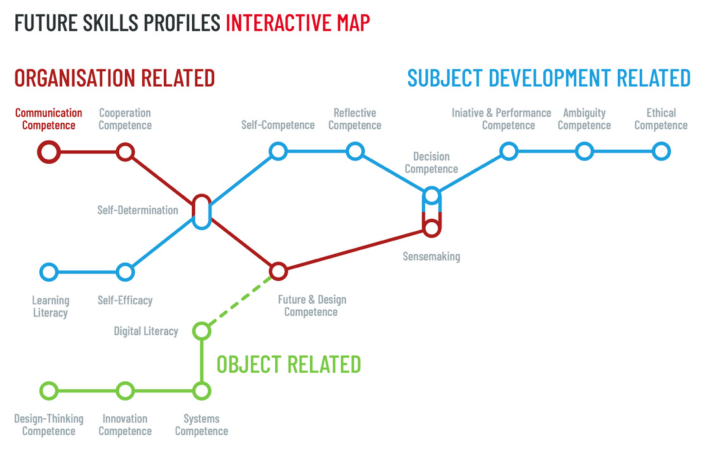
It conceptualizes 17 Future Skill profiles organized into three dimensions: subject-development-related (e.g., Learning Literacy, Self-Efficacy), object- related (e.g., Design Thinking, Digital Literacy) and organization-related
Development of Future Skills Through Innovative Learning Concepts 171 (e.g., Cooperation, Sensemaking). The framework’s robustness is evidenced by a meta-analysis in which 252 competence descriptions from various international models were successfully mapped onto these 17 profiles, confirming its utility as a comprehensive categorization tool (Ehlers, 2022).
Despite the theoretical maturity of such frameworks, there is a growing consensus that empirical research must move beyond conceptualization to investigate how students perceive their own competence development within specific academic programs (Amico et al., 2025; Ehlers et al., 2024). This paper addresses this research gap by examining the innovative bachelor’s program Information Systems 2.0 – Digital Innovation and Transformation (IS2). Utilizing a quantitative survey aligned with the NextSkills framework, the study evaluates the extent to which students perceive these 17 Future Skill profiles as being fostered within their curriculum and identifies which specific program characteristics most effectively support their development.
PROGRAM CONTEXT: INFORMATION SYSTEMS 2.0 Information Systems 2.0–Digital Innovation and Transformation (IS2), formerly Applied Digital Transformation, is an interdisciplinary bachelor’s program launched in 2022 at Coburg University of Applied Sciences and Arts (Akkreditierungsrat, 2024; Hochschule Coburg, 2025b). It aims to prepare students to “shape the future with technology” by integrating applied technology, innovation and change management and the development of soft and cross-cutting skills (Hochschule Coburg, 2025c, 2025d).
The program is characterized by several distinctive design features. It is strongly practice-oriented, with project-based learning at its core; students work on authentic projects with around 40 external partners from industry, public administration and civil society over seven semesters (Hochschule Coburg, 2025b, 2025e). The structural organization follows a sequential “6 + 1” model in which modules run consecutively in intensive three- week blocks with immediate assessment, instead of parallel courses across the semester (Hochschule Coburg, 2025b; Grosch, 2024). Competence- oriented assessment formats predominate, with portfolios, project reports, presentations and reflective assignments forming the main examination types (Hochschule Coburg, 2025a, 2025d). Furthermore, the program emphasizes an interactive learning culture characterized by close collaboration, informal communication and intensive feedback, which can be described as learning on equal footing with lecturers (Grosch, 2024; Zagel et al., 2024).
These design features are communicated as central elements of the IS2 concept and are explicitly linked to the program’s aim of fostering Future Skills alongside disciplinary knowledge (Hochschule Coburg, 2025b, 2025d).
METHODOLOGY
From a methodological perspective, empirically measuring Future Skills remains challenging. According to Kalz (2023), the empirical maturity of existing frameworks currently does not allow for the systematic assessment
and measurement of Future Skills. This study therefore employs a quantitative cross-sectional survey focusing on students’ subjective evaluations of Future Skill development and the perceived impact of program characteristics.
At the time of data collection, 27 students were enrolled in the IS2 program; all except the first author were invited, resulting in 20 valid responses (76.9%). Data were collected online via Microsoft Forms in the final semester week after completion of all modules. The sample included students from various semesters, representing both early and advanced stages of study, ranging up to the completion of the sixth semester.
The questionnaire comprised three sections: (1) general information on study semester and familiarity with the Future Skills concept; (2) self- assessment of the promotion of the 17 Future Skill profiles according to Ehlers (2020); and (3) evaluation of program characteristics related to teaching, assessment, structure and learning environment. In section 2, students rated how strongly their studies promoted each profile, using short, student-friendly descriptions based on Ehlers’ summaries to ensure conceptual alignment (Ehlers, 2020). Section 3 addressed program characteristics highlighted in IS2’s self-description, including project work with real partners, interactive teaching, competence-oriented assessment, sequential structure, blended learning, campus infrastructure (including a Maker Space equipped with digital fabrication tools and creative labs) and explicit promotion of self- reflection (Hochschule Coburg, 2025a, 2025d; Grosch, 2024; Zagel et al., 2024). Two open-ended questions allowed participants to elaborate on key learning experiences and other program aspects supporting Future Skill development. These qualitative responses supplemented the quantitative results by adding individual perspectives and contextual depth.
All items in sections 2 and 3 were rated on five-point Likert-type scales from 1 (“not promoted at all”) to 5 (“promoted very strongly”). Given the ordinal data level, medians and frequency distributions were used as descriptive statistics (Heiberger & Robbins, 2014; Joshi et al., 2015). Medians were calculated for each item and response distributions examined to identify patterns such as very positive, neutral, or critical assessments (Koo & Yang, 2025).
PERCEIVED DEVELOPMENT OF FUTURE SKILLS Most respondents indicated substantial familiarity with the concept of Future Skills. Sixty-five percent knew and could explain the term, 30% had heard of it but were unsure of its meaning and only one respondent reported no familiarity. This widespread awareness provides a favorable precondition for meaningful self-assessment, as respondents can relate their answers to a shared understanding of Future Skills.
Students reported predominantly positive perceptions of competence development across all 17 Future Skill profiles. For each profile, the median is at least 3 (“partially promoted”), mostly 4 (“rather promoted”) or higher, with the two positive categories accounting for the majority of responses.
Development of Future Skills Through Innovative Learning Concepts 173 A median-based ranking identifies four profiles with the highest possible median (Md = 5): Design Thinking, Cooperation, Innovation and Future & Design Competence. For these, at least 80% indicate “rather promoted” and 55–70% “promoted very strongly”. This aligns with the program’s focus on project-based learning, innovation and collaboration, reflecting students’ perception of strong developmental support (Grosch, 2024; Zagel et al., 2024). Digital Literacy and Communication Competence follow with medians of 4.5. Around 85% rate Digital Literacy and 70% Communication Competence as at least “rather promoted”, consistent with the integration of digital tools and communication-intensive project work (Hochschule Coburg, 2025a, 2025d). Subject-development-related competencies—including Learning Literacy, Self-Efficacy, Self-Determination, Self-Competence, Reflective Competence, Decision Competence, Initiative and Performance Competence and Ambiguity Competence—show a median of 4 with wider distributions, indicating less uniform support.
Overall, the results provide empirical evidence that IS2 students perceive substantial Future Skill development, particularly in areas aligned with core design features. High ratings for Design Thinking, Innovation, Cooperation, Future & Design Competence, Digital Literacy and Communication Competence reflect the program’s emphasis on project-based work, innovation, collaboration and digital tools (Hochschule Coburg, 2025a, 2025d; Grosch, 2024). A descriptive comparison across semesters shows that higher-semester students assess Future Skill promotion slightly more positively, especially for Cooperation, Design Thinking and Innovation Competence. The stable ranking of top profiles suggests a consistent competence profile across study progression, supporting arguments for authentic, action-oriented learning environments over content-driven teaching (Meyer-Guckel et al., 2019; Nieth et al., 2024).
At the same time, differences across the 17 profiles emerge. Subject- development-related competencies are rated positively but less strongly than object- and organization-related ones, while Ethical Competence, Ambiguity Competence and Sensemaking appear comparatively weak, indicating potential blind spots.
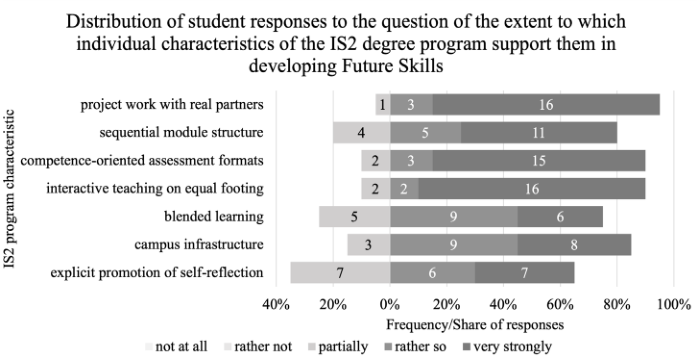
PERCEIVED EFFECTIVENESS OF PROGRAM CHARACTERISTICS Most students also rated the contribution of central program characteristics to their Future Skill development. A ranking based on medians, overall agreement (at least “rather supports”) and the proportion of “supports very strongly” responses reveals a distinct triad of primary drivers, showing a clear structural emphasis among the most strongly promoting factors.
Figure 2: Distribution of student responses to the question of the extent to which individual characteristics of the IS2 degree program support them in developing future skills.
Work on real practice projects with external partners receives the highest ratings (Md = 5). Ninety-five percent of respondents indicate that it at least “rather supports” their Future Skill development and 80% select “supports very strongly”. Interactive teaching on equal footing between students and lecturers also has a median of 5; 90% of respondents rate it as at least “rather supportive” and 80% as “very strongly supportive”. Innovative and competence-oriented assessment formats (such as portfolios and project- based examinations) likewise reach a median of 5, with 90% of respondents indicating at least “rather supports” and 75% “supports very strongly”.
The sequential module structure is evaluated positively, with a median of 5, 80% at least “rather supports” and 55% “supports very strongly”. Campus infrastructure and learning environment, including the Maker Space, are rated with a median of 4 and 85% of respondents see them as at least “rather supportive”. The combination of online and face-to-face teaching (blended learning) has a median of 4, with 75% indicating at least “rather supports”. The targeted promotion of self-reflection also has a median of 4, but only 65% rate it as at least “rather supportive” and 35% as “supports very strongly”, making it the lowest ranked characteristic in relative terms.
These results show that students attribute their Future Skill development primarily to immersive, practice-based and interactive elements of the program, while structural, infrastructural and reflection-oriented elements are perceived as supportive but somewhat less central.
The ranking of program characteristics underscores the central role of practice-based and interactive elements from the students’ viewpoint. Authentic project work with external partners is perceived as the most important driver of Future Skill development, followed closely by interactive teaching on equal footing and competence-oriented assessment formats.
The qualitative responses underline this picture by highlighting open, initially deliberately overtaxing project tasks, repeated presentations to practice partners, excursions and networking events and intensive
Development of Future Skills Through Innovative Learning Concepts 175 collaboration in small groups as particularly formative learning experiences. Students also emphasize an appreciative learning atmosphere, low-threshold interaction with practice-oriented lecturers and concrete project situations such as founding a fictitious company or resolving team conflicts, which may be explicitly linked to gains in communication, teamwork and reflective competence.
These findings align with broader literature that advocates project-based learning, inquiry-based learning and competence-oriented assessment as key strategies for fostering transversal competencies (Allianz für Future Skills, 2024; Amico et al., 2025; Beers, 2011; Dippelhofer et al., 2025; Meyer-Guckel et al., 2019). Projects with real partners expose students to complexity, uncertainty and responsibility, requiring them to apply and integrate knowledge, collaborate and communicate effectively (Dippelhofer et al., 2025; Erpenbeck, 2020; Erpenbeck et al., 2017). Interactive teaching and small group settings facilitate feedback, dialogue and co-construction of knowledge, which are essential for developing social and communicative skills (Gedviliene et al., 2014; Nieth et al., 2024). Competence-oriented assessments such as portfolios encourage students to document and reflect on their learning processes, which can support metacognitive development and self-assessment (Ehlers et al., 2024; Geier et al., 2022; Patel et al., 2024; Seidl, 2024).
Structural and infrastructural features such as the sequential module structure, blended learning and campus facilities are also perceived as supportive but rank slightly lower. This suggests that, from the students’ perspective, structural and technological conditions matter primarily insofar as they enable or reinforce immersive, interactive learning experiences, rather than acting as drivers of competence development. Specifically, the sequential module structure, with its intensive 3-week sprints, serves as a crucial foundation that simplifies and supports the integration of practical projects with external partners (Grosch, 2024).
The relatively modest ratings for targeted promotion of self-reflection indicate that students are less aware of or less satisfied with systematic opportunities for structured reflection on their competence development. This aligns with the more heterogeneous perceptions of subject-development- related competencies and suggests a potential area for enhancement.
CONCLUSION
Beyond the specific case of IS2, the survey findings offer insights for other programs aiming to foster Future Skills, based purely on student perceptions. Students clearly attribute their Future Skill development to immersive, practice-based learning and interactive teaching rather than to isolated content elements. Programs that seek to strengthen Future Skills may therefore benefit from integrating authentic projects with external partners, promoting collaborative learning in small groups and emphasizing student-centered, dialogue-oriented teaching methods. Competence- oriented assessment appears to be recognized by students as a key lever for Future Skill development. Replacing or supplementing traditional exams
with portfolio-, project- and presentation-based assessments can make competence development more visible and create opportunities for reflection and feedback. Designing such assessments with explicit reference to Future Skill profiles may further increase students’ awareness of their competence growth.
LIMITATIONS AND FUTURE RESEARCH The present study is limited by its small sample size and focus on one program at a single institution. Although the response rate is high, the number of participants is restricted, which limits the generalizability of the findings. In addition, the reliance on self-assessment introduces potential biases, including social desirability and varying interpretations of the response scale (Duckworth & Yeager, 2015; West et al., 2016).
Future research could extend this work by conducting longitudinal surveys across multiple cohorts to track perceived competence development over time. Combining self-assessments with qualitative interviews and analyses of student work would allow for richer insights into how students experience Future Skill development and which learning situations they consider particularly formative. Comparative studies across programs with different didactic and structural designs would help identify which elements are most strongly associated with positive student perceptions of Future Skill development. Furthermore, future discourse should address the scalability of these resource-intensive, student-centered learning formats to determine how such innovative concepts can be effectively transferred to larger-scale degree programs and mass curricula.
REFERENCES
Akkreditierungsrat. (2024) “Information Systems 2.0 – Digital Innovation & Transformation (formerly Applied Digital Transformation), B.Sc.”, Coburg University of Applied Sciences. Website: https://antrag.akkreditierungsrat.de/ akkrstudiengaenge/a87dbd67-502a-4550-a4a6-54cf741bfd53 Allianz für Future Skills. (2024). Future Skills Charter. Donors’ Association for
German Science. Amico, G. Dammes, K. Frank, S. Haase, S. Wistuba, F. and Zimmermann, C.
(2025). Anchoring future skills in higher education: An exemplary inventory. Stifterverband für die Deutsche Wissenschaft e.V. Dippelhofer, S. Clippard, M. Rustemeier, L. and Kroll, K. (2025) “A look at higher education”, in: Future Skills at Universities: A field of tension? Concepts, expectations and practical examples in studies and teaching, Dippelhofer, S., Matthes, W., Salzmann, S. and Schork, S. (Eds.). Weinheim: Beltz Juventa. Duckworth, A.L. and Yeager, D.S. (2015). Measurement matters: Assessing personal
qualities other than cognitive ability for educational purposes, Educational Researcher, Volume 44, No. 4, pp. 237–251. Ehlers, Ulf-Daniel. (2020). Future Skills: Learning of the Future – University of the Future. Wiesbaden: Springer Fachmedien. Ehlers, Ulf-Daniel. (2022). Future Skills in Comparison: On the Construction of
a General Framework Model for Future Skills in Academic Education. Next Education.
Development of Future Skills Through Innovative Learning Concepts 177 Ehlers, U.-D. Eigbrecht, L. Horstmann, N. Matthes, W. Piesk, D. and Rampelt, F.
(2024) “Future Skills for Universities: A Critical Assessment,” in: Teaching and Learning Future Skills: Highlights from Higher Education, Schools, and Continuing Education, Koch, H., Schneider, C., and Wilke, U. (Eds.). pp. 348– 374. Stifterverband für die Deutsche Wissenschaft e.V. Erpenbeck, John. (2020) “Universities of the Future”, in: Future Skills between Theory and Practice, Ehlers, U.-D. and Meertens, S.A. (Eds.). pp. 65–82. Wiesbaden: Springer Fachmedien. Erpenbeck, J. Rosenstiel, L. von. Grote, S. and Sauter, W. (2017) “Introduction”, in:
Handbook of Competence Measurement, Erpenbeck, J., Rosenstiel, L. von, Grote, S. and Sauter, W. (Eds.). pp. 1–28. Schäffer-Poeschel. Gedviliene, G. Gerviene, S. Pasvenskiene, A. and Ziziene, S. (2014). The social competence concept development in higher education, European Scientific Journal, Volume 10, No. 28, pp. 36–49. Gehrs, V. Matthes, W. Müller, E. Reale, M. Ribel-Sencan, V. Schork, S. and Walter, C.
(2025) “Future Skills and Their Development”, in: Future Skills at Universities: A Field of Tension? Concepts, Expectations, and Practical Examples in Studies and Teaching, Dippelhofer, S., Matthes, W., Salzmann, S., and Schork, S. (Eds.). p. 17. Weinheim: Beltz Juventa. Geier, N. Eigbrecht, L. Ehlers, U.D. and Winkler, K. (2022). Competency-based learning in dual study programs: Report 1 for the project “DIRK Dual – Digital Reflection Tool for Competency Development in Dual Study Programs”. Baden- Württemberg Cooperative State University. Goulart, V.G. Liboni, L.B. and Cezarino, L.O. (2022). Balancing skills in the digital
transformation era: The future of jobs and the role of higher education, Industry and Higher Education, Volume 36, No. 2, pp. 118–127. Grosch, Christian. (2024). Developing future skills through a sequential module structure and practical orientation: A case study of the bachelor program in applied digital transformation, The Human Side of Service Engineering, Volume 143. Heiberger, R.M. and Robbins, N.B. (2014). Design of diverging stacked bar charts
for Likert scales and other applications, Journal of Statistical Software, Volume 57, No. 5, pp. 1–32. Hochschule Coburg. (2025a) “Modern teaching: Practical, digital, authentic”.
Website: https://www.hs-coburg.de/studieren/bachelor/wirtschaft/wirtschaftsinfor matik-2-0/lehre/ Hochschule Coburg. (2025b) “Module Handbook for the Bachelor’s Degree in Information Systems 2.0: Digital Innovation and Transformation”. Website:https:// www.hs-coburg.de/wp-content/uploads/2025/12/2025-12-01_Modulhandbuch_ WI2.0.pdf Hochschule Coburg. (2025c) “Study Program Presentation: Information Systems 2.0
– Digital Innovation and Transformation”. Website: https://www.hs-coburg.de/ wp-content/uploads/2025/06/Wirtschaftsinformatik_2.0.pdf Hochschule Coburg. (2025d) “Information Systems 2.0: Digital Innovation & Transformation (B.Sc.)”. Website: https://www.hs-coburg.de/studieren/bachelor/ wirtschaft/wirtschaftsinformatik-2-0/ Hochschule Coburg. (2025e) “Information Systems 2.0 – Practice-Oriented
Education for the Digital Future”. Website: https://www.hs-coburg.de/news/ wirtschaftsinformatik-2-0-praxisorientierte-ausbildung-fuer-die-digitale-zukunft/ Joshi, A. Kale, S. Chandel, S. and Pal, D.K. (2015). Likert scale: Explored and explained, British Journal of Applied Science & Technology, Volume 7, No. 4, pp. 396–403.
Kalz, Marco. (2023). Back to the Future? A literature-based critique of future skills, Media Education, pp. 332–352. Koo, M. and Yang, S.-W. (2025). Likert-type scale, Encyclopedia, Volume 5, No. 1.
p. 18. Kotsiou, A. Fajardo-Tovar, D.D. Cowhitt, T. Major, L. and Wegerif, R. (2022). A scoping review of future skills frameworks, Irish Educational Studies, Volume 41, No. 1. pp. 171–186. Lamb, S. Maire, Q. and Doecke, E. (2017). Key skills for the 21st century: An
evidence-based review. Future Frontiers Analytical Report. Meyer-Guckel, V. Klier, J. Kirchherr, J. and Winde, M. (2019). Future Skills: Strategic Potentials for Universities. Stifterverband für die Deutsche Wissenschaft e.V. Next Education. (2026). Future Skills Finder: An interactive future skills map.
Website: https://nextskills.org/en/playground/future-skills-finder/. Nieth, L. Berger, F. Stalla, M. Bauer, F. and Djabarian, Y. (2024). New forms of tertiary education: Innovative future concepts for higher education and what we can learn from them. Working Paper. Patel, N.S. Puah, S. and Kok, X.-F.K. (2024). Shaping future-ready graduates with
mindset shifts: Studying the impact of integrating critical and design thinking in design innovation education, Frontiers in Education, Volume 9. p. 1358431. Poláková, M. Suleimanová, J.H. Madzík, P. Copuš, L. Molnárová, I. and Polednová, J.
(2023). Soft skills and their importance in the labour market under the conditions of Industry 5.0, Heliyon, Volume 9, No. 8, p. e18670. Rampelt, F. Matthes, W. Hannken-Illjes, K. Sandmeir, A. Gehrs, V. Horstmann, N.
Kunz, A.M. Eigbrecht, L. Johannsen, T. Blum, S. Frank, S. Sutter, C. and Koch, H. (2025). Future Skills 2030: An updated framework for future skills. Stifterverband für die Deutsche Wissenschaft e.V. Saleem, S. Dhuey, E. White, L. and Perlman, M. (2024). Understanding 21st century skills needed in response to Industry 4.0: Exploring scholarly insights using bibliometric analysis, Telematics and Informatics Reports, Volume 13. p. 100124. Seidl, Tobias. (2024) “Formative assessment of 21st century skills”, in: Creating
the university of the future: A global view on future skills and future higher education, Ehlers, U.-D. and Eigbrecht, L. (Eds.). pp. 489-507. Wiesbaden: Springer Fachmedien. Stifterverband and McKinsey. (2021). Future Skills 2021 – 21 Competencies for a Changing World. Stifterverband für die Deutsche Wissenschaft e.V. West, M.R. Kraft, M.A. Finn, A.S. Martin, R.E. Duckworth, A.L. Gabrieli, C.F.O. and
Gabrieli, J.D.E. (2016). Promise and paradox: Measuring students’ non-cognitive skills and the impact of schooling, Educational Evaluation and Policy Analysis, Volume 38, No. 1, pp. 148–170. World Economic Forum. (2025). The future of jobs report 2025. Website: https:// www.weforum.org/publications/the-future-of-jobs-report-2025/ Zagel, C. Stübinger, J. Haase, S. and Grosch, C. (2024) “Studying Future Skills? A
Report on Experiences”, in: Teaching and Learning Future Skills: Highlights from Higher Education, Schools and Continuing Education, Koch, H., Schneider, C. and Wilke, U. (Eds.). pp. 190–198. Stifterverband für die Deutsche Wissenschaft e.V.
LISTED IN THE AHFE DIGITAL BOOKSTORE CATALOGUE
Explore the complete digital volume
The Human Side of Service Engineering
Read this individual research paper free through the original publisher, or explore the full digital proceedings book.
ISBN 978-1-964867-97-7
Explore this ISBN in the AHFE Bookstore ↗Listed in the July 2026 bookstore catalogue; search by ISBN to confirm current availability · Digital book purchase optional