Joachim Lauterbach (2026). Shaping Börsen-Zeitung: Evolving from Print Media to a Leading Community Platform for Financial Market Decision-Makers. In: The Human Side of Service Engineering. AHFE Open Access, vol. 221, pp. 77–86. https://doi.org/10.54941/ahfe1007711
Börsen-Zeitung (BZ), a leading German financial newspaper, is transforming from a transaction-centered print medium into a relationship-centered digital community platform for financial market decision-makers. On its transformation journey BZ encounters the “media-transformation gap”, understood as the lag between the transformative potential of digital technologies and the value actually realized in media organizations. To develop knowledge and concepts for bridging this gap, the research applies the Translational Service Research and Design Methodology (TSRDM) and adopts a service lens grounded in Service-Dominant Logic, Service Science, and Service Dominant Architecture (Warg et al., 2025, Woolf, 2008, Spohrer et al., 2022). The findings indicate that by reinterpreting BZ as a service and relationship platform and by structuring offerings as modular services, the organization can reconfigure roles, workflows, and capabilities in a way that editorial content, data, and interaction services reinforce each other in a “platform flywheel” of engagement and learning. The work demonstrates how editorial content transforms from a tangible newspaper as output to an adaptive digital value proposition and input into modular offerings like newsletters, podcasts, and community verticals. While customers move from passive readers to active co‑creators interacting on BZ value propositions and resources and thus build momentum for BZ transformation to a data driven, learning organization continuously enhancing its capacities and capabilities to create (McGowan and Shipley, 2020, Senge, 2006).
Börsen-Zeitung (BZ) is a leading trade publication for the financial sector in Germany and a central actor in a network of financial market stakeholders such as bankers, analysts, and investors. In the course of its digital transformation, BZ aims to shift from a transaction-centered print medium to a relationship-centered community platform. The platform is intended to boost the number of subscribers and to convert customers into active users. Therefore, building on BZ’s strategic strengths in outstanding editorial work and extensive financial market expertise, innovative value propositions are
78 Lauterbach to be developed by linking content, channels, events, and vertical offerings while using AI to reprocess or repackage the editorial content.
The objective is to create momentum in regard to content, speed and culture and thus a BZ platform flywheel: innovative value propositions lead to increased customer engagement; the heightened engagement enables the development of AI and data driven understanding of customer preferences and interests, and this knowledge in turn supports the continuous improvement and further development of BZ’s value propositions and offerings.
Along this path, BZ encounters the “media-transformation gap”, a translational gap describing the lag between the transformative potential of new technologies and the actual value realized within media organizations (Woolf, 2008; Shabdin et al., 2024).
To build knowledge for bridging this gap, BZ adopts a service (eco) system lens and draws on the centrality of service and the “unifying service language” (Warg et al., 2025; Gummesson, 2011; Gummesson, 2008; Spohrer et al., 2008; Spohrer et al., 2022; Vargo and Lusch, 2018). The purpose of this work is to elaborate, design and engineer transformative design principles as mechanisms and value creation paths for building and managing relationships in the service context of BZ community platform.
TRANSLATIONAL SERVICE RESEARCH AND DESIGN METHODOLOGY This research as systematic investigation is driven by the objective to generate knowledge related to overcoming the phenomenon observed and experienced as the “media-transformation gap” (Gioia and Pitre, 1990). To address this challenge, the Translational Service Research and Design Methodology (TSRDM) (Warg et al., 2025) has been selected as the overarching research design capable of bridging the persistent discontinuities between research insights, design practices, and implementation outcomes. Its structured eight-step process provides a procedural and conceptual framework that guides inquiry through successive stages of conceptualization, design, operationalization, and evaluation.
TSRDM is applied because traditional research and design approaches often remain confined within their respective domains, leading to conceptual insights that lack translation into actionable design or implementation capability. The methodology explicitly operationalizes the idea of translation as a dynamic interplay between theoretical abstraction and practical realization. It enables researchers to trace how conceptual models evolve into service system architectures and ultimately into organizational capabilities. By doing so, TSRDM supports the co-creation of knowledge with practitioners and thus strengthens the practical relevance and scientific rigor of the research process.
Drawing on the centrality of service and services as structuring paradigm (Gummesson, 1995; Spohrer et al., 2022) this research develops “translational services” intended to foster practical implementation and overcome the
Shaping Börsen-Zeitung: Evolving From Print Media to a Leading Community 79 “media-transformation gap” by effectively linking the domains of research, design, and engineering. In the context of media transformation, TSRDM provides a lens for systematically identifying how digital service platforms can be designed to enable continuous learning and adaptation across editorial, technological, and business subsystems, thereby translating transformative potential into realized organizational value.
FACING THE “MEDIA-TRANSFORMATION GAP” Along this path, BZ encounters the “media-transformation gap”, a translational gap describing the lag between the transformative potential of new technologies and the actual value realized within media organizations (Woolf, 2008; Shabdin et al., 2024). The gap manifest as disconnects and tensions during the transformation of mindsets, organizational cultures, editorial workflows, value propositions, and practices from print to digital media.
Media organizations often interpret themselves as print product providers, while digital technologies demand seeing the firm as a relationship- and service platform; this creates tensions in culture, editorial self-understanding, and value propositions. Legacy structures (product lines, IT, org charts) are optimized for producing a finished issue, not for orchestrating modular digital services like newsletters, podcasts, communities and data driven personalization. Organizational practices and workflows continue to enact print era routines. Editorial, commercial and tech teams (deadlines, formats, hierarchies, success metrics) practices do not fit to the potential of continuously learning, data driven, interactive digital media practices. Even when the digital vision exists, there are insufficient “translational services” and design principles to systematically bridge research, design and engineering into concrete platform capabilities and new media practices.
KNOWLEDGE BASE TSRDM positions “service” as a unifying language that links research, design, engineering, and implementation by treating all offerings and technologies as configurations of services that support value cocreation in ecosystems (Warg et al., 2025). This “unifying service language” provides shared semantics, syntax, and pragmatics for diverse disciplines, enabling systematic translation of knowledge into reproducible translational services, patterns, and architectures such as Service Dominant Architecture (SDA), (Spohrer et al., 2022).
In this language, services (plural) denote concrete offerings and activities, while service (singular) is defined as the application of resources (knowledge, goods, activities, information) for the benefit of another and is taken as the fundamental basis of social and economic exchange (Vargo and Lusch, 2004; Spohrer et al., 2019). Service-Dominant Logic (S-D logic) frames value cocreation as an interactional, networked process in which multiple human and non-human actors integrate operant and operand resources, with value realized in use and in context rather than embedded in goods (Vargo and Lusch, 2016).
80 Lauterbach Service science models these processes as service systems, understood as open, dynamic configurations of people, organizations, technologies, and information, connected by value propositions and capable of improving their own and others’ states through resource integration (Maglio et al., 2009). SDA then provides an architecture-level structuring of these systems into five interrelated systems (operant resources, interaction, participation, data, institutions), serving simultaneously as plan and implemented output that recursively organizes the process of value cocreation (Warg et al., 2016). Within this structure, interactions are the situated episodes of service-for- service exchange through which resources are integrated and value outcomes emerge. Every value proposition can be interpreted as a vehicle to learn more about its customer; every interaction is understood as a learning moment, as input for new value creation and adaptation. With emphasizing the process of value cocreation and interactions the rationale of the organization shifts from efficiency to a learning organization, i.e. learning that enhances the organizational capacities and capabilities to create (McGowan and Shipley, 2020; Senge, 2006). Recurrent interaction constellations give rise to patterns and translational design patterns, which TSRDM treats as reusable building blocks analogous to Alexander’s pattern language or software design patterns, enabling modular design and recombination of services into new value constellations. Service innovation therefore is considered as the rebundling of diverse services that create novel outcomes that are beneficial to some actors in a given context this almost always involves a network of actors including the beneficiary (Lusch and Nambisan, 2015). Market innovations are driven by the combinatorial evolution (Arthur, 2009) of services and the emergence and institutionalization of new solutions and practices (Vargo et al., 2015).
Reckwitz’s (Reckwitz, 2002) practice theory complements TSRDM by deepening how “service” is understood as enacted, routinized social activity rather than isolated decisions or one-off interactions. For Reckwitz, the basic unit of the social is practices, conceived as routinized bundles of bodily activities, uses of things, forms of know-how, emotions, and shared meanings, so that people appear primarily as “carriers” of practices who enact learned routines in specific situations. Services and translational services therefore materialize as practice-configuring mechanisms (patterns, triggers, design principles, SDA-based architectures) that aim to shift existing routinized bundles and thus how people habitually do, feel, and interpret in a given context, rather than just influencing discrete choices. Institutions and institutional arrangements, in turn, can be read as higher-order stabilizations of such practices: emergent, taken-for-granted rule–meaning complexes that structure what counts as “normal” service conduct and how service systems are reproduced over time. Vargo et al.’s four orders of emergence (Vargo et al., 2022) then describe how ad hoc service interactions can gradually sediment into recognizable practice-patterns, institutionalized routines, and finally reflexively shaped ecosystems, providing TSRDM with a practice- theoretical lens on how translational services and architectures become embedded in, and subsequently reshape, social practices and markets.
Shaping Börsen-Zeitung: Evolving From Print Media to a Leading Community 81 TRANSLATIONAL MINDSET, SERVICES aND DESIGN PRINCIPLES
In this chapter, TSRDM’s unifying service language is used to derive design principles that shift thinking from print products to modular, reconfigurable service offerings, thereby aligning culture, workflows, and value propositions with Service-Dominant Logic, Service Science and Service Dominant Architecture. As demonstrated in Table 1 these principles translate TSRDM’s eight-step process into concrete mechanisms for bridging the media- transformation gap, making translational services actionable within the organizational reality of Börsen-Zeitung.
Table 1: Deriving “translational services” for overcoming the “media-transformation gap”.
Table available in the original PDF paper.
Translational Mindset & Services
Print-Media Goods-Dominant Concept
Digital Platform Service-Dominant Concept Customer receives “value in exchange” Service (eco) system, “value in use”, interaction
Service-Dominant Mindset. Pushes culture and practices towards ongoing engagement
Newspaper content as output
Newspaper content as input into modular value propositions
Newspaper as carrier of services. Rapid unbundling, reconfiguration and rebundling of services for timely themes
Reader as consumer Reader as co-creator, feedback, communities
Reader as co-creator of value, interactions, co-creation patterns Transactional Relational Participative, value co-creation in many-to-many networks
Value chain Value constellation Value proposition, Service (Eco) Systems, service for service exchange, mutual value provision Data Anchors a culture of continuous adaptation Consent, tracking, AI & data driven insights, fast personalization
Institutions New rules and routines for digital practices
Interaction, Habituation, Institutionalization
Trust and safety as implicit trust in editorial brand
Trust and safety as monitorable trust mechanisms
Consent management, compliance by design, authorization, authentication Building on this translational mindset, services and design principles, the next chapter turns to SDA patterns as the architectural plan and implementation logic that persist these design principles in five interrelated systems, enabling Börsen-Zeitung community platform to materialize modular services, recurring interaction constellations, and data driven learning loops in a systematic, reusable way.
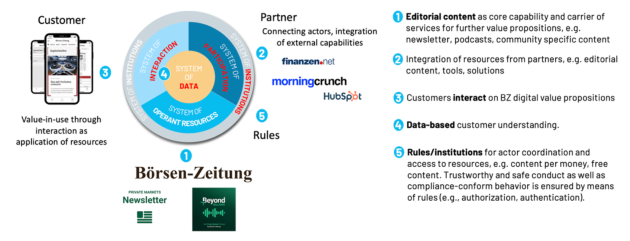
In line with TSRDM we assign the translational services and architectures to service - and software design, “here, the theory practice bridge definitively appears” (Warg et al., 2025): Service Research, the grand theories of Service- Dominant Logic and Service Science and Service Dominant Architectures ground practical evidences. As demonstrated in Figure 1 it starts with SDA as a structure of five systems. In this phase, the structure serves as a plan for the conceptual and logical mapping of translational services.
Editorial content as core capability and carrier of services for further value propositions, e.g. newsletter, podcasts, community specific content is assigned to the System of Operant Resources. In this System services are bundled to value propositions. A high density of services enables BZ to establish innovative value propositions as new combinations. Resources from other actors like content from other media organizations, technical CRM solutions, or AI are connected and integrated via the System of Participation. The system facilitates the participation of other actors as co-producers and cocreators of value propositions. At the core of this system are services for connectivity and resource integration.
Customers interact on BZ digital value propositions via the System of Interaction. This system bundles all services for applying BZ value propositions via acting on BZ resources. For enhancing customer engagement services for seamless interacting with BZ value propositions and thus generating value in use are bundled in this system. Examples are services like access, consent, feedback or commenting.
This system serves as foundation for building data-based knowledge and customer understanding. The latter is build within the System of Data. This system consolidates all data services. Consent and data services for AI- and data driven customer understanding, personalization, and learning loops are realized as data and knowledge patterns that continuously transform interaction traces into insights and adaptive value propositions. E.g. in regard to the content that has been read, the time spend on site, the opend links or the used devices.
Services that establish rules for actor coordination, trust, and safety are consolidated within the System of Institutions. This system defines rights and constraints regarding the access and use of resources (e.g., paid or free content) and ensures trustworthy and safe conduct as well as compliance-conform behavior by means of rules (e.g., authorization, authentication).
Figure 1: SDA patterns as plan and blueprint for the BZ community platform.
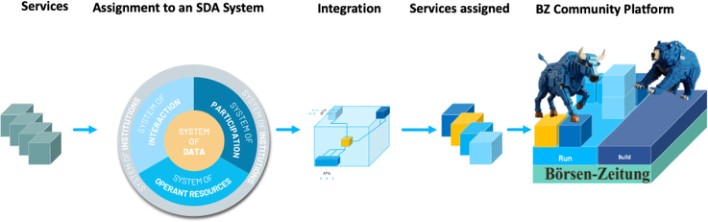
Shaping Börsen-Zeitung: Evolving From Print Media to a Leading Community 83 In the course of implementation by a responsible actor, the SDA systems become service systems. For this purpose, the services within the SDA systems are persisted and integrated during software engineering. E.g. data services of the SDA service systems are integrated via API connections. This enables the SDA-based service systems to mutually create value. For example, if a customer gives consent to subscribe to a newsletter during an interaction, the interaction service system passes this data on to the data system. There, events are triggered that, among other things, initiate payment and authorize the delivery of the newsletter. Figure 2 visualizes the process use case based platform implementation.
Figure 2: Börsen-Zeitungs community platform as implemented SDA pattern (output).
FINDINGS This research applied the Translational Service Research and Design Methodology (TSRDM) as the overarching research and design logic to bridge the media-transformation gap at Börsen-Zeitung (BZ), understood as the lag between the transformative potential of digital technologies and the value actually realized in media organizations. TSRDM’s eight-step process structured the inquiry from problem framing through to the engineering of translational services and Service-Dominant Architecture (SDA) patterns, ensuring that all design principles remained both theoretically grounded in Service-Dominant Logic and Service Science and implementable within BZ’s organizational reality.
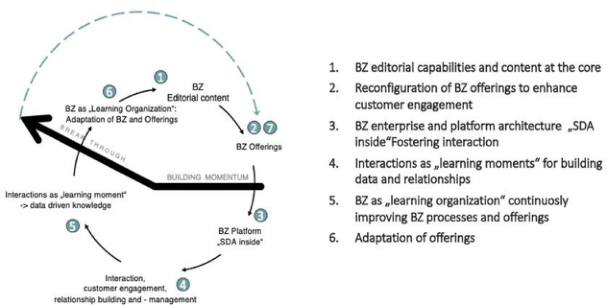
The results indicate that by reinterpreting BZ as a service and relationship platform and by structuring offerings as modular services, the organization can reconfigure roles, workflows, and capabilities so that editorial content, data, and interaction services reinforce each other in a “platform flywheel” of engagement and learning (Figure 3.). The work demonstrates how editorial content can be transformed from a tangible “newspaper product” to an input into modular, digital value propositions such as newsletters, podcasts, and community verticals, while customers move from passive readers to active co-creators in a financial market ecosystem.
Figure 3: BZ platform flywheel.
A core objective for this transformation was to formulate design principles and identify translational services as actionable platform capabilities. The findings show that such translational services aligned with Service Dominant Architecture (SDA), are yielding a structure that functions both as conceptual plan and as implementation logic for the BZ community platform. In this way, the study moves beyond abstract service thinking by linking design principles to concrete SDA-based systems (operant resources, interaction, participation, data, institutions) that orchestrate value co-creation. The use-case-driven evolution of the platform (e.g., newsletters, podcasts, thematic verticals) demonstrates how these translational services configure recurring interaction patterns, consent and data services, participation mechanisms, and institutional rules so that new offerings can be launched and iterated quickly. This leads to “marketing at the speed of culture” (Israeli Ayelet, 2026) advantages (faster experimentation, personalization, feedback loops) directly addressing the intended re-design of relationships and practices.
Relative to the introductory goal of building and managing relationships in a financial community, the findings emphasize that the platform fosters sustained interaction and co-creation across multiple touchpoints. Customers engage not only by consuming content but also through feedback, commenting, and participation in communities and formats, which strengthens and institutionalizes their role as co-creators and deepens their integration into the BZ service (eco) system. The continuous capture and processing of interaction data (e.g., reading behavior, time on site, devices used) enables learning loops that refine value propositions and support personalized, timely offerings for decision-makers. This reinforces mutual value provision: BZ gains richer customer understanding and innovation impulses, while customers benefit from more relevant content, services, and community connections in their professional context.
CONCLUSION
This research shows that bridging the media-transformation gap at Börsen-Zeitung depends on reinterpreting the organization as a service and relationship platform rather than a print product provider. Applying TSRDM aligns Service-Dominant Logic, Service Science, and Service Dominant Architecture with BZ’s concrete transformation tasks, so that translational services become actionable platform capabilities. By structuring editorial content, data, and interaction as modular services within SDA’s five systems, the community platform orchestrates recurring interaction patterns, learning loops, and institutional rules that reinforce a flywheel of engagement and adaptation. Customers thus evolve from passive readers to active cocreators whose interactions continuously inform new value propositions, personalization, and community formats. The findings suggest that media organizations can overcome similar gaps by adopting a unifying service language, use-case-driven SDA patterns, and practice-aware design principles, and by establishing a trust and safety organization that together enable marketing at the speed of culture and foster learning and data-driven media practices.
REFERENCES
Arthur, W. B. 2009. The nature of technology: What it is and how it evolves, Simon and Schuster. Gioia, D. A. & Pitre, E. 1990. Multiparadigm perspectives on theory building.
Academy of management review, 15, 584–602. Gummesson, E. 1995. Relationship Marketing: its Role in the Service Economy. In: Glynn, W. J. & Barnes, J. G. (eds.) Understanding Services Management. John Wiley & Sons Ltd. Gummesson, E. 2008. Total Relationship Marketing Third edition. Elsevier Ltd. Gummesson, E. 2011. Addressing service complexity and value through network
theory: Many-to-many marketing. In: Gummesson, E. (ed.) The Naples Forum on Service. Capri, Italy. Israeli ayelet, S. L., Higgins Matt, Reynolds Reyn 2026. Marketing at the Speed of Culture Marketing at the Speed of Culture. Harvard Business Review. Lusch, R. F. & Nambisan, S. 2015. Service Innovation: A Service-Dominant Logic
Perspective. Mis Quarterly, 39, 155–175. Maglio, P. P., Vargo, S. L., Caswell, N. & Spohrer, J. 2009. The service system is the basic abstraction of service science. Information Systems and e-business Management, 7, 395–406. Mcgowan, H. E. & Shipley, C. 2020. The adaptation advantage: Let go, learn fast,
and thrive in the future of work, John Wiley & Sons. Reckwitz, A. 2002. Toward a theory of social practices: A development in culturalist theorizing. European journal of social theory, 5, 243–263. Senge, P. M. 2006. The fifth discipline: The art and practice of the learning
organization, Broadway Business. Shabdin, N. I., Yaacob, S. & Ibrahim, R. 2024. Developing a Comprehensive Digitalization Gap Analysis Components: Bridging Gaps in People, Process, and Technology for Public Sector Transformation. Process, and Technology for Public Sector Transformation.
Science, logic, and architecture perspectives, Business Expert Press. Spohrer, J. C., Kieliszewski, C. A., Lyons, K., Maglio, P. P., Sawatani, Y. & Patrício, L.
2019. Handbook of service science, Springer. Spohrer, Vargo, S. L., Caswell, N. & Maglio, P. P. The service system is the basic abstraction of service science. Proceedings of the 41st annual Hawaii international conference on System Sciences (HICSS 2008), 2008 2008. IEEE, 104–104. Vargo, S. & Lusch, R. 2016. Institutions and axioms: an extension and update of
service-dominant logic. Journal of the Academy of Marketing Science, 44, 5–23. Vargo, S. L. & Lusch, R. F. 2004. Evolving to a New Dominant Logic for Marketing.
Journal of Marketing, 68, 1–17. Vargo, S. L. & Lusch, R. F. 2018. The SAGE handbook of service-dominant logic, SAGE Publications Limited. Vargo, S. L., Peters, L., Kjellberg, H., Koskela-Huotari, K., Nenonen, S., Polese, F.,
Sarno, D. & Vaughan, C. 2022. Emergence in marketing: an institutional and ecosystem framework. Journal of the Academy of Marketing Science, 1–21. Vargo, S. L., Wieland, H. & Akaka, M. A. 2015. Innovation through institutionalization: A service ecosystems perspective. Industrial Marketing Management, 44, 63–72. Warg, M., Spohrer, J., Böhmann, T., Leitner, C., Carrubbo, L., Gruhn, V., Neuhüttler,
J., Weiss, P. & Burmeister, M.-A. 2025. Translational Service Research And Design Methodology (TSRDM) - A new Service Research and Design Methodology in exploration [Online]. Available: https://www.ifsd.hamburg/translational-service- research-and-design-methodology-tsrdm/ [Accessed]. Warg, M., Weiß, P., Engel, R. & Zolnowski, A. 2016. Service Dominant Architecture based on S-D logic for Mastering Digital Transformation: The Case of an Insurance Company. In: Russo-spena, T. & Mele, C. (eds.) 26th Annual RESER Conference. Naples, Italy. Woolf, S. H. 2008. The meaning of translational research and why it matters. Jama,
299, 211–213.
LISTED IN THE AHFE DIGITAL BOOKSTORE CATALOGUE
Explore the complete digital volume
The Human Side of Service Engineering
Read this individual research paper free through the original publisher, or explore the full digital proceedings book.
ISBN 978-1-964867-97-7
Explore this ISBN in the AHFE Bookstore ↗Listed in the July 2026 bookstore catalogue; search by ISBN to confirm current availability · Digital book purchase optional