Evangelos Markopoulos, Victoria Neumer, Hannu Vanharanta (2023). An enhanced version of the Business Model Canvas for risk management and business continuity. In: Creativity, Innovation and Entrepreneurship. AHFE Open Access, vol. 74, pp. 105–114. https://doi.org/10.54941/ahfe1003311
In a world of uncertainty business planning can be considered as the biggest changes faced by companies and organizations. The recent Covid-19 health crisis and the Russian-Ukraine political conflict are just indicative on the massive impact such situations can have in the planning and operations of any organization. From the Chernobyl disaster in the 80s, the collapse of the Soviet Union in the 90s, the 9/11 terrorist attack in the 2000’s, the Global financial crisis in the 2010’s and so on, such crises seem to continuously appear, without business planning efforts to consider such unpredictable events, which tend to appear frequently the last decade. Therefore, proactive risk, forecast, analysis and management need to be part of planning activities at least in three dimensions. The first one is the organizations dimension which defines the organizational readiness in terms of internal infrastructure to handle a crisis, the second is the socio-economic impact a specific crisis can have on the market and the society an organization operates, and the third dimension is on post crisis activities an organization must perform to achieve business continuity, and in many cases disaster recovery. This paper builds on the existing Business Model Canvas (BMC), a widely known business planning methodology, accepted and used by many organizations. The addition made on the BMC demonstrates in a practical way the position of the three risk dimensions proposed in this research and their interaction and impact with the existing business planning segments of the BMC which remain unchanged. The three risk dimensions form the BMC shield, a term used to conceptualize the protection of the business, around the planning process, from unexpended risks and disasters. The new BMC, with the risk management shield is powered by the Company Democracy Model (CDM), a democratic organizational culture driven in this case towards risk management thinking and action. CDM is used to democratically, collectively and continuously collect, access and integrated risk management data, ideas, and actions in the risk management shield to protect the business planning process. To further demonstrate the BMC shield concept and operations the paper analyses the application of proposed approach within the PESLTE and CAGE international business frameworks. Since most of the crisis have international impact the PESLTE and the CAGE elements must be also analysed from the potential risk dimension during the planning process. The proposed busies planning approach can be used by any organization regardless the size, the sector or region it operates. It is a practical tool that ignites a democratic thinking on dealing with possible risks that can come up but also on how these risks can be mitigated withing the planned operations. The research conducted in based on an extensive literature review, primary research with surveys and interviews but also with the analysis of several case studies that indicate the needs and the trends for the development of such an approach. The paper indicates the pre and post condition on using the proposed methodology, research limitations, areas of further research to be conducted for the application of the proposed approach in vertical organizational sectors and geographic regions.
In a world of uncertainty, business planning can be considered the most significant challenge companies and organizations face. The recent Covid- 19 health crisis and the Russia-Ukraine war indicate the massive impact such situations can have on organizational planning and operations. From the Chornobyl disaster in the 80s, the collapse of the Soviet Union in the 90s, the 9/11 terrorist attack in the 2000s, the Global financial crisis in the 2010s, and so on, such crises seem to continuously appear, finding organiza- tions and governments without risk and contingency management business to deal with such unpredictable events. On the other hand, what constitutes a well-thought business plan remains a fuzzy issue due to the high degree of uncertainly business plans usually have (Podhorecky et al., 2021).
A business plan developed to attract the interest of an investor focuses more on the opportunities and return on investments than business operati- ons and development challenges. Business plans based on past research, data, client feedback, and market trends involve many assumptions by those inte- rviewed or analyzed a market or an opportunity. However, this is widely accepted, especially if those assumptions make sense and derive from credi- ble sources or research, but the degree of realism cannot quite be measurable, and this is where the challenge begins.
Therefore, a new inventor’s dilemma could possibly be introduced related this time with the realism of the business plan. Shall a business plan be opti- mistic where risks are not mentioned or a more pessimistic, down-to-earth and realistic by including risks that might not be appealing to investors, par- tners, and clients? The answer tends to be the optimistic one, justified by the catastrophic results recorded in the global entrepreneurial community, when something doesn’t go as planned. Nearly 133 million startups are crea- ted annually (Babson, 2022), translating to 4 startups per second, with only 0.05% of them reaching basic funding (half of them, nearly 50.000 are in the US), and from those who received basic funding only 1.500 reach VC funding. This means that 1 out of 88.667 or 0.00112%. receives VC funding.
LITERATURE REVIEW
Over time political, social, natural, behavioral, and technical decisions and incidents created and keep on creating unpredicted risks leading to disasters that impact societies and economies locally or globally. As external factors change rapidly, the speed with which companies respond to a crisis must be related to their operational efforts and efficiency. Companies must be agile to deal with the impact of managing a crisis (Dearborn, 2020), and develop strategies and solutions that would work to provide any type of safety (Siakas et al., 2014).
Therefore, given this high level of uncertainty and its impact on businesses, some key factors that contribute to contingency planning seem to be negle- cted by many organizations during periods of crisis. Companies are stunned by such events, and stay passive in the face of the threats, with some being more vulnerable than others (Mainiero, 2002). During a crisis, the most influ- ential leaders maintained a high level of visibility within their own companies. Employees seek solid confirmation that top management sees their plight as one of the company’s primary concerns in times of disruption (Argenti, 2002).
To address and aim for any type of security, individuals and organizations must include in their operation plans circumstances that can possibly dis- rupt their continuity or threaten their existence. However, this does not seem to be the case, especially for entrepreneurs and startups which tend to fol- low the optimistic path instead of the realistic one. This is probably because most business planning tools do not take risk into consideration. In this lite- rature review several widely accepted business planning tools from credible organizations have been studied.
The Business Model Canvas (BMC) is a chart-based template that visu- ally documents nine key areas of new or existing business (Osterwalder,
An Enhanced Version of the Business Model Canvas 107
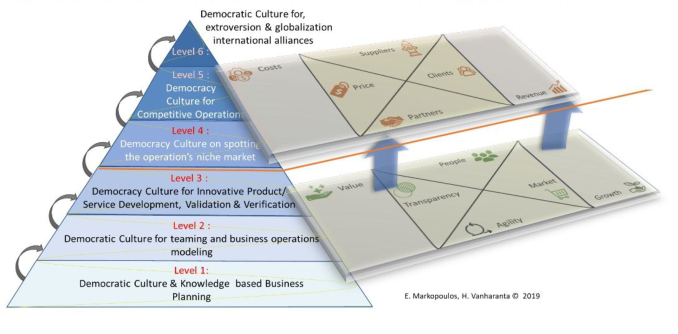
et al., 2010), but none of them addresses key risks or threats. The Lean Canvas is a simpler version of the Business Model Canvas that emphasi- zes mostly business operations (Arwa & Jamaludin, 2018) without having a risk management segment. The McKinsey Business Plan structure is related to McKinsey three horizons of innovation. The model has specific elements that get completed in-depth and gradually over the maturity of the inno- vation (Kubr, 1998) without addressing any transitional risks. The HSBC Business Plan template has a more financial approach, emphasizing more on the tangible and objective financial elements than the subjective ones related to innovation, market disruption, and potential growth (HSBC, 2023). The IBM Watson Build Business Plan Template is a tool under IBM’s Watson Build global initiative that has been designed to accelerate the adoption of Watson by the IBM Business Partners and encourage the development of AI solu- tions on the IBM Cloud (IBM, 2023) but does not consider any risks. Even some more innovative approaches such as the Democratic and Agile Business Plan (DASBP) which is a new business-planning model to address the startup dilemma seem to neglect the risk concept as well (Markopoulos et al., 2019). The model derives from the Company Democracy Model (Markopoulos & Vanharanta, 2014) and uses a double canvas approach to plan the creative dimension of a new venture before the financial dimension (Figure 1).
Factors that make one business model more resilient than another can be found in segments that focus on long-term sustainability (Clinton et al., 2018). An organization can be made more resilient in the face of a crisis by being more modular and diverse in employment as people from different backgrounds have different ways of dealing with a crisis. Another criti- cal point is the adaptability of organizational processes and structures on employee flexibility and learning (Reeves & Whitaker, 2022).
Business model innovation is the way to deal with a crisis and come out of it successfully. Economists, for example, consider austerity as a business model innovation when dealing with recessions. However serious issues derive from
Figure 1: The company democracy model for start-up business planning and operations.
such creative and innovative approaches, as it is necessary to implement first the proper infrastructure (culture, process, technology, etc) within an organi- zation needed to exceed and excel within a business model innovation (BCG, 2022).
PRIMARY RESEARCH To gather data needed to fill the literature gap primary research was condu- cted. A survey was undertaken in this research paper to gather quantitative data from various groups of people to identify how to create the Business Model Canvas to guard against internal and external crises. As a result, public opinion may be gauged, leading to a better understanding of how to create the Business Model Canvas to avoid external disasters. The survey targeted audience was business-savvy, professionals, and academics. To reach a broad number of individuals, this survey was released across a variety of social media platforms and professional networks. Furthermore, Semi-structured interviews with four interviewees provided qualitative data for the resea- rch. The respondents work in various firms, ranging from SMEs to family businesses to conglomerate-based businesses.
RESEARCH RESULTS AND RECOMMENDATIONS The research conducted for this paper was based on 11 interviews and a survey with 93 participants. It indicates that for most people, the internal and external business environment matters the most as it affects the way their business operates. This is in line with the view of many respondents that an effective business model must adapt to uncertainty while providing sound financial analysis and risk management.
A crisis and its impact on a company are far too varied to say which method is most effective based on the circumstances of each crisis. However, respon- dents agreed that a rapid and effective response is most important in crisis management, defining organizational resilience as the ability of an organiza- tion to survive, adapt and even thrive in the face of adversity or unforeseen circumstances.
The participants agreed that adaptability to uncertainty, the speed of response to the crisis, and the ability to shape the situation are factors that make a business model more robust. Stimulating business model innovation is as much as possible as anticipating and adapting to the crisis. By making changes to both a company’s value proposition to its customers and its key activities, business models can improve value creation. These changes impact in turn the target segment, the product or service offering, and the financial segments (cost and revenue).
The current variant of the BMC is rigid and not flexible enough to adopt risk considerations, as it does not clearly consider risk-related factors, especi- ally the ones related to the internal environment and the external ecosystem. Therefore, the BMC can be expanded to consider such aspects with additi- onal planning segments. Ideas and suggestions were given for enhancing the BMC to cover risk factors while leaving its original segments unchanged.
An Enhanced Version of the Business Model Canvas 109
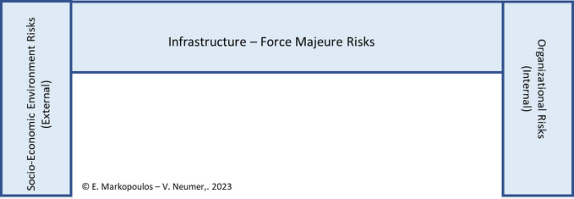
BUSINESS PLANNING RISK MANAGEMENT SHIELD Based on the primary and secondary research there is a need for business planning tools to include risk management and business continuity factors. This need can be addressed with the introduction of three segments related to internal and external risk business operations factors.
The first segment deals with the internal organizational risk management factors that could address issues such as organizational culture, lack of tran- sparency, office politics, employee dissatisfaction, insufficient management, favoritism, employee turnover, inefficient process, bureaucracy, competitive- ness, and other issues that impact organizational performance, productivity, collegiality, and the overall work environment.
The second segment deals with external factors such as the elements of the PESLTE Analysis from the risk point of view. For example, what could be the political risks for a company to operate in a specific country? What are the Economical risks, Social, Technological, Legal, and environmental risks? When doing PESTLE analysis, most of the planners focus on the opportu- nities of each PESLTE element instead of the treats. In a similar way, and under the same thinking, the CAGE framework (Cultural, Administrative, Geographic, Economical) elements can also be part of this segment. Both the PESLTE and the CAGE approach in this segment must be applied by having in mind a specific country or region in which the company targets its main operations or clients.
The third segment deals with the infrastructure risks that can impact busi- ness continuity. These risks are mostly force majeure, unpredictable to a large degree, or unwanted, such as terrorism, natural disaster, infrastructure accidents, war, political tension and instability, financial crisis, etc.
The three segments presented in Figure 2, form a Pi ‘5’ to indicate a busi- ness protection shield. The vertical left and right sides are related to risk management while the horizontal one is related to business continuity.
Figure 2: Business planning risk management shield.
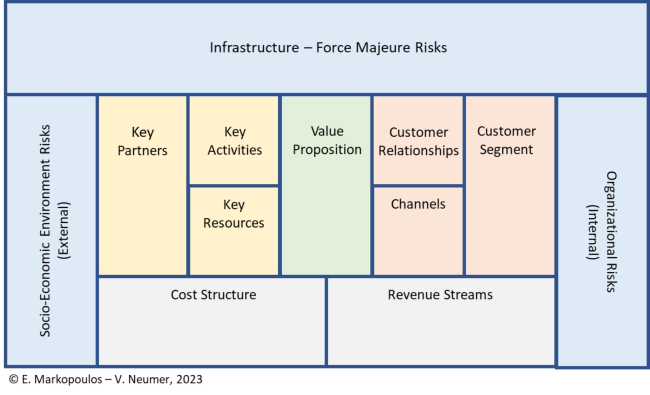
THE NEW RISK BUSINESS MODEL CANVAS (RBMC) By applying the Business Planning Risk Management Shield on the Business Model Canvas, the Risk Business Model Canvas (RBMC) is generated. It must be noted that this is not a new business operations planning model, but one that protects the planned operations with extra security layers.
This is a substantial difference as risk management and contingency plan- ning must run in the background of business operations and never in the foreground. Emphasizing risk management impacts creativity, innovation, passion, and enthusiasm which are vital elements for organizational success, culture, and values.
Figure 3 presents the new Business Model Canvas with the risk manage- ment shield around it. All existing canvas segments remain the same, but the addition of the three new segments changes the dynamics of the model and the way it is used. The risk shield acts indirectly to challenge every element added in each segment of the canvas. If for example a specific key partner is added in the ‘Key partners’ segment the internal and external risk shield elements are activated to check if the organization has the internal expertise to deal with the specific partner if the contracts with the partner secure a safe relationship, the degree of partner’s reliability based on its operations loca- tion, cultural characteristics, legitimacy, etc. Another example could be on the ‘Channels’ when distribution channels involve land or sea transportation that needs to be checked for safety or reliability in climate or physical disa- sters. The same thinking can be applied to all other Business Model Canvas segments.
However, since many elements can populate the three risk segments, there must be a prioritization to keep the most needed and critical.
Figure 3: Risk business model canvas (RBMC).
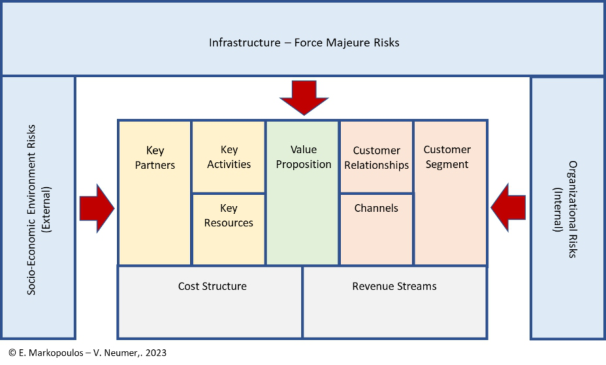
RBMC ADJUSTABILITY The three new sectors embrace the model from a distance not to disturb the planned activities and operations, but they do get closer and impact the plan and its operations when there are gaps, inaccurate or incomplete information in the various planning segments. Detailed and effective planning reduces the risks and places the shield far from the planned operations. However, lose
An Enhanced Version of the Business Model Canvas 111
risk planning creates a smaller gap between the canvas and the shield, while no risk planning brings the shield fully attached to the canvas to prevent any mistake.
It must be noted that not all three risk shield segments must have the same distance from the Business Model Canvas. Organizations focusing more on the internal risks can bring this segment closer, while the Force Majeure risks could have a wider distance, as they are not much likely to happen. Figure 4 indicates the placement of the risk management shield on the business model canvas. Such decisions are also related to the cost and the resources orga- nizations have or are willing to invest in bringing the shield closer to the canvas.
Figure 4: Business model canvas risk shield adjustability.
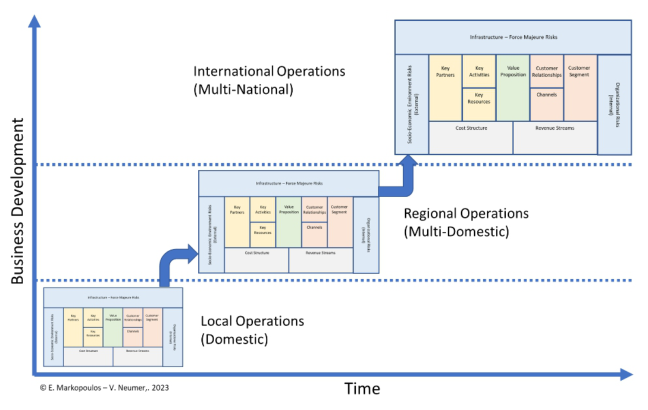
RBMC SCALABILITY The degree of applying the RBMC is related to the size of business opera- tions in terms of volume and regions. Figure 5 presents operations and risk increase as organizations move from local to regional, and from regional to international.
Operating in a local environment within a specific country requires fewer complex operations and therefore fewer risks. The suppliers, for example, can be fewer, can be well known, there is good knowledge of the target segment, understanding of the right approach in customer relations, and the channels are restricted to shorter distances in case of physical deliveries. Therefore, the degree of risks is limited and more controlled due to the homogeneity of the human resources, the clients, and the understanding of the business environment.
On the other hand, organizations operating at the regional level, follo- wing a multi-domestic international business strategy, are more exposed to risks due to the larger volume of operations, and lack of understanding of the various regions enough. The same applies fully and wider international
Figure 5: Business planning risk management scalability.
operations, or multinational operations where the risk is even larger due to unpredicted geopolitical and socioeconomic parameters not possible to understand and plan effectively. In other words, ambitious business plans, aiming to conquer the world, are highly associated with more likely risks that can become catastrophic for the organization.
PRE AND POST-IMPLEMENTATION CONDITIONS Risk management is a circular, never-ending process. The preconditions and the postconditions to apply effective risk management do not differ much. Preconditions can be considered to continuously question the organization’s capability and maturity in identifying internal and external operation risks. Models such as the Company Democracy Model that promote democratic organizational cultures, support collective thinking, and participate in mana- gement can be used. Postconditions are the continuous verification that the identified risks are controlled and linked with new possible risks, making pre- and postconditions an infinite loop.
In a more practical way, the key precondition is the organizational cul- ture on risk management and the exitance or risk management expertise fully supported by the organization’s leadership to investigate, propose, and implement risk management actions. It is also important for the leadership of the organization to practically understand potential risks and readjust any strategy that can prevent the risks from being activated. The postconditions, however, are more of a collective process. Once the organization has iden- tified potential risks, the full workforce must operate with those in mind. It takes one wrong deal, action, or decision to activate a risk, therefore safe ope- rations start within the organizational culture. Safety culture and collective commitment can be a precondition (Einolander et al., 2017), and shared value
An Enhanced Version of the Business Model Canvas 113
organizational cultures can be a postcondition (Markopoulos & Vanharanta, 2015).
LIMITATIONS AND AREAS OF FURTHER RESEARCH The research conducted for this paper included primary data collected from business experts, entrepreneurs, and professionals. However, the model has been developed as a theoretical approach and has not been validated in actual business plans presented to investors or the board of directors. The collections of practical feedback, responses, suggestions, and recommendations for the applicability and improvement of the RBMC, has been planned.
As per future research, the risk shield needs to be developed furthermore to cover very specific links among the Business Model Canvas segments but also discover other interrelations. Such could be the link of the internal risks with the key activities and resources or the external risks with the key par- tners and customer segments. Such relationships can be further developed by categorizing the type of business, the operation locations, the target group, and other factors that significantly affect the business thinking and planning.
CONCLUSION
The new BMC, with the risk management shield as derived from this rese- arch, is powered by the Company Democracy Model (CDM), a democratic organizational culture that is driven towards risk management thinking and action. CDM is used to democratically, collectively, and continuously collect, access and integrate risk management data, ideas, and activities in the risk management shield to protect the business planning process.
The shield is composed of three segments dealing with the internal opera- tion risks, the external environment risk factors, and the force majeure risks that impact business continuity and are not necessarily related to the internal and external organizational environments. The risk management shield has been integrated with the Business Models Canvas to demonstrate its opera- tions, but it can be applied on any other business planning method, tool, or framework.
The proposed business planning approach can be used by any organiza- tion regardless of size, sector, or region in which it operates. It is a practical tool that ignites democratic thinking on dealing with possible risks that can come up but also with how these risks can be mitigated within the planned operations.
REFERENCES
Argenti, P. (2002). Crisis Communication: Lessons from 9/11. Harvard Business Review. Retrieved 1 March 2022, from https://hbr.org/2002/12/crisis-communi cation-lessons-from-911 Arwa A., Jamaludin I. (2018). Business Model Canvas, the Lean Canvas, and the
Strategy Sketch: Comparison’ International Journal of Scientific & Engineering Research, vol. 9, issue 1, January-2018. Babson College (2022). Global Entrepreneurship Monitor 2021/2022 Global Report: Opportunity Amid Disruption. Babson College Website: https://www.ge mconsortium.org/report
BCG. (2022). Business Model Innovation. BCG Global. Retrieved 4 March 2022, from https://www.bcg.com/capabilities/innovation-strategy-delivery/busine ss-model-innovation Clinton, E., Gamble, J., Diaz, V., & Brophy, M. (2018). Long-term thinking in UK
Family Business. Ifb.org.uk. Retrieved 4 March 2022, from https://www.ifb.org. uk/media/4393/long-term-thinking-in-family-business.pdf Dearborn, M. (2020). FORD works with 3M, GE, UAW to speed production of respirators for healthcare workers, ventilators for coronavirus patients. Ford Media Center. Retrieved 4 March 2022, from https://media.ford.com/conten\hbox{t/ford media/fna}/us/en/news/2020/03/24/ford-3m-ge-uaw-respirators-ventilators.html Einolander J., Kantola J., Vanharanta H., Markopoulos E. (2018) Safety Culture
and Collective Commitment in Organizational Context. In: Kantola J., Barath T., Nazir S. (eds) Advances in Human Factors, Business Management, and Leader- ship. AHFE 2017. Advances in Intelligent Systems and Computing, vol. 594. pp. 148–159 Springer, Cham. DOI: https://doi.org/10.1007/978-3-319-60372-8_15 HSBC (2023). How to write a business plan for Small Businesses. HSBC Website:, https://www.business.hsbc.com.mt/-/media/library/markets- selective/malta/pdf/hsbc-cmb-writing-business-plan.pdf IBM (2023) IBM Planning Analytics with Watson. IBM website https://www.ibm.co m/products/planning-analytics Kubr T., Marchesl H., Ilar D. (1998). Starting-Up. Achieving success with professio-
nal business planning. McKinsey & Company, The Netherlands. Mainiero, L. (2002). Action or Reaction? Handling Businesses in Crisis After September 11. Digitalcommons.fairfield.edu. Retrieved 1 March 2022, from https://digitalcommons.fairfield.edu/cgi/viewcontent.cgi?referer=&httpsred ir=1&article=1062&context=business-facultypubs Markopoulos E., Umar O., Vanharanta H. (2020) Agile Start-up Business Planning and Lean Implementation Management on Democratic Innovation and Crea- tivity. In: Ahram T., Karwowski W., Pickl S., Taiar R. (eds) Human Systems Engineering and Design II. IHSED 2019. Advances in Intelligent Systems and Computing, chapter 134, pp. 885–895, vol. 1026. Springer, Cham. DOI: 10.1007/978-3-030-27928-8_134 Markopoulos E. & Vanharanta H. (2015). ‘Company Democracy Model for Deve-
lopment of Shared Value’, Elsevier, Procedia Manufacturing, Volume 3, Pages 603–610, 2015. Markopoulos E, & Vanharanta H. (2014). ‘Democratic Culture Paradigm for Organizational Management and Leadership Strategies - The Company Democracy Model.’ In: Charytonowicz J. (ed) Advances in Human Factors and Sustainable Infrastructure. 5th Intl Conference on Applied Human Factors and Ergonomics. vol. 20. pp. 190–201. Osterwalder A., Pigneur Y. (2010): Business Model Generation: A Handbook for
Visionaries, Game Changers, and Challengers. Wiley. Podhorecki P., Vargas G., Barnet N., Wu C., (2021). Overcoming barriers in enterprise business planning. Deloitte Insights. https://www2.deloitte.com/uk/en/insig hts/ topics/strategy/enterprise-business-planning-barriers.html Reeves, M., & Whitaker, K. (2022). A Guide to Building a More Resilient Business.
Harvard Business Review. Retrieved 1 March 2022, from https://hbr.org/2020/07/ a-guide-to-building-a-more-resilient-business. Siakas, K., Naaranoja, M., Vlachakis, S., & Siakas, E. (2014). Family businesses in the new economy: How to survive and develop in times of financial crisis. Procedia Economics and Finance. Volume 9, Pages 331–341.
LISTED IN THE AHFE DIGITAL BOOKSTORE CATALOGUE
Explore the complete digital volume
Creativity, Innovation and Entrepreneurship
Read this individual research paper free through the original publisher, or explore the full digital proceedings book.
ISBN 978-1-958651-50-6
Explore this ISBN in the AHFE Bookstore ↗Listed in the July 2026 bookstore catalogue; search by ISBN to confirm current availability · Digital book purchase optional